My name is Megan Carter. I'm 28 years old.
In the afternoon, my parents tried to take possession of my million-dollar villa. I was standing 15 feet from the front door, watching them on a security monitor.
My mother held a folder against her chest. My father pointed toward the lock.
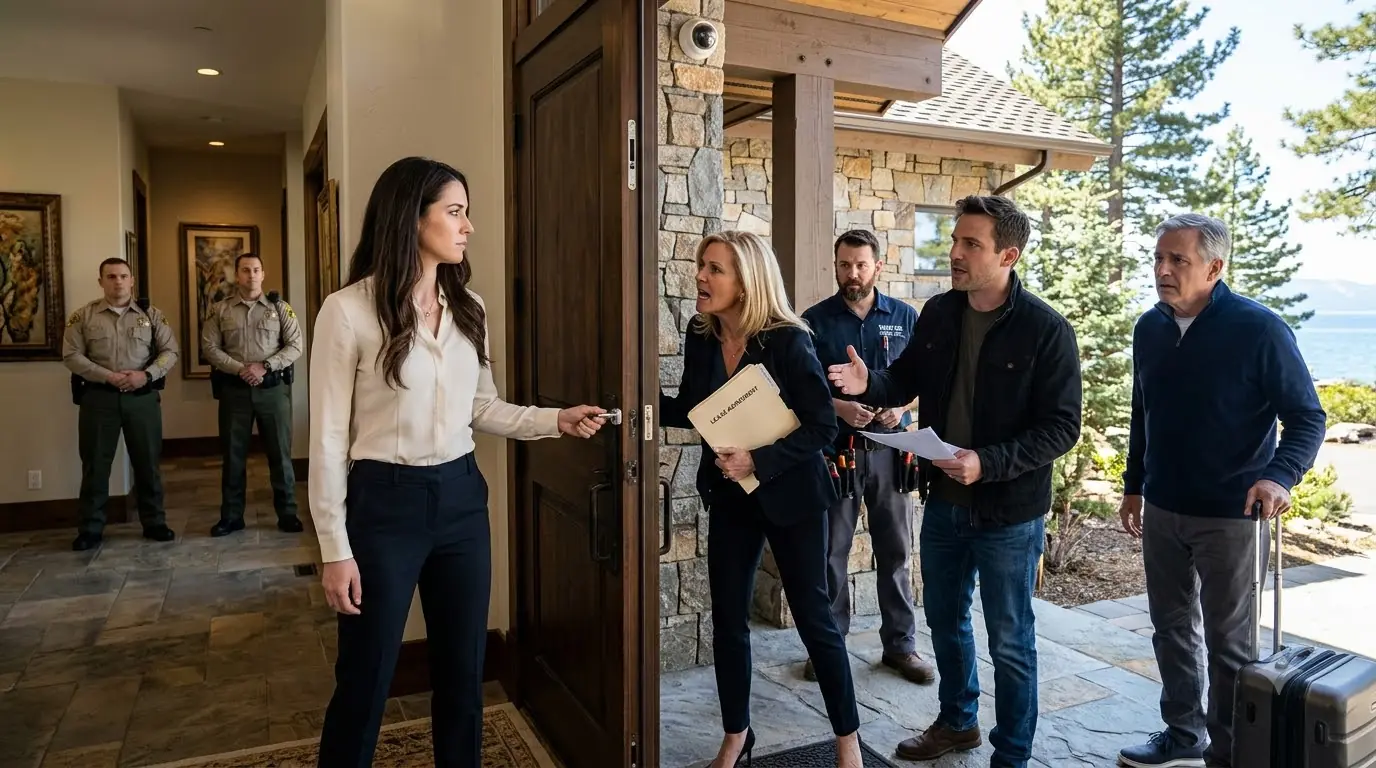
My brother was talking to a locksmith as if he owned the place. What they didn't know was that I had already seen the document inside that folder.
It was a lease with my name typed across the top and a signature at the bottom that looked almost like mine. Almost.
They had told the locksmith they were legal tenants who had been locked out while I was away. They were wrong about two things.
I wasn't away and the lease was fake. The locksmith inserted his tools while my mother smiled at the camera above the porch.
She had no idea the footage was being backed up live. She also didn't know two police officers were standing inside my foyer after I had shown them the messages, forged document, and written warning my family had ignored.
Then the lock clicked, the handle moved. The door opened three inches before the interior security latch stopped it.
My mother saw me first, then she noticed the uniforms behind me. Her smile vanished.
My brother froze with the fake lease in his hand, and my father whispered something that revealed their plan went far beyond simply getting inside my house. The strangest part was my mother's smile.
I watched her through the security monitor while the locksmith worked and for half a second the present disappeared. That smile pulled me backward more than 20 years.
I was seven, sitting on the carpet on Christmas morning while my older brother Ethan ripped open the gaming console he had begged for all year. My mother looked at him exactly the way she looked outside my villa, proud, excited, glowing, because something valuable was entering his life.
My sister Natalie had already opened a huge dollhouse. My package contained generic crayons and a coloring book.
I stared around the room, convinced another gift must be hidden somewhere. Finally, I asked my mother.
"Is there another one with my name on it?"
She barely looked at me.
"You should be grateful for what you have, Megan."
The pain wasn't the price. It was discovering how much attention could exist in one room while none of it reached me.
The monitor crackled. Present day.
Ethan laughed at something my father said, and the sound merged with that Christmas morning. Another memory flashed across my mind.
I was 17, standing inside a school auditorium with the highest academic recognition in my class. Almost every student had family in the audience.
I had reserved two seats. Both remained empty.
My teacher asked whether my parents were running late. I lied and said they were parking.
My mother had gone to Ethan's recreational tournament instead. My father said awards were school stuff and promised we would celebrate later.
We never did. That night, I put the certificate into a drawer and stopped telling them when important things happened.
By college, I had stopped sending reminders. When I earned a scholarship, my mother sent a thumbs up emoji 3 days later.
When I graduated with honors, none of them came. Yet inside my villa years later, I wasn't thinking that success had finally proven my worth.
I had already learned that money does not turn neglect into love. It simply makes certain people more interested in pretending they always believed in you.
My phone vibrated beside me. Another message from Natalie.
She had been the only one to warn me. Her first message two days earlier had said, "Megan, they are planning something."
Natalie and I had never been close, but she had overheard our parents and Ethan discussing my house. According to her, my mother had said, "Once we establish that we have a right to stay there, Megan will have to negotiate."
Ethan answered, "The lease only needs to get us through the door." That sentence was why police were inside my foyer.
My property attorney had told me to preserve everything and avoid confronting them alone. Natalie later confirmed that my family had discussed getting inside first, then forcing me into a dispute they believed I would pay to make disappear.
Outside, my mother touched the folder containing the fake lease and smiled again. This time, the memory didn't hurt.
It warned me. They had always been capable of seeing me.
Ignoring me had simply been convenient. Now, paying attention was convenient.
I didn't become successful because I wanted revenge. For years, I barely allowed myself to think about my family.
I studied computer science because I loved problems that followed rules. Code could fail, but it didn't pretend not to.
I earned scholarships, worked campus jobs, took internships, and joined a software company where I eventually became known for security infrastructure. By 28, I had saved aggressively, invested carefully, and received equity from two major projects.
The villa wasn't a lottery win. It was thousands of boring decisions nobody had applauded.
The purchase price was just over $1 million. I almost didn't post the photos online.
For three days, they sat in my drafts. Then I realized I was still allowing people who ignored my life to control how I celebrated it.
So I uploaded one photograph of myself holding the keys.
The caption said, "Built slowly, bought proudly. Home."
Seven minutes later, my mother liked it. I hadn't received a personal message from her in 11 months.
Twenty-three minutes later, she commented, "So proud of our girl."
An hour later, my father asked, "Beautiful place. Tahoe?"
That evening, Ethan messaged, "That thing must be worth a fortune. You living there alone?"
I turned off notifications.
The next morning, I turned them back on because their questions bothered me. I wanted a record.
Over the following week, the messages changed. My mother sent childhood photos and talked about healing as a family.
My father asked about spare bedrooms, taxes, parking, and whether the villa was held personally or through an LLC. Ethan asked how much similar properties earned as seasonal rentals.
He had recently taken a junior position at a real estate management company and knew just enough terminology to sound confident. Then my mother left a voicemail.
"Megan, we've decided we should come for a few weeks."
You have plenty of space. I texted one sentence.
"Do not come to my property without an invitation."
She answered, Don't be dramatic. My father wrote, You can't keep family outside forever.
Ethan sent the message that changed everything.
"Once people are legally occupying a property, you can't just throw them out."
I took screenshots and called the attorney who had handled my closing. She drafted a notice stating that nobody in my family had permission to enter, reside in, lease, manage, or claim an interest in the villa.
I sent it by email and certified mail. My mother responded with a laughing emoji.
Ethan wrote, Lawyer already? That says a lot.
Twenty-four hours later, my doorbell camera caught him photographing the entrance, address plaque, lock, and side gate. He never knocked.
That evening, Natalie called. I heard them talking about a lease.
What lease? One they say you signed.
My stomach tightened. I never signed anything.
I know. Ethan says they just need something official-looking long enough to establish access.
Mom thinks once they're inside, you'll settle. My attorney asked Natalie to document exactly what she had heard.
I upgraded the cloud storage on every camera, installed an interior security latch, and contacted local police through the non-emergency line. Then, on the morning everything happened, the locksmith company called.
We need to verify an appointment to restore tenant access. I didn't schedule one.
The dispatcher paused. "We were given a lease."
My attorney obtained a copy minutes later, three pages, my address, my legal name, my parents listed as tenants, a three-year term, and at the bottom, a scanned version of my signature from an old university financial aid document my mother had kept. I called police again.
Two officers arrived, reviewed my deed, identification, the attorney's notice, lease, and messages. They agreed to remain while I denied entry and the locksmith clarified who had hired him.
I started a private live backup of every camera feed. At 2:41 p.m., my family arrived.
My mother carried the lease. My father carried an overnight bag.
Ethan carried a laptop case. At 2:46, the locksmith pulled in.
At 2:48, my mother handed him the document. At 2:50, I stopped wondering whether they really wanted reconciliation.
They had already answered that question. The locksmith never fully opened my door.
He managed to turn the main lock because my family had presented paperwork claiming they were tenants improperly locked out. But the moment the door moved inward, my secondary security latch stopped it after three inches.
My mother leaned toward the opening. Megan.
I stepped into view. Behind me stood two uniformed officers.
Ethan's expression changed from confidence to confusion to fear in seconds. My father looked at the officers, then at the fake lease in Ethan's hand, and that was when he whispered, "You said she wouldn't be here."
The microphone above the porch caught every word. Ethan snapped toward him, "Dad, too late."
One officer stepped closer. "Ma'am, do you want these individuals entering your home?"
"No, they have no permission to enter."
"They were notified in writing."