One daughter is a doctor, the other one is a maid, my father announced, raising his glass in front of 14 guests at our family Thanksgiving dinner. And then he laughed.
And then they all laughed. My 8-year-old daughter was sitting right next to me.
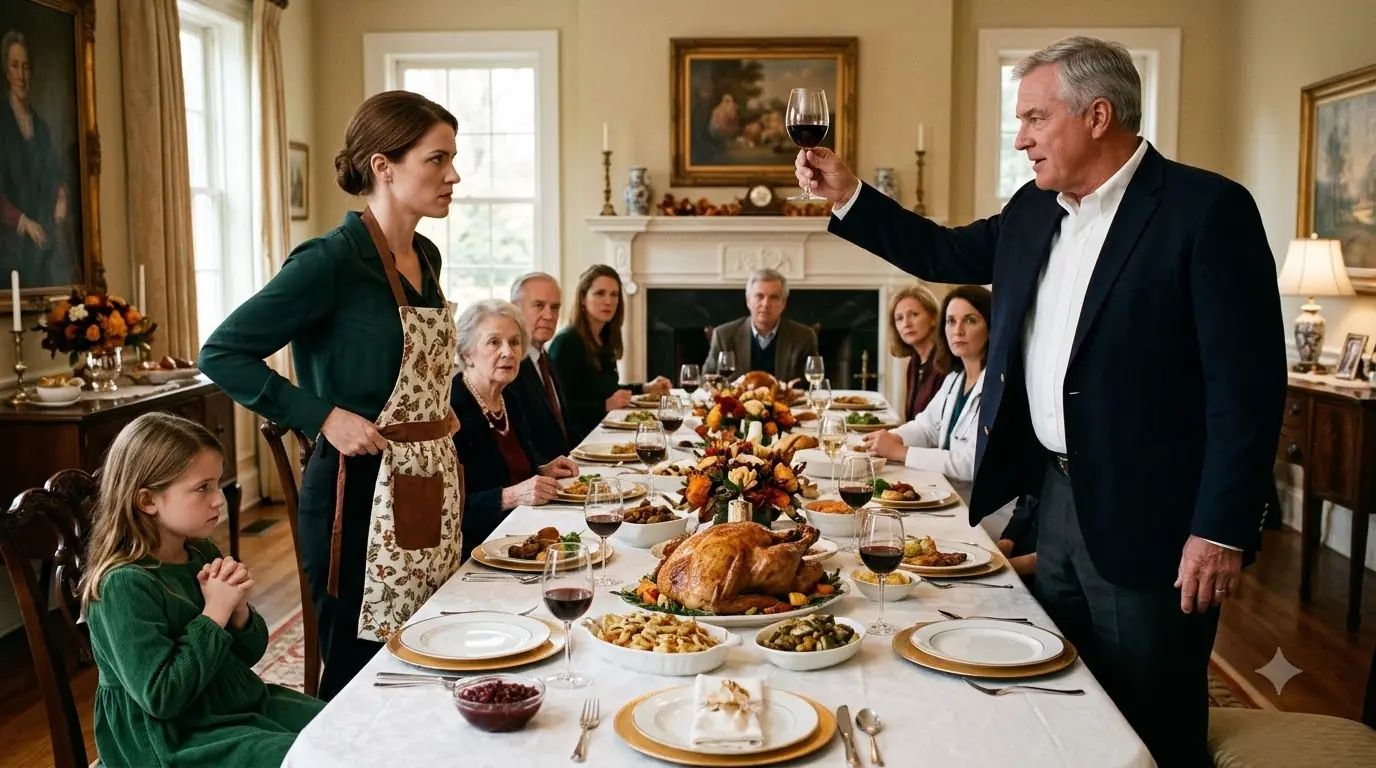
She tugged my sleeve and whispered, "Mommy, is being a maid bad?" That was the last Thanksgiving I stayed silent because what I said next in front of every single person at that table changed everything.
And my father. He hasn't hosted a holiday dinner since.
But before I tell you what I said that night, you need to understand what happened in the six years before and why the man my father was trying so hard to impress all evening was the one person in that room who already knew exactly who I was.
My name is Thea O'Neal. I'm 31 years old.
I'm a single mom. And for the past 6 years, my family has called me the maid.
Now, let me take you back to the spring of 6 years ago, the week I moved home with nothing but two suitcases and a 2-year-old on my hip.
The drive from Richmond to Milbrook takes about 2 hours if you don't stop. I stopped three times because Lily kept crying.
She was two. She didn't understand why daddy wasn't in the car.
Honestly, neither did I.
My ex-husband left on a Tuesday, cleared the checking account on Wednesday, filed from his mother's address on Thursday. By Friday, I was standing on my parents' porch in Milbrook, Virginia, holding a diaper bag and whatever dignity I had left.
My father opened the door. He looked at the suitcases, then at me, then at Lily.
"The cottage out back is empty," he said. "This is temporary.
Don't turn it into a habit." No hug.
No, "Are you okay?" Just terms.
The cottage was 300 square feet, one bedroom, a kitchenette, a bathroom with a shower that ran cold after 4 minutes, but it sat on my parents' land, and there was no lease, no paperwork, just my father's word. At the time, I didn't think that mattered.
Within a week, I was knocking on doors, cleaning houses, $15 an hour cash, while a neighbor watched Lily. I scrubbed bathtubs, mopped hardwood, organized pantries for women who had the life I thought I'd have by now.
That same month, Meredith, my older sister, finished her dermatology residency. My parents threw a dinner for 20 people.
I showed up late because I was still wiping bleach off my hands at a client's house across town.
Richard, my father, didn't miss the chance. He stood at the head of the table and said loud enough for every guest to hear, "Sorry, Thea's late.
She was scrubbing someone's bathtub." Everyone chuckled.
Meredith looked away. I sat down and didn't say a word.
That was the first time. It would not be the last.
The thing is, the jokes didn't start when I moved home. They started long before I ever left.
Growing up, Meredith was the one who got SAT tutoring, AP summer camps, college visits to Duke and UVA. When she got accepted to medical school, my father took out a second mortgage to cover her tuition.
Every penny, no hesitation.
When it was my turn, he sat me down at the kitchen table and said, "Community college is plenty for someone like you." Someone like me.
I still hear that phrase when I close my eyes.
I went to Blue Ridge Community College. I paid for it myself, waitressing, babysitting, cleaning the church on Sundays.
I graduated in two years with honors. Nobody came to the ceremony.
Every Thanksgiving, every Christmas, every Easter brunch, my father would introduce us the same way. "This is my daughter, Dr.
Meredith O'Neal Hartley." Then he'd turn almost as an afterthought.
"And this is Thea."
Not Thea, who graduated with honors. Not Thea, who's raising a child on her own.
Just Thea.
My mother never once corrected him. When I brought it up, Patricia would sigh and press her fingers against her temples.
"Your father just wants the best for both of you. Don't be so sensitive."
Here's what nobody at those holiday tables knew. Meredith's medical school cost $400,000.
My father covered about half. The rest, federal loans, $180,000 in debt that Meredith was still carrying silently, invisibly, while everyone called her the successful one.
But at the O'Neal table, image was everything, and my image had already been decided for me. At least that's what they thought.
It happened the way most things happen when you're desperate, not with a plan, with a pattern. By my second year back in Milbrook, I'd cleaned over 60 homes.
And I started to notice something.
The Shenandoah Valley was full of vacation estates, big properties owned by people who lived in DC or Richmond and visited maybe four times a year. These houses needed more than cleaning.
They needed managing, groundskeepers, maintenance schedules, guest turnover, somebody who could walk a plumber through the front door at 7:00 a.m. and lock up after the caterer at midnight. Nobody was doing it well.
I filed for an LLC, built a website at 2:00 in the morning while Lily slept, named the company Magnolia Estate Services. It sounded bigger than it was, which at the time was just me and a secondhand laptop.
I signed my first three property contracts in the same month. Not huge, but real.
I told my mother. I was excited.
I said, "Mom, I just signed three clients. I'm building something."
Patricia nodded. "That's nice, honey.
Meredith just got invited to speak at a dermatology conference in Boston." I stood in the kitchen holding my phone with the contract confirmation still open and I understood completely, finally, permanently, that nothing I built would ever register in this house.
I could cure cancer and my mother would ask if Meredith had cured it first.
That night, after Lily was asleep, my phone rang, an unknown number with a 540 area code. "Hi," the voice said.
"I'm Gloria. I'm your father's sister and I think we need to talk."
I almost dropped the phone because in this family, Gloria Ashford was a name you didn't say out loud. My father had a sister, past tense, at least in his version.
Gloria Ashford divorced her husband 10 years before my call. In a town like Milbrook, where the Rotary Club still opened meetings with a prayer and couples who separated moved to different counties, that was enough to become a scandal.
But Gloria didn't move. She stayed, opened an antique shop on Birch Street, lived alone, and liked it.
Richard cut her off completely, told us she was a disgrace to the family name. I hadn't spoken to her in a decade.
"I heard about you from a mutual client," Gloria said over coffee the next week. Her shop smelled like cedar and old books.
"A woman whose lakehouse you manage. She couldn't stop talking about you."
Small towns. Everyone knows someone who knows someone.
Gloria didn't waste time. "I want to invest in your company. $15,000, not a loan.
Equity, because somebody should have believed in you a long time ago."
I stared at her. $15,000 was more than I'd made in the last 3 months combined.
"I'm not doing this to spite your brother," she added like she could read my mind.
"Then why?"
"Because I know what it's like to be erased from a family for choosing your own life." She set her cup down.
"Sound familiar?"
I took the money, hired two part-time employees, started running operations like a real company instead of a one-woman scramble. Before I left, Gloria said something that stayed with me.
"Family should be a safe place, Thea, not a cage." Then she paused.
"There's something I know about your father that you don't, but not yet."
I drove home with more questions than answers and a check that would change everything.
Two years. That's how long the quiet lasted.
By 27, I had five employees, eight properties under contract, and a growing reputation in the valley. Magnolia was still small, but it was real.
I reinvested every dollar, bought a proper work van, printed business cards with a logo. Lily helped me pick a white Magnolia on dark green.
I was still living in the cottage, still on my father's land, still without a lease.
That's when Richard decided to remind me. It was a Sunday dinner, the only kind my parents hosted where they didn't invite an audience.
Meatloaf, mashed potatoes, Meredith and Donald across the table, Lily coloring in the corner.
Midway through the meal, Richard set his fork down. "That land out back is worth something now," he said.
Casual, like he was commenting on the weather. "I might need to rearrange things."
I looked up. "Rearrange things?
How?"
"Don't worry about it. Just know that nothing is permanent."
The room went quiet. Meredith stared at her plate.
Donald took a long drink of water. Patricia busied herself with the salt shaker.
Nobody said a word.
Because in this family, when Richard made a statement, it wasn't a conversation. It was a verdict.
Later that night, after Lily was in bed, Patricia called me. Her voice was strained, halfway between apologetic and instructional.
"Someone came to look at the property last week," she said. "A developer?"
My stomach dropped. "What developer?"
"I don't know the details. Your father handles these things."
A pause. "It's probably nothing.
I shouldn't have mentioned it." She hung up.
I sat on the edge of my bed in the cottage on land I didn't own in a house with no lease and felt the ground shift beneath me.
I started looking for a rental, something near Lily's school, something I could afford. The problem with Milbrook is that it's a small town with a tight housing market.
Three-bedroom rentals near Jefferson Elementary, almost non-existent, and the ones that were available cost twice what I could swing without pulling money out of the business.
Patricia found out within a week. In a town this size, the realtor I called was her friend's daughter.
The phone rang at 8 in the morning.
"You're looking at apartments?" Patricia's voice was shaking.
"You're going to take Lily away from us."
"Mom, I'm not taking anyone away."
"Your father will be devastated after everything we've done for you."
I wanted to ask what exactly they'd done, but I didn't.
That evening, Richard called. No preamble.
"You move out, you're on your own completely." His voice was flat, factual.
"Don't expect us to babysit Lily on weekends. Don't expect Thanksgiving invitations."
"Are you serious?"
"I'm being practical."
He knew exactly where to press. Lily called my parents every night before bed.
She drew pictures of Grandpa's garden. She counted the days between visits.
Cutting that connection wasn't something I could do to my daughter, and he knew it.
So, I stopped looking. I wasn't staying because I was weak.
I was staying because leaving at the wrong time would have cost me everything I'd built.
In a small town, Richard O'Neal was respected. If I left, he'd frame it as abandonment.
The ungrateful daughter who took our granddaughter away. That narrative would reach every potential client within 20 miles.
I needed to be strong enough that when I finally walked out, I wouldn't need anything from him. Not his land, not his babysitting, not his version of the story.
That day wasn't here yet, but it was coming. The cracks started showing in Lily first.
Her teacher called me in on a Wednesday. Mrs.
Patterson, kind woman, 20 years in second grade. "Lily's been quiet at lunch," she said.
"The other kids asked what her mom does for work. She didn't answer.
She just shrugged and looked away."