My son didn't raise his voice. He didn't slam his fist on the table or throw anything across the room. He simply looked at me, crossed his arms, and said it the way someone might comment on the weather. "Mom, honestly, you're a burden."
The television was on in the background, some cooking show with bright, cheerful music that felt grotesque at silent. My daughter-in-law, Sandra, was standing near the kitchen doorway. She didn't correct him, she didn't even flinch. She just looked down at her phone and slowly walked away as if what had just been said was perfectly ordinary.
I didn't cry. I didn't argue. I smiled. Then I excused myself quietly, walked to the back bedroom, closed the door, and made one phone call.
Short, barely 2 minutes, but by the time I hung up, something had already begun to shift. Something my son, Marcus, would not understand until it was far too late. That moment, standing in that bedroom, holding the phone against my chest after the call ended, that was not the moment I broke. That was the moment I finally stopped pretending.
But before I tell you about the phone call, I need to tell you who Marcus was before he became the man who called his mother a burden. Because if I skip that part, you won't fully understand what made those words so devastating or why my smile scared him more than any argument ever could. Marcus Allen was born on a Thursday in late February of 1983, during one of the coldest winters Atlanta had seen in years. 7 lb, 4 oz.
He had his father's brow and my mother's nose, and he looked up at me with those dark, serious eyes as if he already understood something about the world. My name is Dorothy Allen. I'm 67 years old, and for 39 years, I believed my greatest accomplishment was the man I raised. My husband, James, and I built our life the slow, honest way.
He worked for the city as an electrician for 26 years. I spent 32 years as a school librarian at Washington Elementary, helping children find the right books, teaching them that a story could hold more truth than anything else in the world. We weren't wealthy, but we owned our home, a two-story brick house on Claremont Road in Atlanta with a magnolia tree in the front yard that James planted the spring after we moved in. No debt.
A savings account we added to every single month without exception. And Marcus. Marcus was a bright child, curious, eager, the kind of boy who asked questions that made his teachers pause. He won a regional science fair in sixth grade.
He earned a partial scholarship to Georgia State, and we covered the rest without him ever knowing exactly how much it cost. Because James said a man shouldn't start his adult life feeling like he owes his parents something that was given freely. Somewhere between that boy and the man who called me a burden, something changed slowly, quietly, the way water wears down stone. James died in March of 2019, a stroke.
He was 64 years old, still working, still strong in every way that mattered to me. One morning, he was in the kitchen drinking his coffee, reading the paper. By the afternoon, he was gone. The silence he left behind had weight, the kind you carry in your chest when you walk into a room and remember that someone who was always there is no longer anywhere.
Marcus flew in from Houston for the funeral. He gave a beautiful eulogy. He held my hand at the graveside. And 3 weeks later, when he called to say he thought I should sell the house on Claremont Road and move to Houston to be closer to family, I thought he meant it the way it sounded, as love.
I sold the house on Claremont Road in August of 2019 for $312,000. The magnolia tree was in full bloom the day the new family came for the keys. I stood on the sidewalk and watched them walk through the front door, and I felt something close inside my chest that I knew would never open quite the same way again. Marcus had already prepared a room for me in his house, the spare bedroom at the end of the hall with a single window that faced the neighbor's fence.
I told myself it was temporary. Months passed, then a full year, then two. And somehow the plans I made in my head never quite made it to paper. Sandra was not unkind in those first months.
She was efficient, precise, the kind of woman who kept the house in a state of order that made me feel, at times, like a visitor who had overstayed a welcome. She was never quite sure she'd been given. There was a schedule for everything. Meals at specific times, the children's activities on a whiteboard calendar in the kitchen.
My presence in the common areas managed through a series of small, unspoken rules I learned one by one. Not because anyone explained them, but because I had spent 32 years reading the rooms of children, and I knew how to read a room. The comments began small, the kind that could always be explained away if you pointed at them directly. Remarks about the grocery bill.
Observations about how much space my belongings took in the garage. A suggestion delivered over dinner in the spring of 2021, gently, almost sweetly, that perhaps I might want to look into senior community living. There was apparently a very nice one 20 minutes away with a pool and organized activities. Wouldn't that be lovely for someone my age?
I said I would think about it. I didn't think about it. But I started noticing other things. The way Marcus would grow quiet when I entered a room where he and Sandra were talking.
The way certain conversations stopped when I appeared. The way my name appeared on fewer and fewer invitations. And then there was the envelope. In October of 2022, I was tidying the small desk in my bedroom when I found a piece of paper that had slipped behind the drawer.
A printout of an email. I don't know how it got there. Perhaps it had fallen from Marcus's jacket pocket when he came in to fix the window latch. Perhaps it had been placed there deliberately.
I will never know for certain, but I read it. And what I read changed the temperature of everything. It was an email between Marcus and a real estate attorney. The subject line read, "Property Transfer, D. Allen Assets."
The body of the email referenced the proceeds from the sale of the Claremont Road house, my $312,000, and a question about what documentation would be needed to establish financial guardianship over a parent deemed unable to manage their own affairs. Unable to manage their own affairs. I read it twice, then a third time. Then I folded it carefully, placed it inside my Bible on the shelf, and sat on the edge of my bed for a long time without moving.
I didn't cry. I thought about James, about the way he used to say that a careful person prepares not just for what they hope will happen, but for what they hope will never happen. I thought about a conversation we'd had in the summer of 2017, sitting on the back porch of the Claremont Road house, watching the fireflies come out over the yard. James had mentioned a name that evening, a quiet, almost casual name.
"If you ever need someone in your corner, Dorothy, call Margaret. She was your mother's attorney. She knows things I hope you never need to know." I had laughed at him then, told him he was being dramatic. He had just smiled and handed me my sweet tea.
Now, sitting on the edge of that bed in my son's house with that folded email inside my Bible, I finally understood why he had said it. The next morning, while Sandra was taking the grandchildren to school and Marcus had already left for the office, I opened my laptop at the small desk in my room. My hands were steady. I want you to understand that.
My hands were completely steady. I searched for Margaret L. Foster, attorney at law, Houston, Texas. The number came up immediately. I stared at it for a moment, then I picked up the phone.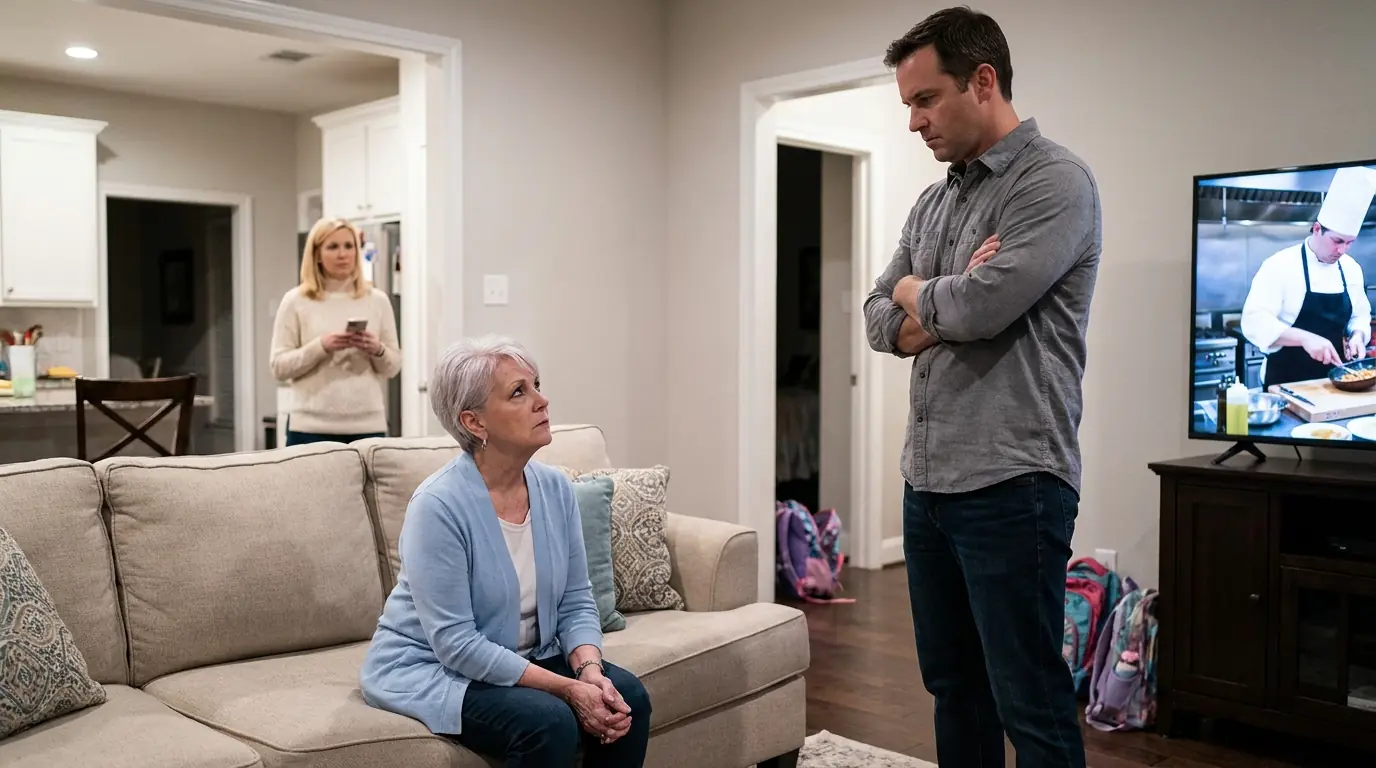
The receptionist answered on the second ring. "Foster and Associates. How may I help you?" "My name is Dorothy Allen," I said quietly. "My late husband, James Allen, spoke very highly of Ms. Frost. I believe she may have worked with my mother, Evelyn Carter, some years ago. I need to speak with her about a personal matter."
There was a brief pause. Then, "Of course, Mrs. Allen. Please hold just one moment." I sat at that small desk and looked out the window at the neighbor's fence while soft music played through the receiver. A cardinal landed on the fence post, bright red against the gray morning.
I watched it for a long moment. Then, a warm, unhurried voice came on the line. "Mrs. Allen. I was wondering when I might hear from you." I blinked. "You were expecting my call?"
"Not expecting," she said carefully. "But your husband left a letter with my office. He asked that it be held until you contacted us or until 5 years had passed, whichever came first. You're just inside the window." My throat tightened.
"A letter?" "Yes, ma'am. And some accompanying documents I think you'll want to see in person." I drove to Margaret Foster's office the following Tuesday morning. I told Marcus I had a doctor's appointment.
He didn't ask which doctor. Margaret Foster was a small woman in her early 70s with silver locks and reading glasses perched at the end of her nose. She shook my hand with a firmness that felt like a promise. "Sit down, Dorothy," she said.
Not Mrs. Allen, Dorothy. The way someone speaks to you when they already know your story. She placed a manila folder on the desk between us. Inside was a letter in James's handwriting.
I recognized it immediately. The careful, even print of a man who had spent decades filling out technical reports and never lost his precision. I won't read you every word he wrote. Some things belong only to the people they were meant for.
But I will tell you this. James Allen had not simply left me the proceeds from the sale of our home. In 2016, 3 years before his death, he had quietly established an irrevocable trust in my name, structured in a way that no one, not a son, not a daughter-in-law, not any court-appointed guardian, could access, redirect, or claim without my explicit written consent. The trust held $480,000, not counting the 312,000 from the house sale, which Margaret informed me had been deposited directly into a separate, protected account the moment I signed the sale document, an account Marcus had no legal access to, regardless of any guardianship petition he might file.
Margaret slid a second document across the desk. "This is a cease and desist letter," she said calmly, "drafted and ready to send to the attorney your son has been corresponding with. All I need is your signature." I looked at the letter for a long moment. Then I looked up at Margaret.
"He thought he was protecting himself from me," I said quietly. Margaret removed her glasses. "Men like that always do." I picked up the pen.
I did not move out of Marcus's house that day. I want you to understand the strategy in that. Margaret advised patience, and patience had always been my strongest quality. We filed the cease and desist quietly.
The attorney Marcus had been consulting received it on a Wednesday afternoon. Marcus came home that evening quieter than usual. He didn't mention it at dinner. Neither did I.
But I watched his face when he looked at me across the table, and I saw something there I had never seen before in 39 years of knowing that face: uncertainty. He didn't know what I knew. He didn't know what I had signed. He didn't know the shape of what James had built around me in silence years before it was ever needed.
He had looked at me and seen a burden. He had not seen the foundation beneath my feet. Two weeks later, I found a small apartment in a quiet neighborhood in the Midtown area of Houston. Two bedrooms, a reading nook by the window, a little balcony where I could grow herbs in clay pots the way I always wanted to.
I signed the lease on my own. I paid the deposit from my own account. I packed my things on a Saturday morning while Marcus was at a golf game and Sandra was running errands. My granddaughter, Amara, who was 14 and somehow already wiser than most adults I knew, sat on the edge of my bed and watched me fold my clothes.
"Grandma," she said quietly, "are you okay?" I stopped folding. I looked at her. Her father's brow, my mother's nose.
And I told her the most important thing I know how to say. "I am more than okay, baby. I am exactly where I'm supposed to be." She nodded slowly as if she understood something she couldn't quite name yet. Maybe one day she will be able to name it.
Maybe that's enough. I left a note on the kitchen counter. Not long. Not angry.
Five sentences thanking Marcus and Sandra for their hospitality and wishing them well. No accusations. No explanations. No open wounds to tend.
Just a door closed quietly on my way out. Marcus called 3 days later. His voice was different, smaller somehow. He said he just wanted to make sure I was settled.
I told him I was. He asked if we could have dinner sometime. I said I would think about it. I moved into the Midtown apartment on the first Saturday of November 2022.
The balcony faced east, and the morning light came in at an angle that reminded me somehow of the back porch on Claremont Road where James and I used to sit with our coffee and talk about nothing important and everything that mattered. I bought a magnolia tree for the balcony. A small one in a terracotta pot. It's too small to give shade yet, but it's growing, and so am I.
The man who called me a burden believed that word could define me. He forgot, or perhaps never understood, that the woman who raised him had spent 32 years teaching children to find themselves in story. I had been in this story the whole time. I just hadn't let him see which page I was on.