My son threw hot coffee on my face because I asked for rice. I stayed silent and walked away. The next day, I froze his accounts, cancelled his payments, and sent a notice giving him forty-eight hours to leave my house. I am Goldie Ali, a 67-year-old widow from South Boston. The pen felt heavier than I remembered as I watched it glide across the last page of the contract, the ink settling into the paper like the final note of a song I had been playing for forty years.
Malie's Pub, the old bar my late husband and I built with our bare hands, was no longer mine. The mahogany counter still bore faint scratches from generations of laughter, spilled beer, and late-night confessions. The smell of polish and whiskey lingered in the air, a scent that had once meant home. I looked around one last time at the upside-down bar stools and the neon sign flickering weakly above the mirror.
In the silence, I could almost hear my husband's laugh echoing from the back room. When I handed over the keys, the young realtor smiled and congratulated me on my retirement. The word retirement did not feel real to a woman who had spent most of her life working seven days a week, raising a son while pouring drinks for men who could never hold their liquor or their promises. However, I was not poor anymore, as the sale of the pub had made me a wealthy woman and comfortable for the first time in my life.
Still, as I stepped into the chilly Boston air, I felt something hollow in my chest. I told myself it was freedom, but deep down, I knew it was loss. A week later, Shawn and Ashley invited me to dinner at their condo in Back Bay. The place was as small as it was spotless, with every single corner meticulously curated for show.
Ashley's candles smelled like lemon and eucalyptus, the kind of scent that made me nervous to breathe too deeply. Shawn was in his usual work attire, a pressed white shirt with no tie and sleeves rolled up just enough to look casual. "Mom," he began in a highly practiced tone, "we've been thinking about something big, a forever home." Ashley smiled, tucking a strand of blonde hair behind her ear, and said it was in Welssley for two million dollars, but absolutely perfect.
She noted it had great schools, a beautiful community, and an in-law suite over the garage that I would love. I took a sip of the wine she'd poured, which was far too dry for my taste, and waited for the real ask. Shawn leaned forward and told me it was not just a house, but an image where the partners live. He explained he was next in line for partner, but the bank wouldn't give them the full loan, so with my help, they'd be set for life.
I looked at my son, the same boy who used to help me stack chairs after closing, and I heard sharp, hungry ambition in his voice. "Shawn, I don't give handouts; I make investments," I said slowly. Ashley's smile faltered, but she lightly replied that it was not charity since I'd have my own space, be near the grandkids, and that it was a family thing. That word family hit me the wrong way, as it had become something purely decorative in their mouths, just like the throw pillows Ashley bought that no one was allowed to touch.
I smiled anyway and told them to let me think about it. Two weeks later, the papers were signed, but they were not the ones my son and his wife expected. I formed a limited liability company, Souy Properties LLC, and used it to purchase the Welssley house entirely in cash. The deed carried only one name: mine.
When I told Shawn, his eyebrows shot up in surprise. "You're serious about this LLC thing?" he asked. "I am," I said, "if I'm paying, I'm the owner, so you'll be tenants and can handle the lease." He looked deeply offended, arguing that they were family and didn't need a lease.
I smiled and replied, "You're the lawyer, you know better, so make it fair." Annoyed and too busy to argue, he quickly agreed. That night, I imagined him in his office downtown scrolling through his firm's server, pulling a template without reading the fine print. He probably thought he was humoring me, muttering to himself that it was just Mom and she wouldn't even read it.
When he handed me the lease, it was thirty pages of legal jargon and arrogance bound in a neat packet. I signed my name on every single page. He and Ashley signed, too, looking proud and completely oblivious. The day we moved in, the Welssley house gleamed like a luxury magazine spread.
The white marble counters, the massive glass staircase, and the minimalist furniture all screamed perfection. My in-law suite sat directly above the garage, a pristine little box completely devoid of warmth. It was explicitly meant for show, not for actual living. I unpacked my few boxes in total silence and looked out the window.
Across the manicured lawn, I saw Ashley arranging flowers in crystal vases while Shawn gave instructions to the movers like a general leading troops. By dinner time, they were already treating me like hired help. "Goldie," Ashley called sweetly, "if you could avoid using the main kitchen, that would be great." "I just had the quartz resealed, and it stains easily."
I nodded, biting back the sharp words that wanted to come out. In the days that followed, I found myself cooking for the kids, cleaning up after their messes, and paying the bills they barely noticed. I had agreed to cover the utilities and the children's private school tuition until they settled in. What I hadn't agreed to was the coldness, the looks, and the small, daily humiliations.
Liam and Olivia walked past me without a word, their faces glued to their iPads, their silence a perfect mirror of their parents. At night, I heard vibrant laughter from the living room—Ashley's high-pitched giggle and Shawn's deep, confident voice. I sat upstairs completely alone, listening to the hum of the heater and the faint echo of my own heartbeat. Sometimes I walked through the empty streets of Welssley where every house looked exactly the same and no one ever said hello.
I thought about the old bar, the sound of the jukebox, and the warmth of the regulars who used to call me "Ma." Here, in this massive house, I was completely invisible. One evening, I overheard Ashley on the phone with a friend saying, "She's sweet, but you know, a little rough around the edges." "South Boston never really leaves you, does it?" her voice asked, dripping with condescending laughter.
I went straight back to my suite and closed the door, telling myself it didn't matter. I told myself I had done the right thing by helping my son secure a better life. But as I looked around the sterile little apartment above the garage, I realized something fundamental had shifted. I had given them a house, but somewhere in the process, I had lost my home.
The rain came down in cold, slanted sheets, drumming against the kitchen windows like impatient fingers. The air inside the Welssley house was so sterile it almost smelled like metal. I stood at the sink, my hands raw from scrubbing the garage earlier that day. The three-car shrine to Shawn's status had been covered in lines of oil and mildew.
Ashley had handed me a bucket and gloves that morning, saying with a bright smile, "You don't mind doing this, right? The cleaning service missed last week." I hadn't said no, as I rarely did. By the time I finished, my back was aching badly and I had skipped lunch. I wanted something, anything warm and real to eat.
Dinner was served at 6:00 sharp, as always. The table was set perfectly, featuring white linen napkins, matte black plates, and a salad so small it looked like a decoration. Ashley had plated seared salmon on kale leaves with the absolute precision of a surgeon. "Keto night!" she announced as though it were a major national holiday.
I smiled politely and took my seat at the far end of the table, across from Liam and Olivia. They were half-watching their tablets under the table, their faces glowing blue in the dim light. The first bite of salmon vanished in seconds; it tasted fine, but there was so little of it. My stomach tightened, reminding me how long it had been since breakfast.
I took small, careful bites of kale, pretending it was enough, but the ache in my stomach grew louder than my thoughts. I glanced toward the counter, imagining a simple, comforting pot of steaming rice. When the plates were nearly clean, I cleared my throat. "Ashley," I said softly, "that was lovely, dear, but I'm still feeling a bit empty."
"It's so cold tonight, so do you think I could make a small bowl of rice? Just a little to warm me up." Ashley froze with her fork halfway to her mouth, then gave a laugh so sharp it sliced the air. "Rice? Oh, God, no, Goldie! We don't keep white carbs in this house."
"Do you know what that does to your glycemic index?" she asked. I tried to smile to keep the peace. "I don't mind cooking it myself, just something warm since I've had a long day." She rolled her eyes and turned toward the kids.
"See, this is what happens when you grow up on pub food—it's all starch and salt, not healthy." Liam giggled, and Olivia whispered something that made them both laugh, causing my cheeks to burn. The sound of the front door slamming suddenly made us all jump. Shawn's voice came first, low and bitter: "Traffic was hell."
He walked in, dripping rain on the tile floor, his suit rumpled and his expression tight. He moved straight to the espresso machine, muttering under his breath as I felt the tension roll off him. The machine hissed and gurgled as he poured himself a shot of espresso so dark it looked like tar. Ashley, sensing the danger, spoke quickly to note his rough day.
He didn't answer her. Then, as he raised the tiny cup to his lips, he caught the last word of our earlier exchange: rice. His eyes flicked toward me as he asked, "Rice? Is that what this is about?" I swallowed hard.
"I'm not complaining, Shawn, I just..." He cut me off, his voice rising in anger. "For God's sake, Mom, can't you just be grateful? You have a roof over your head, food on your plate, and everything paid for, and you're still asking for more?" I blinked, taken aback.
"I'm not asking for more; I cleaned the garage all day, skipped lunch, and I'm just hungry, that's all." He set down the espresso cup a little too hard, the sound ringing loudly through the marble kitchen. "Unbelievable," he muttered, his jaw tightening in fury. Then, in one violent motion, he grabbed the tiny cup again.
"You want something hot?" he snapped, "You're always cold, so right here!" Before I could move, he threw it. The cup flew across the counter and shattered at my feet. The scalding espresso splashed across my hand and the front of my sweater.
I gasped instinctively, clutching my wrist as the burn seared through my skin like fire. The smell of coffee filled the air, bitter and acidic. "Shawn!" I cried out, my voice breaking, "you burned me!" Liam looked up from his tablet, his eyes wide.
Olivia glanced at her father, then went right back to her screen as though absolutely nothing had happened. Shawn stood there, chest heaving, his face twisted with anger. "You're overreacting," he said coldly, "it's just coffee." "It's not just coffee," I said, trembling, "I'm your mother."
He stepped forward, pointing at me, his voice cracking with fury. "And you're a guest, do you understand that? You are living in my house, eating my food for free, and if you don't like it, you can get out." The words hung there, sharp and final. For a moment, the only sound was the steady drip of espresso from the counter.
Something inside me went completely quiet. The pain from the burn dulled beneath a different kind of heat—a cold, steady realization. I looked at the man in front of me—my son, the child I had raised through late nights and double shifts—and I saw nothing of him left. There was just arrogance, entitlement, and a total stranger wearing his face.
I straightened up, still shaking, but silent. I didn't shout back, and I didn't cry; I simply looked at him. Then I looked at Ashley, who was frozen in the corner with her hand over her mouth, pretending to be shocked but not moving to help. I turned to the sink, ran cold water over my burned hand, and watched the skin redden and tighten.
Then I dried it with a towel, folded it neatly, and walked toward the door. Shawn's voice followed me, still full of venom. "You can't just walk away, Mom! Don't you dare pull that silent treatment again!" I didn't answer him.
The marble floor was slick under my shoes as I crossed it, walking past the children, past Ashley's wide eyes, past Shawn's disbelief, and straight up the stairs to my suite above the garage. Inside, I locked the door and stood for a long time, listening to the rain batter the windows. My hand throbbed, but the pain felt distant now. What filled me instead was something calm, steady, and cold.
The woman they had humiliated, pitied, and taken for granted was gone. The mother who once made excuses for her son's temper no longer existed. In her place stood someone else entirely: Mrs. Goldie Ali, proprietor of Souy Properties LLC. And for the first time in a long while, I knew exactly what I was going to do.
I stood at the sink, the sound of running water filling the small suite like static. My hand stung beneath the stream, red and blistering where the espresso had hit. The pain should have made me cry, but it didn't; not a single tear fell. My heartbeat had slowed, and my thoughts sharpened with every passing second.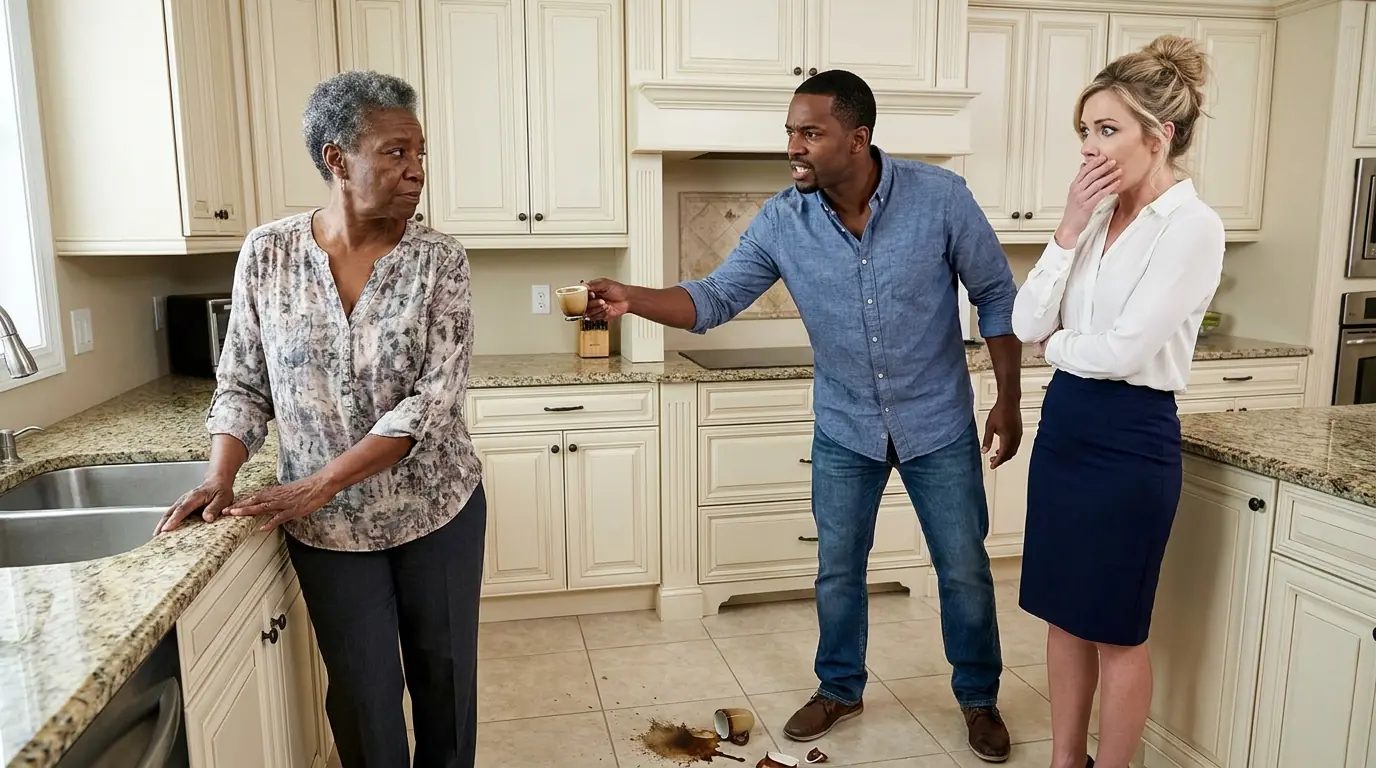
The weak, sentimental mother they thought they could humiliate was gone. What stood in her place was someone colder, older, and infinitely more dangerous. I dried my hand with a towel and laid it flat on the counter. The burn glowed angry and pink under the soft light.
I took out my phone and snapped three photos: one close, one wide, and one with the clock in frame. I'd learned long ago in business that proof was power, and tonight I had both pain and evidence. Sleep never came. I lay in bed listening to the rain die out and the silence of the house settle around me.
Somewhere below, a refrigerator hummed, and in another room, the kids' tablets buzzed with notifications. But in my mind, everything was perfectly still. I was already building the plan, piece by piece, like a blueprint for justice. At dawn, I brewed my own cup of coffee—decaf out of irony—and sat by the window.
The gray sky was just beginning to brighten when I reached for the phone. The first call was to the bank. "Good morning, this is Goldie Ali," I said, keeping my tone steady. "I need to halt all automatic payments from my personal account, effective immediately."
The woman on the other end hesitated and asked, "All of them, ma'am?" "Yes," I said, "that includes the utilities for the Welssley property, the payments to Welssley Hills Golf Club, and Saint Mark's Academy." There was a brief pause before she replied, "Understood, Mrs. Omali; the changes will take effect within the hour." "Perfect," I said, "and please mark the accounts as restricted, with no joint authorizations and no exceptions."
When the call ended, I took a deep breath and made the second one to Davidson Law. A groggy voice answered, and I said, "David, it's Goldie; I need a favor." "Pull the file for Souy Properties LLC, specifically the lease agreement for the Welssley property, the one my son drafted." There was the sound of rustling papers as David replied, "Goldie, it's barely 6:00. What's going on?"
"He assaulted me last night," I said simply, "threw hot coffee on me, and I want him out." There was total silence on the line, then David's voice softened. "Jesus, Goldie, are you hurt?" "I've got burns," I said, "but I'll live; I need you to check Section 7, Clause C."
I could hear him flipping pages, followed by a low whistle. "My God," he said, "he's an idiot." "He used the firm's commercial eviction template, what we call the scorched-earth lease." "Section 7, Clause C states that physical assault or threat of violence against the landlord constitutes an incurable breach, allowing for an unconditional 72-hour notice to quit."
I smiled faintly. "I thought so; I took photos of the burns as evidence, so send the process server this morning, and I'll be out of the house by noon." He hesitated and asked, "Goldie, are you sure about this?" "I've never been surer of anything," I said, "it's time he learned the law he thinks he owns."
By 8:00 a.m., I had packed a small suitcase containing just clothes, my laptop, and the deed papers for Souy Properties. Downstairs, I could hear movement—Ashley's slippers shuffling across the tile, and the smell of perfume already thick in the air. By mid-morning, they clearly thought I was just sulking. Shawn hadn't even knocked on my door, as he never did unless he needed something.
I imagined him sitting at the counter with his laptop open, half-listening to Ashley complain about the Wi-Fi speed. They probably thought the quiet was my apology. The first sign came just after 10:00 a.m. from downstairs when I heard Ashley's voice rise: "That's impossible, try it again!" Another sharp pause followed before she screamed, "Declined? What do you mean declined?"
I took another sip of coffee, savoring the sound. A few minutes later came the kids' cries. "Dad, the Wi-Fi is gone!" Liam's voice was high and desperate, the way children sound when their tiny kingdoms collapse. "Relax, it's just a glitch," Shawn muttered.
But I could already hear the intense irritation building in his tone. Then his phone rang, and though I didn't have to listen to know what it was, the fury in Shawn's voice confirmed it: "What do you mean the tuition payment was rejected? No, there's no mistake, check again; the account's fine!" It wasn't fine.
I looked down at my bandaged hand and smiled without warmth. Every bill, every luxury, and every privilege they had taken for granted was tied directly to me, my name, my accounts, and my generosity. And now all of it was completely gone. By 11:00 a.m., I could hear them pacing downstairs, their voices overlapping in pure panic.
Ashley's tone was shrill, while Shawn's was clipped and defensive. The house that once echoed with their arrogance now buzzed with total confusion. I zipped my suitcase and stood, my reflection faint in the window. The rain had stopped completely, leaving the world clean and washed.
"Let them wonder," I murmured, "let them sweat." "Because before the sun sets, they'll learn something." My late husband used to say when he was still behind that mahogany bar back in South Boston, "Never bite the hand that pays the bills." The sound of the doorbell cut through the chaos like a blade.
I was upstream in my suite, listening to the frantic, ugly noise that comes when panic begins to set in. Shawn was still on the phone with the school, his voice cracking with frustration, while Ashley was pacing and calling credit card companies, her tone wobbling between anger and tears. I could picture it perfectly without seeing a thing—the perfect marble kitchen now cluttered with bills, empty wine glasses, and the mess of their unraveling lives. Then came the sharp, official knock.
It was the kind of knock that doesn't wait for permission. From my window, I saw a man in a dark suit standing at the door, his coat damp from the morning drizzle. Shawn answered, still clutching his phone. "Shawn Ali?" the man asked.
Shawn nodded, distracted, and the man handed him a thick envelope, saying simply, "You've been served." Then he turned and walked away. Shawn stood frozen in the doorway, the envelope in his hands, looking for a moment like a little boy holding something too heavy to carry. Then he tore it open, expecting a case file or maybe a client complaint.
I could almost hear the paper rip from upstairs. The pause that followed was a delicious, heavy, and total silence. Then came his faint voice: "Souy Properties LLC." I knew the exact moment the words sank in.
His footsteps thundered up the stairs, with Ashley right behind him, both of them shouting my name. "Mom, open this door! What is this? What did you do?" I took my time unlocking it. When I opened the door, I was already dressed in a navy blazer, my suitcase packed and upright beside me.
The look on Shawn's face was almost worth everything he'd done. His skin had gone pale, his tie was askew, and his eyes darted between me and the envelope like a man trying to wake from a bad dream. He held up the paper, shaking. "This is insane! Seventy-two hours? You can't do that! It's illegal! I'm a lawyer, Mom, I know the law—it's a 30-day notice minimum!" he yelled.
I met his eyes, calm and cold. "You're a lawyer," I said, "so read." I handed him a copy of his own lease, where his own signature stared back at him from the first page. "You drafted it; Section 7, Clause C is the clause you were too lazy and arrogant to read yourself."
His mouth opened, but no sound came out. I raised my bandaged hand, the gauze now pale brown from the healing burn. "You defined assault on the landlord as an incurable breach," I continued, my voice steady. "It grants the landlord the right to terminate the lease with an unconditional 72-hour notice to quit, so congratulations, counselor, you played yourself."
Ashley started crying—soft at first, then louder. "But 72 hours... we have nowhere to go," she sobbed. "The kids... what are we supposed to tell them?" "We don't have that kind of money."
I turned to her, every ounce of pity long gone. "You had money," I said, "you both did, with good salaries, but you spent it all on cars, vacations, and handbags that cost more than most people's rent." "You lived like royalty because you thought my bank account was your safety net, and now the net's gone." Shawn slammed the lease against the wall, his voice cracking.
"This isn't how family treats family!" I looked at him, completely unflinching. "Family doesn't burn their mother's hand because she asked for rice." He flinched for a second as something human flickered across his face. Then it was gone, replaced by pride and disbelief.
"You can't be serious about this," he whispered. I checked my watch. "You were served at 9:04 this morning," I said, "which gives you until 9:04 on Sunday." "The sheriff will be here to remove you if you're not gone, so I suggest you start packing."
Ashley clutched Shawn's arm, shaking. "Shawn, please do something!" He sank into the hallway chair, staring at the lease like it was written in another language. "I can't," he muttered, "it's airtight." The house was so quiet that even the hum of the refrigerator felt loud.
I could hear my own breathing, steady and slow. I wanted to feel sad, and wanted some part of me to hesitate, but there was absolutely nothing left. They had drained it all. I reached for my suitcase handle and rolled it toward the stairs.
Ashley's sobs followed me, but Shawn didn't move. At the top of the staircase, I stopped and looked back one last time. "Tell Liam and Olivia their grandmother wishes them well," I said, "and you might want to call the school, as they'll need to transfer." I descended the stairs slowly, my heels tapping sharply against the marble.
Every sound echoed, sharp and final. The front door loomed ahead—the same one I had entered with hope and left so many times in silence. This time it would be completely different. When I stepped outside, the taxi was already waiting at the curb, its engine humming softly in the cool morning air.
The driver nodded, opening the trunk behind me. Through the wide glass windows, I saw Shawn and Ashley standing together, looking small and colorless against all that white marble. I didn't wave, and I didn't look back again. As the taxi pulled away from the curb, the mansion shrank in the rearview mirror until it was nothing but a shadow behind the rain-streaked glass.
It was an empty house for people who never understood what home really meant. The months that followed felt like watching a storm from the calm side of the window. I never once called Shawn or Ashley, and they never called me. But word travels fast in Boston from old friends, and I heard bits and pieces through the grapevine.
I learned about a family discovering how hard life can be without a safety net. Their world fell apart quickly, as no one wanted to rent to a family with a 72-hour eviction on their record. Even Shawn's colleagues at the firm had heard the story. The proud associate with the perfect suburban home was now the lawyer who got thrown out by his own mother.
They ended up in a cramped two-bedroom apartment in Quincy, the kind of place where the walls are thin and the neighbors fight through them. Ashley, who used to spend her afternoons at boutique openings, took a job at a furniture store off Route 9. Shawn worked longer hours than ever, chasing billable time just to keep the lights on. Their children, Liam and Olivia, now went to public school.
The uniforms didn't fit right, and the cafeteria food wasn't what they were used to. The entitlement that had once come so easily to them began to crumble under the weight of reality. Six months passed before I saw any of them again. Sometimes late at night, I imagined what their evenings must have looked like: the glossy marble kitchen replaced by laminate counters, the fancy espresso machine replaced by a dented kettle, and a silence between them thick enough to choke on.
One night, Shawn came home late, past midnight, and someone told me later the rain had followed him inside. He found Ashley asleep at the kitchen table, her head resting on her folded arms. In front of her sat an empty bowl of instant rice. The kids were asleep in the next room, and the apartment was dim, smelling faintly of damp carpet and cheap detergent.
He stood there for a long time, looking at what his life had become—the peeling paint, the secondhand couch, and the sound of pipes groaning through the walls. Then, like a film reel snapping into focus, I imagine he remembered that night in the Welssley kitchen. He remembered the cold marble, the sharp light, and me standing small and tired, just asking for a bowl of rice. He remembered the way he had shouted and the way he had thrown that cup.
In that moment, the weight of what I had given and what he had destroyed must have hit him completely. I like to think he sat down then and cried for the first time in years. While they struggled, I started over. I sold the Welssley house the same week the eviction cleared, and every cent went into something that mattered—something that was entirely mine.
I reopened Ali's in South Boston, but this time it was smaller, warmer, and simpler. The new Omali's had a single long bar, mismatched stools, and a chalkboard menu. The air smelled of stew, bread, and beer. The regulars came back one by one—old faces that hadn't changed much over the years.
And when they raised a glass, they still called me Ma Ali. I felt alive again, as I wasn't a landlord or a retiree anymore; I was home. It was a slow Wednesday evening when the bell above the pub door jingled, pulling me from behind the bar. I looked up and there they were: Shawn and Ashley.
They looked smaller than I remembered, thinner and completely humbled. Their clothes were simple, and their eyes were incredibly tired. For a moment, they just stood in the doorway like they weren't sure they belonged there. Shawn was the first to speak, his voice cracking on the single word: "Mom."
Ashley's tears came before her voice did. "Goldie, we're so sorry for everything; you were right, and we were monsters." I didn't rush to answer them. I studied them the way a doctor studies an old wound, searching for infection or signs of healing.
The anger that once lived in me had burned itself out entirely. What remained was something quieter—an ache that no apology could ever erase. I set down the glass I'd been polishing and wiped my hands on a towel. Then I walked to the kitchen and came back with two steaming bowls of beef stew and thick crusts of bread.
I placed them on the counter between us and said, "Sit. Eat." They obeyed without hesitation, spooning the food into their mouths like people who hadn't eaten a real meal in days. For a long time, none of us spoke. The clink of spoons and the hum of conversation from the other end of the bar filled the silence.
When the bowls were half empty, I said quietly, "It's Wednesday, and the truck delivery comes tomorrow." "The walk-in fridge is a mess." Shawn looked up, stew on his chin, and replied, "I can do that, Mom; I can come after work and scrub it out." Ashley nodded, tears welling again. "And I can bust tables on the weekend if you'll have me."
I looked at them both for a long moment—their faces, their hands, and their deep shame. Then I nodded once. "Grab an apron," I said, "we can start with that." And just like that, the noise of the pub seemed to soften around us as the lights felt warmer. They weren't tenants anymore, and they weren't enemies; they were my family, sitting in the place where it had all begun, finally learning how to start over.