Jason Mitchell had always believed the quiet parts of a marriage mattered more than the loud ones.
He believed in the cup of coffee made before the other person woke up.
He believed in small notes left on the fridge, in folded laundry, in remembering which brand of cereal Chloe liked when the grocery store had too many options.
He believed in the soft laugh across the couch after a long day, the hand resting on a knee during a movie, the familiar sound of someone moving through the house without needing to announce themselves.
Most of all, Jason believed in their nightly walks.
At 9:00 p.m., almost every evening for the first three years of their marriage, he and Chloe Mitchell walked the neighborhood together. Sometimes they talked about bills, work, family, movies, or what color to repaint the guest room. Sometimes they said almost nothing at all. They walked beneath porch lights and maple trees, past houses where televisions glowed behind curtains and sprinklers ticked across lawns.
To Jason, those walks made their neighborhood feel like their own private world.
It was where Chloe slipped her hand into his without thinking. It was where she complained about rude cashiers, laughed about old college stories, and leaned her head against his shoulder when they stopped at the corner under the streetlamp. It was where he felt most married to her, not because anything dramatic happened there, but because nothing had to.
For three years, their marriage seemed built from those ordinary things.
And because Jason was a man who trusted routines, he trusted that love could be measured by what stayed steady.
He never imagined the first real crack would arrive as a glowing message on Chloe’s phone.
It happened on a Thursday night while Jason stood in the kitchen reheating leftover takeout.
The house was quiet except for the hum of the microwave and the soft tapping of rain against the kitchen window. Chloe was upstairs, supposedly looking for a sweater. Jason stood barefoot on the cold tile, wearing a gray T-shirt and sweatpants, stirring the noodles in a takeout container because Chloe hated cold spots in leftovers.
Her phone was on the counter.
It lit up.
The notification sound cut through the quiet house like a warning.
Jason glanced down without thinking.
He did not mean to read it. At least that was what he told himself later. It was instinct. A bright screen. A sound. A name. A message.
The contact name was Emily C.
Jason frowned.
He knew Chloe’s friends. He knew her college group, her cousins, her old coworkers, the women from yoga she sometimes texted and never actually met for brunch. He did not remember an Emily C.
Then he read the preview.
Can’t stop thinking about last night. Your husband has no idea how lucky he is.
Jason’s hand went still on the spoon.
The microwave beeped, too loud in the kitchen.
For one second, he stood there frozen, reading the same words again and again while his mind tried to force them into some harmless shape.
A joke.
A friend being dramatic.
A wrong number.
Some weird misunderstanding.
Then he heard Chloe’s footsteps on the stairs.
They were fast.
Too fast.
She entered the kitchen with her hair loose around her shoulders and her eyes already on the counter. She saw Jason standing there, saw the lit phone, and something flashed across her face before she could cover it.
Fear.
Not surprise.
Fear.
She snatched the phone away and pressed it against her chest.
“What are you doing?” she asked.
Jason looked at her.
“What was that?”
“What was what?”
“The message.”
Chloe laughed once, sharp and unnatural. “Nothing. Just drama from a friend.”
“Emily C?”
“Yes.”
“I don’t know an Emily.”
“You don’t know everyone I know, Jason.”
Her voice was sharper than it needed to be. Her eyes were too wide. Her fingers clutched the phone so tightly her knuckles had gone pale.
Jason wanted to believe her.
Believing her meant the house was still safe. Believing her meant the bed upstairs was still theirs. Believing her meant the woman he loved had not become a stranger who could stand in their kitchen and lie with noodles warming behind her.
So he took the easiest path available.
“Okay,” he said quietly.
Chloe stared at him.
The word did not comfort her. It seemed to irritate her.
“Okay?”
Jason turned back to the microwave. “You said it was nothing.”
“It is nothing.”
“Then okay.”
He handed her the takeout container.
She took it slowly, still watching his face as if looking for a fight.
But Jason did not give her one.
He had once loved that sound. Chloe falling asleep beside him had always made him feel trusted, as if her body knew it was safe near him.
Now, listening to that same breathing, Jason realized he was awake next to someone who had learned how to sleep after lying to him.
Jason Mitchell was thirty-four, a white American data analyst with a quiet nature and a mind that looked for patterns even when his heart begged him not to.
He was not the kind of man who shouted first or accused without evidence. In college, he had been the introvert in the library, the man with highlighters, notebooks, and a talent for seeing structure where other people saw chaos. Numbers had always made sense to him. Numbers were kinder than people because numbers did not pretend. Numbers did not smile while hiding another answer.
Chloe had been the opposite.
She was bright, social, beautiful, and able to make any room revolve around her without seeming to try. She had glossy brown hair, expressive green eyes, and the kind of laugh that turned heads in restaurants. She could make friends in an elevator. She could turn a simple story about buying shampoo into something charming. She wore color fearlessly, spoke quickly, and seemed to live in a rhythm Jason had never learned but loved being near.
That difference had once felt like magic.
Chloe made Jason feel seen.
Jason made Chloe feel grounded.
At least that was what she had told him.
They met at a campus volunteer event during their final year of college. Jason had been arranging donation records at a folding table when Chloe appeared with a box of canned soup in her arms and said, “You look like the kind of person who knows where things go.”
He had looked up, nervous, and said, “Usually.”
She laughed as if that were funnier than it was.
That was the beginning.
One year after graduation, they married in a small white church outside Columbus, Ohio. Jason used nearly all his savings for the down payment on a modest three-bedroom house in the suburbs. His name was on the deed because his savings and credit had made the purchase possible, but he never thought of it as his alone.
Love made him generous that way.
The house had pale siding, a small front porch, a fenced backyard, and a kitchen Chloe said was ugly but had potential. They painted the living room together. Jason assembled the bed frame while Chloe sat on the floor reading instructions aloud in an exaggerated British accent. They bought a sofa they could barely afford because Chloe said adults needed one nice piece of furniture. They planted rosemary by the back steps, and it died twice before Jason finally figured out the soil was wrong.
For years, Chloe played the role perfectly.
She danced in his old college T-shirt while making pancakes on Sunday mornings. She left little kisses on his cheek when he worked late. She called him “Jase” in a soft voice when she wanted something or when she was happy enough to forget she was being careful. She told him the house felt alive because of him.
When she quit her administrative job six months after the wedding, Jason worried about the extra financial pressure.
Chloe had sat across from him at the kitchen table, both hands wrapped around a mug of tea, and said, “I feel like I’m disappearing in that office.”
Jason had listened.
“I want to focus on us for a while,” she said. “The house. Maybe figuring out what I actually want. I know it sounds irresponsible, but I feel like if I keep going there every day, I’ll wake up at forty and not recognize myself.”
Jason had hesitated.
The mortgage was manageable with both incomes. On his income alone, it would be tight.
But Chloe looked so hopeful and so tired.
So he said, “We’ll make it work.”
She had come around the table and wrapped her arms around him from behind.
“You always make me feel safe,” she whispered.
He believed her.
A man in love often mistakes dependence for devotion.
Then, two months before the message, the nightly walks stopped.
At first, Chloe had small excuses.
A headache.
A sore ankle.
Too much laundry.
A show she wanted to watch.
Then the excuses became thinner.
“I’m just not in the mood.”
“I don’t feel like walking tonight.”
“Why do we always have to do the same thing?”
That last one had hurt more than Jason admitted.
Their 9:00 p.m. walks had been sacred from the beginning. A quiet hour where they held hands and talked about nothing important until the ordinary became intimate.
Jason tried not to take it personally.
Marriage changes over time, he told himself. People need space. People get tired. Not every small change means something is wrong.
So at first, he walked alone.
He would leave at 9:00, more out of habit than pleasure, and follow their usual route. Past the Andersons’ house with the wind chimes. Past the blue ranch house where an elderly man watched baseball through the front window. Past the corner where Chloe used to stop and point out which houses had the best flowers.
But without her, the sidewalk felt less like a path and more like a corridor leading away from the truth.
Her affection cooled in other ways too.
She turned away from kisses, not dramatically, but enough that Jason noticed. She ended conversations with short replies. When he came home from work, she looked up from her phone with irritation instead of warmth, as if his arrival had interrupted something more important.
She seemed more alive when her phone buzzed than when Jason walked through the door.
Jason bought flowers.
Chloe said they were sweet but left them in the sink too long before putting them in water.
He planned dinners.
She canceled twice because she was tired.
He suggested a weekend trip to a cabin they had once loved.
She said, “Maybe later,” without looking up.
Jason tried to become easier to love.
He spoke less when she seemed irritated. He helped more around the house. He stopped asking too many questions. He told himself the fault might be hidden somewhere inside his own quietness.
Maybe he had become boring.
Maybe steadiness had become a cage.
Maybe love required more color than he knew how to give.
Nothing worked.
And the more he tried, the more Chloe seemed irritated by his effort.
After the message, Jason stopped sleeping properly.
At work, lines of code blurred in front of him while his thoughts circled the same possibility. His job required precision. He built dashboards, cleaned data, searched for patterns in numbers that told businesses where money was leaking or where customers were changing. He was trained to notice anomalies.
And Chloe had become an anomaly.
The phone clutched too quickly.
The name he did not know.
The message too intimate to be harmless.
The walks she no longer wanted.
The way she smiled at her screen.
The sudden showers before bed.
The scent of perfume when she had supposedly been home all afternoon.
He did not want to become paranoid.
He hated the version of himself that checked whether her car was in the driveway when he came back from walks. He hated noticing when she took her phone to the bathroom. He hated the way his stomach tightened every time she said she was going out for errands and came back with no bags.
But he knew Chloe well enough to understand that if he confronted her too soon, she would deny everything and delete whatever proof existed.
So he waited.
Waiting turned the house into a stage where every smile looked rehearsed.
Four days later, Chloe left her phone on their bed while she took a shower.
Jason stood in the doorway for several seconds, listening to the water run.
The phone lay on the comforter, screen up, unlocked and careless for once. Chloe had always been casual with her phone before. He had never looked because he had never felt the need. Trust had been the lock.
Now trust was the thing he was afraid to open.
His hands shook as he picked it up.
He felt as if he were about to step across a line that would split his life in two.
Most of the messages looked harmless.
Her mother.
A grocery store coupon.
A group chat with friends.
An appointment reminder.
Then he saw the contact.
Emily C.
His thumb hovered.
The shower kept running.
He opened the thread.
Most of the messages were gone.
Deleted.
That fact alone made his chest tighten.
But there were fragments left behind, small pieces of a much larger thing.
Emily C: Miss you already.
Chloe: Stop. You know you can’t text like that.
Emily C: He’s on his walk tonight?
Chloe: 9 like always.
Emily C: I like your routines.
Chloe: Don’t be mean.
Emily C: I’m not. I like that he makes it easy.
Jason felt the room tilt.
He sat on the edge of the bed, phone in hand, while the shower hissed behind the bathroom door.
He searched deeper.
Call records. Recent deletes. Shared photos. Hidden folders. Message patterns. He did it with the desperate precision of someone who did not want the truth but needed it anyway.
Emily C was not Emily at all.
The number belonged to Derek Lang, a thirty-two-year-old personal trainer from across town.
Jason found him through a payment app first. Then social media. Derek Lang Fitness. Sculpted arms. Gym mirror photos. Motivational captions. A grin built from confidence and vanity. He posted videos about discipline, hunger, winning, and becoming the kind of man who takes what he wants.
Jason stared at Derek’s profile picture until the image blurred.
That discovery did not break him immediately.
It made him cold.
Derek’s messages appeared under a woman’s name because Chloe had planned for the possibility that Jason might see the phone someday. The deception was not careless, drunken, or impulsive.
It was structured.
That hurt Jason in a way no single kiss could have hurt him.
Over the next week, Jason gathered proof quietly.
He became a ghost in his own marriage.
Chloe still moved through the house as if she controlled the story. She smiled when necessary, complained when convenient, and said she was tired whenever Jason asked if she wanted to talk. She had no idea he was watching. She had no idea he had begun copying evidence into a secure drive she could not access.
He found call logs.
Screenshots.
Deleted message fragments recovered from a synced tablet she had forgotten still connected to their home network.
He found calendar gaps and rideshare receipts.
He found messages that showed the affair had been happening during his nightly walks, right inside the home he paid for.
That discovery did something terrible to him.
Chloe had not simply drifted away from the marriage.
She had created a schedule around his trust.
While Jason walked through dark suburban streets trying to give her space, she had been inviting Derek into the rooms Jason still considered sacred.
The living room where he had held her when her aunt died.
The kitchen where he had learned to cook her favorite lemon chicken.
The bedroom where they had once whispered plans for a child they never had.
The messages were worse than the affair itself.
Chloe and Derek did not only speak about desire. They spoke about Jason like he was an obstacle and a bank account.
Chloe: I can’t keep pretending forever.
Derek: Then don’t.
Chloe: It’s not that simple. The house is in his name.
Derek: You’re married. You can still get something.
Chloe: He’s too trusting. If I play sweet, he won’t protect himself.
Derek: Easy money.
Chloe: Don’t say it like that.
Derek: Babe, I’m saying what you’re thinking.
Chloe: I deserve a life that doesn’t feel like a cage.
Derek: Then take the cage and sell it.
Jason read that last message twice.
Then a third time.
The cage.
His home was a cage now.
The home he bought with years of savings. The home where he fixed the leaky downstairs sink himself to save money. The home where he planted rosemary because Chloe loved the smell. The home where he had tried, quietly and repeatedly, to keep her happy.
He saved everything.
Screenshots. Message threads. Timestamps. Location data. Conversations. Photos. File backups. Cloud copies. USB drive locked in his desk at work.
He did not cry while doing it.
He felt as if tears belonged to the man who still believed there might be an innocent explanation, and that man had quietly disappeared.
By Friday morning, the final message arrived.
Chloe had left her tablet open on the couch while she went upstairs. Jason saw the notification appear in the corner.
Derek: Tonight?
Chloe: Yes. Come at 9. He’ll be on his walk.
Derek: Same door?
Chloe: Front. I’ll leave it unlocked.
Derek: You sure?
Chloe: He never comes back early.
Derek: Perfect.
Jason stared at the screen for a long time.
The whole map of his marriage became visible.
She had used his kindness as a schedule.
His trust as cover.
His own routine as a lock she believed she controlled.
Jason left work early and called Margaret Sinclair, a divorce attorney whose reputation was sharp enough to make dishonest spouses nervous.
Margaret’s office was downtown, on the ninth floor of a brick building that had once been a bank. Jason had searched for attorneys after the first evidence, not because he wanted divorce, but because he wanted to understand what danger looked like before it arrived.
Margaret answered personally after her assistant transferred the call.
“Tell me facts first,” she said. “Feelings later.”
Jason liked her immediately.
He told her the facts.
Three-year marriage.
House in his name, purchased before marriage with his down payment.
Chloe unemployed by choice for most of the marriage.
Affair with Derek Lang.
Evidence of meetings in the house.
Messages discussing divorce, assets, and strategy.
Planned visit that night.
Margaret listened without interrupting.
When he finished, she said, “Do not confront them alone.”
“I wasn’t planning to.”
“Good. Document everything. Avoid physical contact. Do not threaten. Do not block exits. Do not give them an opportunity to turn this into a claim against you.”
Jason closed his eyes.
“I just want proof.”
“You have proof. What you want now is undeniable proof. There’s a difference.”
“Yes.”
“Then secure witnesses. Calm ones. People who will record without escalating.”
“I have neighbors I trust.”
“Call them.”
“I don’t want this to become a spectacle.”
“It became a spectacle when she invited him into your bedroom,” Margaret said. “Your job is to keep it legal, clean, and documented.”
Jason listened carefully.
The old version of him might have acted from pain.
The new version would act from evidence.
He called two neighbors, Mark Reeves and Tom Brennan.
Mark lived two houses down, a retired firefighter with a square jaw, a quiet manner, and a backyard shed full of tools everyone borrowed. Tom lived across the street, an electrician with three daughters, a loud laugh, and a moral compass that did not bend easily.
They were steady men who had known Jason for years. The kind who fixed fences, returned tools, and understood when a friend’s voice sounded wrong.
Jason did not give them every detail over the phone.
Only enough.
“I need you at my house at 9:15,” he told Mark. “Charged phone. Calm head. No questions until then.”
There was a pause.
“Are you in danger?”
“No.”
“Is Chloe?”
“No.”
Mark’s voice lowered. “Then what is this?”
Jason looked out the office window at the parking lot below.
“My life is about to become evidence.”
Mark was silent for one second.
“I’ll be there.”
Tom’s answer was shorter.
“Do I bring my phone?”
“Yes.”
“Do I bring my temper?”
“No.”
“Fine. I’ll leave it at home.”
At 8:45 that night, Jason came home and found Chloe on the couch.
She wore a dark fitted dress Jason had bought for their anniversary, with makeup carefully done and her hair styled as if she were waiting for someone important. The sight almost made him laugh from the cruelty of it.
She had dressed for betrayal in a gift from the husband she planned to ruin.
The house smelled faintly of vanilla candles. Music was not playing yet, but the speaker near the fireplace was already turned on. Two wine glasses sat upside down on the kitchen counter.
Chloe looked up from her phone.
“You’re home early.”
“Finished work.”
“Oh.”
Her eyes flicked toward the clock.
8:46.
Jason saw her calculate.
He set his keys down slowly.
“I’m going for my walk.”
Chloe barely looked up this time.
“Okay. Take your time.”
He looked at her for a long moment.
“Do you want to come with me?”
One last offering.
One last chance for the routine she had used against him to become something honest again.
Her face tightened for half a second.
“I’m tired.”
Jason nodded.
“Sure.”
He walked to the front door.
Behind him, Chloe said, “Jase?”
He stopped.
For one wild second, he thought she might confess.
She might cry. She might say she had made a terrible mistake. She might ask him not to go.
Instead, she said, “Can you lock the door when you leave?”
He turned slightly.
“Thought you usually liked it unlocked while I walk.”
Her eyes froze.
Then she smiled quickly.
“I just mean for safety.”
Jason looked at her.
“Right.”
He walked out.
But he did not go down the street.
He cut across the side yard, moved through the gap in Mark’s fence, and waited behind the hedge where he could see the side of his own house. The October air was cool, carrying the smell of damp leaves and cut grass. Somewhere a dog barked. Somewhere a screen door shut.
Jason’s heart hammered.
His hands stayed steady.
At 8:59, a black Audi rolled to a stop three houses down.
Derek Lang stepped out wearing a tight dark shirt, expensive sneakers, and the careless confidence of a man who believed another man’s home had become his playground.
He looked both ways.
Then he walked toward Jason’s front door.
No hesitation.
No knock.
The door opened.
He slipped inside.
Jason watched the door close behind him and felt the final piece of hope leave his body.
Chloe had left the door unlocked for him.
Mark and Tom arrived silently a few minutes later.
Mark wore a dark jacket, his face grim. Tom held his phone already unlocked, camera ready.
They did not make jokes.
They did not ask for details.
They did not perform outrage.
That steadiness helped Jason stay in control.
“You sure?” Mark asked quietly.
Jason looked at his own house.
“No. But I’m going in.”
The three men entered through the front door because it was Jason’s home.
The house was dim. Chloe had turned off the kitchen light and left the living room lamp glowing softly. Music drifted from upstairs, low and familiar.
Jason stopped at the bottom of the stairs.
He recognized the song.
It was from the playlist Chloe used to play when she wanted the house to feel romantic. She had played it on their second anniversary while they cooked dinner together. She had played it the night they moved into the house and ate pizza on the floor because the table had not arrived yet.
For one second, memory tried to pull him backward.
Then he remembered the messages.
Come at 9. He’ll be on his walk.
He kept climbing.
The stairs creaked once under Tom’s foot. All three men froze.
No sound from upstairs changed.
At the bedroom door, Jason heard Chloe laughing.
It was the laugh that once made him feel chosen.
Now it slipped through the door like proof of how foolish he had been.
Jason looked at Mark and Tom.
Both men nodded.
Tom’s phone was recording, the red light glowing in the hallway.
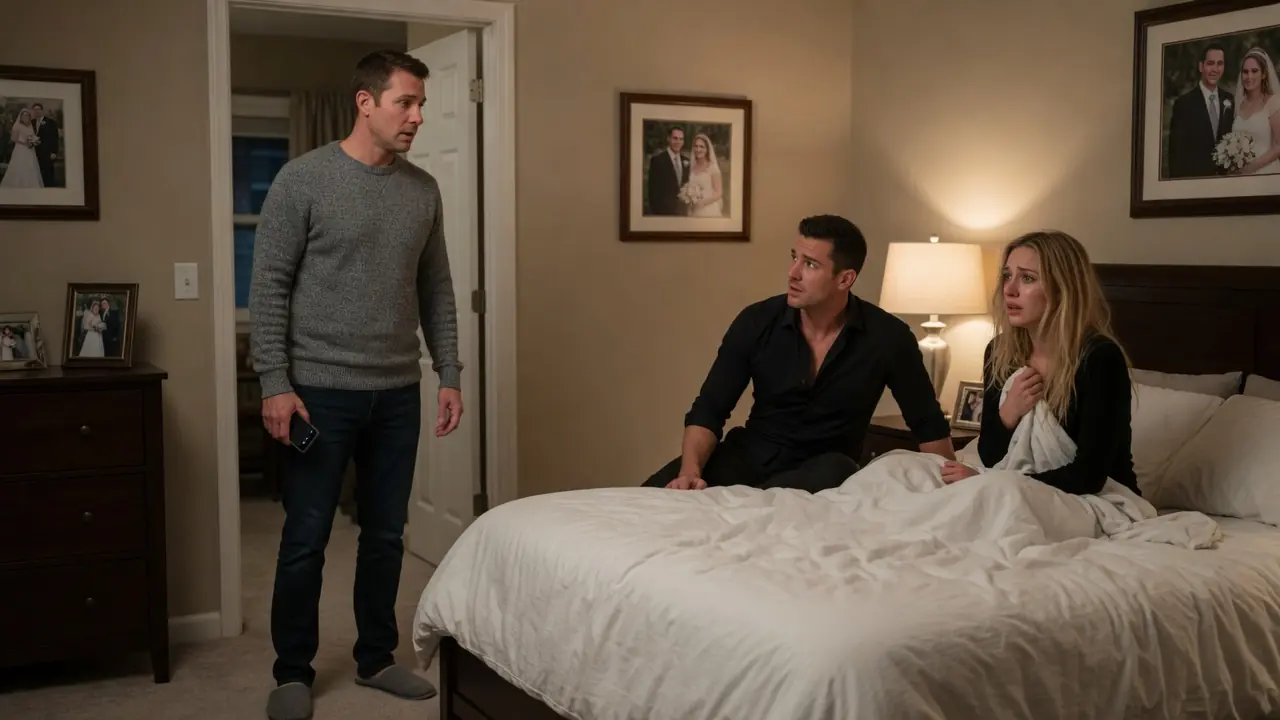
Jason pushed the half-open bedroom door wider.
He did not kick it in.
He did not shout.
He did not rush forward.
The room opened in front of him with a sickening quiet.
And there they were.
Chloe and Derek were tangled under the white sheets in an unmistakably intimate embrace, close enough that no explanation could rescue them, faces flushed with panic the moment they saw him.
For a second, nobody moved.
Chloe clutched the sheet to her chest, her green eyes wide and terrified. Derek jerked backward toward the headboard, his confidence vanishing so quickly he looked smaller than Jason expected.
The room smelled of perfume, music, and betrayal.
Everything in it belonged to Jason.
The bedframe he had assembled.
The lamps he had bought.
The nightstands he had carried upstairs while Chloe laughed at how sweaty he got.
The house he had built his future around.
Jason looked at Tom.
“Are you recording?”
Tom’s voice was steady.
“Every second.”
Jason nodded slowly.
“Make sure their faces are clear.”
Chloe began to cry immediately, but even her tears looked rehearsed to Jason now.
“Jason, please,” she said, her voice breaking. “It isn’t what you think.”
Jason looked at the bed.
Then at Derek.
Then back at Chloe.
“It is exactly what I think.”
His calm frightened her more than shouting would have.
Derek tried to speak, raising one hand as if surrendering could make him innocent.
“Man, I didn’t know she was married.”
Jason took one step into the room, stopping far enough away that no one could accuse him of threatening anything.
“You texted her about taking my money,” he said. “You knew exactly who I was.”
Derek’s face turned pale.
Chloe looked from Derek to Jason and realized he knew far more than the moment in front of him.
She whispered his name again.
Not as a plea this time.
As a confession.
Jason opened a folder on his phone.
His voice did not shake as he read.
“‘He’s too trusting. If I play sweet, he won’t protect himself.’”
Chloe’s mouth fell open.
Jason continued.
“‘The house is in his name, but I can still get something.’”
Derek looked at Chloe.
Jason read the next one.
“‘He’s easy money.’”
Derek’s face changed.
“That was a joke,” he said quickly.
Jason looked at him.
“Funny room for it.”
Chloe covered her mouth with one hand.
“I was angry when I said that.”
Jason shook his head.
“You were planning when you said that.”
He turned the phone toward her, showing screenshot after screenshot.
Her face collapsed because denial had nowhere left to stand.
Mark stayed near the door, silent and watchful. Tom recorded from the hallway, careful not to move closer than necessary. Jason had promised himself he would not let anger ruin the evidence, and he kept that promise with every breath.
The only weapon he used was truth.
“Get dressed,” Jason said.
Chloe stared at him.
“What?”
“Get dressed and leave my house.”
“My house too,” she whispered.
“No,” Jason said. “Not tonight. Tonight, this is the house you chose to betray me in.”
She began sobbing harder.
“Jason, please. I love you.”
Derek looked away.
Jason saw that too.
Not protectively. Not guiltily. Simply annoyed that the evening had turned inconvenient.
“You love me?” Jason asked.
“Yes,” Chloe cried. “I made a mistake.”
“A mistake is forgetting to lock the car. This was a schedule.”
“I was confused.”
“This was not confusion.”
“I was lonely.”
“You had a husband who asked you to walk with him every night.”
She flinched.
“I didn’t know how to tell you I was unhappy.”
“You knew how to tell Derek.”
That silenced her.
She said Derek meant nothing. She said she had been confused, lonely, unhappy, and afraid. She said she did not know how to feel like herself anymore. She said Jason worked too much, was too quiet, too predictable, too content with small things.
Jason listened until she started blaming him for the affair.
That was when his face hardened.
“Do not make your betrayal my fault.”
Derek gathered his clothes in a shaking rush and left the room under Mark’s watchful stare.
Jason did not follow him.
He did not touch him.
He did not waste one more word on him.
Derek’s humiliation was complete without violence.
He had entered the house as a secret and left it as evidence.
Chloe dressed slowly, crying the entire time. Jason turned his back while she did, not out of tenderness, but because dignity was not something he needed to steal from her to keep his own.
She followed him downstairs, barefoot, carrying her heels in one hand.
The house looked almost normal from the entryway.
That was the cruel thing.
The lamp still glowed. The couch still sat in place. The rosemary still leaned against the kitchen window. The mail still waited on the table.
A life can break while furniture remains perfectly still.
Jason opened the front door.
The night air moved into the house, cool and clean.
Chloe stood on the threshold with mascara streaking her face. She looked smaller than the woman who once filled every room with light.
“Where am I supposed to go?” she whispered.
Jason looked at her calmly.
“You had a plan to take my house. Use that planning skill.”
She flinched, but he did not soften.
“Call your parents. Call Derek. Call anyone who helped you believe this would be easy.”
“This is cruel.”
“No,” Jason said. “Cruel was inviting him into our bedroom while I walked the streets thinking I was giving you space.”
“I can’t leave like this.”
“You already left. Your body just stayed longer.”
Chloe looked past him into the house.
“Please, Jase.”
The nickname almost reached him.
Almost.
But Jason remembered her message.
He never comes back early.
“Goodbye, Chloe.”
He stepped back and closed the door.
When the lock clicked, Jason stood in the entryway for a long moment.
Mark and Tom were quiet behind him.
The house felt wounded, but it also felt different, as if the lie that had been living inside it had finally been forced outside.
Jason sank onto the couch and took his first full breath in weeks.
Tom stopped recording.
Mark sat beside him without asking.
For several minutes, none of them spoke.
Then Tom said quietly, “You did good.”
Jason stared at the dark television screen, seeing his own reflection.
“I don’t feel good.”
“You’re not supposed to,” Mark said. “Not yet.”
On Monday morning, Margaret Sinclair reviewed the evidence in her downtown office.
She watched the video once.
She read the messages twice.
She examined the financial records and the house documents, then looked at Jason with professional calm.
“This is very strong,” she said. “The affair is documented, the financial planning is documented, and the house records support your ownership.”
Jason felt something loosen inside him, though he knew relief was still far from happiness.
“What happens now?”
“We file. We protect the house. We prepare for her attorney to claim emotional neglect, instability, or wrongful removal from the home. But given the evidence and the witnesses, her position is weak.”
Jason looked down at his hands.
“I don’t want to destroy her.”
Margaret’s expression softened slightly.
“Then don’t. Let the facts do what facts do.”
The divorce moved quickly because Chloe’s position was weak.
Her attorney tried to argue emotional neglect, confusion, and marital loneliness, but the messages about money destroyed that defense.
It is one thing to be unhappy in marriage.
It is another thing to invite a lover into your spouse’s home while discussing how to take his assets.
Chloe’s parents learned the truth when the divorce papers arrived with copies of the evidence.
At first, they had believed Chloe’s version. She told them Jason had become cold and unreasonable, that he had thrown her out over a misunderstanding, that he had embarrassed her in front of neighbors and refused to talk. Her mother called Jason once, furious and tearful.
“How could you do this to her?” she demanded.
Jason said only, “Ask Chloe to show you the messages.”
Then he hung up.
Two days later, Chloe’s father called.
He sounded older than Jason remembered.
“I’m sorry,” he said.
Jason closed his eyes.
“You don’t have to apologize for her.”
“She told us something different.”
“I know.”
There was a long silence.
Then her father said, “I hope you find peace, son.”
The word son hurt.
Jason thanked him and ended the call.
By the time Chloe tried to explain to her family, the story had already turned against her.
Derek disappeared almost immediately.
He blocked Chloe after the confrontation, according to one angry voicemail she left Jason at 2:00 in the morning.
“He won’t even answer me,” she sobbed. “He said this is too messy.”
Jason listened to the voicemail once, then sent it to Margaret.
Not because he enjoyed Chloe’s pain.
Because evidence still mattered.
Chloe had mistaken Derek’s desire for loyalty. She had mistaken excitement for love. Now, when consequences arrived, Derek did what men like him often do.
He chose the nearest exit.
Jason did not celebrate her downfall.
He did not need her destroyed to feel whole.
What he needed was freedom from the version of himself who had ignored every warning because he loved the person Chloe pretended to be.
Sixty-two days after the night he opened the bedroom door, Jason walked out of the courthouse into bright autumn sunlight.
The divorce was final.
The court awarded him the house, his savings, his retirement accounts, and a clean break from the marriage. Chloe received what the law required, but not the future she had planned. The evidence had narrowed every argument until even her attorney seemed tired of pretending.
Jason stood on the courthouse steps with Margaret beside him.
“You did well,” she said.
“I don’t feel victorious.”
“You probably won’t for a while.”
He looked at the street, at people crossing with briefcases and coffee cups, living ordinary lives with ordinary troubles.
“What am I supposed to feel?”
Margaret put her sunglasses on.
“Free. Eventually.”
Victory was too loud a word for the quiet emptiness inside him.
He felt tired.
Older.
Strangely peaceful.
Sometimes freedom arrives not as joy, but as the absence of fear.
Six months later, Jason had changed the bedroom completely.
New sheets.
New paint.
New furniture.
New curtains.
A new bed he did not assemble with romantic hope, only with patience and a good socket wrench.
He did not erase Chloe because he was bitter. He erased her because healing sometimes requires a room to stop remembering for you.
The house became his again slowly.
One cleaned shelf at a time.
One repainted wall.
One replaced lamp.
One quiet morning when he made coffee and realized he had not thought about whether Chloe would come downstairs.
He replaced the speaker in the bedroom because he could not bear the song from that night. He donated the couch because too many old arguments had sunk into it. He pulled the dead rosemary from the kitchen window and planted basil instead.
Basil grew better.
On Sunday evenings, Mark and Tom often came by with beer and sat with him on the back porch.
They did not mention Chloe unless Jason did first.
Real friends know when silence is a form of loyalty.
Together, they watched the sunset settle over the fence Jason had built with his own hands.
One evening, Tom mentioned that Chloe had moved two towns over and was working at a diner.
Mark said Derek had left the area completely.
Jason listened and felt almost nothing.
Not because he was cruel.
Because the part of him attached to their punishment had finally burned out.
They had become weather he no longer lived under.
A year after the divorce, Jason walked the neighborhood at 9:00 p.m. again.
At first, he avoided the route. The sidewalks had belonged to Chloe in his mind. Their walks. Their corners. Their lamppost. Their quiet ritual.
But one spring night, after rain had washed the streets clean, he put on a jacket and stepped outside.
The first block hurt.
The second hurt less.
By the time he reached the corner under the streetlamp, he stopped and looked around.
The Andersons’ wind chimes still sang in the breeze. The elderly man in the blue ranch house still watched baseball through the window. Someone down the street was grilling. A dog barked twice and gave up.
The neighborhood had not betrayed him.
Chloe had.
That distinction mattered.
Jason kept walking.
The ordinary returned slowly.
Not the same ordinary as before.
Something quieter. Wiser. Less innocent, but stronger.
He learned to cook for one without making too much. He learned which floorboards creaked at night. He learned to sleep in the center of the bed. He learned that loneliness was not the worst thing in the world.
Living beside a lie was worse.
He dated once, briefly, a woman from work named Melissa who liked hiking and asked direct questions. It did not last, but it reminded Jason that he was not invisible. He was simply cautious now. Caution was not damage. It was self-respect wearing armor.
One Saturday afternoon, Jason found an old note from Chloe while cleaning the garage.
It was tucked inside a box of holiday decorations.
Jase, don’t forget we need batteries for the porch lights. Also, I love you. Chlo.
He sat on the garage floor holding the note for a long time.
Then he folded it once and placed it in the trash.
Not angrily.
Not dramatically.
Just because some things no longer deserved storage.
That evening, Mark and Tom came by.
Jason grilled burgers. Tom complained they were overcooked. Mark ate two anyway. They sat on the porch with beer while the sky turned purple.
Jason looked around the backyard at the small garden he had planted after the divorce. Tomato vines climbed their stakes. Basil grew near the fence. The air smelled like cut grass and jasmine from the neighbor’s yard.
For the first time in a long time, the ordinary felt safe again.
That was all he wanted.
Betrayal had given Jason perfect vision, but it had also given him something harder to earn.
Self-respect without apology.
Chloe thought his quietness made him easy to deceive.
Derek thought another man’s home could become a secret playground.
They were both wrong.
Quiet men still know how to close doors.
Jason took a sip of beer and watched the last light fade over his yard.
The perfect lie was over.
The imperfect truth had begun.
His house still stood.
So did he.