My wife stood on our back deck with a suitcase beside her and said, “I’m moving out tonight. Don’t call me again.”
Behind me, two rib eyes were burning on the grill.
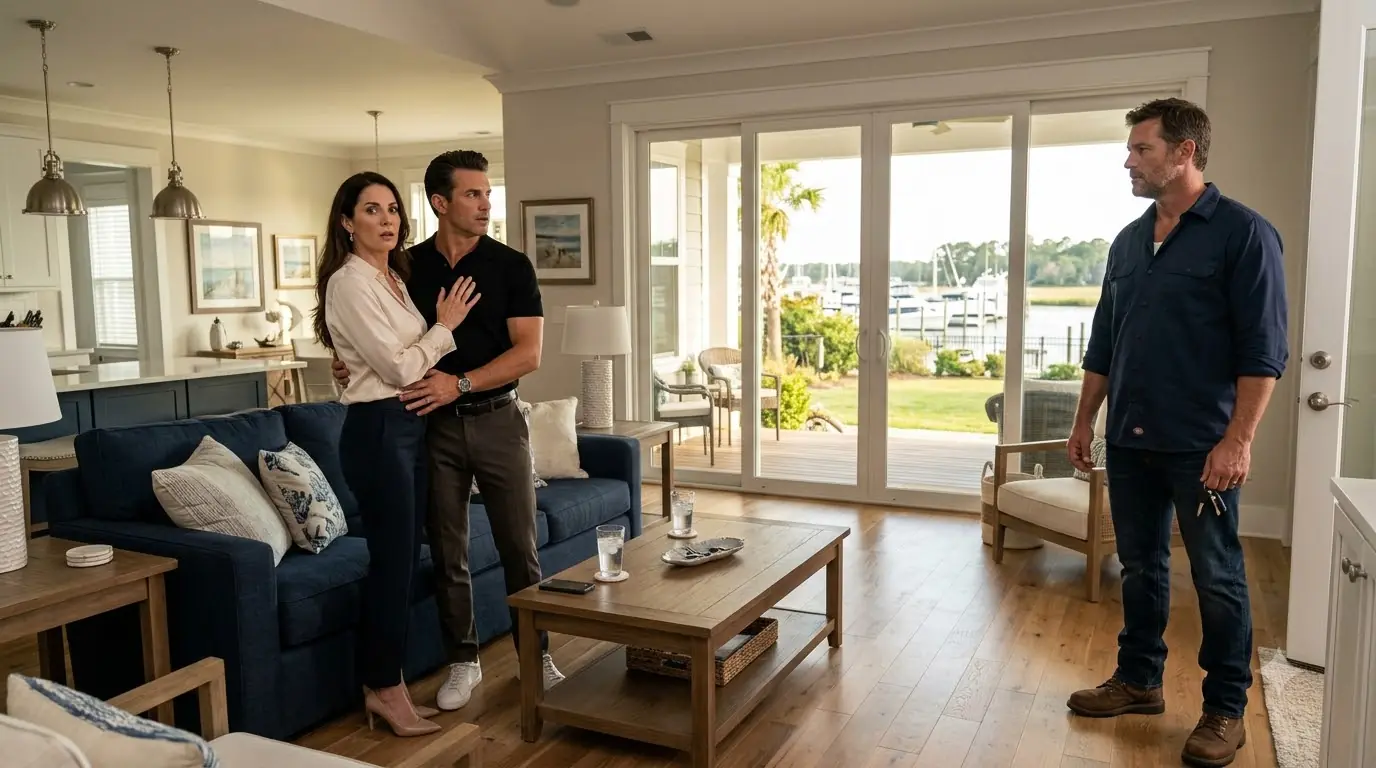
I looked at the steaks.
Then at the suitcase.
Then at the woman I had been married to for seven years.
“Fine,” I said.
That was it.
No shouting.
No grabbing her luggage.
No dramatic speech about vows, sacrifice, or the life we had built.
Erica stared at me for several seconds because “fine” was clearly not the response she had rehearsed for.
Then she lifted the handle of the suitcase.
Three days later, she was pounding on my front door because her card had been declined at an expensive dinner with the man she had left me for.
That was when I finally understood the arrangement Erica had imagined.
She wanted independence from our marriage.
She just did not want independence from my money.
My name is Mark Callahan.
I was forty-two when my marriage ended on a Thursday evening outside Wilmington, North Carolina.
I own a marina service and boat-storage business called Harborline Marine.
We store boats.
Repair docks.
Service engines.
Clean hulls.
Rewire electronics.
Repair trailers.
Winterize equipment.
And answer emergency phone calls from men who always begin with some version of:
“It was running perfectly five minutes ago.”
Usually followed by:
“Then it made a noise.”
Working around boats teaches you to distrust that sentence.
Expensive failures almost never begin with the dramatic part.
The engine does not usually go from perfect to destroyed without warning.
There is a vibration.
A leak.
A faint smell.
A little smoke.
A gauge that reads differently than it did last week.
A sound somebody ignores because dealing with it would be inconvenient.
Marriage, as it turns out, can work the same way.
By the night Erica left, there had been plenty of strange vibrations.
I had simply spent years explaining them away.
I did not grow up around marinas with polished teak boats and wealthy customers arguing about radar packages.
My mother, Diane Callahan, raised me alone.
My father left when I was six and spent the next decade appearing just often enough to make disappointment feel scheduled.
Mom worked reception at a dental office during the day and bookkeeping for a small plumbing company three nights a week.
We were not starving.
We were simply one broken transmission away from panic most of the time.
I knew what an overdue notice looked like before I knew what compound interest was.
I knew that the electric company did not care whether your mother had been awake since five in the morning.
I knew that “we’ll get it next month” was adult language for “we cannot afford it.”
So I worked early.
At fifteen, I washed boats at a marina.
That was where I met Ray Porter and Sam Whitaker.
Ray could fix anything mechanical if you gave him enough time and enough inappropriate language.
Sam had the opposite gift.
He could take chaos and create order.
Inventory.
Schedules.
Invoices.
Customer records.
Parts.
People.
He remembered everything.
I was not the best mechanic.
I was not the best organizer.
What I had was stubbornness.
At twenty-eight, that was enough for the three of us to make a terrible financial decision together.
We started Harborline Marine.
Our first location was a rented corrugated-metal building that leaked at both ends.
The landlord called it industrial waterfront property.
Ray called it a shed with delusions.
We had one hydraulic lift we bought used.
Two service vans.
A pressure washer.
A borrowed trailer.
A computer that sounded like it was preparing for takeoff.
And almost no money.
Our first year was brutal.
We underbid jobs because we were afraid to lose customers.
Then spent twice as many hours completing them.
We accepted work we should have refused.
Extended credit to people who should not have been trusted with a library card.
Bought parts before collecting deposits.
Worked Sundays.
Missed holidays.
Lost money on jobs we thought were profitable because nobody had calculated our actual labor.
Sam eventually created a spreadsheet so detailed Ray threatened to drown it.
That spreadsheet probably saved the company.
The other person who helped was Peter Nolan.
Peter was an attorney with a small business practice near downtown Wilmington.
We met because his father owned an old fishing boat that had taken a beating during a coastal storm.
Ray rebuilt part of the fuel system.
I repaired the damaged dock hardware.
Peter looked at our service agreement while waiting for us one afternoon.
Then he called me.
“Mark.”
“Yeah?”
“Did you write this contract?”
“I found a template.”
“Where?”
“Internet.”
“That explains it.”
“What’s wrong with it?”
He paused.
“Do you want the alphabetical list or the chronological one?”
I laughed.
He did not.
“Mark, if a sneeze could create liability, this agreement would somehow make you responsible for the weather.”
That began a friendship.
Peter rewrote our contracts.
Helped us create proper corporate structures.
Taught me the difference between an asset belonging to me personally and an asset belonging to Harborline.
Explained why casually mixing company and household expenses was the financial equivalent of storing fireworks beside gasoline.
He charged us less than he should have in the beginning.
Years later, when we could afford him properly, he refused to let me forget it.
By thirty-four, Harborline had survived.
By thirty-six, it was doing more than surviving.
Two storage yards.
A larger service building.
Twenty employees during peak season.
Seasonal agreements with yacht clubs.
Dock-maintenance contracts.
Commercial customers.
A reputation for being expensive enough to complain about and reliable enough to call anyway.
That was when I met Erica Vaughn.
I was thirty-five.
She was thirty-four.
We met at a coastal hospitality fundraiser.
One of those events where everybody wore expensive casual clothing and pretended networking beside shrimp skewers was relaxation.
I had come directly from work.
Navy shirt.
Khakis.
Boat shoes.
Faint grease stain on one sleeve.
Erica noticed it.
She was standing near the bar in a dark green dress.
Perfect posture.
Dark hair.
A laugh that made people turn toward her.
She tapped my sleeve.
“Is that intentional?”
I looked down.
“The grease?”
“Yes.”
“Absolutely.”
“Interesting fashion statement.”
“I like people to know I work for a living.”
She smiled.
“Or you missed a spot.”
“That is also possible.”
We talked for the rest of the event.
Erica worked in guest relations for a boutique hotel group.
She was exceptional at it.
She remembered names.
Preferences.
Anniversaries.
Which executive hated sparkling water.
Which bride was pretending not to panic.
Which wealthy guest expected special treatment but needed to believe the special treatment had been spontaneous.
She understood people.
Or I thought she did.
Our first date lasted three hours.
Second date, five.
By the third month, she had met Ray and Sam.
Ray liked her.
Sam liked almost nobody immediately, which made his approval more valuable.
Erica came to Harborline on Saturdays.
Brought coffee.
Walked the docks.
She watched me talk a furious customer down after his engine repair took longer than expected.
Later she said:
“You’re different here.”
“How?”
“Confident.”
“I’m confident everywhere.”
“No.”
“You fake it everywhere.”
“Here, people need you.”
That sentence felt flattering then.
For our wedding, we rented a waterfront restaurant in Southport.
Small ceremony.
Family.
Close friends.
Peter.
Ray.
Sam.
My mother cried before the vows even started.
Erica’s parents were divorced but managed four hours of civility.
No five-tier cake.
No carriage.
No expensive string quartet.
Just good food.
Cold drinks.
Enough shrimp that Ray told me I had accidentally financed the collapse of the local ecosystem.
For the first years, marriage was good.
Really good.
I want that on the record.
People sometimes rewrite an entire relationship after divorce to make themselves look smarter.
I will not.
Erica was affectionate.
Funny.
Supportive.
She hosted dinners for my employees.
Remembered spouses’ names.
When my mother had knee surgery, Erica stayed with her during recovery.
When Harborline nearly lost a major customer over a service mistake, Erica sat with me until two in the morning while I worked through the numbers.
She loved the house we bought outside Wilmington.
Technically, I had purchased the lot before we married, but we built the home during our marriage with a combination of my savings and marital earnings.
Peter would later explain that this made classification and equitable distribution more complicated than the emotional statement “I paid for it.”
At the time, none of that mattered.
It was our home.