My name is Nicholas Bennett, and for a long time, I believed a marriage could survive almost anything if both people still cared enough to sit at the same table and tell the truth.
I was wrong.
A marriage can survive arguments. It can survive bad months, tight money, career pressure, and the quiet disappointments that settle into ordinary life.
But it cannot survive one person deciding that partnership is a prison while still expecting to keep all the comforts the partnership provided.
Dorothy taught me that lesson.
She was not always cruel. That is the part people sometimes struggle to understand when I tell this story. They imagine a bad marriage must have been bad from the beginning, as if every painful ending announces itself on the first date.
Ours did not.
I met Dorothy at a professional networking event in Columbus, Ohio. I was thirty-one then, working as a junior financial consultant and trying to prove myself in a firm where everyone seemed sharper, louder, and better connected than I was. Dorothy worked in human resources for an international nonprofit. She was smart, polished, articulate, and calm in a room full of people trying too hard to impress one another.
We ended up standing near the coffee table, both avoiding the crowd for a few minutes.
She laughed when I admitted I hated networking events.
“Then why are you here?” she asked.
“Because rent exists.”
She smiled.
“I respect that answer.”
That was how it started.
We began meeting for coffee after work. Then museums on Saturdays. Then long evening walks through quiet neighborhoods where we talked about our childhoods, our ambitions, and the kinds of lives we wanted to build.
Dorothy told me she wanted stability. Not luxury, not attention, not a life designed for other people to admire.
“Just peace,” she said once, sitting beside me on a park bench while autumn leaves moved across the sidewalk. “A home where I don’t feel like I have to perform.”
I believed her because I wanted the same thing.
My grandfather had left me enough money to buy a modest three-bedroom house in a quiet suburb just outside the city. It was not grand, but it was paid off. No mortgage. No bank breathing down my neck. No landlord raising rent whenever life started to feel manageable.
That house was my proudest accomplishment, even if I had not earned every dollar of it myself. My grandfather had worked forty years as a machinist and saved with almost religious discipline. When he passed, he left me the kind of gift that can change a young man’s entire future.
A stable place to stand.
Before Dorothy and I married, I told her exactly how I had purchased the house.
“My grandfather left the money,” I said. “The deed is in my name. I bought it last year.”
She nodded.
“That makes sense. It’s your family inheritance.”
There was no argument. No discomfort. No demand that I add her name to anything. She seemed to understand.
We married after two years of dating in a small ceremony with close friends, a few relatives, and no unnecessary drama. Dorothy wore a simple ivory dress. I wore a navy suit. We promised to love, honor, and build a life together.
For the first two years, I thought we were doing exactly that.
Dorothy moved into the house, and at first she loved it. She painted the guest room sage green. She planted herbs by the kitchen window. She replaced the old porch light with one shaped like a lantern because she said it made the house look “welcoming but not showy.”
We had separate bank accounts and one joint account for shared expenses. I covered property taxes, insurance, repairs, and most household costs because the house was mine and my income was stronger. Dorothy contributed to groceries, utilities, and savings when she could.
It felt fair.
More than fair, it felt peaceful.
We cooked together. We watched old movies on Friday nights. We had friends over for dinner sometimes. Dorothy was not overly social then. She liked quiet weekends, small routines, and the feeling of knowing where she belonged.
At least, that was the woman I thought I married.
Things began to change in our third year.
Dorothy reconnected with two old college friends through social media. Their names were Debbie and Kara. Both had been in her sorority. Both had recently moved back to Columbus. Both seemed excited to “get the old group back together.”
At first, I was happy for her.
Debbie was divorced twice and worked in real estate. She was loud, confident, and had very strong opinions about men, marriage, and what she called “wasted years.” She often said she had spent her twenties trying to keep husbands happy and was now “finally choosing herself.”
Kara had never married, though she had lived with three different long-term boyfriends. She worked in event planning and had an endless appetite for nightlife, weekend trips, concerts, and spontaneous plans that usually involved expensive restaurants and expensive cocktails.
At first, Dorothy saw them maybe once a month.
Then twice.
Then every week.
Then twice a week.
The changes were subtle at first.
She came home from dinner with them and suddenly had questions she had never asked before.
“Why do you always ask when I’ll be home?”
“I’m just checking.”
“But why do you need to know?”
“Because you’re my wife, Dorothy. Because if you’re late, I worry.”
She would tilt her head like I had said something suspicious.
“Or because you want to keep tabs on me.”
That was new.
Another night, she came home from drinks with Debbie and Kara and told me about a woman they knew who had “lost herself” in marriage.
“She gave everything to her husband,” Dorothy said. “Now she has no identity.”
I nodded slowly.
“That’s sad.”
Dorothy watched me.
“You don’t think that happens a lot?”
“It probably does.”
“You don’t think it could happen to me?”
I was confused by the sharpness in her voice.
“Dorothy, you have your career, your money, your friends, your hobbies. I’ve never asked you to give those up.”
“That’s not the same as supporting them.”
“What does that mean?”
She shrugged.
“Nothing.”
But it was not nothing.
Soon, every ordinary part of marriage was being re-examined like evidence in a case against me.
If I asked whether she wanted dinner saved, I was monitoring her schedule.
If I asked who was going out, I was suspicious of her friends.
If I suggested we discuss a large purchase before making it, I was limiting her independence.
If I said I missed spending weekends together, I was making her responsible for my emotional needs.
It was like Dorothy had learned a new language, and in that language, husband meant guard, concern meant control, and partnership meant prison.
I tried to be patient.
I told myself all marriages go through seasons. People change. People grow. Sometimes one spouse needs more space. I did not want to be the kind of man who panicked because his wife had friends.
So I said less.
That was my mistake.
Silence did not create peace.
It created room for Debbie and Kara to fill in the blanks.
By the fourth year, Dorothy’s social life revolved around them. They went to wine bars, comedy shows, day trips, rooftop parties, fitness classes, and “girls’ nights” that somehow ended after midnight.
If I expressed concern, Dorothy already had a speech ready.
“I am allowed to have a life outside this marriage.”
“I never said you weren’t.”
“You act like I need permission.”
“I’m asking for consideration, not obedience.”
She would laugh bitterly.
“That sounds like something Debbie’s ex used to say.”
I hated being compared to men I had never met.
I hated even more that Dorothy seemed to enjoy watching me defend myself.
She began posting articles online about women reclaiming their lives, financial independence, and emotional labor. None of the posts mentioned me, but they were written like arrows and aimed like accusations.
People commented underneath.
So proud of you for finding your voice.
Never let a man dim your light.
Marriage should never be a cage.
I stared at those comments, wondering what story Dorothy had been telling when I was not in the room.
Our arguments became circular and exhausting.
I would raise one practical concern, and Dorothy would turn it into a moral indictment.
“Dorothy, you said you’d be home by ten. It’s almost one in the morning.”
“So now I have a curfew?”
“No. I just expected a text.”
“I’m not a teenager.”
“I didn’t say you were.”
“You don’t have to say it. You treat me like one.”
Then she would disappear into the guest room and shut the door.
That room became hers.
Not officially at first.
A night here. A night there. Then most nights. Then every night.
When I asked if she planned to move back into our bedroom, she said, “I need space to feel like myself.”
I stood there in the hallway, looking at the closed guest room door, wondering how much space a marriage could survive.
The real breaking point came in our fifth year.
Dorothy walked into the kitchen one Saturday morning while I was making coffee and said, “Kara’s birthday is next month. We’re going to Las Vegas for a week.”
I turned.
“A week?”
“Yes.”
“Who is we?”
“Me, Kara, Debbie, and maybe two other girls.”
“Girls?”
She gave me a look.
“Women, Nicholas. Don’t be weird.”
I set the coffee spoon down.
“When were you planning to talk to me about this?”
“I’m talking to you now.”
“No, you’re informing me now.”
Her expression tightened immediately.
“I don’t need approval to take a trip.”
“That is not what I said.”
“But it’s what you mean.”
I took a breath.
“Dorothy, a week-long trip to Las Vegas with friends is something married people discuss before booking. That’s normal.”
“Normal for who?”
“For people who share a life.”
She crossed her arms.
“There it is.”
“What?”
“The shared life argument. The same excuse men use when they want to control every decision.”
I felt heat rising in my chest.
“Do not turn this into something it isn’t.”
“It is exactly what it is. You don’t trust me.”
“I don’t trust the way you’ve been treating this marriage lately.”
Her face changed.
The fight lasted hours.
She accused me of jealousy, insecurity, possessiveness, and being “traditional in the worst way.” She told me Debbie had warned her I would react this way. She told me Kara’s boyfriend never questioned her plans. She said other men were confident enough to let women live.
I finally asked, “If you want to live like you are single, why are you still married?”
The room went quiet.
Dorothy looked at me for a long moment.
Then she said, “Maybe I’ve been asking myself the same thing.”
After that, the house became ice.
Dorothy barely spoke to me. She left early, came home late, slept in the guest room, and spent weekends out with Debbie and Kara. I tried twice to open a real conversation. Both times, she shut it down.
“I’m not ready.”
“You just want to argue.”
“I’m tired of explaining basic freedom to you.”
I researched marriage counselors. I wrote down names and numbers. I even considered apologizing for the Vegas argument just to get us back to the table.
But Dorothy was no longer trying to come back.
She was preparing to leave.
I discovered that on a Thursday evening.
I came home late from work and found her sitting at the dining table with papers spread neatly in front of her. She looked calm. Too calm. She was not wearing her wedding ring.
My stomach tightened.
“What is this?”
Dorothy stood.
“I want a divorce.”
I stared at her.
She lifted her chin.
“I’m tired of feeling like I have to check in with you. I’m tired of living according to your comfort. I’m tired of being made to feel guilty for wanting a life of my own.”
The words were practiced.
I could almost hear Debbie and Kara in them.
Dorothy pushed the papers toward me.
“I’ve already spoken with an attorney.”
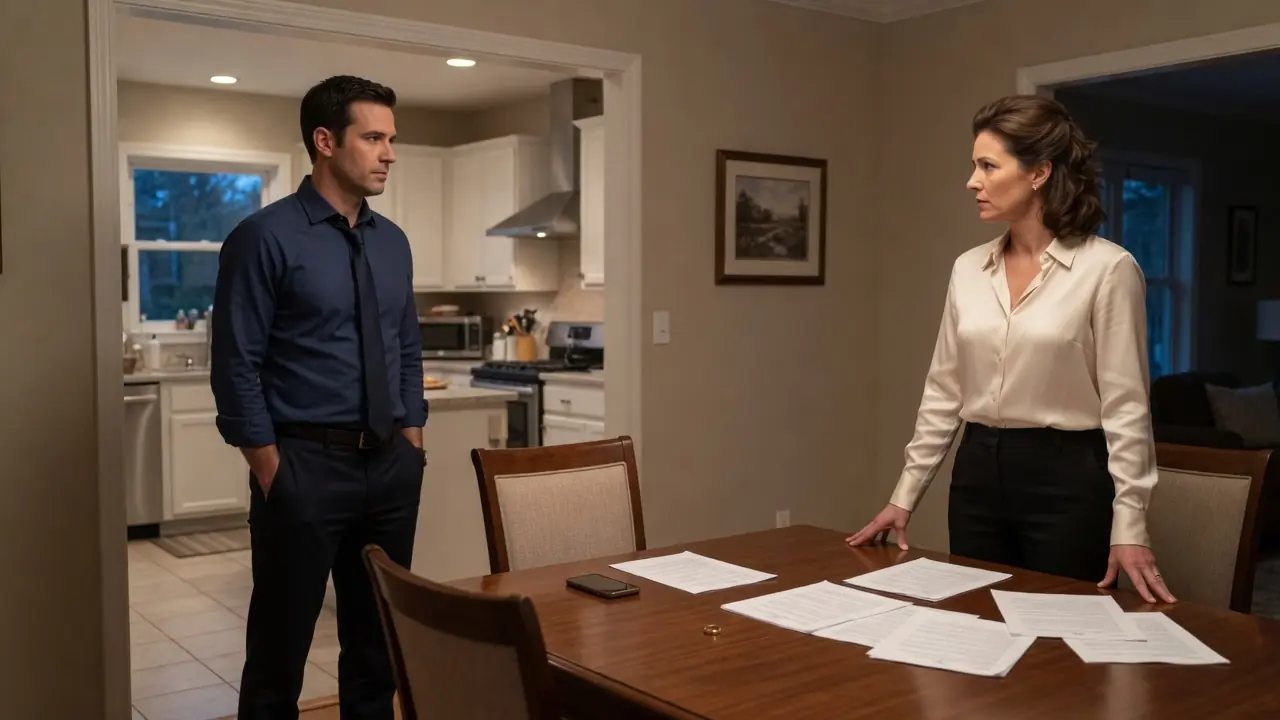
I looked down at the documents.
Divorce petition.
Proposed settlement.
Division of assets.
My eyes moved over one line and stopped.
She was asking for half the value of the house.
My house.
The house I bought before the marriage with my grandfather’s inheritance.
Something in me went very still.
Maybe she expected me to beg.
Maybe she expected me to cry, apologize, promise change, offer compromises, and ask what I could do to keep her.
Instead, I looked at her and said, “Then go live for yourself, Dorothy. But not in my house. And not on my dime.”
Her mouth actually opened.
For the first time in months, she had no prepared response.
“What did you just say?”
“You want to live without me. I accept that. But this house belongs to me. You can leave.”
Her shock turned into anger.
“This is our home.”
“It was my home before you moved in.”
“We’re married.”
“Not for long, apparently.”
“You can’t just throw me out.”
“I’m not throwing you out tonight. But I am telling you the truth. If you are ending this marriage, then you do not get to keep enjoying the security of it while treating me like an obstacle.”
Her face flushed.
“You’re punishing me.”
“No. I’m agreeing with you.”
“You’re being cruel.”
“No, Dorothy. Cruel would be pretending you can break the marriage and keep the husband benefits.”
She grabbed the papers off the table.
“You’ll hear from my lawyer.”
“I already have.”
The next day, I took the documents to my attorney, Mark Ellison, a calm man with silver hair and a gift for making chaos sound manageable.
He reviewed the petition, then looked over his glasses.
“She’s asking for half the house?”
“Yes.”
“Was the house purchased before the marriage?”
“Yes.”
“With inherited funds?”
“Yes.”
“Was her name ever added to the deed?”
“No.”
“Did marital funds pay down a mortgage?”
“There was no mortgage.”
He leaned back.
“That demand will not hold.”
Those six words gave me my first full breath in weeks.
The divorce took fourteen months.
Dorothy fought harder than I expected. Her attorney tried multiple arguments. They claimed she had contributed to maintaining the household. They claimed her grocery and utility contributions indirectly supported the home. They claimed she had been led to believe the house would eventually become marital property.
Mark dismantled each argument with documents.
The deed.
The inheritance records.
The property tax payments from my personal account.
The repair invoices paid by me.
The absence of any written promise that she would be added to the deed.
Dorothy did not handle court well.
She interrupted. She cried. She accused me of hiding things from her. She told the judge I had used the house to control her.
The judge listened patiently, then asked one simple question.
“Mrs. Bennett, did you know before marriage that the house had been purchased by Mr. Bennett with inherited funds?”
Dorothy hesitated.
“Yes, but—”
“Did you ever request to be added to the deed?”
“No, but—”
“Did Mr. Bennett ever promise in writing to transfer partial ownership to you?”
Her lips tightened.
“No.”
That was the beginning of the end.
Dorothy received her share of our joint savings. She kept her car, her personal property, her retirement account, and the items she had purchased with her own money. She did not receive spousal support. The court found she had a stable work history and sufficient earning capacity.
And she did not receive a dollar from my house.
When the divorce was final, she looked at me outside the courtroom with a hatred I had never seen in her before.
“You ruined my life,” she said.
“No,” I answered. “I stopped funding the version of your life that required me to disappear.”
She walked away without another word.
I went home alone.
For the first few months, the house felt haunted.
Her chair at the dining table. Her mug in the cabinet. The sage green guest room. The herb pots by the kitchen window, dry and brittle because neither of us had cared enough to keep them alive.
I replaced the curtains. Repainted the guest room. Donated furniture she had chosen. Rearranged the living room. Not because I wanted to erase her, but because I needed the house to stop holding its breath.
Slowly, it became mine again.
I learned to cook for one. I started jogging in the evenings. I reconnected with friends I had neglected while trying to repair a marriage Dorothy had already abandoned. I went fishing with my brother. I took a woodworking class. I slept without wondering what mood waited behind the guest room door.
Peace returned quietly.
Not all at once.
But enough.
I heard about Dorothy through mutual friends for a while. She moved in with Kara first, then rented an apartment downtown. She posted constantly. Rooftop drinks. Weekend trips. Inspirational quotes about freedom. Photos with Debbie and Kara, all of them smiling under bright lights.
I was not angry.
Not anymore.
If that was the life she wanted, she was free to have it.
Two years after the divorce, my phone rang on a Tuesday evening.
Dorothy.
I stared at the name for a long time.
Against my better judgment, I answered.
“Hello?”
There was silence first.
Then her voice.
“Hi, Nicholas.”
She sounded different. Smaller.
“What do you need?”
A pause.
“I was hoping we could talk.”
“We are talking.”
She sighed.
“I’m in a difficult situation.”
I leaned back in my chair.
“What kind of situation?”
“Financial.”
Of course.
She explained that she had quit her HR job to “find something more aligned with her values.” The new opportunity had not worked out. Her savings were gone. Rent was overdue. Debbie had moved to Florida. Kara had a new boyfriend and no room for her. Her family was helping as much as they could, but not enough.
Then she said it.
“I was wondering if I could borrow some money. Just temporarily. I’ll pay you back when I’m working again.”
The silence between us stretched.
I thought of the dining table. The divorce papers. The cold months. The way she told me she wanted a life without me. The way she assumed my house would finance that life anyway.
“Nicholas?” she said.
“Why would you ask me?”
She sounded startled.
“Because we were married.”
“We are divorced.”
“I know, but we shared a life.”
“You chose to end that life.”
“I didn’t think you’d be cruel about it.”
There it was.
The old pattern.
When she wanted freedom, I was controlling.
When she wanted money, I was cruel.
I closed my eyes.
“Dorothy, you told me you wanted to live for yourself without me. That is what you are doing now.”
“I was angry when I said that.”
“No. You were clear.”
“I just need help.”
“You need support from someone whose support you rejected.”
“That’s not fair.”
“It is exactly fair.”
Her voice sharpened.
“So you’re punishing me.”
“No. I’m respecting the boundary you created.”
“I thought we could still care about each other.”
“I did care about you. That is why I let you leave instead of begging you to stay in a marriage you no longer respected.”
She began to cry, softly at first.
“I made mistakes.”
“Yes.”
“I listened to the wrong people.”
“Yes.”
“I thought independence would feel different.”
That sentence almost softened me.
Almost.
But I had learned that compassion without boundaries becomes an invitation to repeat old harm.
“I hope you rebuild,” I said. “I mean that. I hope you find work, stability, and a life that teaches you peace. But I will not be your emergency fund.”
“You have the house,” she whispered. “You have everything.”
“No, Dorothy. I have what was mine. You have what you chose.”
Her crying stopped.
“You really won’t help me?”
“No.”
“You’ve changed.”
“Yes,” I said. “I finally did.”
She hung up.
I blocked her number that night.
Not out of hatred.
Out of mercy.
For both of us.
A year later, I met Hannah through a friend from my woodworking class. She was a school counselor, patient but direct, warm but not fragile. On our third date, she asked about my divorce. I told her the short version. Later, as trust grew, I told her the fuller one.
She listened without turning Dorothy into a monster or me into a saint.
Then she said, “It sounds like you learned the difference between partnership and access.”
That stayed with me.
Partnership means two people considering each other.
Access means one person using the other whenever convenient.
Dorothy wanted access.
To my house. My stability. My patience. My forgiveness. My money.
But she did not want the obligations that made those things meaningful.
Hannah and I built something slower, steadier, and far more honest than what I had before. We both had friends. We both had separate interests. She traveled sometimes with her sister. I spent weekends fishing with my brother.
But we discussed major plans because we respected the life we were building.
Not because either of us needed permission.
Because consideration is not control.
It is love with manners.
Sometimes people ask if I regret not helping Dorothy when she called.
I do not.
That answer surprises people.
They expect love to mean endless rescue. They think because I once loved her, I owed her a soft landing forever.
But love is not a lifetime insurance policy for someone who burns the bridge and complains about the river.
Dorothy asked for freedom.
I gave it to her.
All of it.
The freedom to leave.
The freedom to choose herself.
The freedom to spend her settlement.
The freedom to discover who remained when the applause of Debbie and Kara faded.
And yes, the freedom to face the consequences without me standing underneath, arms open, ready to catch her again.
I wish Dorothy no harm.
I hope she grows. I hope she finds humility. I hope she learns that independence is not the same as selfishness, and marriage is not a cage just because it asks you to care how your choices affect someone else.
As for me, I still live in the house my grandfather helped me buy.
The porch light is still shaped like a lantern.
The guest room is no longer sage green.
There are new herbs in the kitchen window now, and Hannah keeps them alive better than I ever could. Some evenings, when the house is quiet and the air smells of basil and rain, I think about the day Dorothy stood in the dining room with divorce papers and told me she wanted to live for herself.
At the time, I thought I was losing everything.
But I was only losing the illusion that love could survive without respect.
Dorothy did not free herself that day.
She freed me.
And when I told her she could live for herself, but not in my house and not on my dime, I was not being cruel.
I was finally telling the truth.
A person can leave your life.
They do not get to keep the shelter they only valued after they lost it.