It was 1:58 a.m. when I heard tires crunching over the gravel outside.
I was sitting on the couch in the dark, wide awake, pretending to watch a rerun of some late-night talk show where people laughed too loudly at jokes that were not funny enough to deserve it.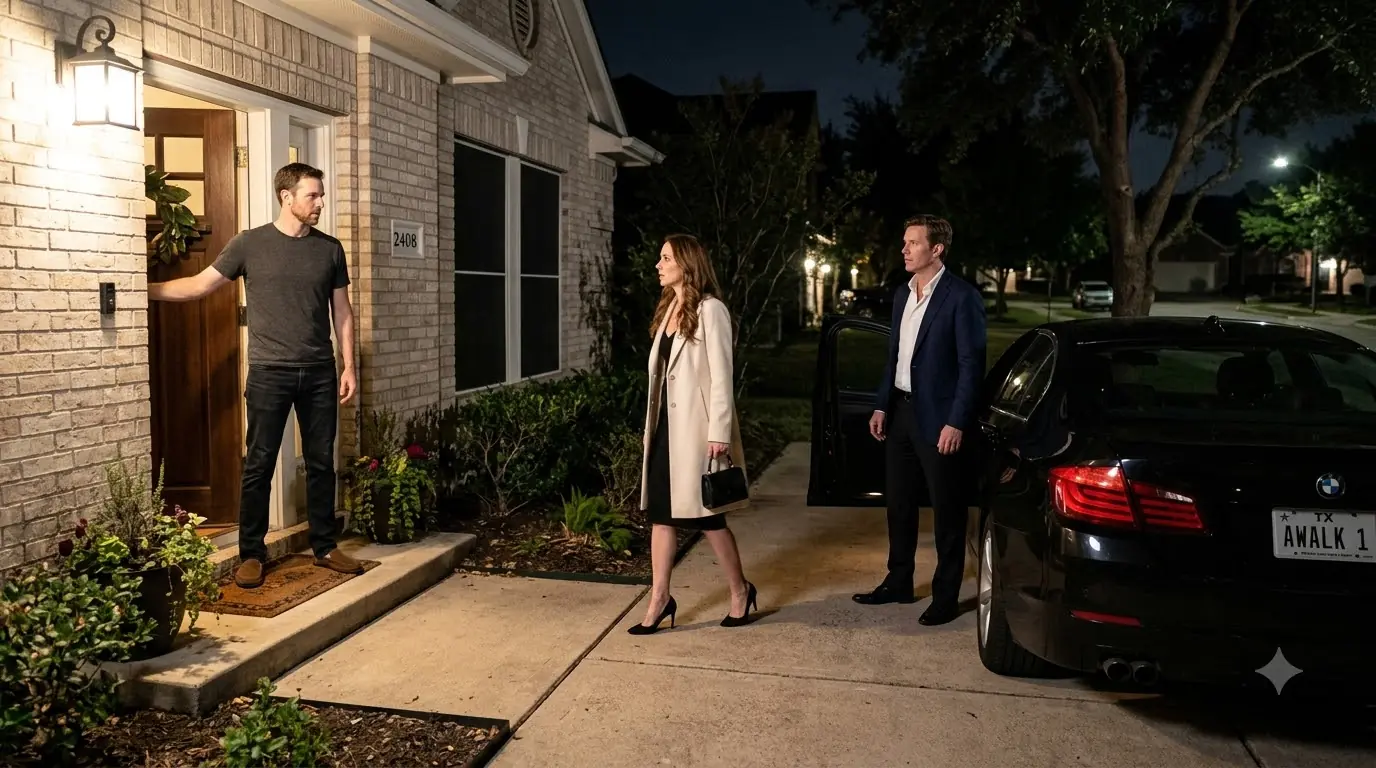
The television cast a pale blue glow across the living room, over the coffee table, over the folded blanket Emily used to keep on her lap, over the framed wedding photo on the mantel that suddenly looked like evidence from another man’s life.
My stomach had been twisting in knots for hours.
Emily had texted me at 9:14 p.m.
Don’t wait up. The meeting’s running late.
That was all.
No heart.
No sorry.
No I’ll call you when I’m leaving.
Just one sentence, clean and practical, like she was notifying a coworker about a delayed shipment.
Two years earlier, I would have believed her without a second thought. I would have texted back, Be safe, love you, and fallen asleep with my phone beside the bed. I trusted my wife then. Not because I was naive, but because trust had once been the easiest thing between us.
Now everything between us required effort.
Even believing her.
At 12:41, I saw her boss’s Instagram story.
I was not looking for it. That was what I told myself at first, though the truth was uglier. I had been scrolling because I was restless, because the house felt too quiet, because some part of me already knew there was a lie sitting somewhere in the night and I was waiting for it to show its face.
Mark Whitman posted the story from a rooftop bar downtown.
He was laughing with three people from the office, champagne glasses raised, the city skyline behind them, holiday lights blurred in the background. The caption read:
End-of-year grind never stops.
There were four people in the video.
Emily was not one of them.
Neither was any meeting table.
Neither was any conference room.
I watched the clip three times.
Mark’s tie was loosened. His cheeks were flushed from alcohol. A woman from accounting was holding a plate of appetizers. Someone shouted, “To closing the quarter!” and everyone cheered.
The video ended after seven seconds.
Seven seconds was enough.
I sat there in the dark with my phone in my hand and felt something inside me sink past anger into a colder place.
If Emily was in a meeting, why was her boss at a bar?
If the meeting was running late, who was running it?
And if she was not there with the group Mark had posted, where was she?
I did not call her.
I did not text.
I did not send a screenshot.
I just sat on the couch with the lights dimmed, waiting.
Not because I wanted to catch her.
That was the part people never understood about betrayal. They imagined confrontation as something dramatic and satisfying, like the wronged person wanted the truth to arrive in a bright explosion.
I did not.
I wanted to be wrong.
I wanted Emily to come through the door alone, tired and irritated, carrying a laptop bag and some boring explanation that made me feel foolish for doubting her. I wanted to apologize silently inside my own head and never tell her how close I had come to suspecting the worst.
But I also needed to know what kind of man I had become.
Because ignoring your instincts has a cost. It does not make you loyal. It makes you smaller. Every time you swallow a question to avoid an answer, something inside you learns to sit down and shut up.
I had been doing that for months.
Tonight, I could not do it anymore.
The headlights flashed across the window.
The tires slowed over the gravel.
Then the engine idled outside the house.
Not Emily’s car.
Her sedan had a tired little engine that coughed in cold weather. This car was different. Smooth. Expensive. Quiet in the way money could afford to be.
I stood slowly.
The late-night host on television kept laughing. The audience clapped. Someone shouted a punchline I did not hear.
I moved toward the front window and pulled the curtain back just enough to see.
Mark Whitman’s black BMW sat at the edge of our gravel driveway, glossy under the porch light. The passenger door opened.
Emily stepped out.
She was laughing.
That was the first thing that hit me.
Not the car.
Not the time.
Not even Mark.
The laugh.
It was light and breathless, the kind of laugh she used to give me when we were newly married and I would say something dumb while burning pancakes on Sunday morning. I had not heard that version of her laugh in our house for months.
Maybe longer.
Her hair was loose around her shoulders, even though she had left that morning with it pinned back. Her black coat was open over the green dress she had told me was “just something professional.” The dress was not inappropriate, not by itself. But at nearly two in the morning, stepping out of her boss’s BMW, it looked like part of a story she had not expected me to read.
Mark came around the front of the car.
He was tall, polished, forty-two, with the kind of face that had probably been called handsome so often he now treated admiration as a utility. He wore a navy overcoat and expensive shoes that had no business touching gravel.
He leaned closer and whispered something.
Emily giggled.
Then his hand slid onto her lower back.
Not accidental.
Not awkward.
Effortless.
Familiar.
The way only someone completely comfortable touching another person would touch them.
My pulse raced so hard I felt it in my throat.
For one second, my hand froze on the curtain.
I could have stayed there. I could have watched them say goodbye. I could have let her come inside and try to lie while I pretended not to know. That had become our rhythm lately. She edited reality. I accepted the edited version because the unedited one might destroy us.
But watching his hand on her back did something final to me.
I opened the door before she reached the porch.
The sudden sound made them both freeze.
Emily’s smile disappeared.
Mark straightened immediately, looking less like an executive and more like a teenager caught sneaking home after curfew.
Cold air rushed into the house around me. I leaned one shoulder against the door frame and folded my arms.
“Well,” I said calmly, “this must be the meeting you mentioned.”
Emily’s face drained of color.
“Ethan.”
Mark cleared his throat.
“Hey, man. I was just giving her a safe ride home.”
His voice cracked halfway through the sentence.
It would have been funny if my chest did not hurt so much.
“A safe ride home,” I repeated.
“Yes,” he said quickly. “She had too much to drink, and I thought—”
“You thought the safest thing to do with another man’s wife was drive her home alone at two in the morning and put your hand on her lower back in my driveway.”
The silence that followed was sharper than shouting.
Emily stared at me like she had never imagined this version of me existed. Maybe she had not. Maybe I had spent too many years being reasonable, patient, careful, forgiving. Maybe she had mistaken self-control for blindness.
Mark looked at Emily for help.
She lowered her head.
That told me more than either of them had said.
“You can go now, Mark,” I said.
He shifted his weight.
“I think maybe we should all calm down.”
I stepped onto the porch.
The cold hit my bare feet through my socks, but I barely felt it.
“Go.”
My voice remained low.
That made it worse.
Anger would have given him something to argue with. Calm left him nothing but the truth of what he was doing standing in my driveway.
He muttered something I did not bother to catch, nodded once like he still had dignity left to preserve, and hurried back to his car.
A moment later, the BMW reversed out of the driveway and rolled toward the street.
Emily stood at the bottom of the porch steps.
Rain from earlier still clung to the railings, frozen into thin shining lines. Her breath came out in shaky white clouds.
For years, I had thought my wife was beautiful in every version of herself.
Barefoot in my T-shirt.
Half-asleep at breakfast.
Dressed for work.
Crying during sad movies.
Angry with flour on her cheek because a recipe had failed.
But standing there at 2:00 a.m., smelling faintly of alcohol and expensive cologne that was not mine, she looked like someone I had loved once and did not recognize anymore.
She stepped inside slowly, almost as if she were walking into a courtroom.
I closed the door behind her.
The house seemed to shrink around us.
“It’s not what it looks like,” she whispered.
I laughed.
Not because anything was funny.
Because it was the oldest line in the book, and somehow I had expected her to be more original.
“Then tell me what it is,” I said.
She wiped under one eye, though no tears had fallen yet.
“We were celebrating the project closing. Everyone was there.”
“Were they?”
“Yes.”
“Were they all invisible when he drove you home?”
She flinched.
“Ethan, please.”
“No, I’m asking. Did the entire office pile into Mark’s BMW and disappear one block before our house? Or did they all vanish when he offered to drive you home?”
Her mouth opened.
Nothing came out.
The television kept murmuring in the living room, laughter from a world where nothing mattered. I walked over and turned it off. The sudden silence felt brutal.
Emily took off her coat with trembling hands and hung it by the door like this was any other night.
That simple, domestic action enraged me more than the lie.
As if she could hang up betrayal beside the scarves and pretend it belonged there.
“I saw his Instagram story,” I said.
She froze.
“The rooftop bar,” I continued. “The one he posted at 12:41. Strange-looking meeting.”
Her shoulders dropped.
For one second, I saw the calculation in her face. Not remorse. Not yet. Calculation. Which lie could still survive? Which version could be salvaged?
That hurt more than I expected.
Because some childish part of me had still hoped that if I confronted her, she would collapse into honesty. That she would say, I’m sorry, I lied, I don’t know what I’m doing, please help me stop.
Instead, she was trying to manage the damage.
“We did have a meeting earlier,” she said.