The crayon drawing is sitting in the middle of the kitchen table when I get home, and it takes me 4 seconds to understand what I'm looking at.
Ren drew three people at a restaurant. She labeled them in her careful second-grade printing.
Daddy. Mommy. Uncle Rowan.
The date in the corner, she always puts the date, her teacher requires it, is last Thursday.
Last Thursday I was at a compliance conference in Harrisburg. Last Thursday Sloan told me she was having dinner with her friend Camille from the firm. I set my keys on the counter. I pick up the drawing. I set it back down flat. I stand there for a moment looking at the crayon wax lines, the way Ren pressed hard on Rowan's figure.
He's the biggest one, arms wide, the way she always draws people she finds impressive. Sloan's figure is leaning toward him. My figure isn't in the picture. I look again. There's no fourth chair, no Daddy at this dinner, just three people, and Ren labeled one of them Daddy because she needed a third name and used the only one she had left.
Here's the thing. I'm a senior regulatory compliance officer for the Mid-Atlantic Regional Financial Authority. I build evidence chains for a living. I know which filings trigger federal review, which morals clauses hold up under scrutiny and arbitration, and exactly how a state-issued mortgage broker's license can be reviewed, suspended, or revoked. I have read more financial fraud cases than I have read novels.
My hands right now are completely still. That's the thing that should worry someone. I pull up Sloan's Instagram on my phone. Three weeks ago, she posted a photo at what the geotag called a girls' night, Renata's wine bar on Prospect. Good lighting, her best angle. I screenshot the post.
Then I go to Rowan Calder's account. He had tagged her in a photo before she deleted the tag. The metadata ghost is still there if you know where to look, and I know where to look. The geotag on his version. Harvest Table on Meridian. Not Renata's wine bar. Not anywhere near it. I screenshot the metadata.
My phone buzzes. Sloane. With a friend tonight, don't worry. I look at the text for a moment. I think about Rowan Calder. Six foot two, loud. The kind of man who fills a room by volume rather than presence.
I think about the velvet box I haven't seen yet, but somehow already know is coming. I think about Ren's drawing and the careful letters spelling out Uncle Rowan in yellow crayon. I type back four words. Yeah, I'm watching you. I mean it literally.
I call Bev next door. Bev Pruitt, my neighbor for six years. Who has a key and knows where the goldfish crackers are. And never asks questions she doesn't want answered. She picks up on the second ring and says she'll be over in ten minutes.
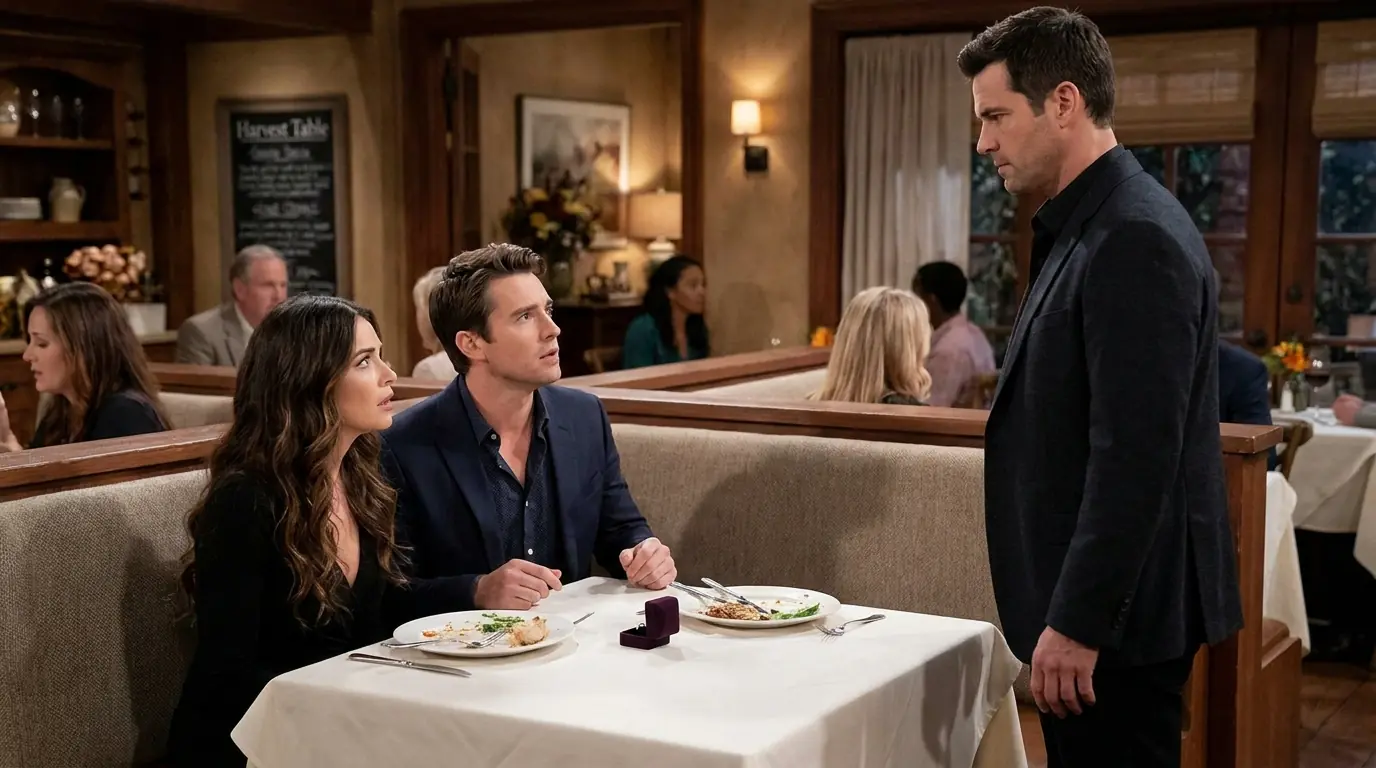
I make a reservation at Harvest Table for one. I change out of my work shirt. I drive downtown. The bar at Harvest Table has a direct sightline to the corner booth. I know this because I've been here before twice for client dinners. And I notice sightlines the way other men notice sports scores.
I order coffee. Ceramic handle, no saucer. The way the bar serves it. And I turn forty-five degrees on the stool and I watch. They're already there. Corner booth. Low Edison light. White tablecloth. Sloane has her hair down, which she only does when she's trying.
Rowan is in a blazer I've seen before at neighborhood cookouts, but he's wearing it differently tonight. Collar open like he has something to prove to the room. Sloane touches his hand across the bread basket. Two fingers light on his wrist. The same pressure she put on my wrist at our wedding when I was nervous and she leaned in and said, "You're fine, Deck. You're fine."
Sloan looks at it and then looks at him and I can see, even from here, even in this light, that she is not surprised by it. She knew it was coming. She's been waiting for it. I set a twenty on the bar. I walk out. Nobody in the restaurant knows anything happened. The hostess smiles at me on the way out. I smile back.
In the F-150 driving home, I run the numbers. Rowan Calder, licensed mortgage broker, co-founder of Calder and Weston. State-issued license renewable every two years. Subject to the professional conduct provisions of the state financial services code. I have read that code. I have read it the way other men read box scores.
Section 14, paragraph C: "Licensees are subject to review upon demonstrated conduct inconsistent with the professional and ethical standards of the financial services industry, including but not limited to conduct that reflects adversely on the licensee's fitness to operate in a position of public trust." Rowan holds a license. I audit institutions for sport. The math is not complicated.
I put Ren to bed. She asks if I'm okay, the way she always does, watching my face with those dark, careful eyes that miss nothing. I say, "I'm good, bug." She studies me for a moment. Seven years old, reading me like a text she's not sure she understands, and then goes back to the drawing she's working on at her desk.
I go to the kitchen table. I look at the restaurant drawing one more time. I smell the crayon wax on it, that particular sharp sweet smell, Ren's hand pressure visible in every line. I get my yellow legal pad, the one I use for compliance notes. I sit down. I write Rowan Calder's name at the top of the page and underline it twice.
Then I write the name of his employer. Then I write the words "morals clause" and put a question mark after them even though I already know the answer. I've read that contract. I read everything. That's always been my problem according to Sloane. I read too much and feel too little. She has no idea how wrong she is on both counts.
Clancy Pruitt's office is above a dry cleaner on Delmar and it smells like menthol cigarettes and old insurance files and the particular staleness of a room where someone has been working alone for twenty years. He's got yellow legal pads stacked on every surface. He snaps a rubber band against the top one when he's thinking, a sound like a small caliber shot.
Snap. "How much documentation you want?" he says. Enough that nobody asks a second question. He nods, snaps the rubber band again. "Two weeks. Don't touch any accounts." My attorney said the same thing. "Smart attorney." He writes something down. "Hotel records or phone records first?"
Both. "Simultaneously." He looks up at me over his reading glasses. He has the eyes of a man who has seen everything and been surprised by none of it. "You've been planning this a while." Since last night. He considers that. "Most guys come in here crying." I'm not most guys.
Snap. "No," he says. "I can see that." His sister Bev stops by twenty minutes later with a paper bag from the deli two doors down. She sets it on Clancy's desk, looks at me, and without any preamble at all says, "After my divorce, I tried everything. The apps, the setups, the fix-ups from people at church. You know what actually worked? This thing called Singletune."
You do this whole values assessment before you see a single photo. What you believe in, what you've been through, what you actually need from another person. I thought it was the most ridiculous thing I'd ever heard. She pauses. "It wasn't." I'm writing down hotel names from the list Clancy slid across the desk. I half listen.
But the word "values" lands somewhere and stays there. The way a burr catches on fabric. Not painful, just present. "I'll keep that in mind," I say. Bev pats my shoulder once and leaves.
Garrison Fox's office is glass and chrome on the fourteenth floor of the Meridian Financial Building, and he reads documents the way surgeons read X-rays. Not for what's there, but for what shouldn't be. He takes forty minutes with my preliminary notes. The yellow legal pad, the screenshots, the metadata. He doesn't say anything while he reads.
He sets down one page and picks up another. His coffee goes cold on the desk between us. When he finishes, he says, "You've already done my job." "Habit." He leans back. "Walk me through the assets." I do. He maps the exposure in twenty minutes. The house in both names, the joint accounts, Sloan's vehicle financed through a joint instrument.
And then, he actually pauses here, which I don't think he does often. He says, "Tell me about the refinancing on the Crestline property. Who brokered it?" "Rowan Calder." Garrison Fox smiles. It is not a warm smile. It is the smile of a man who has just found a twenty in a coat he forgot he owned.
He co-signed two of your refinanced instruments. Yes. That creates a conflict of interest in the marital estate that is... He searches for the word. Exquisite. He sets down his pen. Stop. Don't touch any accounts. Don't move out. Don't say a word to her. Not yet.
Why not yet? Because right now you're the injured party with clean hands. The moment you move money or move out, you're a participant. You want to be a creditor, not a participant. He picks up his pen again. Here's what we're going to do.
I walk out of that office forty minutes later and I am no longer a husband being left. I am a creditor with a plan and a very good attorney.
Clancy delivers on day fourteen. Forty-one photographs, hotel receipts across nine months, the Meridian Suites four times, the Harbor View twice, a place called the Lyndon Arms in Westfield that I've driven past a hundred times without ever registering, and one recorded phone call. I read the transcript once, Rowan's voice on the page. I've been in love with her since the wedding, since before the wedding.
I set it in a manila folder. I write "exhibit A" on the tab out of professional habit. It's just what I do with primary source documents. It means nothing and it means everything. I put it in my desk drawer next to my compliance files. It belongs there.
The knock on my door comes on a Wednesday morning, 9:15, and I open it expecting the mail carrier. Petra Calder is standing on my porch with a folder under her arm, and the particular expression of someone who has rehearsed this moment several times on the drive over, and is now executing it on sheer will.
She's about Sloan's height, dark hair pulled back, wearing a paint-stained cardigan over a white shirt that she didn't notice was paint-stained until she was already in the car. She's an art teacher. I know this because Rowan mentioned her exactly once at a neighborhood event two years ago. My wife teaches high school. She loves it. In the tone of a man describing a hobby his spouse has that he finds charming and slightly irrelevant.
"I think we have overlapping interests," she says. I look at her folder. I look at her face. She is holding herself together with the particular precision of someone who decided on the drive over that she would not fall apart in front of a stranger and she is succeeding but only just.
I step back from the door. "Come in." I get two coffees. I sit back down across from her at the kitchen table, the same table where Rowan's drawing sat, where I made my first list, where the crayon wax smell still faintly lives in the wood grain if I'm not imagining it. I say, "Walk me through what you have."
She does. She's been building her own file for six weeks. She has phone records. She pays the family plan bill and knows how to read it. She has a credit card statement with the Linden Arms on it. She has a photograph she took herself of Rowan's car in the Meridian Suites parking garage at 11:00 on a Tuesday night when he told her he was at a client dinner.
She built this file herself with no PI, no attorney, no professional framework. She just paid attention. She is precise and thorough and she does not embellish. When she finishes I say, "You're the second signature I needed." She looks at me. "For what?"
I open my desk drawer and set exhibit A on the table between us. She reads the transcript. She reads it twice. When she sets it down her hands are flat on the table and she is looking at the middle distance above my shoulder and I can see the exact moment the last version of her marriage dies. Not dramatically, not with tears, just a quiet internal door closing.
"He said you two were never close," she says finally. "We weren't." "He said you were jealous of him." I think about that for a moment. Rowan called her six foot two and loud, who brokered my mortgage, and ate my food at my cookouts, and put his hand on my wife's wrist across a bread basket.
I think about the velvet box. Petra, I say, "In six days, you're going to understand exactly what I think of Rowan." She refills her own coffee without asking where the pot is. She found it herself while I was getting the folder. I notice this. It means something, though I don't examine what yet.
She stays another hour. We go through both files together, cross-referencing dates. The Linden Arms appears in both. Her credit card record and Clancy's hotel receipts, same dates, same room number. When she leaves her folders under her arm, and her spine is straight, and she doesn't look back at the house.
That same evening, Sloan comes home at 9:40. I'm at the kitchen table with a book I haven't been reading for an hour. "You're still up," she says. Mm. She sets her bag on the counter. Her earrings are different from this morning. She changed them somewhere between here and wherever she was.
She opens the refrigerator, closes it without taking anything. "Is something wrong?" I look up from the page. "You tell me." She adjusts her left earring. Twice. Automatic. Left hand. "I don't know what that means." "Sure you do."
She turns from the refrigerator. Her voice has a careful quality, like someone navigating ice. "Declan, if you have something to say, say it." I go back to my page. Not tonight. "Why not tonight?" "Because tonight I'm reading."
She stares at me for a moment. I can feel it without looking up. Then she goes to the bedroom and closes the door. Not quite a slam, but close. And I listen to the silence after it, and write one more item on my list. She changes earrings between leaving and returning. Check Clancy's photos for timeline.
Clancy confirms it the next morning. Three of the forty-one photos show her at the Meridian Suites. In two of them, she's wearing the small gold hoops she left the house with. In the third, taken outside the hotel at departure, she's wearing the pearl drops she came home in.
Forty-five minutes of overlap, where she sat in a parking lot or a bathroom somewhere, and composed herself back into a wife. The detail is not legally significant, but it tells me something about the architecture of the lie. How much thought went into it. How long it's been running. How practiced she is.
Nine months of hotel receipts. Nine months of earring changes. I add it to exhibit A.
Sunday morning arrives gray and still. I'm at the mailbox at 8:15 in a t-shirt and jeans with a coffee. Going through the week's accumulation of HOA newsletters and credit card offers, when Rowan's Escalade turns into the cul-de-sac. He parks in my driveway. He gets out like he owns the asphalt.
Rowan Calder is six foot two and built like a man who played college ball twenty years ago and has been coasting on it since. He walks up the driveway with his hands loose at his sides and his jaw set and says, "We need to talk, brother." I don't step back. I don't step forward. I stand where I am with my coffee and I look at him.
"Clancy says hi," I say. His jaw tightens. His hand goes to his collar. A quick touch. Automatic. The way some men touch their collar when the ground shifts under them. "I know you've been asking questions. I know about the PI." "Then you know more than Sloan does."
"You want to do this?" His voice goes up. It fills the cul-de-sac, that voice. The particular volume of a man who has always won by being louder. "We can do this." "You're standing in my driveway making noise, Rowan. That's all that's happening here."
"Don't give me that quiet act." "It's not an act." He steps into my space. He's got four inches and forty pounds on me, and he is using all of it, leaning in close enough that I can smell his cologne and the coffee he had this morning.
His hand comes up and stops because I haven't moved. Not one inch. Six years. Force Recon, two deployments, one of which I don't talk about at neighborhood cookouts. And the thing you learn, the thing that lives in your body long after everything else fades, is that stillness is louder than any swing. It reads as I have already calculated this, and you don't want the answer.
Rowan's hand drops. I take a sip of my coffee. Across the street, Bev has found a reason to check her mailbox. Two doors down, the Henderson's curtain moves. The Nguyen kid stops his bike at the end of the driveway and watches with the frank attention of a twelve-year-old who knows something is happening without knowing what.
Rowan gets back in the Escalade. He pulls out too fast, and the tires chirp on the asphalt, and he's gone. I go back to my mail. I notice, absurdly, that the HOA newsletter has a full page about the spring mulching schedule, and that someone on the landscaping committee has very strong feelings about the color of the bark.
I think, at least somebody's problems are that small. One beat, internal, dry. Then I go inside.
Bev is at my door twenty minutes later with a plate of something she baked and the expression of a woman who has just witnessed something she needs to process. He came here, she says, not a question. He left. I saw. She sets the plate down on my kitchen counter.
Declan, I want you to know, whatever you need, Ren, the house, witnesses, whatever. I know, Bev. Thank you. She looks at me for a moment. You're not even... She stops. Never mind. Scared? I say. I was going to say angry. I know. She leaves.
I call Garrison Fox and tell him about the driveway visit. He says, "Good. Did anyone see it?" I say, "Three neighbors, minimum." He says, "Even better."
That afternoon with Petra sitting at my kitchen table and her coffee going cold the way mine always does when I'm working, I call Renata Voss. Renata is sixty-four years old and has spent eleven years building the social architecture of her daughter's life with the precision of a woman who knows exactly what things are worth.
She hosted Sunday dinners. She coordinated the neighborhood holiday party. She introduced Sloan to three of her four closest friends. She is not a woman you surprise lightly. I put the phone on speaker. I present the timeline, dates, hotels, the co-signed instruments, the conflict of interest that Garrison Fox called exquisite.
Renata doesn't interrupt. She asks two clarifying questions. Both precise, both the right questions. Then I play eleven seconds of the recording. "I've been in love with her since the wedding. Since before the wedding." Rowan's voice in Renata's kitchen, wherever she is, wherever she's standing right now holding her phone.
Silence. I count. Petra is watching me count. At eleven seconds Renata says, "I'll call her father. I thought you should hear it first. Don't do anything until Sunday dinner." I won't have to. I hang up.
Petra looks at me. "Her own mother," she says, not quite a question. "Her mother built something she's proud of. Sloan dismantled it." I close my notes. By Friday Sloan's entire family knows. By Saturday Sloan doesn't know they know.
Petra is quiet for a moment. "The walls fall inward," she says. "That's right. She won't feel it until she's already inside." That's right. Petra picks up her coffee, sets it down. That's either very elegant or very cruel. "Both," I say. "I know that."
She nods once, accepting it. She doesn't try to talk me out of the darkness in it, and I notice that, too.
Ren finds me in the kitchen Thursday night, the night before the confrontation. She's in her pajamas, holding a yellow crayon, padding on bare feet. She looks up at me with those careful eyes. "Is Uncle Rowan going away?" she says.
I crouch down to her level. The kitchen light is the same yellow as her crayon. "Yeah, bug. He is." She considers this. She nods, slow and certain, the way children accept things that adults spend years arguing about.
Then she goes to the table and sits down and draws. I stand there watching her hand move across the paper. The same hand pressure, the same deliberate lines, the same date in the corner. She hands it to me without comment.
Two people at a table, two plates, one window with sun coming through it. Daddy on one chair. The other chair has no label. I fold it carefully and put it in my shirt pocket.
Late that night, I sit alone at the kitchen table with my phone and a cold coffee, ceramic handle, no saucer. I'm not looking for anything in particular. I scroll past Bev's latest text. She'd forwarded a link to singletune.com with a note, "When you're ready, values first, not photos. Trust me on this one."
I read the description of the assessment. Questions about what you believe in, what you've been through, what you need from another person before you invest anything else. The idea that you could know whether someone shares your foundation before you ever see their face.
I think about eleven years of someone who never once asked me any of those questions, who introduced me at parties with the apologetic half smile, the this-is-my-husband-he-does-something-in-finance-that-meant-he's-not-interesting-enough-to-explain. Who looked at my stillness and called it coldness. Who looked at my precision and called it distance.
I don't sign up. I just sit with it. The concept settles in the same place the word "values" did in Clancy's office. Not urgent, not ready, but present. A door that isn't open yet, but isn't locked either.
I close the phone. I look at Ren's drawing still folded in my shirt pocket, the corner of it visible. One more day.
Saturday afternoon I'm heading to Garrison Fox's office to sign the final filing documents. I'm on the Meridian on-ramp when I check the rearview and see Sloan's Audi three cars back. She's not being subtle about it. She's riding close, changing lanes when I change lanes, her face through the glass tight and frightened.
She's sensed the architecture moving. She just can't see where the walls are. I take the Meridian exit at speed, cut through the Harvest Table parking lot, full circle. The same lot where I parked on Thursday night when I watched her touch Rowan's wrist across the bread basket.
And then into the one-way grid downtown, cutting through the parking structure on Calder Street, emerging on Fifth, and she's gone. I park. I walk into Fox's building. I sign the documents. When I come out forty minutes later, the street is clear.
I drive home at the speed limit. The radio is playing something I don't register. I'm thinking about the filing timestamp and the sequence of what happens next and how many hours remain before the living room fills up.
Saturday evening. I'm in the kitchen when Sloan comes in. She's been somewhere. I don't ask. I stopped asking three weeks ago. And she has the look of a woman who has been trying to reach people who aren't returning her calls. Her mother, her aunt, her friend Camille, who got a version of the story from Renata on Friday and has been quiet since.
Her voice is controlled for exactly two sentences. You've been talking to people. My mother won't return my calls. She sets her phone on the counter. What did you do? I set my coffee down. What did I do? Not a question.
Don't. Her voice shifts, the control cracking at the edges. Don't do that. Don't be calm right now. You don't get to be calm. She picks up her phone, sets it down again. My mother has been calling my father. My aunt called me this morning and hung up when I answered.
What did you tell them? The truth, Declan. I told them the truth, Sloan. I played them eleven seconds of audio and showed them forty-one hotel receipts and let them make their own decisions. I pick up my coffee. They made them.
She throws her phone. It skids across the counter and hits the backsplash and the screen cracks. A clean fracture line, top corner to bottom. She stares at it, then at me. You don't get to be calm, she says again.
But it's quieter now and the quieter it gets, the more it sounds like something else. Like fear. Come to the living room tomorrow at 6:00, I say. Bring whatever version of the story you've been planning. Or what?
Or I file Monday morning and you find out in a courthouse. She stares at me. I pick up my coffee and go to the garage. I spend Saturday night in the garage with the door up, sitting in a lawn chair, watching the cul-de-sac go dark house by house.
Bev's porch light stays on. She knows. I think about Ren's drawing in my shirt pocket and the crayon sun in the corner, the same yellow as the kitchen light. I think about Rowan saying he's loved her since the wedding. I was standing next to him at that altar. I handed him the ring.
I think about that for a while. Then I stop thinking about it because there is work left to do and sentiment is expensive.
Monday morning the Meridian Farmers Market is running its usual organized chaos. The produce tables, the coffee cart, the woman who sells honey in jars with hand-lettered labels, the general pleasant noise of a neighborhood feeling good about itself.
I'm moving through it with the sealed envelope for Hollis Weston under my arm when I see Rowan across the stalls. He sees me at the same moment. He starts moving. Fast, purposeful, cutting through the crowd with his shoulders, using his size. I don't run.
I turn and move through the market with the particular efficiency of a man who learned navigation in terrain considerably less forgiving than a farmers market. Cutting between the produce tables around the coffee cart where a woman is explaining the difference between two roast levels to a patient barista.
Through the narrow gap between the honey table and the bread stand. And out onto the far side onto Calder Street thirty seconds ahead of him. I walk into the Calder and Weston Mortgage Group lobby at 9:02 a.m.
The receptionist, young woman, name tag says Dara, looks up with the professional smile of someone who doesn't know what's in the envelope under my arm. "I'm here to see Hollis Weston," I say. "Tell him it's about a licensing matter." She picks up the phone.
I stand in the fluorescent hum of the lobby and I wait. The envelope is in my hand now. Clancy's photographs, the hotel receipts, the transcript of the recorded call, the two co-signed instruments that create the conflict of interest, the formal complaint documentation I prepared myself in the format required by the State Financial Services Board because I have filed forty-seven of them in my professional career and I know exactly what they need to look like.
Rowan comes through the lobby door behind me at 9:04. He stops when he sees me. He looks at the envelope. He looks at Dara on the phone. He looks at the door to Hollis Weston's office. He touches his collar. Declan. I'm just here for a meeting, Rowan.
Dara says, "Mr. Weston will see you now." I walk past Rowan without looking at him again. Hollis Weston is fifty-five, pragmatic, reputation conscious, in the way of men who built something real and know exactly how fast it can be taken apart.
He's behind his desk when I come in, and he reads the way Garrison Fox reads. Not for the surface, but for the architecture underneath. I set the envelope on his desk. I say, "I'm a senior regulatory compliance officer with the Mid-Atlantic Regional Financial Authority. I wanted to give you the courtesy of seeing this before it goes to the board because some of it involves instruments brokered through your firm."
He opens the envelope. He reads the first page. He sets it down. He picks up his phone and says, "Get me legal." I say, "I'll show myself out." In the lobby, Rowan is standing by Dara's desk. He looks at my face when I come out, and he reads something there that makes him go very still.
"What did you give him?" he says. "Forty-one hotel receipts," I say. "Fourteen months." I walk out through the glass doors into the Monday morning.
The living room at 6:00 Sunday evening. I've arranged it the way I arrange a compliance review. Every chair occupied by someone with a stake in the outcome. Garrison Fox is in the armchair by the window with his briefcase open. Petra Calder's on the couch, her folder on her knee.
Clancy's in the dining chair I brought in from the kitchen, rubber band around his legal pad. Menthol smell already settling into the room. Bev is at the edge of the couch, present and witnessing, which is what I need from her. Renata Voss came in from the side door at 5:45 without being asked because she is a woman who knows where she needs to be.
Ren is at her grandmother, Renata's sister's house for the evening. She drew me a picture before she left. The same two plates, the same window, the same crayon sun. She handed it to me at the door and said, "For your pocket." I folded it and put it in my shirt pocket and she nodded, satisfied, and went to the car.
Sloane comes downstairs at 6:03. She stops on the last stair when she sees the room. She takes in Garrison Fox. She takes in Petra. Something moves across her face. Recognition, calculation, the rapid reassessment of a woman who has just understood that the ground is further below her than she thought.
She looks at her mother. Renata does not look away. Sloane comes into the room and sits in the one remaining chair. The one I left for her. The one facing everyone else. She sets her hands in her lap. She is composed. She has always been good at composed.
"Okay," she says. "Let's talk." I say, "How was Thursday night?" "I was with Camille." "Camille called Renata on Friday," I say. "She was home Thursday night with her kids." Sloane's jaw tightens. Her hands stay in her lap.
"How was the Linden Arms?" I say. Silence. "Which visit?" I say. "There were four. I can be specific." She adjusts her earring. "Left hand." "Twice." Then she stops herself, aware of the gesture, and forces her hand back to her lap.
Garrison Fox opens his briefcase. "Mrs. Ashford, I represent your husband in the dissolution proceedings. I want to walk you through the financial picture before we discuss terms because some of it involves your co-respondent's professional situation, and I think the timeline matters."
He sets a document on the coffee table. "Mr. Calder co-signed two refinancing instruments on this property. That creates a conflict of interest in the marital estate that will require disclosure to the state financial services board as part of the dissolution filing. We filed that disclosure this morning."
Sloane looks at the document. She looks at me. "You filed this morning." I say, "While you were sleeping." "Declan, I'm not a serious person." I say, "That's what you told Camille. I heard you. You were on the phone in the garage and I was in the driveway and you said, 'He's just not a serious person, Cam. He never has been.'"
I thought about that for a while. I look at her. "I want you to know I'm not angry about it." She stares at me. "I want you to know I'm not angry about any of it," I say. "I'm a compliance officer. I build evidence chains for a living. I read everything. I notice everything."
And for nine months I didn't notice this. Which means you were careful. Which means you're smarter than I gave you credit for. Which means we're even on the underestimation. I pick up my coffee. Cold ceramic handle, no saucer. The same cup I've been carrying through this entire thing.
"Garrison has the terms. They're fair. They account for the co-signed instruments and the conflict of interest. Which means Rowan's firm is going to have a complicated few weeks and I'm sorry about that for Hollis Weston's sake because he seems like a decent man who didn't know what his partner was doing."
Sloane's voice, when it comes, is very quiet. "I didn't mean for it." "I know," I say. "That's the thing about these situations. Nobody means for it. It just accumulates." I set the coffee down.
"Rowan said he's loved you since before the wedding. I was standing next to him at that altar. I handed him the ring. I've thought about that a fair amount over the last two weeks and here's what I've come to. That's his problem, not mine. What's mine is the nine months. What's mine is the earring changes. What's mine is Ren drawing three people at a restaurant and putting my name on a chair I wasn't sitting in."
The room is very quiet. Renata is looking at her hands. Petra is looking at the middle distance. Clancy snaps his rubber band once, very softly, and then doesn't again. Sloan says, "What do you want?"
Garrison has the terms. I say again, "They're fair. Read them tonight. Sign them by Friday. If you don't sign them by Friday, we file Monday, and the co-signed instrument conflict goes into the public record, and Rowan's license review becomes a public proceeding."
I stand up. "I want Ren on a schedule that works for her, not for us. I want the house sold and split at assessed value. I want the joint accounts settled through Garrison's office. Everything else, I'll leave for the attorneys." I button my jacket. "I'm going to get Ren from your aunt's house now."
Sloan says, "Deck." I stop. I don't turn around. "I'm sorry," she says. The thing is, and this is the part I'll think about later, in the truck, alone, I believe her. Not the way I once would have needed to believe her. Not the way that would have changed anything. Just the way you believe a weather report, accurate, useful, and not something you can argue with.
"I know," I say. I pick up my keys from the hook by the door. The hook I installed myself six years ago, a Sunday afternoon project that took four times longer than it should have, because Ren kept handing me the wrong size screwdriver and then laughing about it. The hook is solid. It'll outlast the house.
I walk out through the front door. Sloan is standing in the doorway when I reach the F-150. She's come out after me. I don't know if she planned to, or if it just happened. And she's standing there in the porch light with her arms crossed. And she looks, for the first time in a long time, like someone who is exactly where the consequences of her choices have put her.
I get in the truck. I start it. I back out of the driveway. In the rearview mirror, she gets smaller, and then the cul-de-sac turns and she's gone. I drive to my aunt-in-law's house on the other side of town.
Ren is waiting on the porch steps with her backpack and a drawing she made during the evening. She always makes a drawing. Every time she's somewhere new, she documents it. She sees the truck and stands up and waves, both arms, the way she's waved since she was three.
I park. I get out. She runs down the steps and I catch her, and she smells like crayon wax and the particular shampoo she's used since she was four. And she says, muffled against my jacket, "Did you do the thing?" "Yeah, bug." "The important thing?" "Yeah."
She pulls back and looks at my face with those careful dark eyes. She studies me the way she studies everything, thoroughly, without rushing, making her own conclusions. Then she nods, satisfied. "Okay," she says. "Can we get pancakes?"
It's 7:00 at night. "Breakfast for dinner," she says, "and that's a thing." "That is a thing," I say. We get in the truck. I pull away from the curb.
Ren gets her drawing out of her backpack and holds it up so I can see it at a red light. Two people at a diner counter, two plates of pancakes, a window with a moon in it instead of a sun. She's added a detail to the chair beside mine. A small figure with paint on her cardigan.
I look at it for a moment. "Who's that?" I say. Ren considers. "Someone who draws," she says, "like me." The light changes. I drive.
Three weeks later, Petra calls. Not texted, called, which is how I know it's not logistics. She says she's been doing the Singletune assessment. Bev forwarded it to her, too. Apparently Bev has been forwarding it to everyone she knows.
And she says, "There's a question on it about what you need from another person before you invest anything else." She pauses. "I didn't know how to answer it for a long time." "What did you put?" I say.
"That I need someone who reads everything," she says. "And feels it anyway." I'm in the F-150, parked outside the pancake place where Ren and I went three weeks ago. Where the waitress remembered Ren's order and brought her chocolate milk without being asked.
The engine is off. The street is quiet. There's a crayon drawing on the passenger seat. Ren left it this morning. The two plates, the window, the figure with paint on her cardigan. And a new detail I didn't notice until now. The figure has a name written under it in careful second-grade printing. Petra.
"I read everything," I say. "I know," she says. "And I feel it." "I know that, too," she says. "That's why I'm calling."