My wife’s friend whispered, “Just tell him you want a divorce. He’ll beg.”
She did not know I heard it.
Or maybe she did.
Maybe that was part of the pleasure.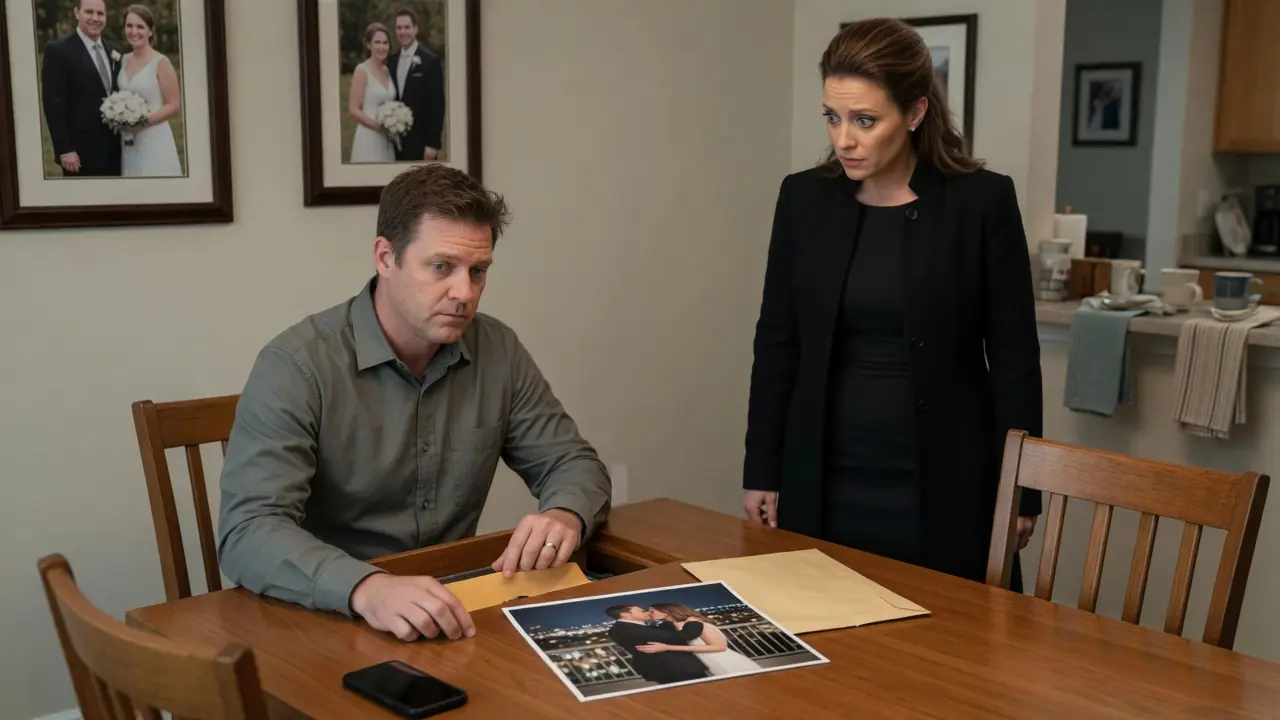
Maybe she wanted the words to reach me just enough to make my humiliation sweeter when it finally happened.
It happened at the Halloween party inside the Hawthorne Grand Hotel in Salem, Massachusetts, a place that knew how to make history feel expensive. Fake cobwebs hung from the chandeliers. Orange lights washed over the ballroom. Black paper bats dangled from invisible thread above tables covered in dark velvet cloth. Near the hotel lobby, beside the concierge desk, a small American flag stood in a brass holder, oddly solemn beneath all the manufactured mystery.
Outside, Essex Street was crowded with tourists in costumes, laughing witches, college students in vampire capes, families with children carrying plastic pumpkins, and couples taking photos beneath the cold October sky.
Inside, my marriage was about to become a stage.
My name is Caleb Rhodes.
At the time, I was forty years old and had been married to my wife, Maren, for seven years.
Seven years is long enough to build routines that feel permanent. It is long enough to know the sound of someone’s car pulling into the driveway without looking. Long enough to understand how they take coffee, which side of the bed they prefer, how they breathe when asleep, how their voice changes when they are lying, though you may spend months convincing yourself not to hear it.
Maren had insisted we attend the party because her friends were going.
More specifically, because Talia Mercer was going.
Maren said I had become “too serious” lately. She said I never wanted to do anything fun anymore. She said couples needed novelty, and music, and costumes, and friends, and maybe if I stopped acting like every social event was a tax audit, we might actually enjoy ourselves.
That was how she talked by then.
Everything was framed as my deficiency.
If I was tired, I was boring.
If I was quiet, I was judgmental.
If I asked a question, I was insecure.
If I did not ask, I was emotionally absent.
There was no correct shape for me anymore.
She wore a silver mask and a dark green dress that caught every bit of light in the room. The dress hugged her body in a way that made strangers look twice and made me remember how easily I once felt proud to stand beside her. Her hair fell over one shoulder in loose waves. She wore the emerald earrings I had bought her for our fifth anniversary, the ones she had said made her feel like old Hollywood.
Before we left the house, I told her she looked beautiful.
She glanced at me in the bedroom mirror while fastening one earring.
“Thank you,” she said.
But there was no warmth in it.
It was the kind of thank you you give to a parking attendant who hands back your keys.
Then her eyes moved over my plain black suit.
“You look like an accountant at a funeral.”
I gave a small laugh.
I should not have.
That was what I did too often.
I laughed off small cuts until they became proof that I could bleed quietly.
“I thought black was acceptable for Halloween,” I said.
“It is if you add a personality.”
She smiled at her reflection.
Not at me.
There was a time when that kind of comment would have been followed by her stepping close, straightening my tie, kissing my cheek, and saying, “You know I’m teasing.”
But she did not do that anymore.
Lately, she left the wound open and walked away.
Maren had not always been cruel.
That is the thing people forget when they hear about betrayal. They want the villain to have been obvious from the start. They want you to say, “I should have known. She was always selfish. She was always cold.”
But that would be a lie.
When I married Maren, she was bright, funny, impulsive, and warm in a way that made ordinary days feel lit from the inside. She danced barefoot in the kitchen when old songs came on. She left notes in my lunch bag when I had long workdays. She cried during commercials with dogs in them and pretended she had allergies. She once drove forty minutes in the rain because I mentioned I wanted the clam chowder from a tiny restaurant near Gloucester and had been too tired to go myself.
I loved her quickly.
Maybe too quickly.
I was thirty-three when we married, steady and careful, the kind of man who saved receipts, paid bills early, compared insurance plans, and believed love was built more through reliability than drama. Maren said that was what made her feel safe. She told me she had dated charming men before me, men who promised the moon and forgot the rent, men who called passion an excuse to behave badly.
“You’re the first man who makes me feel like the floor will still be there in the morning,” she once told me.
I remembered that sentence for years.
I built my life around being that floor.
For a while, she seemed grateful.
Then safe became boring.
Reliable became predictable.
Patient became weak.
At least, that was how Talia explained me to her.
Talia Mercer entered our life through Maren’s work at a luxury event planning company in Boston. She was glamorous, divorced, loud, and proud of never apologizing. She wore red lipstick like armor and treated every room as if it existed to confirm her superiority.
At first, Maren called her “a lot.”
Then she called her “free.”
Then she started saying Talia had “helped her realize things.”
Those things were never good for me.
Talia had a philosophy about marriage, though philosophy is too generous a word for it. She treated marriage like a contest where the wife won by making the husband feel replaceable. She joked that husbands were useful for mortgages, airport pickups, killing spiders, and standing in the background of Christmas cards.
She once said, in front of six people at our house during a cookout, “A man should never be too comfortable. That’s when he starts thinking he owns you.”
I answered calmly, “Respect is not ownership.”
Talia smiled as if I had performed exactly as expected.
Maren rolled her eyes.
Later that night, while we were cleaning up, I said, “She talks about men like they’re appliances.”
Maren stacked plates too loudly.
“She’s joking.”
“She is not joking.”
“You take everything too seriously.”
That was one of the first times I felt the ground shift.
Not because Talia insulted me.
People insult each other all the time in small social ways.
The problem was that Maren no longer stood beside me when it happened.
She stood near Talia and called it humor.
From there, the small cuts multiplied.
Maren began criticizing my clothes, my car, my job, my habits. I worked as a financial analyst for a medical supply company, and she started calling it “spreadsheet prison.” She said I had no edge. No mystery. No hunger. No spark.
I reminded her once that my steady job had paid for our house in Danvers, her student loans, the Italy vacation she still posted about every anniversary, and the emergency money that kept us afloat when her company delayed bonuses one year.
She said that was exactly my problem.
I kept score like a small man.
I did not understand then that some people will happily benefit from your sacrifices while resenting you for remembering them.
The Halloween party was supposed to be harmless.
That was how Maren sold it to me.
“One night,” she said. “Costumes, drinks, music. Please don’t act like I’m dragging you to a funeral.”
“I thought I already dressed for one,” I said, gesturing to my suit.
She did not laugh.
In the car, she barely spoke. She scrolled through her phone, smiling at messages she did not show me. Every time the screen lit up, she angled it slightly away from me, the way people do when they think secrecy is subtle because no one has challenged it yet.
I noticed.
I noticed everything by then.
The changed passcode.
The late work dinners.
The new perfume.
The sudden interest in boutique hotels for “client events.”
The gym sessions that ended with her coming home showered, hair dry, makeup touched up.
The habit of taking calls in the garage.
The way she began saying “my friends” instead of “our friends.”
The way she no longer asked if I wanted anything when she made coffee.
But every time I asked, she turned the question around.
“You’re insecure.”
“You’re controlling.”
“You’re acting like my father.”
“You don’t trust me because you know you’re not exciting.”
That last one stayed with me.
A woman who knows where your fear lives can build a house there if you let her.
So I stopped asking.
Not because I stopped noticing.
Because I was tired of being punished for wanting the truth.
At the Hawthorne Grand, the ballroom glowed with artificial mystery. Women in glittering masks drifted between tables. Men in capes, uniforms, fake fangs, and expensive watches laughed too loudly near the bar. A jazz band played strange covers of pop songs beneath a ceiling full of plastic bats hanging from invisible wire.
Maren became someone else the moment we entered.
Her posture changed.
Her voice lifted.
Her hand slipped from mine.
She introduced me to people as “my husband, Caleb,” in the same tone someone might use to mention a coat they planned to check at the door.
Talia swept toward us in a red dress and a black feathered mask.
“There she is,” Talia said, pulling Maren into an embrace. “The woman who finally left the house.”
Then she looked at me.
“And Caleb. How brave of you to attend something with music.”
Maren laughed.
I smiled politely.
That was the role I had accepted for too long.
Polite husband.
Quiet husband.
Useful husband.
Talia’s eyes moved over my suit.
“Very minimalist.”
“He refused to wear a costume,” Maren said.
“I’m wearing one,” I replied.
Maren looked at me.
“What?”
“A man enjoying himself.”
For one second, she seemed surprised.
Then Talia laughed, but not kindly.
“Careful, Maren. He may develop a personality by midnight.”
A few people nearby laughed.
Maren did too.
I took a sip of water and said nothing.
That silence was not weakness, though they mistook it for that.
It was observation.
The party continued.
Maren drank champagne. Talia whispered in her ear. Men I did not know complimented Maren’s dress, and she accepted each compliment with a brightness she had not shown me in months. I stood beside her for as long as I could, then gave her space because I refused to hover like the insecure husband she would later accuse me of being.
I watched her from ten feet away.
That was close enough to see the performance.
Far enough to hear the truth when Talia leaned toward her near the balcony doors.
The music covered most of their voices.
Not all of them.
“Just tell him you want a divorce,” Talia whispered. “He’ll beg.”
Maren smiled.
Not nervously.
Not sadly.
Not like a woman shocked by the cruelty of the suggestion.
She smiled like she had been waiting for permission.
I stood there with a glass of water in my hand, feeling my marriage tilt.
Not break.
Not yet.
Tilt.
It is strange what the mind does in moments like that. Part of me wanted to walk over, ask her directly, make her deny it. Another part of me wanted to leave the hotel without a word and let her find her own way home. A smaller, older part of me wanted to do exactly what Talia predicted.
Beg before the threat was even spoken.
Instead, I stood still.
That was when I understood something.
For months, Maren had been rehearsing contempt.
The eye rolls.
The jokes.
The comparisons.
The refusal to answer direct questions.
The way she treated my patience as if it were proof I lacked pride.
Talia had not created something from nothing.
She had only given Maren permission to name what was already growing.
Later that night, Maren disappeared.
Talia told me she had gone to the restroom.
Twenty minutes passed.
Then thirty.
The party kept moving around me. Someone dressed as a vampire spilled red wine near the bar. A man in a sheriff costume posed under the American flag in the lobby. Laughter rose from the ballroom as if nobody’s life was quietly falling apart.
I walked toward the hallway.
I did not know what I expected to find.
Maybe nothing.
Maybe Maren on her phone.
Maybe Talia giving her another speech about freedom.
Then I saw the balcony door cracked open.
I did not step outside at first.
I only looked.
Maren was there.
Her silver mask was pushed up into her hair. Her green dress shimmered under the orange light spilling from the ballroom. She stood near the stone railing with a man I had seen earlier by the bar, tall, dark-haired, wearing a black coat and no costume except confidence.
His name, I later learned, was Julian Cross.
In that moment, he was just a stranger standing too close to my wife.
Maren laughed at something he said, head tilted back, one hand resting against his chest. He touched her waist. She did not move away.
Then he leaned down.
She lifted her face.
They kissed.
Not briefly.
Not accidentally.
Not in the confused way drunk people sometimes stumble into terrible choices and immediately regret them.
They kissed like people continuing something that had started long before that balcony.
Cold air entered my lungs and stayed there.
For a second, I could not move.
I remember the details too clearly.
The orange lights glowing through the glass doors behind me.
The faint smell of smoke from someone’s cigarette outside.
The sound of a woman laughing in the ballroom.
The wet shine of the balcony railing from the evening mist.
The way Maren’s hand curled lightly in Julian’s shirt.
A person can live twenty years inside one second.
I took out my phone.
My hand was steady.
That surprised me.
I expected shaking. Rage. A shout tearing out of me. But something quiet and hard settled over me.
Maybe it was shock.
Maybe it was self-respect arriving late but fully dressed.
I took one clear photo.
Maren’s hand on Julian’s chest.
His hand at her waist.
Her mouth on his.
Truth, framed by orange light.
Then I stepped back before either of them saw me.
I did not confront them at the party.
A public scene would have given Maren a way to escape into performance. She could cry, deny, blame the champagne, accuse me of stalking her, accuse me of humiliating her in front of friends. Talia would rush in with outrage. Julian would vanish into the crowd. Everyone would remember my anger more than her betrayal.
So I did nothing.
I returned to the ballroom.
Talia saw me first.
Her eyes searched my face, perhaps wondering if I knew.
When she saw my expression calm, she smiled.
That was her mistake.
She thought calm meant ignorance.
Maren came back fifteen minutes later.
Her lipstick had been freshly touched. Her silver mask was back in place. Her cheeks were flushed from cold or excitement. She walked to me with the bright, careless energy of someone who had just gotten away with something.
“Ready to go soon?” she asked.
I looked at her.
“Whenever you are.”
She seemed almost disappointed.
Maybe she wanted a fight.
Maybe she wanted me to ask where she had been so she could practice the divorce speech Talia had suggested.
But I gave her nothing.
On the drive home, she played music from her phone. She hummed softly, looking out the window at Halloween crowds moving through Salem. Costumed witches crossed beneath streetlights. Tourists posed in front of old brick buildings. A little boy in a skeleton costume ran ahead of his father, laughing.
Maren looked beautiful in the passenger seat.
For a moment, that hurt worse than the kiss.
Beauty can become cruel when it belongs to someone who no longer cares what it does to you.
When we got home, she kicked off her heels by the door.
“You were quiet tonight,” she said.
“I was tired.”
“You’re always tired.”
“I work.”
She rolled her eyes.
“There it is. The martyr speech.”
“I did not make a speech.”
“You don’t have to. You have a whole personality built around silent judgment.”
I hung my coat in the closet.
She stood near the staircase, waiting.
I realized then that Talia’s suggestion had already begun to move through her. Maren wanted the moment. She wanted to say divorce and watch me collapse. She wanted proof that she still had power.
But perhaps the party had not been enough.
Maybe she wanted to sleep on it, talk to Talia at brunch, sharpen the blade, and make the performance cleaner.
So I said goodnight and went to the guest room.
She noticed.
“You’re not coming to bed?”
“No.”
Her eyes narrowed.
“Seriously?”
“I’m tired, Maren.”
She laughed under her breath.
“Of course you are.”
I closed the door before she could continue.
That night, I did not sleep.
I lay in the guest room staring at the ceiling while the photo on my phone seemed to burn through the nightstand drawer. Around three in the morning, I got up, opened my laptop, and began doing the thing I did best.
I organized.
Not emotionally.
Practically.
I created a folder.
Halloween Party.
Inside it, I saved the photo. Then I downloaded copies to two secure places. I wrote down the time, the location, the context, the names I knew, and the events leading up to it.
I searched Julian Cross and found him within minutes.
Brand consultant.
Divorced.
Connected to Talia through mutual friends.
Connected to Maren’s company through multiple events.
There were photos of him from past work gatherings. In two of them, Maren appeared in the background. In one, she stood beside him at a rooftop event six weeks earlier, laughing at something he had said.
I remembered that night.
She had told me the event was women only.
By dawn, my grief had become a plan.
At 8:15, I called an attorney.
Her name was Denise Hartwell, recommended years earlier by a coworker who had gone through a brutal divorce. I had saved her number in my phone after Maren once screamed during an argument that maybe we should split if I was so unhappy.
Back then, saving the number felt shameful.
That morning, it felt wise.
Denise’s assistant scheduled an urgent consultation. At 9:03, Denise called me herself after reading my intake message.
“Mr. Rhodes,” she said, her voice calm and dry, “first, do not make threats. Second, do not leave the marital home permanently without guidance. Third, do not empty accounts, change locks, cancel insurance, or send emotional messages. Fourth, preserve all evidence. Fifth, communicate calmly. If she says she wants a divorce, let her speak.”
“I have a photo,” I said.
“Keep it safe.”
“I plan to.”
“Does she know you have it?”
“No.”
“Good.”
That one word was strangely comforting.
Denise paused.
“And Mr. Rhodes?”
“Yes?”
“Do not beg.”
I almost laughed.
“I wasn’t planning to.”
By noon, Maren had gone to brunch with Talia.
Of course she had.
She left wearing sunglasses, a black coat, and the kind of confidence that comes from having a friend spend the morning convincing you that cruelty is empowerment.
Before she left, she paused near the front door.
“We should talk when I get back.”
I sat at the kitchen table with coffee.
“All right.”
She seemed irritated by how easily I agreed.
“About us.”
“I understood.”
Her eyes searched my face.
Then she left.
I watched her car pull out of the driveway.
Then I printed the photo.
Not on regular paper.
On glossy photo paper from the home office printer we rarely used. I wanted clarity. I wanted no room for denial. When the page emerged, I stood there looking at it for a long time.
Maren and Julian.
Balcony.
Kiss.
Truth, frozen and undeniable.
I placed it inside a plain manila envelope and set it in the drawer beside the dining table.
Then I cleaned the kitchen.
It was absurd, maybe.
But betrayal creates strange rituals. Some men smash glasses. Some men scream. I wiped counters, loaded the dishwasher, folded dish towels, and took out the trash.
Maybe I wanted the house clean before the marriage got dirty out loud.
Maren came home at 4:42 in the afternoon.
She was energized.
I could see it the moment she entered.
Talia had done her work.
Maren walked into the dining room with her coat still on, purse over one shoulder, lips set in a rehearsed line. She looked almost excited, like an actress stepping into her best scene.
“We need to talk,” she said.
I sat at the table.
“All right.”
She removed her coat slowly and placed it over the back of a chair.
“I’ve been thinking a lot.”
“I’m sure.”
Her eyes narrowed slightly, but she continued.
“This marriage isn’t working.”
I said nothing.
“You and I want different things.”
Still nothing.
“I feel trapped, Caleb.”
I watched her face.
She had chosen that word carefully.
Trapped made her sound like a victim.
Trapped suggested I was a cage.
Trapped turned the house we bought, the bills we paid, the life we built, and the patience I gave into something oppressive.
“How long have you felt that way?” I asked.
She seemed pleased I had asked a question.
“A long time.”
“How long?”
“I don’t know. Months. Maybe longer.”
“Before or after Julian?”
The name hit her like a slap.
Her mouth opened, then closed.
“Who?”
I almost admired the instinct.
Even cornered, she reached for denial first.
“Julian Cross.”
Her face shifted too quickly.
Recognition.
Fear.
Then offense.
“I don’t know what Talia told you, but—”
“Talia did not tell me anything useful.”
Maren’s voice sharpened.
“Why are you bringing his name into this?”
“Because I am trying to understand the timeline of your unhappiness.”
She folded her arms.
“My unhappiness is not about another man. That is exactly the problem with you. You reduce everything to suspicion because you can’t handle that maybe I’m just done.”
There it was.
The speech.
Strong.
Prepared.
Talia’s fingerprints all over it.
Maren took a breath and delivered the line.
“I want a divorce.”
Then she looked at me.
Waiting.
For panic.
For pleading.
For pain.
For collapse.
For the humiliation she had been promised.
I leaned back in my chair.
“Okay.”
Her expression flickered.
“What?”
“Okay.”
“That’s all you have to say?”
“What would you like me to say?”
She stared at me.
“I thought you’d care.”
“I do.”
“You’re acting like you don’t.”
“I am acting like a man who heard you.”
Her confidence faltered.
This was not the scene she had rehearsed.
“You’re not going to fight for us?”
I opened the drawer and took out the manila envelope.
“Should I beg before or after I show you what happened out on the balcony?”
Her smile disappeared.
Completely.
For the first time in months, maybe years, Maren had no expression ready.
I slid the envelope across the table.
She did not open it at first.
She only stared.
“Open it,” I said.
Her fingers trembled as she lifted the flap.
She pulled out the glossy photo.
The color drained from her face.
In the photograph, she and Julian were locked in a kiss beneath the orange light of the Hawthorne Grand balcony.
There was no angle generous enough to save her.
No explanation clean enough to cover it.
No Talia nearby to rewrite the moment.
Maren sat down slowly.
“Caleb.”
I folded my hands.
“Should I beg now?”
Her eyes filled with tears.
“Please don’t do that.”
“Do what?”
“Be cruel.”
That word was remarkable.
Cruel.
Not the kiss.
Not the lies.
Not the plan to make me beg.
My refusal to play my role was cruel.
I looked at the photo.
“Cruel would be me pretending I do not know what I know so you can leave with a cleaner story.”
She covered her mouth.
“It was a mistake.”
“No.”
“Caleb.”
“No,” I said again, calm enough that she flinched. “A mistake is forgetting to lock the back door. A mistake is buying the wrong coffee. A mistake is taking Route 1 when traffic is bad. That was not a mistake. That was a choice made after months of other choices.”
She shook her head.
“You don’t understand.”
“I understand more than you hoped.”
Her eyes lifted.
“What does that mean?”
“It means I know Talia told you I’d beg.”
Maren went still.
“I know you smiled when she said it. I know you disappeared afterward. I know you came home and waited until today to deliver the line because you wanted the timing right.”
“That’s not fair.”
I laughed once.
Not loudly.
Not happily.
“Fair?”
She looked away.
“I was confused.”
“Were you confused when you kissed him?”
She said nothing.
“Were you confused when you told me that rooftop event six weeks ago was women only?”
Her eyes snapped back to mine.
“Yes. I found that too.”
“It wasn’t like that then.”
“I don’t believe you.”
She swallowed.
I continued.
“And that is what you never understood. Once you destroy trust, the truth becomes harder to recognize even when it accidentally appears.”
She touched the edge of the photo with trembling fingers.
“Caleb, I was unhappy.”
“So was I.”
The answer startled her.
I leaned forward.
“You think you were the only lonely person in this marriage? You think I enjoyed being mocked by your friends? You think I did not notice you smiling at everyone but me? You think I liked becoming the reliable background to your exciting life?”
Her tears spilled now.
“I tried to talk to you.”
“No. You criticized me. There is a difference.”
“I needed more.”
“You wanted more attention, more thrill, more admiration, more permission to pretend the life we built was beneath you. You did not want more marriage. You wanted applause.”
She flinched.
Some truths need to land.
She whispered, “I never meant to hurt you like this.”
“That is because you never believed I would stop letting you.”
For a moment, the house became very quiet.
This was the part I had feared most, not because I wanted to forgive her, but because I remembered loving her.
The woman across from me was not a stranger.
She was the woman who once danced barefoot in our kitchen. The woman who cried when my father died. The woman who stayed up all night helping me prepare for the job interview that changed our life.
But she was also the woman in the photo.
People are rarely only one thing.
That is what makes leaving them hurt.
Maren wiped her face.
“Are you going to use this against me?”
“Yes.”
Her eyes widened.
“At least I’m honest.”
“You mean in court?”
“If necessary.”
Her voice rose.
“Caleb, please. My career could be affected if this gets ugly. Talia’s company works with Julian. This could become humiliating.”
I stared at her.
“You planned to make me beg at my own dining table, and now you are worried about humiliation?”
She looked ashamed then.
Finally.
Not enough.
But finally.
“I was angry,” she whispered.
“At what?”
“At feeling invisible.”
I sat back.
“Maren, you were never invisible. You just stopped noticing the person who saw you every day.”
She broke then.
Not elegantly.
She put both hands over her face and sobbed.
I did not move to comfort her.
That may sound cold. Maybe it was.
But for years, every time Maren cried, my body reacted before my mind. I moved toward her. I apologized even when I was not wrong. I softened facts so she could feel safe. I made myself responsible for her emotions because I thought that was love.
That day, I stayed seated.
Her pain was real.
It was also no longer mine to manage.
After several minutes, she lowered her hands.
“What happens now?”
“I already called an attorney.”
She stared at me.
“When?”
“This morning.”
“You knew I was going to say it?”
“I knew Talia told you to.”
“And you just waited?”
“Yes.”
Her mouth trembled.
“That feels manipulative.”
“No,” I said. “That feels unfamiliar because I stopped reacting on your schedule.”
She had no answer.
I placed another sheet of paper on the table.
It was a list.
Bank accounts.
Mortgage documents.
Retirement accounts.
Car titles.
Insurance.
Shared subscriptions.
Passwords to change.
Practical things.
The skeleton of a marriage after love leaves the room.
Maren looked at it like it offended her more than the photo.
“You made a list?”
“I make lists.”
“I know,” she said bitterly. “You always make lists.”
“That habit kept our life running while you were deciding whether I was worth respecting.”
Her face crumpled again.
“I don’t want it to end like this.”
“How did you want it to end?”
She looked at the photo.
“I thought maybe we could talk.”
I raised an eyebrow.
“After you said divorce so I would beg?”
She closed her eyes.
“Talia said—”
“No.”
She opened her eyes.
“No?”
“You do not get to hand your choices to Talia like she was driving your body on the balcony.”
Maren looked down.
That sentence ended the last of her defense.
Talia called twenty minutes later.
Maren’s phone lit up on the table.
Talia Mercer.
Neither of us moved.
It rang until it stopped.
Then a text appeared.
Did he beg yet?
Maren saw it.
So did I.
The message sat there between us like one last insult from a woman who had enjoyed poisoning a house she did not have to live in.
Maren picked up the phone and typed something.
I did not ask what.
She turned the screen toward me.
No. He knew. And you need to stop texting me.
Then she blocked Talia.
I felt no satisfaction.
The damage had already been done.
“You should have done that months ago,” I said.
“I know.”
Again, too late.
The first week after that was almost polite.
That surprised me.
Maren moved into the guest room. We communicated about bills, attorneys, and schedules. She cried sometimes behind closed doors, and I heard her because the walls were thin. I pretended not to, because privacy was one mercy I could still offer.
She tried twice to discuss counseling.
I refused.
Not because I believed counseling was useless.
Because I knew she did not want counseling to rebuild trust. She wanted counseling to slow consequences.
There is a difference.
The photo remained saved with my attorney.
Denise Hartwell reviewed everything and told me Massachusetts divorce law would not turn the kiss into some dramatic courtroom victory the way movies pretend. But the photo mattered in negotiations, especially if Maren tried to create a false narrative.
“She may say the marriage was mutually broken,” Denise said. “You do not need to argue emotionally. Documentation helps.”
Documentation.
A cold word for proof that your heart was not paranoid.
Maren’s story changed depending on who asked.
To her mother, she said we had been struggling.
To coworkers, she said we were separating amicably.
To Talia, according to a message Maren later showed me, she said, You made me think he was weak. He wasn’t. I was.
That one stayed with me.
Not because it fixed anything.
Because it showed she had finally seen the shape of what happened.
Talia did not take rejection well.
She sent Maren messages from another number.
You’re seriously choosing his feelings over your freedom?
You’re letting him punish you.
He’s manipulating you with one stupid photo.
Maren did not reply.
Then Talia sent me a message through social media.
You’re pathetic for stalking your own wife.
I stared at it for a long time.
Then I sent back one sentence.
You told her I would beg.
She blocked me.
Good.
As the divorce process began, people revealed themselves in predictable and surprising ways.
My sister, Hannah, wanted to drive from New Hampshire and “talk sense into Maren,” which meant shout. I told her not to. My coworker Andrew took me to lunch and admitted his own wife had cheated years earlier, something he had never told anyone at the office. Our neighbor Mrs. Keller left banana bread on the porch with a note that said, You do not need to explain. Eat something.
Maren’s parents came to the house one Sunday afternoon.
Her father, Daniel, looked older than I remembered. Her mother, Francine, wore the expression of a woman determined to hold sadness and dignity at once. They sat in the living room where Maren and I had once hosted Christmas.
Francine cried first.
“I am sorry, Caleb.”
I looked at Maren.
She nodded faintly.
“She told us.”
“Everything?”
Francine looked down.
“Enough.”
Daniel cleared his throat.
“I told my daughter there is pain in every marriage. But there is a difference between pain and betrayal.”
Maren cried quietly beside him.
I did not enjoy watching her be held accountable by her parents.
That surprised me too.
Part of me thought I wanted everyone to see what she had done. But when they did, it felt less like justice and more like standing in the wreckage with witnesses.
Daniel looked at me.
“You were good to her.”
“I tried.”
“No,” he said. “You were.”
Maren covered her face.
I looked away.
The divorce moved forward.
The house became the hardest issue.
We had bought it together five years earlier. Both names on the mortgage. Both names on the deed. But I had paid more of the down payment from savings I built before the marriage. Maren wanted to sell at first, then changed her mind, then changed again.
I think she wanted the house emotionally, not practically.
She wanted proof that not everything was ending.
I wanted peace.
In the end, I bought out her share with help from a refinance and savings. The day she signed the paperwork, she walked through the house room by room. I stayed in the kitchen.
When she came back, her eyes were red.
“I remember when we painted the bedroom,” she said.
“So do I.”
“You got paint in your hair.”
“You said it improved me.”
She gave a sad laugh.
“I was happy then.”
I believed her.
That was the hard part.
“I was too,” I said.
She looked at me.
“Do you ever think maybe we could have saved it if I had told you sooner?”
“Yes.”
Her face lifted slightly.
Then I said, “But not after you decided I was someone to humiliate.”
She nodded slowly.
“I know.”
There was no anger in her face then.
Only recognition.
She moved out two weeks later.
No dramatic goodbye.
No begging from either of us.
She took her clothes, books, art prints, the blue chair she loved, and the espresso machine she had bought during a phase where she wanted to become “a morning person.” She left behind three mugs, a box of Halloween decorations, and the green dress.
I found it hanging in the back of the closet.
For a long time, I stood there looking at it.
Then I folded it carefully, placed it in a box with the silver mask, and mailed it to her apartment.
Not out of kindness exactly.
Out of refusal to keep ghosts in my closet.
The first night alone in the house felt unreal.
The silence had weight.
I expected relief, but grief came first. It moved through the rooms with me. In the kitchen, I remembered Maren dancing. In the living room, I remembered Sunday movies. In the hallway, I remembered arguments. In the bedroom, I remembered the years before Talia, before Julian, before contempt dressed itself as freedom.
I slept on the couch.
At 2:00 a.m., I woke and nearly called her.
Not because I wanted her back.
Because habit can impersonate love when loneliness gets loud.
Instead, I called Hannah.
She answered on the first ring.
“I was waiting.”
“You knew?”
“You sound like the kind of idiot who might call his ex.”
“I almost did.”
“Good. Call me instead. I’m meaner, but safer.”
I laughed for the first time in days.
Months passed.
The divorce finalized in spring.
By then, Salem no longer looked like Halloween. Tourists had thinned. The cold had softened. Trees along the streets began growing green again. The Hawthorne Grand still stood downtown, elegant and indifferent, its balcony visible from the sidewalk if you knew where to look.
For a long time, I avoided that street.
Then one Saturday, I walked past it on purpose.
The balcony doors were closed. No orange lights. No fake cobwebs. No music covering whispers. Just stone, glass, and ordinary afternoon light.
I stood across the street for a moment.
Then I kept walking.
That was how healing often happened for me.
Not with declarations.
With one ordinary step taken through a place I thought would always hurt.
Maren wrote me a letter six months after the divorce.
Caleb,
I know I no longer have the right to ask you to read anything from me, so I will keep this as honest as I can.
Talia did not ruin our marriage. I let her voice become louder than my conscience because it told me what I wanted to hear. Julian did not steal me. I walked toward the attention because it made me feel powerful without requiring me to be kind.
You were not perfect. Neither was I. But I betrayed you, and then I tried to turn your love into something I could perform against.
The worst part is that I did think you would beg. I thought your devotion made you weak. I understand now that it was my character that was weak, not your love.
I am sorry for the balcony. I am sorry for the smile. I am sorry for every small cut before the wound everyone could finally see.
Maren
I read it twice.
Then I put it in a drawer.
Not the drawer where I once kept the photo.
That one was empty now.
The photo still existed with the attorney, filed away in a closed matter. I did not keep a copy on my phone. I did not need to look at it anymore. Some evidence is necessary only until your mind stops trying to protect the person who hurt you.
A year after the Halloween party, I was invited to another event at the Hawthorne Grand.
A work dinner.
I almost declined.
Then I accepted.
I wore a navy suit this time, not the black one Maren mocked. I arrived alone. The lobby still had the American flag near the concierge desk. No fake cobwebs this time. No orange lights. No masks. Just polished floors, quiet music, and people shaking hands over business cards.
During dinner, a woman from the legal department named Elise sat beside me. She was funny in a dry way and asked good questions without turning answers into weapons. When I told her I lived in Danvers, she said she loved old houses but hated old plumbing. I laughed because that was exactly correct.
After dinner, people drifted toward the bar.
I stepped outside onto the balcony.
The same balcony.
Cold air moved over the stone railing. Essex Street glowed below. A group of tourists passed wearing witch hats even though Halloween was weeks away, because Salem never fully lets the season die.
I stood where Maren had stood.
I expected pain.
It came, but softer than before.
Not a blade.
A bruise.
Elise appeared at the door.
“Is this a private brooding balcony, or can anyone join?”
I smiled.
“Anyone.”
She stepped outside, holding a cup of tea.
“Too loud in there.”
“It is.”
She looked at me.
“You okay?”
I considered lying.
Then I said, “I had a bad memory here.”
She nodded, not pushing.
“Do you want me to leave?”
“No.”
So she stayed.
We talked about nothing dramatic. Weather. Work. Old hotels. The strange number of people willing to wear capes in public if the city gives them permission. It was simple. Unforced. No performance.
For the first time, that balcony held a memory that did not belong to betrayal alone.
That mattered.
I did not fall in love with Elise that night. Life is not so neat. But I walked back inside knowing something important.
The place where someone hurt you does not get to own the rest of your story.
Talia’s prediction had been simple.
Tell him you want a divorce.
He’ll beg.
She was wrong.
But not because I did not love Maren.
That was what neither of them understood.
I loved her deeply.
That was why her betrayal hurt enough to change the air in my lungs.
But love is not the same as surrender. Love is not proof that a person can insult your dignity and still expect you to crawl toward them because they finally threatened to leave.
I did not beg because begging would not have saved my marriage.
It would only have saved Maren from seeing who she had become.
The night she came home ready to perform her freedom, she expected tears, panic, pleading, and apology. She expected the old Caleb, the man who laughed off small cuts and called it peace. She expected me to accept the role Talia had written for me.
Instead, I placed the photo on the table.
A single picture.
A single truth.
A single question.
“Should I beg before or after I show you what happened out on the balcony?”
That was when her smile disappeared.
And in the silence that followed, mine finally returned.
Not because I had won.
Divorce is not winning.
Betrayal is not a game with trophies.
I smiled because, for the first time in years, I did not abandon myself to keep someone else comfortable.
I smiled because I finally understood the difference between being patient and being used.
Between forgiveness and self-erasure.
Between love and humiliation.
Maren wanted me to beg for the marriage.
But the marriage she wanted me to beg for was already gone.
What remained was a man sitting at his own dining table, holding proof in one hand and his dignity in the other, finally strong enough to choose himself.
And sometimes, that is not revenge.
Sometimes, that is survival.