My name is Michael Anderson, though most people call me Mike.
I am fifty years old, and until that Thursday night in Boston, I believed I had a good marriage. Not a perfect one, because no honest man who has been married almost twenty years would claim perfection.
But a good one. A real one. A marriage built through bills, birthdays, arguments, forgiveness, late-night talks, school meetings, family vacations, sick days, mortgage payments, and all the ordinary sacrifices that make a life.
My wife’s name is Rebecca.
I called her Becca.
We met when we were both young enough to think love was mostly about passion and timing. Over the years, we learned it was more about showing up when passion was tired and timing was inconvenient. At least, I thought we had learned that together.
We had two children.
Curtis was fifteen, tall, quiet, and growing faster than I could emotionally prepare for. He had inherited Rebecca’s sharp eyes and my stubborn jaw. He was in that stage where every answer came with a shrug, every emotion hid behind headphones, and every hug had to look accidental.
Sophie was ten.
My princess.
She still held my hand in parking lots, still believed I could fix anything with enough tools and confidence, still asked me to check the closet for monsters if the wind made the house creak. She had her mother’s smile and my habit of asking too many questions.
For years, I believed the four of us were safe inside something strong.
Then came Rebecca’s business trip to Boston.
She worked as a consulting director for a national firm, and travel had always been part of the job. Chicago one month. Atlanta the next. Sometimes Dallas, sometimes Denver, sometimes New York. Usually three or four days at a time. She was good at what she did, very good. Smart, polished, persuasive, the kind of woman who could walk into a conference room full of executives and make them listen before she opened her laptop.
This Boston trip was longer than usual.
Seven days.
She said it was an intensive client engagement, a high-value account, and that her firm expected late nights. I accepted that because marriage requires trust, and because for seventeen years I had never had a real reason not to trust her.
That Wednesday morning started like any other morning during one of her trips.
I was in the kitchen trying to keep breakfast moving before school. Curtis sat at the table with his phone in one hand and toast untouched in the other. Sophie was pushing Cheerios around her bowl with a spoon, making small circles in the milk.
“Eat, Soph,” I said, pouring coffee into my travel mug.
“I am eating,” she said.
“You are conducting cereal research.”
She smiled a little, but the smile did not reach her eyes.
“What’s wrong?”
She shrugged, looking down at the bowl. “I miss Mom.”
That simple sentence hit me harder than it should have.
Curtis did not look up, but I saw his thumb pause over his screen.
Rebecca had only been gone three days, but the house felt different without her. Less noisy. Less complete. I missed the sound of her heels near the front door, the way she hummed when making tea, the way she would walk behind me in the kitchen and touch my back for no reason.
At least, that was what I thought I was missing.
Sophie stirred her cereal again.
“Do you think Mommy misses us?”
“Of course she does,” I said.
“Then why doesn’t she call more?”
The question landed in the kitchen and stayed there.
Rebecca had texted the first day. She had called briefly the second night, but only for four minutes. She said she was exhausted, apologized, told Sophie she loved her, told Curtis to keep his grades up, and told me she would make it up to us when she got home.
Since then, nothing.
I told myself she was busy.
I told myself consulting was demanding.
I told myself the knot in my stomach was just the ordinary loneliness of a husband whose wife was away.
Then, while watching Sophie push cereal around the bowl, the idea hit me.
“What if we went to see her?”
Sophie’s head snapped up.
“What?”
I set down my mug.
“What if we flew to Boston this weekend and surprised Mom?”
For a second, the kitchen went silent.
Then Sophie’s face lit up like Christmas morning.
“Really? Like actually show up?”
“Like actually show up.”
Curtis finally looked up from his phone.
“You mean fly there?”
“That is usually how people get to Boston quickly.”
He tried to look unimpressed, but I saw the corner of his mouth lift.
“That would actually be pretty cool.”
From a fifteen-year-old boy, that was practically an emotional parade.
Sophie bounced in her chair.
“Can we bring Mom flowers? Can we go to her hotel? Can I knock on the door?”
“One question at a time,” I said, laughing for the first time that morning.
But inside, I was already planning.
By noon, I had called in a favor at work to take Friday off. I arranged for the kids to miss school. I booked three tickets to Boston, found a hotel room at the same Marriott where Rebecca was staying, and reserved a rental car.
The whole time, I kept picturing her face.
The surprise.
The joy.
Maybe tears.
Maybe that laugh she had when something caught her completely off guard.
I had not surprised my wife like that in years. Life had become too scheduled. Too practical. Too full of deadlines, tuition payments, grocery lists, and calendar reminders. I thought this trip might remind us of who we had been before routine swallowed romance.
That afternoon, I tried calling her.
It went straight to voicemail.
Not unusual, I told myself.
I sent a text.
Miss you. Kids are asking when you’re coming home. Love you.
No response.
That evening, while packing bags, I tried again.
Voicemail.
A small uneasiness moved through me, but I pushed it away. Boston was hosting some major business conference. Rebecca was probably in meetings, networking, making connections, doing what she did best. She had always been intense when work mattered.
Still, when I tucked Sophie in that night, the uneasiness returned.
She clutched her favorite stuffed bunny to her chest.
“Do you think Mommy will cry when she sees us?” she asked.
“Maybe,” I said, brushing hair from her forehead. “It’s going to be the best surprise ever.”
She smiled and closed her eyes.
I stood in her doorway for a moment, watching her settle into sleep.
I had no idea how wrong I was.
No idea that the surprise waiting in Boston was not ours to give, but one waiting to destroy us.
The flight to Boston the next day was not long, but it felt endless.
Curtis sat by the window with headphones on, staring out at clouds like they held answers. Sophie sat between us, talking nonstop about everything she wanted to tell her mother.
She wanted to show Rebecca the friendship bracelet she had made at school.
She wanted to ask if they could visit an aquarium.
She wanted to tell her that Curtis had burned grilled cheese trying to help me make dinner on Tuesday.
Curtis pulled off one headphone.
“I did not burn it. I toasted it aggressively.”
Sophie giggled.
For a moment, watching them bicker, I felt lucky.
Then I checked my phone again.
I had tried calling three more times before we boarded.
Nothing.
Not even a ring until the last attempt, which rang twice and then went to voicemail.
I sent another text.
Hope your meetings are going well. Miss you.
Delivered.
No response.
Curtis noticed.
“Dad, why are you checking your phone every five seconds?”
“Just making sure the rental car is confirmed.”
He looked at me for a second longer than necessary.
Curtis had always been too perceptive.
He did not push.
When we landed at Logan Airport, I tried one more call.
Voicemail.
I left a message, keeping my tone light.
“Hey, babe. Just checking in. Give me a call when you get a chance. Love you.”
The rental car process was a nightmare. Wrong reservation. Long line. Sophie needing the bathroom twice. Curtis growing more irritated with every delay. By the time we pulled out of the airport garage, it was past eight in the evening.
Boston glowed under the city lights.
The streets were busy with Thursday night life. People hurried along sidewalks in coats, restaurants were full, and traffic moved in short bursts between signals. Sophie pressed her face to the window.
“It looks like a movie.”
“It is a city,” Curtis said.
“Cities can look like movies.”
“Movies look like cities.”
I should have smiled.
Instead, my hands tightened around the steering wheel.
As we neared the Marriott, the knot in my stomach tightened enough to become pain. I tried calling Rebecca again.
This time it rang.
Once.
Twice.
Three times.
Then voicemail.
Sophie leaned forward from the back seat.
“Is that Mom?”
“No answer,” I said.
“Maybe she’s showering.”
“Maybe.”
Curtis looked at me in the rearview mirror.
He knew.
Not the details, not yet.
But he knew something was wrong.
The hotel lobby was bright, elegant, and warm. Marble floors, low lighting, a flower arrangement near the elevators, business travelers moving through with laptop bags and practiced urgency. Sophie looked around with wide eyes.
“Mom gets to stay here?”
“Her company pays for it,” I said.
“Wow.”
I pointed toward a cluster of plush chairs near the lobby windows.
“You two wait here while I check in. Then we’ll go upstairs and surprise Mom.”
Sophie bounced on her toes.
“Can I knock?”
“We’ll see.”
Curtis dropped into a chair and pulled out his phone, but he did not put his headphones back on.
At the front desk, a young woman with a professional smile greeted me.
“Good evening, sir. How can I help you?”
“I’d like to check in,” I said, handing over my ID. “And I also need to get in touch with my wife. She’s staying here. Rebecca Anderson.”
Her fingers moved over the keyboard.
“Yes, Mrs. Anderson is with us. Would you like me to ring her room?”
Relief washed over me.
At least she was here.
“Yes, please.”
The receptionist dialed, waited, then frowned slightly.
“I’m sorry, sir. There’s no answer.”
“Could you try again?”
She did.
Same result.
“I’m sorry. Still no answer.”
“That’s okay,” I said, forcing a laugh. “She’s probably in a meeting.”
The receptionist processed my reservation and handed me two key cards.
“You’ll be in room 732.”
“Thank you. What room is Rebecca in?”
The receptionist hesitated.
“I can confirm she is on the same floor. Room 718.”
“Great.”
She looked at the screen again, and something flickered across her face.
A small hesitation.
A tiny professional mistake.
“What?” I asked.
“Oh, nothing.”
“What is it?”
She swallowed.
“I apologize. It just appears Mrs. Anderson checked in with a plus one.”
The lobby noise seemed to drop away.
“A plus one?”
“Yes, sir. The reservation indicates two guests in the room. I assumed…”
She stopped.
“I’m sorry. I shouldn’t have said anything.”
My mouth went dry.
I forced another laugh, worse than the first.
“No, that’s fine. Probably a colleague. Maybe the company booked shared accommodations.”
But I knew better.
Rebecca’s company never made senior consultants share rooms. She had told me that herself, more than once, usually while joking that she had earned private hotel rooms after years of airport delays and bad coffee.
I returned to the kids with the room keys in my hand and a cold pressure behind my ribs.
“Did you find Mom?” Sophie asked.
“Not yet. Let’s go up to our room first and freshen up.”
“But can we surprise her right away?”
“In a few minutes.”
Curtis stood, his eyes on my face.
“What happened?”
“Nothing.”
He did not believe me.
The elevator ride was silent except for Sophie humming to herself. Our room was nice, standard high-end hotel style, with two queen beds, a view of city lights, and a bathroom Sophie immediately declared “fancy.”
I set down the bags.
“Wash up, both of you. We’ll figure out food after.”
“Can we see Mom first?” Sophie asked.
“Soon.”
While they were occupied, I stepped into the hallway.
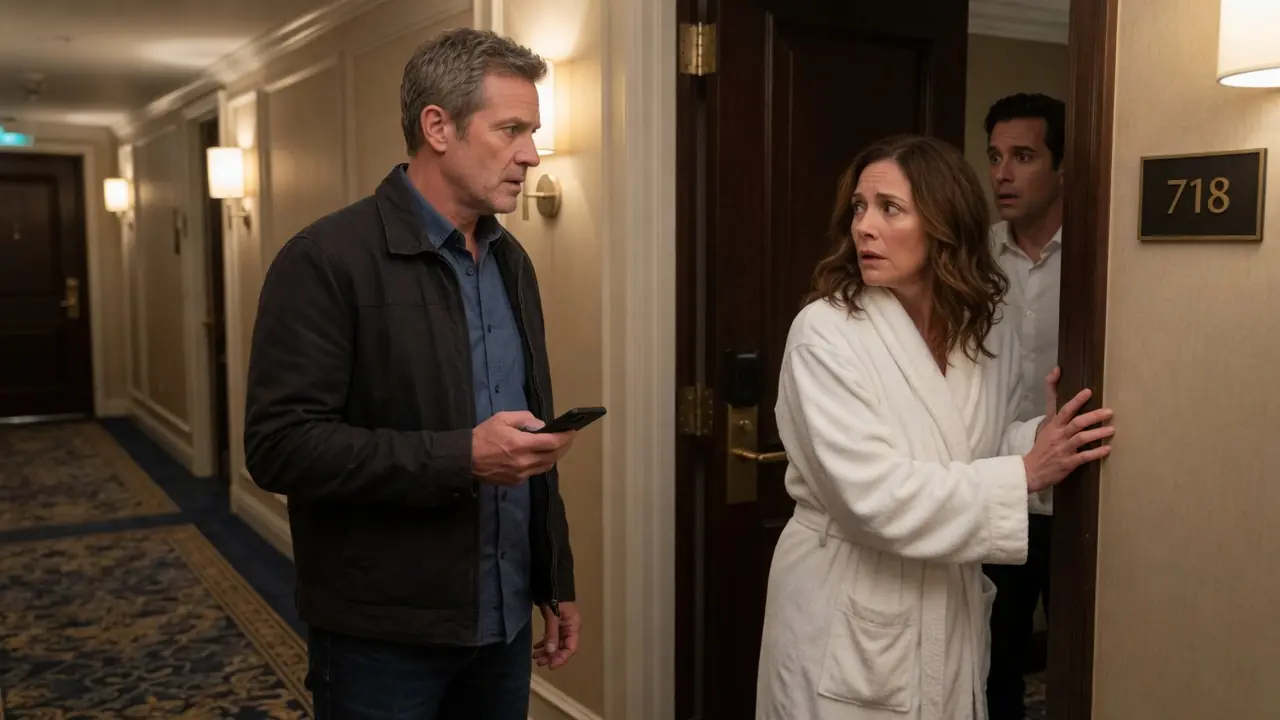
Room 718 was down the hall, past the ice machine and two closed doors. I walked toward it slowly, my heart pounding so hard I could feel it in my throat.
For a moment, I stood outside the door and listened.
At first, nothing.
Then faint music.
A laugh.
A man’s laugh.
My hand lifted before I felt ready.
I knocked.
No answer.
I knocked again, harder.
The movement inside stopped.
The music lowered.
I pulled out my phone and typed one message.
I’m outside your hotel room door. Open up.
I heard a muffled male voice.
Then Rebecca’s voice, low and panicked.
The door opened slowly.
Rebecca stood there in a hotel bathrobe.
Her hair was disheveled, her face flushed, her eyes wide with shock. In the first half second after she saw me, she looked terrified. Then the fear rearranged itself into something almost worse.
Annoyance.
“Mike,” she hissed, stepping into the hallway and pulling the door almost closed behind her. “What are you doing here?”
I stared at her.
For several seconds, I could not speak.
Then I found one word.
“Surprise.”
Her eyes moved past me down the hallway.
“What?”
“The kids and I flew in to see you.”
Her face drained of color.
“The kids are here?”
“At the hotel. In our room. Down the hall.” My voice sounded distant, like someone else was speaking through me. “They’ve been excited all day.”
Rebecca ran a hand through her hair and glanced back at the room.
“You should have called first.”
The words hit me so hard I almost stepped back.
I stared at the woman I had loved for almost twenty years.
“I did call. Multiple times.”
“That’s not what I meant.”
“No,” I said quietly. “I know exactly what you meant.”
The door opened wider behind her.
A man appeared.
Tall, fit, early forties, dark hair damp as if he had just showered. He was buttoning his shirt, face confused, not frightened. Not at first.
“Becca, is everything okay out here?”
Becca.
My name for her.
My private name.
Something inside me went very still.
“Who are you?” I asked.
My voice was dangerously quiet.
Rebecca turned quickly.
“Trevor, go back inside.”
“No,” I said. “Trevor can answer.”
The man looked between us.
“I’m Trevor. Trevor Wells. From the Chicago office.”
He extended his hand by reflex, then seemed to realize how insane that was and dropped it.
“I didn’t know Becca was married.”
If he had punched me, it would have hurt less.
I turned to Rebecca.
“You told him you were single?”
Her eyes closed briefly.
“Mike, please.”
Trevor stepped back.
“Look, man, I had no idea. She never mentioned a husband. Definitely never mentioned kids.”
There it was.
Not only betrayal.
Erasure.
She had not simply cheated on me. She had removed me from her story so she could become someone else in his.
Rebecca whispered, “Trevor, please leave.”
He grabbed his jacket from inside the room.
“Yeah. I’m going.”
As he passed me, he muttered, “Sorry, man.”
I did not move.
Sorry was too small a word to touch what had just happened.
Trevor hurried down the hall toward the elevators.
Rebecca and I stood alone in front of room 718.
“Seventeen years,” I said.
Her eyes filled.
“It was a mistake.”
“No,” I said. “Calling the wrong number is a mistake. Forgetting a meeting is a mistake. This was a decision.”
She looked down the hall, fear rising.
“Where are the kids?”
“In our room.”
“What did you tell them?”
“Nothing yet.”
“Good,” she said quickly. “Good. We need to think before we say anything.”
I looked at her.
She heard herself and flinched.
“I mean for their sake.”
“For their sake,” I repeated.
“Yes.”
“Sophie has been excited all day to see you. Curtis actually put his phone down long enough to help me book the flights. They thought their mother would open the door and be happy.”
Rebecca covered her mouth.
Guilt finally reached her face.
Real guilt this time.
Not for being caught.
For the children.
“I need five minutes,” she said.
“For what?”
“To get dressed. To fix myself. I’ll come to your room.”
“You can fix your hair,” I said. “You cannot fix this in five minutes.”
Her tears fell.
“Mike.”
“How long?”
She froze.
“How long has this been going on?”
“It was just this once.”
I looked toward the elevator where Trevor had disappeared.
“He didn’t know you were married.”
She did not answer.
“Try again.”
Her shoulders sagged.
“We met at a conference in Chicago.”
“When?”
“Four months ago.”
The floor seemed to tilt beneath me.
“Four months.”
“We talked. Texted. It was emotional first.”
I almost laughed.
“People always say that like it makes things cleaner.”
“I was lonely.”
“You were married.”
“You were distant.”
“You had my number.”
She looked at me then, wounded by the simplicity of the truth.
“If you were lonely, you could have called me. If you were unhappy, you could have told me. If you wanted out, you could have said so. Instead, you told another man you were single.”
“I was scared.”
“No. You were selfish.”
Her face crumpled.
A door opened farther down the hall. A man in a suit stepped out, looked at us, sensed trouble, and quickly moved toward the elevators.
Rebecca lowered her voice.
“Please. Not here.”
I stepped back.
“The kids are waiting.”
She grabbed my wrist.
“Mike, please don’t tell Sophie.”
I looked at her hand on me.
Then at her face.
“I don’t know what I’m going to tell her.”
“Please.”
I pulled away gently.
“For once, Rebecca, you don’t get to manage the story.”
I walked back to room 732 with my legs feeling like they belonged to someone else.
Outside our door, I stopped.
How do you enter a room where your daughter is waiting to surprise her mother after you have just seen that mother with another man?
How do you rearrange your face into something safe when your whole life has just split open?
I took one breath.
Then another.
I opened the door.
Sophie jumped up from the bed.
“Did you find Mom?”
Curtis looked at me from the other bed.
His eyes narrowed immediately.
“What’s wrong?”
“Mom’s coming in a few minutes,” I said.
Sophie clapped.
“Is she happy? Did she cry?”
“She was definitely surprised.”
Curtis did not look away from me.
The kid saw everything.
“Why do you look like that?” he asked.
“Like what?”
“Like something happened.”
Before I could answer, room service arrived. Burgers, fries, chocolate cake, lemonade for Sophie, soda for Curtis, coffee for me. The normalness of the tray almost broke me. I tipped the waiter too much and closed the door.
Sophie was too excited to notice my hands shaking.
Curtis noticed.
A few minutes later, someone knocked.
“Mom!” Sophie shouted.
She ran to the door before I could stop her and flung it open.
Rebecca stood in the hallway, completely composed.
Hair brushed.
Makeup fixed.
Professional blouse.
No bathrobe.
No visible evidence.
If I had not seen her twenty minutes earlier, I might have believed she had come straight from a meeting.
Sophie launched herself into Rebecca’s arms.
“Mommy!”
Rebecca hugged her tightly.
For a second, I saw pain on her face so raw it almost looked like love.
“My baby,” she whispered. “What are you doing here?”
“We surprised you,” Sophie said, pulling back. “Dad planned it. Curtis helped a little. We flew on a plane. I brought Bunny. We got burgers. Are you happy?”
Rebecca’s eyes met mine over Sophie’s head.
There was a silent plea there.
Play along.
Not for me.
For her.
For the child whose face was shining with joy.
“I’m happy to see you,” Rebecca said.
Curtis sat on the bed, unmoving.
“Hey, Mom.”
His voice was neutral.
Too neutral.
Rebecca crossed the room and kissed his head.
“Hey, buddy. You look taller.”
“It’s been three days.”
She tried to smile.
An awkward silence followed.
Sophie began talking fast, telling Rebecca about the flight, the rental car, the hotel lobby, the fancy bathroom, the view, the chocolate cake. Rebecca nodded, laughed in the right places, and occasionally glanced at me.
“Dad said we can all have dinner,” Sophie said.
Rebecca’s smile faltered.
“I would love that, sweetheart, but I have a work dinner tonight.”
The room went quiet.
I could not stop the short laugh that left me.
I turned it into a cough, badly.
Sophie’s face fell.
“But we came all the way here.”
“I know. I know, honey. I’m so sorry. It’s a client dinner. Very important. I can’t miss it.”
Curtis looked up.
“Of course you can’t.”
Rebecca flinched.
“Curtis.”
He returned his eyes to his phone.
Sophie’s lower lip trembled.
“You don’t want to stay with us?”
Rebecca knelt in front of her.
“Oh, sweetheart, of course I do. More than anything. But this account is very important, and Mommy has responsibilities.”
I stared at her.
Responsibilities.
The word sat in the room like a lie wearing perfume.
Rebecca looked at me.
“Can I talk to you in the hallway?”
I followed her out, leaving the door slightly open.
The moment we were alone, she whispered, “I really do have a client dinner.”
“Is that before or after Trevor returns?”
Her eyes flashed.
“He is not going.”
“How reassuring.”
“Mike, please. I need time to figure this out.”
“Figure what out?”
“How to handle this.”
“You could start with honesty.”
“I am trying to protect the kids.”
“No,” I said. “You are trying to protect yourself from the kids knowing who you became.”
She looked down.
“Please do not tell Sophie tonight. Let her have tonight.”
That was the first thing she had said since I opened that hotel door that made any sense.
Sophie did not deserve the truth thrown at her like broken glass.
Curtis, however, was not ten.
And he already knew something was wrong.
“I won’t tell Sophie tonight,” I said.
Rebecca exhaled.
“Thank you.”
“But I will not lie if Curtis asks me directly.”
Her face tightened.
“Mike.”
“No. You do not get to ask me to become dishonest so you can feel less guilty.”
She wiped at her eyes.
“Tomorrow. We can talk tomorrow. I’ll spend the day with you and the kids.”
“What about Trevor?”
“It’s over.”
“You said that quickly.”
“Because it’s true.”
I studied her face and found panic, guilt, fear.
I did not yet find truth.
“Go to your dinner,” I said.
She looked startled.
“What?”
“Go. Land the account. Shake hands. Smile. Do whatever matters more than staying in that room with the daughter who flew across the country to hug you.”
“That is cruel.”
“No,” I said. “That is accurate.”
Back inside, Sophie was picking at fries.
“Mom can’t stay?”
“Not tonight,” I said, sitting beside her. “She has work.”
Sophie nodded slowly, trying to be brave.
“Can we do something fun then?”
“Anything you want.”
“Can we see the harbor? My friend Emma said Boston Harbor has lights and boats.”
I was exhausted.
Destroyed.
Angry enough to shake.
But my daughter looked at me with hopeful eyes, and I remembered that parenthood often meant bleeding quietly so your child could have one good hour.
“Sure,” I said. “Let’s go see the harbor.”
Curtis looked at me.
“Now?”
“Now.”
He stood without argument.
That was when I knew he was waiting for the chance to talk.
We walked through Boston Harbor under a cold night sky. Sophie skipped ahead, pointing at boats, lights, restaurants, and one enormous yacht she claimed looked bigger than our house. The air smelled of salt, diesel, and winter.
Curtis walked beside me with his hands in his pockets.
For a while, he said nothing.
Then, quietly, without looking at me, he asked, “Mom’s cheating, isn’t she?”
I nearly stumbled.
“Curtis.”
“Don’t do that.”
“Do what?”
“Use my name like I asked a bad question.”
I looked at my son.
He was fifteen, but in that moment his face seemed older. Not adult, not yet, but pulled toward adulthood by something he should not have had to carry.
“What makes you think that?”
“The way she looked. The way you looked. The way she suddenly had work even though we came to surprise her.” He kicked a pebble along the walkway. “And because she’s been different.”
A wave of nausea moved through me.
“You noticed?”
“Yeah.”
“For how long?”
He shrugged.
“A while. Always texting. Smiling at her phone. Getting weird when Sophie asks who she’s talking to. Taking calls outside. Wearing nicer clothes for trips than she used to.”
I looked toward Sophie, who was leaning over a railing, talking to her stuffed bunny as if it were also impressed by the harbor.
Had everyone seen signs except me?
Or had I seen them too and simply chosen not to know?
Curtis stopped walking.
“Tell me the truth, Dad.”
I looked at him.
He deserved childhood.
But he had asked for truth.
And truth, even painful truth, was better than making him live inside confusion.
“Yes,” I said quietly. “I found your mother with another man.”
Curtis’s jaw tightened.
He did not cry.
He did not yell.
That somehow made it worse.
“Who?”
“A man from her Chicago office. Trevor.”
His face hardened.
“She brought us here while he was there?”
“She didn’t know we were coming.”
“That doesn’t make it better.”
“No.”
He stared out at the water.
“Does Sophie know?”
“No.”
“Don’t tell her yet.”
“I won’t. Not tonight.”
“She still thinks Mom hangs the moon.”
The phrase landed hard because I had thought almost the same thing about Sophie.
Curtis turned back to me.
“What happens now?”
“I don’t know.”
“Are you getting divorced?”
The word felt impossible.
One day earlier, I had been packing toothbrushes and imagining Rebecca’s happy tears. Now my son was asking about divorce beside Boston Harbor while my daughter pointed at boats.
“I don’t know yet,” I said. “But whatever happens, nothing changes how much I love you and Sophie.”
He looked at me with a bitterness too old for him.
“If she loved us, she wouldn’t have done it.”
I wanted to defend Rebecca as his mother.
Some instinct in me still reached for that.
But I could not defend what she had done.
“Adults can love people and still make selfish choices,” I said.
“That sounds like an excuse.”
“It isn’t meant to.”
“She chose him.”
I said nothing.
Curtis leaned closer to me then, not quite a hug, but enough that his shoulder touched my arm.
“We’ll be okay, Dad,” he said. “You, me, and Sophie.”
My fifteen-year-old son was comforting me.
That almost broke me.
I put my arm around his shoulders.
“Yes,” I said, though I did not yet believe it. “We will.”
When we returned to the hotel, Sophie was half asleep on my back, her arms looped around my neck. Curtis carried Bunny because Sophie had declared the harbor air too cold for stuffed animals.
The elevator doors opened on our floor.
Rebecca was waiting outside our room.
Her arms were crossed. Her eyes were red. She looked like she had been crying, but also like she was angry we had not been where she expected us to be.
“Where have you been?” she asked.
“Harbor.”
“I’ve been calling.”
“I left my phone in the room.”
Curtis brushed past her and opened the door with the key card.
Rebecca turned.
“Curtis, honey.”
He did not answer.
He walked inside.
Rebecca looked at me.
“What did you tell him?”
“The truth.”
Her face paled.
“You had no right to do that without discussing it with me.”
I shifted Sophie gently against my shoulder.
“Lower your voice.”
Sophie stirred.
“Mommy?”
Rebecca’s face changed immediately.
She stepped closer, touching Sophie’s hair.
“I’m here, sweetheart.”
“Did you finish work?”
“Yes.”
“Can you stay now?”
Rebecca looked at me.
I said nothing.
“Yes,” she whispered. “I can stay for a little while.”
Inside, I helped Sophie change into pajamas and tucked her into bed. Rebecca stood awkwardly nearby, as if she no longer knew where to place herself inside her own family.
Sophie reached for her.
“Mom, will you sit till I fall asleep?”
Rebecca sat on the edge of the bed.
“Of course.”
Curtis sat on the other bed with headphones on but no music playing. I could tell because the cord was not plugged into anything.
Sophie fell asleep holding Rebecca’s hand.
The moment her breathing changed, Rebecca carefully let go and looked at me.
“Can we talk?”
I glanced at Curtis.
He pulled one headphone off.
“Go. Sort this mess out.”
Rebecca flinched at the coldness in his voice.
I followed her to room 718.
The room had been cleaned.
The bed was made.
Trevor’s presence erased from the surface.
But I could still feel him there.
I stayed near the door.
Rebecca sat on the edge of the bed, then stood again, unable to settle.
“Curtis hates me,” she said.
“He’s hurt.”
“He looked at me like I’m disgusting.”
I did not answer.
That answer would have been too honest.
She wrapped her arms around herself.
“I made a terrible mistake.”
“How long?”
She closed her eyes.
“Mike.”
“How long?”
“Four months.”
“Physical for four months?”
“No. Emotional first. Texting. Calls. Then the last trip to Chicago. Then here.”
“How many times?”
She covered her face.
“Three.”
I leaned against the wall because my legs felt unsteady.
Three.
A number small enough for her to think it sounded survivable.
Large enough to prove this was no accident.
“Did he really not know you were married?”
She lowered her hands.
“No.”
The answer stunned me even though I expected it.
“How?”
“I took off my ring when I traveled.”
The room went silent.
There are details that reveal more than confessions.
That was one of them.
Not only had she lied.
She had prepared.
She had removed the symbol of our marriage before stepping into another version of herself.
I looked at her left hand.
The ring was there now.
It looked obscene.
Rebecca followed my gaze and covered it with her right hand.
“I don’t know who I was trying to be.”
“Single,” I said.
She began to cry.
“I felt invisible.”
I stared at her.
“There are family photos in every room of our house. Your children call you every night when you travel. I have spent seventeen years loving you in every practical way I knew how.”
“I know.”
“No, you don’t. If you knew, we wouldn’t be here.”
“I felt like a mother and employee and wife, but not like a woman.”
“You could have told me.”
“I tried.”
“When?”
She opened her mouth.
Closed it.
That was answer enough.
“You imagined conversations,” I said. “Then punished me for not hearing them.”
Her tears came harder.
“That isn’t fair.”
“Do not ask me for fairness tonight.”
We stood in that hotel room for a long time, separated by a bed that had become evidence.
Finally, I said, “I’m taking the kids home tomorrow.”
Her face shot up.
“No.”
“Yes.”
“Mike, please. We should spend the day together. Show Sophie Boston. Talk. Let me prove…”
“Prove what? That you can play mother in the morning after cheating at night?”
She recoiled.
I regretted the cruelty immediately, but not enough to take it back.
“I need my children away from this room,” I said. “Away from him. Away from whatever version of you existed here.”
She whispered, “Do you hate me?”
“No.”
That seemed to hurt her more.
“I wish I did,” I said. “It would be simpler.”
The flight home was quiet.
Rebecca came to the airport to say goodbye. Sophie hugged her tightly and asked why she could not come with us. Rebecca told her she had to finish work. It was another lie, and this time I watched it enter our daughter’s face without permission.
Curtis gave Rebecca a stiff one-arm hug.
She whispered something to him.
He did not respond.
On the plane, Sophie fell asleep against the window before takeoff.
Curtis sat beside me.
After an hour, he took off his headphones.
“Are you okay?”
I looked at him.
“I will be.”
He nodded.
“I don’t want to stay at the house when she comes back.”
The sentence surprised me.
“We’ll figure it out.”
“I mean it.”
“I know.”
He looked at Sophie.
“She can’t see you two screaming.”
“We won’t scream.”
“You don’t know that.”
He was right.
I did not.
When we got home, the house looked exactly the same, which felt offensive.
The kitchen still held Rebecca’s tea mug near the sink. Her sweater hung over a chair. A sticky note on the fridge reminded me to buy Sophie poster board for a school project. Our wedding photo sat on the hallway table, both of us smiling like people who had no idea how fragile a future could become.
That evening, after Sophie went to bed, Curtis and I sat at the kitchen table.
“Do we tell her?” he asked.
“Not everything.”
“She’ll ask why Mom isn’t home.”
“I’ll tell her your mom and I are having adult problems.”
“That sounds fake.”
“It is incomplete, not fake.”
He almost smiled.
Then his face went serious.
“Don’t let Mom make this your fault.”
I stared at him.
“What?”
“She’ll try. She already started. At the hotel. Saying she felt invisible and you work too much.”
I looked down at my hands.
Curtis continued.
“You work because we need stuff. Because bills exist. Because school is expensive. Because Mom likes nice hotels and good clothes and vacations. Don’t let her turn that into you being a bad husband.”
I could not speak for a moment.
No child should have to defend a parent from another parent’s narrative.
Yet there he was, doing it.
“Curtis,” I said quietly, “you do not need to take care of me.”
He looked at me with tired eyes.
“Someone should.”
Rebecca came home two days later.
Not to stay.
At my request, she came while the kids were at school. She looked thinner, exhausted, and frightened. She had cut the Boston trip short and taken leave from work. For the first time since I had known her, career did not seem to be the center of her thoughts.
She stood in the living room holding her suitcase.
“I ended it with Trevor.”
I said nothing.
“I told him everything. He was angry too. He said I ruined his life.”
A dry laugh escaped me.
“How unfair for him.”
Rebecca flinched.
“I deserved that.”
I gestured toward the couch.
She sat.
We talked for three hours.
Or rather, she talked and I listened.
She said she had felt lost. She said work made her feel powerful while home made her feel needed but not wanted. She said Trevor made her feel young, interesting, admired. She said it became easier to pretend I did not exist while traveling than to face how far she had let things go.
I asked questions.
Specific ones.
Dates.
Places.
Messages.
Hotels.
Who knew.
Whether anyone at work suspected.
Whether she had used family money.
Whether she had brought him near our children in any way.
The answers came slowly.
Painfully.
Not all at once.
Every time she hesitated, I knew there was another truth behind the door.
By the end, I understood enough.
Not everything.
Maybe betrayed spouses never get everything.
But enough.
“I want counseling,” she said.
“I want space.”
“How much?”
“I don’t know.”
“Can I stay in the guest room?”
“No.”
Her face collapsed.
“Mike.”
“The kids need stability. I need to breathe. You can stay with your sister or rent somewhere.”
“This is my home too.”
“Yes,” I said. “And you made it unsafe for me.”
That sentence stopped her.
She moved into an apartment downtown the next week.
Telling Sophie was the hardest thing I have ever done.
We sat in the living room, the three of us: me, Rebecca, and our little girl curled into the corner of the couch with Bunny in her lap. Curtis sat on the stairs nearby, pretending not to listen, but listening to every word.
Rebecca began crying before we finished the first sentence.
That made Sophie cry too.
I took over.
“Mom and I are having serious problems,” I said gently. “She is going to live somewhere else for a while.”
Sophie’s face crumpled.
“Because of Boston?”
Rebecca covered her mouth.
I looked at my daughter.
“What do you mean?”
“You were different after Boston. Everyone was different.”
Children notice the temperature of a room even when adults hide the fire.
“Yes,” I said. “Some things happened in Boston that hurt our family.”
“Did Mom do something bad?”
Rebecca made a small sound.
I chose every word carefully.
“Mom made choices that hurt me and hurt our marriage. But she loves you. That part is true.”
Sophie turned to Rebecca.
“What did you do?”
Rebecca slid from the couch to her knees in front of Sophie.
“I broke a promise to your dad,” she whispered. “A very important promise.”
Sophie looked at me.
“Can she fix it?”
I felt something tear inside me.
“I don’t know.”
Sophie began sobbing then, not dramatically, not loudly, but with the helpless confusion of a child whose family had stopped being the ground beneath her feet.
Curtis came down the stairs and sat beside her.
She leaned into him.
Rebecca reached for them both.
Curtis allowed it for Sophie’s sake, but his body stayed stiff.
That was our new family.
Four people in one room.
Love still present.
Trust shattered across the floor.
Over the next months, life changed in practical, painful ways.
Rebecca came for scheduled visits. She took Sophie to dinner, helped with homework, attended school events, and tried too hard. Sophie adored her and feared her at the same time, which was heartbreaking to witness. She would cling to Rebecca at pickup, then cry after drop-off because she was afraid loving her mother meant betraying me.
I told her every time, “You are allowed to love your mom.”
Curtis pulled away.
He answered Rebecca with short sentences. He refused dinners with her at first. When she came to his basketball game, he played harder than I had ever seen him play, then walked past her afterward without stopping.
Rebecca cried in her car.
I saw it.
I did not comfort her.
Maybe that sounds cruel, but there are moments when comforting the person who broke you becomes another form of self-betrayal.
We tried counseling.
Three sessions.
Rebecca cried.
I sat stiffly.
The therapist asked whether I wanted reconciliation.
I said, “I want to want it.”
That was the most honest answer I had.
But every time Rebecca reached for me, I saw room 718.
Every time she said she loved me, I heard Trevor say, “I didn’t know Becca was married.”
Every time she wore her ring, I imagined her taking it off before seeing him.
By the third session, Rebecca understood before I said it.
“You can’t come back from it,” she whispered.
“I can’t come back to who I was before it.”
“That doesn’t mean we can’t build something new.”
“No,” I said. “But I don’t know if I want a new marriage with someone who destroyed the old one.”
She nodded, crying silently.
The divorce papers came six weeks later.
Not three weeks like in a movie.
Real life moves slower, even when it is falling apart.
There were lawyers, accounts, custody discussions, property issues, school schedules, insurance questions, and the brutal logistics of turning one family into two households. Rebecca did not fight dirty. I will give her that. Maybe guilt stopped her. Maybe love did. Maybe exhaustion.
We agreed to shared custody, with the children primarily staying in the house until they adjusted.
I kept the house.
Rebecca kept her retirement and personal accounts.
We divided what had to be divided.
No court drama.
No screaming in public.
No revenge.
Only a long, painful dismantling of what we once thought would last forever.
The day we signed, Rebecca and I sat across from each other in a conference room while rain streaked the window.
She looked at the papers for a long time.
“I never wanted this,” she said.
“Neither did I.”
“I thought I was unhappy,” she whispered. “But I think I was just selfish and bored and too proud to admit I had a good life.”
I looked at her.
That was the first explanation that sounded true.
She signed.
Then pushed the papers toward me.
“Do you think you’ll ever forgive me?”
I considered lying to make the moment softer.
I did not.
“I think someday I will forgive you enough not to carry anger. But I don’t think I will ever trust you with my heart again.”
Her eyes filled.
“That’s fair.”
It was the first time in months that word had not made me angry.
The first year after the divorce was hard.
Sophie had nightmares.
Curtis became quiet in a way that worried me.
I learned how to cook more than five meals badly and three meals well. I learned which teacher needed emails, which days Sophie needed extra patience, and how to sit with Curtis without forcing him to talk. I learned that single fatherhood was not one heroic act, but a thousand small acts repeated while tired.
Rebecca worked to repair her relationship with the kids.
Slowly.
Painfully.
Curtis eventually agreed to breakfast with her once a month. Then every other Sunday. He did not forgive quickly, but he did speak. Sophie forgave faster, then got angry later, then forgave again, because children process grief in waves.
I did not interfere.
I wanted them to have their mother.
I also wanted them to learn that love and accountability could exist in the same room.
Two years later, Curtis graduated high school.
Rebecca and I sat on opposite sides of the auditorium.
After the ceremony, Curtis found me first.
He hugged me hard, no teenage awkwardness left.
“Thanks for keeping us steady,” he said.
I had to look away.
Rebecca stood nearby, eyes wet.
Curtis turned to her after a moment and hugged her too.
Not as long.
But real.
That mattered.
Sophie, now twelve, took pictures of everyone and ordered us to smile because “graduation is not for divorced awkwardness.”
She was still my princess, though sharper now.
Wiser than I wished she had to be.
Life did not become perfect.
It became honest.
That was enough.
As for Rebecca, she stayed single for a long time. She left the consulting firm, not because she had to, but because she said the travel had become a place where she lost herself. She took a local role with less status and more stability. She went to therapy. She apologized many times, and after a while, I stopped needing to hear it.
Trevor disappeared from the story quickly.
Men like that often do.
He mattered less than the door he stood behind.
People sometimes ask if I regret taking the kids to Boston.
That question has followed me for years.
If we had stayed home, maybe Rebecca would have continued lying. Maybe the affair would have ended quietly. Maybe she would have buried it and come back to us. Maybe our family would have remained intact on the outside, while something rotten grew beneath it.
I do not know.
What I know is this.
My daughter wanted to surprise her mother because she loved her.
My son helped plan the trip because some part of him still wanted to believe in family.
I went because I loved my wife.
Love led us to that hotel.
Truth met us at the door.
For a long time, I hated that door.
Room 718.
I saw it in dreams.
I saw Rebecca’s bathrobe, Trevor’s shirt, her face when she realized the children were down the hall. I saw my own hand raised to knock, the last seconds before knowing.
But now, years later, I understand something I could not understand then.
A door can destroy a lie.
That does not make the pain good.
It does not make betrayal useful.
But truth, however brutal, gives you ground to stand on.
Lies only give you rooms that look safe until someone opens them.
I am not the same man I was before Boston.
Curtis is not the same son.
Sophie is not the same little girl.
Rebecca is not the same woman.
Our family did not survive in the way I once hoped.
But my children and I did.
We built new routines.
New birthdays.
New holidays.
New inside jokes.
New versions of home.
And on quiet mornings, when Sophie sings in the kitchen and Curtis comes home from college with laundry and stories, I sometimes feel something I thought was gone forever.
Peace.
Different from before.
Less innocent.
More earned.
What happened in that hotel room did not stay there.
It followed us home.
It broke us open.
It forced every hidden thing into the light.
And though I would never call it a blessing, I can say this now without bitterness:
The worst discovery of my life gave me back the one thing I did not know I had lost.
The truth.