The well bucket came up nearly dry on a morning when the wind was already hot enough to sting Mabel Hart’s face.
She stood beside the low stone well outside the homestead, holding the empty bucket while the rope creaked against the wooden frame above her. Beyond the house, the Wyoming grassland stretched pale and brittle toward the horizon, and every gust lifted a veil of dust across the yard.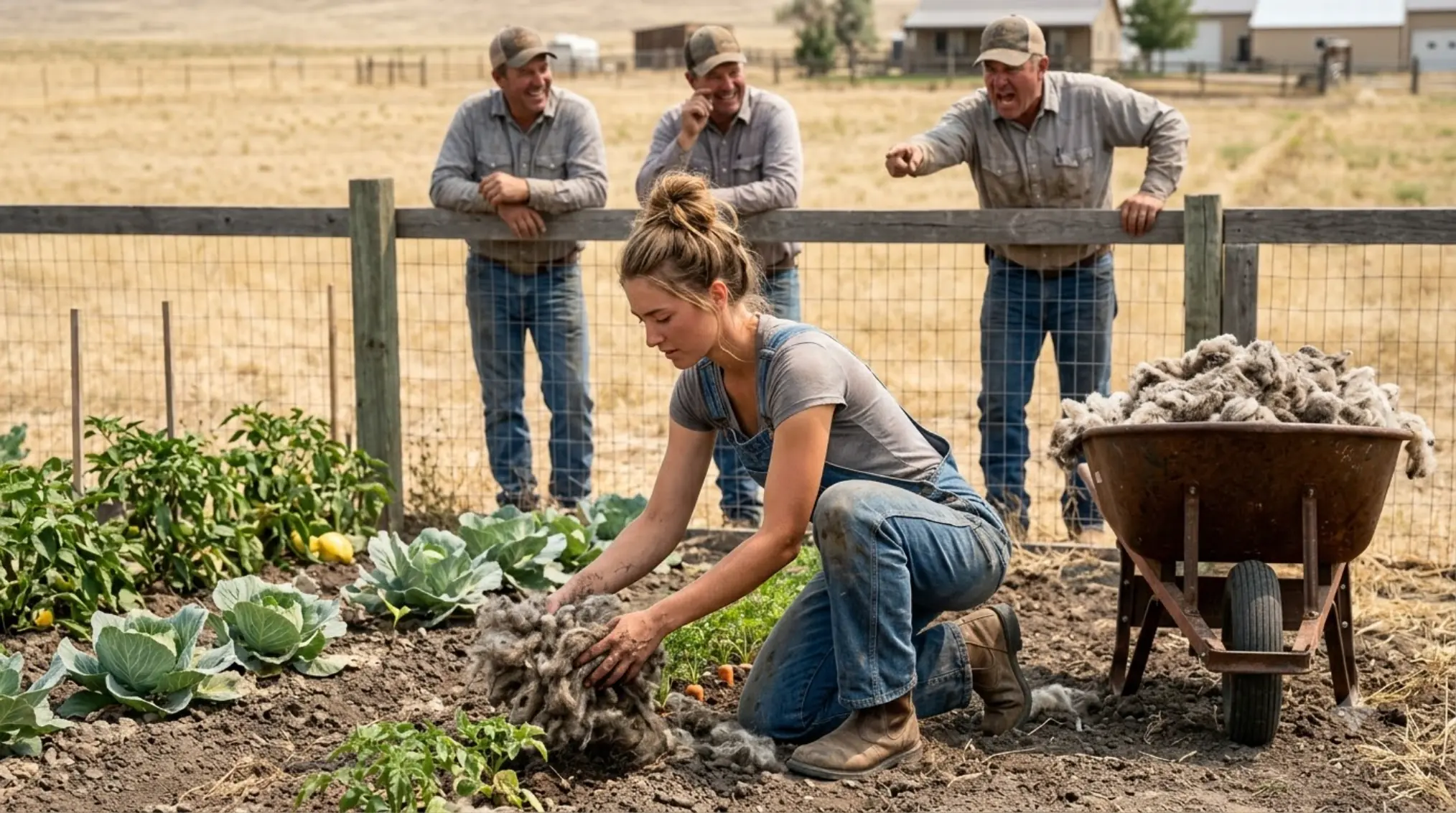
Mabel turned toward her vegetable garden.
It was still green.
Not perfectly green.
Not untouched.
But green enough to look almost unnatural beside the exhausted land around it.
Rows of squash, cabbage, beans, carrots, and tomatoes rose from dark earth covered in thick, dirty gray sheep wool.
Three months earlier, the neighbors had laughed at that wool.
Now nobody laughed when they rode past.
Mabel was twenty-four years old in the summer that taught half the county not to judge a thing by where it came from.
She had fair skin browned lightly by the western sun, hazel eyes, long light-brown hair that she usually tied into a messy knot, and hands that had lost their softness during three years of homestead work. She had come west with her husband, Eli Hart, carrying more hope than money and believing, as most young couples did, that determination could substitute for nearly everything they lacked.
The land had corrected that belief quickly.
Their first season produced enough wheat to make them hopeful.
The second gave dust.
By the third year, Eli had begun taking freight work between Cheyenne and a northern post because the farm alone could not reliably support them.
That meant Mabel often ran the homestead by herself.
She kept twelve chickens, a milk cow named Pearl, the small crop ground, and a vegetable garden she guarded with an intensity that sometimes made Eli smile. The nearest general store sold flour, salt, coffee, and canned goods at prices that made every jar of beans Mabel preserved feel like money placed directly into the pantry.
The garden was not decoration.
It was winter food.
And the greatest enemy of that garden was water.
A seasonal creek ran below the low rise where the Hart homestead sat.
In May it flowed strong enough to splash against Mabel’s boots.
By July it sometimes narrowed to a thin ribbon between exposed stones.
Every morning, Mabel carried water from the creek to the garden.
Every evening, she did it again.
Bucket after bucket.
She could spend two hours a day hauling enough water to keep the plants alive, yet by noon the top layer of earth would already have hardened beneath the sun.
The wind stole moisture faster than she could replace it.
Weeds stole what remained.
By late May, Mabel had begun wondering whether the garden itself was worth the labor.
Then she visited the Shoalter sheep place.
Hollis Shoalter ran nearly a thousand sheep across the grasslands west of the Hart farm. When Mabel arrived carrying eggs to trade, she found him inside the shearing shed standing beside an enormous pile of coarse, dirty fleece.
The railroad wool buyer had already taken everything valuable.
What remained was belly wool.
Tag ends.
Fleece matted with burrs, dirt, manure, lanolin, and whatever else sheep accumulated over a season outdoors.
Hollis looked disgusted by it.
“Three hundred pounds, maybe more,” he said.
“What are you doing with it?” Mabel asked.
“Burn it.”
She looked at the pile.
“Why?”
Hollis laughed.
“What else would I do with it?”
Mabel stepped closer.
The wool smelled strong.
She picked up a thick gray clump.
“What would you want for all of it?”
Hollis stopped laughing.
“For this?”
“Yes.”
He studied her face as though waiting for the joke.
None came.
Finally he said, “A dozen eggs and you can take as much as you can haul.”
Mabel agreed.
By the time she rode home with the first sack tied behind her saddle, she had already begun questioning herself.
Three hundred pounds of filthy wool.
She had no book telling her what to do with it.
No agricultural bulletin.
No neighbor’s advice.
No memory of seeing anyone put raw wool in a garden.
The idea had come from somewhere much older.
Ohio.
Her childhood.
A forest floor.
Mabel remembered walking beneath trees during August and pushing fallen leaves aside with her shoe.
Underneath, the dirt remained cool.
Dark.
Moist.
A hundred yards away, exposed ground could bake dry beneath the same sun.
The forest did something farmers around her did not.
It covered its soil.
Leaves fell.
They stayed.
They blocked the sun, held moisture, and eventually became part of the earth itself.
Mabel looked at the wool tied behind her saddle.
It was not leaves.
But it was a covering.
That evening she stood beside her garden while the wind pulled at her skirt.
The squash leaves had begun curling.
The bean rows looked tired.
Her radishes had already bolted.
She could almost hear her neighbors if she went through with it.
She imagined Agnes Dune staring at the wool with her thin, unimpressed mouth.
She imagined the Puit boys riding past slowly.
She imagined Hollis telling somebody at church that young Mrs. Hart had finally gone strange from spending too much time alone.
Mabel hated that those thoughts bothered her.
Then she looked at the dying squash.
If she did nothing, she might lose them anyway.
The next morning, Mabel carried the first load of wool into the garden.
She began with the squash bed.
She pulled the coarse fleece apart with both hands and spread it around each plant in a thick layer two to three inches deep.
She left a ring of bare soil immediately around each stem.
The result looked terrible.
The garden appeared to have grown fur.
By noon she had covered the squash and beans.
The following day she covered the cabbages and half the carrots.
She deliberately left the other half of the carrot bed uncovered.
That was not fear.
It was comparison.
Mabel wanted to know whether the wool actually worked.
Agnes Dune arrived that afternoon carrying a churn dasher she had borrowed.
She was sixty years old, narrow, sharp-eyed, and built with the stubborn durability of old fence wire.
Agnes stopped at the garden gate.
She stared.
Then she stared longer.
“What in the world have you done?”
Mabel explained.
The forest floor.
The leaves.
Water loss.
The possibility that the wool might hold moisture.
Saying it aloud made the theory sound thinner than it had inside her head.
Agnes walked closer.
“My grandmother used wool and straw in a root cellar.”
Mabel looked hopeful.
“To keep it damp?”
“To hold temperature.”
Agnes narrowed her eyes.
“That is not the same as carpeting your vegetables.”
Mabel exhaled.
“No.”
Agnes handed over the churn dasher.
“We’ll see what we see.”
That was not approval.
But coming from Agnes, it was not complete condemnation either.
The story spread anyway.
By the end of the week, Pratt-style restraint had no equivalent in their Wyoming settlement.
The Puit brothers rode down the road deliberately slowly so they could stare.
Hollis visited under the excuse of checking what had happened to his discarded wool.
He leaned against the fence.
“Folks say you’ve carpeted your turnips.”
Mabel kept working.
“Folks have time to talk.”
Hollis grinned.
“They say you’ll put curtains around the beans next.”
Mabel pressed another section of wool flat.
“Then they can come watch me sew them.”
Hollis laughed harder.
Mabel smiled just enough to hide how much the teasing bothered her.
Because for the first week, nothing happened.
The plants did not suddenly grow twice as large.
The wool looked ugly.
It smelled unpleasant whenever she watered.
At night, Mabel occasionally lay awake wondering whether she had made herself ridiculous for no reason.
Then, on the fourth day, she noticed something.
She had watered the bare carrots that morning.
By afternoon, their soil was pale and crusted.
Mabel moved to the wool-covered cabbage bed.
She pushed her fingers through the fleece.
The upper wool felt dry.
The layer beneath it felt cooler.
Then her fingertips reached the soil.
Mabel froze.
It was damp.
Not wet.
But unmistakably damp.
She dug slightly deeper.
The earth was cool.
Mabel sat back on her heels.
She said nothing to anyone.
Hope was dangerous when you announced it too soon.
So she began testing.
The bare carrots continued receiving water twice a day.
The wool-covered carrots received water once.
The next morning, Mabel checked both.
The uncovered soil had already begun cracking.
The covered soil still held moisture.
She skipped an evening watering on the wool beds.
Morning came.
Still damp.
Then she noticed the weeds.
Pigweed and lamb’s-quarter came up aggressively between the uncovered rows.
Under the wool, almost nothing appeared.
The fleece blocked sunlight from reaching the weed seeds.
Suddenly, Mabel was not only saving water.
She was saving hours of labor.
By the second week, the difference became obvious.
The wool-covered squash produced enormous dark-green leaves.
The uncovered plants remained smaller and yellowed around the edges.
The cabbages under wool began forming tight heads.
Beans climbed their supports vigorously.
The uncovered half of the carrot bed struggled.
Mabel brought Agnes back.
She showed her the comparison.
Agnes bent slowly, complaining about her knees.
She pushed one finger beneath the wool.
Then she tested the uncovered ground.
She repeated the process.
Finally she straightened.
“Well.”
Mabel smiled.
“Is that all?”
Agnes looked offended.
“It is enough.”
Mabel pulled apart a section of fleece near the soil.
The underside had changed.
The lowest fibers were darker.
Softer.
Beginning to decompose.
“I think it may be feeding the soil too.”
Agnes examined it.
“Wouldn’t surprise me.”
She looked toward the road.
“My beans are burning.”
Mabel said nothing.
Agnes glanced back.