“You would save my daughter?”
Makhia’s voice filled the doorway before his body crossed it. He stood in the entrance of Marianne Vale’s cabin with Arizona dust on his face, blood on one sleeve, and a motionless girl cradled in his arms as if she were both treasure and accusation. Behind him, three Comanche riders waited in the sunlight with horses blowing hard from the climb. Inside the cabin, Marianne froze with one hand on the edge of her worktable and the other still blackened from trying to save her father’s journals from the stove fire.
For one terrible second, neither of them moved. Marianne saw the girl first, no more than fifteen, her dark hair fallen across one cheek, her fingers curled inward like claws around nothing. Her jaw was locked so tightly that the cords of her neck stood out, and her legs hung limp from Makhia’s arms. The chief’s eyes never left Marianne’s face.
“You would save my daughter?” he repeated, lower this time. “Then tell me why every healer has failed, and why your father’s name was spoken before she lost her voice.”
Marianne felt the words strike harder than any slap. Her father had been dead for six months, or so the territory believed, but his shadow still lived in every corner of the cabin. Dr. Elias Vale had treated settlers, miners, soldiers, and tribes when nobody else would ride far enough or risk enough to help them. He had also left behind locked journals, coded drawings, and warnings Marianne had only begun to understand.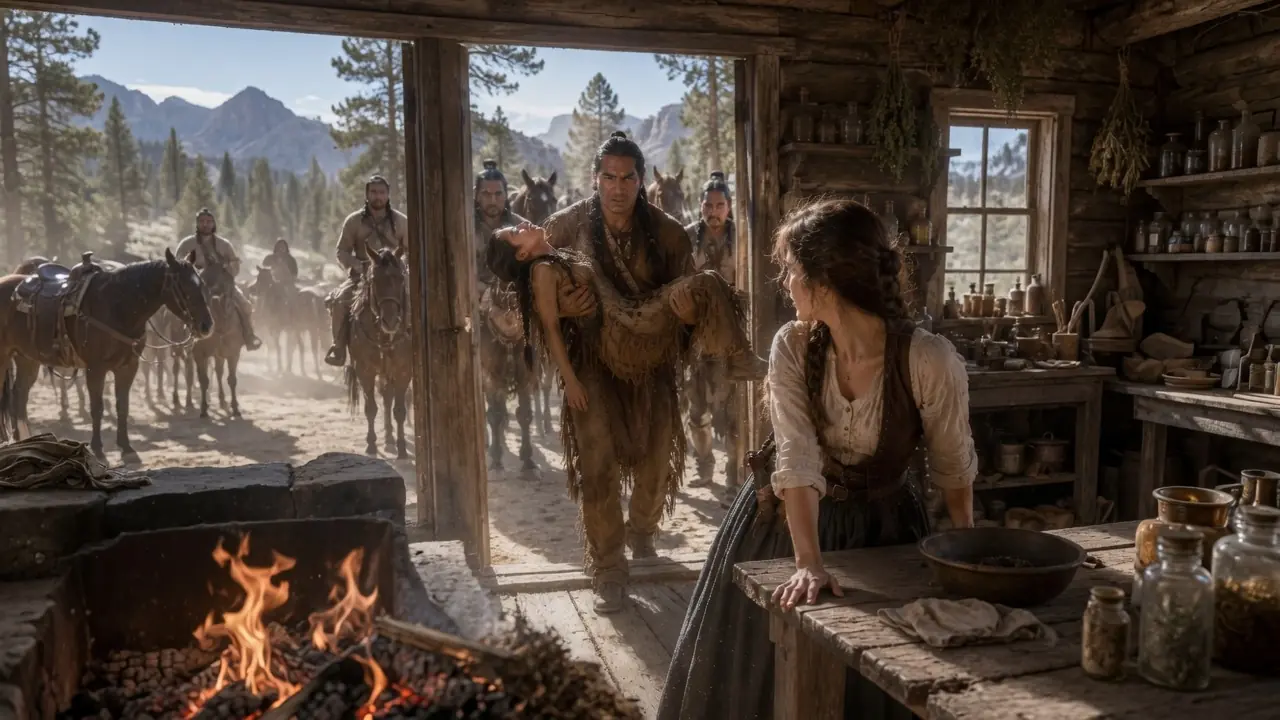
“Lay her on the table,” Marianne said.
Makhia did not move. “If she dies here, healer, your floor drinks more than sorrow.”
Marianne lifted her chin though fear tightened her throat. “If she stays in your arms, she dies faster.”
That was the first time she saw pain break through his fury. It moved across his face quickly, almost violently, before he crushed it beneath stillness again. He stepped inside and laid the girl on the rough wooden table where Marianne had stitched ranch hands, set bones, delivered babies, and once watched her own mother take her final breath. The table creaked under Chenoa’s weight, and the cabin seemed to shrink around them.
The riders remained by the door, silent and watchful. Outside, the horses stamped and snorted, their reins creaking in the wind. Sunlight fell across the plank floor in hard golden bars, catching the ash floating from the stove. Marianne’s father’s last surviving journal lay half-burned beside the hearth, its pages curling inward like dying leaves.
Marianne approached the girl slowly. “Her name?”
“Chenoa.”
“How long?”
Makhia’s hands gripped the table edge. “Seven moons since her fingers first stiffened. Four since her legs betrayed her. Three days since her voice left.”
Marianne touched Chenoa’s wrist. The pulse was weak but steady. She lifted one eyelid and saw the eye respond faintly to light. Not coma. Not fever. Not ordinary poisoning. The girl was trapped inside a body that had been made into a prison.
“Who treated her?” Marianne asked.
Makhia’s mouth hardened. “Our healers. A Mexican surgeon near Tucson. A mission priest who said prayers while his hands shook. A soldier doctor at Fort Lowell who gave powder and said she was cursed by nerves.”
“And my father?”
The cabin became quieter.
Makhia leaned closer. “Your father saw her once, before he disappeared from our camp. He said the sickness was not from the spirits and not from nature. Then soldiers rode near our winter ground, and he was gone before dawn.”
Marianne swallowed. Her father had told her almost nothing about those journeys. He had returned from them pale, restless, and unwilling to explain why he slept with a pistol under his pillow. In the last weeks before his death, he wrote constantly in his journals, then hid pages in strange places: beneath floorboards, inside medicine tins, under the lining of his medical bag. Marianne had thought grief was making her see mystery where there was only a dying man’s confusion.
Now Chenoa lay on her table, and the mystery had a heartbeat.
Marianne brushed the girl’s hair away from her neck. Makhia watched every movement. His face was carved from suspicion, but his eyes followed his daughter’s smallest breath. Marianne had seen powerful men break before, but never so silently. He looked like a chief holding back a war because his child needed quiet.
There was no rash, no swelling, no bite mark. Marianne pressed along the spine, felt each bone beneath the skin, and stopped at the base of the skull. Something there made her fingertips pause. A tiny raised scar sat hidden under the hairline, nearly healed and narrow as a needle prick.
“Who cut her here?” Marianne asked.
Makhia bent over the table. “No one.”
“This is not birthmarked.”
“No one touched her there.”
Marianne looked at him. “Someone did.”
One warrior shifted by the door, hand dropping toward his knife. Makhia did not look back, but the man stilled immediately. Marianne reached for her brass magnifying lens and angled it toward the window. The scar gleamed under the thin line of light. It was too clean, too deliberate, too small for any accidental wound.
“I need more light,” she said. “Now.”
Makhia snapped one word in Comanche. A rider stepped inside, took a polished copper plate from Marianne’s shelf without asking, and angled sunlight through the open window. A sharp beam struck Chenoa’s neck. The scar shone pale against her skin.
Marianne’s stomach turned.
She had seen this before.
Not on flesh, but on paper.
The half-burned journal near the stove had contained a diagram of a tiny metal sliver shaped like a sewing needle, with notes written in her father’s hurried hand. She had not understood it before the fire took the page. Now she remembered one phrase clearly: nerve gate.
Makhia saw recognition cross her face. “You know it.”
“I know enough to be afraid,” Marianne whispered.
He grabbed her wrist. His grip was hard, but not careless. “Afraid for whom?”
“For her,” Marianne said. “And for anyone who wanted this hidden.”
Makhia released her slowly.
Marianne opened her medical case and selected her finest extraction forceps. Her hand trembled once, then steadied. She cleaned the skin with alcohol, ignored Chenoa’s faint whimper, and pressed the forceps against the scar. The girl’s body tightened, but her eyes did not open.
Makhia’s voice cracked. “Daughter.”
Marianne worked slowly, feeling beneath the skin. The riders watched from the doorway like statues. The stove snapped behind her, and outside, wind scraped dust across the threshold. Then the forceps touched something hard.
Click.
The sound was tiny, but every person in the cabin heard it.
Makhia’s face changed. “Inside?”
“Yes.”
His voice dropped into danger. “What is inside my child?”
Marianne did not answer because answering too soon might break her concentration. She widened the wound a fraction, slid the forceps deeper, and felt the object shift. Chenoa’s back arched slightly, her locked jaw forcing a sound of pain through her throat. Makhia stepped forward, but Marianne lifted one hand.
“Do not touch her.”
He stopped. The effort cost him visibly.
With one careful pull, Marianne drew the object free. It emerged slick with blood, dark metal catching sunlight along one edge. Smaller than a grain of corn, slender and needle-shaped, it looked too delicate to have done so much harm. Marianne dropped it into a white porcelain bowl.
Clink.
The sound seemed louder than the gunshots she had heard in distant canyons.
Makhia stared at the bowl. “What is that?”
“Not medicine.”
“Poison?”
“No.” Marianne forced herself to breathe. “A device.”
One rider muttered something behind him. Makhia did not turn. “A white man’s device?”
Marianne looked toward the stove where her father’s journal had burned. She saw again the diagram, the coded notes, the warning she had not finished reading. Her father had known. Whether he made it, found it, or feared it, he had known.
“I don’t know who placed it,” she said.
Makhia’s eyes narrowed. “That is not the question I asked.”
Marianne lifted the bowl. “Then ask the question you fear.”
His face hardened, but his voice lowered almost to a whisper. “Did your father do this to my daughter?”
The cabin seemed to tilt around her. Marianne wanted to answer no immediately, fiercely, with the blind loyalty of a daughter. But she had inherited too many secrets to spend truth so cheaply. She looked at Chenoa, at the tiny wound beneath her hair, at the object shining in the bowl.
“I don’t believe he harmed her,” Marianne said. “But I believe he knew who did.”
Makhia’s hand closed around the edge of the table until the wood groaned. “Belief is thin medicine.”
“It is all I have until she wakes.”
As if the girl had heard them through whatever prison held her, Chenoa suddenly gasped. Her fingers jerked once, then again. Makhia dropped to his knees beside her so fast the table shook. His huge hands hovered over her, afraid to hold too tightly, afraid not to hold at all.
“Chenoa?” he whispered.
The girl’s lips parted. A broken sound came out first, dry and faint. Then one word followed.
“Father.”
Makhia bowed his head over her hand. His body shook once, and in that moment he was not a feared chief, not a warrior whose name made settlers bar doors before dusk. He was only a father hearing his child return from a darkness he could not fight with weapons.
Marianne should have felt relief. Instead, dread opened inside her.
Chenoa’s eyes were not on Makhia.
They were fixed on the stove.
“The silver bird,” the girl whispered.
Marianne went cold.
Makhia looked up. “What does that mean?”
Before Marianne could answer, a rifle shot cracked outside. One of the horses screamed and reared. A second shot shattered a brown medicine bottle on the shelf, spraying bitter liquid across the wall. Makhia lunged over Chenoa, covering her body with his own.
“Down!” he roared.
Marianne dropped behind the table as glass rained across the floor. The riders at the doorway scattered, two diving inside and one firing back toward the tree line. Smoke drifted through the open door. Chenoa whimpered beneath Makhia’s arm, her returning body trembling with terror.
Marianne crawled toward the hearth and grabbed the half-burned journal. Another shot tore through the window frame above her head. Splinters struck her cheek. She did not stop. Her fingers closed over the smoking leather cover just as a hidden page slipped loose from the lining.
It was not fully burned.
Marianne unfolded it with shaking hands. A drawing stared back at her: the same needle-shaped device, marked beside a black ink symbol of a bird with silver wings. Under it, her father had written one name.
Silas Kincaid.
Marianne’s breath caught. Dr. Silas Kincaid had been her father’s colleague years ago, a traveling physician attached to railroad survey crews and army supply routes. He was charming, educated, and cruel in the quiet ways polite men could be cruel. Marianne remembered him visiting when she was sixteen, bringing sweets in one hand and asking questions about nerve reflexes over supper.
Makhia crawled toward her, keeping his body between Chenoa and the window. “What did she mean?”
Marianne held up the page. “The silver bird is a mark. A company mark, maybe a private medical contract. My father wrote Kincaid’s name beside it.”
The chief’s eyes flared. “Where is he?”
“I don’t know.”
A voice called from outside, smooth and amplified by the canyon wall. “Miss Vale, I would prefer not to damage your father’s house further.”
Marianne froze.
She knew that voice.
Makhia watched her face. “Kincaid?”
Marianne nodded.
The voice continued. “Send out the girl and the device. I have no quarrel with you unless you insist on inheriting Elias’s mistakes.”
Makhia’s expression became deadly calm. He reached for the rifle above Marianne’s door.
“No,” Marianne said quickly. “If you rush out, he kills her first. He came because he knows removing the device woke her.”
“Then he fears what she remembers.”
“Yes.”
Makhia looked toward his daughter. Chenoa’s eyes were open now, clouded with pain but aware. Her fingers moved weakly against the blanket. Marianne crawled to her and pressed a cloth against the wound at the base of her skull.
“Chenoa,” Marianne said softly. “Listen to me. Did you see the silver bird?”
The girl swallowed painfully. “Box.”
“What box?”
“Soldier wagon. Doctor man. Silver bird painted on wood.”
Makhia’s face twisted. “Where?”
Chenoa’s eyes filled with tears. “At the spring camp. Before my hands went cold.”
Marianne looked at Makhia. “They brought the device there.”
His voice was a blade. “Why my daughter?”
Outside, Kincaid called again. “This is a medical matter, Chief. Your daughter was dying long before I intervened.”
Makhia surged toward the door, but Marianne grabbed his sleeve. “He wants you angry.”
“I am angry.”
“I know. But she needs you alive.”
That stopped him more surely than force could have.
Marianne thought fast. The cabin had two exits if one counted the loose floor hatch beneath the pantry shelves, an old root passage her father used during summer heat. It opened behind a line of boulders near the dry wash. She had not used it in years, but if the boards still lifted, Chenoa might be carried out while Kincaid watched the front.
She whispered the plan to Makhia. His eyes remained on the door, but he listened. One rider would draw fire from the side window. Another would lead the horses away to make noise. Makhia would carry Chenoa through the hatch while Marianne kept Kincaid speaking.
“You come with us,” Makhia said.
Marianne looked at the burning journals, the broken bottles, the cabin that held all she had left of her father. Then she looked at the device in the bowl. “Not until I know what he wants destroyed.”
Makhia’s gaze sharpened. “He will kill you.”
“Maybe,” she said. “But if he takes that device and my father’s page, he will do this again.”
For a moment, something like respect moved across his face. “You are either brave or foolish.”
“My father always said the difference is who survives to tell it.”
Makhia almost smiled. Almost.
Then he lifted Chenoa gently. The girl made a small broken sound, and he pressed his forehead to hers. “Stay with me, little hawk.”
Marianne slipped the metal device into a small glass vial, sealed it with wax, and tucked the journal page into her bodice. She then stood slowly, hands raised, and stepped toward the shattered window.
“Dr. Kincaid,” she called. “If you want your work, come explain it to me like a civilized man.”
A laugh drifted from outside. “Your father used that tone when he wanted to pretend he still had power.”
“My father is dead.”
“Your father became inconvenient.”
The words struck Marianne so hard she nearly forgot to breathe. Behind her, the pantry boards lifted with the faintest scrape. Makhia lowered Chenoa into the passage, moving with impossible care for a man of his size. The riders shifted into position.
Marianne kept her eyes forward. “You killed him.”
Kincaid stepped into view beyond the window, standing near the cottonwoods with a rifleman beside him. He wore a dust-colored coat, fine gloves, and a silver bird pin at his collar. His hair was neatly combed, his beard trimmed, his smile almost regretful.
“Elias killed himself when he chose conscience over progress,” Kincaid said. “He helped design a tool that could end frontier bloodshed without open war, then lost his nerve when he saw it work.”
Marianne’s hand curled at her side. “You paralyzed a child.”
“I immobilized the daughter of a war leader to force negotiation.”
“You call that medicine?”
“I call it history being guided by men intelligent enough to shape it.”
A gunshot erupted from the side window as one of Makhia’s riders fired. Kincaid’s rifleman turned. At the same instant, another warrior drove the horses into a panicked run, filling the yard with dust and noise. Kincaid shouted, distracted for one heartbeat too long.
Marianne grabbed the oil lamp from the table and hurled it against the floor near the doorway.
Flame burst across spilled alcohol and broken herbs. Smoke filled the cabin fast. Marianne dropped low, coughing, and ran for the pantry hatch. A bullet punched through the wall behind her, close enough to shower her with bark and clay. She slid into the passage just as Makhia reached back and seized her wrist.
He pulled her into darkness.
The tunnel was low, airless, and thick with the smell of old earth. Chenoa lay wrapped in Makhia’s arms ahead of them, breathing shallowly but alive. Marianne crawled after them with the vial pressed tight in one fist. Behind them, her cabin cracked and roared as fire found dry rafters.
They emerged behind the boulders into blinding light. Horses waited below the wash, held by one of Makhia’s riders. Smoke rose from the cabin above, and Kincaid’s men shouted through it. Makhia placed Chenoa on a horse with a gentleness that made Marianne look away.
Then he turned to her. “Ride.”
“I can’t leave the page.”
“You have it?”
“Yes.”
“Then ride.”
They rode hard into the canyon, leaving the cabin burning behind them. Marianne clung to the saddle, her cheek bleeding, her lungs full of smoke. Makhia rode beside Chenoa, one hand always near her shoulder. The girl remained conscious, whispering fragments as they moved: silver bird, wagon, cold hands, white gloves, Father.
By dusk, they reached a hidden camp beneath red cliffs where Makhia’s people waited in tense silence. Women rushed forward when they saw Chenoa. A grandmother began to weep. Marianne expected suspicion, maybe hatred, but no one touched her. Makhia spoke briefly in Comanche, and the camp parted to make room.
They placed Chenoa on blankets near a small fire. Marianne cleaned the wound again, checked her pulse, and watched with cautious hope as the girl flexed one finger, then another. Recovery would not be instant. The body did not forgive captivity in a single evening. But the prison door had opened.
Makhia stood across the fire from Marianne. “Your father made the thing?”
Marianne opened the journal page. “He may have helped design it before he knew how it would be used. But he tried to stop Kincaid. That is why he died.”
Makhia looked toward his daughter. “And you?”
“I finish what he failed to finish.”
“How?”
Marianne lifted the vial. The tiny device caught the firelight. “This proves what Kincaid did. The page proves he knew. If we can get both to Judge Albright in Tucson, and to the army surgeon who hated my father but respects evidence, Kincaid loses his protection.”
Makhia’s eyes held hers. “Your law moves slowly.”
“Yes.”
“My grief does not.”
“I know.”
For a long moment, he said nothing. Then Chenoa’s weak voice rose from the blankets.
“Father.”
Makhia turned immediately and knelt beside her. Chenoa’s fingers brushed his wrist. The movement was small, almost nothing, but to him it seemed to shake the world. Marianne saw his eyes close as he held his daughter’s hand.
“Do not kill him for me,” Chenoa whispered.
Makhia bowed his head. “He deserves death.”
“Yes,” she breathed. “But I want my voice to reach farther than his blood.”
Those words changed the camp.
Makhia looked at Marianne across the fire, and this time there was no accusation in his eyes. Only a terrible, disciplined promise. “Then we take your proof.”
Three days later, they rode toward Tucson under a pale dawn. Chenoa traveled on a litter between two horses, stronger each day, able now to move her hands and speak in short sentences. Marianne rode beside her, carrying the vial and the page wrapped beneath her blouse. Makhia rode ahead, silent and watchful.
Kincaid tried once to stop them at a narrow pass. He came with six armed men and the confidence of someone used to fear doing half his work. But he had expected a grieving father, not a chief carrying evidence and restraint sharpened into strategy. Makhia’s riders surrounded the pass from above before Kincaid understood he was the one trapped.
Marianne faced him from horseback. “You should have burned the whole journal.”
Kincaid’s smile faltered. “You have no idea what powers stand behind me.”
“And you have no idea what a daughter remembers,” Marianne said.
Chenoa lifted her head from the litter. Her voice was weak but clear enough for every man in the pass to hear. “Silver bird. White gloves. You told me my father would kneel.”
Makhia stared at Kincaid with death in his eyes, but he did not reach for his weapon. That restraint frightened Kincaid more than rage would have. Men like him understood violence. They did not understand a father choosing witness over revenge.
In Tucson, the first officials tried not to listen. Then they saw the device. Then they saw the journal page. Then the army surgeon, pale with recognition, admitted he had heard rumors of experimental nerve instruments moving through private contracts tied to railroad security. By sunset, Silas Kincaid was in custody.
Justice did not come cleanly. It never did in the territory. Men argued, denied, hid papers, and protected names higher than Kincaid’s. But the story could not be buried, because Chenoa lived to speak, Marianne had proof, and Makhia had chosen to stand before the law without surrendering his dignity to it.
Weeks later, Marianne returned to the ashes of her cabin. Makhia rode with her, Chenoa beside him on a gentle horse, her hands still weak but holding the reins. The cabin was gone except for the stone hearth and blackened beams. Marianne stood in the ruins and felt grief pass through her without knocking her down.
“My father died here twice,” she said quietly. “Once in body, once in truth.”
Makhia looked at the ashes. “Truth can burn and still leave a trail.”
Chenoa dismounted carefully and walked to Marianne. Each step was slow, but each one was hers. She held out a small woven cord with a silver feather charm tied to it, hammered flat from the destroyed device. Marianne stared at it.
“I do not want the silver bird to belong to him,” Chenoa said. “Let it mean the day he failed.”
Marianne’s eyes filled. “You should keep it.”
Chenoa shook her head. “You found it. You made it speak.”
Marianne accepted the charm with trembling fingers. Across from her, Makhia gave one solemn nod. There would never be easy friendship between their worlds, not after so much blood and theft and suspicion. But in the ashes of that cabin, something honest stood between them.
A father had brought his dying daughter to the woman he feared.
A healer had found the truth hidden beneath the girl’s skin.
And a child who had been silenced had spoken loudly enough to bring down the man who thought pain could be buried like metal.
Marianne tied the silver feather around her wrist. Then she looked toward the canyon where the wind moved through the pines and the last smoke of her old life had finally disappeared. She had no cabin now, no journals left whole, and no father untouched by shadow. But she had a purpose clear enough to follow.
Makhia lifted Chenoa onto her horse. Before he mounted, he turned back to Marianne.
“You would save my daughter,” he said, his voice no longer an accusation.
Marianne looked at Chenoa, alive beneath the morning sun.
“Yes,” she answered softly. “And she saved me from the lie I was still living inside.”