“Miss, may I have another plate?”
The question came from Silas Boone, the meanest cowboy on Grady Ranch and the first man who had laughed when Edith Mayburn stepped down from the supply wagon that morning. He stood before her now with his hat held awkwardly against his chest and an empty tin plate extended in both hands. Behind him, nineteen ranch hands had stopped eating, waiting to discover whether his sudden politeness concealed another cruel joke.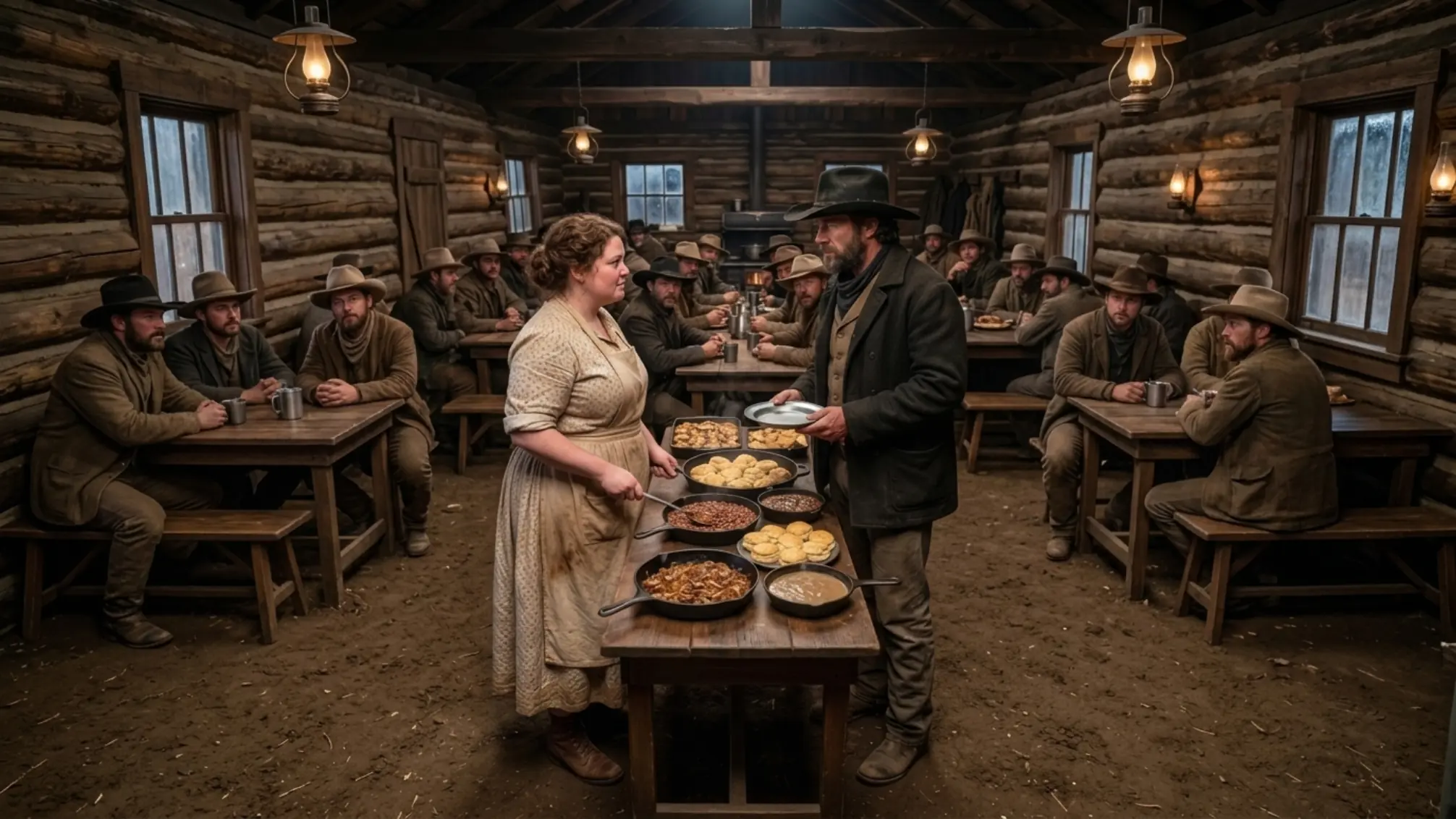
Edith tightened her grip around the long wooden serving spoon. “There is still some gravy in the skillet.”
“I wasn’t asking about the gravy.”
The faint hope that had risen inside her immediately disappeared.
Silas glanced toward Coulter Grady, who sat at the head of the long bunkhouse table. “I was wondering whether Miss Mayburn would consider cooking at my wedding next month.”
Several men lowered their eyes, already anticipating the answer. Everyone in Powder Creek knew Silas was engaged to Lillian Crowley, the beautiful daughter of the richest cattle broker in the territory. He had spent months boasting that he would give her the grandest celebration the county had ever seen.
Edith relaxed slightly. “I would be honored.”
Silas shifted his weight. “Lillian says you should come through the kitchen entrance so her guests won’t mistake you for family.”
The ranch hands laughed.
Not all of them, but enough.
The sound struck Edith harder than the words because she had allowed herself to believe, for one fragile moment, that the meal had changed something. She looked down at the creamy gravy cooling across his plate and suddenly felt foolish for imagining that golden biscuits, smoky beans, and bread pudding could make cruel men kinder.
Silas extended the plate farther. “So, can I have another helping?”
Coulter’s chair scraped violently across the floor.
He rose so fast that his tin cup overturned, spilling coffee across the table. “Put the plate down.”
Silas looked at him. “I was only teasing.”
“You insulted the woman who fed you.”
“She is hired help.”
Coulter crossed the room slowly. He did not shout, and that frightened the cowboys more than anger would have. The ranch owner stopped directly in front of Silas, close enough that the younger man’s grin began to weaken.
“Miss Mayburn entered this bunkhouse as my employee,” Coulter said. “She became a guest the moment she served food to men who had spent the morning mocking her.”
Silas laughed nervously. “You going soft because she filled your stomach?”
Coulter removed the empty plate from his hands and placed it on the table.
“No. I’m remembering my father’s first rule.”
“And what was that?”
“A hungry man may forget his manners. A fed man has no excuse.”
The bunkhouse fell silent.
Coulter turned toward the long table. “Anyone who speaks to Miss Mayburn that way again can collect his pay and leave before sunset.”
One of the older cowboys cleared his throat. Another quietly placed his hat on the bench. Nobody laughed now.
Silas’s face reddened. “You would fire me over a joke?”
“I would fire you because you mistook cruelty for humor.”
“You need me for the northern drive.”
“I need riders. Men are optional.”
A low murmur moved through the room.
Silas looked toward the other cowboys, expecting support. None came. Even the men who had laughed avoided his eyes because everyone understood Coulter Grady never issued a warning twice.
Silas snatched his hat and marched toward the door.
Before leaving, he turned toward Edith. “You should be grateful anyone wants you near a wedding.”
Coulter took one step after him.
Silas disappeared into the snow.
For several seconds, Edith remained beside the stove with her hands trembling around the serving spoon. She had endured insults in markets, churches, stores, and homes where women invited her to cook but asked her not to sit at the table. Nobody had ever defended her without expecting something in return.
Coulter returned to his seat.
He looked around the room. “Finish your breakfast.”
The cowboys obeyed.
Edith tried to continue serving, but her fingers would not stop shaking. She set the spoon down, wiped both hands against her apron, and stepped into the pantry before anyone could see her eyes filling with tears.
The small room smelled of flour, dried apples, and smoked meat. She pressed one palm against the rough wooden wall and forced herself to breathe quietly. Crying had always invited pity, and pity was only cruelty wearing gentler clothes.
The pantry door opened behind her.
Coulter entered but remained near the threshold, leaving enough space that she did not feel cornered.
“You didn’t need to do that,” Edith said.
“Yes, I did.”
“You may lose your best rider.”
“He stopped being my best rider when he forgot how to act like a man.”
She turned toward him. “People will say you defended me because you feel sorry for me.”
“People in Powder Creek say whatever makes their own lives feel more interesting.”
“They will laugh at you.”
“They already do.”
That answer surprised her.
Coulter removed his hat. Without it, he looked less severe, though the years of wind, cold, and responsibility remained carved across his face.
“My wife died nine years ago,” he said. “For the first two years, everyone told me when to mourn, when to stop mourning, and when to marry again. When I didn’t follow their schedule, they called me bitter. When I kept the ranch, they called me stubborn. When I stopped attending dances, they called me strange.”
Edith lowered her eyes. “People call me worse.”
“I know.”
The blunt acknowledgment hurt less than denial would have.
Coulter continued. “I did not bring you here because I pity you. I brought you because twenty men were eating beans hard enough to stop a bullet, and everyone in town said Edith Mayburn could make supper from an empty cupboard.”
A reluctant smile touched her mouth. “The cupboard was not empty.”
“It contained flour, onions, salt pork, and something that may once have been coffee.”
“That is almost a feast.”
His expression softened.
“Will you stay?”
“For how long?”
“Until spring, at least. Longer if you decide the ranch suits you.”
Edith studied him. “And if the men object?”
“They can learn to cook.”
She laughed before she could stop herself.
Coulter looked pleased, though he hid it quickly beneath his hat.
During the following weeks, Grady Ranch changed.
At first, the cowboys entered the bunkhouse suspiciously, as if every meal might demand a price beyond hunger. Edith ignored their awkwardness and worked. She prepared beef stew thickened with roasted flour, yeast rolls brushed with butter, cornmeal cakes sweetened with molasses, and pies made from dried apples soaked overnight.
The men stopped arriving late.
They washed before eating.
Some even began removing their hats without being reminded.
Coulter ate with them whenever ranch work allowed. He never demanded special dishes, though Edith noticed he preferred the crisp edges of cornbread and avoided cooked carrots with the stubbornness of a child. When she quietly stopped placing carrots on his plate, he noticed.
“You remember what everyone likes,” he said one evening.
“That is part of feeding people.”
“No. Plenty of cooks remember recipes. You remember people.”
The words stayed with her long after he left the bunkhouse.
Winter deepened across Powder Creek.
Snow buried fence posts, froze water troughs, and turned every trip between buildings into a test of endurance. Edith woke before dawn, carried wood to the stove, and prepared breakfast while the ranch remained dark.
Coulter often appeared before the others.
He would knock softly, enter carrying split logs, and pretend he had come only because the woodpile was low. Edith knew the truth. The pile was rarely low because he refilled it every evening.
They developed a quiet routine.
She made coffee.
He fed the stove.
Sometimes they spoke about ranch accounts, storms, cattle, and supplies. Other mornings, they simply listened to the wind scraping snow against the windows.
One morning, Coulter found her struggling to lift a fifty-pound flour sack from the pantry floor.
“I can manage,” she said.
“I know.”
He lifted it anyway.
Their hands touched briefly against the coarse cloth.
Edith withdrew first.
Coulter placed the sack on the counter but did not step away. “You do that often.”
“What?”
“Pull back as if kindness burns.”
She forced a small smile. “Experience teaches caution.”
“Experience can teach the wrong lesson.”
“And what lesson would you suggest?”
“That not every hand reaches out to hurt you.”
Before she could answer, the bunkhouse door opened and three cowboys entered, bringing cold air and loud conversation with them. Coulter stepped away, but the space between them felt altered.
By February, Edith knew every man on the ranch.
Old Amos needed softer bread because half his teeth were missing. Young Peter could not read but remembered any instruction spoken twice. Jacob Mercer became quiet every Sunday because his wife and sons lived two hundred miles east, and bad weather prevented letters from arriving.
Silas remained on the ranch only because the northern drive required experienced riders and Coulter had agreed to let him stay after a formal apology.
The apology contained all the right words and none of the right feeling.
Edith accepted it because refusing would only create another story for the town. Silas stopped mocking her openly, but his eyes carried resentment whenever Coulter entered the kitchen.
One afternoon, he found Edith alone behind the smokehouse.
“You enjoy having him protect you?” he asked.
“I do not need protection from you.”
“You think Grady looks at you like a woman?”
She continued trimming herbs.
Silas stepped closer. “He looks at you like a useful mule. Strong enough to work, too plain to tempt him.”
Edith’s knife stopped.
He smiled because he had found the old wound.
“You feed him, wash his table, and warm his house. But when spring comes, he will attend the cattlemen’s dance and choose a woman he can proudly stand beside.”
Edith faced him. “Are you finished?”
“Not quite. Lillian told me people are already laughing. They say Coulter hired a wife large enough to survive the winter.”
The words entered deeply because they sounded believable.
Silas left before she could respond.
That evening, Coulter arrived for supper and found the bunkhouse table prepared but Edith absent. A young ranch hand said she had taken bread to the house and gone to her room early.
Coulter found her packing.
The battered trunk lay open across the narrow bed in the small room beside the kitchen. Two dresses, an extra apron, and a pair of stockings were folded inside.
“Where are you going?”
“Back to my cabin.”
“In this weather?”
“The road is passable.”
“Barely.”
“I managed before.”
Coulter stepped into the room. “What happened?”
“Nothing.”
“You have fed men who lie badly. You should recognize the sound.”
She closed the trunk.
“Spring is coming.”
“Eventually.”
“You needed a cook for winter. The cattle will move north, and fewer men will remain here.”
“I still intend to eat.”
“You can hire someone else.”
“I don’t want someone else.”
The sentence stopped her.
Coulter’s expression changed as though he had also surprised himself. He removed his hat and looked down at it.
“Silas spoke to you,” he said.
Edith did not answer.
“What did he say?”
“It does not matter.”
“It matters if it caused you to pack.”
She turned away. “He reminded me that kindness and love are different things.”
Coulter became very still.
“I never promised love.”
“No. You never did.”
The answer was reasonable, yet pain tightened his face.
Edith continued before her courage disappeared. “You have treated me with more respect than any man I have known. I will always be grateful. But I cannot remain here imagining that every shared cup of coffee means more than it does.”
“What do you imagine it means?”
She looked at him.
“Do not make me say it.”
“I need you to.”
Tears burned behind her eyes. “I imagine you notice when I enter a room. I imagine you bring wood before dawn because you want to see me. I imagine your hand stays near mine longer than necessary.”
Coulter listened without moving.
“And then I remember what I look like.”
His jaw tightened. “What does that mean?”
“It means men do not choose women like me.”
“Men like Silas?”
“Most men.”
“I am not most men.”
The trunk stood between them.
Coulter placed his hat on top of it.
“My wife was small,” he said. “Thin, graceful, and admired by every person who met her. When she died, people told me I would find someone similar because they assumed love was a shape that could be replaced.”
Edith lowered her eyes.
“I spent years believing I would never love again because loving another woman felt like betraying her. Then you entered my bunkhouse carrying a spoon, stared down twenty hungry men, and transformed scraps into something that made the whole room remember home.”
“That is cooking.”
“No. That is you.”
Her breath caught.
Coulter stepped around the trunk.
“You are strong enough to lift flour sacks, kind enough to remember which cowboy cannot chew crust, and brave enough to stay in a room where men laughed at you. You have more warmth in one hand than most people carry in their entire bodies.”
Edith shook her head. “You are trying to stop me from leaving.”
“Yes.”
“Because you need a cook.”
“Because the ranch was a place I endured until you arrived.”
Silence filled the small room.
Coulter reached for her hand but stopped before touching it. “May I?”
She nodded.
His fingers closed gently around hers.
“You said no one marries a fat girl,” he murmured. “I have thought about those words every morning since I heard them.”
Shame returned immediately. “I should never have said that.”
“I am glad you did.”
“Why?”
“Because now I know exactly which lie you have spent your life believing.”
He lifted her hand to his chest.
Beneath her palm, his heart beat hard.
“I am not asking you to stay because I feel sorry for you,” he said. “I am asking because when you leave a room, I notice its emptiness. When you smile, I spend the day trying to earn another one. And every morning before sunrise, I carry wood into that kitchen because it gives me an excuse to stand beside you while the rest of the ranch is asleep.”
Edith stared at him.
“Coulter…”
“I do not know how to make this sound pretty.”
“It already does.”
His thumb moved across her knuckles.
“I love you, Edith Mayburn.”
The words broke something inside her, not violently but completely. Every insult, every rejected dance, and every mirror she had avoided seemed to lose part of its power.
She began to cry.
Coulter looked alarmed. “Was that the wrong thing?”
“No.”
“Then why are you crying?”
“Because I have waited thirty-six years to hear it.”
He stepped closer.
Edith rested one hand against his coat. “Are you certain?”
“I have survived droughts, blizzards, stampedes, and men with guns. I have never been more certain of anything.”
She laughed through her tears.
Coulter cupped her face in both hands, moving carefully enough that she could pull away. She did not.
Their first kiss was gentle, almost uncertain.
The second was not.
Outside the room, a floorboard creaked.
Coulter opened the door suddenly.
Six cowboys scattered through the bunkhouse, pretending to examine walls, boots, and an empty coffee pot.
Old Amos remained where he stood.
“Congratulations,” he said.
Edith covered her face.
Coulter pointed toward the door. “All of you, outside.”
“It is snowing,” Peter protested.
“Then listen from farther away.”
The men retreated, laughing for an entirely different reason than before.
Silas watched from the far end of the bunkhouse.
His expression carried no amusement.
Two weeks later, trouble arrived from Powder Creek.
Lillian Crowley canceled her wedding after learning that Silas had lost most of his savings gambling in the back room of the town saloon. Her father accused him of dishonesty, and Silas blamed Coulter for reducing his position on the ranch after the bunkhouse insult.
He left before dawn, taking a horse that did not belong to him.
Three days later, a winter storm trapped the northern cattle herd inside a narrow valley. Silas returned unexpectedly with two men from another ranch, claiming he knew a safe route through the western ridge.
Coulter did not trust him.
But the herd needed movement before snow buried the lower trail.
Edith packed bread, dried meat, and coffee for the riders. Before Coulter mounted, she caught his coat and pulled him closer.
“Do not take the western ridge.”
“Why?”
“Silas spoke to the supply driver yesterday. I heard him say the old bridge was still usable.”
“It isn’t.”
“I know. The spring flood took half the supports.”
Coulter looked toward Silas, who waited near the corral.
“You think he is leading us there deliberately?”
“I think wounded pride makes foolish men dangerous.”
Coulter changed the route.
Silas protested, then finally drew his revolver.
The confrontation ended without gunfire because fifteen cowboys aimed back before he cleared the holster. Under questioning, one of the hired men admitted Silas planned to strand Coulter near the collapsed bridge, take control of the herd, and claim the ranch owner had died in the storm.
Silas was delivered to the territorial marshal.
Coulter returned after midnight with snow covering his coat.
Edith met him at the ranch-house door.
She struck his chest once with both fists.
“You frightened me.”
“I followed your warning.”
“You still frightened me.”
He wrapped both arms around her.
“I came back.”
She pressed her face against his coat. “You had better continue doing that.”
By spring, the snow withdrew from Powder Creek.
Grass returned to the valley, calves filled the corrals, and the Grady Ranch kitchen windows remained open to warm air. Edith no longer slept in the small room beside the bunkhouse.
Her trunk stood inside Coulter’s house.
They married beneath a cottonwood tree on the first Saturday of May.
Edith wore a cream dress she had sewn herself, fitted to her body rather than designed to hide it. Coulter stood beside her in a dark coat, looking at her with such open admiration that the whispers stopped before they began.
The entire ranch attended.
Old Amos cried.
Peter denied crying despite obvious evidence.
Even Lillian Crowley came, bringing wildflowers and a quiet apology for the kitchen-door insult Silas had repeated in her name.
At the supper afterward, nineteen cowboys waited patiently while Edith and Coulter ate first.
When the plates emptied, Silas’s former bunkmate approached the bridal table holding his tin dish.
“Mrs. Grady,” he asked, “may I have another plate?”
The room became silent.
Everyone remembered the question from that first winter morning.
Edith smiled.
“You may.”
Coulter stood and took the plate from him. “Serve yourself. My wife has already cooked enough today.”
The cowboys cheered.
Edith looked up at the man beside her.
Years earlier, she believed being chosen required becoming smaller, quieter, or more beautiful by someone else’s measure. Coulter had never asked her to change.
He saw the powerful arms that stirred kettles and carried sacks.
He saw the broad body that had survived hard winters alone.
He saw the tenderness she placed inside every meal and the courage required to keep offering warmth to a world that had rarely returned it.
Powder Creek continued calling Edith the finest cook in the territory.
But Grady Ranch knew better.
She was the heart that made exhausted men return to the table, the woman who saved the herd by trusting her instincts, and the person who transformed a lonely ranch house into a home.
Edith Mayburn once whispered that no one married a fat girl.
Coulter Grady spent the rest of his life proving that the right man did not choose her despite who she was.
He chose her because he had finally learned to see all of her.