Martha Higgins had learned to judge a room by how quickly people forgot she was standing in it.
At Bitter Creek Boarding House in Wyoming Territory, forgetting her was easy.
Travelers remembered the smell of cinnamon pie drifting through the hall before dawn.
They remembered biscuits so light that miners joked Martha must have taught flour how to float.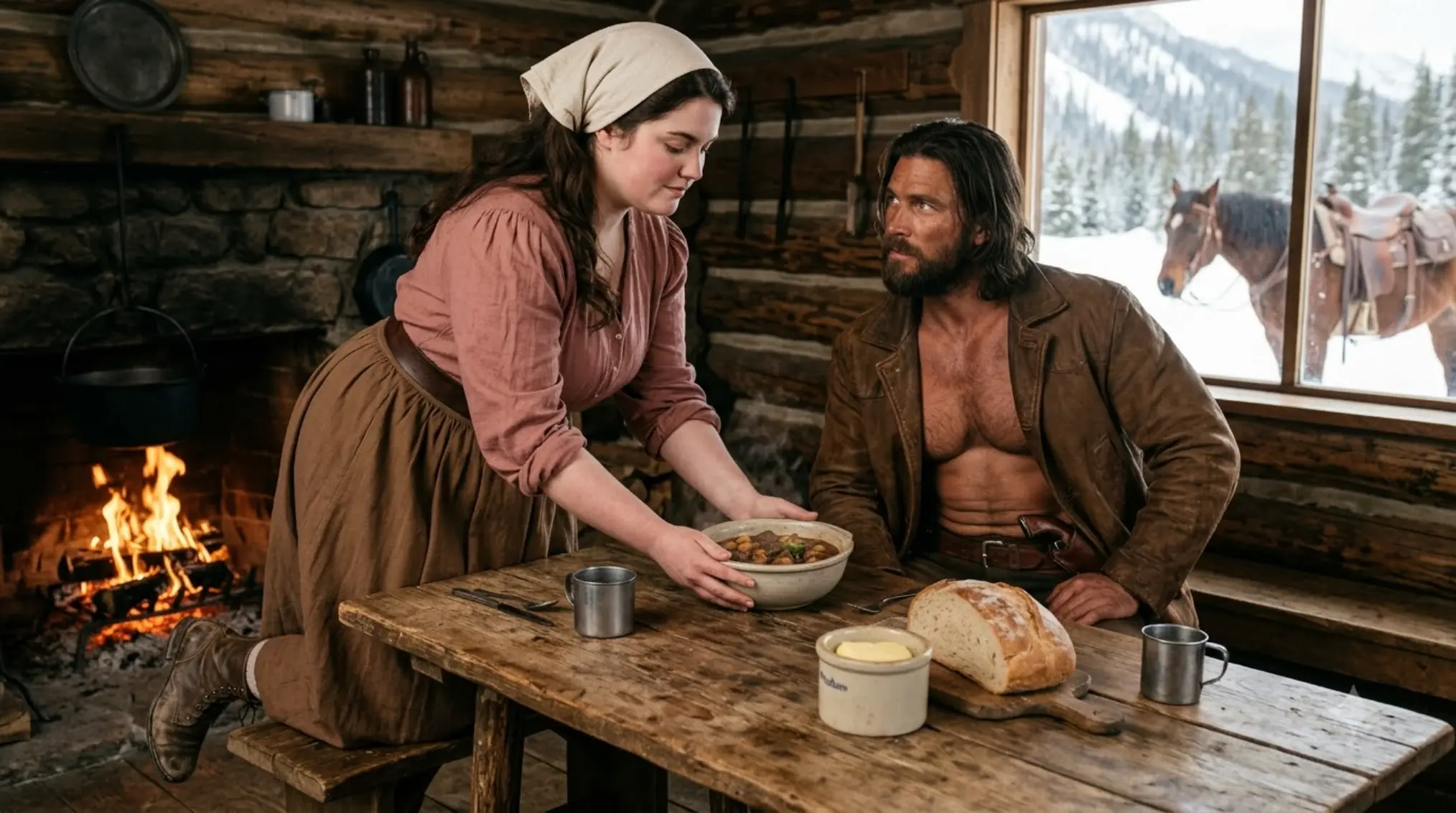
They remembered thick beef stew after crossing forty frozen miles, hot bread split open beneath melting butter, roast onions glazed with molasses, dried-apple cakes, chicken dumplings, and coffee strong enough to wake a dead mule.
They rarely remembered Martha.
That was how Abigail Higgins preferred it.
“Kitchen girls should be heard only when plates hit the table,” her stepmother often said.
Martha was twenty-four years old and taller than most women in Bitter Creek, with full hips, broad shoulders, strong arms, soft round cheeks, and a body people had been teaching her to apologize for since she was twelve.
Abigail called her heavy.
Martha’s half-sister Ruth called her enormous when nobody else was listening.
Men were less creative.
They joked about reinforced chairs.
Strong bed frames.
Winter provisions.
How much flour a husband would need to keep Martha fed.
They said those things loudly enough for her to hear and softly enough to deny cruelty if challenged.
Martha learned not to challenge anyone.
She lowered her eyes.
Worked.
Cooked.
Scrubbed.
Carried.
Endured.
Her father, Thomas Higgins, had never spoken to her that way.
Before his death, he had called her his strong girl.
Not big.
Not clumsy.
Strong.
He had taught her to split kindling, mend harness leather, sharpen knives, identify bad potatoes before rot reached the center, and judge a storm by how horses shifted their weight.
Thomas had worked mines before buying the boarding house.
He said surviving underground had taught him that usefulness mattered more than prettiness.
“A beam doesn’t care whether another beam is handsome,” he once told her while repairing the pantry ceiling. “It cares whether the other one holds.”
Martha had laughed.
Years later, she would remember those words.
At twenty-four, she remembered mostly his absence.
Thomas had supposedly died seven years earlier in a mining collapse near Colorado.
Abigail received the news through a letter.
No body returned.
No personal effects except his battered watch, which Abigail sold within a month.
Martha asked questions at first.
Which mine?
Who was with him?
Where was he buried?
Why had nobody come to speak with the family?
Abigail answered until she became irritated.
Then she stopped answering.
“Dead is dead,” she said.
Life narrowed afterward.
The boarding house debt grew.
Abigail stopped treating Martha like a daughter and began treating her like unpaid labor.
By twenty-four, Martha rose at four every morning.
She lit the stove.
Kneaded dough.
Fed twelve to twenty guests depending on the season.
Washed linen.
Prepared supper.
Cleaned.
Then slept in a narrow room behind the pantry.
Ruth attended dances.
Martha baked the cakes served at them.
One February evening, everything changed.
She had been carrying folded sheets along the upstairs corridor when she heard Abigail speaking inside the office.
A man answered.
His voice was oily and amused.
Horace Grimby.
Martha recognized him immediately.
Everyone around Bitter Creek knew Horace.
He owned a laundry operation near the Dakota line, three wagons, several workers who appeared terrified of him, and enough debt notes to control half a dozen struggling businesses.
He had lent Abigail three hundred dollars.
Martha had not known.
She stopped outside the office.
“You promised January,” Grimby said.
Abigail lowered her voice.
“I need more time.”
“You’ve had time.”
“The winter was poor.”
“Not my concern.”
Martha heard paper slide across the desk.
“Three hundred principal.”
“Interest.”
“Transport fee.”
“What transport fee?”
“The fee I invent when people annoy me.”
Grimby laughed.
Abigail did not.
“I have no cash.”
“Then sell the house.”
“I cannot.”
“Then give me something worth three hundred.”
Silence.
Martha started to step away.
Then Abigail spoke.
“I have Martha.”
Martha froze.
Grimby laughed.
“The big one?”
Her fingers tightened around the linen.
“She’s strong,” Abigail continued. “She can wash, cook, lift, clean. You said your laundry needs workers.”
“Workers need wages.”
“She owes us.”
Martha pressed one hand to the wall.
“Owes you for what?”
Grimby sounded entertained.
“Food.”
“Shelter.”
“Years under this roof.”
Abigail’s voice became colder.
“Take her.”
“She’ll work until the debt is cleared.”
Grimby said nothing for several seconds.
Then:
“She willing?”
“She doesn’t need to be.”
Martha stopped breathing.
“Her father left debts.”
“I raised her.”
“She’ll do as she’s told.”
Grimby finally said:
“End of the month.”
Martha backed away.
The sheets slipped from her arms.
She caught them before they hit the floor.
For years she had told herself Abigail was cruel because bitterness had hollowed her out.
She had told herself Ruth was thoughtless because she was young.
She had told herself if she worked hard enough, eventually the boarding house might become hers.
Now she understood.
She was property.
Not legally.
But in Abigail’s mind.
Something to be exchanged when money disappeared.
Martha returned to the kitchen.
She placed the sheets on the table.
Then sat beside the stove for a long time.
Her hands were shaking.
She had twenty-seven days.
No money.
No relatives she trusted.
No horse.
No property.
No place to go.
For the first time since her father died, Martha allowed herself to cry.
Not loudly.
The boarding house was full.
She pressed her apron against her face until the tears stopped.
Then she stood.
There was bread to shape.
People still expected supper.
Three days later, Martha found the newspaper.
A traveler from Kansas had left it folded beneath his mattress.
She was cleaning the room when something slipped loose.
Western Matrimonial Circular.
Martha nearly threw it away.
Then curiosity won.
That night, after everyone slept, she carried the paper into the kitchen and read advertisements by lantern light.
Widowers wanted wives to raise children.
Farmers wanted women “pleasant of face and agreeable temperament.”
Shopkeepers wanted refined young ladies.
One Colorado rancher specifically requested someone under one hundred twenty pounds.
Martha snorted.
“Hope you starve.”
Then she turned the page.
Near the bottom was a small notice.
No decorative border.
No flattering language.
WANTED: Wife capable of surviving severe winters, hard work, and isolation. High San Juan Mountains, Colorado. No foolishness. Practical woman preferred. C. Orr.
Martha read it twice.
Then again.
No demand for beauty.
No demand for thinness.
No mention of piano playing or dancing.
Hard work.
Winter.
Isolation.
Practical.
Those were things Martha understood.
She found paper.
Dipped a pen.
Started.
Mr. Orr,
Then stopped.
What did women write to strangers asking for wives?
She nearly laughed.
Nothing about the situation was normal.
So Martha wrote what she knew.
She could cook.
Preserve vegetables.
Smoke meat.
Sew.
Repair ordinary clothing.
Tend chickens.
Make soap.
Manage stores.
Keep yeast alive through winter.
Recognize spoiled flour.
Treat minor burns.
Use a shotgun badly but improve with instruction.
She paused.
That sounded almost confident.
Abigail’s voice entered her head.
No man wants to wake beside that body.
Martha stared at the paper.
If she traveled hundreds of miles and the stranger rejected her on sight, she might be stranded.
Better honesty now.
Her pen moved.
I should tell you something before you waste postage. No one marries a fat girl, sir. At least no one here would. I am large and I will not pretend otherwise. But I can cook. I can make a feast from an empty pantry, stretch flour through winter, and keep a hearth warm when the wind is trying to tear the roof away.
She swallowed.
Then added:
If those things matter more to you than a narrow waist, you may write back. If they do not, I will understand.
She signed:
Martha Higgins, Bitter Creek, Wyoming Territory.
Her final nickel paid the postage.
Then nothing happened.
One week.
Two.
Three.
Grimby returned to speak with Abigail.
Martha saw him studying her from the dining room doorway.
Not like a man looking at a woman.
Like someone estimating labor.
She almost became sick.
Four days remained before the end of the month.
Then a postal rider left an envelope.
Martha saw her name.
Her heart stopped.
She carried it into the pantry.
Inside was a railway ticket.
Bitter Creek to Denver.
Denver south through Pueblo and onward toward Silverton.
There was also a piece of paper.
Five words.
Martha read them.
Then covered her mouth.
I don’t eat dresses. Come.
For several seconds she stared.
Then laughter escaped her.
Real laughter.
Loud enough that Ruth called from upstairs:
“What’s wrong with you?”
Martha pressed the letter against her chest.
Nothing was wrong.
For once, something might be right.
She left that night.
One carpetbag.
Her father’s cast-iron skillet.
A tin of spices.
Two dresses.
Her coat.
The letter.