“Get up and lose that costume before I drag you out of this parking lot myself.”
Officer Craig Halpern’s finger stopped inches from Marcus Reed’s face while dozens of shoppers watched from between rows of parked cars. Marcus remained on one knee beside a line of shopping carts, his polished black shoe covered in dust and one hand resting calmly against his raised thigh. His formal black commissioner jacket was immaculate despite the humiliation, gold piping running along the edges, polished brass buttons catching the Virginia sunlight, and rows of state police service ribbons fixed neatly across his chest. Halpern looked at all of it and saw only a costume.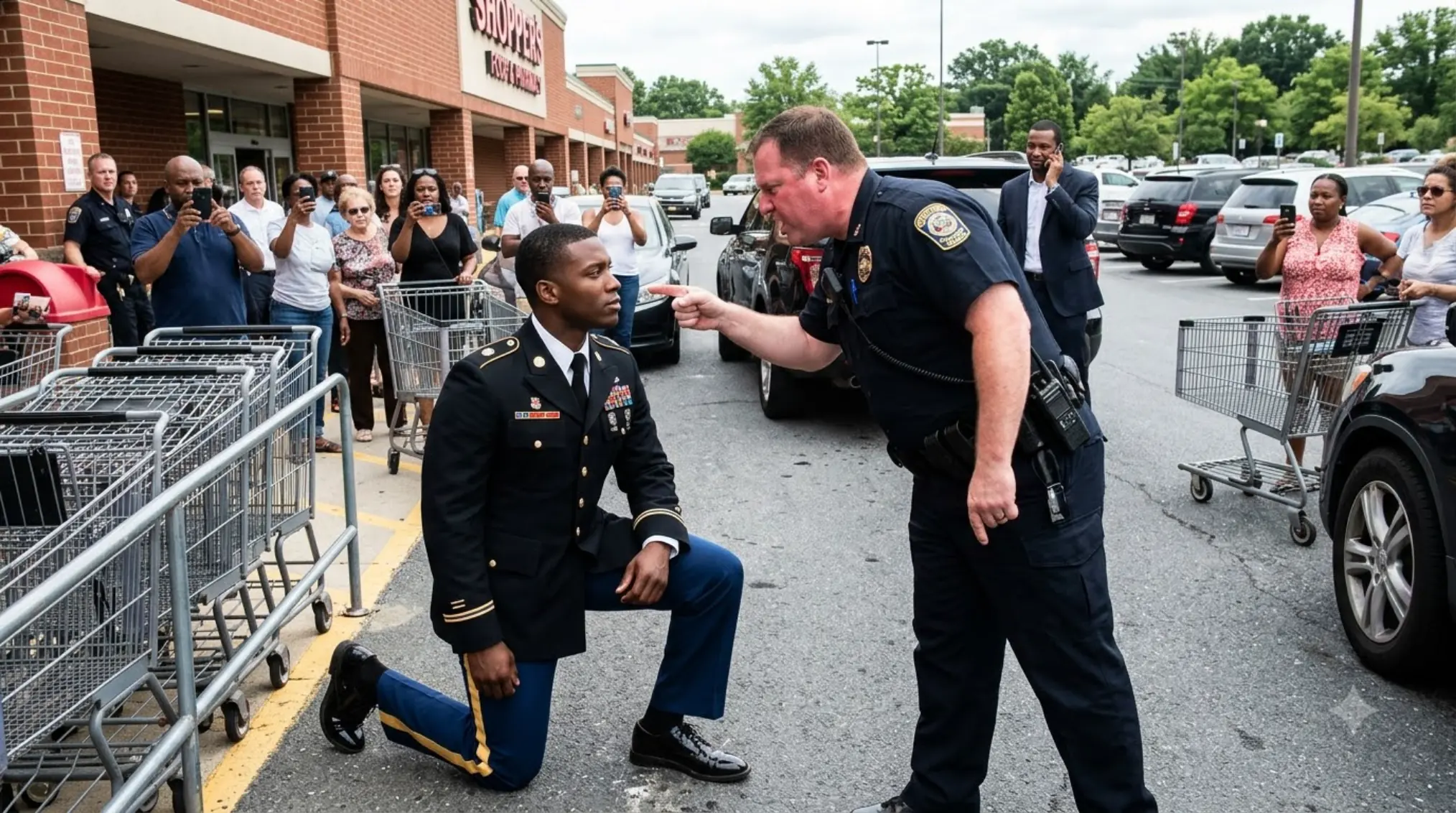
Marcus looked much younger than the forty-seven-year-old officer towering over him. At thirty-two, he had smooth deep-brown skin, a clean-shaven face, close-cropped black hair, sharp dark eyes, and a strong jaw that made his expression look composed even when anger was burning beneath it. He had been appointed State Police Commissioner only seven months earlier, making him one of the youngest people ever to hold the position. That morning, however, he had arrived without his usual security detail because he was supposed to attend a memorial ceremony nearby and had stopped at the shopping center to pick up a small gift for his eight-year-old daughter.
Nobody in the parking lot knew that.
Halpern certainly did not.
“You had your chance to verify me before you decided humiliation was easier,” Marcus said.
Halpern slapped one hand against the metal shopping cart beside them. The sharp bang made several people jump.
“I don’t care who you claim to be. One more word and I’ll bury you in charges.”
Marcus slowly turned his eyes toward the far end of the parking lot.
A tall Black man in a dark suit stood beside a black SUV with a phone against his ear. He had arrived less than thirty seconds earlier, taken one look at Marcus on his knee, and made a short call without raising his voice.
Marcus recognized him immediately.
Deputy Commissioner Aaron Cole.
A faint smile touched Marcus’s face.
Halpern noticed.
“What’s funny?”
Marcus rose slowly as distant sirens began multiplying from several directions.
“Keep talking,” he said. “The people coming through that entrance already know exactly who I am.”
Halpern turned toward the sound.
At first there was only one siren.
Then three.
Then more.
The officer’s expression changed.
Less than ten minutes earlier, he had believed the morning belonged completely to him.
Marcus had pulled into the shopping center at 9:16 a.m. after leaving the Virginia Department of Public Safety headquarters in Richmond before sunrise. His schedule had been packed. A ceremony honoring officers killed in the line of duty was scheduled for eleven, followed by a regional leadership meeting, then a late afternoon briefing on new statewide misconduct reporting procedures.
His daughter, Maya, had created one complication.
“Daddy, you promised.”
Marcus had been halfway out the door when she reminded him.
The school had a family-history project due Monday, and Maya wanted something that represented her late grandfather, Marcus’s father, Henry Reed. Henry had spent thirty-four years as a neighborhood mechanic and had never held an official title in his life. He believed responsibility mattered more than status and had raised Marcus with one rule that appeared in almost every childhood lecture.
If someone gives you authority, make them safer, not smaller.
Marcus wanted Maya to use Henry’s old pocket watch for her presentation.
The battery needed replacing.
That was why a state police commissioner in formal ceremonial uniform ended up walking into an ordinary suburban shopping center on a Saturday morning carrying a small wooden watch box.
He parked near the jewelry store.
Across the parking lot, Officer Craig Halpern sat in a patrol SUV finishing coffee.
Halpern had worked for the local department for nineteen years. He was muscular, broad-necked, impatient, and respected by some younger officers because he had a reputation for taking control quickly. He had also accumulated complaints throughout his career, though none had resulted in major discipline.
Most were described as communication problems.
Aggressive tone.
Unnecessary escalation.
Refusal to verify information.
Treating questions as challenges.
Marcus did not know any of that when he stepped from his car.
Halpern did not know Marcus either.
He saw a Black man wearing a highly decorated formal uniform crossing the parking lot and immediately decided something looked wrong.
Halpern got out of his cruiser.
“Hey.”
Marcus continued toward the store, assuming the officer was calling someone else.
“Hey! You in the fake uniform.”
Marcus stopped.
He turned slowly.
“Excuse me?”
Halpern approached.
“Where did you get that?”
Marcus looked down at his commissioner jacket.
“Get what?”
“The costume.”
Marcus studied him.
“This isn’t a costume.”
“Sure.”
Halpern stepped closer and examined the ribbons.
“You collecting decorations now?”
Several shoppers nearby slowed.
Marcus remained calm.
“I’m on my way to an official ceremony.”
“Official?”
“Yes.”
“What organization?”
Marcus looked directly at him.
“Virginia State Police.”
Halpern laughed.
It was the first moment Marcus realized the encounter might become serious.
“You expect me to believe that?”
“You can verify it.”
Halpern walked around him slowly.
Marcus disliked the movement but did not react.
The officer stopped directly in front of him.
“I know enough about uniforms to know something’s wrong here.”
Marcus raised an eyebrow.
“What exactly?”
Halpern pointed toward the commissioner insignia.
“That.”
Marcus looked at it.
“What about it?”
“People don’t just walk around shopping centers dressed like this.”
“I stopped to buy something.”
“In full dress uniform?”
“I’m attending a ceremony.”
Halpern shook his head.
“You already said that.”
“Because you asked twice.”
That answer irritated him.
“Identification.”
Marcus reached slowly toward the inner pocket of his jacket.
Halpern’s hand moved toward his belt.
“Slow.”
Marcus stopped immediately.
“My identification is inside my jacket.”
“I said slow.”
Marcus pulled out a black credential wallet.
Before he could open it fully, Halpern grabbed his wrist.
Marcus’s eyes sharpened.
“Officer.”
“What?”
“Let go.”
“Not until I know what you’re reaching for.”
“You asked for identification.”
A woman near the shopping carts lifted her phone.
Then another shopper did the same.
Marcus noticed the cameras.
So did Halpern.
Instead of calming him, the audience appeared to make him more determined to win.
“Open it.”
Marcus did.
The credential displayed his photograph, commissioner title, department seal, and state identification number.
Halpern looked at it for barely two seconds.
Then he laughed.
“That’s fake.”
Marcus stared.
“Call the verification number.”
“I don’t need to.”
“Yes, you do.”
Halpern’s expression hardened.
“Don’t tell me what I need to do.”
Marcus slowly closed the credential wallet.
“You accused me of impersonating an official. I provided identification. Verify it.”
Halpern stepped closer.
“You don’t give orders here.”
A man pushing a shopping cart stopped.
“He just told you to check the card.”
Halpern turned.
“Move along.”
The man stayed.
Halpern looked back at Marcus.
“You’re coming with me until this gets sorted out.”
Marcus’s voice became quieter.
“On what legal basis?”
“Possible impersonation.”
“Based on what evidence?”
“The uniform.”
“That credential resolves the question.”
“It resolves nothing.”
Marcus took a slow breath.
Years of leadership training told him to lower the emotional temperature.
His father’s voice told him the same thing.
Make them safer, not smaller.
“Officer Halpern.”
Halpern looked surprised.
Marcus had read his name tag.
“I’m asking you one final time to verify my credential through your dispatch channel.”
Halpern pointed toward the pavement.
“Get on your knee.”
The witnesses became silent.
Marcus stared.
“What?”
“You heard me.”
“There is no reason for me to kneel.”
“You’re being detained.”
“Then state the offense.”
Halpern reached toward Marcus’s shoulder.
Marcus stepped back.
Only one step.
Halpern immediately raised his voice.
“Stop resisting!”
Several shoppers gasped.
Marcus froze.
“I’m not resisting.”
“Down.”
Marcus looked at the phones.
Then at Halpern.
He understood the trap.
If he continued arguing, Halpern would escalate.
If he physically resisted, even slightly, the entire situation could become dangerous.
Marcus lowered himself onto one knee.
Dust immediately coated the toe of his polished shoe.
Halpern stood over him.
“There. Was that so difficult?”
Marcus looked up.
The humiliation was deliberate.
That was what angered him most.
Not being questioned.
Not even being detained.
Authority sometimes required verification.
Marcus had ordered officers under his leadership to challenge credentials when circumstances justified it.
But Halpern had been offered verification and rejected it.
He preferred dominance to facts.
One woman whispered, “This is insane.”
Another man was openly recording.
Halpern pointed toward Marcus’s chest.
“You people buy these medals online and expect everybody to salute.”
Marcus’s expression tightened.
“You should stop.”
Halpern laughed.
“Threat?”
“No.”
Marcus looked toward the cameras.
“Advice.”
That was when Deputy Commissioner Aaron Cole entered the parking lot.
Aaron had planned to meet Marcus near the memorial site. When Marcus failed to arrive at the agreed staging location and stopped answering a secure department message, Aaron checked the commissioner vehicle location authorized for official travel.
The signal placed Marcus at the shopping center.
Aaron drove over.
He saw the crowd first.
Then the patrol SUV.
Then Marcus.
On one knee.
Aaron parked.
He did not run.
He stepped out, looked at the local officer, and pulled out his phone.
His call lasted twenty seconds.
“Commissioner Reed is being detained at Ridgeway Shopping Center. Local patrol officer refusing credential verification. Multiple civilian recordings. Send command liaison and notify the state public safety duty office.”
He listened.
“Yes.”
Another pause.
“No emergency entry unless required.”
Then he ended the call.
Marcus noticed him.
The faint smile appeared.
Halpern saw it.
“What’s funny?”
Marcus stood.
Halpern immediately moved forward.
“I didn’t tell you to get up.”
Marcus brushed dust from his knee.
“No.”
He looked toward the shopping center entrance.
“But this stop is no longer yours to manage alone.”
Sirens approached.
Halpern turned.
Three black SUVs entered first.
Behind them came two marked state police command vehicles.
Then a public safety supervisory unit.
They did not race through the lot recklessly.
They moved with controlled purpose.
The effect was more intimidating because nobody appeared panicked.
Vehicles stopped in a line fifty yards away.
Doors opened.
Senior officers and public safety officials stepped out.
Halpern stared.
The nearest man wore commissioner-command insignia beneath a dark formal jacket.
Another carried a department tablet.
A third was already speaking into a radio.
Aaron Cole walked toward Marcus.
Halpern blocked him.
“This is an active police investigation.”
Aaron stopped.
“I’m aware.”
“Then stay back.”
Aaron showed his credential.
“Deputy Commissioner Aaron Cole, Virginia State Police.”
Halpern looked at it.
Then at Marcus.
His face changed.
Aaron nodded toward the man he had humiliated.
“And that is Commissioner Marcus Reed.”
Silence.
One of the witnesses whispered, “Oh my God.”
Halpern stared at Marcus’s uniform again.
The insignia that had looked fake thirty seconds earlier now looked painfully authentic.
The polished buttons.
The commissioner badge.
The ribbons.
The formal trousers.
Every detail he had dismissed because he did not expect a thirty-two-year-old Black man to hold that authority.
Halpern swallowed.
“There’s been a misunderstanding.”
Marcus said nothing.
Halpern tried again.
“Commissioner, if I’d known—”
Marcus lifted one hand.
“Stop.”
The officer froze.
Marcus stepped closer.
“If you had known what?”
Halpern looked around.
“My position.”
Marcus’s voice remained calm.
“You mean mine.”
“Yes.”
“So your behavior would have changed if you knew my title?”
Halpern hesitated.
“That’s not what I meant.”
Marcus pointed toward his discarded credential wallet sitting on the hood of the patrol vehicle.
“You knew my title.”
“I believed the identification could be fraudulent.”
“Did you verify it?”
“No.”
“Did dispatch tell you it was false?”
“No.”
“Did I threaten you?”
“No.”
“Did I run?”
“No.”
“Did I refuse identification?”
Halpern’s jaw tightened.
“No.”
Marcus looked toward the cameras.
“Then why was I on my knee?”
Halpern had no answer.
A local police supervisor arrived several minutes later.
Captain Allison Moore moved quickly across the lot, looking first at Halpern, then Marcus, then the line of state vehicles.
She appeared to understand the scale of the problem immediately.
“Commissioner Reed.”
Marcus nodded.
“Captain.”
“I apologize for what happened.”
Marcus shook his head.
“Don’t apologize before reviewing it.”
Moore stopped.
Marcus pointed toward the witnesses.
“Preserve every recording.”
Then toward Halpern.
“Preserve his body camera.”
Another direction.
“Dispatch traffic.”
He looked at Aaron.
“And nobody from my office interferes with the local review.”
Aaron nodded.
Halpern stared at him.
“You’re not filing a complaint?”
Marcus looked at him.
“I didn’t say that.”
He stepped closer.
“I said I’m not controlling the investigation.”
Captain Moore ordered Halpern relieved from the scene pending review.
His badge stayed on him that morning.
His weapon stayed secured by department procedure.
But his patrol authority ended before he left the parking lot.
The witnesses remained.
Marcus retrieved his wooden watch box from the ground where it had fallen during the confrontation.
One corner was scratched.
The watch inside was safe.
He looked toward the jewelry store.
Aaron followed his gaze.
“You still planning to get the battery changed?”
Marcus nodded.
Aaron almost laughed.
“Right now?”
“Maya will kill me if I show up without it.”
The absurd normality broke the tension.
Several witnesses smiled.
Marcus entered the jewelry store.
The clerk had watched the entire event through the window.
Her hands shook as she took Henry Reed’s old watch.
“No charge.”
Marcus shook his head.
“I’ll pay.”
“Commissioner, please.”
He looked at her.
“You did the work.”
She finally accepted the money.
The investigation lasted six weeks.
It uncovered more than the parking-lot detention.
Halpern’s body camera showed Marcus repeatedly offering verification.
His report draft, however, described Marcus as “evasive,” “hostile,” and “unable to provide credible credentials.”
Video contradicted those descriptions.
Civilian footage showed Halpern mocking the uniform before examining the ID.
Dispatch logs showed he never attempted credential verification.
Investigators then reviewed previous complaints.
Thirteen surfaced.
Four involved Black professionals questioned after presenting identification.
One involved a physician stopped near his own vehicle outside a hospital.
Another involved a university administrator accused of using a stolen executive parking permit.
In most cases, Halpern eventually released the person.
But the same pattern appeared.
Assumption first.
Verification later.
Sometimes never.
Captain Moore sat through every case review.
She eventually told the city manager:
“We treated each complaint as an isolated personality conflict.”
The manager asked, “What changed?”
Moore answered:
“We finally looked at the pattern.”
Halpern received a formal disciplinary hearing.
His attorney argued he had made a good-faith mistake.
Marcus did not testify about Halpern’s personality.
He testified only about facts.
“I presented valid identification.”
“Yes.”
“Did the officer verify it?”
“No.”
“Did you physically resist?”
“No.”
“Did you threaten him?”
“No.”
“Why did you kneel?”
Marcus paused.
“Because I understood that being legally correct did not make the moment physically safe.”
That sentence changed the room.
Later, when asked whether his status made the detention more serious, Marcus answered:
“No.”
He looked directly toward the review panel.
“My position makes the story unusual.”
A pause.
“It does not make the misconduct worse.”
Another.
“If anything, the real question is how Officer Halpern treats someone whose identity cannot summon a convoy.”
Halpern looked down.
The department terminated him after the review found repeated failure to follow verification procedures, inaccurate reporting, improper escalation, and conduct inconsistent with professional standards.
The firing became the headline.
Marcus disliked that.
He believed the more important change happened afterward.
The local department rewrote identification verification procedures.
Officers received clear instructions requiring reasonable attempts to confirm disputed professional credentials before escalating absent an immediate safety threat.
Supervisors automatically reviewed incidents where citizens presented government credentials that officers rejected.
Complaints involving similar behavior were analyzed collectively rather than separately.
The state police adopted changes too.
Marcus did not pretend his own organization was immune from the same failures.
At a statewide leadership meeting, he stood before nearly two hundred commanders and showed a still image from the parking lot.
Himself.
One knee on asphalt.
Halpern pointing down.
Phones raised around them.
Marcus said:
“This image is uncomfortable because you know who I am.”
The room remained silent.
“Now imagine you don’t.”
He let the words settle.
“No commissioner title.”
“No command convoy.”
“No people rushing to verify the person on the ground.”
Marcus walked slowly across the stage.
“Would the conduct suddenly become acceptable?”
Nobody answered.
“It cannot.”
Months later, Marcus visited the same shopping center with Maya.
She carried her school project under one arm.
Henry Reed’s old pocket watch was mounted carefully inside a display box beside a photograph of him standing outside his repair shop.
Maya pointed toward the parking lot.
“Was it there?”
Marcus knew what she meant.
“Yes.”
She looked toward the shopping carts.
“Where?”
He showed her.
Maya stared at the pavement.
“You had to kneel?”
“Yes.”
“Were you scared?”
Marcus considered lying.
Then remembered his father.
Make them safer, not smaller.
“Yes.”
Maya looked surprised.
“But you’re the commissioner.”
“Commissioners get scared.”
“You didn’t look scared in the video.”
“That doesn’t mean I wasn’t.”
She thought about that.
Then asked the question Marcus had expected eventually.
“Did you make him lose his job?”
Marcus crouched so they were eye level.
“No.”
“But he got fired.”
“Yes.”
“Because of you?”
“Because investigators reviewed what he did.”
Maya frowned.
“That sounds like the same thing.”
Marcus smiled.
“It isn’t.”
He pointed toward the spot.
“If I used my job to punish him because he embarrassed me, that would be revenge.”
Then toward the police station several miles away.
“If his department reviews the evidence and decides his behavior violated the rules, that is accountability.”
Maya absorbed the distinction.
“Which one is better?”
“Accountability.”
“Why?”
“Because revenge depends on who has more power.”
Marcus touched the pocket-watch display.
“Accountability is supposed to work even when nobody powerful is involved.”
Maya nodded slowly.
They walked toward the jewelry store.
The same clerk recognized him.
“Commissioner Reed.”
Marcus smiled.
“Just Marcus today.”
The clerk looked at Maya.
“And who is this?”
“My boss.”
Maya grinned.
“That’s true.”
The clerk laughed.
Outside, a patrol cruiser passed through the lot.
Nobody stopped.
Nobody stared.
The ordinary afternoon continued.
That mattered to Marcus more than the convoy ever had.
People later told the parking-lot story because they loved the reversal.
Aggressive officer humiliates young Black man.
Black SUVs arrive.
Hidden authority revealed.
Officer suddenly realizes the man on one knee outranks people he never imagined could answer the call.
It made an irresistible story.
Marcus understood why.
But whenever someone asked what moment mattered most, he never chose the sirens.
Not the convoy.
Not Aaron Cole stepping forward.
Not Halpern’s face when the commissioner title became undeniable.
Marcus remembered the moment before all of that.
The parking lot was still quiet.
No command vehicles.
No important witnesses.
No official recognition.
Just one officer and one man being told to kneel.
Marcus had deserved fair treatment then.
His title changed nothing about that.
The uniform changed nothing.
The commissioner badge changed nothing.
And the lesson Marcus carried into every department meeting afterward was brutally simple.
Authority reveals character most clearly when the person standing in front of you appears to have none.
Officer Craig Halpern thought Marcus Reed was powerless.
That was why the consequences became larger than one parking-lot mistake.
Not because Halpern insulted a commissioner.
Because the moment he believed he was dealing with nobody important, he showed everyone exactly how he believed a nobody could be treated.