"Wrong house, wrong man; it doesn't matter. Time for a lesson."
Detective Frank Wilson's boot crashes through Brian Davis's front door at 12:03 a.m., splintering the frame as four officers storm into the house with tactical flashlights cutting through the darkness of the Henderson subdivision.
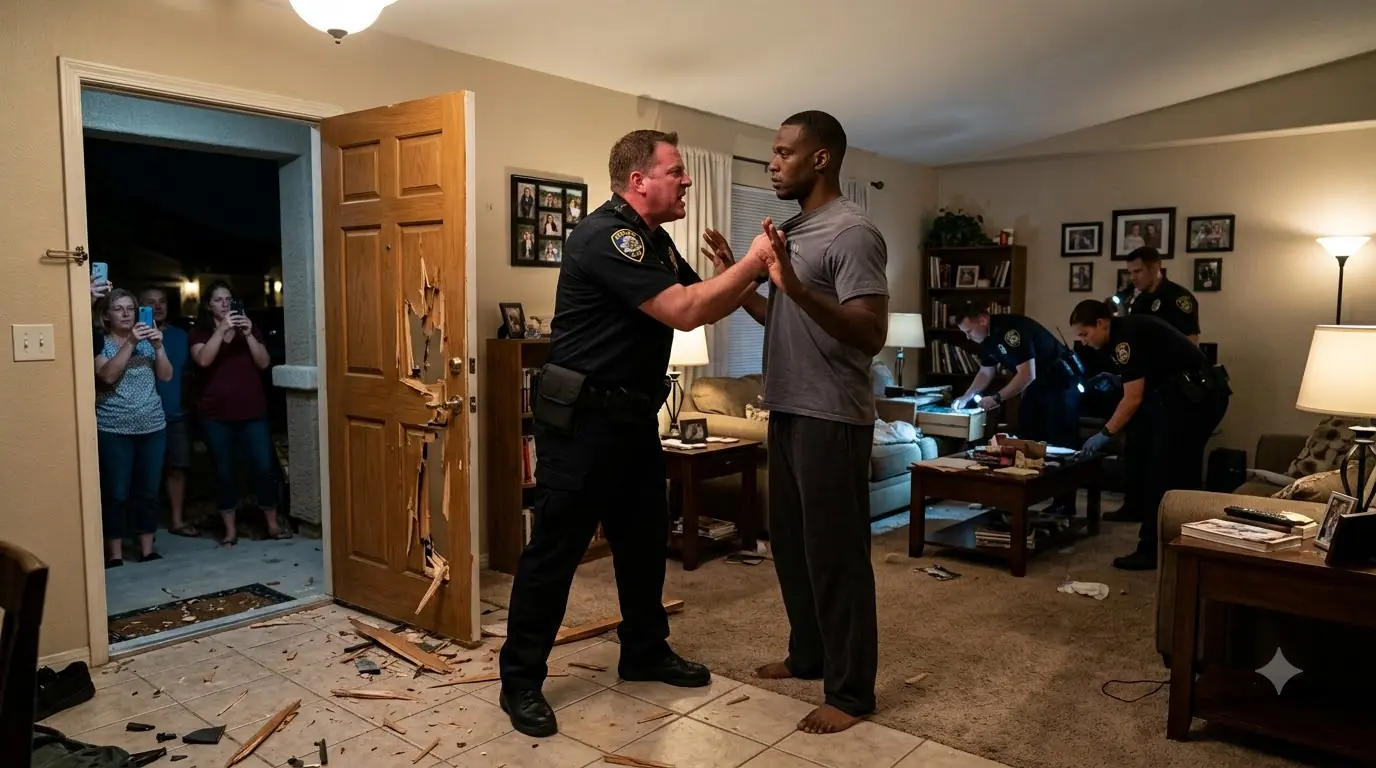
Brian emerges from his bedroom in boxer shorts and a T-shirt with his hands raised, but there is something unusual about his posture: too controlled, too professional.
"Get on the ground," Wilson snarls, adding a racial insult before shoving Brian face-first onto his own living room floor. Brian does not fight back or beg, and his breathing stays steady as if he has been trained for this exact kind of situation.
Some doors should not be kicked down. Some men are not who they appear to be, and some mistakes carry consequences far beyond one corrupt detective's imagination.
Within minutes, the house will be surrounded by witnesses, cameras, and forces Wilson never expected. The quiet man on the floor is not nearly as helpless as he looks.
Three hours earlier, Brian Davis waters his front yard in the Henderson subdivision as part of his usual Tuesday routine. It is 9:15 p.m., and the sprinkler system needs another manual adjustment, the third time this month.
His neighbors wave from their driveways as they return from late shifts at Allegiant Stadium, McCarran Airport, and the Strip casinos that never sleep.
"Evening, Brian," Mrs. Patterson calls from across the street while wrestling grocery bags from her Honda Civic.
"Working late again?"
"Consulting work," Brian replies with practiced ease as he adjusts the spray nozzle.
"Client presentation tomorrow morning; technology implementation for a security firm. You know how corporate types are about deadlines."
She does not know how it really is. None of them do.
Mrs. Patterson thinks Brian helps companies install computer systems. His duplex sits quietly among cookie-cutter homes built for middle management and civil servants, with solar panels under the streetlights and zero-scaped yards arranged according to HOA rules.
It is the kind of neighborhood where people mind their own business and assume their neighbors lead ordinary, predictable lives. Brian has worked hard to make sure that assumption holds.
His mailbox fills with consulting invoices from Dataflow Solutions LLC, home-improvement catalogs, pizza coupons, credit-card offers, and electric bills under Brian Davis's name showing moderate usage. His Netflix subscription renews automatically, and his membership at the 24 Hour Fitness on Eastern Avenue looks exactly like the kind of detail a normal suburban resident would have.
The paper trail has been built carefully over eighteen months. Nothing in it looks suspicious, and nothing in it looks federal.
Brian has even learned the small rhythms of cover life: which grocery store has the shortest checkout line, when the HOA landscapers arrive, which neighbor complains about trash pickup, and how long a normal person should stand in a driveway talking about sprinkler heads before the conversation becomes memorable.
He pays every utility bill on time, complains about rising insurance costs, orders pizza often enough to be recognizable to the delivery driver, and uses a local gym membership with enough consistency to leave a believable trail. The point is not to look invisible; it is to look ordinary enough that no one wants to look twice.
The garage holds a modest silver Toyota Camry with 87,000 miles, Craftsman gardening tools dusted from weekend yard work, and cardboard boxes labeled "Marketing Materials" that really do contain brochures and software manuals. The cover identity works because it is made from real details rather than theatrical ones.
Neighbors see a divorced consultant rebuilding his life after moving from California following a difficult separation. They do not see the man who disappears for three or four days at a time and returns with the deep exhaustion that comes from tracking dangerous people through casino back rooms, police-union meetings, and late-night money drops in warehouse districts.
His refrigerator displays Emma's school photos. His twelve-year-old daughter lives with his ex-wife, Jennifer, in Phoenix, and her soccer schedule hangs beside grocery lists, parent-teacher reminders, and pizza-delivery magnets.
Those details are not fake. They are the parts of Brian's life that make the cover convincing because they are genuinely his.
His divorce is real, too, and so is the distance between Henderson and Phoenix. On weekends when the operation allows it, he drives to see Emma and spends hours pretending that the most complicated thing in his world is whether she should quit soccer for robotics club.
Jennifer knows he works for the FBI but not the full details of the current assignment. Emma knows almost nothing, only that her father travels for consulting work and sometimes misses calls because a client emergency ran late.
Brian hates that part of deep-cover work more than the danger. A lie told to a criminal is strategy; a half-truth told to your child still feels like a debt.
At 9:47 p.m., Brian's secure Samsung phone buzzes once with an encrypted message from Special Agent Sarah Johnson at the FBI Las Vegas Field Office.
"Progress update needed on Operation Clean Sweep; Wilson's crew has accelerated their timeline significantly; Casino money is moving through police-union accounts faster than expected. Captain Rodriguez is getting nervous about federal attention."
Brian types back carefully: "Target remains completely unaware; network mapping 97% complete; financial trails confirmed through three casino sources. Recommend proceeding to phase three within forty-eight hours maximum."
He powers down the phone and slides it into a hidden compartment behind his bathroom mirror beside his service Glock 19 and a leather wallet containing federal credentials. Then he goes back to being suburban consultant Brian Davis, a man who watches true-crime documentaries and complains about HOA fees at neighborhood meetings.
At 11:15 p.m., he settles into bed with a worn paperback copy of Tom Clancy's Clear and Present Danger. It is an ironic choice for a man whose real life has become more dangerous than most political fiction.
The house feels peaceful, safe, and ordinary, exactly as designed through months of careful preparation. Wilson is about to shatter that illusion.
At 12:03 a.m., Brian's front door explodes inward under the force of a police boot. Detective Frank Wilson leads the charge through the destroyed frame, followed by Officers Martinez, Thompson, and Garcia.
Four tactical flashlights cut through the darkness. Brian jolts awake in his bedroom, his heart hammering against his ribs.
"Hands where we can see them. Get up now."
Brian raises his hands slowly and deliberately. Federal training takes over automatically: comply, observe, survive, gather intelligence.
Wilson's flashlight blinds him for a moment. The smell of cheap cologne, adrenaline, and freshly splintered wood fills the hallway.
"Step out of bed. Keep those hands visible."
Brian complies without hesitation, still wearing boxer shorts and a faded gray FBI Academy T-shirt that Wilson cannot read clearly in the chaotic darkness. Wilson shoves him toward the living room and pats him down roughly for weapons that are not there.
"What's this about, officers?" Brian asks, his voice remarkably calm.
"You'll find out when we decide to tell you."
Across the street, Mrs. Patterson's porch light comes on. Then another neighbor's light, then three more.
Midnight police raids do not happen in this part of Henderson. Neighbors emerge cautiously onto their driveways, and cell phones begin recording almost immediately.
The subdivision is populated by casino employees, teachers, retired military families, airport workers, nurses, and municipal clerks. They know enough about police procedure from ordinary life to understand that something about the scene feels wrong even before anyone mentions a warrant.
Mrs. Patterson has lived across from Brian for almost a year and has never heard him raise his voice. Mr. Carter two houses down remembers Brian helping him replace a broken irrigation timer without accepting payment, and the teenager next door remembers him fixing a bicycle chain in the driveway.
Those little memories begin to matter because every witness is comparing the calm man they know with the violent story the officers are trying to create.
Ring doorbells capture the broken doorway and the officers moving through the house. Every second becomes digital evidence Wilson does not yet realize will follow him.
Wilson handcuffs Brian with punishing force. The metal tightens against Brian's wrists, but he does not resist or complain.
His breathing remains controlled and professional. It is exactly the response of someone trained for high-stress detention.
"Search warrant for what specific crime?" Brian asks, using precise legal language.
Wilson answers with another insult and orders him to stay silent. The prejudice in his tone carries into the night air where neighbors are listening.
Mrs. Patterson's seventeen-year-old son starts streaming from across the street. Within minutes, clips of the raid begin circulating through Henderson.
Officer Martinez sweeps through Brian's kitchen, overturning drawers and spilling coffee grounds and utensils across the counters. Thompson searches the master bedroom, while Garcia photographs the rooms with a department-issued camera.
It looks like a standard search, except no one has produced a warrant. Brian notices that immediately.
"Where is your search-warrant paperwork?" he asks quietly.
Wilson strikes him across the mouth without warning.
"You don't ask questions in my city. We ask questions."
Brian tastes blood but stays still. Outside, neighbors react audibly, and more phones rise to record.
"Brian!" Mrs. Patterson calls from her driveway.
"Are you okay? What's happening?"
Wilson turns toward the doorway.
"Ma'am, step back inside your house; this is official police business. Do not interfere."
She does not go inside. Instead, she calls 911 and describes what she is seeing in real time.
Seven other neighbors make similar calls. Dispatch begins receiving multiple independent reports of possible police brutality at 447 Sunrise Lane.
Brian studies Wilson's face in the moving flashlight beams. His eyes are bloodshot, and the smell on his breath suggests he has been drinking.
This is not legitimate police work. It is targeted intimidation disguised as law enforcement.
Martinez emerges from the kitchen empty-handed.
"Nothing suspicious in there, Frank. Just normal kitchen stuff."
Thompson returns from the bedroom with the same result.
"Clean, too clean. Like he was expecting us."
Wilson's frustration grows. Whatever they came to find is not here.
Brian's cover remains solid: consulting materials, family photos, ordinary bills, a believable suburban life with no obvious cracks. Wilson's desperation starts pushing the raid toward something worse.
The Ring doorbell footage spreads through Henderson's neighborhood apps. Mrs. Patterson's stream begins with a few dozen viewers and keeps climbing as people share it to Facebook and Instagram.
Emergency dispatch receives repeated calls about the conduct inside the house. What Wilson intended to be quiet is becoming public by the minute.
The first Ring-doorbell clip is reposted into a Henderson neighborhood group, then copied into a Las Vegas accountability page, then shared by people who have no idea who Brian is but know exactly what an unlawful-looking raid looks like. Viewer counts move from dozens to hundreds while the officers are still searching the kitchen.
One clip shows the splintered door and Wilson ordering neighbors away. Another captures Brian asking for the warrant in a calm voice moments before he is struck.
By the time Channel 8 receives the first call, the internet has already created an archive Wilson cannot erase.
"This is unconscionable," Mr. Carter whispers from two houses down while filming through his living-room window.
"Where is their warrant? Where is their supervisor?"
Wilson drags Brian across the living room by the handcuffs. Brian stumbles but stays balanced, athletic, and controlled.
The neighbors notice how he moves. He does not look like a terrified civilian, even while being mistreated.
"Where's the money?" Wilson demands as he pushes Brian against the dining-room wall.
Family photos of Emma shake in their frames.
"We know you've been talking to people, making calls, asking questions about things that don't concern you."
Brian says nothing. His calculated silence only makes Wilson angrier.
"I'm talking to you. Answer me."
Thompson returns from the garage shaking his head.
"Nothing there either. Car maintenance stuff, lawn equipment, receipts going back two years."
The crowd outside grows to more than a dozen residents. Phones glow in the night like small electronic torches.
Mrs. Patterson calls her daughter, Sarah Patterson, a producer at Channel 8 News.
"Something terrible is happening to Brian. They're hurting him, and I don't think they have any legal right to be there."
Garcia finishes searching the bathroom and looks increasingly uncomfortable.
"No drugs, no hidden weapons, no cash bundles, nothing. This guy is cleaner than my grandmother's kitchen."
Wilson's face darkens with every negative report. The plan had been simple: break in, find evidence that Brian had been asking about casino operations, intimidate him, and if necessary manufacture something that would make him easy to discredit.
Instead, they are carrying out an obviously questionable raid in front of witnesses and cameras. Wilson refuses to accept that the plan is failing.
"Check his computer: hard drive, phone records, bank statements, emails, social media. Something is here."
Martinez boots up Brian's Dell desktop. The screen fills with consulting presentations, client emails, Netflix history, classic-rock playlists, and Amazon receipts for household supplies.
Nothing looks unusual. Brian's digital footprint is deliberately boring.
"Frank," Martinez says carefully, "maybe we got bad intelligence. This guy looks legitimate."
"The intel is solid," Wilson snaps.
"Rodriguez confirmed it at the union meeting; this guy has been asking pointed questions about union business and casino-security arrangements. Someone is paying him to sniff around."
Brian reacts internally to the name. Captain Miguel Rodriguez, president of the Las Vegas Metro Police Union, is the center of the corruption network Brian has spent eighteen months mapping.
Operation Clean Sweep began with irregular casino-security contracts and overtime payments that did not match staffing records. It expanded when investigators discovered union accounts receiving money routed through consulting firms connected to casino vendors.
The deeper Brian and Sarah Johnson went, the more the same names appeared: Rodriguez authorizing assignments, Wilson intimidating witnesses, favored officers receiving unexplained bonuses, and casino contractors winning bids after private meetings with union leadership.
Three casino sources independently confirmed envelopes of cash and disguised consulting payments. What investigators still lacked was a complete map tying street-level intimidation to the union leadership and the money, which is why Brian's cover had been allowed to run for eighteen months.