The hillside looked dead long before Clara Bennett planted the first garlic bulb.
Summer heat had baked the earth outside Cedar Ridge, California, into hard brown plates. Dry grass gathered around the leaning fence posts, the old irrigation ditch had not carried water in twelve years, and the weathered barn at the bottom of the slope leaned so badly that one strong winter storm could finish what time had begun. Most farmers driving past saw land worth clearing, selling, or forgetting.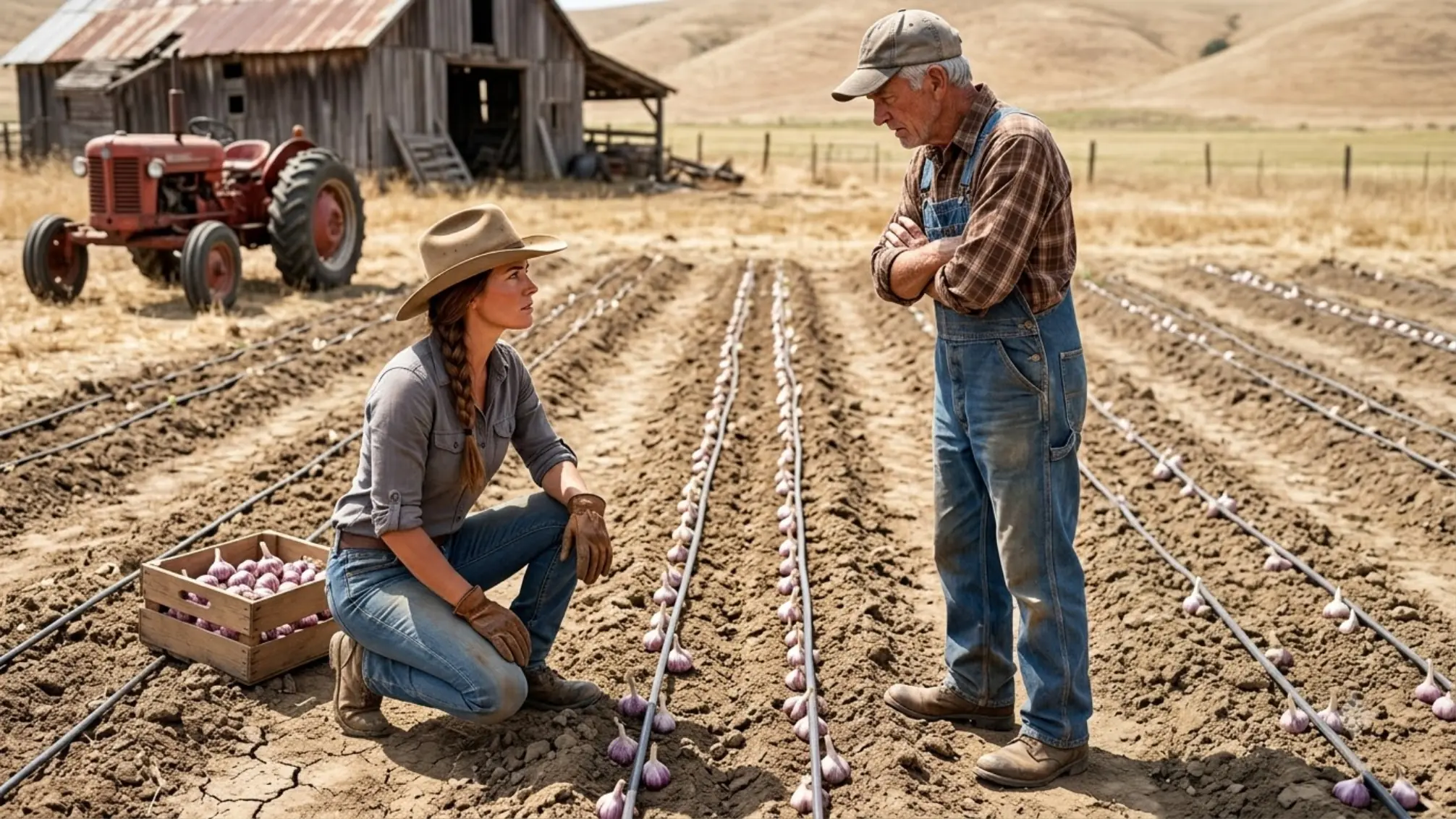
Clara saw five hundred places to begin.
She knelt between two marked rows with a wooden crate beside her boots. Purple-striped garlic bulbs filled the crate, each one separated carefully into cloves and sorted by size. Dust clung to her gray work shirt, faded jeans, and leather gloves, while long chestnut-brown hair rested in a loose braid beneath her tan hat.
Walter Briggs stood several feet away with his arms crossed.
At seventy-two, Walter had spent nearly his entire life working land surrounding Cedar Ridge. His weathered face carried deep lines from sunlight, debt, and disappointment. He wore a brown plaid shirt beneath faded denim overalls, a stained work cap, and boots that had crossed more fields than Clara had years behind her.
He watched her press another clove into the soil.
Old Farmer (scornfully, glaring at the rows): “Five hundred bulbs in dead soil—you just buried every dollar you had.”
Farm Woman (coldly, rising to face him): “No, I planted what you were too afraid to try.”
Old Farmer (threateningly, stepping closer): “When they rot, I’ll take this hillside for half its value.”
Farm Woman (fiercely, holding his stare): “Keep your money—the buyers who ignored you for twenty years are already coming for my garlic.”
Walter’s expression changed.
It lasted only a second, but Clara saw it clearly. The contempt remained in his mouth and narrowed eyes, yet something sharper appeared beneath it when she mentioned the buyers. Fear, perhaps, or the pain of a name he had spent years trying not to hear.
“You have no buyers,” he said.
“I have people waiting for samples.”
“People ask for free samples every day.”
“They are not free.”
Walter glanced down the rows. “You think some fancy chef in San Francisco will climb this hill because you put pretty garlic in a box?”
“I think buyers want flavor, storage life, and clean growing records.”
“You read that in a book?”
“I learned it from soil reports.”
Walter laughed once. “Soil reports do not make crops.”
“No. Work does.”
She returned to her knees and resumed planting.
Walter remained there long enough to understand that she would not argue again. Then he turned toward his old red tractor, muttering that the first hot wind would expose her foolishness. Clara waited until the machine disappeared beyond the lower fence before allowing herself to breathe normally.
Her confidence had been partly performance.
The hillside truly was poor.
Her savings truly were buried in it.
And the buyers had requested samples, but none had promised to purchase a single bulb.
Clara inherited the twenty-six-acre property from her aunt Lucille, who had lived alone in the small farmhouse until heart failure took her the previous winter. Lucille had never farmed commercially. She rented the lower pasture to a neighbor, kept chickens, and maintained a vegetable garden large enough to feed herself.
The hillside had remained untouched.
Local records described it as low-value, erosion-damaged ground unsuitable for conventional production. Two agricultural advisers recommended Clara sell the parcel to Walter Briggs, whose property surrounded it on three sides. Walter offered seventy thousand dollars within a week of Lucille’s funeral.
Clara declined.
He increased the offer to eighty-two thousand.
She declined again.
Walter then explained that property taxes, repairs, and water expenses would destroy her within two years. He presented the warning as kindness, but Clara noticed the survey map folded inside his truck. A red line crossed the hillside toward the county road.
She later discovered that Walter wanted a direct route from his farm to the new agricultural distribution center planned near Cedar Ridge.
The land was not worthless to him.
He simply wanted Clara to believe it was.
Before returning to California, Clara had worked for an agricultural testing laboratory in Oregon. She analyzed soil, plant tissue, mineral deficiencies, and crop diseases for farmers who rarely knew the name of the young woman preparing their reports. The work taught her that failed land was often misunderstood land.
The hillside could not support corn, almonds, or large vegetable crops without expensive intervention.
Garlic was different.
The soil drained quickly. The winter temperatures were cool enough for bulb development. Years of neglect meant no recent chemical residue. The slope received full sunlight, while a buried spring line identified in Lucille’s old property documents offered a possible water source.
Clara tested sixteen garlic varieties in small containers before selecting three.
She chose forty percent Spanish Roja for flavor, thirty-five percent Chesnok Red for cold tolerance and roasting quality, and twenty-five percent California Early for reliability. Most of the seed came from a certified disease-free supplier in Oregon. A smaller portion came from an elderly grower who had preserved a local purple-stripe line for more than thirty years.
That local garlic interested the buyers.
Chef Adrian Vale of the Westbridge Culinary Group had tasted it once at a regional food event. He described the flavor as sweet at first, then deeply warm without bitterness. When Clara contacted his purchasing office and explained that she planned to grow a documented trial crop, the group agreed to evaluate samples.
Two specialty grocers made similar requests.
So did a seed-preservation company.
None promised success.
They only promised to look.
For six weeks, Clara prepared the hillside before planting. She loosened the rows with rented equipment, spread compost, added gypsum where tests showed compacted layers, and planted cover strips between production rows to reduce erosion. She repaired part of the old irrigation line herself, though the buried spring remained too weak to supply the full field.
Walter watched from his neighboring property.
Sometimes he drove past slowly.
Other times he stopped at the fence and offered advice shaped like insult.
He said she was applying too much compost.
Then he said it was not enough.
He claimed the bulbs were planted too deep, though he never stepped close enough to measure.
When rain finally arrived in November, thin green shoots appeared in straight lines across the hillside. Clara stood above them at sunrise, holding Lucille’s old coffee mug and watching the field become visible for the first time.
The crop looked fragile.
It also looked alive.
Walter arrived that afternoon.
He parked beside the fence and stared without speaking. Clara expected another insult, but he remained silent until she walked toward him.
“They came up evenly,” he admitted.
“Most of them.”
“Winter will test them.”
“It will.”
“You should have planted more California Early.”
“The purple varieties are the reason buyers are interested.”
“Buyers want volume.”
“These buyers want something specific.”
Walter tightened his hands around the fence rail. “You keep saying buyers as if you know them.”
“I know their requirements.”
“That is not the same thing.”
“No.”
He seemed disappointed that she agreed.
Walter’s own farm spread across nearly four hundred acres. He grew onions, conventional garlic, alfalfa, and processing tomatoes. His land had once been among the most productive operations in the county, but equipment failures, water costs, and changing contracts had pushed the farm toward debt.
Twenty years earlier, Walter began trying to sell premium garlic to Westbridge Culinary Group.
He sent letters, sample boxes, yield reports, and storage records.
The company rejected him every year.
Sometimes the response cited inconsistent size. Other years, it mentioned excessive chemical residue or insufficient flavor. Once, a purchasing agent wrote that Walter’s garlic had been harvested too late and cured too quickly, leaving it harsh and unstable.
Walter treated every rejection as an insult from people who did not understand farming.
He never treated it as information.
Instead of changing his methods, he increased acreage. He planted larger varieties because buyers at ordinary markets paid by visual size. He used more nitrogen to accelerate leaf growth and harvested according to trucking schedules rather than bulb maturity.
His garlic looked impressive.
It did not taste memorable.
Clara learned this history from Walter’s former foreman, Miguel Santos.
Miguel stopped by the hillside one morning carrying a repaired irrigation valve. He was sixty-one, with careful hands and the habit of examining work before discussing it. He had served under Walter for eighteen years before leaving after a wage dispute.
“I heard you needed this fitting,” he said.
Clara looked at the valve. “Who told you?”
“People talk.”
“Walter?”
Miguel smiled. “Walter does not admit other people need help. He only announces they will fail.”
Clara installed the valve while Miguel inspected her rows. He approved of the mulch depth and spacing but warned that the western side would dry faster than her moisture estimates suggested.
“Wind comes down after March,” he said. “It pulls water from that ground like cloth from a wound.”
Clara adjusted the irrigation schedule that evening.
Miguel’s warning saved the western rows.
By January, the garlic had survived frost, heavy rain, and two weeks of strong wind. Clara removed weeds by hand and recorded growth in a notebook. She photographed leaf development, measured moisture levels, and marked weaker plants with colored flags.
Walter called it unnecessary fussing.
Yet he began visiting more often.
One afternoon, he found Clara applying compost tea through the irrigation line.
“That mixture will clog your emitters,” he said.
“I filtered it twice.”
“It will still clog them.”
“Then I will clean them.”
“You think work fixes every mistake?”
“No. But refusing to adjust guarantees one.”
Walter looked toward the plants. “Westbridge will not buy this.”
“You sound certain.”
“They rejected crops better than yours.”
“Larger than mine.”
“Better.”
“Did you follow their curing requirements?”
His face hardened. “I have grown garlic longer than that company has existed.”
“That was not my question.”
He stepped closer. “You think a laboratory job makes you a farmer?”
“No. Planting, losing sleep, repairing water lines, and risking my own money are working on that.”
Walter stared at her for several seconds.
Then he walked away.
The first real problem arrived in February.
Clara found yellowing leaves across thirty plants near the lower row. At first, she suspected nitrogen deficiency or excess moisture. Tissue tests revealed something worse: early signs of white rot, a fungal disease capable of remaining in soil for decades.
Her stomach dropped when she read the result.
White rot could destroy the crop and make future garlic production nearly impossible. The affected area appeared limited, but every irrigation cycle risked spreading contaminated soil.
Clara marked the section, stopped water flow, and removed the infected plants with surrounding soil. She sealed everything in heavy bags and disinfected her tools. Then she sent additional samples to two laboratories.
Both confirmed the disease.
The pattern bothered her.
The infected plants were concentrated in a narrow oval near an access path. No other part of the hillside showed symptoms. The seed had been certified clean, and the disease appeared too suddenly for natural spread.
Clara checked the fence.
One wire had been lifted and returned.
A boot print remained near the affected row.
She called the county agricultural office.
Inspector Dana Mills documented the site but explained that proving deliberate contamination would be difficult without a witness or video. She advised Clara to install cameras and restrict access.
Walter appeared before the inspection vehicle left.
“What happened?” he asked.
“White rot.”
His face showed no surprise.
Clara noticed.
“You heard already?”
“Word travels.”
“I found it this morning.”
Walter looked toward Dana’s vehicle. “Inspectors talk.”
“She has not called anyone.”
He recovered quickly. “Then perhaps Miguel did.”
“Miguel has not been here.”
Walter folded his arms. “You think I contaminated your field?”
“I think you knew what I found before I told you.”
“You are becoming paranoid.”
“Am I?”
He stepped toward her. “Sell me the property before the disease spreads. I will pay sixty thousand.”
“Your first offer was seventy.”
“Land with white rot is worth less.”
“The disease has not been confirmed beyond one section.”
“You just said it was.”
“I said the plants tested positive. I did not say the land was ruined.”
Walter’s eyes moved toward the bagged soil.
“Take the offer.”
“No.”
“You will lose the crop.”
“Then I lose it.”
“You cannot afford that.”
“That is my problem.”
His voice sharpened. “You do not know what you are doing.”
Clara stepped closer until only the fence separated them.
“Then why are you so desperate to own the result?”
Walter left without answering.
Clara installed cameras that afternoon.
Emily Grant, a local electrician, helped bury the wires and position two small units inside the barn. The system recorded the access path, irrigation controls, and lower rows. Clara did not tell anyone exactly where the cameras were located.
For three weeks, nothing unusual happened.
Then someone entered at 2:16 on a Monday morning.
The figure wore a hood and carried a plastic container. He approached the irrigation tank, removed the cap, and began pouring liquid into the water.
Clara had installed a motion alarm.
When her phone sounded, she called the sheriff and drove from the farmhouse with every light off. The intruder heard the approaching vehicle and ran toward the lower fence.
Deputies caught him beside Walter’s property.
He was seventeen-year-old Caleb Briggs, Walter’s grandson.
The plastic container held concentrated herbicide.
At the sheriff’s office, Caleb claimed he wanted to frighten Clara so she would stop “stealing his grandfather’s future.” He admitted placing infected soil in the lower row after finding old contaminated dirt near a storage shed on Walter’s farm.
Walter arrived with an attorney.
He denied knowing anything about the sabotage.
Caleb looked at him through the interview-room window.
“You told me she would ruin us,” the boy said when deputies allowed them to speak. “You said the buyers should have been ours.”
Walter closed his eyes.
He had not directly ordered the attacks.
But he had spent months describing Clara as a thief, outsider, and threat. He told Caleb that Westbridge had rejected the Briggs farm unfairly and that Clara was using laboratory tricks to take what Walter deserved.
The boy converted resentment into action.
Clara chose not to demand the harshest possible charge.
She supported agricultural restitution, probation, and mandatory work repairing the damage. Caleb would spend weekends under supervision at the county soil-conservation nursery and repay the testing and cleanup costs.
Walter called the choice pity.
Clara called it preventing a foolish seventeen-year-old from becoming the man bitterness was already building.
The herbicide never reached the irrigation lines.
The cameras saved the crop.
Public attention brought consequences Clara had not expected. A local newspaper published a short story about the sabotage and the unusual garlic trial. Westbridge’s purchasing office contacted her to confirm whether contamination threatened the product.
Clara provided every laboratory report.
She also told them the truth.
Thirty plants had been removed. The surrounding soil remained under observation. Independent tests would be conducted before harvest.
The purchasing director thanked her for the transparency.
Walter would have hidden the disease.
Clara documented it.
That difference mattered.
Spring growth accelerated across the hillside. The garlic leaves thickened and reached toward the sunlight in uniform green rows. Clara reduced irrigation as bulbs developed and removed flower stalks from the hardneck varieties so the plants would direct energy underground.
She sold the scapes to local restaurants.
Chef Adrian Vale ordered forty pounds after tasting them sautéed with olive oil and lemon. He called Clara personally afterward.
“If the bulbs carry this sweetness,” he said, “we may have something.”
“May?”
“I do not buy promises.”
“Neither do I.”
He laughed. “Good answer.”
The call did not guarantee a contract, but it gave Clara the first sign that her plan might work beyond the field.
Walter heard about the scape order.
He arrived while Clara and Miguel packed the final boxes.
“You sold leaves to Westbridge?”
“Flower stalks.”
“They bought those?”
“They bought all of them.”
“For how much?”
Clara closed the box. “Enough.”
Walter stared toward the rows.
His own garlic field lay beyond the northern ridge, planted across eighty acres. He had grown more garlic that year than Clara might produce in a decade. Yet no chef had called him personally. No buyer had requested his scapes.
“You are using my name,” he said.
Clara looked up. “For what?”
“To get their attention. You tell them you grow beside Briggs Farm.”
“I tell them my address.”
“They know this valley because of me.”
“Then you had twenty years of attention.”
Walter’s jaw tightened.
“You enjoy this.”
“No.”
“You enjoy seeing me fail.”
Clara set down the packing tape.
“I spend most days trying not to fail myself. I do not have time to build my life around your disappointment.”
The words silenced him more effectively than anger.
He left without another threat.
Harvest began in early June.
Clara stopped irrigation ten days before lifting the first bulbs. She waited until the lower leaves browned while the upper leaves remained green, exactly as the buyers specified. She harvested each row carefully with a digging fork to avoid cuts and bruising.
The first bulb emerged coated in dry brown soil.
Clara brushed it gently with her glove.
The wrapper was tight, the cloves well formed, and purple streaks circled the outer skin. It was not enormous. It was balanced, aromatic, and clean.
Miguel lifted another.
Then another.
Consistency continued across the row.
By sunset, wooden crates filled the curing barn. Clara arranged the bulbs on raised screens with controlled airflow and recorded temperature and humidity every four hours. She did not wash them or cut the tops too early, practices Walter used to speed shipments.
Curing required patience.
So had everything else.
Walter began harvesting his acreage the following week. A processing contract demanded immediate delivery, forcing him to lift bulbs after unexpected rain. Several outer wrappers tore in the damp soil. Crews cut tops quickly and loaded the garlic before proper curing.
The volume looked impressive.
The quality declined in storage.
On the morning Clara prepared her first sample shipment, Walter blocked the access road with his tractor.
She stopped her pickup twenty feet away and stepped out.
“What are you doing?”
“You cannot move this crop.”
“The road is part of my recorded easement.”
“Your aunt’s agreement allowed household access, not commercial trucking.”
“It allows agricultural transport.”
“Not at this scale.”
“I have one pickup.”
Walter climbed down from the tractor.
Behind Clara, Miguel remained near the barn. He had already called the county road office and Clara’s attorney.
Walter approached the truck bed and looked at the sample boxes.
“You think these people will save you?”
“I think they will evaluate the garlic.”
“They will use you for a story, buy one season, and disappear.”
“Then I will find other buyers.”
“You do not understand how this business works.”
“I understand that blocking a legal road will not improve your garlic.”
He pointed toward the boxes. “Those contacts belonged to me.”
“They rejected your product.”
“Because purchasing agents wanted bribes and favors I would not give.”
“Is that what happened?”
Walter’s face changed again.
Clara lowered her voice.
“Or did they tell you exactly what needed to improve?”
He looked away.
Twenty years of rejection letters sat inside a drawer in Walter’s office. Clara had never seen them, but Miguel remembered several. They discussed curing temperatures, residue levels, harsh flavor, irregular maturity, and poor storage performance.
Walter read every letter as disrespect.
He never adjusted the process because changing would mean admitting someone outside his farm understood part of his crop better than he did.
Clara stepped toward the tractor.
“Move it.”
“No.”
“The sheriff is coming.”
“Let him.”
“The buyers are coming too.”
Walter turned.
“What?”
Clara pointed toward the county road.
Three dark vehicles and a refrigerated truck appeared beyond the lower hill.
Chef Adrian Vale had decided not to wait for shipped samples. He brought Westbridge’s purchasing director, two specialty-grocery representatives, an independent produce inspector, and the owner of a seed-preservation company.
They had come to the farm.
Walter stared at the approaching convoy.
For twenty years, he had mailed boxes, written letters, and attended trade events hoping those companies would visit Briggs Farm.
They drove past his entrance without slowing.
The vehicles stopped behind Clara’s pickup.
Adrian stepped out first. He was fifty, tall and silver-haired, wearing a white shirt beneath a dark field jacket. Purchasing director Lena Ortiz followed with a clipboard and insulated sampling case.
She looked at the tractor blocking the road.
“Is there a problem?”
Clara answered before Walter could.
“A temporary misunderstanding about access.”
Walter stepped forward.
“I am Walter Briggs.”
Adrian recognized the name. “Briggs Farm?”
“Yes.”
“We reviewed your submissions several years ago.”
“I submitted every year.”
Adrian’s expression remained polite. “Then you know our quality requirements.”
Walter pointed toward Clara’s truck. “Her garlic came from the same dead hillside and the same valley. Whatever she claims to have done differently is marketing.”
Lena looked at Clara. “May we inspect the curing barn?”
“Yes.”
Walter followed them.
Clara considered stopping him, then decided witnesses were more valuable than privacy.
Inside the barn, Lena selected bulbs randomly from six separate crates. The produce inspector measured size, wrapper integrity, moisture content, disease signs, and physical damage. Adrian cut cloves from each variety and evaluated aroma before roasting several on a portable stove.
The Spanish Roja developed deep sweetness.
The Chesnok Red became creamy without losing warmth.
The local purple-stripe variety produced a complex flavor Adrian described as nutty, floral, and almost smoky.
Walter stood near the door with his arms crossed.
Adrian tasted a second clove.
Then a third.
“How many pounds do you have?” Lena asked.
“Just under twenty-four hundred after final trimming,” Clara replied.
“Across all varieties?”
“Yes.”
“Do you have complete production records?”
Clara placed three binders on the table.
Planting dates.
Seed certificates.
Soil tests.
Irrigation logs.
Disease reports.
Corrective actions.
Harvest dates.
Curing temperatures.
Every decision appeared in writing.
Lena reviewed the white-rot section carefully.
“You removed the affected area immediately?”
“And submitted follow-up soil tests.”
“Any positive result beyond the isolated site?”
“No.”
“You documented the sabotage?”
“The county report is in the final binder.”
Walter’s face tightened as the visitors read.
He had expected Clara’s honesty to frighten them.
Instead, it increased their confidence.
Adrian turned toward Lena.
“I want the Spanish Roja and all of the local purple stripe.”
The specialty grocers requested the California Early and part of the Chesnok crop. The seed company offered a contract for the remaining local bulbs, provided Clara retained the largest and healthiest specimens for next season’s planting.
Within forty minutes, every marketable bulb had a buyer.
The prices exceeded Clara’s highest projections.
She did not cheer.
She sat on an overturned crate because her knees had suddenly become unreliable.
Miguel placed one hand on her shoulder.
“You did it,” he said.
Clara looked across the barn at the rows of garlic hanging beneath controlled fans.
“No. The crop did.”
Walter remained near the door.
Lena approached him with one of Clara’s binders.
“Mr. Briggs, our company did not ignore you.”
His face reddened. “You rejected me for twenty years.”
“We provided evaluation notes.”
“You wanted boutique-sized crops and paperwork instead of real farming.”
“We wanted garlic that met the standards of our kitchens.”
“I produced more in one field than she produced on this entire hill.”
Adrian answered quietly.
“We do not cook acreage.”
Walter looked around the barn.
The sentence struck harder than any insult Clara could have offered.
He walked outside without saying goodbye.
News spread before the refrigerated truck finished loading.
By evening, photographs of the convoy appeared online. Local reporters called Clara. Agricultural publications requested interviews about reclaiming marginal land, growing specialty garlic, and documenting disease control.
The most repeated version of the story said a young woman defeated an old farmer who had laughed at her.
Clara disliked that version.
Farming was not a duel where one crop required another person’s destruction.
Walter’s bitterness had harmed people, and Caleb’s sabotage could not be excused. Yet Clara understood that his anger had grown from fear. His debt was larger than anyone knew, his equipment needed replacement, and the distribution-road project had become his final hope of preserving the farm.
Two months after Clara’s sale, Walter’s processing buyer rejected nearly thirty percent of his stored garlic because of mold, broken wrappers, and unstable moisture. The remaining crop sold at a low commodity price.
His bank issued a warning.
Walter did not visit Clara.
Caleb did.
The seventeen-year-old arrived on a Saturday morning wearing work gloves and carrying a county-supervision form. His restitution agreement required two hundred hours of agricultural conservation work, but the county allowed Clara to decide whether any portion could be completed on her property.
“I understand if you say no,” he said.
Clara studied him.
He looked ashamed rather than angry.
“What did your grandfather tell you about the buyers?”
“That they stole his methods and gave the opportunity to people with better connections.”
“Do you believe that now?”
Caleb looked toward the empty curing barn.
“No.”
“What do you believe?”
“That he kept getting the same answer and blamed everyone except himself.”
Clara gave him a shovel.
He spent the next eight weekends removing contaminated soil, rebuilding the lower fence, and planting non-host cover crops in the affected area. Miguel supervised without kindness or cruelty. Caleb worked hard and asked questions.
By autumn, he began studying soil management at the community college.
Walter interpreted the change as betrayal.
He stopped speaking to his grandson for three months.
Then a November storm damaged part of Briggs Farm’s storage roof. Walter attempted the repair alone, fell from a ladder, and fractured his wrist. Caleb found him and called Clara because he did not know who else might come.
She drove Walter to the hospital.
He sat beside her in the truck with his injured arm held against his chest.
“You do not have to do this,” he said.
“I know.”
“I tried to take your land.”
“Yes.”
“My grandson tried to destroy your crop because of me.”
“Yes.”
“You still came.”
“You were injured.”
Walter looked out the window.
“You make everything sound simple.”
“Some decisions are.”
After the doctor set his wrist, Clara drove him home. The farmhouse looked neglected, and unopened envelopes covered the kitchen table. One came from the bank.
Walter saw her notice it.
“I can manage.”
“I did not ask.”
“You are wondering whether I am losing the farm.”
“I already know you are in trouble.”
His pride rose immediately. “You think buying one crop makes you an expert?”
“No.”
“You think those chefs will stay loyal forever?”
“No.”
“You think your binders can protect you from drought, disease, or prices?”
“No.”
Her repeated agreement left him nowhere to fight.
Clara placed his medicine beside the sink.
“I think records reveal problems early. I think changing methods can improve a crop. I think asking for help before foreclosure is better than pretending experience makes you invincible.”
Walter lowered himself into a chair.
“What would you change?”
It was the first honest question he had ever asked her.
Clara sat across from him.
She did not promise to save Briggs Farm.
She reviewed his soil tests, storage losses, loan documents, and rejection letters. The buyers’ criticisms remained remarkably consistent over twenty years. Walter harvested too early for some fields and too late for others because he treated eighty acres as one crop. He overfed nitrogen, underinvested in curing, and prioritized size over flavor.
His operation was too large for premium hand-managed garlic and too inefficient for low-margin processing markets.
He needed to reduce acreage.
Sell unused equipment.
Restructure debt.
Separate fields by maturity.
Improve curing.
And accept that volume was not the same as value.
Walter hated every recommendation.
He followed some of them anyway.
Clara introduced him to an agricultural restructuring adviser through Westbridge’s supplier-development program. The company did not promise to buy his garlic, but it agreed to evaluate a redesigned trial plot if he followed documented standards.
Walter planted ten acres instead of eighty.
He called it surrender.
Clara called it focus.
The following summer, his trial crop improved. It did not meet Westbridge’s highest standard, but the rejection letter praised the storage quality and recommended lower nitrogen and a later harvest for two sections.
Walter read the letter three times.
Then he changed the plan.
The second trial earned a limited order from a regional restaurant group. It was smaller than Clara’s first contract and far smaller than the business Walter once imagined.
He framed the purchase agreement.
Clara expanded carefully.
She planted two thousand bulbs the next season, not fifty thousand. She built disease-control zones, installed improved drip lines, and hired Caleb part-time while he completed agricultural classes. Miguel became field manager and helped design a curing facility capable of serving nearby small growers.
Three years after the first harvest, the hillside produced several recognized garlic varieties and a locally registered purple-stripe line called Lucille Ridge.
The name honored Clara’s aunt.
Westbridge renewed its contract every year.
Specialty stores placed waiting lists for the local variety.
Seed growers purchased carefully selected stock.
Clara never called the land dead again.
One late afternoon, Walter climbed the hillside carrying a small wooden box. His hair had become almost completely silver, and his steps were slower than when he first stood over Clara’s five hundred bulbs.
She found him near the original lower row.
“What is that?” she asked.
He opened the box.
Inside were copies of every rejection letter Westbridge had sent him across twenty years.
“I kept these because I thought they proved how unfair the world was,” he said.
Clara lifted the first letter.
It contained detailed comments about curing and flavor.
“What do you think they prove now?”
“That I was given the answer and kept arguing with the envelope.”
She returned the letter.
Walter looked across the green hillside.
“I was wrong about this ground.”
“Yes.”
“I was wrong about you.”
“Yes.”
“You could make an apology easier.”
“I did not ask for one.”
He almost smiled.
“I told everyone you buried your money.”
“I remember.”
“You did bury it.”
Clara looked at the rows.
“That is where crops begin.”
Walter closed the box.
“My bank approved the restructuring.”
“Good.”
“Caleb wants to manage the trial fields when he finishes school.”
“Will you let him?”
“I am trying to learn how.”
The following harvest, Walter and Clara shipped garlic on the same refrigerated truck.
His boxes occupied six pallets.
Hers occupied fourteen.
Neither number mattered as much as the fact that both crops had passed inspection.
Chef Adrian visited during harvest week and walked the original five-hundred-bulb plot. Most of the plants there were descendants of the first local purple-stripe line.
He asked Clara when she had known the hillside would succeed.
“I did not know,” she answered.
“You sounded confident.”
“I was defending the chance to find out.”
That distinction became the heart of the story whenever reporters asked.
Clara had not possessed secret certainty.
She had possessed information, discipline, and enough courage to risk being wrong.
Walter had not failed because he was old.
He failed because he treated experience as proof that he no longer needed to change.
The buyers he pursued for twenty years did not choose Clara because she was younger, luckier, or more fashionable. They chose her crop because she listened to their standards, documented her methods, protected quality, and allowed evidence to correct her decisions.
Years later, the collapsing barn was replaced with a shared curing and training center. Young farmers came to study specialty-crop production, soil recovery, disease prevention, and direct-market contracts.
The first display inside the entrance contained two objects.
A wooden crate holding five hundred dried garlic stems.
And Walter’s box of rejection letters.
A small sign between them read:
Potential grows only where pride leaves room for learning.
Walter complained that the sentence made him sound foolish.
Clara reminded him that he had written it himself.
On the anniversary of the first harvest, they stood together above the hillside while workers lifted purple garlic from the soil. The old red tractor remained near the barn, restored but rarely used. Caleb supervised irrigation checks below, carrying a tablet filled with field records.
Walter watched the buyers’ refrigerated truck arrive.
Old Farmer (quietly, folding his arms): “Twenty years I chased that truck.”
Farm Woman (gently, brushing soil from a bulb): “You were chasing the buyer instead of improving what went inside it.”
Old Farmer (regretfully, looking over the hillside): “I nearly destroyed this crop before admitting you were right.”
Farm Woman (firmly, meeting his eyes): “You were not afraid the land would fail. You were afraid it would succeed without you.”
Walter absorbed the words.
Then he nodded.
Everyone once believed Clara had buried her future in dead ground.
Walter believed five hundred garlic bulbs would rot before anyone important noticed them. He offered to purchase the hillside after failure, never imagining the field would expose the reason his own dream remained out of reach.
The buyers did come.
They did purchase the entire harvest.
But the true turning point was not the convoy, the contracts, or the premium price.
It was the moment a young farmer trusted evidence more than ridicule—and an old farmer finally understood that twenty years of rejection had never been a closed door.
It had been advice he was too proud to follow.