“You planted five hundred bulbs on the county’s deadest hill—and now you’re calling this a business?”
The veteran farmer stood at the edge of the rocky field with his thumbs hooked inside his faded denim overalls. At sixty-one, he had spent nearly his entire life growing corn, soybeans, and cattle on the flat land surrounding the property, and he regarded the hillside with the contempt of a man who believed experience had already answered every important question. Before him, a beautiful twenty-four-year-old farm girl knelt between long rows of garlic, her chestnut-brown braid hanging beneath a weathered cowboy hat as she brushed soil from a newly harvested bulb.
“No,” she answered, placing the heavy purple-striped bulb into a wooden crate. “The three contracts in my pocket call it a business.”
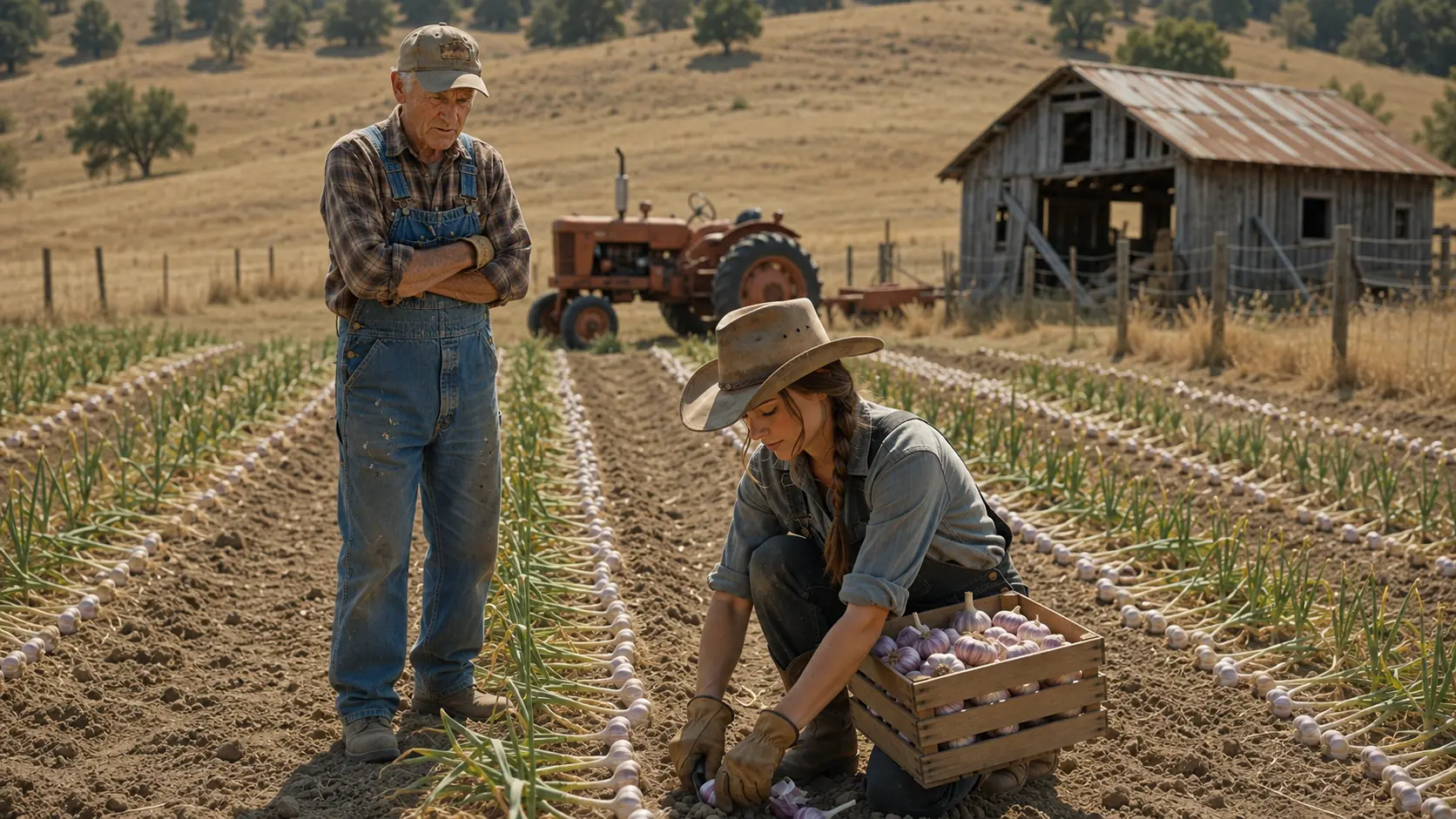
The veteran farmer looked past her toward the collapsing shed, the rusted tractor, and the stones scattered across the uneven ground. “Those chefs will disappear the moment they taste what this shale did to your crop.”
The farm girl rose and glanced toward the county road. A low engine rumble drifted over the ridge, followed by the flash of sunlight against the first refrigerated truck climbing toward the farm.
“Then step aside,” she said. “The buyers you chased for twenty years came here to taste mine.”
Eight months earlier, no one in Monroe County had called the hillside a farm. The tax assessor described the forty-one acres as nonproductive agricultural land, though even that sounded more generous than what the property appeared to be. Most of the lower field had been stripped of topsoil decades earlier, while the upper slope carried a dense layer of clay over broken shale.
Three dead apple trees stood near the eastern boundary. Their gray branches reached toward the sky like hands that had stopped expecting help. An abandoned wooden shed leaned toward a rusted tractor that had not moved since its rear axle broke eleven years earlier.
The farm girl purchased the land with nearly every dollar she had saved since leaving agricultural college. She did not inherit the money, receive a grant, or marry into a farming family. She had earned it repairing equipment, working harvest seasons, packing vegetables at a distribution warehouse, and taking every temporary farm job that paid enough to move her one step closer to owning ground of her own.
The property cost less than a decent house in town because no bank considered it capable of supporting a commercial crop. The seller had tried wheat and failed. The owner before him had planted a small orchard, lost most of the trees to poor drainage, and abandoned the rest.
When the farm girl signed the deed, the real-estate agent asked what she intended to build there.
“A farm,” she replied.
The agent looked through the window toward the barren slope. “I meant after you clear it.”
“I don’t intend to clear it.”
That answer traveled through the county before she had finished unloading her belongings. By the end of her first week, people had already decided that she was inexperienced, stubborn, or too proud to admit she had purchased unusable land. A few admired her courage, though they expressed their admiration in the cautious tone normally reserved for someone approaching a dangerous animal.
The veteran farmer lived beyond the eastern fence. His operation covered more than nine hundred acres of rich, level ground that had belonged to his family for four generations. He owned modern combines, climate-controlled grain storage, irrigation wells, and enough equipment to make the farm girl’s rusted tractor appear like something abandoned after a war.
He introduced himself on her third morning.
“You bought the hill,” he said.
“I did.”
“Have you seen what happens to it in spring?”
“I studied the drainage maps.”
He glanced at the boxes stacked beside her truck. “Maps won’t change clay.”
“No, but roots might.”
The veteran farmer laughed. It was not cruel laughter, at least not then. It was the dismissive sound of someone hearing a young person repeat an idea that time would eventually correct.
He offered to purchase the upper twenty acres from her. The price was low, but he described it as generous because the land produced nothing. He said he could use the slope for cattle in dry weather and prevent her from wasting money attempting to cultivate it.
The farm girl refused.
“You’ll come back to me before winter,” he warned.
“Then you won’t need to keep repeating the offer.”
She spent the next six weeks doing almost nothing that resembled farming. Instead of planting immediately, she walked the hillside every morning with a steel probe, a measuring tape, and a black notebook. She divided the slope into a grid, pressed the rod into the soil at fifty-six marked points, and recorded the depth where it met resistance.
The result remained nearly identical across the entire property. Beneath eight or nine inches of loose surface soil lay a compressed layer of clay created by decades of heavy machinery crossing the hill while it was wet. Water could not pass through it quickly, so spring rain spread sideways, drowned shallow roots, and then disappeared before summer.
The ground had not failed because it lacked nutrients.
It had failed because every previous crop had been planted above a false floor.
The farm girl spent evenings at the county extension office reading agricultural bulletins older than her parents. Most people searched modern websites or watched equipment demonstrations, but she trusted documents written when farmers had fewer chemicals, fewer machines, and more reason to study the behavior of difficult soil.
One bulletin from 1971 contained a diagram showing how certain winter crops followed natural fractures through compacted clay. The report did not mention garlic. It focused on wheat, soybeans, and cover crops, but the farm girl recognized that the principle concerned root behavior rather than one specific plant.
Hardneck garlic produced strong roots before the ground froze. If she planted deeply enough, the roots could reach cracks already beginning to form inside the compacted layer. Winter’s repeated freezing and thawing would widen those fractures, while the garlic remained protected beneath mulch.
She ordered five hundred bulbs from a specialty grower in California. Most were Music and German Red varieties known for cold tolerance, flavor, and strong storage. The order cost three hundred and forty dollars, more than she had spent on food during the previous three months.
When the packages arrived, the veteran farmer saw her unloading the brown paper bags.
“What did you buy?”
“Garlic.”
He looked from the bags to the hillside. “For the garden?”
“For the hill.”
His expression changed from amusement to concern, as if her decision had crossed from unusual into irresponsible. “Garlic doesn’t fix bad ground.”
“Neither does laughing at it.”
He shook his head and returned to his truck.
The farm girl began planting before sunrise during the third week of October. She used a heavy iron dibble bar to punch each hole through the rocky surface, then lowered one clove into the earth and closed the opening with her gloved palm. Every bulb entered the soil at a measured depth and position based on the grid in her notebook.
The work was slow. On the steepest section, she had to brace one boot against a stone while driving the bar downward with her full weight. Cold wind blew across the slope, and by midday her shoulders trembled each time she lifted the tool.
Drivers slowed along the county road to watch.
Some offered advice without leaving their trucks. Others asked whether she was planting flowers. One man told her she should save time by throwing the bulbs into the creek because the result would be identical.
The veteran farmer visited on the second afternoon. He stood above the first completed terrace and studied the precise rows.
“You’re planting too deep,” he said.
“For a normal bed.”
“This isn’t a normal bed.”
“That’s the first thing we agree on.”
He crouched and examined the soil. “Spring water will rot them before they surface.”
“Only if the water remains above the hardpan.”
“It will.”
“We’ll know in March.”
He straightened. “You talk as if the ground signed a contract with you.”
“It did.”
The veteran farmer looked at her.
“I pay attention,” she explained. “It tells me what it needs, and I decide whether I can provide it.”
“That isn’t how land works.”
“It may not be how your land works.”
The answer offended him more than she intended. He had farmed successfully for forty years, survived droughts, floods, disease, and collapsing markets. He believed knowledge came from repetition, hardship, and seasons endured—not from a notebook carried by a young woman on a hillside everyone else had abandoned.
He walked away without offering further advice.
By the end of the fourth day, all five hundred cloves were underground. The farm girl covered the rows with straw, repaired the boundary fence, and stretched a simple barrier across the lower terrace to discourage deer. She placed numbered stakes beside each section and recorded the planting date, variety, soil depth, and expected emergence.
Then the hillside became quiet.
Winter arrived in November. Snow covered the field, thawed, froze again, and returned in heavier layers. From the county road, the land looked as empty as it had before she purchased it.
The veteran farmer passed occasionally on his way to inspect cattle. Each time, he saw the farm girl walking across the frozen slope with her notebook. She measured cracks where the soil appeared, checked whether the straw had shifted, and replaced stones along the terrace edges.
He could not decide whether her discipline impressed or irritated him.
In January, a windstorm tore part of the roof from her shed. The veteran farmer expected her to abandon the property until spring, but the following morning she stood on a ladder replacing the damaged boards. Two days later, he saw smoke rising from the chimney of the tiny farmhouse she had repaired beside the orchard.
“She’s staying,” his wife observed.
“She owns the place.”
“That isn’t what I meant.”
He pretended not to understand.
March came with heavy rain.
Water rushed down the county ditches and flooded the lower portions of several farms. The veteran farmer drove toward the hillside expecting to see garlic rows washing into the creek.
Instead, the water moved slowly across the farm girl’s contour beds. The terraces interrupted its speed, while the straw protected the exposed soil. More importantly, narrow channels had formed where the frozen hardpan fractured beneath the surface.
The water was sinking.
The veteran farmer left his truck and pushed a metal rod into the ground. It passed through ten inches of soil before meeting resistance—nearly two inches deeper than it had the previous autumn.
The farm girl approached carrying her notebook.
“You came to see the disaster?”
“I came to see whether you needed help.”
“Do I?”
He looked across the stable terraces. “Not yet.”
It was the closest he came to admitting surprise.
The first green shoots appeared three days later.
They emerged in narrow lines along the dark hillside, pale at first and then stronger as the sun returned. Not every clove survived, but nearly ninety percent broke through the soil.
The farm girl walked every row and recorded each missing plant. She did not celebrate publicly or hang a sign beside the road. She knew sprouting was only one stage, and crops could fail in dozens of ways before harvest.
Neighbors stopped laughing, but they did not yet believe.
Some said the garlic would remain too small. Others predicted disease, deer damage, or summer heat would finish what winter had not. The veteran farmer said nothing, which was more noticeable than his earlier criticism.
By May, the hillside had become a field.
Long green leaves moved in the wind where dead weeds and stones had once dominated the slope. The roots opened narrow pathways through the compacted layer, and rainfall reached deeper soil that had remained untouched for decades.
The farm girl applied compost between rows, removed weeds by hand, and monitored the leaves for rust. She refused chemical treatments unless necessary because she wanted to understand what the plants could accomplish without having every problem removed for them.
Her bank account continued shrinking.
The garlic looked healthy, but healthy plants did not pay taxes until someone purchased them. She took weekend repair jobs, sold eggs, and restored the abandoned tractor with parts collected from salvage yards. At night, she studied pricing, storage, curing, and direct-market contracts.
The veteran farmer heard she had contacted restaurants in Columbus and Cincinnati.
“They won’t buy from an operation that small,” he told her near the fence.
“They might.”
“I spent twenty years trying to sell specialty corn and beef directly to those places. They want volume, certification, delivery schedules, and consistency.”
“They also want something different.”
“Different doesn’t fill a truck.”
“No, but value does.”
He almost laughed, but the confidence in her answer stopped him.
The first serious test came in June, when several days of extreme heat struck the county. Corn leaves curled, pasture grass faded, and shallow garden crops wilted by noon. The hillside looked vulnerable beneath the harsh sun.
Yet the garlic remained upright.
Its roots had reached moisture trapped beneath the fractured clay. The same layer that once prevented drainage now slowed deeper water from disappearing entirely. The hillside held enough to protect the crop while neighboring fields required constant irrigation.
The veteran farmer watched from his eastern boundary one evening. His own pumps had run since dawn, while the farm girl carried only a small tank across the upper terrace to help younger plants.
“You planned for this too?” he called.
“I planned for the ground.”
“That isn’t the same as planning for weather.”
“No one plans the weather.”
He nodded slowly. “That’s finally something sensible.”
She smiled. “I’ll write down the date.”
The garlic scapes curled in early summer. The farm girl cut them carefully and offered them to a small cheese maker in the next county. The woman purchased two boxes, used them in a limited batch, and called three days later asking for every scape still available.
That small sale paid for fuel, new harvest crates, and repairs to the cooling room.
More importantly, the cheese maker tasted one early bulb.
She contacted a chef in Columbus.
The chef arrived in a spotless car that looked uncomfortable on the farm road. He wore clean boots, carried a small notebook, and studied the hillside without commenting on the shed or tractor.
The farm girl gave him one raw clove.
He sliced it with a pocketknife and tasted it.
For nearly a minute, he said nothing.
The garlic began with a clean heat, then developed sweetness and a deep mineral flavor unlike the flat, sharp product delivered through commercial distributors. Slow growth in the shale-rich hillside had concentrated the oils, while the plant’s struggle through the fractured clay created dense bulbs with tightly wrapped cloves.
“How much will you have?” he asked.
“Just under five hundred marketable heads, depending on final grading.”
“I’ll take one hundred pounds.”
“I won’t have that much after seed stock.”
“What can you guarantee?”
She named an amount.
He wrote a price on a page and handed it to her. It was almost three times what the regional produce distributor had offered.
The farm girl did not accept immediately.
She asked about delivery dates, moisture requirements, quality standards, and payment. The chef looked increasingly interested as the questions continued. Most small growers became excited by the number and ignored the contract details.
She had prepared for both.
By the time he left, she had her first signed agreement.
The cheese maker connected her with a fermentation specialist in Pittsburgh. The Columbus chef called a restaurant owner in Cincinnati. Samples were shipped, tasted, and discussed.
Within three weeks, the farm girl had three contracts in her pocket.
She told no one except the banker financing her equipment repairs. She wanted signed commitments, not compliments. Praise disappeared when markets shifted, but contracts created obligations on both sides.
Harvest began in late July.
The farm girl loosened each bulb by hand to avoid damaging the wrappers. She shook away the soil, trimmed the roots, and placed the garlic carefully into wooden crates. The healthiest bulbs were larger than anyone expected, their purple-striped skins tight around heavy cloves.
That was when the veteran farmer returned.
He had heard refrigerated trucks were scheduled to arrive, but part of him remained convinced the buyers would cancel after seeing the property. Serious restaurant suppliers operated from clean packing facilities, not weathered sheds beneath hills filled with stones.
He found the farm girl kneeling between the rows.
“You planted five hundred bulbs on the county’s deadest hill—and now you’re calling this a business?”
She answered without looking impressed by his arrival. “The three contracts in my pocket call it a business.”
He laughed toward the broken shed because it was easier than acknowledging the crates around her. “Those chefs will disappear the moment they taste what this shale did to your crop.”
Then the first truck appeared.
A second followed it over the ridge.
The third stopped near the farmhouse while the Columbus chef climbed from the passenger side. He walked directly toward the harvest crates, selected a bulb, broke open one clove, and tasted it.
The veteran farmer waited.
The chef turned to the driver. “Load every crate marked for us.”
The fermentation buyer examined the German Red bulbs and asked whether the farm girl could double production the following year. The Cincinnati restaurant owner requested exclusive access to the upper-terrace harvest, offering a deposit large enough to pay the property taxes and repair the shed.
Within an hour, almost the entire marketable crop had been loaded.
The veteran farmer remained beside the fence.
He had spent two decades inviting restaurant buyers to tour his operation. Most praised his farm but purchased from larger distributors offering lower prices and guaranteed volume. His crops were excellent, but they were commodities available from thousands of other farms.
The farm girl had produced something the buyers could not replace easily.
She approached him after signing the final delivery document.
“You were right about one thing,” she said.
He looked at her suspiciously. “What?”
“The hill nearly killed the crop.”
“That sounds more like I was right about everything.”
“But the struggle changed the flavor. Easy ground would have grown bigger bulbs faster. It wouldn’t have grown these.”
He looked toward the remaining rows. “You knew that would happen?”
“I suspected. Knowing came after the harvest.”
That answer mattered to him.
She had not been certain. She had simply prepared better than anyone realized, reduced the risks she could control, and accepted the ones she could not. Her confidence had not come from believing failure was impossible.
It came from knowing failure would teach her something worth carrying into the next season.
The veteran farmer removed his cap.
“I called you foolish.”
“You did.”
“I tried to buy the hill because I thought you’d lose it.”
“I remember.”
“And when the garlic came up, I waited for it to fail.”
“I noticed.”
He studied the soil beneath his boots. “I was wrong.”
The apology was short and uncomfortable, but honest.
The farm girl reached into the nearest crate and handed him one bulb she had reserved for seed. “Plant it on your worst ground.”
He looked at it. “One bulb won’t prove anything.”
“No. But it might make you start asking better questions.”
The following autumn, the farm girl planted nine hundred bulbs. She did not cover the entire hillside, even though the contracts would have supported faster expansion. She added only as much as she could manage without lowering quality or exhausting the soil.
The veteran farmer helped repair the shed roof.
He never admitted that the work was an apology, and she never embarrassed him by asking. In return, she showed him the 1971 extension bulletin and the pages of measurements that had guided her planting plan.
He read them twice.
The next spring, a short row of hardneck garlic appeared along the most compacted corner of his eastern field. When neighbors asked what he was doing, he gave different answers depending on his mood.
Sometimes he said he was improving the soil.
Sometimes he said he was conducting a test.
Only once did he tell the full truth.
“I’m learning from the young farmer next door.”
Within four years, the dead hillside supported several garlic varieties, herbs, pollinator strips, and a small curing barn built from lumber salvaged from the original shed. The farm girl hired two local workers, added a soil-research partnership with the extension office, and created a seed program for farmers trying to restore difficult land.
She never sold the hillside.
The three dead apple trees remained near the eastern boundary. She trimmed the dangerous branches but left the trunks standing as reminders of every person who had looked at the land and seen only previous failure.
Her garlic appeared on restaurant menus across three states. The labels carried the county name, the hillside location, the variety, and the harvest year. Buyers who once ignored the region began traveling there specifically to meet small growers.
The veteran farmer visited during every harvest.
He still argued with the farm girl about planting depth, curing time, machinery, and whether old agricultural bulletins deserved more respect than modern equipment manuals. Their disagreements became one of the county’s favorite forms of entertainment.
But he never again called the land worthless.
Years later, the original five hundred-bulb field became the demonstration plot at the center of the farm. The farm girl placed a weatherproof box beside it containing copies of the soil maps, root diagrams, and handwritten notes that had guided her first season.
Above the box, she mounted a small wooden sign:
THE GROUND WAS NEVER DEAD. PEOPLE JUST STOPPED LISTENING.
Visitors often assumed the story was about garlic.
It was not.
It was about the difference between land that had failed and land that had been misunderstood. It was about information preserved by people who would never meet the farmer eventually helped by it. It was about patience strong enough to survive ridicule and preparation deep enough to make courage useful.
Most of all, it was about a young woman who looked at a ruined hillside and refused to accept the conclusion everyone else had inherited.
The veteran farmer had believed experience meant knowing what could not be done.
The farm girl taught him something harder.
Sometimes experience becomes valuable only after a person is brave enough to question it.