Samuel Reed noticed the boy because of the shoes.
Not his face. Not his clothes. Not even the way he stood outside Reed’s Shoe Repair on a gray October afternoon, staring through the window as if the small shop held something more valuable than money.
It was the shoes.
They were old sneakers, split at the sides, with one sole peeling away so badly that the boy had tied it together with a piece of string. The left shoe was too small. Samuel could tell from the way the boy shifted his weight, lifting his toes slightly every few seconds to ease the pressure.
Samuel had repaired shoes for fifty-two years. He could read pain in the way people walked.
He was seventy-eight now, a thin white-haired man with a bent back, large square glasses, and hands rough from decades of leather, glue, polish, and thread. His shop sat on a quiet corner in Akron, Ohio, between a closed barbershop and a small laundromat. The sign above the door had faded, but it still read:
REED’S SHOE REPAIR
Inside, the place smelled of leather and cedar polish. Old boots lined one shelf. Dress shoes waited in brown paper bags. A brass bell hung above the door, though fewer people came in these days. Most folks bought cheap shoes and threw them away when they broke. Repairing things had become old-fashioned, like handwritten letters and Sunday dinners.
Samuel understood. Time changed.
But he still opened the shop every morning.
His wife, Evelyn, had once told him, “As long as your hands can fix something, Sam, keep the door open.”
Evelyn had been gone nine years.
Samuel kept the door open.
That afternoon, he watched the boy through the window for nearly five minutes. The child looked about ten years old, with light brown skin, dark curly hair, and a navy school jacket zipped to his chin. A backpack hung from one shoulder, patched with silver duct tape at the bottom. He stared at the display of polished secondhand shoes near the window, then looked down at his own feet.
Samuel wiped his hands on a cloth and walked to the door.
When he opened it, the bell jingled softly.
“You looking for someone?” Samuel asked.
The boy jumped back. “No, sir.”
“You need a repair?”
The boy glanced down at his shoes, then quickly moved one foot behind the other. “No.”
Samuel tilted his head. “That shoe says otherwise.”
The boy’s face flushed. “It’s fine.”
“Son, I’ve heard shoes lie less than people, and that one is begging for retirement.”
The boy almost smiled, but he stopped himself.
“I don’t have money,” he said.
Samuel nodded slowly. “Didn’t ask if you did.”
The boy looked suspicious. “Then why are you talking to me?”
“Because you’ve been standing outside my shop looking like you want to come in but don’t think you’re allowed.”
The boy lowered his eyes.
Samuel stepped aside. “Come inside. It’s cold.”
“I can’t buy anything.”
“You can warm up for free.”
The boy hesitated.
Samuel added, “And I’ve got a chair that’s been empty all day. It needs purpose.”
That confused the boy enough to make him step inside.
The bell rang again behind him.
Samuel pointed to the wooden chair near the counter. “Sit.”
The boy sat carefully, placing his backpack on his lap.
“What’s your name?” Samuel asked.
“Jayden.”
“Jayden what?”
The boy hesitated. “Jayden Moore.”
“I’m Samuel Reed. Most people call me Mr. Reed.”
Jayden nodded.
Samuel crouched slowly in front of the boy, though his knees protested. “May I look at that shoe?”
Jayden pulled his foot back. “It’s okay.”
“If it were okay, it wouldn’t be held together with string.”
“My mom said we’ll get new ones soon.”
“I believe she said that.”
Jayden’s eyes sharpened. “She will.”
Samuel looked at him gently. “I’m not saying she won’t.”
That softened the boy’s face a little.
Jayden stretched out his left foot.
Samuel studied the sneaker. The sole was separating. The toe box had cracked. The inside lining was worn thin. Worse, the shoe was at least a size too small. It had probably been hurting him for weeks.
“You walk to school in these?” Samuel asked.
Jayden shrugged. “It’s not far.”
“How far?”
“Twenty minutes.”
Samuel looked up.
Jayden immediately said, “I’m fine.”
Samuel had heard those words from men with broken boots, women with blistered heels, workers who stood twelve hours on concrete, and children who did not want anyone to know they were hurting.
Fine rarely meant fine.
“Where’s your mother?” Samuel asked.
“At work.”
“And your father?”
Jayden looked away. “Not around.”
Samuel did not push.
Instead, he stood, went to the back shelf, and began pulling down boxes.
Jayden watched him nervously. “What are you doing?”
“Looking.”
“For what?”
“A miracle in size five.”
Jayden frowned. “I’m size four.”
“No,” Samuel said. “You were size four about six months ago.”
The boy looked startled.
Samuel found a pair of brown leather school shoes, barely worn, donated by a customer whose grandson had outgrown them. They were sturdy, flexible, and warm enough for winter. He brought them over.
“Try these.”
Jayden shook his head quickly. “No. I can’t.”
“You can try them. Trying is not a crime in Ohio.”
“I can’t pay.”
“You already said that.”
Jayden’s voice grew tight. “Then why do you keep offering?”
Samuel sat on the low stool in front of him.
“Because your feet hurt,” he said simply.
Jayden stared at him.
For a moment, the shop was quiet except for the hum of the heater and the faint sound of rain beginning outside.
Samuel loosened the laces and held out one shoe.
Jayden slowly removed his broken sneaker.
His sock had a hole at the big toe.
The boy noticed Samuel noticing and tucked his foot back.
Samuel stood without saying a word, opened a drawer, and pulled out a new pair of thick gray socks.
Jayden looked embarrassed. “I don’t need those.”
“Your toes disagree.”
“I can’t take all this.”
“Jayden,” Samuel said, “a man my age does not argue with toes.”
The boy blinked.
Then, despite himself, he laughed.
It was a small laugh, but it made him look like a child again.
Samuel helped him try on the socks and shoes. Jayden stood and took a few steps across the shop.
His face changed immediately.
The tightness left his mouth. His shoulders lowered. He looked down at the shoes like he had stepped into another life.
“They don’t hurt,” he whispered.
Samuel felt something inside his chest tighten.
“That is usually the goal of shoes.”
Jayden walked another small circle, testing them.
“How much?” he asked.
Samuel folded the broken sneakers and placed them beside the chair. “For you? Nothing.”
Jayden’s smile vanished. “No.”
“No?”
“I’m not charity.”
Samuel nodded. “Good. Neither am I.”
“I can work.”
“At ten?”
“I’m almost eleven.”
“Congratulations.”
“I mean it. I can sweep. I can take trash out. I can clean windows.”
Samuel studied him.
The pride mattered. He could see that. Giving too freely sometimes made a child feel smaller. Letting him contribute might let him stand.
“All right,” Samuel said. “You can sweep the front of the shop for ten minutes. That will cover the socks.”
“And the shoes?”
Samuel looked toward the shelf. “Those shoes have been waiting for someone who needed them. You did them a favor.”
“That doesn’t make sense.”
“Many true things don’t.”
Jayden swept the front of the shop with serious focus, though he kept glancing down at his new shoes. When he finished, Samuel packed the broken sneakers in a paper bag.
“Why are you keeping those?” Jayden asked.
“I’m not. You are.”
“But they’re broken.”
“Keep them anyway,” Samuel said. “One day, you’ll want to remember what you walked through.”
Jayden did not understand, but he took the bag.
Before leaving, he paused at the door.
“Mr. Reed?”
“Yes?”
“My mom might be mad.”
“For the shoes?”
“She doesn’t like people thinking she can’t take care of me.”
Samuel nodded. “Then tell her this: I run a shoe repair shop. I saw damaged shoes and behaved exactly like a man with no social skills around damaged shoes.”
Jayden stared at him.
Samuel smiled. “Or bring her here. I’ll explain.”
Jayden looked down at the shoes again. “Thank you.”
“You’re welcome.”
The boy stepped into the rain.
Samuel watched him walk away, no longer limping.
That was supposed to be the end of it.
But life, Samuel had learned, rarely ended kindness where it began.
Two days later, near closing time, a woman entered the shop holding Jayden’s hand.
She was in her early thirties, with tired brown eyes, dark hair pulled into a bun, and a work uniform from a nursing home beneath a thin coat. She looked embarrassed, defensive, and exhausted all at once.
Jayden stood beside her in the brown shoes.
“Mr. Reed?” she asked.
“That’s me.”
“I’m Alisha Moore. Jayden’s mother.”
Samuel nodded. “Good to meet you.”
She took a breath. “I wanted to return the shoes.”
Jayden’s face fell.
Samuel looked at her carefully. “Do they not fit?”
“They fit,” she said. “That’s not the problem.”
“What is?”
Her voice tightened. “I don’t want my son taking expensive things from strangers.”
“They weren’t expensive.”
“They look expensive.”
“They were donated.”
“That doesn’t mean free.”
Samuel leaned on the counter. “Mrs. Moore, I understand.”
Her eyes flashed. “Do you?”
“Yes.”
“I work double shifts. I know his shoes were bad. I knew. I was going to buy him new ones Friday.”
Jayden looked down.
Samuel’s voice softened. “I believe you.”
Alisha seemed caught off guard.
“I’m not neglecting him,” she said, but now her voice shook.
“I didn’t think you were.”
She swallowed hard. “People do.”
Samuel was quiet for a moment.
Then he said, “My wife and I had one son. His name was Peter. When he was young, there was a winter when I couldn’t afford a proper coat for him. I was working, but not enough. Evelyn cut up one of her old wool coats and sewed lining into his jacket. I remember the shame more than the cold.”
Alisha looked at him.
“Poverty makes good parents look careless to people who don’t look close,” Samuel continued. “I try to look close.”
Alisha’s face changed.
The fight left her shoulders.
“I’m sorry,” she whispered. “I didn’t mean to come in angry.”
“You’re a mother. Anger is sometimes fear wearing shoes.”
Jayden looked at him. “That actually makes sense.”
Samuel pointed at him. “Don’t sound so surprised.”
Alisha laughed despite herself, then wiped her eyes quickly.
“I want to pay something,” she said.
Samuel shook his head. “Jayden already swept.”
“For ten minutes.”
“He was very thorough.”
Jayden stood straighter.
Samuel looked at Alisha. “But if it helps, bring him by Saturday morning. I could use someone to sort laces by color.”
Jayden’s eyes lit up. “Really?”
Alisha hesitated.
Samuel added, “You can stay too. I have coffee. Bad coffee, but free.”
That Saturday, Jayden came back.
So did Alisha.
And the Saturday after that.
At first, Jayden sorted laces, swept floors, and carried small boxes. Soon he learned how to polish leather, how to identify worn soles, how to tell when a shoe needed stitching rather than glue. Samuel showed him the tools one by one: awls, lasts, edge irons, brushes, needles, and waxed thread.
Jayden absorbed everything.
He asked questions constantly.
“Why does leather crack?”
“Why do people wear shoes that hurt?”
“Why don’t stores make shoes that last longer?”
“Can shoes tell where someone has been?”
Samuel answered as best he could.
“Yes,” he said to the last one. “Shoes remember roads.”
Jayden loved that.
Alisha started bringing breakfast sandwiches on Saturday mornings. Samuel protested.
“You can’t feed me in my own shop.”
“You feed my child with wisdom and old-man jokes. I’m allowed.”
The shop grew warmer with them in it.
Samuel had lived alone since Evelyn passed. His son, Peter, lived in Chicago and called once a month, always rushed, always apologetic. Samuel loved him, but distance had become a habit between them. The shop had become his company.
Now, on Saturdays, it filled with Jayden’s questions and Alisha’s laughter.
Customers noticed.
“Got yourself an apprentice?” one man asked.
Samuel looked at Jayden, who was buffing a pair of boots with intense concentration.
“Looks that way.”
Jayden grinned for the rest of the day.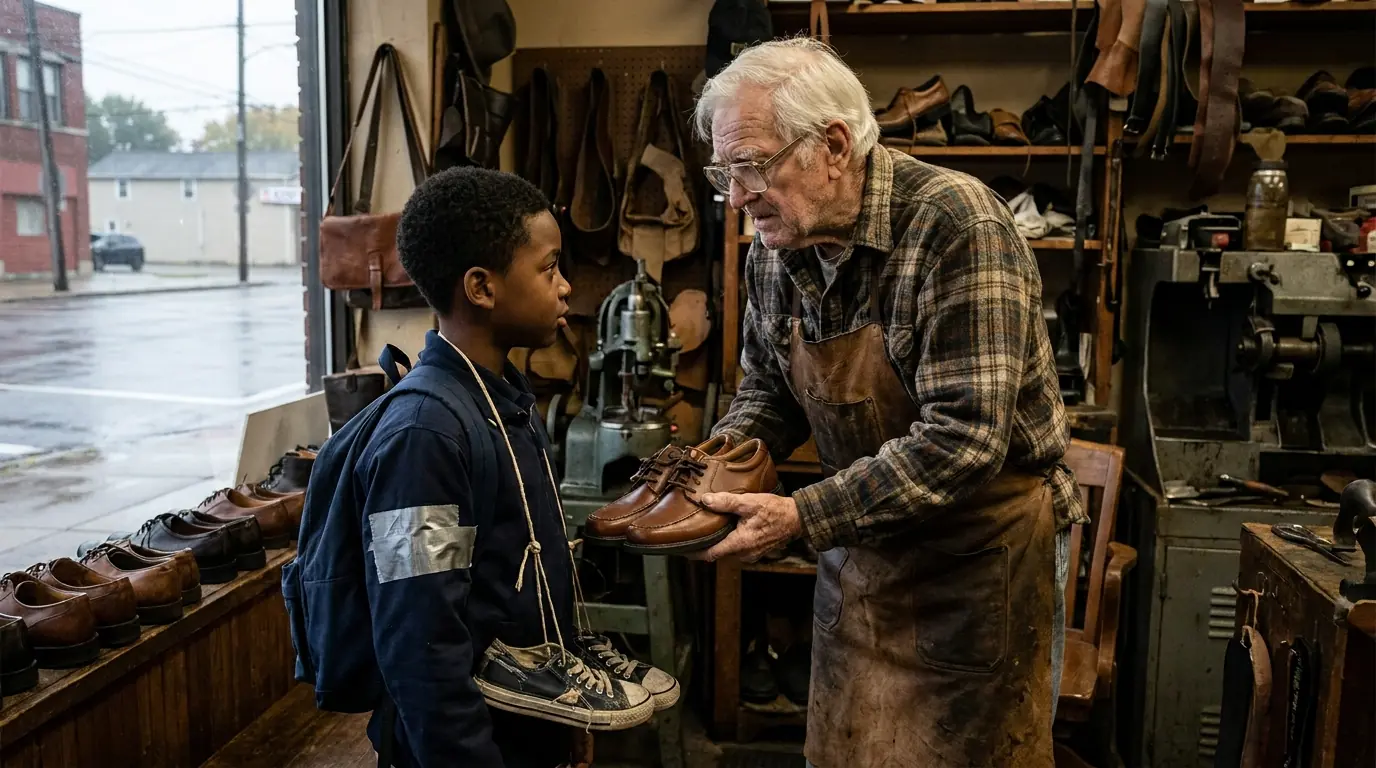
Months passed.
Jayden’s school noticed changes too. He walked better. He focused more. He joined a science club after Samuel helped him build a small model of a shoe sole for a class project about pressure and movement. He wrote an essay titled The Man Who Fixes Roads For Feet, which made Samuel pretend to cough when Alisha read it aloud because he did not want them to see him cry.
By spring, Jayden had become part of Reed’s Shoe Repair.
He had his own apron, too large at first, then less so year by year. Samuel wrote his name on the inside pocket with a permanent marker.
JAYDEN M.
“You misspelled apprentice,” Jayden joked.
Samuel looked over his glasses. “I’ll write that when you stop putting brown polish near black leather.”
“That happened once.”
“Once is how legends begin.”
Life did not become easy for the Moores, but it became steadier.
Alisha got a better position at the nursing home, then began taking night classes to become a licensed practical nurse. Samuel helped by watching Jayden after school twice a week. Jayden did homework in the back of the shop, then helped clean before closing.
Sometimes Alisha arrived late, apologizing before she even entered.
Samuel always said, “We had work to do.”
He never made her feel like she had failed.
One evening, when Jayden was twelve, he fell asleep on the old chair near the heater, a math book open on his lap. Alisha came in quietly and stopped at the sight.
“I hate that he has to spend so much time waiting on me,” she whispered.
Samuel looked at the boy. “He isn’t waiting. He’s growing.”
She leaned against the counter, exhausted. “I keep thinking one day I’ll catch up.”
“You will.”
“How do you know?”
“I don’t,” Samuel admitted. “But I’ve repaired too many shoes to believe worn-out means finished.”
Alisha looked at him for a long moment.
Then she said, “You saved him, you know.”
Samuel shook his head. “No. I bought shoes.”
“No,” she said. “You noticed he was hurting.”
That stayed with him.
Years moved steadily.
Jayden grew taller. His voice deepened. His feet outgrew the brown shoes, then another pair, and another. Samuel kept the original pair in a box beneath the counter, along with the broken sneakers tied with string.
When Jayden was fifteen, he started sketching shoe designs in the margins of his homework. Not flashy fashion shoes, but practical ones. Shoes for nurses who stood all day. Shoes for kids walking long distances. Shoes for elderly people who needed stability without looking like they wore medical equipment.
Samuel found one sketch on the workbench.
“What’s this?”
Jayden tried to grab it. “Nothing.”
Samuel held it higher. “This is not nothing. This is a very serious-looking shoe.”
“It’s just an idea.”
“For what?”
Jayden shrugged. “My mom’s feet hurt after shifts. Her work shoes are ugly and still hurt. I thought maybe there could be better ones.”
Samuel studied the drawing. It was rough but thoughtful.
“Good heel support,” he said. “Wide toe box. Flexible sole. Slip resistant?”
Jayden looked surprised. “Yeah.”
Samuel nodded slowly. “You’re thinking like someone who listens to feet.”
Jayden smiled. “That’s weird.”
“It is also rare.”
From then on, Samuel encouraged the designs. He gave Jayden old catalogues, leather scraps, and books about footwear construction. He taught him how shoes failed, where seams split, how cheap materials broke down, how balance changed with age.
Jayden began to dream beyond the shop.
At seventeen, he won a state innovation competition for designing an affordable school shoe with replaceable soles.
At eighteen, he earned a scholarship to study industrial design in Cincinnati.
The night before he left for college, he came to the shop after closing.
Samuel was polishing a pair of boots that did not need polishing.
“You nervous?” Samuel asked.
“No.”
Samuel looked at him.
Jayden sighed. “Terrified.”
“Good.”
“Good?”
“Fear means you are walking somewhere new.”
Jayden looked around the shop. “What if I fail?”
“Then you come back, eat terrible soup with me, and try again.”
“You make soup?”
“Badly.”
Jayden laughed, then grew quiet.
“I don’t know how to thank you,” he said.
Samuel waved a hand. “Call your mother. Study hard. Don’t wear cheap shoes. That’s enough.”
“No, it isn’t.”
Samuel looked at him.
Jayden’s eyes were shining. “You gave me shoes when I had string holding mine together. But it wasn’t just that. You gave me a place where I wasn’t embarrassed. You let me work without making me feel poor. You taught me how things are made, how things break, how things can be fixed.”
Samuel swallowed.
Jayden stepped forward and hugged him.
At first, Samuel stood stiffly.
Then he wrapped his arms around the boy who was no longer a boy.
“Go on,” Samuel whispered. “Make something good.”
College changed Jayden, but it did not take him away.
He called every Sunday. He sent photos of prototypes. He visited during breaks and worked in the shop like he still had laces to sort. Alisha visited too, proudly wearing the nursing badge she had earned after years of night classes.
Samuel’s own life became harder.
His hands stiffened with arthritis. His eyesight worsened. The rent on the shop increased when the building changed owners. Business slowed further. A new chain repair kiosk opened inside the mall, offering quick fixes cheaper than Samuel could manage.
He did not tell Jayden everything.
He did not tell Alisha either.
Old men are often foolish with pride.
By the time Samuel turned eighty-six, Reed’s Shoe Repair was in danger.
The new building owner wanted to renovate the block and bring in higher-paying tenants. Samuel received a letter giving him ninety days to either sign a new lease at nearly double the rent or vacate.
He read it three times.
Then he folded it neatly and placed it beneath the counter.
For the first time in fifty-two years, Samuel imagined the shop empty.
No smell of leather.
No bell over the door.
No workbench.
No shelves.
No Evelyn’s voice in memory telling him to keep the door open.
He tried to continue as usual, but the shop seemed to know. The light felt dimmer. The tools felt heavier. Even the bell sounded tired.
Alisha found out because the building owner came in one afternoon while she was visiting.
“Mr. Reed,” the man said, barely glancing at her, “I need your decision by Friday.”
Samuel’s face hardened. “I know.”
The man left a new copy of the lease on the counter and walked out.
Alisha picked it up before Samuel could stop her.
Her eyes widened.
“Sam.”
“It’s business.”
“You can’t pay this.”
“No.”
“What are you going to do?”
He looked around the shop. “I suppose I’ll close.”
Alisha’s face filled with pain. “Have you told Jayden?”
“No.”
“Sam.”
“He has finals. And work. And a life.”
“You are part of his life.”
Samuel turned away. “I won’t make him feel responsible for an old shop.”
Alisha’s voice softened. “You made him feel responsible for his future.”
“That was different.”
“Everything is different when you’re the one who needs help, isn’t it?”
He did not answer.
But Alisha called Jayden that night.
Three days later, Jayden walked into Reed’s Shoe Repair wearing a charcoal coat, polished boots, and the expression of someone trying very hard not to cry.
He was twenty-six now, tall, confident, with the same sharp eyes that had once watched Samuel repair shoes in silence. He had graduated, worked with a footwear company, and recently helped launch a small design studio focused on affordable, durable shoes.
Samuel looked up from the counter.
“You should be in Cincinnati.”
“You should have called me.”
Samuel sighed. “Your mother talks too much.”
“My mother talks exactly enough.”
Jayden picked up the lease.
“How long have you known?”
“Long enough.”
“Were you really going to close without telling me?”
Samuel removed his glasses. “I didn’t want to pull you backward.”
Jayden stared at him. “Backward?”
“This shop is old. I am old. You have bigger things now.”
Jayden’s voice became quiet. “Everything big I have started in this shop.”
Samuel looked away.
Jayden opened the leather folder he was carrying and placed several documents on the counter.
Samuel frowned. “What is this?”
“A contract.”
“I don’t sign things I don’t understand.”
“Then I’ll explain.”
Jayden pointed to the first page. “My company is opening a community footwear lab. We need a repair and testing space. A real one. Not a showroom. Not a polished office. A place with history, tools, and someone who understands how shoes actually live after they leave a factory.”
Samuel stared at him.
Jayden continued, “We want to lease this shop from the building owner under our company name, cover the new rent, renovate the back room, and keep Reed’s Shoe Repair open as part of the lab. You would remain master repair consultant.”
Samuel blinked. “Master what?”
“Repair consultant.”
“That sounds fake.”
“It pays real.”
Samuel shook his head. “Jayden…”
“I’m not finished.”
“There’s more?”
Jayden smiled slightly. “A lot more.”
He turned another page. “We’re starting a program called First Step. It will provide free durable shoes to kids whose families can’t afford proper footwear. Every pair will come with repair support. No child should walk to school in pain because shoes cost too much.”
Samuel’s hands trembled.
Jayden reached into his bag and pulled out a box.
It was old, worn at the corners.
Samuel knew it immediately.
Inside were the broken sneakers tied with string and the brown leather shoes Samuel had given him.
“I kept them,” Jayden said.
Samuel whispered, “I told you one day you’d want to remember what you walked through.”
“I remember every day.”
Jayden placed the shoes on the counter between them.
“You didn’t just give me shoes,” he said. “You gave me my first step. Now I want this shop to give that to other kids.”
Samuel pressed one hand against the counter to steady himself.
“I can’t let you do all this for me.”
Jayden’s eyes softened. “Then don’t. Let me do it with you.”
The renovation began one month later.
Samuel complained about nearly everything.
The new lights were too bright.
The new register was too complicated.
The back room paint smelled strange.
The young designers drank too much iced coffee.
The new sign was unnecessary.
Jayden listened patiently and ignored what needed ignoring.
But he preserved what mattered.
The old workbench stayed. Evelyn’s framed photograph remained on the shelf. The brass bell above the door was polished but not replaced. The leather smell remained. The front counter, scarred by decades of coins, elbows, and repairs, stayed exactly where it had always been.
The new sign outside read:
REED’S SHOE REPAIR & FIRST STEP LAB
Beneath it, smaller letters read:
Because Every Child Deserves Shoes That Do Not Hurt.
On opening day, children from local schools arrived with parents, teachers, and social workers. Volunteers measured feet. Designers fitted shoes. Samuel sat near the front, pretending to supervise while secretly wiping his eyes every few minutes.
Alisha stood beside him in her nursing uniform, proud beyond words.
“You okay?” she asked.
“No,” Samuel said. “But in a good way.”
Jayden brought over the first child in the program, a little boy named Marcus whose sneakers were splitting at the sides.
Samuel looked at the boy’s shoes, then at Jayden.
For a moment, time folded.
He saw a ten-year-old outside the window, one sole tied with string.
Jayden seemed to see it too.
Samuel crouched slowly, with Jayden helping him balance.
“What’s your name, son?” Samuel asked.
“Marcus.”
“Well, Marcus,” Samuel said, “those shoes have worked hard.”
Marcus looked embarrassed. “They’re bad.”
“No,” Samuel said gently. “They carried you this far. That makes them honorable. But now they can rest.”
Marcus smiled a little.
Jayden handed Samuel a new pair of shoes, sturdy and warm.
Samuel helped the boy try them on.
Marcus stood, took three steps, and looked down in wonder.
“They don’t hurt,” he whispered.
Samuel closed his eyes for a second.
When he opened them, Jayden was watching him with tears on his face.
Years passed, and First Step grew.
The program expanded to other cities. Jayden’s company became known not for luxury shoes, but for shoes that lasted, shoes designed for real people, shoes built with repair in mind. He hired cobblers, designers, teachers, and former kids from the program. Samuel’s old lessons lived inside every product.
Reed’s Shoe Repair became busier than it had been in decades.
Children came for shoes. Workers came for repairs. Designers came to learn from Samuel. Journalists came too, though Samuel hated interviews and answered most questions with, “Ask Jayden. He uses longer words.”
At ninety, Samuel no longer worked full days. He came in three mornings a week, sat at the bench, and taught.
He taught how to thread a needle.
How to smell bad leather.
How to polish without rushing.
How to ask a customer where the shoe hurts, because the answer was rarely only about the shoe.
On his ninety-first birthday, Jayden organized a celebration at the shop.
Samuel complained again.
“I am too old for balloons.”
Alisha laughed. “You are exactly old enough for balloons.”
The shop filled with people. Children who had received shoes years before returned as teenagers. Parents brought cards. Former customers brought photographs of repairs Samuel had done decades earlier. Peter, Samuel’s son, came from Chicago and stayed the whole weekend, finally understanding what the shop had meant to his father and to many others.
Near the end of the party, Jayden stood beside the counter.
“I want to say something,” he announced.
Samuel groaned. “No speeches.”
Jayden smiled. “You’ve been saying that for twenty years.”
“And yet no one listens.”
Everyone laughed.
Jayden placed the old box on the counter. Inside were the broken sneakers and the brown shoes, now displayed carefully behind glass.
“I walked into this shop when I was ten years old,” Jayden said. “My shoes were too small, broken, and tied together with string. I was embarrassed. I was angry. I expected Mr. Reed to look at me the way some adults looked at poor kids, like we were problems waiting to happen.”
He looked at Samuel.
“But he didn’t see a problem. He saw pain. Then he fixed what he could without making me feel small.”
Samuel’s eyes lowered.
Jayden continued, “Those shoes changed how I walked. This shop changed how I saw myself. Mr. Reed taught me that broken things are not worthless, that repair is an act of respect, and that every person deserves to move through the world without pain.”
The room grew quiet.
“First Step exists because of him. Every child who walks out of here standing taller carries a piece of what he gave me.”
Jayden turned and lifted a small wooden plaque.
It read:
SAMUEL REED WORKBENCH
Where Broken Soles Found New Roads.
Samuel covered his face with one hand.
Jayden came close. “You gave me shoes, Mr. Reed. I brought back a road.”
Samuel reached for his hand.
For a moment, neither spoke.
The bell above the door rang softly as someone entered, but no one turned right away.
Samuel looked around the shop: at the tools, the polished shelves, the children laughing near the fitting area, Alisha smiling through tears, Peter standing beside old customers, Jayden holding the plaque with both hands.
He had once believed he was simply helping a boy with painful shoes.
But kindness had its own craftsmanship.
A pair of shoes became a Saturday apprenticeship.
A Saturday apprenticeship became a dream.
A dream became a company.
A company became a program.
And an old shop that Samuel thought would die with him became the first step for children he would never even meet.
Later that evening, after the party ended, Jayden helped Samuel lock up.
Rain tapped softly against the window, just as it had the first day they met.
Samuel stood near the door, looking at the sign outside.
“Do you ever miss the old name?” Jayden asked.
Samuel shook his head.
“No,” he said. “It still says Reed’s. It just learned to walk farther.”
Jayden smiled.
Samuel looked down at Jayden’s polished boots.
“Good shoes,” he said.
Jayden laughed. “I had a good teacher.”
Samuel reached up and turned off the lights.
The brass bell gave one final soft sound as they stepped outside together.
And as Jayden helped the old man down the front step, Samuel realized that the greatest thing he had ever repaired was not a shoe.
It was a path.
One that began with a boy ashamed of his broken sneakers and led, many years later, to a doorway where no child had to stand outside hurting alone.