The snow began falling over Cedar Hollow, Vermont, just before dusk, soft at first, then thick and steady, covering the road signs, the rooftops, and the narrow sidewalks in a quiet white blanket. By six o’clock, most of the town had already disappeared behind closed curtains and locked doors. The bakery had turned off its lights. The small pharmacy had flipped its sign to CLOSED. Even the church bell tower looked lonely against the gray winter sky.
At the far end of Pine Street, seventy-six-year-old Arthur Bennett sat alone in his kitchen, listening to the wind press against the windows.
His house was old, built by his father before Arthur was born. The floorboards creaked in familiar places. The kitchen faucet dripped unless turned just right. The wallpaper near the stove had faded from yellow to almost white. But to Arthur, every corner held a memory. His late wife, Helen, had planted the rose bushes by the porch. His son, Michael, had carved his initials beneath the stair rail when he was nine. His daughter, Elaine, had learned to ride a bicycle in the gravel driveway.
Now Helen was gone, Michael lived in Oregon and rarely called, and Elaine had her own family in Ohio. Arthur did not blame them. Life scattered people. That was what he told himself on quiet nights when the house felt too big for one old man.
On the kitchen table sat a small bowl of chicken soup, two slices of bread, and a cup of tea. It was not much, but it was enough. Arthur had learned to make enough feel like plenty.
He lifted his spoon, then paused.
A sound came from outside.
At first, he thought it was the wind pushing a branch against the siding. Then it came again.
A soft knock.
Arthur turned toward the back door.
No one used the back door anymore.
He stood slowly, one hand braced against the table. His knees complained as he crossed the kitchen. When he pulled aside the curtain, his breath caught.
Three children stood on the back porch.
The oldest was a girl, maybe twelve, with dark hair tucked under a thin hood. She had one arm wrapped around a small boy who could not have been more than six. Beside them stood another boy around nine, his cheeks red from the cold, his hands tucked beneath his arms. None of them wore proper winter coats. Their shoes were soaked. Snow clung to their hair and shoulders.
Arthur opened the door immediately.
Cold air rushed into the kitchen.
“Lord help us,” he said. “Come inside.”
The girl shook her head quickly. “We’re sorry, sir. We don’t want trouble.”
“You’ll have worse trouble if you stay out there,” Arthur replied. “Inside. Now.”
The firmness in his voice left little room for argument. The children stepped in carefully, as if afraid the floor itself might reject them.
Arthur shut the door and turned the lock.
The youngest boy trembled so hard his teeth clicked.
Arthur pulled three towels from a drawer and handed them over. “Dry your faces. Sit by the stove.”
The girl kept standing. “We just need to warm up for a minute. Then we’ll go.”
“You’ll do no such thing.”
Her eyes lifted to his. They were sharp with fear and responsibility.
Arthur knew that look.
It was the look of a child who had been forced to think like an adult.
“What are your names?” he asked.
The girl hesitated.
Arthur softened his voice. “I’m Arthur Bennett. This is my house. You knocked on my door, so I’d like to know who I’m speaking to.”
The girl swallowed. “I’m Nora.”
She touched the shoulder of the nine-year-old boy. “This is Caleb.”
Then she pulled the smallest closer. “And this is Tommy.”
Tommy stared at the floor.
Arthur nodded. “Nora, Caleb, and Tommy. All right. Sit down before you fall down.”
The children moved toward the old wooden chairs near the stove. Caleb sat first. Tommy climbed into the chair beside him, still shaking. Nora remained standing until Arthur pointed to the last chair.
“That one won’t bite,” he said.
She sat.
Arthur looked at his soup on the table, then at the children’s thin faces.
It was not enough for four people.
But hunger had a way of making decisions simple.
He took down three bowls from the cabinet and poured the soup evenly, giving the largest portion to Tommy. Then he sliced the bread into smaller pieces and placed them on a plate. He added crackers from an old tin, an apple cut into wedges, and the last piece of cheddar from the refrigerator.
Nora watched silently.
When Arthur set the food in front of them, she said, “We don’t have money.”
“I didn’t ask for money.”
“We can’t pay you back.”
“Good,” Arthur said. “I hate accounting.”
Caleb looked confused. Tommy kept staring at the soup.
Arthur sat across from them. “Eat.”
Nora picked up her spoon slowly, but she did not eat until Tommy took the first sip. The little boy closed his eyes when the warm soup touched his tongue.
Arthur looked away for a moment.
He remembered feeding his own children during storms. Helen would stand by the stove, cheeks red from the heat, telling everyone there was always more soup even when there was not. Somehow she had made every meal feel abundant.
The children ate quietly at first. Then hunger overcame caution. Caleb dipped bread into his soup. Tommy held his bowl with both hands. Nora tried to eat slowly, but Arthur saw how quickly her eyes moved to the remaining crackers.
He pushed the tin closer.
“Take them,” he said.
Nora looked at him. “Are you going to eat?”
“I already did.”
That was not true, but she was young enough to want to believe him and old enough to know she should not.
“You didn’t,” she said softly.
Arthur smiled. “I’ve had many dinners in my life. Tonight, you three need this one more than I do.”
Nora’s eyes filled, but she blinked the tears away before they could fall.
After the bowls were empty, Arthur made hot tea with extra sugar and gave Tommy a blanket from the living room. The boy curled into it like a small bird.
Outside, the snow grew heavier. The wind howled along the roofline.
Arthur looked at the children’s wet shoes lined beneath the stove.
“Where are your parents?” he asked.
The room went still.
Caleb looked at Nora.
Nora stared into her cup.
Arthur waited.
Finally, she said, “Our mom is at work.”
“At this hour?”
“She cleans offices at night.”
“And your father?”
Tommy whispered, “He left.”
Nora touched his arm quickly.
Arthur nodded as if the answer were ordinary, though nothing about three children walking through a snowstorm was ordinary.
“Does your mother know you’re here?”
“No,” Nora said.
“Where is home?”
She hesitated. “The motel near Route 8.”
Arthur frowned. The motel near Route 8 had once been decent, but now it was mostly rented by the week to people with nowhere else to go.
“Why did you leave?”
Nora’s spoon lay untouched beside her bowl. She folded her hands tightly.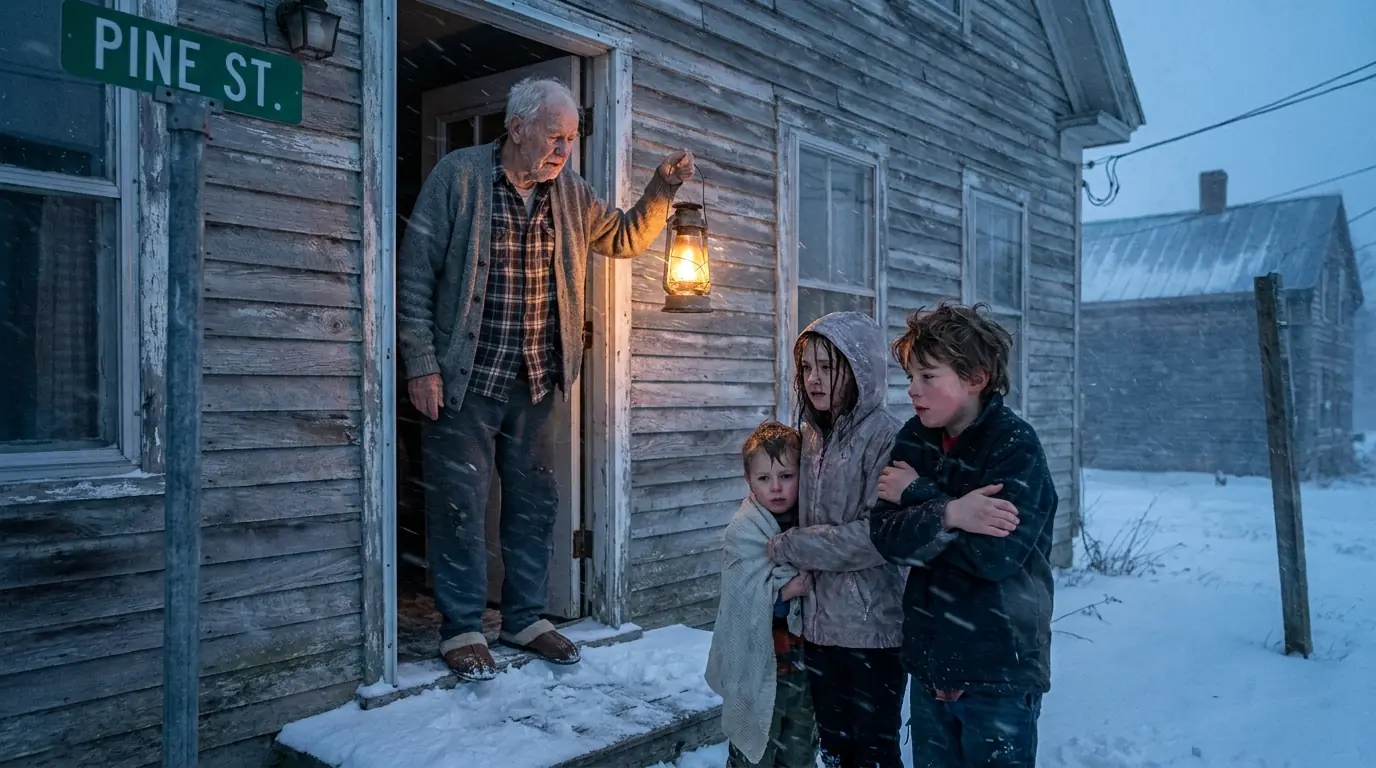
“The heat stopped working,” she said. “Mom told the manager, but he said he’d fix it tomorrow. Tommy started crying because it was so cold, and Caleb said we could walk to the gas station, but the road was too icy. We got turned around.”
Caleb lowered his head. “It was my idea.”
Nora immediately said, “No, it wasn’t.”
“Yes, it was.”
Arthur held up a hand. “No one is on trial in my kitchen.”
The children fell silent.
He stood and went to the wall phone, an old beige one Helen had insisted on keeping long after everyone else bought newer things.
Nora stood quickly. “Please don’t call the police.”
Arthur turned. “I was going to call your mother.”
Nora’s face tightened. “She’ll get in trouble.”
“For children being cold?”
“For leaving us there.”
Arthur studied her carefully.
Nora spoke faster. “She didn’t want to. She has to work. If she misses another shift, she’ll lose her job. She told us to stay under the blankets. She said she’d bring food when she came back. She didn’t know the room would get that cold.”
Arthur heard the desperation in her defense.
A child protecting a parent from a world that had already judged them too often.
“What is your mother’s name?” he asked.
“Marissa Cole.”
“Do you know her number?”
Nora recited it from memory.
Arthur dialed.
The phone rang six times. Then a woman answered, breathless and afraid.
“Hello?”
“Mrs. Cole?”
“Yes?”
“My name is Arthur Bennett. I live on Pine Street. Your children are safe in my kitchen.”
There was a silence. Then a broken sound.
“Oh my God. Nora? Caleb? Tommy?”
“They’re here. They’re cold, but they’ve eaten. They’re safe.”
Marissa began crying. “I just got back to the motel. They were gone. I thought…” Her voice collapsed.
Arthur spoke gently. “The roads are bad. Don’t try to walk here. Do you have a car?”
“No. I take the bus. Please, sir, please don’t call anyone yet. I’m coming.”
“You’ll freeze before you make it.”
“I don’t care.”
“I do,” Arthur said. “Stay where you are. I’ll call my neighbor. He has a truck.”
Nora watched him with wide eyes.
Arthur called his neighbor, Ben Harris, a retired firefighter who lived two houses down. Ben answered on the second ring.
“Arthur? You all right?”
“I need a favor.”
Twenty minutes later, Ben’s truck pulled into Arthur’s driveway with Marissa Cole inside.
She burst through the back door wearing a thin black work uniform, her hair falling from a messy bun, her face pale with terror. The moment she saw her children, she dropped to her knees.
Tommy ran to her first. Caleb followed. Nora stood frozen for a second, then moved into her mother’s arms.
Marissa held all three of them, crying into their hair.
“I’m sorry,” she whispered again and again. “I’m so sorry.”
Arthur stood by the stove and looked down at his hands.
He did not know their whole story yet, but he knew enough. Poverty had a cruel way of making decent people look careless from a distance. But up close, it was often exhaustion, impossible choices, and love stretched thinner than a winter coat.
Marissa finally looked up at him.
“Mr. Bennett, thank you. Thank you for bringing them in. Thank you for feeding them. I don’t know what I would’ve done if…”
She could not finish.
Arthur pulled out a chair. “Sit down, Mrs. Cole.”
“I can’t. We need to go.”
“Back to a motel room with no heat?”
Her face flushed with shame.
“They said they’d fix it tomorrow.”
“And if they don’t?”
She looked away.
Arthur turned to Ben. “Can you bring in the cot from my garage?”
Ben understood immediately. “Sure thing.”
Marissa stood. “No. Sir, we can’t stay here.”
Arthur looked at the children, then at her. “The storm is getting worse. The motel has no heat. There’s a spare room upstairs, a couch in the living room, and a cot in the garage. Tonight, you stay here.”
“I don’t want to impose.”
“You’re not imposing. I’m inviting.”
“We’re strangers.”
Arthur’s eyes softened. “Not anymore.”
That night, Arthur gave Marissa his daughter’s old room. Nora and Tommy slept on blankets on the floor beside her because they did not want to be apart. Caleb slept on the couch under a quilt Helen had sewn years ago.
Arthur slept in his recliner.
He woke several times to the sound of wind and once to the sound of Tommy crying in his sleep. Marissa soothed him softly, whispering that they were safe.
In the morning, Arthur made oatmeal, toast, and scrambled eggs. He used the last of the milk and nearly all the bread. Marissa noticed.
“I’ll replace everything,” she said.
Arthur waved a hand. “Food is meant to be eaten.”
After breakfast, Marissa told him more.
She had moved to Cedar Hollow six months earlier after leaving a difficult marriage in New Hampshire. Her ex-husband paid no support and rarely answered calls. She worked nights cleaning offices and mornings at a laundromat when shifts were available. The motel was expensive, but it was the only place that did not require a deposit she could not afford. She was on a waiting list for subsidized housing, but the list was long.
“I keep thinking if I just work more, I’ll catch up,” she said, staring into her coffee. “But every time I get close, something happens. Someone gets sick. The motel raises the weekly rate. The bus pass goes up. Tommy needs shoes.”
Arthur listened without interrupting.
Nora sat beside her mother, shoulders tense, as if ready to defend her again.
Arthur looked at the girl. “You’re very loyal.”
Nora lowered her eyes. “She works hard.”
“I believe you.”
That seemed to surprise her.
Arthur called the motel that morning. The manager was rude, then dismissive, then suddenly polite when Arthur mentioned the fire marshal and children sleeping in a room without heat during a snowstorm. By noon, the heat was fixed.
But Arthur did not feel good about sending them back.
Before they left, he packed food into paper bags: rice, canned beans, oatmeal, peanut butter, apples, and the jar of strawberry jam Helen used to make every summer, though this jar came from the store.
Marissa tried to refuse.
Arthur placed the bags in Ben’s truck anyway.
“You can argue after the children have enough food,” he said.
Marissa looked at him then, really looked at him. “Why are you doing this?”
Arthur glanced toward the living room, where Tommy was touching the carved wooden birds on the shelf.
“My wife and I wanted a house full of grandchildren,” he said. “Life gave us quiet rooms instead. Maybe the rooms were waiting.”
Marissa’s eyes filled.
The next weeks brought the Coles back to Arthur’s house again and again.
At first, Marissa only came when she needed help with something practical. A ride to the grocery store when the bus was canceled. A place for the children to stay when her overnight shift ran late. A warm meal after the motel’s tiny microwave broke.
Arthur never made her feel small for asking.
He kept a shelf in the pantry stocked with food the children liked. He learned that Nora loved tomato soup but pretended not to care. Caleb liked fixing things and would follow Arthur around with a screwdriver if allowed. Tommy loved stories about animals, especially bears, but only if the bear was friendly.
Soon, Thursday evenings became dinner nights.
Arthur cooked, Marissa helped clean, and the children filled the house with the noise it had been missing for years.
Nora did homework at the kitchen table. Caleb helped Arthur repair the loose cabinet door. Tommy sat on the rug and built towers from old wooden blocks Arthur found in the attic.
One evening, while Marissa washed dishes, Arthur stood beside her drying plates.
“She’s too serious,” he said, nodding toward Nora.
Marissa looked at her daughter, who was helping Tommy spell his name. “She had to grow up fast.”
“She should be allowed to slow down.”
“I know.”
Marissa’s voice broke slightly.
Arthur put the plate down. “You’re doing better than you think.”
She closed her eyes. “Some days I don’t believe that.”
“Then borrow my belief until yours comes back.”
Marissa wiped her face quickly and laughed through the tears. “Helen must have loved you very much.”
Arthur smiled sadly. “She had patience.”
By February, the motel situation became worse. The manager raised the weekly rent again. Marissa’s hours at the laundromat were cut. Nora began falling asleep in class. Caleb got into a fight after another child called his family “motel trash.”
Arthur found out when the school called Marissa, and Marissa showed up at his house afterward looking defeated.
“I can’t keep doing this,” she whispered in the kitchen. “I’m trying, but I can’t catch my breath.”
Arthur looked through the doorway at the children in the living room. Nora was reading to Tommy. Caleb sat apart, angry and ashamed.
That night, after everyone left, Arthur sat alone in Helen’s chair.
He looked at the house around him.
Four bedrooms. Two unused. A dining room no one dined in. A backyard where no child had played in twenty years.
He thought of Michael and Elaine. They had lives of their own. They worried about him from a distance but did not want the house. They had told him many times he should sell it and move somewhere smaller.
Arthur had refused because the house was memory.
But what good was memory if it could not become shelter?
The next morning, he called Marissa.
“Bring the children after school,” he said.
“Is something wrong?”
“No. Something is right.”
When they arrived, Arthur had a pot of stew on the stove and four mugs on the table. He waited until everyone had eaten before speaking.
“I want you to move in here.”
Marissa stared at him.
Nora’s spoon froze.
Caleb looked up sharply. “Here?”
Tommy whispered, “Forever?”
Arthur smiled gently. “Not forever if you don’t want. Long enough to save money. Long enough to breathe. Long enough for the children to sleep in warm rooms.”
Marissa shook her head. “Mr. Bennett, no. That’s too much.”
“So is paying half your income to a motel that can’t keep the heat working.”
“I can’t take advantage of you.”
“You won’t. You’ll help with groceries when you can. The children will help with chores. You’ll save money. I’ll stop eating dinner alone.”
Marissa stood and walked to the window.
Nora followed her with worried eyes.
Arthur continued, “I’ve spoken to my children. They think I’m stubborn but not insane.”
That made Caleb almost smile.
Marissa turned back. “What if people talk?”
Arthur snorted. “I am seventy-six years old. If people haven’t found something to say about me by now, that’s their failure.”
Nora asked quietly, “Would we have beds?”
Arthur looked at her. “Yes. Real beds.”
Tommy’s eyes widened. “Can I have a bear blanket?”
“I don’t own one,” Arthur said. “But I suppose we can solve that tragedy.”
Marissa covered her mouth.
She tried to say no again. She really did. But the children’s faces betrayed how badly they wanted to say yes.
Three days later, the Coles moved into Arthur’s house with three suitcases, two trash bags of clothes, and a cardboard box of school papers and toys.
The house changed overnight.
Boots lined the back door. Toothbrushes appeared in the bathroom cup. Nora’s books stacked on the nightstand in the blue room. Caleb’s tools, mostly borrowed from Arthur, occupied a corner of the garage. Tommy’s bear blanket, purchased from a thrift store, became his most prized possession.
Arthur began waking earlier, not because he needed to, but because the house did.
Breakfast became busy. Lunches had to be packed. The school bus came at 7:18. Tommy could never find his left mitten. Caleb forgot permission slips. Nora pretended she did not need help with anything.
Arthur loved every chaotic minute of it.
At school, things improved slowly.
Nora joined the library club. Caleb’s teacher discovered he was excellent with mechanical projects and recommended him for a weekend youth engineering program. Tommy stopped crying during morning drop-off.
Marissa saved money. She slept more. Color returned to her face. With Arthur’s encouragement, she applied for a receptionist job at a local dental office. She did not think she was qualified, but Arthur helped her practice interview questions at the kitchen table.
When she got the job, she came home crying.
“I got it,” she said from the doorway.
The children screamed.
Arthur stood from his chair and clapped once, hard. “Of course you did.”
“It has regular hours,” she said. “Health insurance after ninety days.”
Nora hugged her mother so tightly Marissa almost dropped her purse.
That spring, Arthur’s house looked alive again. Marissa planted herbs in Helen’s old garden boxes. Caleb repaired the loose porch step. Nora organized Arthur’s books alphabetically, then by topic when he complained that alphabetical order lacked imagination. Tommy made drawings and taped them to the refrigerator.
Arthur’s own children visited in May.
Michael arrived first, tall and cautious, with his wife and teenage son. Elaine came the next day with her husband and two daughters. At first, they seemed uncertain about the Cole family living in their childhood home. Arthur saw it in their careful smiles and polite questions.
That night, Elaine found him on the porch.
“Dad,” she said softly, “are you sure about all this?”
Arthur knew what she meant. “Yes.”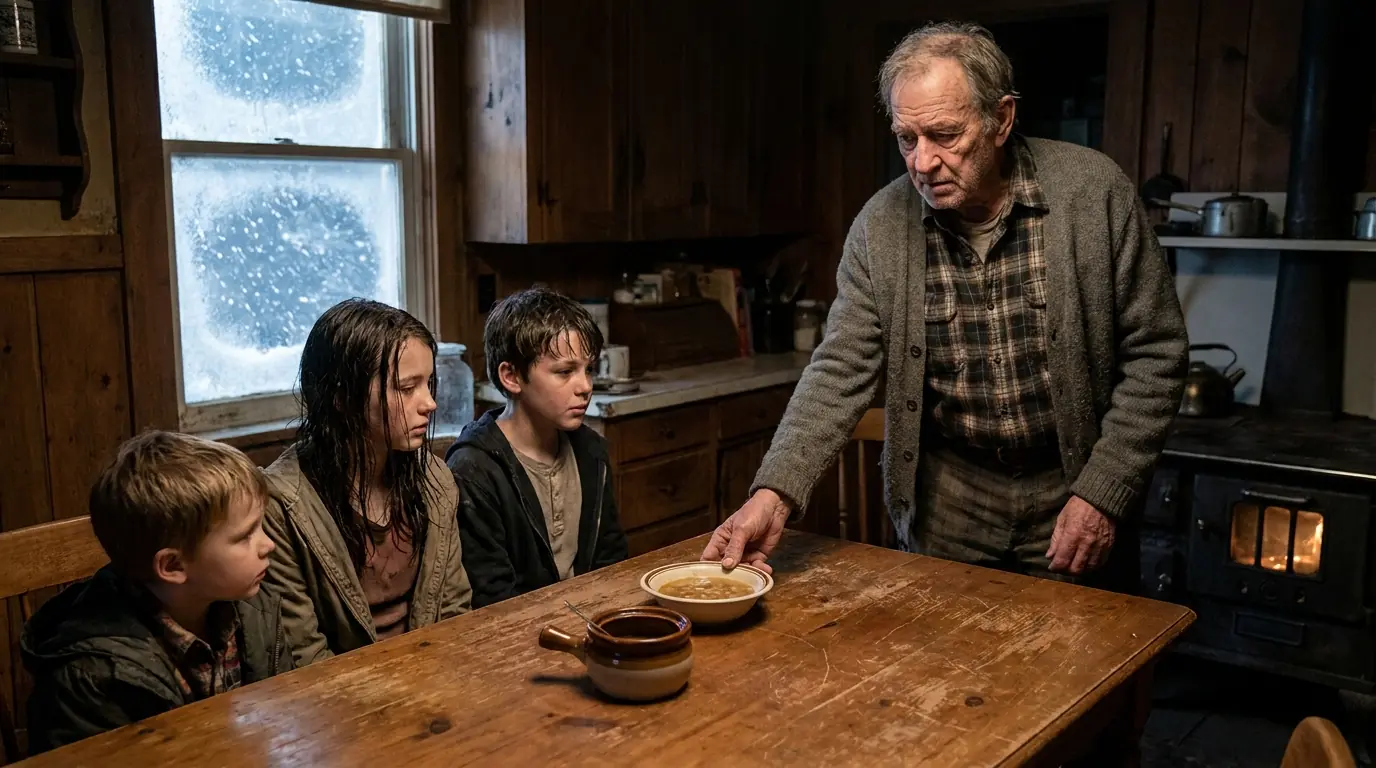
“You barely know them.”
“I know enough.”
“People can take advantage.”
Arthur looked through the window at Caleb helping Michael’s son with a puzzle, at Nora laughing with Elaine’s daughters, at Marissa drying dishes beside the sink.
“They brought this house back to life,” he said.
Elaine sat beside him.
After a while, she took his hand. “Mom would have loved this.”
Arthur’s throat tightened. “Yes. She would have.”
By the end of the visit, Michael was teaching Caleb how to change a tire, Elaine was giving Marissa advice about dental office software, and all the children were playing in the yard.
Family had a way of expanding when fear got out of the way.
But good things did not mean easy things.
In October, Arthur received a letter from the county. His property taxes had risen again. Repairs were needed too. The roof, already patched twice, would not survive another winter without serious work. The heating system was old. The insurance company wanted upgrades.
Arthur tried to hide the bills, but Nora found him one evening at the kitchen table with his head in his hands.
“What’s wrong?” she asked.
“Nothing that concerns you.”
“That means it’s bad.”
Arthur sighed. “You’re too smart.”
She sat across from him. “Is it money?”
He did not answer.
Nora looked at the papers. “Are we the reason?”
“No,” Arthur said immediately.
“But if we weren’t here, food would cost less. Heat would cost less.”
“Nora.”
She stood. “I can get a job.”
“You are twelve.”
“Thirteen next month.”
“That changes nothing.”
Her eyes filled with tears. “I don’t want you to lose your house because of us.”
Arthur reached across the table. “Listen to me. This house was in trouble before you came. Old houses are like old men. They require more maintenance than anyone expects.”
She did not smile.
Arthur continued, “You are not a burden. Not you. Not your brothers. Not your mother.”
Nora whispered, “Then why does everything good always cost too much?”
Arthur had no answer for that.
Winter came hard.
The roof leaked in the upstairs hallway. The furnace failed twice. Arthur’s savings shrank. Marissa offered rent, but Arthur refused most of it, insisting she keep saving for her future.
Then, in January, Arthur slipped on ice outside the garage.
Caleb found him.
The boy ran into the house shouting. Marissa called 911. Arthur had fractured his hip.
At the hospital, he tried to joke, but everyone saw the fear beneath it. Surgery went well, but recovery would be long. He could not manage stairs. He could not live alone. He would need help with meals, medication, appointments, and physical therapy.
Michael and Elaine came immediately.
They stood in the hospital hallway with Marissa, speaking in low voices.
“He should move to assisted living,” Michael said. “At least temporarily.”
Arthur heard enough through the half-open door.
His heart sank.
Assisted living was not a terrible place. He knew that. But the thought of leaving Helen’s house, even temporarily, felt like being uprooted at the end of life.
Marissa entered his room later and found him staring at the ceiling.
“You heard,” she said.
“I’m old, not deaf.”
She sat beside him. “They’re worried.”
“I know.”
“So am I.”
Arthur turned his head. “I don’t want to leave the house.”
Marissa took his hand. “Then don’t.”
He gave a tired laugh. “You say that like it’s simple.”
“It isn’t. But you once told me hard doesn’t mean impossible.”
He looked at her.
Marissa continued, “You gave my children warm rooms when they had none. Now we make sure you stay in yours.”
When Arthur came home, the dining room had been rearranged into a temporary bedroom. A rented hospital bed stood near the window. Caleb had built a small shelf for Arthur’s books and medicine. Nora had made a schedule for meals, exercises, and appointments. Tommy had drawn a sign that said, WELCOME HOME, GRANDPA ARTHUR.
Arthur stared at it.
“Grandpa?” he asked.
Tommy looked worried. “Is that okay?”
Arthur tried to answer, but his throat closed.
He nodded.
The Coles cared for him through the hardest months.
Marissa drove him to physical therapy before work. Nora read to him when his eyes grew tired. Caleb helped him with exercises and repaired every loose thing in the house as if fixing the building could also fix the man. Tommy sat beside him in the afternoons, telling bear stories that made no sense but always ended happily.
Arthur hated needing help.
But he loved being loved.
One evening, when pain had made him irritable, he snapped at Caleb for moving his cane.
The boy’s face fell.
Arthur regretted it immediately.
“Caleb,” he called.
The boy stopped in the doorway.
“I’m sorry.”
Caleb shrugged. “It’s okay.”
“No, it isn’t. Pain makes me rude. That doesn’t make it your fault.”
Caleb looked down. “I just don’t want you to fall again.”
Arthur nodded. “I know.”
Caleb came back and sat near the bed.
After a moment, he said, “When we first came here, I thought you were just being nice for one night.”
“So did I.”
Caleb smiled faintly.
“You stayed,” Arthur said.
“So did you.”
By spring, Arthur could walk with a cane. The house had survived the winter, but barely. The roof still needed replacing. The county sent another notice. Michael and Elaine, though supportive, worried about long-term costs.
Arthur began to wonder if selling was inevitable.
He did not say it aloud.
But Nora knew.
She always knew.
One Saturday morning, she gathered Caleb and Tommy in the living room.
“We need to do something,” she said.
Caleb frowned. “About what?”
“The house.”
“We don’t have roof money.”
“No,” Nora said. “But maybe other people do.”
That afternoon, she asked Arthur if she could use the old family photos in the hallway.
“For what?” he asked.
“A school project.”
Arthur narrowed his eyes. “That sounds suspicious.”
“It is educational.”
He allowed it.
Nora created a video with Caleb’s help. It showed Arthur’s house through the years: Helen in the garden, Arthur holding baby Michael, Elaine on her bicycle, snow on the porch, the dining room full of children again. Then Nora spoke into the camera.
Her voice shook at first, but grew stronger.
“This is Arthur Bennett’s house. It has sheltered people for almost eighty years. Last winter, when my brothers and I were lost in a snowstorm, Mr. Bennett opened his door, gave us his last meal, and later gave us a home. He never asked for anything back. Now his house needs repairs, and we want to help him the way he helped us.”
Caleb added footage of the leaking roof and the broken furnace. Tommy held up his bear blanket and said, “Grandpa Arthur gave me a warm place.”
They posted the video through a local community page with Marissa’s permission.
No one expected much.
By morning, it had been shared over a thousand times.
By the end of the week, local news called.
Arthur was furious.
“You put my roof on the internet?”
Nora stood her ground. “You put our lives back together.”
“That is not the same thing.”
“It is to us.”
He wanted to argue, but he saw Helen in her then. That stubborn kindness. That refusal to let pride block what love required.
The town responded.
A roofing company offered labor at no cost if materials could be covered. Then a lumberyard donated materials. A retired electrician volunteered. The church organized meals for workers. The high school shop class built new porch railings. Maggie from the café sent coffee every morning.
Michael flew back from Oregon and helped coordinate permits. Elaine handled donations and paperwork. Marissa organized volunteers with the efficiency of someone who had rebuilt her own life from chaos.
Arthur sat on the porch in a heavy coat, cane beside him, watching people repair the home he thought he might lose.
He looked overwhelmed most days.
One afternoon, Ben Harris sat beside him.
“Never seen you so quiet,” Ben said.
Arthur watched Caleb carrying boards with two teenage volunteers.
“I gave them soup,” Arthur said.
Ben looked at him. “What?”
“That first night. I gave them soup and bread.”
Ben smiled. “Looks like it grew.”
The repairs took six weeks.
The roof was replaced. The furnace upgraded. The porch rebuilt. A downstairs bathroom was modified for Arthur’s safety. The old dining room was turned into a proper bedroom suite so he would not need stairs. Helen’s garden was restored, with new rose bushes planted along the fence.
At the end, the town held a small gathering in the yard.
Arthur hated being the center of attention, but Marissa insisted he sit on the porch where everyone could see him.
Nora stepped forward with a folded paper.
Arthur groaned. “Please tell me there are no speeches.”
“There is one speech,” Nora said. “You’ll survive.”
The crowd laughed.
Nora unfolded the paper, but then she looked at Arthur and lowered it.
“I wrote something,” she said. “But I think I can say it better without reading.”
Arthur’s eyes softened.
Nora continued, “When my brothers and I came to this house, we were cold and scared. I thought adults only helped if they had to, or if someone paid them, or if they wanted something back. Grandpa Arthur didn’t know us. He didn’t know if we’d be trouble. He didn’t know if anyone would thank him. He just opened the door.”
Her voice trembled.
“He gave us food, but that wasn’t the biggest thing. He gave us a place where we didn’t have to be afraid. He helped my mom breathe again. He helped Caleb believe he could build things. He helped Tommy feel safe enough to sleep. And he helped me remember how to be a kid.”
Arthur wiped his eyes with a handkerchief.
Nora turned toward him.
“We can’t pay back what you gave us. But we can protect the place where you gave it. This house is not just yours anymore. It’s ours too. And we’re not letting you lose it.”
The yard was silent except for sniffles and the soft spring wind.
Then Caleb stepped forward carrying a small wooden box he had made himself. He placed it in Arthur’s lap.
Inside was a new house key.
Attached to it was a tag carved from smooth wood.
HOME IS WHO OPENS THE DOOR.
Arthur held it with trembling hands.
Tommy climbed carefully onto the porch and hugged him.
Then Caleb joined.
Then Nora.
Then Marissa.
Arthur closed his eyes as the family he had never expected gathered around him.
Years passed, and the Bennett house remained full.
Marissa eventually saved enough to buy a small home nearby, but she and the children never really moved out of Arthur’s life. They came every Sunday for dinner. Nora helped manage his appointments. Caleb maintained the house with pride. Tommy still brought new bear stories, though as he grew older, the bears became funnier and less friendly.
Arthur lived to see Nora graduate high school with honors. He watched Caleb win a state competition for designing a low-cost emergency heating unit for small homes. He sat in the front row when Tommy played a tree in the school play and forgot every line except, “The forest remembers.”
Arthur laughed until he cried.
On his eighty-fifth birthday, the family gathered in the backyard beneath strings of soft lights. Michael and Elaine came with their families. Ben Harris grilled chicken. Neighbors brought pies. Children ran through Helen’s garden.
Arthur sat at the long table, older and thinner now, but smiling.
Nora, twenty-one and studying social work, stood to make a toast.
“No speeches,” Arthur warned.
She raised her glass. “Just a short one.”
“That’s how all long speeches begin.”
Everyone laughed.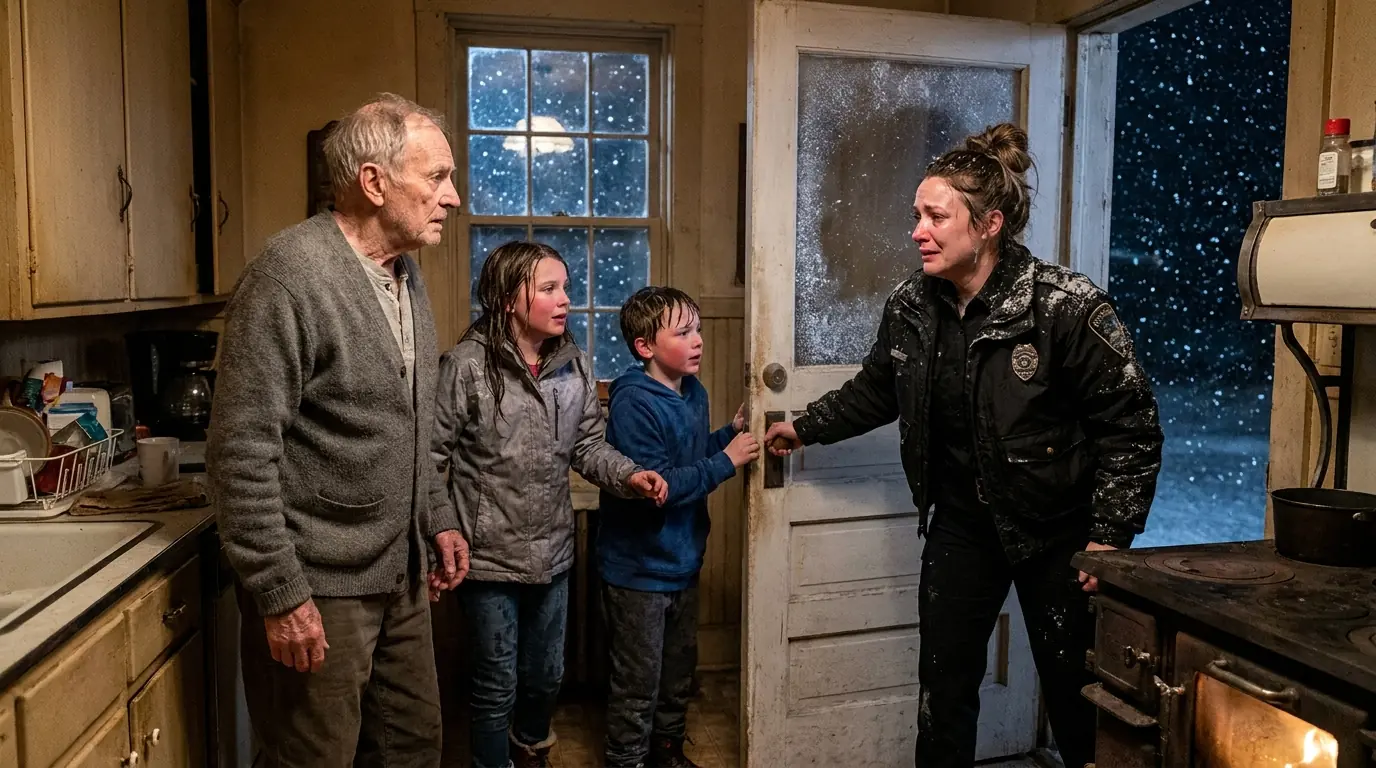
Nora looked at him with deep affection.
“When we were children, Grandpa Arthur taught us that kindness is not measured by how much a person has. It is measured by what they are willing to share when they have little. He shared his last meal, his house, and his heart. And because of that, none of us are lost anymore.”
Arthur looked around the table.
At Marissa, healthy and confident.
At Caleb, strong and thoughtful.
At Tommy, laughing with his cousins.
At his own children, closer now than they had been in years.
At the house glowing behind them, repaired, alive, filled with voices.
He thought again of that snowy night when he had been about to eat a small bowl of soup alone.
He had believed he was giving away his dinner.
Instead, he had opened the door to the rest of his life.
Later, after the party, Nora found him sitting on the porch.
“You okay?” she asked.
Arthur smiled. “Just thinking.”
“About what?”
“That I used to worry this house would end with me.”
Nora sat beside him. “It won’t.”
“No,” he said softly. “I suppose it won’t.”
She leaned her head on his shoulder like she had done as a child.
The night air smelled of roses and cut grass. Somewhere inside, Tommy was laughing. Caleb was arguing with Michael about tools. Marissa was helping Elaine wrap leftovers.
Arthur held the wooden key tag in his hand, worn smooth now from years of touch.
HOME IS WHO OPENS THE DOOR.
He looked toward the yard, then toward the warm windows, and felt Helen near him in the quiet.
He had given three lost children soup, bread, and shelter.
In return, they had given him back his house.
More than that, they had given him back the sound of family.
And for Arthur Bennett, in the final bright chapter of his life, that was worth more than anything money could buy.