Walter Grayson was seventy-eight years old and still opened his old garage every morning, even when no cars were waiting outside.
Grayson’s Garage sat at the edge of a two-lane road outside Cedar Ridge, Oregon, where pine trees rose behind the building, and passing trucks rattled the loose glass in the front office window.
The garage had once been busy from sunrise to evening. Farmers brought pickups with bad starters. Families came in with worn brakes. Teenagers asked Walter to patch old cars that should have retired before they were born. Travelers stopped when their engines overheated on the long road between small towns.
But those days had thinned.
A new auto center opened near the highway exit, bright and modern, with digital signs, free coffee, and waiting chairs that did not squeak. Younger drivers trusted apps and chain stores. Walter still trusted his hands, his ears, and the sound an engine made when it was trying to hide a problem.
His wife, Helen, had passed six years earlier. Their only daughter lived in Portland and called every Sunday, always asking if he had eaten enough, slept enough, and thought about moving closer.
Walter always said the same thing.
“I still have work here.”
Most weeks, that was only half true.
He had a few loyal customers left. Old Mr. Barnes brought his truck every spring whether it needed repair or not. The school secretary, Mrs. Cleary, trusted Walter with her station wagon. A couple of ranchers still preferred him because he never replaced a part unless it truly needed replacing.
But the bills came faster than the customers.
The roof leaked above bay two. The lift groaned whenever he raised anything heavier than a sedan. The sign outside had lost two letters, so at night it read “Grays n’s Ga age” when the old bulbs flickered on. Walter kept meaning to fix it, but there was always something more urgent.
Still, every morning, he unlocked the door.
He put on his faded denim work shirt, tied an old red rag through his belt loop, brewed coffee strong enough to wake a broken alternator, and waited for the road to send him something.
One cold April afternoon, the road did.
The rain had been falling since noon, not hard at first, then heavy enough to blur the pine trees beyond the garage. Walter was in bay one, rebuilding a carburetor for a customer who refused to give up on a 1972 Ford truck, when he heard a motorcycle engine outside.
Not the smooth rumble of a rider passing through.
This engine coughed, knocked, and cut out.
Walter looked up.
A moment later, the garage door creaked as someone pushed it open.
A biker stood there, soaked from the rain.
He was a large man in his early thirties, broad-shouldered, with a black leather jacket dripping water onto the concrete floor. His beard was short and dark, his hair flattened from his helmet, and tattoos showed along the backs of his hands. Behind him, through the open doorway, a black motorcycle sat crooked near the road, rain sliding down its tank.
The biker kept one hand on the doorframe, not stepping too far inside.
“Sorry to bother you,” he said. “You open?”
Walter wiped his hands on the red rag.
“That depends on whether you’re selling something or needing something.”
“Needing, I guess.”
“Then I’m open.”
The biker glanced back at the road.
“My bike started losing power about a mile back. I thought I could make it to town, but she died right there.”
Walter stepped closer to the door and squinted through the rain.
“You push it here?”
“Yes, sir.”
“From a mile back?”
“Close to it.”
Walter looked at the man’s soaked jacket, muddy boots, and tired face.
“That was stupid.”
The biker blinked.
Then he gave a short laugh.
“Probably.”
“Bring it in before the weather finishes what the engine started.”
The biker hesitated.
“I don’t have much cash on me.”
Walter stared at him.
“Did I ask you to empty your pockets or push the bike?”
The biker smiled faintly.
“Push the bike.”
“Then do that.”
Together, they rolled the motorcycle into bay two. Walter moved slower than he used to, but his hands still knew how to guide weight safely. The bike was heavy, black and chrome, scratched along one side, with saddlebags worn from use. It had seen many miles but had been cared for.
Walter noticed that.
He noticed everything mechanical.
“What’s your name?” he asked.
“Daniel.”
“Daniel what?”
“Daniel Reyes.”
“Walter Grayson.”
“I saw the sign.”
“Then you saw it’s missing letters.”
Daniel looked embarrassed, as if he had been caught noticing.
“I wasn’t going to say anything.”
“Good. That means you have survival instincts.”
Daniel laughed again, more naturally this time.
Walter pointed to a stool near the workbench.
“Sit. You look like rain with boots.”
“I can help.”
“You can help by not dripping near the electrical cords.”
Daniel sat.
Walter rolled the bike farther into the bay and began checking the basics. Battery. Fuel. Plugs. Connections. He listened when Daniel explained what had happened: the sudden loss of power, the sputtering, the way the throttle stopped responding cleanly.
“Could be fuel line,” Walter said. “Could be electrical. Could be both, if the machine is feeling dramatic.”
Daniel nodded.
“She’s been acting up all week.”
“Machines usually whisper before they shout. Most people ignore the whisper.”
“I thought I could get home before dealing with it.”
“That is how shouting begins.”
Walter worked quietly for several minutes. Daniel sat on the stool, hands clasped between his knees, watching with the anxious focus of someone whose motorcycle was more than transportation.
After a while, Walter glanced at him.
“Long ride?”
“From Boise.”
“Where you headed?”
“Coast.”
“By yourself?”
Daniel nodded.
Walter did not ask why. Men on motorcycles often traveled alone for reasons they did not want named.
Instead, he said, “You eaten?”
Daniel looked surprised.
“I’m fine.”
“That wasn’t the question.”
“I had coffee this morning.”
Walter sighed.
“Coffee is not food. It is an argument with sleep.”
Daniel smiled.
Walter walked to the small office, opened the mini fridge, and took out a wrapped ham sandwich and an apple. He set both on the workbench beside Daniel.
“There.”
Daniel looked at the food.
“I can’t take your lunch.”
“You already took my dry floor.”
“I’ll pay.”
“For an old sandwich?”
“For the repair too.”
“We’ll talk repair when I know what’s broken.”
Daniel held the sandwich but did not unwrap it.
“I don’t like taking things.”
Walter leaned against the bench.
“Then don’t take it. Borrow it permanently.”
Daniel stared at him.
“That makes no sense.”
“Most pride doesn’t either. Eat.”
Daniel ate.
Slowly at first, then with real hunger.
Walter pretended not to notice.
The rain grew heavier, drumming against the metal roof. The garage smelled of oil, wet leather, coffee, and cold air. Walter found the problem after twenty minutes: a loose battery connection, moisture intrusion near a cracked wire housing, and a clogged fuel filter that looked like it had been asking for replacement for months.
“Good news,” Walter said.
Daniel stood.
“What?”
“Not dead.”
“And bad news?”
“Neglected.”
Daniel winced.
“I deserve that.”
“The bike deserves better.”
“I know.”
Walter replaced the fuel filter from a box of old stock, dried the connections, patched the cracked housing, cleaned the terminals, and secured the battery properly. He moved carefully, slower than a younger mechanic, but with a patience that made each motion certain.
Daniel watched.
“My grandfather used to work like that,” he said.
Walter did not look up.
“Slowly?”
“Like the machine could hear him.”
Walter’s hands paused briefly.
“Maybe it can.”
Daniel smiled, but there was something soft behind it.
“He passed a few years ago. He taught me to ride. Not mechanics, though. He tried, but I was too impatient.”
“Most young men are.”
“I’m not that young.”
“You pushed a motorcycle a mile in the rain instead of stopping sooner. You’re young enough.”
Daniel laughed under his breath.
When the repair was done, Walter told him to try the engine.
The motorcycle started with a low, steady rumble.
Daniel’s whole face changed.
Relief, gratitude, and something like affection passed over him as he listened to the engine settle.
Walter nodded.
“Better.”
Daniel shut it off.
“How much do I owe you?”
Walter named a number far lower than the work deserved.
Daniel frowned.
“That can’t be right.”
“It is.”
“You replaced parts.”
“Old stock.”
“You worked over an hour.”
“I work slow.”
Daniel pulled out his wallet.
“I can pay fair.”
Walter looked at him.
“You can pay me by not ignoring the next problem until it strands you in a rainstorm.”
Daniel hesitated.
“That doesn’t feel like enough.”
“It rarely does when someone helps you.”
The words landed quietly.
Daniel looked down at the money in his hand.
Then Walter added, “And you can come back someday with that bike running properly. I like seeing repairs that stayed repaired.”
Daniel looked up.
“I will.”
“You say that now.”
“I mean it.”
Walter studied him for a moment, then nodded.
The rain had eased to a mist by the time Daniel prepared to leave. Walter wrapped the cracked old wire housing he had replaced in a rag and handed it to him.
“Keep that.”
Daniel frowned.
“Why?”
“To remind you machines warn people before they quit.”
Daniel put it in his saddlebag.
At the door, he turned back.
“Walter?”
“What?”
“Thank you for seeing me as a rider, not trouble.”
Walter’s expression shifted.
Most people would not have caught it.
Daniel did.
Walter looked toward the road.
“I fix what comes through the door,” he said. “Don’t matter what it looks like arriving.”
Daniel nodded once, then rode away carefully into the wet gray afternoon.
Walter stood in the open garage doorway until the sound faded.
Then he went back to the carburetor.
But the garage felt a little less empty.
Daniel came back two weeks later.
This time, the weather was clear, the motorcycle ran smoothly, and he carried a cardboard box strapped to the back seat.
Walter was sweeping the shop floor when Daniel pulled in.
“Well,” Walter called, “look at that. It remembered how to live.”
Daniel grinned and took off his helmet.
“She’s running better than she has in months.”
“That’s because someone finally listened to her.”
Daniel unstrapped the box and carried it inside.
“My mother makes tamales,” he said. “She told me to bring you some.”
Walter looked at the box.
“That’s a lot of tamales.”
“She said old mechanics don’t eat enough.”
“She never met me.”
“She said that too.”
Walter opened the box. The smell filled the garage immediately, warm and rich.
He tried to look annoyed.
He failed.
“Your mother is a dangerous woman.”
“The best kind.”
From then on, Daniel began stopping by whenever his rides took him through Cedar Ridge.
Sometimes he came alone. Sometimes he brought other riders. Not loud troublemakers, as some townspeople assumed when motorcycles pulled up outside the garage, but ordinary people with weathered jackets, helmets under their arms, and stories from long roads.
There was Renee, who ran a small print shop and rode a blue cruiser. Marcus, a quiet electrician with a laugh that surprised people. Tasha, a nurse who rode on weekends because, as she told Walter, “Engines don’t ask me to fill out forms.” And Evan, who talked too much but always brought good coffee.
At first, Walter treated them all like customers.
He checked tire pressure. Adjusted chains. Tightened loose bolts. Replaced bulbs. Gave blunt advice.
“You need new brake pads.”
“I just replaced them.”
“With what? Crackers?”
The riders loved him.
They started calling him Mr. Grayson.
He told them Walter was fine.
They called him Mr. Grayson anyway.
Over time, Saturdays at the garage began changing.
Daniel would stop by with coffee. Renee printed new price cards for the office when she saw Walter’s handwritten ones fading in the window. Marcus fixed the faulty light in bay two. Tasha brought first aid supplies after she noticed Walter had nothing better than old bandages and stubbornness. Evan helped paint the front door and talked the entire time.
Walter complained about all of it.
“You people act like I adopted a motorcycle club.”
Daniel smiled.
“Did you?”
“No.”
“Feels like yes.”
“Feelings are unreliable.”
But Walter began keeping extra coffee.
Then extra folding chairs.
Then a small shelf in the office where riders could leave flyers for community rides and local events.
Grayson’s Garage became a quiet stop on the long road west. Riders knew they could pull in, check their bikes, drink coffee, and get honest advice from an old man who insulted their maintenance habits but never their dignity.
For a few years, that was enough.
Then Cedar Ridge changed.
A large highway service center opened fifteen miles away. The county widened the main road but rerouted traffic away from Walter’s stretch. New development pushed property values up, then taxes followed. Walter’s landlord, who owned the garage building and the lot behind it, died. His son inherited the property and had no attachment to old garages.
One afternoon, a letter arrived.
The lease would not be renewed at the end of the year.
The building would be sold.
Walter sat in the office, reading the letter beneath the buzzing fluorescent light.
He read it twice.
Then he folded it neatly and placed it under the coffee mug Helen had given him years ago.
The garage suddenly felt too quiet.
He looked through the office window at the two repair bays, the old lift, the workbench, the wall of tools, the faded calendar from 1998 he kept because Helen had written notes on it. He had spent decades in that building. He had fixed engines, changed tires, helped stranded travelers, argued with old trucks, taught neighborhood boys how to check oil, and kept himself alive after Helen died by opening the same door every morning.
Now it had an expiration date.
Walter did not tell anyone.
Not his daughter.
Not Daniel.
Especially not Daniel.
He continued working. He took small jobs. He drank bitter coffee. He pretended the boxes accumulating near the back wall were for organization, not packing.
Daniel noticed anyway.
One Saturday in October, he rode in with Renee and Marcus.
Walter was taking down an old shelf.
Daniel looked at the boxes.
“What’s going on?”
“Cleaning.”
“You hate cleaning.”
“That is why it takes practice.”
Renee walked toward the office window and saw the folded letter under the mug. She looked at Daniel. Daniel looked at Walter.
Walter stiffened.
“Don’t.”
Daniel picked up the letter.
Walter’s voice hardened.
“I said don’t.”
Daniel read it anyway.
His face changed.
“Walter.”
“No.”
“You weren’t going to tell us?”
“There’s nothing to tell.”
“They’re closing the garage.”
“The lease is ending.”
“That’s the same thing.”
“No. One sounds dramatic.”
Daniel looked around the shop.
“When?”
“End of December.”
“That’s two months.”
“Your math remains good.”
“Why didn’t you call me?”
Walter picked up a wrench and placed it in a toolbox.
“Because I am not your responsibility.”
Daniel stepped closer.
“You helped me when I was stranded.”
“I fixed your bike.”
“You fed me. You dried me out. You treated me like I mattered when I walked in here looking like trouble.”
Walter’s jaw tightened.
“You paid me back in tamales.”
“That was my mother.”
“Then thank her.”
Daniel stared at him, frustration and hurt mixing in his face.
“You’re really going to pack this place up and disappear?”
“I’m old.”
“That is not an answer.”
“It is the most honest answer I have.”
Walter turned away.
“My hands hurt. My knees hurt. Customers are fewer. Rent is higher. The world moved on to places with waiting rooms and tablets. Maybe it’s time.”
Daniel’s voice softened.
“Do you want it to be time?”
Walter did not answer.
Renee stepped in gently.
“Walter.”
He looked at her.
She held up the letter.
“Do you want to close?”
For a moment, he stayed silent.
Then his shoulders dropped.
“No.”
The word was quiet.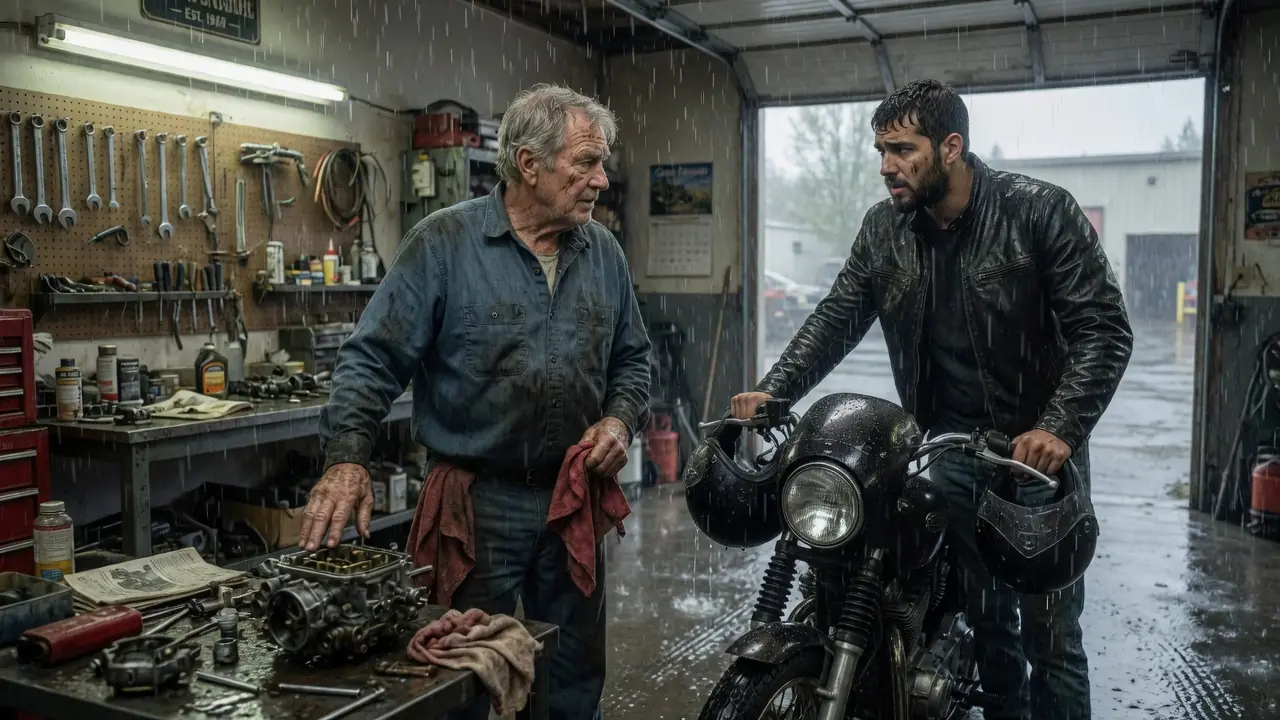
But it filled the whole garage.
Daniel nodded once.
“Then give us two months.”
Walter frowned.
“For what?”
“To listen to the engine before it quits.”
That was something Walter had said years ago.
He hated hearing his own wisdom used against him.
“I don’t want charity,” he said.
“Good,” Daniel replied. “Because I don’t want to give charity. I want to build something useful.”
Daniel moved fast.
Faster than Walter liked.
He called everyone.
Riders who had stopped at the garage. Customers Walter had helped. Local drivers. Farmers. Teachers. Small business owners. The school secretary. The ranchers. The old truck owners. People who had once broken down on that lonely road and found Walter under the garage lights, wiping his hands on a red rag and saying, “Let’s see what’s wrong.”
Stories came back.
A woman wrote that Walter had fixed her car for half price when she was a single mother trying to get to work.
A retired farmer said Walter kept his truck alive through three hard seasons.
A teacher wrote that Walter had once stayed late to repair her car so she could drive to her daughter’s graduation.
One rider said Walter adjusted his brakes and refused payment because “bad brakes make stupid funerals, and I don’t attend those.”
Walter denied saying that.
Everyone believed he had.
Daniel and Renee created a plan.
Not just a fundraiser.
A future.
They discovered that the old garage building could not be purchased affordably, but the vacant feed store two streets over was for sale. It had better road access, a larger lot, and a roof that needed work but good bones. Daniel proposed turning it into Grayson Road Garage, part repair shop, part rider stop, part training space for young mechanics.
Walter would not have to own it alone.
A cooperative would buy the building. Riders, customers, and local supporters could invest small amounts. Daniel’s motorcycle shop would sponsor the tool transfer and help with licensing. Renee would handle communications. Marcus would update the electrical. Tasha would organize safety workshops. Walter would remain the master mechanic and mentor, working as much as his body allowed.
“You are out of your minds,” Walter said when they presented the plan.
Daniel smiled.
“Maybe.”
“This is too big.”
“So was pushing a motorcycle a mile in the rain. I survived bad planning once.”
“This is serious.”
“So am I.”
Walter shook his head.
“I can’t ask people to put money into an old mechanic.”
“They’re not,” Renee said. “They’re putting money into the place you made possible.”
“I made a garage.”
Daniel looked at him.
“No. You made a door people weren’t afraid to walk through.”
Walter looked away.
The first community meeting was held in the garage itself.
Walter refused to speak.
Daniel spoke instead.
People packed into the two bays, standing between toolboxes, old tires, and half-packed shelves. Rain tapped the roof, and the old heater rattled near the office door.
Daniel stood beside Walter’s workbench.
“Years ago,” he began, “I pushed my bike through rain to this garage. I didn’t have enough money for a proper repair. I expected to be judged before I was helped.”
He glanced at Walter.
“Instead, this old man called me stupid, fed me a sandwich, fixed my bike, and charged me less than he should have.”
People laughed.
Walter muttered, “Still accurate.”
Daniel continued.
“That day changed more than my ride. It changed how I saw community. Grayson’s Garage became a place where people who live on the road could stop and be treated like neighbors. We are not here to save a building just because it is old. We are here to carry forward what happened inside it.”
He lifted a folder.
“We have a plan. A new location. A cooperative model. Training programs. Rider safety days. Honest repairs. And Walter’s name on the door, whether he likes attention or not.”
Walter did not.
But people did.
The campaign spread.
Not wildly. Not magically.
Steadily.
People gave what they could. Fifty dollars. Twenty dollars. Five hundred. One local business owner contributed more because Walter had once repaired his delivery van overnight. A group of riders organized a benefit ride called Keep The Road Running. Renee printed shirts with the old garage sign restored properly. Marcus rewired the vacant feed store at cost. A roofing company donated labor after hearing the story on local radio.
Walter became embarrassed on a daily basis.
“I hate this,” he told Daniel one morning while watching volunteers clean the feed store.
“I know.”
“Everyone keeps thanking me.”
“That must be awful.”
“It is.”
Daniel handed him coffee.
“You could try saying you’re welcome.”
“I could try many unnatural things.”
The old feed store slowly became a garage.
The front room became an office and waiting area, with old photographs from Grayson’s Garage on the wall. The main floor became three repair bays. A side room became a classroom for basic maintenance workshops. The back lot became a safe space for motorcycle checks before long rides.
Walter’s old workbench was moved carefully from the original garage and placed beneath a row of windows.
Helen’s coffee mug came with it.
So did the faded 1998 calendar.
Daniel tried to replace it.
Walter stared at him until he stopped.
The opening day arrived in early spring.
Grayson Road Garage stood freshly painted in deep green and white. The sign above the door read:
Grayson Road Garage
Repairs. Rides. Second Chances.
Walter hated the second line.
“It sounds sentimental.”
Renee said, “It tested well.”
“With who?”
“Everyone but you.”
“That is suspicious.”
Motorcycles filled the lot. Cars lined the road. Old customers came. New riders came. Walter’s daughter drove down from Portland and cried before she even got inside.
“Dad,” she whispered, looking around. “You didn’t tell me it was this big.”
“I tried to prevent it.”
She hugged him.
He tolerated it with watery eyes.
Daniel stood near the entrance and tapped a wrench lightly against a metal stand.
“No speeches,” Walter called.
Daniel smiled.
“Just one.”
“That is one too many.”
People laughed.
Daniel looked at the crowd.
“This place exists because one old mechanic believed broken things deserved attention before judgment. Engines. People. Roads. Pride.”
Walter stared at the floor.
“He helped many of us in small ways. A repair. A sandwich. A lower bill. A safe place to wait out rain. A reminder that machines warn you before they quit. Today, we return those small things together.”
He turned toward Walter.
“Mr. Grayson, this garage is yours as long as you want to stand in it, sit in it, complain in it, teach in it, or tell us we’re doing something wrong.”
Walter’s lips twitched.
Daniel held out a key.
Not shiny and ceremonial.
A real key on a worn metal ring.
Walter took it slowly.
His hand trembled.
“What’s this?”
“The front door.”
“I figured that out.”
Daniel smiled softly.
“Then open it.”
Walter stood before the new garage door while everyone waited.
For a second, he could not move.
He thought of the old garage. The leaky roof. The missing letters. Helen bringing him lunch. Daniel dripping rain on the concrete floor. Riders laughing near the office. Customers who had trusted him. Years he had thought were ending.
Then he put the key in the lock.
Turned it.
Opened the door.
The applause rose behind him, but Walter barely heard it.
Inside, the morning light fell across his old workbench.
It felt like something had not ended after all.
It had moved.
The first year at Grayson Road Garage was harder than Walter expected and better than he admitted.
He could no longer work full days, but he did not need to. Younger mechanics handled the heavy jobs. Walter diagnosed problems, taught, corrected, and occasionally insulted poor maintenance decisions with impressive precision.
A teenage apprentice named Leo became his first real student.
Leo was sixteen, quiet, and angry in the way boys often are when they are afraid no one expects much from them. Daniel brought him in through a local youth training program.
Walter handed him a wrench.
Leo looked at it.
“I know how to use one.”
“Then you’ll know how to hold it correctly.”
“I am holding it correctly.”
“No. You’re holding it like it owes you money.”
Daniel stood in the doorway trying not to laugh.
Leo stayed.
So did others.
The garage began hosting Saturday maintenance classes. Riders learned how to check tire pressure, chains, brakes, oil, lights, and emergency tool kits. Young people learned basic engine systems. Local drivers brought cars. Travelers stopped. Coffee was always terrible. Walter insisted terrible coffee kept people humble.
The place became busy.
Not just with repairs, but with belonging.
Daniel remained involved, balancing his own motorcycle shop with the cooperative. He and Walter argued often.
About pricing.
About signage.
About whether the waiting area needed plants.
About Daniel’s habit of calling meetings “strategy sessions.”
“I fix engines,” Walter said. “I do not strategize.”
“You strategize constantly.”
“I complain with structure. Different thing.”
Years passed.
Walter turned eighty-two.
Then eighty-three.
His hands shook more now. He walked with a cane, though he claimed it was “for threatening loose parts.” He spent more time in the classroom than the repair bays. He taught by memory, by ear, by touch.
He could still hear when an engine lied.
One autumn afternoon, Daniel found him sitting alone at the workbench, holding the cracked wire housing from Daniel’s motorcycle years earlier.
Daniel had forgotten Walter kept it.
“You still have that?”
Walter nodded.
“Reminds me I was right.”
“About what?”
“Machines whisper before they shout.”
Daniel sat beside him.
“And people?”
Walter looked out across the garage.
Leo was teaching a younger student how to check brake fluid. Renee was taping flyers near the front office. Marcus had his head inside an electrical panel. Tasha was laughing with a customer near the coffee pot. A traveler was waiting with a paper cup in both hands, looking relieved to be somewhere safe.
“People whisper too,” Walter said.
Daniel grew quiet.
“I did,” he said.
Walter looked at him.
“That day in the rain?”
Daniel nodded.
“I didn’t say how bad things were. My shop was barely making it then. I’d spent too much on repairs, lost two big jobs, and thought maybe I was failing at everything. Then the bike died, and I almost laughed because it felt like the road agreed with me.”
Walter listened.
“You gave me a sandwich and fixed the bike,” Daniel continued. “But mostly, you didn’t treat me like failure had already been decided.”
Walter stared at the old wire housing.
“I didn’t know that.”
“I know.”
Walter swallowed.
“Good thing I had a sandwich.”
Daniel laughed softly.
“Very good thing.”
On the fifth anniversary of Grayson Road Garage, the cooperative held a celebration.
Walter protested.
Everyone ignored him.
There were motorcycles, trucks, families, students, old customers, food tables, repair demonstrations, and a wall of photographs showing the journey from the old garage to the new one.
At the center was a framed picture of Walter and Daniel on opening day, both looking uncomfortable with attention.
Beneath it was a plaque:
It Started With A Rainstorm, A Broken Bike, And A Man Who Opened The Door.
Walter said the plaque was too wordy.
Renee said he was too predictable.
Near the end of the celebration, Daniel led Walter to the classroom.
Inside, the room had been renamed.
Walter Grayson Workshop
For Young Mechanics Who Need A First Chance
Walter stood in the doorway and said nothing.
Leo, now a certified mechanic working full-time at the garage, came forward with a small red toolbox.
“This is for the first student scholarship,” Leo said. “Every student gets basic tools when they finish the program. We named it after you.”
Walter looked at the toolbox.
“You named a toolbox after me?”
Daniel smiled.
“The Grayson Starter Kit.”
Walter blinked.
“You people are determined to make me sound dead.”
Leo grinned.
“You’re too mean to be dead.”
Walter laughed before he could stop himself.
Then his eyes filled.
He turned away, but Daniel placed a hand on his shoulder.
“You once gave me a start when I needed one,” Daniel said. “Now this place gives starts every year.”
Walter looked at the classroom.
At the benches.
The tools.
The young faces waiting in the doorway.
The life still moving because one rainy afternoon had not ended at a closed door.
He cleared his throat.
“Fine,” he said. “But if you’re putting my name on tools, they’d better not be cheap.”
Everyone laughed.
Later that evening, after the celebration ended, Walter and Daniel sat outside the garage with coffee in paper cups. The sun was setting beyond the pines. A few motorcycles remained in the lot, cooling after long rides.
Walter looked at Daniel.
“You saved my garage.”
Daniel shook his head.
“You saved the reason I believed places like this mattered.”
Walter took a slow sip of coffee.
“This coffee is awful.”
“You made it.”
“I know. Consistency is important.”
Daniel laughed.
For a while, they sat in comfortable silence.
Then Walter said, “I was afraid, when the old place closed, that everything Helen and I built would vanish.”
“It didn’t.”
“No,” Walter said softly. “It got louder.”
A motorcycle rolled into the lot just before closing.
The rider was young, maybe twenty, soaked from an unexpected rain shower, his bike sputtering badly.
He stepped inside the open garage door, hesitant.
“You still open?” he asked.
Walter looked at Daniel.
Daniel looked at Walter.
Walter stood slowly, leaning on his cane.
“That depends,” he said. “You selling something or needing something?”
The young rider gave a nervous smile.
“Needing.”
Walter nodded toward the repair bay.
“Then we’re open.”
He turned to Leo.
“Get him a towel. And check the coffee. If it tastes good, throw it out and start over.”
The garage came alive around the rider.
Tools moved. Lights clicked on. Someone rolled the bike in. Someone handed the young man a towel. Someone else offered him a chair.
Walter watched from the workbench, his old eyes bright.
Years earlier, Daniel Reyes had pushed a broken motorcycle through the rain and found an old man who saw a person before he saw a problem.
Walter thought he had only fixed a machine, shared a sandwich, and sent a rider back onto the road.
But kindness has a way of traveling farther than engines.
Years later, Daniel returned with riders, neighbors, plans, money, labor, and loyalty. He did not simply save Walter’s garage. He helped turn it into a place where others could learn, repair, rest, and begin again.
What Walter received was not just a new building or his name on a sign.
He received proof that his life’s work had not gone obsolete.
He received students to teach, friends who returned, a reason to unlock the door each morning, and a family made from roads, tools, and second chances.
And from then on, whenever rain tapped the roof and a motorcycle engine coughed near the road, Walter Grayson would wipe his hands on his red rag, look toward the open garage door, and say,
“Bring it in. Let’s hear what it’s trying to tell us.”