At seventy-nine years old, Edward Lawson still kept the porch light on every night.
His neighbors in Asheville, North Carolina, often teased him about it.
“Ed, nobody’s coming by after nine.”
Edward would only smile and say, “A light doesn’t hurt anybody.”
The truth was, the porch light had been his late wife’s habit.
Margaret used to turn it on every evening before dinner, even if everyone was already home. She said a lit porch made a house look forgiving.
Edward never knew exactly what she meant by that, but after she died, he kept the ritual. Every evening at dusk, he turned on the small yellow light by the front door.
It made the house feel less empty.
Edward had been a carpenter for most of his life. His hands were broad, scarred, and permanently rough from wood, nails, sawdust, and weather.
Even now, with stiff fingers and aching knees, he could still tell by touch whether a board was good. His small house at the edge of town was full of things he had built himself: the kitchen table, the porch swing, the bookshelves, the cedar chest at the foot of his bed.
But since Margaret’s passing seven years earlier, the house had grown too quiet.
His daughter lived in Raleigh with her own family. His son lived in Arizona. They called, visited when they could, and asked him gently to move somewhere easier.
Edward always refused.
“This house still has good bones,” he would say.
So did he, he hoped.
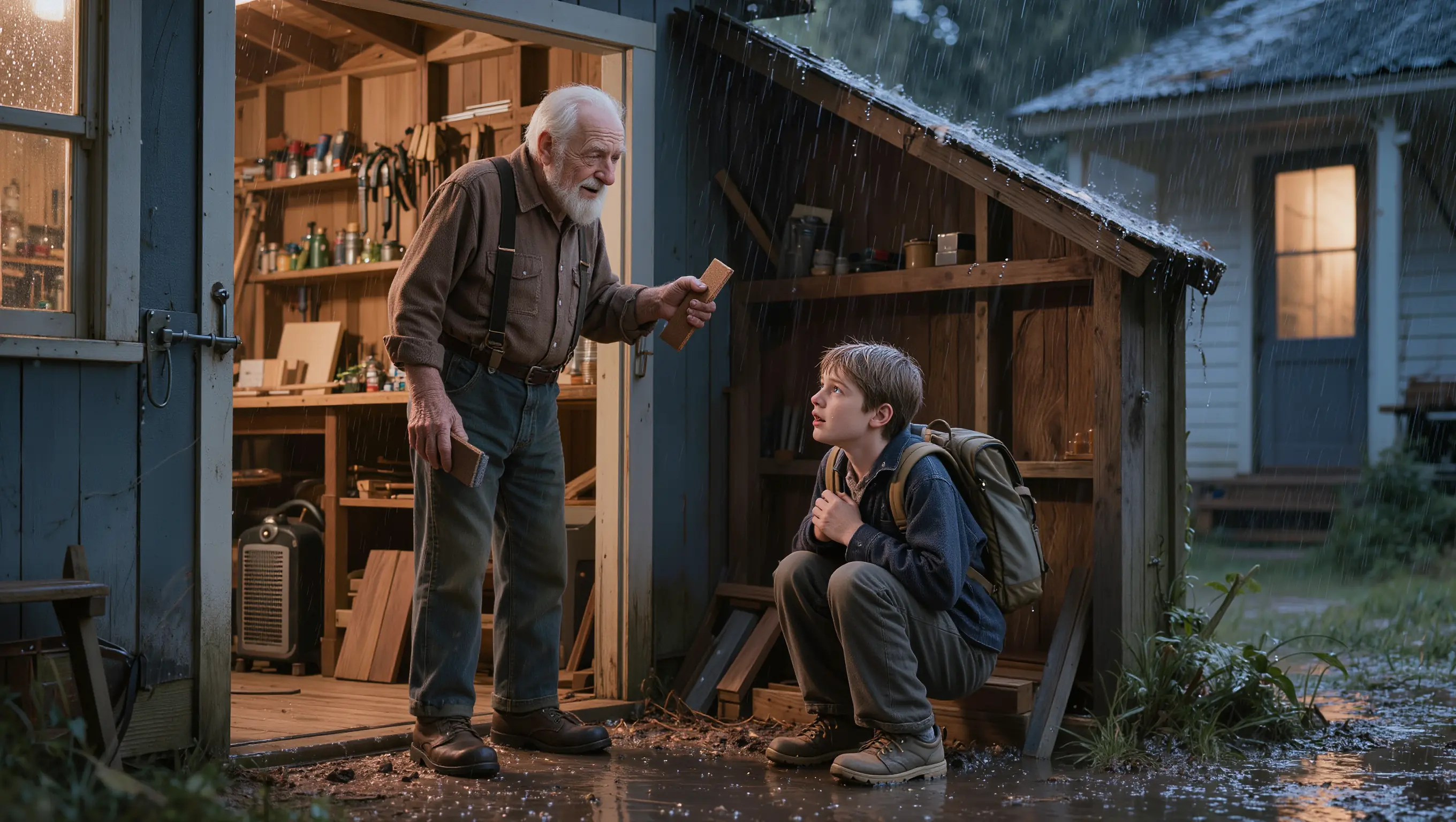
One rainy October evening, Edward was in his workshop behind the house, sanding the edge of a small wooden stool, when he heard something near the shed.
At first, he thought it was a raccoon.
Then he heard a cough.
He set down the sandpaper and listened.
There it was again.
A child’s cough.
Edward opened the workshop door and looked into the rain.
A boy was crouched beneath the narrow roof overhang of the shed, trying to stay dry. He looked about eleven years old, with dark blond hair flattened by rain, pale cheeks, and a backpack hugged tightly against his chest. His jacket was soaked at the shoulders. His sneakers were muddy, and one lace dragged through the wet grass.
When the boy saw Edward, he jumped to his feet.
“I’m sorry,” he said quickly. “I was just waiting for the rain to stop.”
Edward stepped onto the workshop threshold. “In my shed?”
“I didn’t go inside.”
“I can see that.”
“I wasn’t stealing anything.”
“I didn’t say you were.”
The boy looked toward the road as if planning to run.
Edward softened his voice. “What’s your name?”
The boy hesitated.
“Caleb.”
“Caleb what?”
“Caleb Turner.”
“I’m Edward Lawson.”
The boy nodded toward the house. “I know. Your mailbox says Lawson.”
“So it does.”
Rain fell harder, drumming against the shed roof and running in silver lines down the workshop windows. The boy shivered but tried to hide it.
Edward noticed.
“You live nearby, Caleb?”
“Not far.”
“That’s not an address.”
The boy’s jaw tightened. “I’m fine.”
Edward gave a small sigh. “Son, I’ve been alive seventy-nine years. ‘I’m fine’ usually means the opposite.”
Caleb looked down.
Edward stepped aside and opened the workshop door wider. “Come inside. You can stand by the heater while the rain lets up.”
Caleb shook his head. “I can’t.”
“Why not?”
“I don’t have money.”
Edward almost laughed, not because it was funny, but because the sentence broke his heart.
“I don’t charge admission to my workshop.”
“I shouldn’t be here.”
“Probably not,” Edward said. “But here you are.”
Caleb stared at him, unsure what to do with an adult who did not shout.
Edward pointed toward the small electric heater near the bench. “Five minutes. Door stays open if that makes you feel better.”
The boy hesitated, then stepped inside.
The workshop smelled of cedar, pine, varnish, and rain-damp clothes. Caleb stood near the heater, still clutching his backpack. His eyes moved across the tools on the wall, the stacks of lumber, the half-finished stool on the bench.
“You make things?” he asked quietly.
“When the wood cooperates.”
“Does it?”
“Not often.”
For the first time, Caleb almost smiled.
Edward took a clean towel from a shelf and held it out.
“For your hair.”
Caleb took it carefully. “Thank you.”
“Hungry?”
The boy’s face closed immediately. “No.”
His stomach growled loud enough to answer for him.
Edward raised one eyebrow.
Caleb’s face turned red.
“I have soup in the house,” Edward said. “And cornbread if the old man next door didn’t eat it all.”
“You live alone.”
Edward paused. “Yes.”
“So there’s no old man next door?”
“I am the old man next door. Sometimes I blame myself for missing food.”
Caleb stared at him, then gave a small surprised laugh.
Edward smiled. “Come on.”
Caleb stayed frozen.
“I can’t go in your house.”
“Smart rule,” Edward said. “Here is what we’ll do. I’ll call someone safe first. Your mother, father, whoever is looking for you. Then you can decide whether to sit at my kitchen table or keep negotiating with your stomach.”
At the word mother, Caleb’s face changed.
Edward saw it immediately.
“Caleb,” he said gently, “who is looking for you?”
The boy lowered his eyes.
“My mom.”
“Does she know where you are?”
“No.”
“Where is she?”
“At the hospital.”
Edward went still. “Is she sick?”
Caleb shook his head quickly. “No. She works there. Laundry department.”
“And why aren’t you home?”
The boy swallowed.
“We had to leave.”
“Leave where?”
“Our apartment.”
Edward waited.
Caleb rubbed the towel between his hands. “The landlord changed the locks this morning. Mom said he wasn’t supposed to, but he did. She had to go to work because if she missed another shift, she’d lose the job. She told me to stay with Mrs. Allen downstairs until she got off.”
“What happened?”
“Mrs. Allen’s daughter came over. There wasn’t room. They said I could wait in the hallway, but the landlord came back and told me to get out.”
Edward’s jaw tightened.
“What time does your mother finish?”
“Midnight.”
It was not even seven.
“You were going to stay outside until midnight?”
Caleb said nothing.
Edward looked at the boy’s soaked jacket, thin shoulders, and backpack held like the last piece of home he had.
This child was not fully homeless.
Not yet.
But the world had pushed him outside for one dangerous night.
And one night was enough to change a child.
“Do you know your mother’s phone number?” Edward asked.
Caleb nodded.
Edward handed him the workshop phone.
The boy dialed with shaking fingers.
No answer.
He tried again.
No answer.
“She can’t keep her phone on during shift,” Caleb said quickly. “But she checks during break.”
Edward nodded. “Then we leave a message.”
He took the phone gently and spoke after the beep.
“Ms. Turner, my name is Edward Lawson. Your son Caleb is safe at my house on Willow Creek Road. He is cold, but he is all right. I will keep him here until you can call or come. My number is…”
When he hung up, Caleb stared at the floor.
“She’ll be mad.”
“No,” Edward said. “She’ll be scared.”
“I shouldn’t have left Mrs. Allen’s.”
“You were told to leave.”
“I should’ve found somewhere better.”
“You are eleven.”
“Almost twelve.”
“Still not old enough to outthink a bad landlord in the rain.”
Caleb looked away, but his eyes were wet.
Edward led him into the house.
The kitchen was warm and simple. A round wooden table sat near the window. A pot of vegetable beef soup rested on the stove. The smell filled the room, rich and steady. Caleb stood just inside the doorway, dripping onto the mat.
Edward pointed to a chair. “Sit.”
“I’ll get it wet.”
“Chairs dry.”
Caleb sat carefully.
Edward gave him soup, cornbread, a glass of milk, and a folded napkin. The boy stared at the bowl.
“That’s too much.”
“No,” Edward said. “Too much would be dessert before soup.”
Caleb looked up. “There’s dessert?”
“Depends how well you behave around cornbread.”
The boy almost smiled again.
He ate slowly at first, then faster. Edward turned toward the sink and washed a clean mug so Caleb would not feel watched. When the bowl was empty, he filled it again without asking.
Caleb whispered, “Thank you.”
“You’re welcome.”
After dinner, Edward gave him dry socks and one of his old flannel shirts. It hung loose on Caleb’s thin frame. Then he placed Caleb’s shoes near the heater and set his wet jacket on a chair to dry.
Caleb sat at the kitchen table with his backpack still on his lap.
“You can put that down,” Edward said.
“It has our papers.”
“What kind of papers?”
“Birth certificate. Mom’s work stuff. Lease. Some pictures. She told me not to lose them.”
Edward looked at the backpack differently now.
Not a school bag.
A family archive.
A boy carrying proof that his life existed.
“You did well keeping it safe,” Edward said.
Caleb blinked.
“I did?”
“You did.”
The boy’s shoulders lowered a little.
At 8:15, the phone rang.
Edward answered.
A woman’s voice came through, frantic and breathless. “Mr. Lawson? This is Rachel Turner. Is Caleb there? Is he okay?”
“He’s safe.”
A broken sob came through the phone.
“Oh God. Caleb.”
Edward handed the phone to him.
“Mom?”
Caleb’s face crumpled the moment he heard her voice.
“I’m sorry,” he whispered. “Mrs. Allen couldn’t keep me. I didn’t know where to go. I didn’t lose the papers.”
Edward looked away to give him privacy.
Rachel Turner arrived just after midnight.
She came in a faded hospital laundry uniform beneath a thin coat, her hair pulled into a messy bun, her face pale with exhaustion and fear. The moment Caleb opened the door, she dropped to her knees and pulled him into her arms.
“I’m sorry,” she cried. “I’m so sorry, baby.”
Caleb clung to her. “I kept the papers.”
“I don’t care about the papers.”
“You said they were important.”
“You are important.”
Edward stood quietly in the hallway.
Rachel looked up at him with tears on her face.
“Mr. Lawson, thank you. I don’t know what would have happened if you hadn’t—”
“Don’t finish that sentence,” Edward said softly. “He’s safe.”
Rachel tried to stand, but exhaustion made her sway.
Edward reached for a chair.
“Sit down before you fall down.”
“I can’t stay. We need to figure out where to go.”
“You already have.”
She looked confused.
“You and Caleb can stay here tonight,” Edward said.
“No. Sir, we can’t.”
“You can.”
“I can’t pay you.”
“I didn’t ask.”
“We’re not homeless,” she said quickly, shame rising in her voice. “I mean—we have money coming. I have a job. The landlord wasn’t supposed to lock us out. I just need a few days to fix it.”
Edward’s face softened.
“I believe you.”
Rachel stopped.
“You do?”
“Yes.”
That simple answer nearly broke her.
She covered her mouth and cried.
One night became five.
Then two weeks.
Edward helped Rachel contact a tenant advocate. He drove her to retrieve belongings the landlord had tried to keep. He made copies of documents, called a church housing fund, and connected her with a retired attorney who still owed Edward a favor for repairing his porch.
Rachel did not need saving from laziness.
She needed time, witnesses, and someone who knew which doors to knock on.
Edward gave her those.
Caleb stayed in the small guest room that had once belonged to Edward’s son during summer visits. At first, he kept his backpack on the bed beside him. Then on the third night, he placed it on the chair. By the seventh night, he put his schoolbooks on the desk.
Edward noticed.
He said nothing.
Every morning, Rachel left for work before sunrise. Edward made Caleb oatmeal, drove him to school, and picked him up afterward. In the afternoons, Caleb sat in the workshop doing homework while Edward worked on small carpentry jobs.
At first, Caleb only watched.
Then he asked questions.
“What’s that tool?”
“A block plane.”
“What does it do?”
“Shaves wood.”
“Why?”
“Because wood, like people, sometimes needs smoothing before it fits where it belongs.”
Caleb frowned. “You always talk like that?”
“Unfortunately.”
By the second week, Caleb was sanding scrap wood. By the third, he helped Edward build a small shelf for the kitchen.
“You’re good with your hands,” Edward said.
Caleb shrugged. “I just like when things fit.”
Edward smiled. “That’s a beginning.”
Rachel eventually found a safer apartment through a housing program. It was small, but clean, with working locks and a landlord who followed the law. When they moved out, Caleb stood in Edward’s workshop, quiet.
“You’ll forget us,” he said.
Edward looked at him. “No.”
“People say things.”
“I build things,” Edward replied. “I know the difference between words and structure.”
Caleb looked up.
Edward handed him a small wooden keychain shaped like a house.
“I made this from cedar. Put your new key on it.”
Caleb held it carefully. “I’ll pay you back one day.”
Edward smiled. “For soup?”
“For not making me feel like we were nothing.”
Edward’s throat tightened.
“You were never nothing, son.”
Caleb and Rachel did not disappear.
Every Saturday, Caleb came to Edward’s workshop. Rachel worked extra shifts, and Edward became the safe place between school, work, and home. Caleb learned to measure, sand, cut, glue, clamp, and finish wood. He learned patience. He learned that rushing made things crooked. He learned that broken boards could sometimes be trimmed into something useful.
At thirteen, he built a birdhouse.
At fifteen, he built a small table.
At seventeen, he built a cedar chest for his mother.
Rachel cried when she saw it.
“You made this?” she whispered.
Caleb nodded. “Mr. Lawson helped.”
Edward grunted. “Barely. He’s getting bossy.”
Caleb smiled.
Years passed.
Caleb grew into a thoughtful, steady young man. He did well in school, especially math and design. He became interested in architecture, not grand buildings or luxury homes, but affordable housing, legal housing, safe housing, places where families like his would not be one bad landlord away from standing in the rain.
When he graduated high school, Edward sat beside Rachel in the front row.
Caleb received a scholarship to study architecture and construction management.
After the ceremony, Caleb handed Edward a small wrapped box.
Inside was the original cedar keychain, worn smooth from years of use.
“I replaced it,” Caleb said, pulling a new one from his pocket. “But I wanted you to have the first one back.”
Edward ran his thumb over the wood.
“You kept it all this time?”
Caleb’s voice softened. “It reminded me there was a door somewhere that opened.”
Edward looked down quickly.
“Go build better doors,” he said.
Caleb did.
College led to internships. Internships led to work with a nonprofit housing developer. By twenty-eight, Caleb was managing projects that turned abandoned buildings into safe apartments for working families. He insisted on good locks, community rooms, legal support offices, and storage spaces where families could keep important papers safe.
He called Edward every Sunday.
Sometimes they talked about work.
Sometimes they talked about wood.
Sometimes they said very little, and that was enough.
But Edward was aging.
At eighty-seven, his knees made the workshop harder. His hands shook when using fine tools. The roof on his house leaked. The porch sagged. His property taxes rose. His children urged him again to sell and move closer.
Edward resisted.
Then a storm damaged the workshop roof.
The repair estimate was too high.
For the first time, Edward considered closing the workshop and selling the house.
He did not tell Caleb.
Rachel did.
A week later, Caleb arrived at Edward’s porch carrying rolled blueprints and a leather folder.
Edward opened the door and sighed. “Your mother talks too much.”
“She learned from the best.”
“That sounds like an insult.”
“It’s a compliment.”
Caleb stepped inside.
At the kitchen table, he unrolled the plans.
Edward saw his house.
But restored.
The roof repaired. The porch rebuilt. The workshop expanded. The spare rooms updated. The backyard cleared and redesigned.
Then he saw another page.
The workshop would become a community carpentry and housing support center. Teenagers from unstable housing situations could learn woodworking and construction basics. Families facing illegal lockouts or housing crises could get referrals, document storage help, and emergency guidance. The spare room would be available, through proper nonprofit support, for short-term crisis stays when a child needed a safe supervised place until a parent could arrive.
At the top of the design was a sign:
THE EDWARD LAWSON HOMEWORKSHOP
Good Bones. Open Doors.
Edward stared at it.
“No.”
“Yes.”
“I don’t need my name on a sign.”
“I know,” Caleb said. “That’s why it belongs there.”
“I just let you stay a few nights.”
Caleb’s face changed.
“You did not just let me stay,” he said quietly. “You believed my mother. You helped her fight for us. You gave me a room where I could put my backpack down. You taught me that things with good bones are worth saving.”
Edward looked away, tears in his eyes.
“I’m old, Caleb.”
“I know.”
“I can’t run something like this.”
“You won’t have to. I’m not asking you to run it. I’m asking you to sit in the workshop and tell teenagers when they’re sanding wrong.”
Edward laughed despite himself.
“That I can do.”
The renovation took eight months.
Edward complained about the noise, the dust, the new safety railings, the young workers moving his tools, and the fact that everyone suddenly cared too much about his knees.
Caleb ignored all complaints related to ladders.
But he preserved what mattered. Margaret’s porch light stayed. The kitchen table stayed. The original workbench remained. The cedar keychain was framed near the entrance.
On opening day, Rachel stood beside Edward, crying before anyone spoke. Caleb stood in front of the workshop with a small crowd of neighbors, families, volunteers, and teenagers waiting for the first class.
“When I was eleven,” Caleb said, “my mother and I were locked out of our apartment illegally. She had to work or lose her job. I had nowhere to go for one night. Edward Lawson found me in the rain and opened his door.”
Edward lowered his head.
“He did more than shelter me,” Caleb continued. “He gave my mother time to fight. He gave me a place to feel human. He taught me that good bones can survive damage, and that open doors can change a life.”
The crowd applauded.
Edward cried and did not pretend otherwise.
Years later, the Edward Lawson HomeWorkshop became one of the most trusted places in Asheville. Teenagers learned carpentry there. Families received housing referrals. Children in temporary crisis had somewhere safe to wait. The workshop smelled of cedar, sawdust, and possibility.
Edward came every morning.
He sat at his old bench, showing kids how to measure twice, sand with patience, and respect tools.
One rainy evening, a boy stood in the doorway with a soaked backpack in his arms.
“My mom’s at work,” the boy whispered. “We got locked out.”
Edward looked across the workshop at Caleb, now a grown man with kind eyes and sawdust on his sleeve.
Caleb nodded.
Edward stood slowly, his cane in one hand.
“Come in, son,” he said. “Let’s call your mother.”
The boy looked down. “I don’t have money.”
Edward smiled gently.
“I didn’t ask for money.”
Behind them, the porch light glowed through the rain.
Long ago, Edward had thought he was sheltering one boy for one night.
But kindness, like good wood, carries weight long after the first cut.
One dry room became trust.
Trust became family.
Family became purpose.
And the boy who once had nowhere to go returned years later to make sure Edward’s door stayed open for every child who needed one safe night before morning.