Evelyn Harper was seventy-six years old and stubborn enough to live alone at the end of a country road that most people forgot existed.
Her farmhouse sat outside Millbrook, Tennessee, past a wooden bridge, two miles of narrow pavement, and a long gravel driveway lined with old oak trees. The house was white once, though years of weather had softened it into a tired cream color. Blue shutters framed the windows. A porch wrapped around the front, with two rocking chairs, a wind chime, and pots of red geraniums, Evelyn watered every morning.
She had lived there for almost fifty years.
Her husband, Walt, had built the porch. Her children had learned to ride bicycles in the yard. Her grandchildren had once chased fireflies near the barn during summer visits. But now the children had moved away, the grandchildren were grown, and the road to the farmhouse seemed longer every year.
Still, Evelyn refused to leave.
“This house knows me,” she always said.
The roof needed work. The barn door sagged. The fence along the back pasture leaned in three places. The old mailbox tilted toward the ditch like it was tired of standing. But Evelyn kept the place as best she could. She baked bread on Mondays, tended a small vegetable garden, fed the birds, repaired what she could with wire and patience, and watched the road from her porch in the evenings.
Most days, no one came by.
So when the storm came that late November afternoon, Evelyn expected nothing but wind, rain, and the usual argument between the porch swing and the railing.
The weather had turned vicious without warning.
By three o’clock, the sky over Millbrook had gone nearly white with freezing rain and mist. Wind slammed across the fields and rattled the windows of the old farmhouse. The oak branches scraped against each other like dry bones. Rain struck the porch roof so hard it sounded like handfuls of gravel being thrown from the clouds.
The narrow country road beyond Evelyn’s mailbox was almost impossible to see.
She had already brought in the flowerpots, latched the barn door as best she could, and placed towels near the back entrance in case water crept under the threshold again. The house smelled of cornbread, chicken stew, lemon soap, and the sharp scent of rain blowing through old seams in the window frames.
Evelyn was in the kitchen, pulling a pan of cornbread from the oven, when she heard the sound.
At first, it was only a broken roar beneath the storm.
Then came a sharp metallic cough.
Then the skid of tires on wet gravel.
Then a heavy thud from the road.
Evelyn froze with the hot pan in both hands.
For one breath, she listened.
The wind howled against the house. Rain hammered the glass. Somewhere outside, an engine sputtered once, weakly, and went silent.
“Lord have mercy,” she whispered.
She set the pan down, grabbed her coat from the chair, snatched the old emergency lantern from beside the pantry door, and stepped onto the porch.
The wind hit her face like ice water.
Down near the mailbox, through the gray curtain of freezing rain, she saw a motorcycle tilted in the ditch. Its headlight flickered weakly, shining crookedly across the wet gravel. Beside it, a large man was struggling to stand, one hand gripping a fence post, the other pressed against his thigh. His black leather jacket was soaked through, his helmet had rolled into the mud, and the wind pushed at him every time he tried to straighten.
Evelyn’s knees ached on good days.
That day was not a good day.
But she moved faster than she had in years.
She pulled her hood tight, stepped off the porch, and hurried down the slick driveway with one hand braced against the fence. The gravel shifted beneath her shoes. Cold rain ran down her cheeks and under her collar. The lantern swung in her hand, throwing shaky light across the road.
“Hey!” she called. “Can you hear me?”
The biker lifted his head.
He was broad-shouldered and bearded, with tattooed hands gripping the fence post. Rain ran down his face. He looked rough enough to scare a nervous person, but what Evelyn saw first was not danger.
It was shock.
“My bike slid,” he said, breathing hard. “I’m okay. I think I’m okay.”
“You don’t look okay.”
“I just need a minute.”
“You don’t have a minute standing in freezing rain.”
He tried to straighten, but his leg buckled slightly.
Evelyn reached him and held out her arm. She was not strong enough to carry a man his size, but she was stubborn enough to guide him.
“Lean on the fence,” she ordered. “Slow steps. My house is right there.”
“I don’t want to trouble you.”
“Son, you are already trouble. Now be useful and walk before this weather turns you into a statue.”
Despite the cold, the biker gave a weak laugh.
“My name’s Caleb.”
“Good. Caleb can walk. Start now.”
He obeyed.
One step.
Then another.
He leaned against the fence more than against Evelyn, but she stayed beside him, holding the lantern, watching his feet, telling him where the gravel dipped and where the mud had gone slick. The walk from the mailbox to the porch had never seemed long before. That afternoon, it felt like a mile.
By the time they reached the steps, Caleb was shivering hard.
Evelyn pushed open the front door.
“Boots off by the mat. Jacket near the stove. Sit in that chair before you fall into my table.”
Caleb looked around the kitchen, dazed and embarrassed.
“I’m getting your floor wet.”
“It’s a floor, not a wedding dress. Sit.”
He lowered himself into the chair by the old heater. Evelyn brought towels, then an old quilt from the hallway closet. She set it around his shoulders without fussing over him too gently, because men that large often became embarrassed when kindness felt too tender.
“Hands around this mug,” she said.
She placed hot tea in front of him, then ladled thick chicken stew into a bowl and cut a square of warm cornbread.
Caleb stared at the food, still trying to steady his breathing.
“I don’t know how to thank you.”
“You can thank me by not pretending you were fine out there.”
He looked toward the rain hammering the windows.
“If you hadn’t seen me…”
“I did see you,” Evelyn said firmly. “So don’t finish that sentence.”
He closed his mouth.
For a moment, the only sounds were the storm, the heater, and Caleb’s unsteady breathing slowly returning to normal.
Evelyn picked up the landline and called her neighbor, Mr. Dobbins, who owned a tow trailer and owed her several favors after she had fed him through a long roof repair years earlier. The line crackled twice before connecting.
“Roy,” she said, “there’s a motorcycle in my ditch and a biker in my kitchen. No, he is not trouble. The road is slick, and I need that machine hauled before it sinks into the mud. Yes, now. Bring chains.”
Caleb looked at her with surprise.
“You don’t have to do all that.”
“I know. Eat.”
He looked down at the stew.
Hunger and shock battled pride for a moment.
Hunger won.
He ate slowly at first, then with the quiet concentration of someone who had not realized how badly he needed warmth until it was in front of him.
Evelyn sat across from him with a cup of tea.
She studied him without staring.
He was in his early thirties, with a short beard, a strong jaw, and arms covered in ink. His leather vest had patches from riding groups, charity rides, and motorcycle shops. His boots were muddy. His knuckles were scratched. He had the careful manners of someone who knew people judged him before he spoke.
“You ride that loud thing all the way out here just to throw yourself into my ditch?” Evelyn asked.
His mouth twitched.
“Wasn’t the plan.”
“Plans are usually better before engines get involved.”
“Yes, ma’am.”
“Stop calling me ma’am every sentence. Makes me feel like I’m sitting in a courtroom.”
“What should I call you?”
“Evelyn.”
“Yes, Evelyn.”
He took another spoonful of stew.
“My bike lost grip on the gravel. I slowed down, but the road was slicker than I thought. I was trying to get to the main highway before the weather got worse.”
“You failed.”
“I noticed.”
“Good. Awareness is the first sign of intelligence.”
This time, he laughed properly.
The sound filled the kitchen for a second, warm against the storm.
Mr. Dobbins arrived twenty minutes later with a tow trailer, two heavy chains, and complaints loud enough to be heard before he knocked.
Evelyn refused to let Caleb go back outside.
“You sit there,” she told him. “Roy and I have moved stubborn things before.”
Caleb tried to stand.
“Evelyn, it’s my bike.”
“And my ditch.”
Mr. Dobbins peered into the kitchen and grinned.
“You found yourself a big one, Ev.”
“I found myself a wet one,” Evelyn said. “Help me get his motorcycle out before the road turns into pudding.”
With Mr. Dobbins handling the trailer and Evelyn supervising from beneath the porch roof with the lantern, they hauled Caleb’s motorcycle out of the ditch and secured it near the barn. The machine had scratches along the side and a bent foot peg, but it was not ruined. The engine problem would need a proper look after the storm.
By then, the rain was falling so hard that even Mr. Dobbins refused to drive the bike anywhere farther.
“Leave it here tonight,” he said. “Road’s no good.”
Evelyn looked at Caleb.
“You hear that? Your machine sleeps in the barn. You stay until the weather eases.”
Caleb’s eyebrows lifted.
“I can’t impose.”
“You already have mud on my floor, tea in my mug, and my quilt around your shoulders. Imposing has happened. Now be polite and accept it.”
He looked at her for a long moment.
Then he nodded.
“Thank you, Evelyn.”
“Better.”
That night, Caleb sat in Evelyn Harper’s kitchen wrapped in an old quilt, drinking tea from a chipped blue mug while thunder rolled across the hills. He had expected suspicion. Maybe fear. Maybe someone telling him to move along.
Instead, an old woman with a sharp tongue and steadier courage than anyone he knew had walked into freezing rain, guided him out of the storm, fed him, called for help, and made room for him at her table.
For the first time that day, Caleb felt safe enough to breathe.
The storm passed near midnight.
By morning, the world outside had turned silver and brown. Ice clung to the fence wire. The road was wet, but passable. Caleb’s motorcycle stood in the barn, still muddy, one side scratched from the slide.
Caleb woke on the living room couch under two quilts Evelyn had tossed at him the night before.
The smell of coffee pulled him toward the kitchen.
Evelyn was already awake, flipping biscuits in a cast-iron pan.
“You sleep?” she asked.
“Yes.”
“Snore?”
“I don’t think so.”
“That means yes.”
He smiled and sat at the table.
After breakfast, Caleb inspected the motorcycle. The battery connection had come loose during the slide, and the foot peg needed repair. The machine would run, but not comfortably.
Evelyn stood near the barn door with her arms crossed.
“You know what you’re doing?”
“I own a motorcycle repair shop in Chattanooga.”
“Well, that answers that.”
He glanced at her, amused.
“You thought I was guessing?”
“I’ve met men who guess confidently.”
“Fair.”
He fixed the battery connection well enough to start the engine. It rumbled inside the barn, deep and loud.
Evelyn covered one ear.
“Good grief. Does it have to announce itself to three counties?”
Caleb laughed.
“She’s not subtle.”
“Clearly.”
Before leaving, Caleb tried to pay her.
Evelyn refused.
“You can’t charge a man for being dragged out of weather.”
“I can pay for the food.”
“Insulting my stew will not help you.”
He held out cash anyway.
She gave him a look so sharp he lowered his hand.
“Then how do I thank you?”
She pointed toward the leaning fence beyond the barn.
“You can stop by sometime and tell me if that fence is about to lose its last argument.”
Caleb looked at the fence.
“You want me to fix it?”
“I want you to look at it. If I wanted you to fix it, I’d say so.”
He smiled.
“When?”
“Saturday morning. Not before eight.”
“I’ll be here at nine.”
“We’ll see.”
He put on his helmet, then paused.
“Evelyn?”
“Yes?”
“I don’t forget things like this.”
“Good,” she said. “Memory is cheaper than interest.”
He rode away slowly down the wet road.
Evelyn watched until the motorcycle disappeared past the mailbox.
Then she looked at the muddy floor, the damp towels, the empty bowl, and the folded quilt on the chair.
“Well,” she muttered, “that was more excitement than I ordered.”
But she was smiling.
The next Saturday, Caleb returned at exactly nine.
He rode up the driveway with tools strapped to his motorcycle and parked near the barn. This time, the weather was clear. Sunlight moved through the oak trees, and the grass still held beads of water from the morning dew.
Evelyn stood on the porch holding coffee.
“You’re late,” she said.
“You said not before eight.”
“It’s nine.”
“I thought that was safe.”
“Barely.”
He laughed.
That morning, Caleb fixed the back fence.
Evelyn expected a rough patch. Instead, he worked carefully. He pulled out rotted boards, measured replacements, set the posts straight, and repaired the gate latch so smoothly it opened without the old angry squeal.
“You’ve done this before,” Evelyn said.
“My grandfather had a small ranch outside Knoxville. I spent summers fixing whatever he pointed at.”
“Good man?”
“The best.”
“Still around?”
Caleb shook his head, but there was no heavy tragedy in it, only fondness.
“No. But he left me most of what I know.”
Evelyn nodded.
“That’s what good people do. Leave something useful.”
By noon, she had made sandwiches.
By three, the fence stood straight again.
Caleb packed his tools.
“That’s enough for today,” Evelyn said.
“I can do the barn door next week.”
“You are not adopting my property.”
“Maybe just fostering it.”
She tried not to smile.
“You’re too clever for someone who rides a machine louder than thunder.”
“My mother says worse.”
“You should listen to your mother.”
“I do. Selectively.”
From then on, Caleb came almost every Saturday.
Sometimes alone. Sometimes with Renee, a tall woman with silver-streaked hair and a calm, practical voice. Occasionally with Mason, a younger rider who was not very useful at first but was cheerful enough that Evelyn tolerated him.
They fixed the barn door, repaired the porch railing, cleared brush from the ditch, replaced broken steps, cleaned gutters, and helped Evelyn haul old lumber from behind the shed.
Evelyn fed them.
That became the agreement.
Caleb brought tools. Evelyn made lunch.
She refused to call it help.
He refused to call it repayment.
So they called it Saturdays.
Over time, Evelyn learned pieces of his life.
Caleb owned a small custom motorcycle repair shop in Chattanooga. He had started it with two toolboxes, a used lift, and more confidence than money. He loved engines because they were honest: if something was wrong, there was usually a reason. He worked long hours, rode on weekends, and belonged to a local riding group that organized road cleanups, charity events, and community fundraisers.
“You don’t look like a fundraiser,” Evelyn told him one Saturday.
“What does a fundraiser look like?”
“Less oil under the fingernails.”
“That’s why I let Renee handle paperwork.”
Renee, sitting on the porch steps, lifted her tea glass.
“Best decision he ever made.”
Caleb also learned about Evelyn.
She had been a school secretary for thirty years. Her husband, Walt, had kept the farm going on weekends while working at a hardware store. Their children loved her but lived far away, busy with their own lives. Evelyn did not resent them, though loneliness sometimes made her sharp.
“I don’t need saving,” she told Caleb once while he replaced a porch board.
“I know.”
“You keep showing up like I do.”
“I show up because you make the best peach preserves in Tennessee.”
“That is true.”
“And because you remind me of my grandmother.”
“That better be a compliment.”
“It is.”
“She bossed you around?”
“Constantly.”
“Then she was a wise woman.”
Caleb smiled.
By summer, the farmhouse looked better than it had in years.
Not new. Evelyn did not want new. She wanted held together. She wanted familiar things made strong again.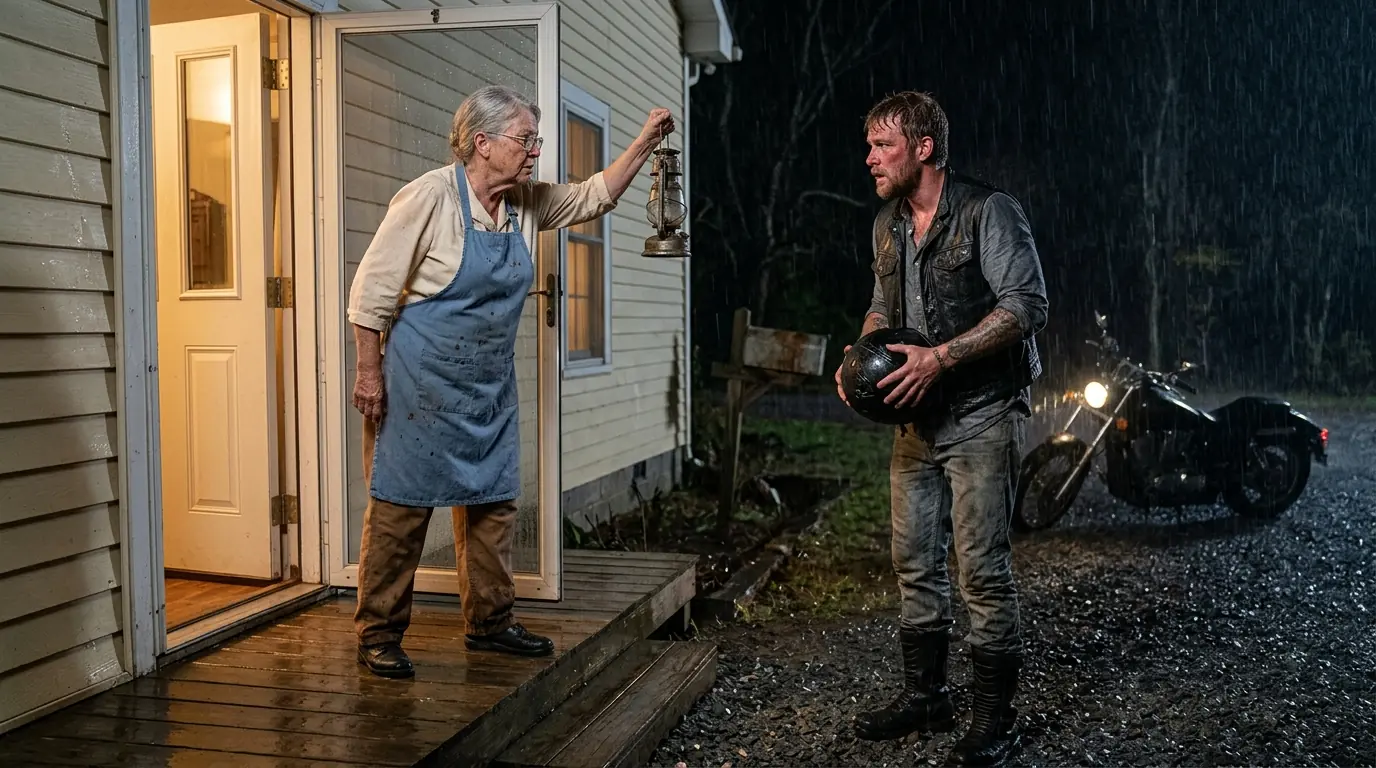
The porch no longer dipped. The fence stood straight. The barn door closed properly. The garden gate swung smoothly. The mailbox no longer leaned toward the ditch.
Caleb installed a small bench near the garden because Evelyn liked to rest while watering.
She pretended to hate it.
Then used it every day.
The friendship grew quietly.
Caleb stopped by sometimes just to bring groceries when storms were coming. Evelyn sent him home with jars of preserves, bread, tomatoes, and stern advice he did not request.
When his motorcycle shop had a slow month, she helped him rewrite a newspaper ad because, according to her, “No one trusts a business that uses six exclamation points.”
When Evelyn’s kitchen faucet broke, Caleb fixed it before she could call a plumber.
When Caleb had a customer refuse to pay for completed work, Evelyn listened to him complain over coffee and said, “Kindness is not weakness, but neither is an invoice.”
He framed that sentence and hung it in his shop.
Years passed like that.
Slowly.
Then faster.
Evelyn turned seventy-eight, then seventy-nine.
Caleb’s shop grew. He hired two mechanics. Renee helped him organize bigger community rides and local events. Mason finally learned how to be useful with a wrench.
Evelyn’s house, however, began facing problems too large for Saturday repairs.
A new development company purchased land near the main road. Surveyors came. Signs appeared. Rumors spread that the county wanted to widen the rural road and reroute part of the drainage system. Then Evelyn received the first letter.
Her property taxes would rise.
Then came the second letter.
Part of her gravel driveway might need major work to meet new access requirements.
Then the third.
Her farmhouse, because of its age, needed repairs to meet insurance standards: roof work, electrical updates, foundation inspection. The numbers made her sit at the kitchen table for a long time without moving.
She did not tell Caleb.
Of course she did not.
Pride was one of the few things age had not taken from her.
But Caleb noticed.
He noticed the new stack of envelopes under the sugar jar. He noticed Evelyn no longer buying extra birdseed. He noticed the roof patch she had not mentioned. He noticed the way she looked at the front pasture as if trying to memorize it.
One Saturday in October, he arrived and found her sitting on the porch with a letter in her lap.
“Bad news?” he asked.
“Nosy news.”
“That means bad.”
She folded the letter.
“I may have to sell.”
Caleb went still.
“The house?”
“The land first. Maybe the house after.”
“No.”
“That is not a legal argument.”
“It’s a strong emotional one.”
“Emotions don’t pay taxes.”
He sat in the other rocking chair.
For a moment, they looked out at the yard in silence.
The oaks had turned gold. The gravel drive curved toward the road. The mailbox stood straight because of him. The garden bench sat near the tomatoes. The barn door, once sagging, held firm.
“What happened?” Caleb asked.
Evelyn told him.
Not all at once. In pieces.
The taxes. The insurance repairs. The access road requirements. The developer’s offer. The pressure to sell before the costs became impossible.
“I’m not poor,” she said, because pride required the sentence.
“I didn’t say you were.”
“I just don’t have enough for this much at once.”
“I understand.”
“I don’t want pity.”
“I didn’t bring any.”
She looked at him.
“What did you bring?”
Caleb leaned forward, elbows on knees.
“A memory.”
She frowned.
“Of what?”
“You helped me when my bike slid outside your house. You came into freezing rain, dragged me out of the storm, gave me tea, tools, cornbread, and just enough insults to make me feel welcome.”
“That was basic manners.”
“No,” Caleb said. “It was a door opening. You treated me like a neighbor before I had earned the word.”
Evelyn looked away.
“You fixed my fence after.”
“And then you fed me for four years.”
“Your math is rude.”
“It’s accurate.”
She smiled despite herself.
He became serious again.
“Let me help.”
“You already have.”
“Let me help bigger.”
“No.”
“You don’t even know what I mean.”
“I know it involves people fussing over me.”
“It involves people honoring you.”
“There is that word again. People use it when they want to get around my refusal.”
“Because your refusal is very tall.”
She sighed.
“Caleb.”
“Evelyn.”
They stared at each other.
She lost first, mostly because he had learned patience from her.
“What are you thinking?”
He looked toward the road.
“Your farm road is one of the best riding routes in the county. Quiet, beautiful, historic, and ignored. That can change.”
“I do not want motorcycles roaring past my porch every day.”
“I know. Not that. Controlled events. A heritage ride. Farm breakfast days. A small roadside market for your preserves, local produce, and crafts. We bring people here a few weekends a year, not all the time. Enough income to help with taxes and repairs. Enough public attention that the county and developer can’t treat this place like empty land.”
“That sounds complicated.”
“It is.”
“I hate complicated.”
“You like pretending you do.”
She frowned.
He continued.
“Renee knows grant writing. Mason’s cousin works in rural tourism planning. My shop can sponsor the first ride. The riders can volunteer for repairs. We can create a fund for the road and house improvements, not charity, a community preservation project.”
Evelyn shook her head.
“This is just a fancy way to pass a hat around.”
“No. It’s a way to make the house support itself without selling itself.”
That sentence made her quiet.
Caleb softened his voice.
“You told me once good people leave something useful. Let this place keep doing that.”
For the first time, Evelyn did not say no.
The plan took months.
Evelyn disliked most of it.
She disliked paperwork. She disliked photographs. She disliked meetings at her kitchen table where people used phrases like “historic rural route” and “community engagement.” She disliked the idea of strangers knowing her problems.
But she liked the repairs.
And she liked watching people respect the old place.
Renee came with folders, forms, and a calm confidence Evelyn admired. Mason brought lumber and made three mistakes before breakfast, but he kept trying. Caleb organized volunteers from his riding group. Some repaired fencing. Some painted the barn. Some cleared brush along the driveway. One retired electrician updated the wiring at a reduced cost. A roofer who rode with Caleb’s group gave Evelyn a payment plan so gentle she called it suspicious.
The project became known as Harper Road Home.
Evelyn hated the name.
“It sounds like a funeral program.”
Caleb said, “It sounds like a place worth returning to.”
She had no answer for that.
The first Harper Road Home Ride took place the following spring.
Evelyn woke before sunrise to bake biscuits, though everyone had told her not to work too hard. She ignored them. By seven, the kitchen smelled of coffee, bacon, biscuits, and peach preserves. Folding tables stood beneath the oaks. Local farmers brought eggs, honey, jam, and vegetables. A neighbor sold handmade quilts. A high school music group played near the barn.
Then the motorcycles came.
Not hundreds at first. Maybe sixty.
They rolled in slowly and respectfully, engines low, guided by volunteers so the yard stayed safe. Riders parked in the side pasture. They removed helmets, stretched legs, and looked around with smiles that made Evelyn’s chest tighten.
They were not there to take.
They were there to support.
Caleb stood near the porch, directing people with the ease of someone who had finally found the right road.
Evelyn sat in her rocking chair, arms crossed.
“You look like a queen,” Renee said.
“I look like a woman whose yard has been invaded by leather.”
“Lovingly invaded.”
“That is not better.”
But Evelyn smiled.
People bought breakfast plates, preserves, tomatoes, quilts, and raffle tickets. They toured the barn, read a small sign about the farmhouse history, took careful photos, and left donations in a wooden box Caleb had built from old fence boards.
By noon, Evelyn had told twelve strangers how to make proper biscuits and corrected three people on the difference between jam and preserves.
By three, the event had raised enough to cover the next property tax payment.
By the end of the month, with donations, market sales, and a small rural preservation grant Renee secured, Evelyn had enough to begin the roof repair.
She sat at the kitchen table staring at the numbers.
“This is real?” she asked.
Caleb nodded.
“It’s real.”
“And I don’t have to sell the front pasture?”
“No.”
“The house?”
“No.”
“The barn?”
“No.”
She looked down.
“I don’t know how to thank people.”
Caleb smiled.
“You usually start by telling them they’re doing something wrong.”
“That is my love language.”
“I know.”
The rides continued twice a year.
Spring and fall.
Not too many. Not too loud. Always organized carefully. Always respectful of the road, the land, and Evelyn’s peace.
Harper Road Home became known among riders as one of the warmest stops in Tennessee. People came for the route, but they returned for Evelyn’s biscuits, sharp humor, and the feeling that the farmhouse at the end of the road was not a tourist stop but a welcome.
The project expanded gently.
A small farm stand was built near the driveway, open on weekends. Local teenagers helped sell preserves and produce. Evelyn taught a few of them how to bake bread. Caleb’s riders repaired the old smokehouse and turned it into a tiny history room with photographs of the Harper family, old farm tools, and stories Evelyn recorded reluctantly after Renee insisted.
The county, seeing the community interest, adjusted its road plan to protect the old oak line and offered assistance for drainage improvements instead of pushing costly access changes onto Evelyn alone.
The developer stopped calling.
Caleb called that a victory.
Evelyn called it “people finally developing sense.”
Years passed.
Evelyn grew older, but the house grew stronger.
The roof was repaired. The porch repainted. The barn stabilized. The driveway improved. The garden expanded. The old mailbox stood proudly at the roadside with a new sign beneath it:
Harper Road Home
Preserves, Biscuits, Stories, And Spring/Fall Ride Days
Evelyn complained the sign was too long.
Everyone ignored her.
On her eightieth birthday, Caleb organized a small dinner on the porch.
Evelyn warned him not to throw a party.
He threw a party.
Not a huge one. Just Caleb, Renee, Mason, a handful of riders, neighbors, two of Evelyn’s children, three grandchildren, and a dozen people who had somehow become part of the farmhouse’s second life.
Evelyn sat in her rocking chair with a quilt over her knees and looked at the table spread across the porch: fried chicken, biscuits, green beans, pies, preserves, coffee, and a birthday cake Mason had decorated so badly it became the evening’s main entertainment.
“That cake looks like it fell off a truck,” Evelyn said.
Mason sighed.
“I tried.”
“I can tell. That’s what worries me.”
Everyone laughed.
After dinner, Caleb stood near the porch steps holding a small wooden box.
Evelyn narrowed her eyes.
“No speeches.”
“It’s not a speech.”
“You’re standing like it is.”
“It’s a gift.”
“Gifts can be dangerous.”
He stepped closer and handed her the box.
Inside was a key tied with a green ribbon.
Evelyn stared at it.
“What is this?”
Caleb’s voice softened.
“We created a nonprofit trust for the property.”
Her eyes lifted sharply.
“Caleb.”
“Listen first.”
“I dislike that instruction.”
“I know. Listen anyway.”
He sat on the porch step in front of her so they were nearly eye level.
“The trust doesn’t take the house from you. You remain the owner. You make the decisions. But it protects the land from being sold for development after you’re gone, if that’s what you want. It keeps the farmhouse as Harper Road Home, a community place, a riding stop, a market, a teaching kitchen, whatever you decide it should become.”
Evelyn’s fingers tightened around the key.
“My children agreed?”
“They helped shape it.”
She looked toward her family. Her daughter nodded through tears.
“We know you never wanted this place erased,” her daughter said. “Now it won’t be.”
Evelyn looked back at Caleb.
“And the key?”
“That opens the new farm stand. Built from wood from the old barn door. We finished it this morning.”
“You all were hammering at six a.m.”
“Yes.”
“I thought raccoons had gotten ambitious.”
Caleb laughed.
Evelyn looked down at the key again.
“What did I do to deserve all this?”
The porch went quiet.
Caleb answered gently.
“You opened your door.”
She shook her head.
“For a biker with a motorcycle in my ditch.”
“For a stranger,” he said. “And then you kept opening it.”
Evelyn’s eyes filled.
“I only gave you tea.”
“And tools,” he said.
“And cornbread.”
“And a reason to come back.”
She looked at the yard, the repaired barn, the straight fence, the oaks, the gravel drive, the people gathered around her, the riders who had become family, the children laughing near the garden bench Caleb had built years before.
Her home had not been saved by one grand miracle.
It had been saved by return.
One person helped.
Then came back.
Then brought others.
Then those others helped too.
That was how kindness worked when it was allowed to keep moving.
Later that evening, after the guests left and the porch grew quiet, Evelyn and Caleb sat in the rocking chairs while crickets sang in the grass.
“You know,” Evelyn said, “when you first walked up my drive, I almost didn’t let you in.”
Caleb smiled.
“Because I looked frightening?”
“Because I had just cleaned the kitchen.”
He laughed.
She smiled, then grew thoughtful.
“But I’m glad I did.”
“So am I.”
“You turned out useful.”
“That’s high praise from you.”
“It is.”
He looked toward the farm stand, the new roof, the barn glowing softly beneath porch lights.
“You saved me first,” he said.
She scoffed.
“Your motorcycle needed a wire tightened.”
“No,” Caleb said. “I needed to be treated like a neighbor.”
Evelyn turned to him.
His expression was calm, honest, grateful.
She reached over and patted his hand.
“Well,” she said, “you became one.”
The next spring, Harper Road Home welcomed its largest ride yet.
Evelyn sat on the porch as motorcycles rolled in slowly beneath the oak trees. Families walked between tables. Teenagers sold jars of peach preserves. Riders lined up for biscuits. Renee managed the donation box. Mason proudly showed off the farm stand, though Evelyn still refused to let him decorate cakes.
Caleb stood near the driveway, greeting riders and guiding them toward the pasture.
At one point, a young rider approached the porch, helmet in hand.
“Are you Mrs. Harper?”
“Depends who’s asking.”
He smiled nervously.
“My bike’s acting up. Caleb said you’re the reason this place exists.”
Evelyn looked past him at Caleb, who was grinning from near the driveway.
“Caleb talks too much,” she said.
Then she pointed toward the side of the house.
“Tools are in the shed. Water’s on the porch. And if you’re hungry, biscuits are on the table.”
The young rider’s face softened with relief.
“Thank you.”
Evelyn rocked back in her chair.
“Don’t thank me yet. If you track mud into my kitchen, I charge extra.”
As he hurried off, Evelyn looked out over the yard and felt the old house around her, steady and alive.
Years earlier, she had helped one biker outside her farmhouse because his motorcycle had slid off the icy gravel during a brutal storm and he needed more than a phone, water, and tools.
He needed someone to step into the weather.
He needed someone to see him as a person before judging the leather jacket, the beard, the tattoos, or the roaring machine in her ditch.
Evelyn thought it was a small thing.
But small things have roads of their own.
Caleb returned with tools.
Then with friends.
Then with a plan.
Then with a community strong enough to help save the home she thought she might lose.
What Evelyn received was not only money for repairs, protected land, or a farm stand built from old barn wood.
She received proof that her house still mattered.
She received new footsteps on the porch, laughter beneath the oak trees, and a family made not by blood alone, but by showing up again and again.
And every time thunder rolled over Millbrook or a motorcycle slowed near the mailbox, Evelyn would set down her tea, look toward the road, and smile before muttering,
“Well, let’s see what trouble found my driveway today.”