Margaret Ellis was sixty-eight years old when she first heard about the two boys nobody wanted.
She was sitting alone in her small kitchen in Greenville, South Carolina, drinking tea from the same blue mug she had used for twenty years.
Outside, rain tapped softly against the window, running in thin silver lines down the glass.
The old oak tree in her backyard moved slowly in the wind, its branches stretching over the little house where Margaret had lived since her husband, Thomas, passed away.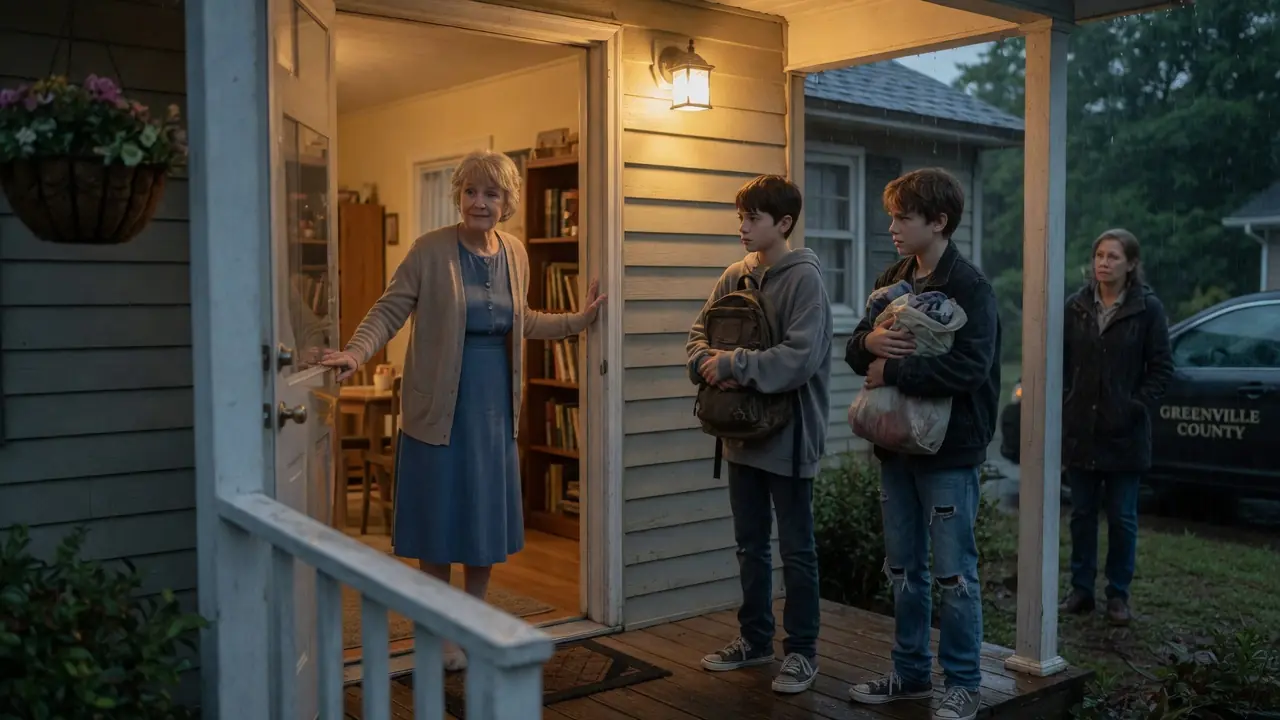
The house was quiet now.
Too quiet.
Thomas had been gone for seven years, and the silence he left behind had never completely faded. He used to fill the rooms with small sounds: his shoes by the door, his radio playing in the garage, his voice calling from the garden asking where he had put the screwdriver he was holding in his own hand. Sometimes Margaret still turned her head when the pipes creaked, expecting to hear him come in through the back door.
She still kept his gardening gloves hanging near the back door.
She still cooked too much food.
She still bought two loaves of bread even though she lived alone.
Old habits were sometimes just love with nowhere else to go.
Before Thomas died, Margaret had worked as a school librarian for thirty-five years. She had a soft voice, careful hands, and a memory full of children who had once come to her with torn book covers, overdue notices, scraped knees, and questions they were too embarrassed to ask anyone else. She knew which children loved adventure stories because they were brave, and which children loved them because they wished they were.
Margaret and Thomas never had children of their own.
They had wanted them. For years, they prayed, hoped, waited, and endured the kind of polite sympathy that made empty rooms feel even emptier. Eventually, they stopped talking about it every month and built a life around other kinds of love. They filled their house with books, neighbors, church dinners, stray cats, borrowed children, and anyone who needed a place to sit for a while.
After retirement, Margaret volunteered at a local children’s center twice a week.
The center sat beside a brick church and an old playground with faded swings. It served children in temporary placements, group homes, and foster care. Some came for after-school tutoring. Some came because they needed dinner. Some came because the building was warm and nobody there asked them why they did not want to go home.
That was where Margaret met Daniel Harper.
He was fourteen years old.
Tall for his age.
Thin.
Quiet.
Always standing near walls instead of people.
The first time Margaret saw him, he was sitting alone in the corner of the reading room with a book in his hands. He was not reading it. He was just holding it, his fingers pressed tightly around the cover as though it were something solid in a world that kept shifting under him.
Margaret recognized that.
Some children held books because they loved stories.
Some held them because stories were safer than people.
She walked over slowly, not too close, and nodded toward the book.
“What are you reading?”
Daniel looked up.
His eyes were dark and guarded.
“Nothing.”
Margaret smiled.
“That’s a difficult title.”
For one second, the boy almost smiled.
Almost.
Then he looked back down at the book.
Margaret did not push. She had worked with children long enough to know that trust was not a door adults could kick open and call kindness. Trust was a porch light. You turned it on and waited.
His file explained the rest later.
Both parents gone.
No close relatives able to take him.
Multiple temporary placements.
Behavior problems.
Trust issues.
The kind of words adults used when they described the wounds of children without mentioning the reasons behind them.
A month later, Margaret met another boy.
His name was Lucas Reed.
Fifteen years old.
Shorter than Daniel, but louder.
Where Daniel disappeared into silence, Lucas fought everything.
Questions.
Rules.
Adults.
Help.
Especially help.
He had sharp brown eyes, messy black hair, and the kind of expression that dared the world to reject him first so he would not have to wait for it. He argued with tutors, refused to sit still, and laughed when someone threatened consequences. He had been moved from home to home because people said he was “too angry.”
Margaret hated that phrase.
Too angry.
As if anger were the child’s problem instead of the child’s armor.
She knew anger was often just sadness that had learned how to defend itself.
The first time Lucas spoke to her, he was standing in the hallway outside the cafeteria, arms crossed, refusing to go in because someone had told him he had to apologize to another boy.
Margaret stopped beside him.
“Hungry?”
“No.”
“That is unfortunate. They made macaroni.”
“I hate macaroni.”
“You haven’t tasted this macaroni.”
“I hate all macaroni.”
Margaret nodded thoughtfully.
“A sweeping position.”
Lucas narrowed his eyes.
“What?”
“It means you have made a large judgment without enough research.”
He stared at her like she had spoken another language.
Then he said, “You always talk weird?”
“Yes.”
That time, he did smile.
Only a little.
But enough.
One afternoon, the director of the children’s center asked Margaret to stay after volunteering.
Her name was Elaine Foster, a woman in her early fifties with tired eyes and a desk covered in folders. Margaret knew immediately that something was serious. People who worked with children in crisis did not ask retired librarians to stay late for cheerful reasons.
“Margaret,” Elaine said carefully, “I need to ask something difficult.”
Margaret folded her hands in her lap.
“That usually means the answer is yes before you ask.”
Elaine sighed.
“There are two boys who need placement.”
Margaret waited.
“Together.”
That word mattered.
“Together?” Margaret repeated.
“Yes.”
Elaine opened the folder, then closed it again, as if the paper could not explain what the heart already understood.
“Daniel Harper and Lucas Reed.”
Margaret looked toward the hallway. She could hear children laughing in the art room, the squeak of a chair, the low murmur of a volunteer helping with homework.
“I did not realize they were connected.”
“They met in emergency placement two years ago,” Elaine said. “They are not brothers by blood, but they have become brothers in every other way that matters.”
Margaret nodded slowly.
“And it has been difficult finding a home for both.”
Elaine’s mouth tightened.
“Yes.”
“Because they are teenagers.”
“Yes.”
“Because one is too quiet and one is too angry.”
Elaine looked down at the folder.
“Those are the words people use.”
Margaret’s voice grew softer.
“And because most families want small children who still look like hope.”
Elaine did not answer.
She did not have to.
The room seemed to grow still around them.
“What happens if no one takes them together?” Margaret asked.
“They will likely be separated.”
Margaret closed her eyes.
Separated.
Two boys who had already lost parents, homes, birthdays, bedrooms, familiar streets, and any faith that adults meant what they promised. Now the system wanted to take the one person each of them still reached for in the dark.
“Where are they sleeping tonight?” Margaret asked.
“At the center.”
“Do they have a place tomorrow?”
Elaine was silent.
Margaret looked down at her hands. They were older now. Veins raised. Knuckles stiff in the mornings. Hands that had shelved thousands of books, held Thomas’s hand through chemotherapy, planted tomatoes, washed dishes, signed cards, and carried casseroles to grieving neighbors.
She knew what she should say.
She should say she was too old.
Her house was too small.
Her retirement income was limited.
She had no experience raising teenage boys.
The practical answer was obvious.
But practical answers had never stopped a child from needing someone.
“I’ll take them,” Margaret said.
Elaine stared at her.
“Margaret…”
“I said I’ll take them.”
“You understand this will not be easy.”
Margaret smiled sadly.
“Neither was losing my husband. Neither was growing old alone. Neither was watching children learn not to hope.”
Elaine’s eyes filled.
“There will be paperwork. Inspections. Training. Background checks. Emergency approval first, then review.”
“Then we had better start.”
Elaine pressed her fingers to her lips for a moment.
“You are sure?”
Margaret looked toward the hallway again.
“No,” she said honestly. “But I am willing.”
Sometimes willingness was all courage had at the beginning.
The first night Daniel and Lucas arrived at Margaret’s house, they brought almost nothing.
Daniel carried one backpack.
Lucas carried a plastic grocery bag with clothes inside.
That was it.
No childhood boxes.
No family photographs.
No toys.
No objects that said they belonged somewhere.
Margaret hated that.
Children should have too many things.
Not too few.
She stood on the porch as Elaine’s car pulled into the driveway. The rain had stopped, but the air still smelled damp and green. The porch light glowed yellow over the steps. Margaret had swept twice that afternoon, rearranged the guest rooms three times, and nearly burned the chicken because her nerves kept making her check the front window.
Daniel stepped out first.
He looked nervous but tried to hide it behind stillness.
Lucas climbed out next, carrying his plastic bag like he expected someone to snatch it from him. He looked suspicious, chin lifted, eyes already searching for the trap.
Margaret came down one step.
“Before you come inside,” she said.
Both boys stopped.
They looked at each other.
Then at her.
Margaret smiled.
“I need you to understand something.”
Lucas crossed his arms.
“What?”
“This is your home.”
Neither boy reacted.
They had heard promises before.
Margaret continued.
“You do not have to earn dinner.”
Silence.
“You do not have to be perfect.”
Silence.
“And nobody is taking your room away because you had a bad day.”
Daniel looked down.
Lucas looked away.
Margaret opened the door wider.
“Now come inside before my neighbors think I’m standing out here arguing with teenagers.”
That almost got a reaction from Lucas.
Almost.
The house was small but warm.
Two bedrooms upstairs.
A kitchen with yellow curtains.
A living room lined with bookshelves.
A dining table where Thomas had repaired countless watches, radios, and school science projects for neighborhood children.
Margaret had prepared two rooms.
Fresh sheets.
New towels.
A lamp beside each bed.
A small bookshelf.
A plastic laundry basket.
A toothbrush still in its package.
She had even placed a handwritten note on each pillow.
You belong here.
Lucas picked his up, read it, and immediately put it down.
Daniel stared at his longer.
Margaret pretended not to notice.
That night, she cooked chicken and rice, green beans, biscuits, and apple cobbler because she did not know what teenage boys liked and had decided too much food was safer than too little.
Daniel ate quietly.
Lucas ate like he was angry at the plate.
Margaret said nothing about manners.
Not the first night.
After dinner, Lucas carried his dish to the sink without being asked. Daniel wiped the table with a paper towel, moving carefully as if waiting for someone to tell him he had done it wrong.
“Thank you,” Margaret said.
Both boys looked startled.
That small thank you was the first brick.
The first months were difficult.
Very difficult.
Daniel barely spoke.
He woke from nightmares and sat silently on the edge of his bed until morning. Sometimes Margaret found him in the kitchen at three o’clock, barefoot, staring at the back door like he was deciding whether to run before someone made him leave.
She never asked him why he was awake.
She would simply put the kettle on.
“Tea?” she would ask.
He always shrugged.
She always made two cups.
Lucas tested every boundary Margaret created.
He stayed out late.
He refused help.
He argued about everything.
“Dinner is at six,” Margaret said one evening.
“I’m not hungry.”
“You will be.”
“I said I’m not.”
“And I said you will be.”
“You always win arguments?”
“No. I just have more years of practice.”
Lucas hated that he almost laughed.
Almost.
He slammed doors.
Margaret waited.
He muttered under his breath.
Margaret ignored the parts that did not need answering.
He said once, “You’re not my mother.”
Margaret looked at him calmly.
“No. I am Margaret.”
He stared, wrong-footed.
“I didn’t ask you to pretend,” she continued. “I only asked you to hang up your wet towel.”
That ended the argument because Lucas had prepared for rejection, not practicality.
Margaret never tried to replace their parents.
She never said, “Forget the past.”
She never said, “You should be grateful.”
She simply showed up.
Every morning.
Every evening.
Every difficult conversation.
She learned Daniel liked pancakes but hated syrup.
She learned Lucas secretly loved old movies but pretended they were boring.
She learned Daniel tapped his fingers when anxious.
She learned Lucas cleaned the kitchen when he was upset because he needed somewhere to put his anger.
She learned Daniel was good with tools.
She learned Lucas was fast with numbers but pretended school was pointless because trying and failing scared him more than not trying at all.
She learned everything she could.
Because love was not magic.
Love was attention.
One night, six months after they arrived, Margaret found Lucas sitting on the porch steps.
It was almost midnight. The summer air was thick, and crickets chirped from the dark yard. Lucas sat with his elbows on his knees, staring at the street like he expected someone to appear there and prove every good thing false.
Margaret came out wearing her robe and slippers.
She sat beside him.
No lecture.
No questions.
Just sat.
After several minutes, Lucas spoke.
“Why?”
Margaret looked at him.
“Why what?”
“Why did you pick us?”
She was quiet.
Because the honest answer was complicated.
Because she had no children.
Because she had lost Thomas.
Because she knew what loneliness looked like when it sat across from you at breakfast.
Because two boys had been carrying pain too heavy for their age, and nobody else had wanted to carry even a corner of it with them.
Finally, she said, “Because you were standing there needing someone.”
Lucas looked away.
“That’s stupid.”
“Probably.”
“You don’t even know us.”
“I know enough.”
“You don’t know what we’ve done.”
Margaret looked at him.
“No.”
A pause.
“But I know what happened to you.”
Lucas went silent.
The crickets continued.
A car passed slowly at the end of the street.
Then Lucas covered his face with both hands, and for the first time since he came to her house, he cried.
Not loudly.
Not dramatically.
Like a boy trying to keep grief from escaping and failing.
Margaret put one arm around his shoulders.
At first, he went stiff.
Then he leaned against her.
“I hate this,” he whispered.
“I know.”
“I hate needing people.”
“I know.”
“What if you get tired of us?”
Margaret looked out at the dark yard.
“I am tired most days. That is not the same as leaving.”
He cried harder then.
He apologized afterward.
Margaret told him tears were not something requiring forgiveness.
Daniel changed slowly.
Very slowly.
But Margaret noticed.
He started eating breakfast at the table instead of waiting until everyone left.
He started asking questions.
Small ones at first.
Where do you keep the extra paper towels?
Can I take this book upstairs?
Do you care if I fix the loose cabinet door?
He joined the school reading club because the librarian told him he had good taste and Margaret pretended she had not called ahead to make sure someone noticed. He helped Margaret carry groceries. He began staying in the living room after dinner instead of vanishing upstairs.
One afternoon, she found him repairing a broken chair in the garage.
The chair had been Thomas’s old work chair. One leg wobbled, and Margaret had meant to throw it away for years but never could.
“You fixed that?” she asked.
Daniel shrugged.
“It was loose.”
Margaret walked around it, inspecting it like a customer.
“Your father must have been handy.”
Daniel froze.
The wrong words sometimes entered a room before anyone could catch them.
Margaret immediately regretted it.
But Daniel did not run.
After a long moment, he quietly said, “I don’t remember much.”
Margaret put a hand on his shoulder.
“You don’t have to.”
That night, Daniel finally told her about his parents.
Not everything.
Just enough.
Enough to explain why trusting people felt dangerous.
Enough to explain why he stayed near walls.
Enough to explain why books were easier to hold than hands.
Margaret listened.
She never interrupted.
At the end, Daniel whispered, “I think I forgot what normal felt like.”
Margaret answered, “Then we’ll practice.”
And they did.
They practiced normal in tiny, stubborn ways.
Laundry on Saturdays.
Church some Sundays, but never forced.
Grocery lists on the refrigerator.
Homework at the dining table.
Movie nights with popcorn Lucas claimed was too buttery and then finished anyway.
Birthday cakes with crooked candles.
Christmas stockings hung on the mantel, including one for Thomas because Margaret said love did not need a body to have a place at Christmas.
The first Christmas Daniel and Lucas spent with Margaret, she bought them each a winter coat and wrapped the boxes with red paper.
Lucas stared at his coat.
“You bought this new?”
“Yes.”
“Why?”
“Because the old one had a broken zipper.”
“It still worked.”
“It did not close.”
“That’s different.”
“That is exactly the same.”
Daniel ran his fingers over the sleeve of his coat and said nothing.
Later that night, Margaret found both boys’ old coats folded neatly near the back door, as if they could not quite believe they were allowed to replace anything without losing something.
Two years passed.
The boys became young men.
Daniel was sixteen.
Lucas was seventeen.
The house that had once felt like three separate lives slowly became one.
There were shoes by the door.
Arguments over the television.
Homework on the kitchen table.
Dirty dishes Margaret complained about every day.
Pancake batter on Sunday mornings.
Lucas yelling from upstairs because Daniel had used his shampoo.
Daniel muttering that Lucas had used his charger.
Margaret standing at the bottom of the stairs saying, “If both of you survive this shampoo crisis, dinner is at six.”
Ordinary things.
The things children remember most.
Margaret often thought that ordinary was a miracle people overlooked.
Then came the phone call.
The one that changed everything.
Margaret was in the garden when Elaine Foster called.
Tomatoes had begun to ripen, and Lucas had promised to help stake the beans but was nowhere in sight. Daniel was in the garage trying to repair an old lawn mower someone from church had given them. The house behind Margaret stood warm in the afternoon light, its paint peeling in places, its porch sagging slightly, but still theirs.
“Helen,” Elaine said, then corrected herself quickly. “Margaret. I’m sorry. I have three files open.”
Margaret straightened.
“What happened?”
“I need to discuss something serious.”
Her hand tightened around the phone.
“The boys?”
“They are safe.”
That helped, but not enough.
“Your foster approval is being reviewed.”
Margaret looked toward the house.
“Why?”
“There was a routine inspection request. The county has updated standards. There are concerns about the condition of the property, your income documentation, and your ability to continue long-term care.”
Margaret’s mouth went dry.
“You’re saying I’m too old.”
“No one is saying that.”
“But someone is thinking it.”
Elaine was quiet.
The review was brutal.
Not because Margaret was a bad guardian.
Because the world often measured care with numbers.
Income.
Age.
Bedrooms.
Forms.
Railings.
Roof condition.
Electrical updates.
Checklist after checklist.
Not patience.
Not midnight conversations.
Not the way Lucas stopped flinching when someone raised a voice.
Not the way Daniel started believing his future could be different.
An inspector walked through the house with a clipboard.
She saw the old roof.
The small rooms.
The cracked tile in the upstairs bathroom.
The railing on the porch that wobbled if pulled too hard.
The aging kitchen cabinets.
The window in Lucas’s room that stuck in humid weather.
She wrote everything down.
Margaret watched.
Finally, she asked, “Does your form have a place for progress?”
The inspector looked confused.
“What?”
“Does it have a place for writing that Daniel no longer thinks he is invisible?”
Silence.
“Does it have a place for writing that Lucas came home one night and apologized without being asked?”
The inspector looked down.
Margaret continued.
“Because those things matter too.”
The woman’s face softened, but the pencil remained in her hand.
“I understand, Mrs. Ellis.”
“No,” Margaret said gently. “I don’t think you do.”
Paperwork won.
The house needed repairs Margaret could not afford immediately. She had some savings, but not enough. Thomas’s pension helped with groceries and utilities, not roof work, electrical updates, porch reconstruction, and new windows.
The boys were told they might need another placement.
Together or separately.
The same fear returned.
The same one they thought they had escaped.
Lucas became furious first.
He punched the shed door hard enough to bruise his knuckles.
“They can’t do that.”
Margaret wrapped his hand in a towel.
“They can.”
“No. We live here.”
“I know.”
“This is our home.”
Margaret’s eyes filled, but she kept her voice steady.
“Yes.”
Daniel went quiet in a way Margaret had not seen in over a year.
That frightened her more than Lucas’s anger.
He stopped eating breakfast. He stopped working on the lawn mower. He sat in his room with the door open but did not come downstairs unless called. One evening, Margaret found him standing in the hallway between the two bedrooms, looking at the walls as if trying to memorize them.
“Daniel?”
He did not turn.
“I should have known better,” he said.
“Known what?”
“That homes don’t last.”
Margaret crossed the hall and stood beside him.
“This one did.”
“Not long enough.”
The words entered her chest and stayed there.
The night before the final decision, Daniel found Margaret sitting alone at the kitchen table.
She was crying quietly.
He had never seen that before.
Not once.
“Mom?”
The word slipped out.
Both of them froze.
Margaret looked up.
Daniel looked embarrassed, almost frightened by what he had said.
“I’m sorry.”
She stood so quickly the chair scraped the floor. Then she wrapped her arms around him and held him tight.
“No,” she whispered. “Never apologize for giving love a name.”
Lucas appeared in the doorway.
He had heard.
For once, he did not joke.
He walked across the kitchen and wrapped his arms around both of them.
The three of them stood there in the yellow light, holding on to one another while the house around them seemed to listen.
The decision came three weeks later.
Margaret could no longer continue as their official guardian unless the house was brought into compliance within ninety days. She did not have the money. The county did not have the flexibility. Donations were discussed. Church help was discussed. Temporary extensions were discussed.
In the end, none of it was enough.
The boys would transition to another placement.
Together, if possible.
Separately, if necessary.
Those words nearly broke Margaret.
Together, if possible.
As if love were a scheduling preference.
The morning they left, Margaret cooked breakfast.
She always cooked breakfast.
Pancakes.
Eggs.
Toast.
Fruit.
Everything they loved.
Nobody ate much.
Lucas sat with both hands under the table, jaw clenched.
Daniel kept staring at the kitchen window.
At the front door, Elaine waited beside the county car with red eyes and an apology she had already given too many times.
Daniel hugged Margaret first.
“You changed my life,” he whispered.
Margaret shook her head.
“No.”
“Yes.”
“No. You changed yours. I just reminded you that you could.”
Lucas stood with his plastic bag of things, though now he had more than one bag. Clothes. Books. A few old movies. A framed photograph of him, Daniel, and Margaret in the backyard beside a crooked tomato plant.
He looked angry.
Not because he was angry.
Because anger was easier than heartbreak.
Margaret reached for him.
He hesitated.
Then suddenly hugged her too.
Quickly at first.
Almost like he was embarrassed.
Margaret held him anyway.
“I love you,” she whispered.
Lucas did not answer.
But he did not pull away.
When the car drove away, Margaret stood on the porch watching until it disappeared.
Then she went inside and found two notes on the dining table.
Daniel’s said:
I will come back when I can.
Lucas’s said:
Do not give my room away.
Margaret pressed both notes to her heart.
Years passed.
The house became quiet again.
Too quiet.
Margaret kept their rooms.
She never changed them.
Daniel’s books stayed on the shelf.
Lucas’s old baseball cap stayed on the desk.
The photograph remained on the mantel.
Their drawings stayed on the refrigerator until the paper curled at the edges.
Margaret wrote letters.
At first, she sent them every week.
Then every month.
Sometimes she received replies.
Sometimes she did not.
There were stretches of silence that frightened her. Daniel and Lucas were placed together for a while in a group home two towns away, then briefly separated when Lucas turned eighteen and aged out sooner. Daniel finished high school through a program that helped foster youth graduate. Lucas got into trouble once, then called Margaret from a pay phone and cried so hard she could barely understand him.
“You are not what happened on your worst day,” she told him.
He kept that sentence.
Later, he told her so.
Daniel enrolled in community college, then transferred to Clemson to study architecture after a professor saw his drawings of old houses and told him he understood structure emotionally. Lucas worked construction first, then carpentry, then site management. He learned to frame walls, pour foundations, read plans, lead crews, and negotiate with men who underestimated him because he had once been a teenager nobody wanted.
They visited when they could.
At first rarely.
Then more.
Life pulled at them. Work. School. Money. Pride. The old fear of needing too much from someone. But Margaret never stopped writing. She never asked why they had not called sooner. She never made love feel like a debt.
When Daniel graduated college, Margaret sat in the crowd wearing her blue church dress and cried so openly that Lucas handed her three napkins and said, “You’re embarrassing the whole family.”
Margaret smiled through tears.
“Good.”
When Lucas started his own small contracting company, he brought her a business card.
Reed & Harper Construction.
Margaret ran her thumb over the letters.
“You put Daniel’s name on it?”
“He designs. I build.”
Daniel shrugged from the doorway.
“He insisted.”
Lucas looked away.
“We said together, didn’t we?”
Margaret put the card on her refrigerator.
Beside the old photograph.
Twenty years after the boys first arrived at her porch, Margaret was eighty-eight.
The house needed repairs again.
Real repairs this time.
The roof leaked near the hallway.
The porch steps sagged.
The kitchen floor dipped near the sink.
The old oak tree had dropped a heavy limb during a storm and cracked part of the back fence. The garden had become overgrown because Margaret’s knees no longer allowed long afternoons kneeling in the dirt.
Neighbors told her to sell.
A county outreach worker gently suggested assisted living.
Church ladies offered rides and casseroles and advice.
Margaret listened politely.
She understood.
She was old.
The house was tired.
But leaving felt like abandoning the place where two boys had learned they belonged.
One Saturday morning, she sat at the kitchen table drinking tea from the same blue mug she had used for twenty years. Rain tapped softly against the window, just as it had the day she first heard about Daniel and Lucas.
The doorbell rang.
Margaret frowned.
She was not expecting anyone.
She walked slowly through the house, one hand on the wall for balance. When she opened the door, she froze.
Two men stood on her porch.
Older now.
Confident.
Successful.
But she knew their eyes.
“Mom,” one said.
Margaret covered her mouth.
“Daniel?”
He smiled, and suddenly the quiet boy with the book was there inside the grown man.
Then the other man stepped forward.
Lucas.
His hair had threads of gray at the temples. He was broader now, stronger, wearing a work jacket with his company logo stitched over the pocket.
Margaret reached out with shaking hands and touched both their faces.
“Look at you.”
Lucas laughed softly.
“You still say that.”
“Because it is still true.”
They hugged her together.
For the first time in many years, Margaret held both boys at once.
Not boys anymore.
Men.
But in her arms, some part of them became fourteen and fifteen again, standing on her porch with almost nothing, waiting to see whether one more adult would give them up.
They spent the morning talking.
Daniel had become an architect specializing in community housing and restoration. Lucas had built Reed & Harper into a respected construction company known for honest work, fair wages, and hiring young people who needed second chances. Together, they had started building affordable homes for families who had been priced out, aged out, pushed out, or forgotten.
Because they remembered what a home meant.
Margaret made tea.
Lucas inspected the ceiling leak without being asked.
Daniel walked through the house quietly, touching doorframes, looking at old corners, remembering.
“You kept our rooms,” he said.
“Of course.”
“For twenty years?”
“I was told not to give one away.”
Lucas looked down, embarrassed.
“You kept that note?”
“It was an instruction from a resident.”
Daniel laughed softly.
Then he sat at the kitchen table and placed a folder in front of her.
Margaret immediately frowned.
“Another folder.”
Lucas smiled.
“You still hate those.”
“Yes. They usually contain bad news from people with clipboards.”
“You are going to hate this one less.”
She opened it.
Inside was a deed record, a bank confirmation, and a document showing the remaining debt on her house had been paid in full.
Her eyes widened.
“What is this?”
“The house is paid off,” Daniel said.
Margaret looked up.
“No.”
“Yes.”
“I did not ask you.”
“We know.”
“I do not need saving.”
Lucas nodded.
“That is why we are not saving you.”
He pointed to the papers.
“We are investing in what saved us.”
Margaret stared at him.
Then Daniel turned more pages.
Renovation plans.
A restored porch.
A repaired roof.
Reinforced floors.
Accessible bathroom.
Wider doorways.
A garden rebuilt with raised beds so Margaret could tend flowers without kneeling.
Then more pages.
Plans for an expanded home next door on the lot they had already purchased quietly through their company.
A community house for older foster youth aging out of care.
A kitchen big enough for shared meals.
Small bedrooms with locks.
A counseling office.
A library.
A workshop.
A garden.
The name was printed clearly on the first design page.
The Margaret House.
She stared.
“No.”
Daniel smiled.
“Yes.”
“My name?”
“Because you taught us what home meant.”
Margaret’s eyes filled.
“I only gave you a room.”
Lucas shook his head.
“No.”
He looked around the kitchen.
“You gave us a place where we stopped waiting to be abandoned.”
Silence filled the room.
Then Margaret laughed through tears.
“You two became troublemakers.”
Lucas grinned.
“Learned from you.”
The renovation began the following month.
At first, Margaret complained about the noise.
Then she complained about the dust.
Then she complained because Lucas kept moving her tea mug to keep it away from sawdust, and she said a woman should be allowed to know where her own tea was.
Daniel sat with her every week, showing her plans and asking her opinion.
“What color for the porch?”
“White.”
“Trim?”
“Green.”
“Kitchen cabinets?”
“Do not make them look like a hospital.”
“Noted.”
Lucas supervised the crew personally.
He repaired the porch first.
Then the roof.
Then the kitchen floor.
The old house did not become unrecognizable. Daniel made sure of that. He restored it instead of erasing it. Thomas’s old workbench stayed in the garage. The yellow kitchen curtains remained. The oak tree was trimmed but not removed. The dining table was refinished, its scratches preserved beneath polish like history made smooth but not hidden.
Margaret cried the day they finished the porch.
Not because it was beautiful.
Because it was strong.
The Margaret House opened one year later.
It was not an institution.
Daniel refused that word.
It was a home.
A real one.
A kitchen where people cooked together.
A living room where teenagers could watch movies without worrying someone would take the couch away.
A library with shelves built by Lucas and filled with books chosen by Margaret.
A workshop where young people could learn basic repairs.
A garden with raised beds, tomatoes, beans, flowers, and a small sign that read:
Things grow better when they are not moved every time they begin to root.
Margaret chose the curtains.
She said everyone else made too many unnecessary decisions.
The first teenager arrived on a rainy Tuesday afternoon.
He was seventeen, holding one backpack and nothing else.
His name was Marcus.
He stood on the porch with his shoulders tight and his eyes moving over everything, looking for the catch.
Margaret opened the door.
She was eighty-nine now.
Slow.
Small.
But still strong.
Marcus looked past her.
“I’m not staying long.”
Margaret smiled.
“That is all right.”
He looked surprised.
“You are not going to tell me I have to?”
“No.”
“Why?”
Margaret opened the door wider.
“Because everyone deserves a place where they can stop running first.”
Marcus stepped inside.
Daniel and Lucas watched from the kitchen doorway.
They saw Margaret do what she had always done.
Open the door.
Make food.
Give someone time.
Later that evening, Marcus found the note on his pillow.
You belong here.
He came downstairs holding it.
“What is this?”
Margaret looked up from stirring soup.
“A note.”
“I can read.”
“Then why ask?”
Marcus frowned.
“Do you mean it?”
Margaret set the spoon down.
“Yes.”
He looked toward Daniel and Lucas.
Lucas said, “She means it. Arguing won’t help.”
Marcus stared at the note again.
Then folded it carefully and put it in his pocket.
Margaret saw.
She pretended not to.
Years passed, and The Margaret House grew.
Some young people stayed three months.
Some stayed a year.
Some left too early and came back ashamed, only to find their room still waiting.
That was the rule Daniel and Lucas insisted on.
No disappearing without a door left open.
Margaret became the heart of the place, though she denied it every time someone said so.
“I am too old to be anybody’s heart,” she would say.
Lucas always answered, “Then stop beating so loudly.”
She would swat him with a dish towel.
Every Thanksgiving, the long table filled with young people, volunteers, neighbors, and former residents who returned with children of their own. Daniel carved the turkey badly. Lucas criticized him. Margaret made gravy in the old pot Lauren from church once suggested she replace, and she told everyone old things had earned their place.
One year, Marcus stood to speak.
He was twenty-three then, wearing a clean shirt and nervous hands.
“I came here with one backpack,” he said. “I thought staying meant getting trapped. Mrs. Ellis told me I could stop running first. That was the first time anybody made staying feel like my choice.”
Margaret looked down at her plate.
Daniel touched her shoulder.
Lucas cleared his throat too loudly.
The room applauded.
Margaret cried anyway.
Near the end of her life, Margaret spent most afternoons on the restored porch.
Her blue mug beside her.
Thomas’s gardening gloves still hanging near the back door.
Daniel and Lucas visited constantly, though she accused them of hovering.
“You have a business to run,” she told Lucas.
“I own it. I can hover if I want.”
“You are still bossy.”
“You raised me.”
“I took you in. There is a difference.”
“No, there isn’t.”
Daniel often brought plans for new houses, asking her opinion even when she claimed not to understand drawings.
“This window should be bigger,” she would say.
“Why?”
“Because sad people need light.”
He would mark the plan.
Lucas once asked her if she understood what she had started.
Margaret looked out at the garden where two teenagers were arguing over tomato stakes.
“I opened a door,” she said. “You two built the rest.”
Daniel shook his head.
“You gave us the blueprint.”
She smiled.
“Then it needed better handwriting.”
On her ninetieth birthday, The Margaret House hosted a celebration in the garden.
Former residents came from across the state.
There was music.
Cake.
Too many flowers.
A banner that made Margaret complain because it said Queen Margaret, and she said queens did not wash their own dishes.
Lucas stood to give a speech.
For once, he did not joke immediately.
“When I was fifteen,” he said, “I arrived at Mrs. Ellis’s house with a grocery bag of clothes and a heart full of reasons not to trust anyone. I thought love was temporary. I thought home was something people offered until you became inconvenient.”
He looked at Margaret.
“She proved me wrong by doing the same ordinary things every day. Dinner. Laundry. Notes on pillows. Waiting up when we were late. Letting us be angry without letting us be cruel. She did not rescue us by making life easy. She rescued us by making love steady.”
Daniel continued after him.
“When I became an architect, people asked why I cared so much about doors, windows, kitchens, and tables. I care because the first place that saved me was not grand. It was a small house with a leaky roof, a blue mug, yellow curtains, and a woman who believed children should have too many things, not too few.”
Margaret covered her face.
“I told you both no speeches.”
Lucas smiled.
“You told us many things.”
Daniel lifted a small framed photograph.
It was the old picture of Margaret, Daniel, and Lucas in the backyard beside the crooked tomato plant.
“This hangs in the entrance of The Margaret House now,” Daniel said. “Not because we are special. Because it shows the day we started becoming a family.”
That night, after everyone left, Margaret sat between Daniel and Lucas on the porch.
The house glowed behind them.
The new community home stood next door, warm lights in every window.
Rain began softly, just enough to darken the steps.
Margaret listened to it.
“I used to hate quiet,” she said.
Lucas leaned back.
“You? You love quiet.”
“No. I loved peace. People confuse the two.”
Daniel looked at her.
“What is the difference?”
Margaret smiled.
“Quiet is an empty room. Peace is knowing someone may come through the door.”
Lucas reached for her hand.
“We came back.”
Margaret squeezed his fingers.
“Yes,” she whispered. “You did.”
But they knew the truth.
They had come back because she had first opened the door for them.
Margaret Ellis had not rescued two orphan boys nobody wanted by giving them perfect lives. She had given them something harder and better. She gave them a place where love did not vanish after a bad day. She gave them breakfast after arguments, birthdays after grief, and rooms that stayed theirs long enough for hope to unpack.
Years later, those boys returned as men.
They rebuilt her broken home.
They paid off the debt.
They raised the porch.
They repaired the roof.
They turned one small house into a shelter for others who had been told they were too old, too angry, too quiet, too difficult, too much history, too little hope.
And every time a young person arrived at The Margaret House with one bag and guarded eyes, Daniel and Lucas saw themselves again.
Then they saw Margaret.
Old now.
Smiling at the door.
Opening it wider.
Because Margaret had taught them that home was not a building.
It was the promise that someone would still be there after the hard day.
And because of her, they spent the rest of their lives making sure other children heard the words that had once saved them.
You belong here.