Snow had been falling outside Clara Whitmore’s cabin for nineteen hours when somebody knocked on the door.
Not the soft knock of Mrs. Wilkins from the neighboring property.
Not the three quick taps her grandmother always used after carrying firewood in from the shed.
This sound was heavy.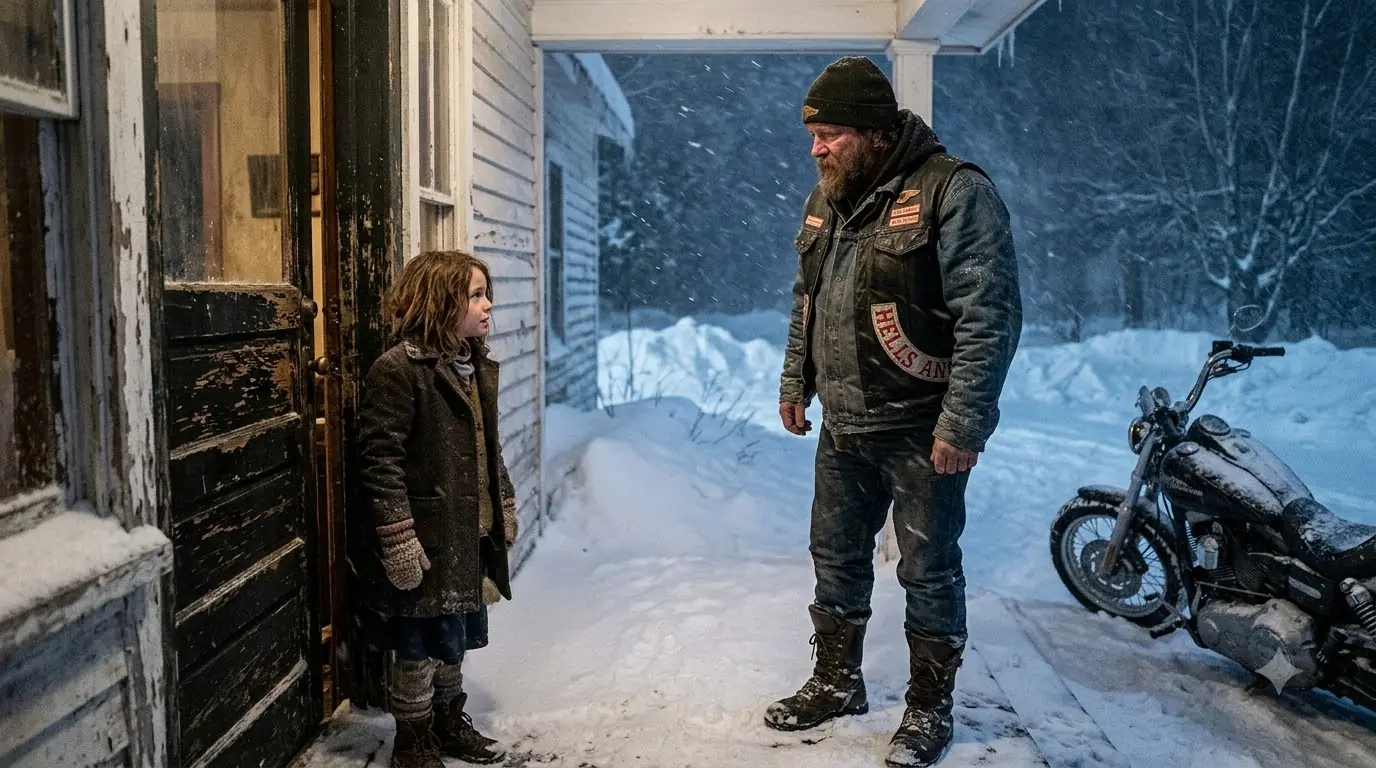
Once.
Then silence.
Clara sat upright beside the wood stove.
Her spoon remained suspended above a bowl of canned tomato soup.
The little cabin outside Bozeman had never felt large when her grandmother was alive.
Without her, every room seemed to stretch farther away.
The kitchen was too quiet.
The hallway too dark.
Even the ticking clock above the refrigerator sounded louder than before.
Clara touched the small silver cross hanging around her neck.
Her grandmother had placed it in her palm four days earlier while paramedics lifted her onto a stretcher.
“Keep this close, sweetheart.”
Clara had asked when she was coming home.
Grandma Eleanor had smiled.
“Soon as those doctors stop fussing over me.”
They both knew Eleanor hated hospitals.
Clara believed her.
That was four days ago.
Nobody had brought Eleanor home.
Nobody had come for Clara either.
Mrs. Wilkins had checked on her the first evening, but the blizzard worsened and the older woman’s own husband became ill.
A sheriff’s deputy had apparently been told Clara was staying with family.
Clara did not know which family.
There was no family.
Her father had disappeared before she could remember his face.
Her mother had died when Clara was four.
Grandma Eleanor had been everything after that.
Parent.
Teacher.
Cook.
Hairdresser.
Storyteller.
The person who remembered library day, school pictures, medicine, birthdays, and how Clara liked toast cut diagonally instead of straight.
Then the ambulance doors closed.
Clara had stood in the snow holding the silver cross.
And waited.
The knock came again.
Clara froze.
Her grandmother’s rule returned immediately.
Never open your door to strangers.
Clara slid down from the chair.
She walked quietly toward the front room.
The curtains were closed.
She moved one corner aside.
At first she saw only snow.
The porch railing had nearly disappeared beneath it.
The yard was white all the way to the tree line.
A streetlamp near the driveway flickered through the storm.
Then Clara saw the motorcycle.
It leaned awkwardly near the bottom of the porch steps, black metal nearly buried.
And beside the door was a man.
Huge.
He was down on one knee.
Long gray hair stuck wetly to his face.
A thick beard was covered in ice.
A black leather motorcycle jacket clung to broad shoulders.
His gloves were white with snow.
He did not look like the people Grandma invited inside.
He looked like the kind of stranger every warning was invented for.
Clara’s heart pounded.
Then the man lifted one hand.
Not toward the door handle.
He knocked again.
Weakly.
“Hello?”
His voice barely carried through the wood.
Clara stayed silent.
The man leaned his shoulder against the porch post.
“If somebody’s inside…”
He coughed.
“I don’t need to come in.”
Clara listened.
“Just need somewhere out of the wind.”
He lowered himself onto the porch floor.
His movements were slow.
Clumsy.
Clara remembered another thing her grandmother used to say.
Something strange.
Something Clara once thought was only a joke.
Never open your door to strangers unless the storm outside is colder than the fear inside you.
She had asked what that meant.
Eleanor replied:
“It means rules matter, sweetheart. But sometimes kindness and good judgment have to stand beside them.”
At eight, Clara still did not completely understand.
But she understood the man was shaking.
Badly.
She went to the closet.
Pulled out the old floral quilt Eleanor used on cold nights.
Then returned to the door.
Her hand rested on the lock.
She hesitated.
“Who are you?”
The man’s head lifted.
He looked surprised.
“My name’s Robert.”
Clara did not move.
“Robert what?”
“Lawson.”
“You got another name?”
A weak laugh escaped him.
“People call me Bear.”
Clara frowned.
“That’s weird.”
“I’ve heard worse.”
“Why are you here?”
“My bike slid off the road.”
He gestured vaguely toward the motorcycle.
“I saw your porch light.”
Clara pressed herself closer to the door.
“You could be lying.”
“Yes.”
That answer surprised her.
Most dangerous people in her imagination insisted they were good.
Bear continued:
“You don’t know me.”
“So don’t open the door unless you feel safe.”
Clara stared at the quilt.
Then asked:
“Are you freezing?”
“Pretty close.”
She unlocked only the inner door while keeping the screen door latched.
Cold air rushed through.
Bear turned.
For the first time, they saw each other clearly.
Clara was tiny inside her pale-yellow winter jacket.
Long light-brown hair fell across her face.
The silver cross rested over her cream sweater.
Bear looked even larger close up.
But his eyes were not hard.
They were exhausted.
And worried.
Strangely, not for himself.
For her.
“You alone?”
Clara immediately tightened her grip on the door.
Bear saw the fear.
He raised both hands.
“Forget I asked.”
She studied him.
Then pushed the quilt through the narrow gap.
“Take this.”
Bear stared.
“You’ll need it.”
“The stove’s on.”
He accepted the quilt slowly.
“Thank you.”
Clara started closing the door.
Bear said:
“Lock it.”
She frowned.
“What?”
“If I were my granddaughter standing where you are, I’d tell her to lock it.”
Clara closed the door.
Turned the lock.
Then watched through the window.
Bear wrapped the quilt around himself.
He remained outside.
He did exactly what he promised.
That mattered.
Ten minutes passed.
Clara’s soup became cold.
Bear remained on the porch.
His shaking did not stop.
Clara returned to the door.
“Bear?”
“Yeah?”
“There’s a heater inside.”
“I noticed.”
“You can sit by the door.”
Silence.
“Inside?”
“Yes.”
Bear stood slowly.
Clara opened the door only halfway.
He stayed where he was.
“You sure?”
“No.”
Bear nodded.
“Good answer.”
Clara looked confused.
“It’s okay not to be sure.”
He stepped inside only after she backed away.
Then he removed his boots.
That surprised her too.
Snow melted from his jacket onto the floor.
“Grandma hates wet floors.”
Bear looked toward the empty hallway.
“She home?”
Clara said nothing.
Bear crouched beside the stove.
Warmth hit his face.
He closed his eyes.
For nearly a minute, neither spoke.
Then Clara asked:
“Do bikers always look scary?”
Bear opened one eye.
“Mostly for advertising.”
She almost smiled.
“What are the patches?”
“Places.”
“People.”
“Friends.”
“Some aren’t around anymore.”
Clara looked at one small patch on his chest.
A pair of wings.
“Are you in a gang?”
Bear sighed.
“Your grandmother taught you questions.”
“She says questions keep people from fooling you.”
“Smart woman.”
He looked toward Clara.
“I ride with a motorcycle club.”
“We work on bikes.”
“Do charity runs.”
“Argue too much.”
“Nothing you need to worry about.”
Clara seemed satisfied.
She brought him a mug of hot water because she did not know how to make coffee.
Bear drank it anyway.
“This is excellent coffee.”
“It’s water.”
“Explains why it tastes healthy.”
She smiled.
Then the smile disappeared.
Bear noticed.
“Where is your grandmother?”
Clara touched the cross.
“At the hospital.”
“How long?”
“Four days.”
“Who’s staying with you?”
Clara looked toward the floor.
Bear felt something cold settle in his stomach despite the stove.
“Clara.”
She looked up.
“You know my name?”
“It’s embroidered on your backpack.”
She glanced toward the chair.
“Oh.”
Bear kept his voice gentle.
“Who’s here with you?”
“No one.”
He stared.
“Tonight?”
She nodded.
“How about last night?”
Another nod.
Bear sat straighter.
“And the night before?”
Clara stopped answering.
That was answer enough.
Bear’s voice softened.