The first thing Michael Mercer noticed about the boy was that he never asked what the motorcycle was worth.
Most people did.
Especially when they saw the black touring bike sitting on the gravel shoulder with its chrome reflecting the Oklahoma afternoon sun.
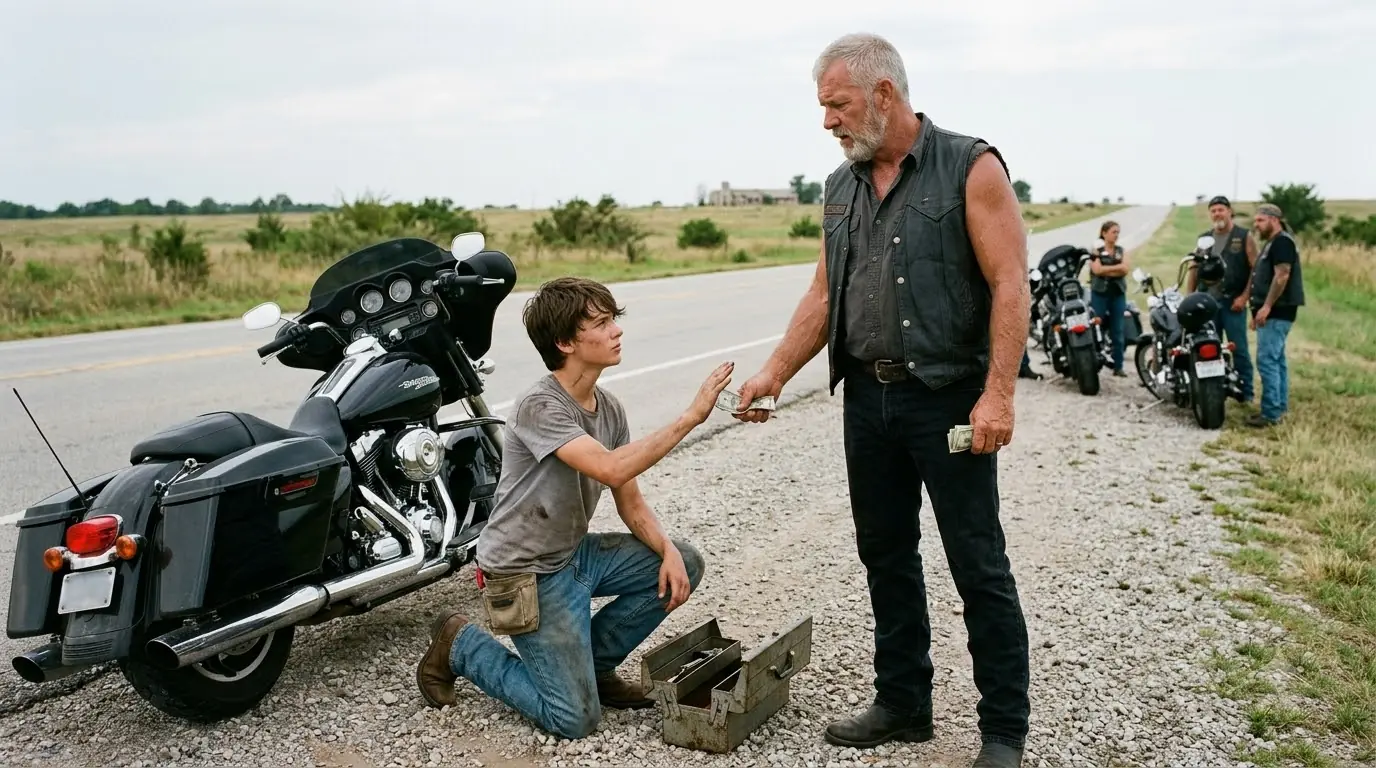
Some guessed thirty thousand dollars.
Others asked if it was custom.
A few wanted photographs.
The teenager kneeling beside it did none of those things.
He simply said:
“Try the ignition again.”
Michael looked down at him.
“You sure?”
“No.”
The boy wiped grease from his thumb onto already filthy jeans.
“But I’m more sure than I was ten minutes ago.”
Michael almost smiled.
He turned the key.
The starter engaged.
For half a second nothing happened.
Then the engine fired.
The big V-twin settled into a heavy rhythm.
Michael stared.
Behind him, three other riders erupted.
“Damn!”
“Kid got it!”
“Stone, you owe him!”
Michael barely heard them.
He listened to the engine.
Smooth.
No sputter.
No leak.
The motorcycle had died without warning twenty minutes earlier, forcing the group onto the shoulder of a two-lane highway outside Tulsa.
Michael had checked the obvious things.
Fuel.
Battery.
Connections.
Nothing.
Reed Lawson had called a towing company.
Estimated arrival:
Ninety minutes.
Then this boy had appeared walking down the road carrying a battered metal toolbox.
Fifteen minutes later, the motorcycle was running.
Michael shut it down.
“What exactly did you do?”
The boy pointed toward the lower section of the engine.
“Fuel-line fitting loosened.”
Michael frowned.
“I checked it.”
“You checked whether it was connected.”
The boy nodded toward a tiny metal fitting.
“It was connected.”
“Just not sealing.”
Michael crouched.
“And you fixed that with what?”
The teenager held up a small strip of shaped metal.
“Temporary collar.”
Michael stared.
“You made that?”
“Yeah.”
“Out of what?”
The boy looked almost embarrassed.
“Part of an old hose clamp.”
Reed laughed.
“Stone, this kid fixed your forty-grand bike with garbage.”
Michael ignored him.
He looked closer.
The repair was clever.
Not reckless.
Not something designed to survive years.
But enough to get the bike safely to a proper shop.
The kid knew that too.
“It’s temporary,” he said.
Michael looked at him.
“I know.”
“Don’t ride three hundred miles on it.”
“I wasn’t planning to.”
“Good.”
The boy began placing tools back inside his box.
Michael watched.
The toolbox itself looked older than the kid.
Rust along the hinges.
One broken latch.
Inside were mismatched wrenches, screwdrivers with cracked handles, sockets from different manufacturers, electrical tape, wire, pliers, a cheap multimeter held together with black tape, and several handmade tools Michael could not immediately identify.
“You carry that around?”
The boy shrugged.
“When I need it.”
Michael reached into his leather vest.
He pulled out his wallet.
“How much?”
The boy looked confused.
“For what?”
Michael removed several bills.
“For fixing my bike.”
“No.”
Michael paused.
“No?”
The kid stood.
He was taller than Michael first realized.
Thin.
Sun-touched skin.
Messy dark hair.
Gray-blue eyes.
Grease covering both forearms.
His faded gray T-shirt had a small hole near the collar.
He looked exhausted.
But he looked Michael directly in the eyes.
“I don’t need money.”
Michael glanced toward Reed.
Reed raised both eyebrows.
Michael held out three hundred dollars.
“You spent your time.”
“No.”
The boy closed his toolbox.
“You were stranded.”
Michael frowned.
“That usually still costs something.”
“Not everything has to.”
Then the teenager started walking away.
Michael stared.
“Kid.”
He stopped.
“What’s your name?”
“Ethan.”
“Ethan what?”
“Cole.”
Michael nodded toward the empty road.
“Where the hell did you come from?”
Ethan pointed toward the white building visible far across the dry field.
Michael had noticed it earlier.
Old farmhouse.
Two floors.
Wide porch.
Several smaller buildings behind it.
A faded sign near the driveway.
GREENHAVEN CHILDREN’S HOME
Michael looked back at Ethan.
“You live there?”
Ethan nodded.
Then picked up his toolbox.
Michael looked toward the building again.
The pieces moved into place.
No parents arriving.
No car.
No phone visible.
Worn clothes.
Old tools.
“You walked from there?”
“Yeah.”
“That’s three miles.”
“Closer to two and a half.”
Reed laughed.
“He corrected you.”
Michael ignored him.
“Why?”
Ethan looked toward the motorcycles.
“Heard you guys trying to start it.”
“From there?”
“You can hear these things from another county.”
Reed nodded proudly.
“Good machines.”
Michael glanced at him.
“Not helping.”
Ethan smiled faintly.
Michael held out the money again.
“Take it.”
The smile disappeared.
“No, sir.”
“Why not?”
Ethan looked uncomfortable.
“Because I didn’t come over here for money.”
“That doesn’t mean you can’t get paid.”
“I know.”
“Then?”
Ethan tightened his grip on the toolbox.
Michael finally lowered the bills.
“Okay.”
The boy nodded.
“Thanks.”
Then he walked.
Michael watched him go twenty feet.
Something bothered him.
Not the refusal.
The way Ethan had said it.
Like accepting money would change the meaning of what he had done.
Michael called:
“Ethan.”
The boy turned again.
Michael walked toward him.
“What do you want?”
Ethan frowned.
“What?”
“Everybody wants something.”
“That doesn’t mean money.”
“So what?”
The boy looked toward Greenhaven.
For several seconds he said nothing.
Then:
“A place to keep learning.”
Michael waited.
Ethan looked down.
“We have a workshop.”
“At the home?”
“Yeah.”
“Who teaches?”
“Mr. Porter.”
“Mechanic?”
“Used to be.”
Michael nodded.
“So what’s the problem?”
Ethan hesitated.
“The workshop’s closing.”
“Why?”
“Money.”
Michael looked toward the old building again.
Ethan continued:
“The home got a new director.”
“They’re cutting anything that isn’t required.”
“Tools cost money.”
“Parts cost money.”
“Insurance.”
“Electric.”
Michael asked:
“How many kids use it?”
“Seven.”
“Any good?”
Ethan shrugged.
“Some.”
“You?”
Ethan looked down at his battered toolbox.
“I’m trying.”
Michael had repaired motorcycles for almost forty years.
He knew talent.
The boy was trying too hard to hide his.
Michael asked:
“What happens when it closes?”
“Nothing.”
“That’s not an answer.”
Ethan looked toward him.
“I age out in three years.”
“And?”
“I get a job.”
“Doing what?”
“Whatever I can.”
“You want mechanics.”
“Yes.”
“Then why not trade school?”
Ethan smiled without humor.
“With what money?”
Michael said nothing.
The boy picked up his toolbox.
“Your bike should make it to town.”
Michael nodded.
Ethan walked away.
This time Michael did not stop him.
Ten minutes later, the bikers were moving again.
Michael rode slower than usual.
Reed eventually pulled alongside him at a traffic light.
“You thinking?”
Michael looked over.
“Dangerous habit.”
“Kid got to you.”
Michael faced forward.
“No.”
“Liar.”
The light changed.
They rode.
Michael remained quiet for eighteen miles.
Then turned suddenly into an old industrial lot.
Reed followed.
Three other bikers pulled in.
Michael shut off his engine.
Reed removed his helmet.
“What?”
Michael pointed toward his motorcycle.
“How much did Miller Performance quote me for that repair last year?”
“Fuel-system refresh?”
“Yeah.”
“Two grand?”
“Twenty-four hundred.”
Michael nodded.
“That kid identified a leak I missed.”
Reed shrugged.
“So?”
“So he did it with a toolbox that belongs in a museum.”
One rider named Cal Morris leaned against his motorcycle.
“You want to buy him tools?”
Michael looked at him.
“No.”
Reed smiled.
“Bigger.”
Michael stared toward the road.
“The workshop.”
Cal laughed.
Michael did not.
Cal stopped laughing.
“You’re serious.”
Michael nodded.
“How bad could it be?”
Reed asked.
Michael pulled out his phone.
“We find out.”
Greenhaven Children’s Home was older than any of them expected.
Built in 1934.
Expanded several times.
Renovated poorly.
Maintained through donations, state funding, church partnerships, and more optimism than money.
Michael learned most of that from their website before he finished his coffee.
Thirty-one children currently lived there.
Ages six to seventeen.
Many were not technically orphans.
Some had lost parents.
Some came from unsafe homes.
Others had parents unable to care for them.
Michael knew enough not to turn complicated lives into one label.
He found the workshop mentioned on an old newsletter.
GREENHAVEN SKILLS GARAGE
Started thirteen years earlier by volunteer mechanic Harold Porter.
Small-engine repair.
Bicycles.
Lawn equipment.
Basic automotive skills.
Safety.
Tool identification.
Problem solving.
The article included photographs.
Michael enlarged one.
Children stood around two old workbenches.
Behind them hung tools.
Not many.
But organized.
Another image showed a younger Ethan.
Maybe eleven.
Holding a carburetor.
The caption read:
Ethan learns how fuel systems work under Mr. Porter’s supervision.
Michael stared.
Reed looked over his shoulder.
“That him?”
“Yeah.”
Cal asked:
“Director?”
Michael scrolled.
Rebecca Doyle, Executive Director.