Nia Caldwell boarded Flight 817 seven minutes before anyone noticed she mattered.
That was how she preferred it.
At thirty-six, Nia had spent most of her professional life becoming increasingly valuable to people who rarely recognized her face. Financial magazines knew her name, aviation executives knew her signature, and investment bankers knew precisely how quickly she could end negotiations by closing a folder and saying nothing, but the public mostly associated Caldwell Meridian Aviation Group with its silver-and-blue corporate logo rather than the woman who controlled forty-one percent of its voting shares.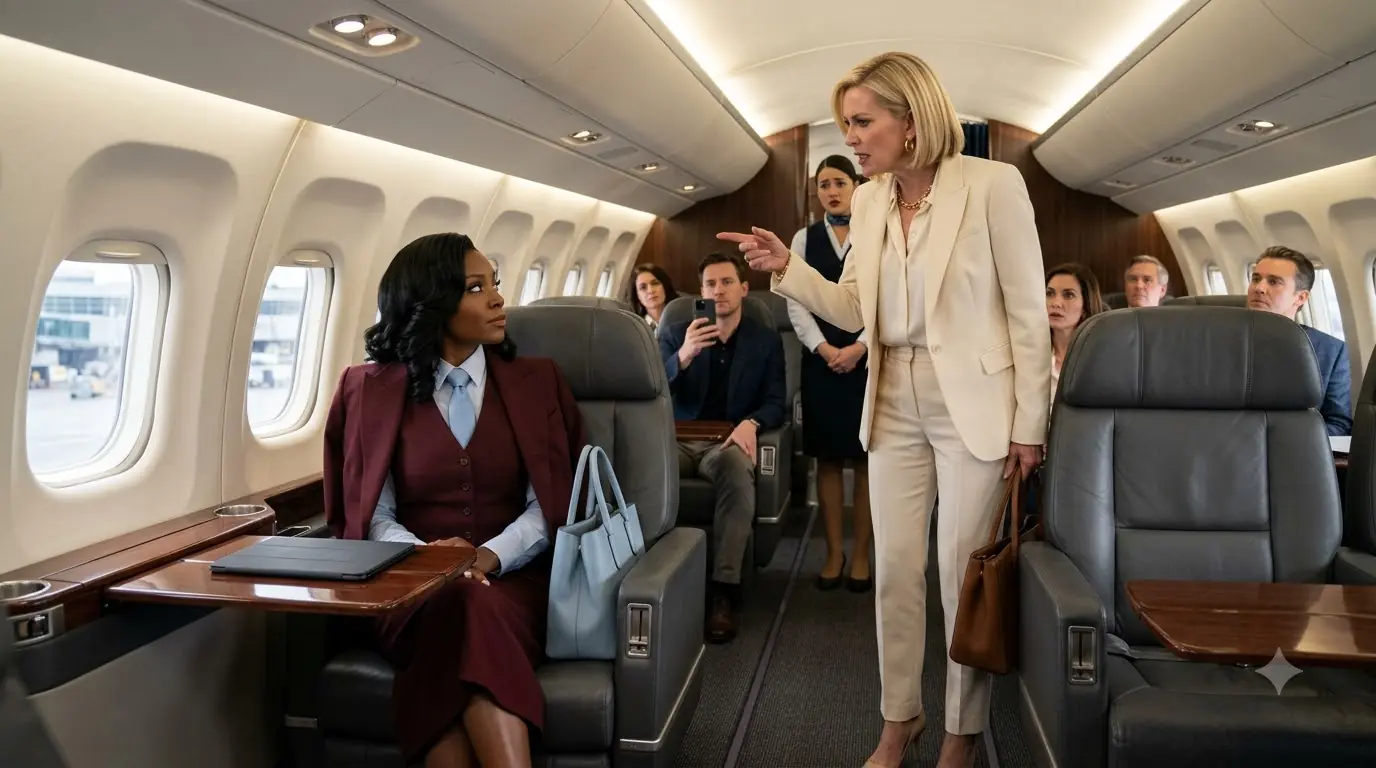
Nia liked the anonymity.
It allowed people to behave normally.
That morning she wore a burgundy tailored blazer draped over her shoulders, a fitted matching waistcoat with gold buttons, a crisp pale-blue shirt, narrow blue tie, and a long burgundy skirt that fell elegantly below her knees. Her dark skin was flawless beneath minimal makeup, her shoulder-length black hair curved softly around her face, and a structured light-blue tote rested beside her feet as she settled into Seat 2A.
The first-class cabin was quiet.
Fourteen wide leather seats.
Polished walnut trim.
Cream overhead panels.
White pillows.
Champagne glasses waiting on small side tables.
Passengers were already opening laptops, checking messages, or staring through windows toward the morning traffic moving across JFK’s ramp.
Nia placed her tablet on the tray.
She had an eleven-thirty conference call scheduled shortly after landing in Los Angeles with the executive committee of a company Caldwell Meridian was considering acquiring. The transaction was worth approximately $2.6 billion, although Nia had already decided the number mattered less than whether the target company’s culture could survive integration.
Culture had been occupying her thoughts lately.
Caldwell Meridian had grown too quickly.
Seven years earlier, Nia controlled a regional executive-charter company operating eleven aircraft.
Now the group owned stakes across airport services, maintenance providers, regional airlines, executive aviation businesses, and a recently acquired premium transcontinental carrier called Meridian Atlantic.
Flight 817 belonged to that carrier.
Technically, Nia did not personally own the airplane.
Corporate structures were more complicated than headlines.
But Caldwell Meridian controlled the company that controlled the aircraft operator, which meant virtually everyone responsible for that morning’s departure ultimately reported into an organization Nia chaired.
She rarely used that fact when traveling.
Employees deserved to work without feeling their owner was examining every movement.
Today, though, Nia was paying attention.
Meridian Atlantic had received several complaints over the previous quarter about inconsistency in its premium cabins.
Not serious enough individually to trigger investigations.
Enough to interest her.
Some passengers described flight attendants bending rules aggressively for wealthy regulars while enforcing them rigidly against unfamiliar customers.
Others mentioned uneven responses to rude behavior.
The phrase appearing repeatedly was:
“The crew seemed more concerned about keeping the difficult passenger happy.”
Nia disliked that.
Customer service required flexibility.
It did not require surrendering standards to whoever complained loudest.
She had not boarded Flight 817 as an undercover operation.
She simply intended to observe.
Then Evelyn Price entered the cabin.
Nia noticed her because the woman stopped moving.
Evelyn stood beside Seat 2B with one hand holding the strap of a large brown luxury tote.
She was fifty-five, blonde, expensively dressed in a cream blazer and ivory trousers, gold watch shining beneath the cabin lights. Everything about her announced practiced wealth—not merely expensive clothing but the expectation that rooms should rearrange themselves before she needed to ask.
She looked at the seat number.
Then at Nia.
Then back at the seat.
Her face changed.
Nia noticed.
Rachel Morgan, the lead flight attendant, stood behind Evelyn.
“Mrs. Price?”
Evelyn turned.
“There’s been a mistake.”
Rachel checked the boarding card.
“Two-B?”
“Yes.”
Rachel smiled politely.
“That’s right here.”
Evelyn looked toward Nia again.
“No.”
Rachel’s smile weakened.
“I’m sorry?”
“I’m not sitting here.”
Nia continued looking at her tablet.
The words were not yet interesting enough to interrupt her.
Rachel checked the seat.
“Is there something wrong with it?”
“Yes.”
“What?”
Evelyn looked directly at Nia.
“That.”
The cabin changed.
Not loudly.
Attention moved.
Passengers who had been pretending not to listen suddenly became very interested in screens they were no longer reading.
Nia slowly raised her eyes.
Evelyn stared down at her.
Nia held the gaze for one second.
Then another.
“Good morning.”
Evelyn did not answer.
She looked toward Rachel.
“I paid almost twelve thousand dollars for this ticket.”
Rachel nodded carefully.
“I understand.”
“And this is what you assign me?”
Nia closed her tablet.
Rachel lowered her voice.
“Mrs. Price, perhaps we can step toward the galley.”
“No.”
Evelyn planted herself more firmly in the aisle.
“I want another seat.”
Rachel looked around.
The first-class cabin was full.
“I’m afraid we don’t have another open first-class seat.”
“Then move her.”
Silence.
Nia stared.
Rachel did too.
Evelyn pointed toward Nia as though identifying misplaced luggage.
“Put her somewhere else.”
Rachel swallowed.
“Mrs. Price—”
“I am a Platinum Meridian client.”
“Yes.”
“I fly with you twenty or thirty times a year.”
“I understand.”
“Then solve it.”
Nia leaned back.
Her expression remained calm.
Inside, something tightened.
She had experienced prejudice before.
Boardrooms.
Hotels.
Private clubs.
Financial conferences.
The more sophisticated the environment, the more sophisticated the language usually became.
Rarely did someone hand you the insult unwrapped.
Evelyn apparently disliked ambiguity.
Rachel said:
“Ms…”
She looked toward Nia.
Nia answered:
“Caldwell.”
Rachel froze for perhaps half a second.
The surname should have meant something.
Apparently it did not yet.
Rachel continued.
“Ms. Caldwell has an assigned first-class ticket as well.”
Evelyn laughed.
“That isn’t my problem.”
Nia spoke for the first time.
“Then what is your problem?”
Evelyn looked down.
Nia’s voice was neither aggressive nor soft.
Simply direct.
Evelyn answered:
“I prefer not to sit beside you.”
“That part is obvious.”
Several passengers looked away to hide reactions.
Nia continued.
“Why?”
Evelyn crossed her arms.
“I don’t need to justify personal comfort.”
“Then purchase two seats next time.”
The man across the aisle coughed into his hand.
Evelyn’s face sharpened.
“Excuse me?”
Nia picked up her tablet again.
“You want an empty adjacent seat.”
“No.”
“You want this passenger removed.”
She pointed lightly toward herself.
“That makes your preference somebody else’s problem.”
Evelyn looked toward Rachel.
“You’re going to let her speak to me like this?”
Rachel appeared increasingly trapped.
“Mrs. Price, please…”
Evelyn stepped closer.
“I have been flying Meridian Atlantic since before half your cabin staff finished school.”
Rachel nodded.
“We appreciate your loyalty.”
“Then act like it.”
Nia looked toward Rachel.
That sentence mattered.
She watched the attendant’s face.
Customer loyalty.
Revenue.
Status.
Internal pressure.
All of it moved behind Rachel’s eyes.
Evelyn knew how corporations worked.
She knew a high-value customer complaint could become an employee’s disciplinary meeting.
That knowledge was power.
And she was using it.
Rachel whispered:
“Let me see if we can find another solution.”
Nia’s eyes moved toward her.
“What solution?”
Rachel stopped.
Evelyn immediately said:
“Move her.”
Nia looked directly at Rachel.
“Is her ticket more valuable than mine?”
Rachel hesitated.
“No, Ms. Caldwell.”
“Then why would the solution involve changing my seat?”
Rachel’s face reddened.
“I didn’t say that.”
“You were about to consider it.”
The attendant said nothing.
Nia continued:
“I am not angry with you.”
That seemed to make Rachel more uncomfortable.
“I’m asking what policy says.”
“There’s no policy requiring you to move.”
“Good.”
Nia looked toward Evelyn.
“Then we have our solution.”
She pointed toward Seat 2B.
“Sit down.”
Evelyn’s mouth opened.
Several passengers looked openly now.
One man behind them lifted his phone discreetly.
Evelyn noticed and became louder rather than quieter.
“I will not.”
Nia shrugged.
“Then don’t.”
“I’m not flying beside you.”
“Apparently not.”
Nia reopened her tablet.
Evelyn stared.
The dismissal enraged her more than argument would have.
She turned toward Rachel.
“Get your supervisor.”
“I am the lead cabin attendant.”
“Then get the captain.”
Rachel looked toward the front galley.
“Mrs. Price, the captain is completing departure procedures.”
“I don’t care.”
Nia said:
“He probably does.”
Evelyn snapped toward her.
“Stay out of this.”
Nia raised an eyebrow.
“You made me the subject of it.”
Evelyn’s voice lowered.
“You know exactly what you’re doing.”
Nia looked curious.
“What am I doing?”
“Trying to make this something it isn’t.”
The familiar defense arrived.
Nia almost smiled.
“I haven’t called it anything.”
“You’re implying it.”
“I asked why you refused the seat.”
“And I said comfort.”
“Comfort caused by what?”
Evelyn stopped.
Nia waited.
The cabin waited.
No answer.
Nia nodded once.
“Thought so.”
Evelyn turned toward Rachel.
“Get the captain now.”
Rachel reluctantly picked up the cabin phone.
While she called forward, another flight attendant named Samantha Lee approached from the galley.
She looked at Rachel.
“What happened?”
Evelyn answered before anyone else.
“I am being harassed.”
Nia laughed.
Not loudly.
But she could not stop herself.
Evelyn pointed.
“See?”
Samantha looked toward Nia.
“Ms. Caldwell?”
“Yes.”
“Are you willing to switch seats?”
Nia’s face changed immediately.
There it was.
The instinct.
Not address the aggressor.
Move the easier person.
She placed her tablet carefully on the tray.
“Why are you asking me?”
Samantha looked uncomfortable.
“To de-escalate.”
“Who escalated?”
Samantha glanced toward Evelyn.
“That isn’t really…”
Nia interrupted.
“It is exactly the question.”
Samantha fell silent.
Nia continued:
“You have one passenger refusing an assigned seat because she does not want to sit beside another passenger.”
“Yes.”
“Which passenger is violating a cabin requirement?”
Samantha hesitated.
“The one refusing the assigned seat.”
“Correct.”
“So why did your first proposed solution involve moving the other passenger?”
Neither attendant answered.
Nia felt her irritation shift.
Evelyn remained offensive.
But now Nia was seeing something more important.
The company culture.
Exactly what the complaints described.
The difficult customer becomes the center.