“Look at you—just another street kid in cuffs pretending he knows the law.” Officer Grant Keller stood behind seventeen-year-old Marcus Williams with his arms folded, wearing the same contemptuous smile he had worn the night Marcus was arrested. Marcus stood in front of the defense table wearing a charcoal T-shirt, an unzipped black hoodie, dark jeans, and black sneakers, his wrists locked together by steel cuffs. He turned only slightly toward Keller and answered, “Then why are you so scared of the video?”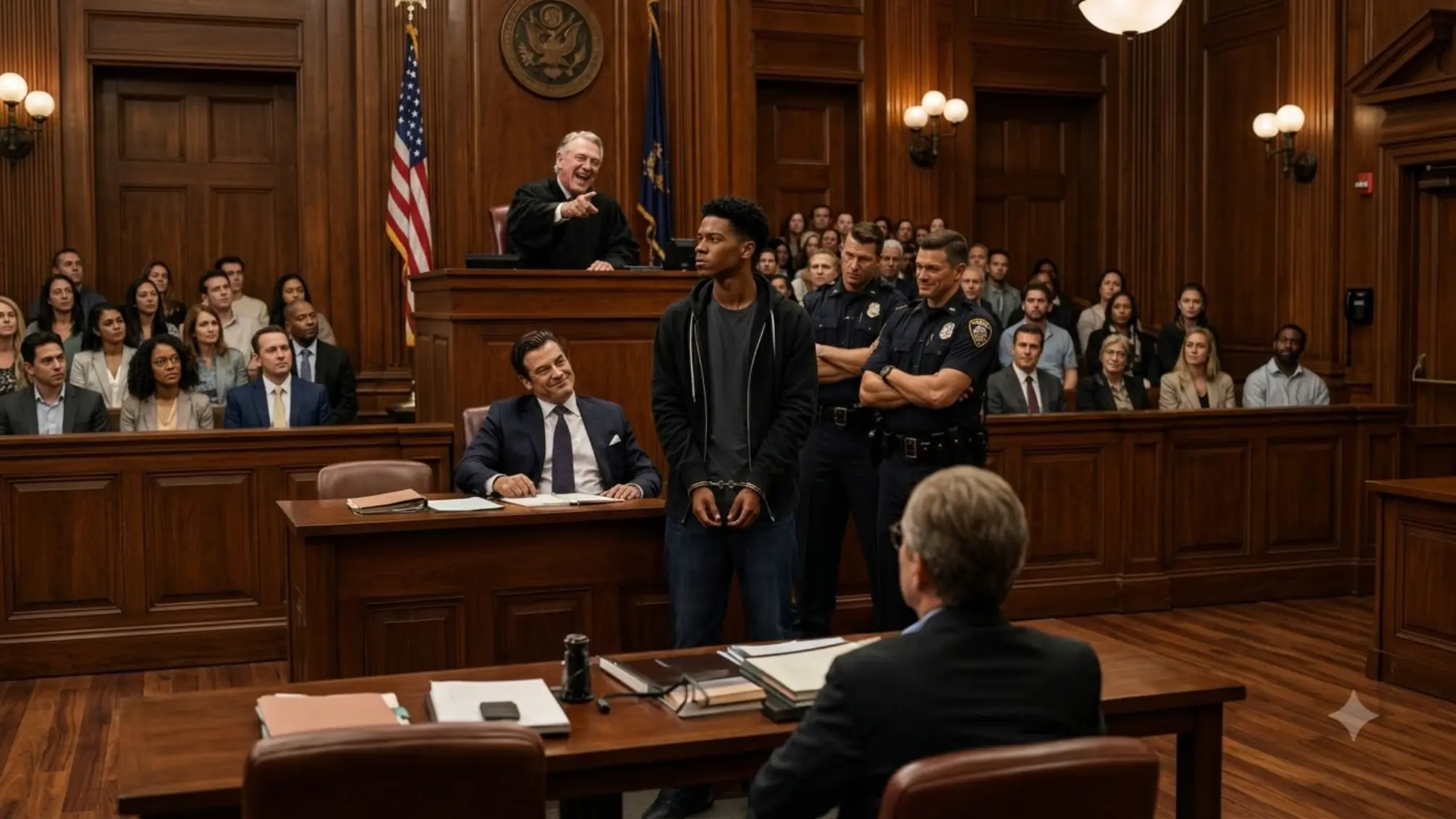
Keller’s smile vanished for half a second. He stepped closer and lowered his voice. “Keep running your mouth and I’ll add resisting before you leave this room.” Marcus looked directly at him. “Do it—the courtroom’s about to see who actually broke the law.”
The words traveled farther than Marcus intended. Prosecutor Ethan Vale looked up from his files, while Judge Richard Morrison leaned back behind the polished wooden bench with irritation already spreading across his face. Behind them, a packed gallery watched with the uncomfortable fascination people often showed when they believed someone else’s life was about to collapse.
Judge Morrison pointed toward Marcus. “Enough theatrics. You’re not in some television courtroom.” Several people chuckled, including one of the officers standing beside Keller. Marcus’s mother, Denise Williams, sat rigidly in the second row clutching a cream envelope from Harvard University against her chest.
Inside that envelope was a full academic scholarship.
Marcus had earned it after years of work that almost nobody in the courtroom knew about. He had a 4.18 weighted GPA, captained his school debate team, volunteered at a neighborhood legal clinic, and planned to study political science before eventually becoming an attorney. None of those facts appeared in the police report describing him as an “aggressive suspected vehicle burglar.”
The case had begun sixteen days earlier at 9:42 p.m. Marcus was walking home from the public library after staying late to finish a scholarship essay. His mother had offered to pick him up, but their apartment was less than a mile away, and Marcus liked walking because it gave him time to think. He wore the same black hoodie now hanging open in the courtroom.
A blue Honda Accord sat along Marston Avenue with its hazard lights blinking. Marcus recognized the driver immediately. Mrs. Evelyn Carter was seventy-two and lived three buildings from his mother. Her front tire had collapsed against the curb.
Marcus crossed the street. “Mrs. Carter, you okay?” She laughed nervously and told him she had never changed a tire in her life. Marcus had learned from his uncle, so he placed his backpack on the sidewalk, found the spare and jack in her trunk, and started working.
Ten minutes later, a patrol cruiser stopped behind them.
Officer Keller stepped out first. His partner, Officer Ryan Brooks, followed. Keller shone his flashlight directly into Marcus’s face and ordered him away from the car.
Marcus stood slowly. “I’m changing her tire.” Keller looked toward Mrs. Carter, then back at Marcus. “Did I ask you?”
Mrs. Carter immediately spoke. “Officer, he’s helping me.” Keller ignored her and ordered Marcus to place his hands on the hood. Marcus asked why.
That question changed the officer’s attitude.
Keller moved closer. “Because I said so.” Marcus remained beside the tire, holding a lug wrench loosely toward the ground. “I’ll put the tool down, but I want to know why I’m being detained.”
Brooks glanced toward Keller. “Grant, she says she knows him.” Keller’s eyes stayed fixed on Marcus. “We had a call about somebody checking car doors.”
Marcus slowly placed the wrench on the pavement. “Then check the call description.” Keller said, “You fit it.”
Marcus later learned the caller had described a man approximately thirty years old wearing a red baseball cap and a tan jacket. Marcus was seventeen, bareheaded, and wearing black. None of that stopped Keller.
Mrs. Carter stepped forward. “I told you, he’s helping me.” Keller pointed toward the curb and ordered her back. Then he told Marcus to turn around.
Marcus refused.
Not aggressively.
He simply said, “I haven’t committed a crime, and your description doesn’t match me.”
Keller grabbed his arm.
Marcus instinctively twisted away from the sudden contact. Within seconds, Keller slammed him against the Honda while Brooks shouted for everyone to calm down. Marcus’s cheek hit the cold metal above the rear door.
Mrs. Carter screamed.
Keller forced Marcus’s hands behind his back and cuffed him. He claimed Marcus had resisted detention and threatened him with the lug wrench. Brooks said nothing.
That silence would eventually matter.
Marcus was taken to the precinct and charged with resisting arrest, obstruction, and attempted vehicle burglary. The final charge stunned Mrs. Carter because the vehicle supposedly being burglarized belonged to her, and she repeatedly told officers Marcus had permission to be touching it. Her statement somehow became a three-line summary saying she was “uncertain about the events leading to police contact.”
She was not uncertain.
She called Denise the next morning furious.
“I told them exactly what happened.”
Denise listened without interrupting. She had raised Marcus alone since his father died when Marcus was six, and she had learned over the years that panic rarely improved bad situations. She called a local defense attorney named Julian Price.
Julian requested body-camera footage immediately.
The police department produced only eleven minutes.
It began after Marcus was already in handcuffs.
Julian read the accompanying report twice. Keller claimed Marcus had been seen pulling on the Honda’s door handle, refused repeated lawful commands, raised a metal wrench toward officers, and physically resisted restraint. Brooks signed the report as a witnessing officer.
Mrs. Carter nearly threw the paperwork across Julian’s office.
“That is a lie.”
Julian looked at her. “Which part?”
“All of it.”
That was when Marcus remembered something.
His phone.
He had been using it before the officers arrived because Mrs. Carter asked him to search for a diagram showing where the Honda’s jack point was located. Marcus had placed the phone on top of his backpack with the camera accidentally still recording from a school project he had filmed earlier. When Keller’s flashlight swept across him, Marcus kicked the backpack farther beneath the car because he did not want it stepped on.
The recording continued.
For twenty-seven minutes.
Marcus’s phone captured the entire encounter from ground level.
The camera angle was imperfect, but the audio was exceptionally clear. It recorded Mrs. Carter asking Marcus for help. It captured Keller arriving, Marcus explaining what he was doing, Mrs. Carter confirming his story, and Brooks saying the suspect description did not appear to match.
Most importantly, it recorded the moment Keller whispered to Brooks after Marcus was handcuffed.
“Turn yours off until we get our story straight.”
Julian stopped the video.
Nobody spoke.
Denise covered her mouth.
Marcus stared at the screen.
Julian replayed the sentence.
Same words.
Same voice.
Then came something worse.
Brooks said, “The woman says it’s her car.”
Keller answered, “Then make it resisting. We didn’t come this far for nothing.”
Marcus looked toward his mother.
Denise’s eyes had filled with tears, but her expression was no longer frightened.
It was furious.
Julian copied the video three times.
One copy went into his locked case file. Another went to an independent digital-forensics specialist who created a cryptographic hash and documented the original metadata so nobody could later claim the recording had been altered. The third copy went into a sealed evidence package.
Julian told Marcus one thing repeatedly.
“Do not talk about this video publicly.”
Marcus listened.
That was difficult when classmates heard about the arrest. Social media posts called him a thief before any hearing took place. A local page reposted his booking photograph beside the words TEEN CAUGHT BREAKING INTO CAR.
Harvard contacted him.
The scholarship had not been withdrawn, but admissions placed the matter under review pending resolution of the criminal charges.
Denise did not tell Marcus immediately.
He found the email himself.
For the first time since his arrest, he cried.
Not because he believed he was going to prison.
Because something he had built for years could disappear over another man’s lie.
Julian filed a discovery motion asking for all body-camera recordings, dispatch audio, GPS logs, and original metadata from the officers’ devices. Prosecutor Ethan Vale responded that the department had provided all available footage.
Julian asked why both cameras began recording only after Marcus was handcuffed.
Vale said officers sometimes activated cameras late during rapidly developing incidents.
Then Julian requested the camera audit logs.
The prosecution objected.
Judge Morrison denied the first request without a hearing.
Julian filed again.
This time he attached departmental policy requiring continuous activation during investigative stops.
The judge sighed in open court. “Counsel, we are not turning a juvenile resisting case into a federal inquiry.”
Marcus heard the irritation.
So did Denise.
Julian answered calmly. “Your Honor, if evidence was intentionally withheld, it stopped being a routine resisting case.”
Morrison rolled his eyes.
“Everyone thinks they’re Perry Mason lately.”
That comment told Julian something important.
The judge had already decided what kind of case this was.
The prosecution offered Marcus a deal.
Plead guilty to misdemeanor obstruction, complete six months’ probation, and the burglary charge would disappear. No jail. No felony.
Denise looked almost relieved when Julian first explained it.
Marcus did not.
“If I plead guilty, Harvard sees guilty.”
Julian nodded.
“Yes.”
“And I didn’t do it.”
“No.”
Marcus stared at the offer.
“Then we fight.”
Denise looked toward him.
“Baby, I just want you home.”
“I am home.”
He touched the Harvard envelope.
“But if I say I did something I didn’t do because they scared us enough, they’ll do it again to somebody else.”
Denise began crying quietly.
Julian watched the seventeen-year-old across his desk.
“All right.”
They rejected the deal.
That decision made the prosecution more aggressive.
Vale added language alleging Marcus had displayed “escalating hostility” during the encounter. Keller gave an interview to internal investigators claiming he could not remember when his body camera had been activated.
Then Julian finally obtained the audit logs through a renewed motion.
Both cameras had been manually deactivated within seconds of the stop.
Keller’s camera was turned back on eleven minutes later.
Brooks’s camera was reactivated almost simultaneously.
Julian now had the phone recording and device logs supporting it.
Still, he did not reveal the full video.
He wanted the officers committed to their sworn testimony first.
That brought everyone to Judge Morrison’s courtroom.
Marcus arrived in everyday clothes because Julian refused to dress him like somebody playing a role for sympathy. The handcuffs were required by courthouse transport policy even though Marcus had never behaved violently. Keller and Brooks stood behind him.
The judge saw the teenager and immediately began making comments.
Keller joined in.
That was when Marcus mentioned the video.
Julian turned toward him sharply.
Marcus realized he had said too much.
Across the room, Keller went pale.
Prosecutor Vale leaned toward one of his assistants.
Judge Morrison lifted his gavel.
“Mr. Williams, apparently nobody has taught you when to remain silent.”
Marcus looked toward Julian.
His attorney gave the smallest nod.
Not permission to speak freely.
Permission to stop being afraid.
Marcus looked back at the bench.
“Your Honor, I object.”
Laughter rippled through the room.
Morrison laughed louder than anyone.
“You object?”
“Yes, sir.”
“To what?”
Marcus swallowed.
“To being sentenced in everybody’s head before the evidence comes out.”
The laughter stopped.
Julian stood.
“Your Honor, my client’s wording may be unconventional, but given the comments made in this courtroom, I request that the record reflect his concern.”
Morrison’s expression hardened.
“Sit down, counselor.”
Julian remained standing.
“I also have a supplemental evidentiary filing.”
Vale’s head snapped toward him.
“What filing?”
Julian lifted a sealed flash drive.
“Newly authenticated defense evidence.”
Keller whispered something behind Marcus.
Julian heard it.
“So did my client.”
Judge Morrison stared at the drive.
“What is it?”
“A continuous video recording beginning before officers arrived.”
The entire room changed.
Vale stood immediately.
“This was never disclosed.”
Julian turned toward him.
“It was disclosed thirty-six hours ago through the electronic portal.”
Vale looked at his assistant.
The young prosecutor’s face drained.
She whispered, “It’s in the system.”
Morrison frowned.
Julian continued.
“The defense requests playback for the limited purpose of resolving factual disputes concerning the stop and preservation of police evidence.”
Vale objected.
The judge almost sustained it.
Then Julian said, “The recording includes an officer discussing deactivating body cameras.”
Nobody moved.
Morrison looked toward Keller.
For the first time that morning, the judge stopped smiling.
“Play it.”
The courtroom monitor lit up.
The image showed pavement, Marcus’s backpack, part of the Honda tire, and Mrs. Carter’s shoes.
Her voice came through clearly.
“Thank you for helping me, Marcus.”
Then Marcus.
“No problem, Mrs. Carter.”
The patrol cruiser arrived.
Keller’s voice filled the speakers.
The entire courtroom listened.
Marcus explained the tire.
Mrs. Carter confirmed it.
Brooks mentioned the suspect description.
Keller dismissed him.
Then came the arrest.
The sound of Marcus hitting the car caused Denise to close her eyes.
Finally, the crucial exchange played.
“Turn yours off until we get our story straight.”
The courtroom became absolutely silent.
Brooks’s recorded voice followed.
“The woman says it’s her car.”
Then Keller.
“Then make it resisting. We didn’t come this far for nothing.”
No one laughed.
Keller looked toward the exit.
Two courthouse deputies subtly moved closer.
Vale sat down slowly.
Judge Morrison stared at the monitor.
Julian stopped the playback.
“Your Honor, that is why the defense requested camera audit logs.”
Morrison said nothing.
Julian placed printed records on the table.
“The logs show both officers manually deactivated their devices during the disputed period.”
Vale stood again.
“Your Honor, the state needs a recess.”
Julian looked at him.
“My client needed one sixteen days ago.”
Morrison struck the gavel.
“Counsel.”
Julian stopped.
The judge ordered a forty-five-minute recess.
Marcus remained standing as deputies prepared to move him.
Then something unexpected happened.
Brooks stepped forward.
“I need to speak to someone.”
Keller looked at him.
“Ryan, shut up.”
Brooks stared back.
“No.”
Keller moved toward him.
A courthouse deputy stepped between them.
Brooks looked toward prosecutor Vale.
“The video is accurate.”
The gallery erupted.
Judge Morrison ordered everyone silent.
Brooks continued anyway.
“Keller told me to turn off my camera.”
Vale looked stunned.
“And you did?”
“Yes.”
“Why?”
Brooks swallowed.
“Because he was senior.”
The answer sounded pathetic even to him.
He continued.
“He wrote the report. I signed it.”
Denise stared at him.
“You knew?”
Brooks could not meet her eyes.
“Yes, ma’am.”
Marcus looked away.
The betrayal hurt differently from Keller’s aggression.
Keller had always appeared hostile.
Brooks had known the truth.
And chosen silence.
After recess, everything moved quickly.
Vale asked to dismiss every charge against Marcus with prejudice.
Julian agreed.
Judge Morrison approved the dismissal.
Then Julian requested that Marcus’s handcuffs be removed immediately.
The judge hesitated.
The gallery noticed.
Morrison finally nodded.
A deputy unlocked them.
Marcus rubbed his wrists.
For seventeen days, he had imagined that moment.
He expected triumph.
Instead, he felt tired.
Judge Morrison looked down at him.
“You are free to go.”
Marcus remained still.
Julian touched his arm.
They could leave.
Then Morrison added, “Young man, perhaps this experience will teach you to avoid situations that can be misunderstood.”
Denise stood.
Julian’s jaw tightened.
Marcus slowly turned back toward the judge.
“What should I have avoided?”
Morrison frowned.
Marcus continued.
“Helping my neighbor?”
Nobody breathed.
The judge opened his mouth.
Marcus looked directly at him.
“Or being outside after dark?”
Morrison said nothing.
Julian quietly said, “Marcus.”
The teenager nodded.
He turned away.
That was enough.
Outside the courtroom, reporters had already gathered.
Julian refused interviews.
Marcus did too.
Denise held the Harvard envelope in one hand and her son’s arm with the other.
Before they reached the elevator, a woman called Marcus’s name.
Mrs. Carter.
She walked toward him with a cane.
Marcus hugged her.
“I’m sorry,” she whispered.
“For what?”
“They made my statement sound like I didn’t know you.”
“That wasn't you.”
She pulled back.
“I should've screamed louder.”
Marcus smiled faintly.
“You screamed plenty.”
She laughed through tears.
The criminal case ended that morning.
The consequences did not.
The district attorney referred Keller and Brooks to an independent investigation after discovering Vale’s office had received incomplete police evidence. The state attorney general’s public-integrity unit later joined because body-camera records had potentially been manipulated and false statements submitted in court.
Keller was suspended.
Brooks cooperated.
Investigators reviewed previous arrests involving Keller.
They found a pattern.
Several reports used nearly identical language.
“Suspect reached toward waistband.”
“Suspect became suddenly aggressive.”
“Body camera activated after immediate threat was controlled.”
The camera logs told a more complicated story.
In five cases, Keller had manually deactivated his device before important moments.
Two convictions were reopened.
Then four.
Eventually twelve.
One involved a twenty-three-year-old man named Jordan Ellis who had pleaded guilty to resisting arrest because he could not afford to remain in jail waiting for trial.
His conviction was vacated.
Another involved a homeless veteran accused of assaulting Keller during a sidewalk encounter.
That case was reopened too.
Brooks admitted he had known about inappropriate camera practices for months.
He accepted disciplinary consequences and later testified before a grand jury.
Keller was eventually charged with offenses related to falsified reports and evidence tampering.
The process took more than a year.
Marcus did not follow every hearing.
He had another life to reclaim.
Harvard reviewed the dismissal order, authenticated recording, and supporting documentation.
The scholarship remained intact.
When the email arrived, Denise screamed so loudly their upstairs neighbor came running.
Marcus read it three times.
Then he sat at the kitchen table and cried.
Not because he had won.
Because the future he thought had been stolen was suddenly back in his hands.
Months later, Julian invited Marcus to his office.
“I have something for you.”
He handed him the original flash drive.
Marcus stared at it.
“What am I supposed to do with this?”
“Keep it.”
Marcus shook his head.
“I hate that thing.”
Julian understood.
“The video saved you.”
“No.”
Marcus looked at him.
“Mrs. Carter saved me by telling the truth. The video just made people believe her.”
Julian leaned back.
That sentence stayed with him.
The system should never have required a hidden recording to take an elderly eyewitness seriously.
Marcus eventually filed a civil claim against the city.
It did not demand an absurd fortune.
Julian structured it around damages, legal costs, policy changes, and accountability.
The city settled.
Part of the settlement funded Marcus’s education expenses not covered by his scholarship.
Another portion supported a community legal-access program teaching teenagers how to preserve evidence and understand basic rights during police encounters.
Marcus insisted on one condition.
The program would not teach teenagers to argue aggressively with officers.
It would teach them to stay safe, document when legally possible, request counsel, preserve records, and understand that surviving the encounter mattered more than winning an argument on the sidewalk.
His mother approved.
“Finally, something you say sounds seventeen.”
Marcus smiled.
Judge Morrison faced consequences too, though not the dramatic kind people online predicted after clips of the hearing spread.
A judicial conduct commission reviewed his comments.
The phrases “street thug,” “boy,” and his laughter at a juvenile defendant became part of the inquiry.
Morrison argued that he had been attempting to control the courtroom.
The transcript suggested otherwise.
He received formal discipline and later announced he would not seek another term.
Marcus never celebrated.
When a reporter asked whether he felt vindicated, he answered, “I wanted a fair hearing, not somebody else’s life destroyed.”
That response surprised people.
It should not have.
Marcus had spent enough time watching powerful people confuse punishment with justice.
He did not want to become one of them.
The following fall, Denise drove him to Cambridge.
She cried for most of the trip.
Marcus complained about it for approximately forty miles before giving up.
The cream Harvard envelope traveled with them inside the glove compartment.
Denise refused to throw it away.
“You carried that thing into court like a weapon,” Marcus said.
“It was evidence.”
“Evidence of what?”
“That you had somewhere better to be.”
Marcus laughed.
When they arrived, Denise helped him carry boxes into his dorm room.
Before leaving, she stood by the door longer than necessary.
“You okay?”
Marcus nodded.
“You?”
“No.”
He hugged her.
“I’ll call.”
“You better.”
After she left, Marcus sat beside his new desk.
Students moved outside the window.
Nobody knew the teenager unpacking books had once stood handcuffed while a courtroom laughed.
He liked that.
He opened his laptop.
His first class assignment asked students to write about the difference between law and justice.
Marcus stared at the blank page.
Then he smiled.
He knew exactly where to begin.
Years later, he would still remember Judge Morrison’s courtroom in precise detail.
The wood panels.
Keller’s folded arms.
Vale’s confident smile.
His mother clutching that envelope.
The cuffs pressing against his wrists.
But the part Marcus remembered most clearly was the silence after the recording played.
Minutes earlier, everyone powerful in that room had believed he was the person who needed explaining.
Then evidence spoke.
And suddenly the people wearing badges, carrying files, and sitting behind the bench had questions to answer.
Marcus learned something that morning no textbook could have taught him.
Truth did not always arrive loudly.
Sometimes it sat beneath a parked car on a teenager’s phone.
Sometimes it waited inside an audit log.
Sometimes it lived in the memory of an elderly woman whom officials tried to summarize into uncertainty.
And sometimes the difference between a ruined life and a second chance was whether somebody bothered preserving it.
Marcus never forgot another lesson.
The police officers had been wrong before anyone knew about Harvard.
Judge Morrison had been wrong before Marcus mentioned the video.
The teenager did not become worthy of fair treatment because he had excellent grades or a scholarship waiting.
A child struggling in school would have deserved the same hearing.
A teenager with no college plans would have deserved the same evidence.
A guilty defendant would still have deserved a truthful police report.
That principle eventually shaped Marcus more than the arrest itself.
During his second year at Harvard, he returned home during winter break and visited Mrs. Carter.
Her Honda was still parked outside.
She opened the door and smiled.
“You checking my tires?”
Marcus laughed.
“Absolutely not.”
She made him tea.
They sat at her kitchen table.
Mrs. Carter looked older.
Marcus looked different too.
“You still want to be a lawyer?” she asked.
“Yes.”
“What kind?”
Marcus thought about it.
“The kind who asks for the video.”
Mrs. Carter smiled.
“Good.”
Before leaving, he walked past Marston Avenue.
The place where he had been arrested looked completely ordinary.
Cars lined the curb.
Streetlights buzzed.
Someone’s dog barked behind a fence.
Marcus stopped beside the exact patch of pavement where his backpack had rested.
He once thought that night had divided his life into before and after.
Maybe it had.
But standing there years later, he understood something else.
Keller had tried to write Marcus’s story for him.
The police report called him aggressive.
The booking photograph made him look guilty.
The courtroom laughter made him look powerless.
None of those things became the final version.
Marcus continued walking.
Not because he had forgotten what happened.
Because he finally understood that surviving someone else’s lie did not require living inside it forever.
And the boy everyone in that courtroom had been ready to dismiss before lunch eventually built his future around one lesson they had accidentally taught him:
When power tells a story, ask for the evidence.