“You either show me identification, or you step away from this property.”
Officer Derek Stanton delivered the order from the bottom of the porch steps as though the decision had already been made. Behind him, red and blue lights reflected across the windows of two police cruisers parked sideways in the driveway. Several neighbors had stepped onto their lawns to watch, and one woman stood three houses away with her arms crossed, appearing pleased with the commotion she had created.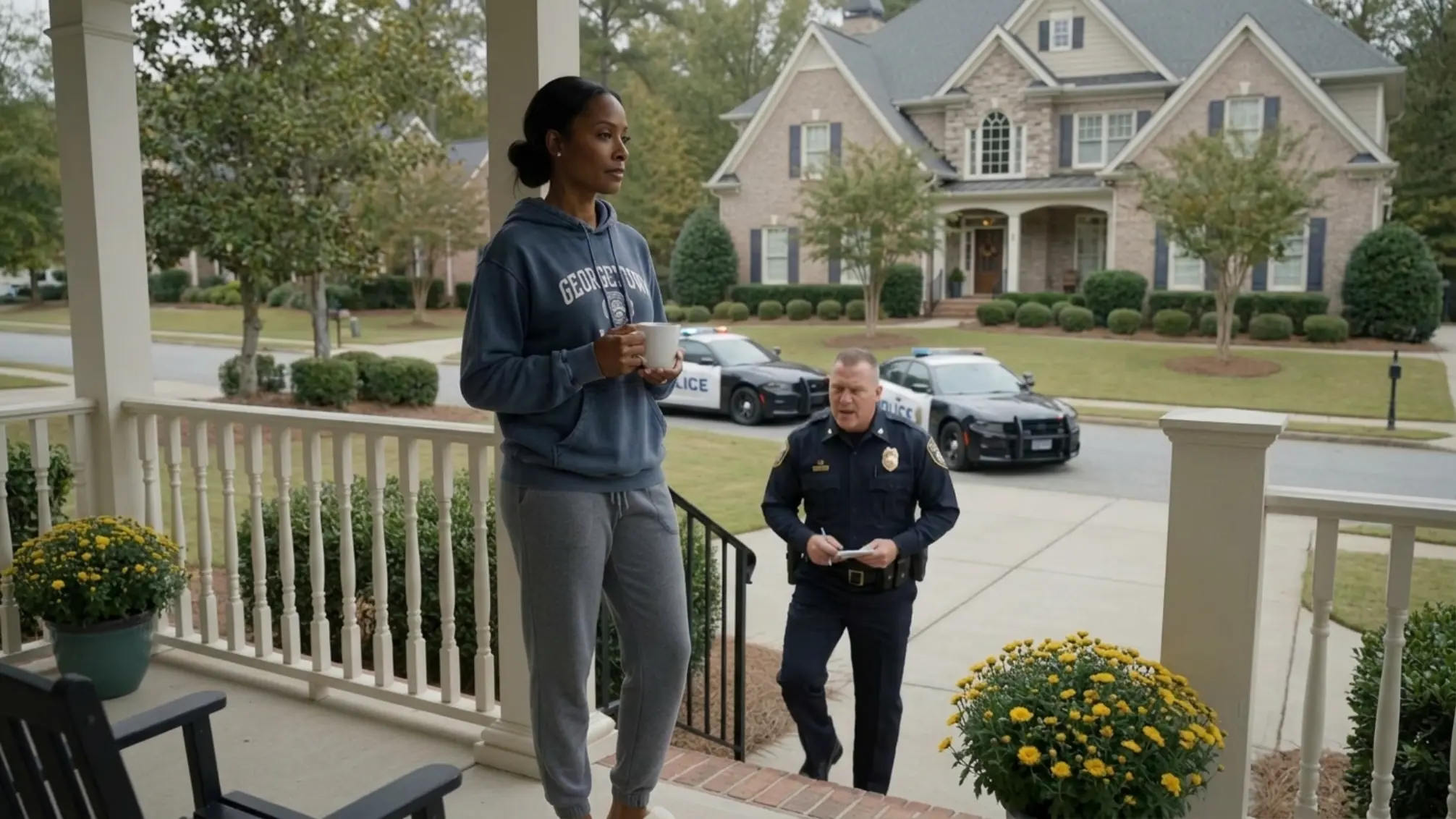
Olivia Carmichael lifted her coffee mug and took one slow sip.
She was forty-two years old, dressed in a faded Georgetown Law hoodie, gray sweatpants, and soft house slippers. Her black hair had been gathered into a relaxed bun, and the morning breeze carried the smell of freshly cut grass across the expensive Hawthorne Hills subdivision. Nothing about her appearance resembled the tailored federal prosecutor photographed in newspapers during her confirmation ceremony.
That was precisely why Stanton had decided she did not belong there.
“You’re standing on my porch,” Olivia said. “What crime are you investigating?”
“We received a report of a suspicious person attempting to access this residence.”
“The front door behind me is open.”
“That proves nothing.”
“It proves I have a key.”
Stanton’s expression tightened. He was a broad, heavyset white American officer in his late forties, with closely shaved hair and a habit of resting one hand on his duty belt whenever he wanted to appear more imposing. His younger partner, Brian Hayes, remained beside the first cruiser, glancing between Olivia and the growing audience.
“Put down the cup,” Stanton ordered.
Olivia looked at her mug.
“Is coffee now part of your investigation?”
“I said put it down.”
“No.”
The refusal was calm, not loud, but it changed the atmosphere immediately. Stanton had expected uncertainty, fear, or hurried obedience. Instead, Olivia studied him with the precise concentration she normally reserved for witnesses whose stories were about to collapse under questioning.
Stanton stepped onto the first porch stair.
“Do not make this harder than it needs to be.”
“I’m not making it difficult,” Olivia replied. “I’m asking you to explain why two patrol cars entered my driveway before either officer asked whether I owned the house.”
“We’re verifying that now.”
“No. You started with a conclusion. Now you’re searching for facts that support it.”
Hayes shifted uneasily.
“Ma’am,” he said, attempting a gentler tone, “showing identification would clear this up quickly.”
Olivia turned toward him.
“So would checking the property record through dispatch.”
Hayes opened his mouth, then looked at Stanton.
Stanton climbed another step.
“We don’t take instructions from possible trespassers.”
“You should take instructions from the Constitution.”
A few neighbors exchanged glances. The woman standing three houses away, Brenda Wallace, leaned toward an older man beside her and whispered something behind her hand. Olivia saw the satisfaction on Brenda’s face and immediately understood who had called.
Brenda had introduced herself only once, two weeks earlier, when she placed a neighborhood association welcome packet beneath Olivia’s mailbox rather than walking to the door. Since then, she had watched the Carmichael residence from behind bright white blinds whenever contractors, delivery drivers, or Olivia’s colleagues arrived.
Olivia had ignored it.
This morning, Brenda had escalated from observation to accusation.
Stanton unclipped the small notepad attached to his belt.
“Name.”
“I haven’t agreed to provide one.”
“Address.”
“You’re standing in front of it.”
“Date of birth.”
Olivia’s eyes hardened.
“Officer, you have not identified any lawful basis for demanding personal information from me.”
“The basis is a burglary call.”
“Did the caller report a broken window?”
“No.”
“A forced door?”
“No.”
“An alarm?”
“No.”
“Did anyone see me enter the house unlawfully?”
Stanton hesitated.
“The caller said you did not belong here.”
“And you accepted that as fact.”
“She said the property had recently been sold.”
“That part is accurate.”
“To someone else.”
“No. To me.”
Stanton gave a dismissive laugh.
“Then prove it.”
Olivia lowered the mug.
“A homeowner does not have to prove ownership to every officer dispatched by a neighbor who dislikes what she sees.”
“That attitude is going to get you detained.”
“On what charge?”
“Obstruction.”
“Refusing to cooperate with an unsupported assumption is not obstruction.”
Stanton removed his handcuffs from his belt.
The metal made a sharp sound in the quiet street.
Hayes stepped forward.
“Sir, maybe we should verify the homeowner information first.”
Stanton glanced over his shoulder.
“I’m handling it.”
“But dispatch can—”
“I said I’m handling it.”
The younger officer stopped, but his discomfort was now visible. Olivia noticed it and understood that Hayes knew the encounter had moved beyond reasonable investigation. He simply lacked the confidence to challenge the senior officer beside him.
Stanton turned back toward Olivia.
“Step down from the porch and place your hands behind your back.”
“No.”
“You are being temporarily detained.”
“For standing at my own front door?”
“For interfering with an active investigation.”
“You have not conducted one.”
Stanton climbed the final step.
Olivia remained still, holding the coffee mug at waist level where both officers could see it clearly. She did not reach for her telephone or step toward the open door. Every movement she made was deliberate because she understood how quickly an ordinary gesture could be misrepresented after the fact.
“If you place those handcuffs on me,” she said, “the official record of this morning will not support your decision.”
Stanton’s mouth tightened.
“Are you threatening me?”
“I am warning you that accountability exists.”
“You think you can intimidate an officer with legal phrases?”
“No. I think your own body camera will explain exactly what happened.”
For the first time, Stanton glanced down at the camera attached to his uniform.
The movement lasted less than a second.
Olivia noticed.
“Your camera is operating, correct?”
Stanton did not answer.
Hayes checked his own.
“Yes, ma’am.”
“Good. Then the record will show that I repeatedly told you I own this residence, that neither officer observed evidence of unlawful entry, and that your partner threatened detention without verifying the caller’s assumptions.”
Stanton pointed the handcuffs toward her.
“Last chance.”
Olivia placed the coffee mug on the small glass table beside her chair. The ceramic base clicked softly against the surface.
Then she straightened.
“Call your watch commander.”
“I don’t need a supervisor.”
“You do now.”
“I am not calling a captain because a trespass suspect knows a few legal terms.”
Olivia looked at his nameplate.
“Officer Derek Stanton, contact Captain David Miller. Tell him you are at 4420 Oakleaf Drive.”
The specificity disturbed him.
His hand lowered slightly.
“How do you know Captain Miller?”
“He attended my swearing-in ceremony last month.”
Hayes’s face changed.
He looked at Olivia more carefully, studying her features rather than her clothing. Recognition appeared gradually, followed by alarm.
“Sir,” he whispered, “I think we received a department notice about her.”
Stanton looked at him.
“About who?”
Hayes swallowed.
“The new United States Attorney.”
Silence settled over the porch.
Stanton stared at Olivia, attempting to reconcile the woman in house slippers with the federal official whose appointment had recently been announced. Pride battled caution across his expression.
Olivia did not rescue him from the uncertainty.
“You can confirm my identity by calling Captain Miller,” she said. “That is the lawful verification process you should have begun ten minutes ago.”
Stanton looked toward the neighbors, aware that retreat would be witnessed by everyone who had watched him arrive. Brenda Wallace still stood near the edge of her driveway, her posture rigid with anticipation.
“You’re claiming to be the United States Attorney?” Stanton asked.
“I’m not claiming anything. I’m telling you who owns this house.”
“That title doesn’t place you above police procedure.”
“No one is above lawful procedure. That includes you.”
Hayes reached for his radio.
“Dispatch, Unit Four-Bravo. Request a watch commander at Oakleaf Drive.”
Stanton turned sharply.
“I didn’t authorize that.”
Hayes kept his hand on the microphone.
“Supervisor requested. No emergency. Scene is stable.”
The dispatcher acknowledged and announced that Captain Miller would arrive within several minutes.
Olivia picked up her coffee again and sat in the patio chair.
Stanton remained at the edge of the porch, handcuffs still in one hand but no longer raised. Hayes returned to the driveway, his face pale. The neighbors continued watching as the authority of the scene slowly shifted away from the two patrol officers.
“You could have avoided this by showing identification,” Stanton muttered.
Olivia crossed one leg over the other.
“You could have avoided it by asking a neutral question.”
“We responded to a call.”
“You responded to the caller’s conclusion.”
“We have to take reports seriously.”
“You also have to evaluate them.”
Stanton looked toward Brenda.
The caller’s confidence now seemed less reassuring.
Olivia continued.
“You saw a Black woman in casual clothes and decided she matched the caller’s description of someone who did not belong here. You never asked whether the report itself was based on prejudice, assumption, or mistake.”
“I didn’t say anything about your race.”
“You didn’t need to.”
Several more neighbors stepped onto porches as a black unmarked SUV turned onto Oakleaf Drive. It approached quickly, stopping behind the cruisers. Captain David Miller exited before the engine had fully quieted.
He was a tall white American man in his late fifties with silver hair and a reputation for maintaining control without raising his voice. He surveyed the cruisers, the neighbors, Stanton standing near the porch, and Olivia seated with her coffee.
His face lost color.
“Stanton,” he called. “Step away from the residence.”
“Captain, we received a burglary report.”
“Step away.”
“But she refused—”
“Move.”
The command ended the argument.
Stanton walked backward down the porch steps. Hayes stood beside the cruiser, looking relieved that someone else had finally taken control.
Captain Miller removed his uniform cap and approached Olivia alone.
“Ms. Carmichael,” he said, “I apologize for this encounter.”
Olivia stood.
“What information did your officers receive?”
“A suspicious-person report.”
“Did dispatch say there was forced entry?”
“I don’t know yet.”
“Did the caller identify an actual crime?”
“I’ll retrieve the recording.”
“Please do.”
Miller nodded and turned toward the officers.
“Neither of you leaves until the call, body-camera footage, and dispatch log are secured.”
Stanton’s face reddened.
“Captain, she refused to identify herself.”
“After telling you she owned the home?”
“She could have been lying.”
“Did you check?”
Stanton said nothing.
Miller looked at Hayes.
“Did either of you ask dispatch to confirm the ownership record?”
“No, sir.”
“Did you observe damage, an alarm, an open window, or any sign of unlawful entry?”
“No, sir.”
“Then why were handcuffs removed?”
Hayes glanced toward Stanton.
Stanton spoke quickly.
“She became uncooperative.”
Captain Miller’s voice grew quieter.
“A person disagreeing with you is not automatically uncooperative.”
Olivia watched without interruption. She had spent her career seeing institutions protect themselves through careful language, allowing individual mistakes to become vague misunderstandings. She was not interested in public humiliation, but she would not permit the encounter to be rewritten.
“Captain,” she said, “your officers entered my driveway with emergency lights activated. Officer Stanton approached with his hand near his weapon, ordered me off my own porch, and threatened detention before confirming a single fact. Officer Hayes recognized the problem but did not intervene until the situation had already escalated.”
Hayes lowered his eyes.
“That description is accurate,” he admitted.
Stanton looked at him in disbelief.
Miller turned toward Olivia.
“Both officers will be removed from patrol pending review.”
“I want the review to examine more than procedure.”
“It will.”
“Examine the caller’s language, the dispatch classification, and why an unsupported report produced this response.”
Captain Miller nodded.
“I understand.”
“No, Captain. You understand who I am. The important question is whether this response would be taken as seriously if I were not the United States Attorney.”
Miller held her gaze.
“That is fair.”
“It is more than fair. It is the entire issue.”
He contacted dispatch and requested the original emergency recording. Within moments, the audio file appeared on his department-issued telephone.
Miller activated the speaker.
Brenda Wallace’s voice filled the quiet driveway.
She described a suspicious woman wearing unkempt clothes on the porch of the newly sold Carmichael property. She said the woman appeared out of place and might be studying the house before attempting to enter. Most importantly, Brenda stated with certainty that the woman was not the homeowner.
The recording ended.
Olivia looked toward the house three doors away.
Brenda had stepped backward onto her lawn, but it was too late to disappear.
“Captain,” Olivia said, “bring the recording.”
She walked down the driveway.
Miller followed. Stanton and Hayes remained beside the cruisers under instructions not to move. The neighbors who had gathered began retreating toward their houses as Olivia crossed the sidewalk in her slippers, coffee still in hand.
Brenda attempted a smile when Olivia approached.
“I’m glad they cleared everything up.”
Olivia stopped several feet away.
“You called the police.”
“I was only being cautious.”
“You told them I was not the homeowner.”
“That was what I understood.”
“From whom?”
Brenda hesitated.
“I knew the house had been sold.”
“So did everyone.”
“I hadn’t met the new owner.”
“Neither had most of the neighborhood.”
Brenda glanced at Captain Miller.
“She looked suspicious.”
Olivia’s voice remained controlled.
“What action did you observe?”
“She was standing outside.”
“On a porch.”
“Yes.”
“Drinking coffee.”
Brenda’s cheeks flushed.
“She was wearing very casual clothes.”
“It was Saturday morning.”
“I did not know who she was.”
“Then why did you tell dispatch you knew she was not the owner?”
Brenda opened her mouth but produced no answer.
Olivia took another step closer.
“You transformed uncertainty into certainty because the truth you imagined felt more believable than the possibility that a Black woman owned this house.”
“That isn’t fair.”
“It is exactly what happened.”
“I’m not prejudiced.”
“This is not a discussion about the label you prefer. It is about the choice you made.”
Brenda looked toward the surrounding homes, suddenly aware that the same neighbors she had expected to praise her were hearing every word.
“I was protecting the community.”
“You sent armed officers to my home without checking whether there was anything to protect.”
“I didn’t tell them to behave that way.”
“You created the premise that made their behavior possible.”
Brenda’s eyes filled with defensive tears.
“I made a mistake.”
“Yes.”
The simple agreement unsettled her more than anger would have.
Olivia turned to Captain Miller.
“I want the call documented as part of the review. I also want a formal report regarding the false statements made to dispatch.”
Miller nodded.
“A detective can determine whether the facts support further action.”
“That is appropriate. I am not asking for a predetermined result.”
Brenda looked surprised.
“You’re not having me arrested?”
Olivia faced her again.
“I’m asking the system to examine evidence instead of reaching a conclusion first. That is the courtesy you denied me.”
Brenda lowered her eyes.
Captain Miller remained with her to explain that a detective would make contact later. Olivia returned to her property, where Stanton and Hayes were waiting.
Stanton had put the handcuffs away.
His posture no longer carried the confidence with which he arrived.
“Ms. Carmichael,” he began, “I apologize for the misunderstanding.”
Olivia stopped before him.
“It was not a misunderstanding.”
He swallowed.
“We received incomplete information.”
“You received an accusation. You decided it was true.”
“I was trying to secure the scene.”
“You created the danger at the scene.”
Stanton glanced toward Miller.
“I never intended to harm anyone.”
“Intent does not erase risk.”
“I followed my training.”
“Then your training requires review.”
His face hardened slightly.
“You’re going to destroy my career over one mistake?”
Olivia looked at him for several seconds.
“No. Your career will be determined by the complete record, your previous conduct, your willingness to accept responsibility, and the judgment of your department. That is more fairness than you offered me.”
Stanton looked away.
Olivia turned toward Hayes.
The younger officer stood rigidly, his hands clasped behind him.
“You knew something was wrong,” she said.
“Yes, ma’am.”
“You suggested checking the property record.”
“Yes.”
“Then you stopped when he rejected the idea.”
Hayes nodded.
“I was afraid of undermining a senior officer.”
“Your responsibility is not to protect seniority. It is to protect the public and uphold the law.”
“I understand.”
“Do you?”
His eyes met hers.
“I do now.”
Olivia’s expression softened only slightly.
“Remember this feeling the next time silence seems easier than disagreement.”
“I will.”
Captain Miller ordered both officers to turn over their vehicle keys and remain available for an internal investigation. Another unit arrived to transport them back to the station. The flashing lights were finally switched off, restoring the street to its ordinary appearance.
Before leaving, Miller approached Olivia once more.
“I know an apology is not enough.”
“No, it isn’t.”
“I will provide you with the incident number and the name of the investigator assigned.”
“Thank you.”
“We will review the dispatch response, supervision, and neighborhood-call policy.”
“Include training on verification before escalation.”
“I will.”
“And do not design the response around my title.”
Miller paused.
“Meaning?”
“The next homeowner may be a teacher, a cashier, a nurse, or someone without the language to challenge an officer. They deserve the same protection.”
Miller replaced his cap.
“You’re right.”
The cruisers left Hawthorne Hills slowly, without lights or sirens. Neighbors disappeared into their homes, closing doors and blinds that had remained open during the confrontation. Brenda stood alone on her lawn, staring at the pavement.
Olivia returned to her chair.
Her coffee was cold.
She drank it anyway.
Three days later, internal investigators interviewed every person involved. The body-camera recordings confirmed that Stanton escalated the encounter before conducting basic verification. His personnel file revealed two previous complaints involving homeowners who had been treated as suspects after vague neighborhood reports.
Both earlier complaints had been closed without substantial review.
This time, they were reopened.
Hayes admitted that he recognized the lack of evidence but deferred to Stanton. He was removed from field duty and assigned retraining with a written warning that future silence during improper conduct would carry more serious consequences.
Stanton was suspended.
The final disciplinary decision would take months, but his authority was no longer protected by the assumption that one encounter had simply gone wrong.
The department also reviewed Brenda’s emergency call. Investigators concluded that she made unsupported statements as though they were verified facts. She received a formal citation for misuse of the emergency system and was required to appear before a local court.
The Hawthorne Hills neighborhood association removed her from the watch committee.
Brenda sent Olivia a written apology.
It contained several explanations, including fear, confusion, neighborhood security, and lack of information. Olivia read the letter once, then returned it with a single handwritten sentence.
An apology begins when explanations end.
A second letter arrived one week later.
It was shorter.
Brenda wrote that she had looked at Olivia, decided what kind of person she must be, and used public power to act on that decision. She acknowledged that the consequences could have been far worse than embarrassment.
Olivia kept that letter.
Months later, Captain Miller invited her to speak at a department training session on escalation, public trust, and constitutional policing. She initially declined, unwilling to turn a violation of her rights into unpaid work for the institution responsible.
Miller returned with a different proposal.
He asked her to review a revised policy requiring officers responding to suspicious-person calls at residences to begin with observation and neutral verification whenever circumstances permitted. Supervisors would review any encounter where officers threatened detention before confirming whether a reported crime had occurred.
Olivia accepted the policy review.
She did not ask for her name to appear on it.
The first Saturday after the new procedure took effect, Olivia stepped onto her porch wearing the same Georgetown hoodie, gray sweatpants, and slippers. She carried a fresh cup of coffee and sat beneath the quiet morning sun.
A moving truck had arrived across the street.
A young Latino American couple stood beside it, directing workers toward their new home. Several neighbors watched from windows, uncertain about people they had not yet met.
Olivia crossed the street.
She introduced herself, welcomed the couple to Hawthorne Hills, and handed them a list of local services and neighborhood contacts. She did not ask what they had paid, where they worked, or whether they belonged.
She began with the only fact that mattered.
They were home.