Vanessa Cole had been standing on her own front porch for less than four minutes when the first police cruiser stopped in front of her house. She wore a faded navy Georgetown hoodie, gray sweatpants, clean running shoes, and small pearl earrings, hardly the clothing anyone would associate with the federal prosecutor whose name had appeared on the front page of Atlanta newspapers only weeks earlier. Her sleek black hair was pulled into a low bun, and both hands rested around a white ceramic coffee mug while the quiet suburban street slowly woke around her. Vanessa had planned to spend ten peaceful minutes outside before returning upstairs to prepare for one of the most sensitive federal hearings of her career.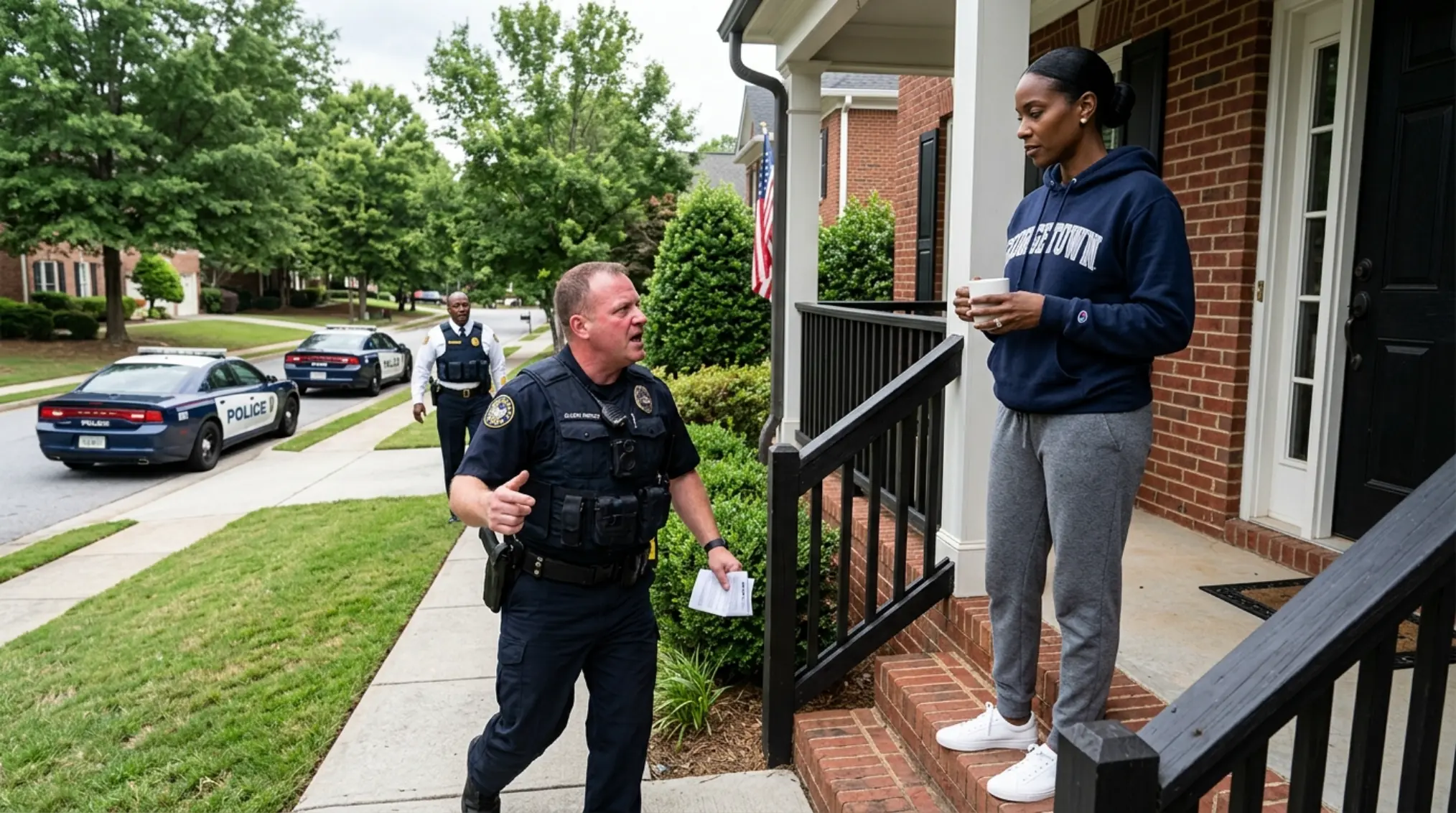
The second cruiser arrived before the first officer had even reached her driveway. Vanessa watched it roll to the curb behind the first vehicle and felt the smallest flicker of irritation, not fear. She knew procedures, jurisdictions, constitutional limitations, and police authority better than almost anyone standing on that street. More importantly, she knew she had done absolutely nothing except walk out of the front door of a house she had owned for six years.
Officer Daniel Mercer came up the driveway carrying folded citation papers in one hand. He was forty-six, broad through the shoulders, with short brown hair, a square flushed face, and the stiff gait of a man who expected strangers to obey before he finished speaking. His body camera was clipped high on his dark patrol shirt. Vanessa noticed immediately that it was active.
“Ma’am,” Mercer called. “Stay where you are.”
Vanessa looked down at her slippers, then at the porch beneath her feet.
“I wasn’t going anywhere.”
Mercer reached the bottom step.
“We received a report about a suspicious person at this residence.”
Vanessa glanced toward the neighboring houses. Curtains moved behind one upstairs window across the street. Someone had apparently seen her outside and decided that required police attention.
“What suspicious activity?”
Mercer ignored the question.
“Do you live here?”
“Yes.”
“I need identification.”
Vanessa took a slow sip of coffee.
“For standing on my porch?”
Mercer’s jaw tightened.
“For verifying who you are.”
“You can verify the property owner through your system.”
“That isn’t what I asked.”
“No,” Vanessa said. “It isn’t.”
The second officer remained near his cruiser. He was younger, perhaps thirty, and appeared noticeably less comfortable with the situation. He kept glancing between Mercer, Vanessa, and the house number mounted clearly beside the front door.
Mercer climbed one step.
“Ma’am, I’m not going to argue with you. Give me your ID.”
Vanessa set the mug on the porch railing.
“You came onto private property because somebody called you about a woman standing outside. You haven't identified a crime. You haven't identified reasonable suspicion of one. So before you start issuing commands, tell me exactly why you believe I’m required to produce identification.”
Mercer stared at her.
The younger officer looked down.
That should have been the moment Mercer reconsidered.
Instead, he heard challenge.
And challenge, in his mind, required dominance.
He unfolded the citation papers and slapped them against the porch railing.
“ID. Now. Or I’m dragging you off this porch myself.”
Vanessa’s expression changed.
Not into fear.
Into focus.
She picked up the mug and set it firmly on the small table beside her.
“Try it.”
Mercer blinked.
Vanessa continued.
“Then explain why you arrested me at my own house.”
Mercer stepped onto the porch.
“You want to test me?”
“I want you to explain your legal basis.”
His palm smashed against the railing.
“Keep running your mouth and you’re going in cuffs.”
The younger officer finally moved.
“Mercer.”
“Stay out of it.”
“Maybe we should verify the address first.”
Mercer turned sharply.
“I said I’m handling it.”
Vanessa noticed the younger man’s shoulders drop.
That mattered.
Everything about this encounter was telling her something.
Not only about Mercer.
About the department.
A third vehicle turned onto the street.
This one was an unmarked black SUV.
Mercer did not notice.
Vanessa did.
The SUV slowed behind the cruisers.
A tall man in a dark police command uniform stepped out.
Captain Raymond Ellis had been with the department for twenty-eight years. His face was familiar to Vanessa because he had sat three rows behind the defense table during a federal law-enforcement conference only two months earlier. Vanessa had delivered the keynote presentation.
Ellis looked toward the porch.
Then stopped.
Mercer pointed at Vanessa.
“Last chance.”
She did not look away from him.
“Go ahead.”
Mercer reached toward the handcuffs on his belt.
Vanessa lifted one finger past his shoulder.
“Your captain just recognized the federal prosecutor you’re threatening.”
Mercer froze.
For a second, his face showed confusion rather than fear.
Then Captain Ellis shouted from the sidewalk.
“Officer Mercer!”
Mercer turned.
Ellis was already moving quickly up the driveway.
“Step away from her.”
Mercer looked back at Vanessa.
Then toward Ellis.
“Captain, we got a suspicious-person call.”
“I said step away.”
Mercer lowered his hand.
Ellis reached the porch and removed his hat.
“Ms. Cole.”
Vanessa nodded.
“Captain.”
Mercer’s expression changed instantly.
His entire posture softened.
That sudden transformation irritated Vanessa more than the shouting had.
Ellis looked at Mercer.
“Do you know who this is?”
Mercer swallowed.
“No, sir.”
“This is United States Attorney Vanessa Cole.”
The younger officer’s eyes widened.
Mercer looked toward Vanessa again.
His face lost color.
“I didn’t know.”
Vanessa picked up her coffee.
“That shouldn't have mattered.”
Nobody spoke.
She stepped closer.
“You were willing to drag me from my own porch thirty seconds ago. The only thing that changed was somebody told you my title.”
Mercer opened his mouth.
Vanessa held up one hand.
“Don’t apologize yet.”
Captain Ellis looked uncomfortable.
Vanessa continued.
“I want the call information preserved. Dispatch recording. Body cameras. Vehicle camera. Every radio transmission.”
Ellis nodded immediately.
“Of course.”
Mercer’s face hardened slightly.
“Ma’am, I was responding to a complaint.”
Vanessa looked at him.
“Then tell me what crime was reported.”
“Suspicious behavior.”
“That isn't a crime.”
“The caller said you didn’t belong at this address.”
“And what did you do to verify the caller’s assumption?”
Mercer hesitated.
Nothing.
Vanessa pointed toward the house.
“My name is on the property record.”
He remained silent.
“The plate on the vehicle in the garage is registered here.”
Silence.
“You could have asked dispatch.”
Mercer finally said, “I asked you.”
“No.”
Vanessa’s voice became colder.
“You ordered me.”
Captain Ellis glanced toward Mercer.
Vanessa continued.
“And when I asked why, you threatened physical removal.”
Mercer looked down at his body camera as if remembering it for the first time.
Vanessa noticed.
“So now you remember the camera.”
Mercer’s jaw tightened.
Captain Ellis stepped between them.
“Ms. Cole, I’m going to handle this immediately.”
Vanessa turned toward him.
“I hope so.”
She picked up her mug again.
“But not because I’m a federal prosecutor.”
Ellis nodded slowly.
“Understood.”
Vanessa looked at the younger officer.
“What’s your name?”
“Officer Jamie Carter, ma’am.”
“You suggested verifying the address.”
“Yes.”
“Why?”
Carter glanced at Mercer.
Then back at Vanessa.
“Because nothing about the call described a crime.”
Ellis heard that.
“So why did you come with him?”
“Backup.”
“Did you believe she needed to provide ID?”
Carter hesitated.
“No, sir.”
Mercer turned.
“Watch yourself.”
Vanessa’s eyes immediately returned to him.
“There.”
Mercer frowned.
“That.”
“What?”
“The way you speak to anyone who questions you.”
Ellis looked at Mercer with an expression that said the conversation had moved far beyond one complaint.
Vanessa did not know it yet, but she had just touched the edge of something the department had been quietly avoiding for years.
By eleven that morning, Captain Ellis had ordered Mercer off street duty pending administrative review. The decision was not made because Vanessa demanded it. She had actually refused to make any recommendation, precisely because she did not want anyone later claiming the outcome had been dictated by federal power. Instead, Ellis reviewed the first minutes of body-camera footage and made the decision himself.
The video was worse than he expected.
Mercer arrived already confrontational.
He never asked dispatch to verify the homeowner.
He never asked the caller for evidence of trespassing.
He escalated almost every time Vanessa asked a lawful question.
Then came the part Ellis watched three times.
“ID. Now. Or I’m dragging you off this porch myself.”
Ellis leaned back in his office chair.
Deputy Chief Monica Reyes stood beside him.
“How many complaints?”
Ellis looked at her.
“Against Mercer?”
“Yes.”
Reyes opened the internal system.
The answer was not one.
It was not two.
There were nine.
Most were marked resolved.
One involved a college professor stopped while retrieving mail outside his own building.
Another involved a restaurant owner who refused to allow a search of his parked car without explanation.
A third involved a nurse returning home late at night who said Mercer demanded identification after a neighbor reported “someone checking doors.”
She had been unlocking her own front entrance.
Ellis stared at the screen.
“Who closed these?”
Reyes clicked through the records.
“Different supervisors.”
“Same conclusion?”
“Mostly insufficient evidence.”
“Body camera?”
“Some.”
Ellis looked toward her.
“Pull everything.”
The porch encounter had suddenly become something larger.
Vanessa had spent the morning in federal court and knew nothing about the internal review until Ellis called that afternoon.
“I’m not asking for special treatment,” she told him.
“You’re not getting it.”
“Good.”
Ellis paused.
“But your incident led us to reopen several older complaints.”
Vanessa became quiet.
“How many?”
“Nine involving Mercer directly.”
“And?”
“We’re reviewing supervisory handling too.”
Vanessa leaned back in her chair.
That interested her.
One officer could behave badly.
A pattern survived only when systems allowed it.
“What do you need from me?”
“A statement.”
“You already have the video.”
“I want your statement anyway.”
“Fine.”
She paused.
“And Captain?”
“Yes?”
“Talk to Officer Carter separately.”
Ellis frowned.
“Why?”
“He tried to slow Mercer down.”
“I saw.”
“And Mercer told him to stay out of it.”
Ellis understood.
Sometimes the most useful witness inside a culture was the person who had learned exactly how dangerous it was to disagree.
The neighborhood caller turned out to be Linda Preston, a woman living three houses away. She had moved into the subdivision eight months earlier and had never introduced herself to Vanessa. When dispatch interviewed her again, Linda admitted she did not know who owned the property.
She had simply seen Vanessa standing outside.
Asked why that seemed suspicious, Linda said Vanessa had been “watching houses.”
Vanessa had actually been looking at a delivery truck making a three-point turn at the end of the street.
Linda then said she believed the homeowners were “an older professional couple.”
That description was completely fabricated.
Vanessa lived alone.
Dispatch asked whether Linda had ever met the owner.
No.
Seen the owner?
Not that she knew of.
So why had she called?
Linda could not offer an answer that survived careful questioning.
That information became part of the administrative file.
But Vanessa surprised everyone by asking investigators not to make Linda the center of the case.
“The caller made a bad assumption,” she said during her statement. “The officer is trained not to turn assumptions into facts.”
The internal investigator nodded.
“What do you believe should have happened?”
“He could have approached politely.”
Vanessa folded her hands.
“Said there had been a call. Asked whether I lived there. Verified ownership through dispatch if he had concerns. Then left.”
“That simple?”
“Yes.”
“He says your refusal to identify yourself complicated the encounter.”
Vanessa’s expression sharpened.
“My exercise of a right does not create legal justification retroactively.”
The investigator nodded.
She continued.
“If an officer becomes more aggressive every time someone asks why, that is not an identification problem.”
“What is it?”
“A power problem.”
Over the next month, Internal Affairs reviewed Mercer’s previous encounters.
The similarities were difficult to ignore.
People who complied instantly received professional treatment.
People who asked questions frequently appeared in reports as “argumentative.”
People who questioned searches became “uncooperative.”
Several reports claimed individuals displayed “aggressive posture,” yet body-camera footage showed something much less dramatic.
Folded arms.
Raised eyebrows.
Requests for badge numbers.
One man had simply said, “I don’t consent.”
Mercer’s report described him as “hostile to lawful authority.”
The department’s attorneys became concerned.
Not because every complaint proved misconduct.
They did not.
But the pattern revealed something else.
Mercer had learned to treat verbal disagreement as escalation.
And supervisors had repeatedly accepted his descriptions without comparing them carefully to video.
That was the deeper failure.
Captain Ellis ordered a department-wide audit of complaint classifications.
The review found forty-three incidents over three years in which “verbal noncompliance” had been used to justify escalating routine encounters.
Most officers involved had only one or two such reports.
Mercer had twelve.
Vanessa learned about the audit through an official liaison rather than rumor.
She read the preliminary findings late one evening in her office.
What bothered her most was not Mercer.
It was a supervisor’s handwritten note attached to one older complaint:
Officer should work on tone, but citizen could have avoided incident by cooperating.
Vanessa stared at that sentence.
Then circled it.
The logic was familiar.
The citizen could have prevented misconduct by surrendering faster.
That was how institutions quietly transferred responsibility away from authority.
Mercer requested a formal hearing.
He entered wearing a suit rather than a uniform.
His attorney argued that he had responded to a legitimate suspicious-person complaint and faced a homeowner who refused identification.
Then the body-camera video played.
Mercer’s own words filled the conference room.
“ID. Now. Or I’m dragging you off this porch myself.”
His attorney stopped taking notes.
Next came Carter’s statement.
He had believed there was insufficient basis for detention.
He had suggested verification.
Mercer had overridden him.
Then investigators played radio logs.
Mercer never asked dispatch to check ownership.
The hearing officer asked him why.
“I was attempting to establish identity directly.”
“Why?”
“To determine whether she belonged there.”
“What evidence suggested she didn’t?”
“The caller.”
“Anything else?”
Mercer paused.
“No.”
The hearing officer leaned forward.
“So an unidentified caller’s assumption became sufficient in your mind to threaten removal from private property?”
Mercer’s attorney objected to the phrasing.
The question remained.
Then came the hardest moment.
The hearing officer played the video immediately after Captain Ellis identified Vanessa.
Mercer’s voice became softer.
His posture changed.
He began saying “ma’am.”
The contrast was unmistakable.
The hearing officer asked, “Why?”
Mercer looked confused.
“Why what?”
“Why did your conduct change?”
“Because I realized who she was.”
The room went silent.
The hearing officer nodded.
“That is exactly what concerns us.”
Mercer understood too late.
The department suspended him for six months and removed him from patrol permanently pending completion of extensive retraining and psychological fitness review. Two supervisors received disciplinary action for failing to investigate earlier complaints adequately. Complaint procedures changed so that body-camera footage had to be reviewed whenever an officer described a citizen as aggressive or uncooperative without an accompanying physical act.
Officer Carter was transferred to community response at his own request.
Several months later, Captain Ellis called Vanessa.
“I thought you’d want to know.”
“What happened?”
“Mercer resigned.”
Vanessa remained quiet.
“He didn’t want reassignment.”
“His decision.”
Ellis paused.
“We also finished the larger audit.”
“And?”
“Policy changes go into effect Monday.”
That mattered more to her.
“How broad?”
“Entire department.”
Vanessa smiled faintly.
“Good.”
Ellis added, “Some officers are angry.”
“I imagine.”
“They think one porch argument rewrote the department.”
Vanessa looked out her office window.
“No.”
“What?”
“One porch argument exposed a department that needed rewriting.”
Ellis laughed once.
“Fair enough.”
Six months after the original incident, Vanessa stood on her porch again.
Same mug.
Different hoodie.
The neighborhood looked exactly as it had before.
Children rode bicycles near the corner.
A delivery van stopped across the street.
Someone trimmed hedges.
Then a patrol cruiser approached.
Vanessa noticed immediately.
It slowed.
Stopped.
Officer Carter stepped out.
Vanessa raised an eyebrow.
He walked toward the porch carrying nothing.
“No citation papers this time?”
Carter smiled.
“No, ma’am.”
“What brings you here?”
“Captain sent me to deliver something.”
He handed her a small envelope.
Inside was a formal letter summarizing the completed policy reform.
Vanessa read the first page.
Carter waited.
“You didn't need to bring this personally.”
“I know.”
“Then why did you?”
He looked toward the porch railing where Mercer had slammed the papers months earlier.
“I wanted to see this place without somebody yelling.”
Vanessa laughed.
“Better?”
“Much.”
She folded the letter.
“You did the right thing that morning.”
Carter shook his head.
“I barely did anything.”
“You questioned bad judgment.”
“I should have done more.”
Vanessa considered him.
“Maybe.”
He looked surprised by the answer.
She continued.
“But courage isn't something people either have or don’t have. Sometimes you practice it.”
Carter nodded.
“I’ve thought about that.”
“Good.”
He turned to leave.
Vanessa called after him.
“Officer.”
He looked back.
“Yes?”
“If someone calls tomorrow because they see a suspicious woman on a porch?”
Carter smiled.
“I’ll ask what crime she’s committing.”
Vanessa lifted her coffee mug.
“Now we’re getting somewhere.”
The story reached the public eventually.
Not through Vanessa.
A local reporter obtained the disciplinary records months later.
The headline focused on the obvious twist:
OFFICER THREATENED WOMAN ON PORCH, LEARNED SHE WAS U.S. ATTORNEY.
Vanessa disliked it immediately.
During a press conference on an unrelated matter, a reporter asked whether her title had protected her.
“Yes,” Vanessa said.
The room quieted.
She continued.
“And that is precisely what bothered me.”
The reporter frowned.
“What do you mean?”
“When my captain arrived and identified me, the officer’s behavior changed instantly.”
She looked around the room.
“My title gave me credibility.”
Another reporter asked, “Isn’t that a good thing?”
“No.”
Vanessa shook her head.
“The good thing would have been not needing it.”
She paused.
“I was standing on my property. The law did not become more protective because someone discovered my occupation.”
The clip spread widely.
But Vanessa cared far more about a much smaller moment several weeks later.
She was outside collecting a package when Linda Preston approached from down the street.
The neighbor who had made the original call looked uncomfortable.
“Ms. Cole?”
Vanessa waited.
Linda stopped near the sidewalk.
“I owe you an apology.”
Vanessa said nothing.
“I shouldn’t have called.”
“No.”
Linda swallowed.
“I thought—”
“That’s the part worth examining.”
Linda looked embarrassed.
“I know.”
Vanessa walked down the porch steps.
“What did you think?”
Linda struggled.
“That you weren't from here.”
“Why?”
No answer.
Vanessa did not rescue her from the silence.
Finally Linda said, “I made an assumption.”
“Yes.”
“I’m sorry.”
Vanessa studied her for several seconds.
Then nodded.
“Thank you for saying it.”
Linda looked surprised.
“That’s it?”
“What were you expecting?”
“I don't know.”
Vanessa picked up the package.
“I don't need you humiliated.”
She turned toward the house.
“I need you to recognize the next person before you make the next call.”
Linda stood there quietly.
“I will.”
Vanessa hoped so.
A year later, the department’s audit showed fewer escalations from suspicious-person calls and fewer complaints involving demands for identification. The numbers were not perfect. Institutions rarely transformed because of one event.
But they moved.
Captain Ellis retired two years later.
At his retirement dinner, he found Vanessa near the back of the ballroom.
“I never thanked you.”
“For what?”
“For not destroying us.”
Vanessa looked at him.
“That was never my goal.”
“You could have.”
“No.”
She shook her head.
“I could have embarrassed you.”
Ellis waited.
“That’s different from fixing anything.”
He smiled.
“You still terrifying people in federal court?”
“Only when necessary.”
They laughed.
Then Ellis became serious.
“You know what I remember most?”
“The porch?”
“Mercer saying he didn't know who you were.”
Vanessa nodded.
Ellis continued.
“He thought that was his defense.”
“It wasn't.”
“No.”
Ellis looked toward the room filled with officers.
“It was the whole problem.”
Vanessa raised her glass slightly.
“Now you understand why I kept asking what crime had been reported.”
Ellis smiled.
“I understood eventually.”
Vanessa still lived in the same house.
She still drank coffee on the same porch.
Some mornings she wore expensive suits and left for federal court in a government vehicle.
Other mornings she wore sweatpants and old university hoodies.
The porch never changed ownership based on her clothing.
Her rights never increased when she wore a title.
Her dignity never depended on whether a captain recognized her face.
And that was ultimately why the encounter mattered.
Officer Mercer believed authority meant people had to prove they belonged wherever he found them.
Vanessa believed authority carried the opposite obligation.
The more power someone possessed, the more carefully they had to explain why they were using it.
On that quiet Atlanta morning, Mercer demanded identification because somebody else had decided Vanessa looked suspicious outside her own home.
Minutes later, he discovered the woman he threatened was one of the most powerful federal prosecutors in the state.
But that was never the real twist.
The real twist was that her job should not have mattered at all.
She did not need to be the U.S. Attorney to deserve a lawful explanation.
She only needed to be a woman standing peacefully on her own porch.