“Nice truck,” Officer Grant Miller said with a smirk. “Too bad it doesn’t belong to a nobody like you.”
Elijah Cross stood outside Crawford’s Deli in the crushing Texas heat, still holding half a sandwich in one hand while his brand-new Obsidian Black Toyota Tundra hung several feet above the street. Heavy chains tightened around the frame, and the crane on the tow truck groaned as the front wheels climbed higher. Customers had gathered beneath the striped awning, watching as if Elijah were already guilty of something.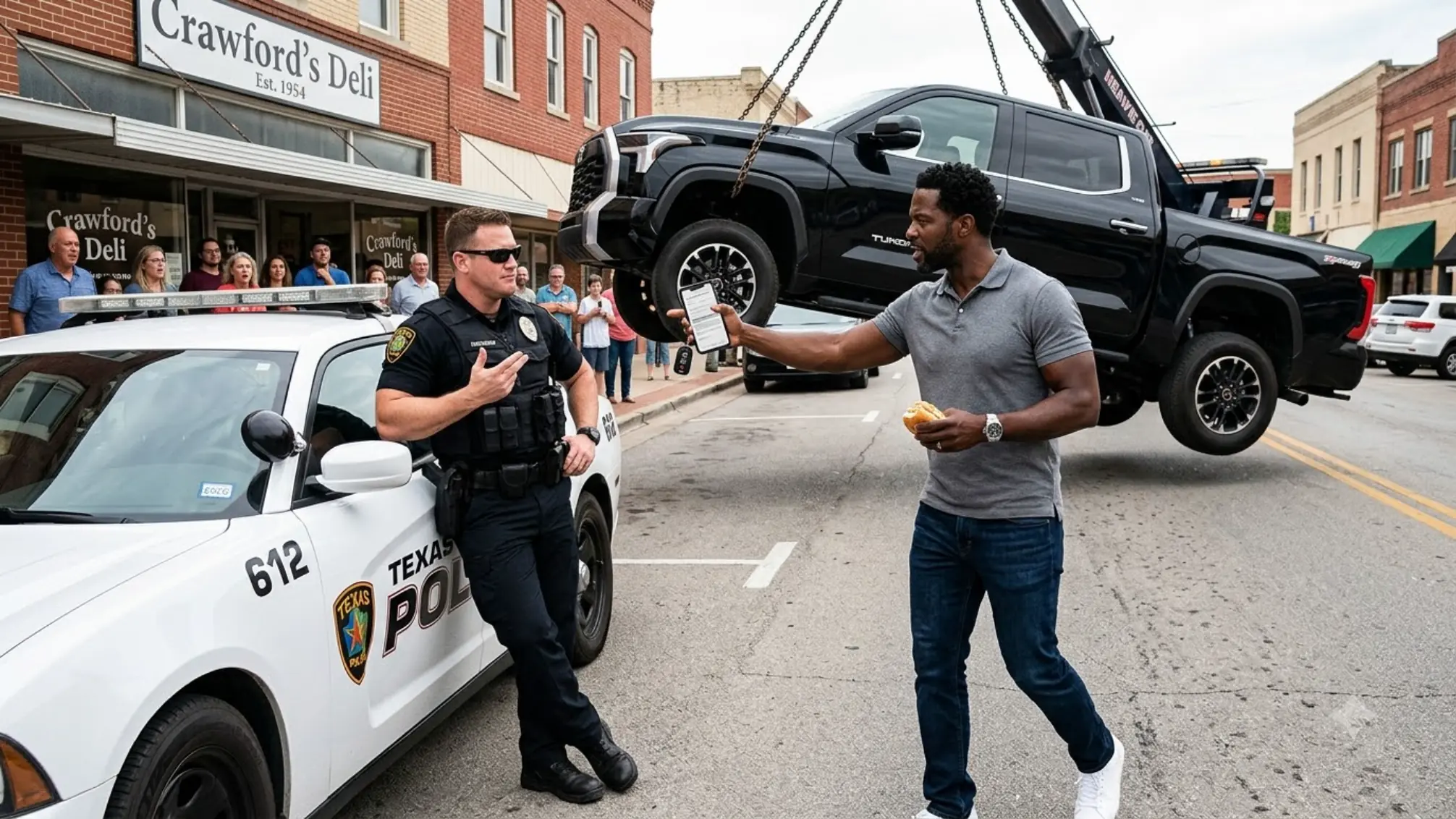
“Lower it before I strip that badge off you,” Elijah said.
Grant pushed away from the white patrol cruiser and reached toward the handcuffs on his belt. “Keep talking, and you’re going downtown.”
Elijah lifted his phone and turned the screen toward him.
“Call your chief,” he said. “I’m the man who bought his fleet.”
For the first time since Elijah had stepped out of the deli, Grant’s smile weakened.
The phone displayed a signed municipal fleet-purchase authorization worth more than eight million dollars. At the top appeared the logo of Crossline Motors, one of the largest independent automotive dealership groups in Texas. At the bottom was the signature of its founder and chief executive officer.
Elijah Cross.
Grant stared at the screen, then looked back at the man wearing a plain gray polo and dark jeans. His eyes moved from Elijah’s face to the suspended truck, as if he expected the truth to change if he examined the scene again.
“That could be anything,” Grant said.
“It’s the contract that put your department inside that cruiser.”
Grant glanced toward the vehicle he had been leaning against. The unit number on its side matched one of the vehicles listed in the agreement.
The tow operator stopped the crane.
His name was Marcus Dean, a broad man in his early fifties who had spent twenty years recovering damaged vehicles and clearing highways after storms. He had avoided looking at Elijah when Grant first ordered the tow, but the mention of the fleet contract changed his posture.
“Officer,” Marcus said, “I need confirmation before I move this truck any farther.”
Grant turned on him.
“You already received confirmation.”
“You told me it was suspected stolen.”
“It is.”
Elijah held up the key fob.
“Then explain why the alarm responds to this.”
He pressed the unlock button.
The Tundra’s lights flashed above them.
A murmur passed through the crowd.
Grant’s jaw tightened.
“Keys can be stolen with a vehicle.”
Elijah opened the manufacturer’s ownership application on his phone. His full name, vehicle identification number, purchase date, and dealership information appeared on the screen. The VIN matched the number visible through the truck’s windshield.
Marcus lowered the crane control.
Grant grabbed his wrist.
“I did not tell you to lower it.”
Marcus pulled his arm free.
“And I’m not damaging a forty-thousand-dollar truck because you don’t like the owner.”
“It’s closer to eighty,” Elijah said.
Marcus looked up at the suspended vehicle.
“Then I’m definitely lowering it.”
Grant stepped between him and the control panel.
“You interfere again, and I’ll cite your company for obstruction.”
Marcus stared at him.
“Obstruction of what?”
Grant pointed toward Elijah.
“An active vehicle-theft investigation.”
Elijah slowly placed his sandwich on the hood of a parked sedan. The anger inside him had become colder, no longer struggling for control. He opened the recording application on his phone and began documenting the officer, tow truck, patrol unit, crowd, and position of his suspended vehicle.
Grant noticed.
“Stop recording.”
“No.”
“That is a lawful order.”
“No, it isn’t.”
Grant walked closer.
“You want to test me?”
“You already tested the ownership record before ordering the tow?”
“I don’t answer to you.”
“That’s about to change.”
Three weeks earlier, Elijah had finished one of the most demanding negotiations of his career. Crossline Motors had been competing for a statewide package involving hundreds of municipal vehicles, maintenance agreements, emergency replacements, and long-term financing. The deal required nights of legal review, repeated meetings, and personal guarantees that could have exposed his company to enormous losses.
He had closed the final agreement that morning.
Instead of celebrating, Elijah drove two hours to the small town of Red Oak Junction to visit one of Crossline’s older dealerships. He wanted to speak privately with the staff after hearing that a regional manager had been pressuring employees to hide warranty expenses.
The visit lasted longer than expected.
By lunchtime, Elijah had eaten nothing since the previous evening. He parked beside Crawford’s Deli in a legal curbside space, locked the truck, and went inside for a sandwich.
Grant arrived eight minutes later.
According to witnesses, the officer circled the Tundra twice before stopping beside the driver’s door. He looked through the tinted windows, photographed the plates, and spoke briefly with dispatch.
The plate returned to Elijah Cross.
No theft alert appeared.
No registration problem existed.
Grant called the tow truck anyway.
He later claimed the truck looked inconsistent with the neighborhood and might have been connected to recent vehicle thefts. But the businesses surrounding Crawford’s Deli regularly served contractors, ranch owners, and oil-field workers driving expensive pickups.
The truck did not look out of place.
Elijah did.
The first thing Grant asked when Elijah approached was not whether he owned the vehicle.
He asked what Elijah was doing near it.
“I’m leaving with it,” Elijah answered.
Grant looked at his clothes.
“Not until I know where you got it.”
That sentence had started everything.
Now Grant reached for Elijah’s phone.
Elijah pulled it back.
“Touch my property again and you’ll have another problem.”
Grant’s face hardened.
“You’re threatening an officer.”
“I’m warning you not to seize evidence of your own conduct.”
The crowd had grown to nearly thirty people. A young cashier from the deli stood near the door holding her phone upright. Two construction workers stopped beside their truck, and an elderly couple watched from beneath a tree.
Grant looked around and understood that he was losing control of the audience.
He placed one hand on Elijah’s chest.
“Turn around.”
Elijah did not move.
“For what?”
“Obstruction.”
“I answered every question and showed ownership.”
“You became aggressive.”
“You put your hand on me.”
Grant pushed harder.
“Turn around.”
Elijah raised both hands where everyone could see them.
“I’m not resisting.”
Grant pulled one wrist behind his back.
Marcus stepped toward them.
“Officer, he didn’t do anything.”
Grant pointed at him.
“Stay back.”
Elijah felt the metal cuff close around his left wrist. The pressure inside his chest rose, but he forced himself to remain still. Years earlier, his father had taught him that surviving a confrontation sometimes required refusing the reaction another person wanted to provoke.
“Your body camera is running?” Elijah asked.
Grant did not answer.
“Is it running?”
Grant reached for Elijah’s other wrist.
A woman’s voice came from the deli entrance.
“It was off when he arrived.”
The cashier held her phone higher.
Grant looked toward her.
“Put that away.”
She stepped backward but kept recording.
Elijah turned his head slightly.
“Send that video somewhere safe.”
Grant tightened the cuff.
“Stop directing witnesses.”
Sirens sounded at the end of the street.
Grant’s expression relaxed.
“You wanted the chief,” he said. “You’re getting backup.”
Two additional patrol vehicles approached, followed by a black department SUV. The crowd separated as the vehicles stopped beside the deli.
Police Chief Raymond Holloway stepped out of the SUV.
He was sixty-one, tall and silver-haired, with the controlled manner of someone accustomed to walking into scenes after younger officers had made them worse. Grant released Elijah’s second wrist before completing the arrest and moved toward the chief.
“Possible stolen vehicle,” Grant said. “Owner became confrontational and threatened department personnel.”
Elijah held up his cuffed hand.
“I showed him the registration, purchase record, key, and VIN.”
Chief Holloway looked toward the suspended Tundra.
“Why is it still in the air?”
Marcus answered.
“Because Officer Miller threatened my license when I tried to lower it.”
Grant turned sharply.
“That’s not what happened.”
“It’s recorded.”
The chief looked toward the crowd.
Nearly every visible phone was pointed toward them.
He returned his attention to Elijah.
“Your name?”
“Elijah Cross.”
Holloway stopped.
Grant noticed.
The chief looked at the gray polo, then at the phone still held in Elijah’s right hand.
“Crossline Motors?”
“Yes.”
Holloway’s eyes moved to the white patrol cruiser.
Six months earlier, the chief had shaken Elijah’s hand at a fleet ceremony in Dallas. Elijah had worn a dark suit and stood beneath a Crossline banner while the department accepted fourteen new cruisers and four utility vehicles.
Without the suit, Holloway had not recognized him immediately.
Now he did.
“Remove the cuff,” Holloway ordered.
Grant stepped closer.
“Chief, he threatened to strip my badge.”
“Remove it.”
“He interfered with an investigation.”
“What theft report?”
Grant hesitated.
“Suspicious circumstances.”
“What report?”
“There have been truck thefts in the region.”
“That is not what I asked.”
Holloway held out his hand.
“Give me your dispatch log.”
Grant did not move.
The chief took the radio from his shoulder and called communications directly. The dispatcher confirmed that Grant had requested a registration check at 12:18 p.m.
The plate returned valid.
The registered owner was Elijah Cross.
No stolen-vehicle alert appeared.
Grant requested a tow at 12:22.
Four minutes after learning who owned the truck.
Chief Holloway lowered the radio.
“You knew the registered owner’s name before Mr. Cross came outside.”
Grant’s mouth opened.
“I believed the vehicle might have been taken without the owner reporting it.”
“Then why didn’t you contact the owner?”
“I was securing the vehicle.”
“You were lifting it from a legal space.”
Grant pointed toward Elijah.
“He did not look like the registered owner.”
The street became silent.
Elijah stared at him.
Chief Holloway’s face changed.
“What does the registered owner look like?”
Grant realized too late what he had said.
“I mean the circumstances did not match.”
“What circumstances?”
Grant looked toward the truck, then Elijah’s clothes.
No explanation could survive being spoken aloud.
Elijah held up the phone.
“The man who didn’t look like the owner signed the department contract you praised at the council meeting.”
Holloway closed his eyes briefly.
Then he turned toward Marcus.
“Lower the vehicle carefully.”
Grant moved forward.
“Chief—”
“That is an order.”
Marcus returned to the controls. The crane released slowly, lowering the Tundra until all four tires touched the pavement. He removed the chains while another officer photographed the connection points for possible damage.
Chief Holloway unlocked Elijah’s cuff personally.
“I apologize for what happened.”
Elijah rubbed his wrist.
“An apology does not preserve the evidence.”
“It will be preserved.”
“His body camera was off.”
Holloway looked at Grant.
“Is that true?”
Grant glanced toward the device on his vest.
“It malfunctioned.”
One of the backup officers examined it.
“The power is on.”
Grant stepped away.
“It failed to record.”
The officer pressed a button.
A red indicator appeared.
The camera began recording immediately.
Chief Holloway’s voice became colder.
“Secure Officer Miller’s equipment.”
Grant stared at him.
“You’re suspending me because this man sells cars to the city?”
“I am separating you from an active investigation because you ordered a legal vehicle seized after receiving valid registration, attempted to arrest the owner, and appear to have disabled your camera.”
Grant pointed toward Elijah.
“He is using money to intimidate the department.”
Elijah stepped closer.
“No. I’m using documents to prove what you did.”
Chief Holloway ordered another officer to escort Grant away from the crowd. Grant resisted verbally but surrendered his service weapon, radio, and badge after realizing every movement remained on dozens of phones.
The patrol fleet contract became relevant for a different reason that afternoon.
Elijah’s company did not own the police vehicles after delivery, and he had no authority to take them back. But Crossline’s agreement included a compliance provision allowing the company to suspend maintenance and future financing if vehicles were used in officially documented misconduct that the municipality refused to investigate.
Elijah did not threaten to cancel the contract.
He did something more dangerous.
He asked for the written preservation procedure.
Chief Holloway provided it.
Elijah emailed the police department, city attorney, mayor, fleet oversight committee, and Crossline’s legal counsel before leaving the street. His notice requested the dispatch recording, vehicle-camera data, tow authorization, license-plate query, internal messages, officer location history, and all complaints previously involving Grant.
The city could no longer treat the incident as a misunderstanding witnessed only by two men.
By sunset, four separate public videos had been uploaded.
One showed Grant laughing while the truck rose.
Another captured him saying the vehicle did not look like it belonged to Elijah. The deli cashier’s recording showed him ordering her to stop filming and attempting to cuff Elijah after proof of ownership had been displayed.
The final video came from Marcus’s tow truck.
His cab camera recorded Grant’s original instruction.
“Lift it before the guy comes back,” Grant said. “We’ll sort out ownership later.”
Marcus provided the recording voluntarily.
Internal affairs suspended Grant that evening.
Elijah returned to his hotel with bruising around his wrist and small scratches beneath the Tundra’s frame. The dealership technicians inspected the truck and found damage to a protective panel where one chain had been attached incorrectly.
The repair cost was minor.
The meaning was not.
Elijah had built Crossline Motors from one used-car lot purchased with money borrowed against his mother’s house. He spent years walking into banks where lenders addressed questions to white junior employees standing beside him. He had negotiated acquisitions with owners who assumed he was a driver until someone introduced him as the buyer.
Success had not ended those moments.
It had merely made their contradictions more expensive.
The next morning, Crossline’s board called an emergency meeting. Several directors wanted to suspend all business with Red Oak Junction immediately. Elijah refused.
“Half the department did not order my truck lifted,” he said.
“They protected the officer,” a director replied.
“The chief intervened.”
“After recognizing you.”
Elijah looked around the conference table.
“That is the real problem.”
If Holloway had not recognized the Crossline name, Grant’s report might have become the official story. Elijah might have spent hours in custody while the truck entered an impound lot. The officer would have described him as aggressive, and the disabled body camera would have left room for doubt.
Elijah did not want exceptional treatment because of his company.
He wanted ordinary treatment before anyone knew who he was.
Crossline continued servicing essential vehicles but paused new purchases until the city completed an external review. The decision placed political pressure on the department without endangering active patrol operations.
The review uncovered more than Elijah expected.
Grant had ordered eleven vehicles towed during the previous eighteen months under vague suspicious-vehicle claims. Eight belonged to Black or Latino drivers. In six cases, registration was valid before the tow occurred.
Three owners paid storage charges because challenging the seizure cost more than recovering the vehicle quickly.
One young Black mechanic lost work after his van remained impounded for nine days. Grant’s report claimed the tools inside suggested theft activity, even though the man owned a registered repair business.
Another driver was arrested after demanding that officers release his mother’s car.
His charge was later dismissed.
Grant had learned that towing created leverage. Drivers became angry when they watched expensive property disappear, and that anger allowed him to describe them as threatening or unstable. Once arrested, they faced a more difficult fight over the original seizure.
The disabled camera appeared repeatedly.
Internal logs showed Grant had manually placed his body unit in standby during seven disputed encounters. Supervisors accepted his explanations without reviewing the pattern.
Chief Holloway testified before the city council.
He admitted the department recognized Elijah’s identity faster than it recognized the misconduct.
“That should concern every resident,” Holloway said. “Mr. Cross’s title changed the urgency in the scene when it should not have changed the facts.”
Grant’s attorney argued that the officer had acted cautiously during a period of increased vehicle theft. The attorney accused Elijah of using corporate influence to destroy a public servant over an honest mistake.
The tow-truck recording undermined that defense.
Grant had ordered the vehicle lifted before speaking with Elijah.
The valid registration undermined it further.
Then investigators recovered a private message Grant sent to another officer while the truck was being attached.
Bet the guy comes out claiming it’s his. Watch this.
The message proved the public spectacle was intentional.
Grant expected a confrontation.
He wanted one.
The department terminated him after the disciplinary hearing. The district attorney also reviewed the attempted arrest, false reporting, unlawful seizure, and interference with witnesses.
Grant eventually accepted a plea agreement involving official misconduct and falsification of records. He surrendered his law-enforcement certification and paid restitution connected to several improper tows.
The city reimbursed every identified victim.
Marcus’s towing company returned the fees it received from the disputed seizures, though investigators concluded he had acted under police orders in most cases. Marcus implemented a new policy requiring documented legal grounds before attaching any occupied or recently identified vehicle.
He called Elijah personally.
“I should have stopped when you first showed the key.”
“You were afraid of losing the police contract.”
“Yes.”
“That fear helped lift my truck.”
Marcus was quiet.
“I know.”
Elijah did not absolve him, but he accepted the apology after Marcus agreed to testify in the other drivers’ claims.
Crossline Motors resumed its municipal partnership only after the city accepted new safeguards. Officers requesting nonemergency tows had to document registration results, state the legal basis, and activate body cameras before the truck arrived.
A second supervisor had to approve seizures when the registered owner was present and disputed the action.
Tow companies received authority to pause when police instructions conflicted with visible ownership records.
Six months later, Elijah returned to Crawford’s Deli.
He parked the repaired Tundra in the same legal curbside space and entered wearing another gray polo. The cashier recognized him immediately and refused payment for his sandwich.
Elijah placed money beside the register anyway.
“You kept recording when he ordered you to stop.”
“I was scared.”
“So was I.”
“You didn’t look scared.”
“That doesn’t mean it wasn’t there.”
Outside, a young police officer stood near the Tundra.
Elijah paused at the door.
The officer was examining the truck but made no move toward it. When Elijah approached, the man stepped back from the curb.
“Beautiful vehicle,” he said.
“Thank you.”
“Is that the one from the videos?”
“Yes.”
The officer looked embarrassed.
“Our department talks about that case during training now.”
“What do they say?”
“That suspicion is not evidence, ownership doesn’t have a dress code, and a uniform doesn’t make a guess lawful.”
Elijah studied him.
“That’s a good beginning.”
He unlocked the truck.
The lights flashed.
No chains tightened beneath the frame. No crowd gathered to watch him prove that his own property belonged to him. No one asked whether a man dressed casually could afford what he drove.
Elijah climbed inside and looked once toward the white patrol cruiser parked farther down the street.
He had not taken the department’s fleet away.
He had helped change what those vehicles could be used to do.
Grant believed the most humiliating part of the encounter was lifting Elijah’s truck in front of strangers. He was wrong.
The real humiliation was believing a Black man had to reveal wealth, influence, and a chief’s contract before his ownership deserved to be believed.
Elijah’s signature had funded the patrol fleet.
The evidence ensured no driver would need a powerful signature to be treated as the owner again.