Special Agent Marcus Hail had been inside the Oak Haven Police Department for less than four minutes when Officer Travis Reed snapped the first handcuff around his wrist.
Marcus stood beside a gray administrative desk beneath cold fluorescent lights, wearing a tailored charcoal suit over an open-collar white shirt. His gold FBI badge and federal identification lay open beside a stack of case folders, clearly visible beneath the department emblem mounted on the wall. Yet Reed twisted Marcus’s arm behind his back as though the credentials were nothing more than costume jewelry.
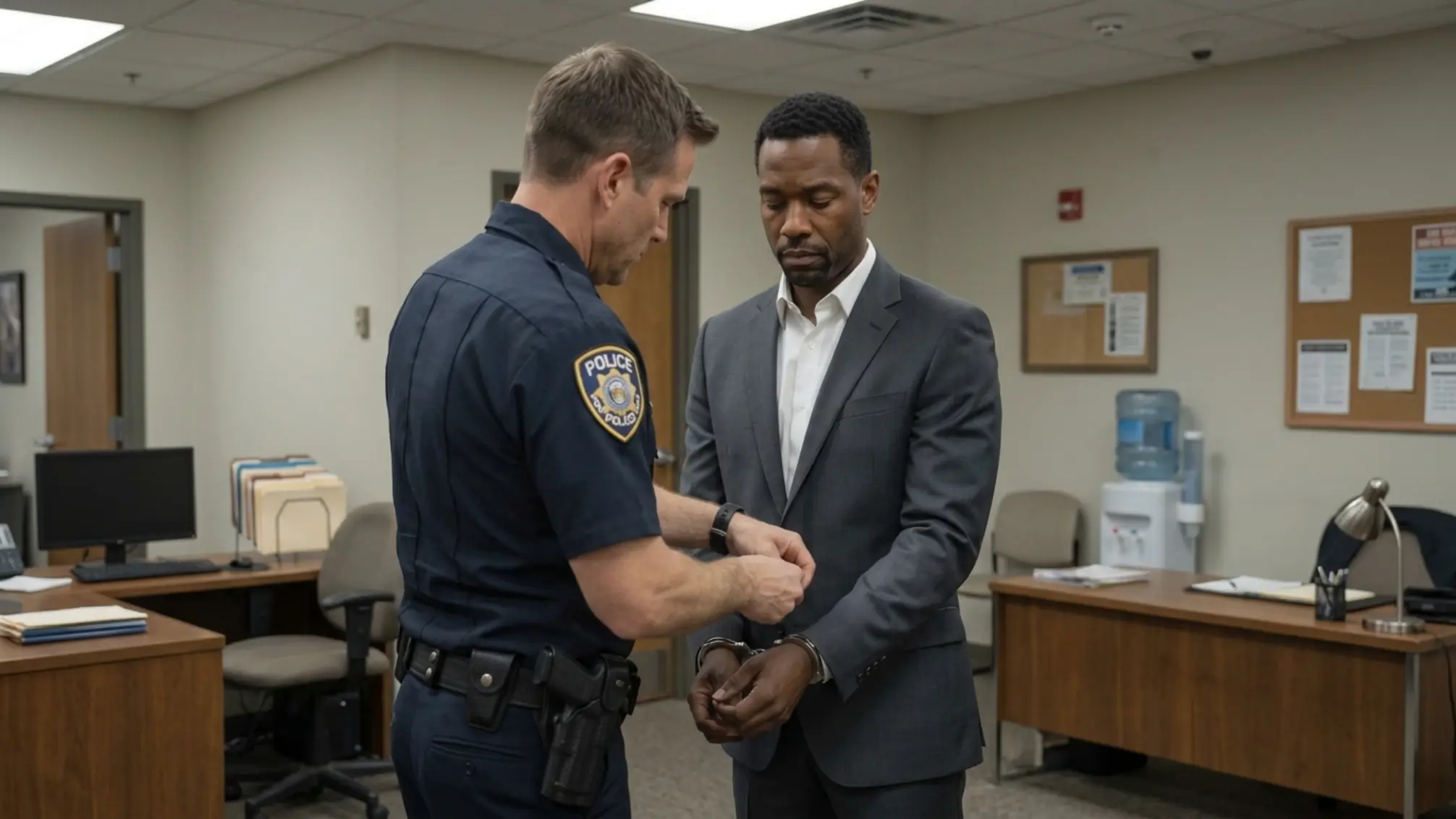
“Your fake badge won’t save you in my station,” Reed said.
Marcus looked down as the second cuff closed. “Keep tightening. You’re making this expensive.”
Reed grabbed his forearm and leaned closer, his square jaw clenched. “One more word, and I’ll drag you into booking.”
Marcus stepped toward him instead of retreating. “Good—and don’t unlock them when the district attorney walks in.”
The officers working at nearby desks stopped typing.
A police radio continued murmuring from somewhere near the records counter, but no one reached for it. Two civilian employees stared over their computer screens. A young Latino American patrol officer named Daniel Ruiz stood near the copy machine with a file in his hands, his expression tightening as he watched Reed pull the restrained man away from the desk.
Marcus had entered through the public lobby at 8:47 that morning. He presented his identification to the receptionist and explained that he had a confidential appointment with District Attorney Lena Harper and Police Chief Harlan Voss. The receptionist called upstairs, received confirmation, and issued him a temporary visitor badge.
He should have been escorted to the third-floor conference room.
Instead, the receptionist asked him to wait inside the administrative office because the elevator had temporarily stopped working. Marcus entered through a secured door opened by an employee, then stood quietly beside an empty desk while reviewing a message on his phone.
That was when Reed noticed him.
The forty-five-year-old white American officer had just returned from patrol and immediately demanded to know why Marcus was inside a restricted area. Marcus calmly explained the scheduled meeting and displayed the visitor badge clipped to his jacket.
Reed removed it and declared it invalid.
Marcus then produced his federal credentials.
Reed called them fake.
“You walked into a police office carrying a weapon and pretending to be federal law enforcement,” Reed said as he pulled Marcus toward the center of the room. “You should be grateful I haven’t put you on the floor.”
“My service weapon is holstered, concealed, and registered to the United States government.”
“You expect me to believe that?”
“The identification on the desk gives you a number to verify.”
“I don’t need instructions from you.”
“That seems to be the problem.”
Reed shoved him against a filing cabinet.
Metal drawers rattled beneath the impact. Marcus kept his hands still behind his back and turned his face toward the black security camera positioned above the records-room door. A small green light indicated that it was active.
“I do not consent to this detention, search, or seizure,” Marcus said clearly. “I am not resisting.”
Reed tightened his grip. “You don’t decide whether you’re resisting.”
Several officers exchanged uncomfortable looks.
Ruiz placed the file on a desk. “Reed, maybe we should run the badge.”
Reed turned sharply. “Maybe you should mind your assignment.”
“It’ll take thirty seconds.”
“I said it’s fake.”
Marcus looked at Ruiz. “Officer, please preserve the credentials exactly where they are.”
Reed pulled Marcus away from the filing cabinet. “Stop giving orders in my station.”
Marcus’s expression remained controlled. “This is not your station.”
Reed’s face flushed.
He yanked Marcus’s suit jacket open and found the holstered handgun at his waist. Reed’s hand flew to his own weapon while he shouted for everyone to move back.
“Gun!”
Marcus did not move.
“You already knew I was armed,” he said. “I told you before you searched me.”
Reed removed the holster and placed it beside the FBI badge. He then took Marcus’s phone, wallet, and the sealed folder Marcus had carried into the building.
Marcus’s voice hardened. “Do not open that folder.”
Reed smirked. “Now I definitely will.”
“It contains sealed federal investigative material.”
“You’re in no position to threaten me.”
“That was not a threat. It was your final warning.”
Reed broke the seal.
Inside were copies of internal police complaints, dispatch records, and federal subpoenas prepared for service that morning. The first page displayed the name Officer Travis Reed in bold type.
Reed stopped breathing for a moment.
Marcus watched him read.
The officer quickly closed the folder and tossed it onto the desk. “Anybody could print this.”
“Then verify my badge.”
Reed reached toward the handcuff keys clipped to his belt.
Marcus stepped away.
“Don’t unlock them.”
Reed stared at him. “You’re refusing release?”
“I am refusing to let you erase the physical evidence before my scheduled meeting begins.”
“You think these cuffs are evidence?”
“The marks on my wrists will be. So will the credentials you ignored, the sealed file you opened, and the recording of every warning you received.”
Reed looked toward the nearest camera.
Its green light was still on.
Captain Samuel Brooks emerged from his office at the far end of the room. The fifty-three-year-old Black American supervisor wore a white command shirt beneath a dark jacket and carried a cup of coffee in one hand. He took in the scene—the restrained man, the open FBI badge, Reed standing beside the unsealed folder—and placed the cup down without drinking.
“What happened?”
Reed answered immediately. “Armed impersonator entered the secure office.”
Captain Brooks looked at the gold badge. “Did you verify it?”
“He became combative.”
Marcus remained silent.
Brooks turned to Ruiz. “Did you see the beginning?”
“Yes, Captain.”
“What happened?”
Ruiz glanced at Reed, then at Marcus.
Reed’s voice became threatening. “Be careful.”
Captain Brooks moved between them. “Officer Reed, do not tell another officer how to answer me.”
Ruiz swallowed. “The man showed a visitor badge. Reed removed it. Then he showed federal identification. Reed said it was fake and cuffed him before running anything.”
“Did he resist?”
“No.”
“Did he threaten anyone?”
“No.”
Reed stepped forward. “He said this would be expensive.”
“After you cuffed him?” Brooks asked.
“Yes, but—”
“Then that was an observation, not a threat.”
The administrative-office door opened behind them.
District Attorney Lena Harper entered wearing a navy business suit beneath a pale gray coat. The forty-seven-year-old Black American attorney carried a structured leather briefcase and walked with the brisk focus of someone already late for a meeting.
She saw Marcus in handcuffs.
Her expression went completely still.
Then she saw Reed.
“What have you done?”
Reed squared his shoulders. “Ma’am, stay behind the desk.”
Lena stopped. “Do you know who I am?”
“I don’t care who you claim to be.”
Captain Brooks closed his eyes briefly.
Lena removed her official identification and held it up. “I am District Attorney Lena Harper, and the man you have restrained is Assistant Special Agent in Charge Marcus Hail of the FBI Civil Rights Division.”
Reed looked at the credential, then back toward Marcus’s badge.
The color faded from his face.
He reached for the handcuff keys again.
Marcus’s voice stopped him.
“Leave them.”
Lena studied Marcus. “You want them to remain?”
“Until the chief arrives and the station’s recording systems are formally preserved.”
Captain Brooks nodded. “I’ll secure the cameras.”
Reed stepped toward him. “Captain, we can handle this internally.”
“No,” Marcus said.
Reed turned. “Nobody asked you.”
Marcus lifted his restrained hands slightly. “You arrested me, seized my federal weapon, opened sealed investigative material, and accused me of impersonation. You are going to document each action exactly as you intended before you learned my title.”
“This was a misunderstanding.”
“You understood enough to threaten Officer Ruiz when he suggested verification.”
Lena placed her briefcase on the desk. “Captain Brooks, no one is to access, alter, pause, or export any footage until an independent image is made.”
“Understood.”
“Lock the evidence network.”
A civilian technology employee rose from her desk. “The chief has administrative override access.”
“Then disable remote access and document the change.”
Reed looked around the office. “You can’t shut down a department because of one arrest.”
Marcus’s expression remained calm. “This department was already under investigation before you saw me.”
The silence returned.
Reed glanced at the folder he had opened.
Lena followed his eyes.
“You opened that?”
“He claimed it contained federal records.”
“So you broke the seal?”
“I was searching for identification.”
“The identification was lying beside your hand.”
Captain Brooks walked to the desk and examined the front page without touching it. He recognized several complaint numbers.
His expression changed.
“I submitted two of these reports to internal affairs,” he said.
Marcus looked at him. “Both were closed as unsupported.”
“I was told witnesses withdrew.”
“They did not.”
Reed backed away from the desk. “This is ridiculous. I’ve worked here nineteen years.”
Lena faced him. “Then you had nineteen years to learn that verified credentials can be confirmed before someone is handcuffed.”
Police Chief Harlan Voss hurried through the door moments later. The sixty-one-year-old white American chief had silver hair, a broad frame, and a department phone clenched in one hand.
He stopped when he saw Marcus.
“Agent Hail.”
“Chief.”
Voss looked toward Reed. “Take those cuffs off him immediately.”
Marcus moved back before Reed could approach.
“No.”
The chief frowned. “Agent, I understand you are angry.”
“This is not about anger.”
“We’ll suspend Officer Reed while we investigate.”
“You’ve investigated him before.”
Voss’s expression tightened. “I’m not discussing personnel matters in an open office.”
Marcus looked around at the officers and employees who had witnessed the encounter.
“Officer Reed did not seem concerned about privacy while inventing charges against me.”
Chief Voss lowered his voice. “What do you want?”
“I want you to follow the same process this department would use if I were an ordinary civilian without federal authority.”
The chief hesitated.
Marcus continued. “Would Officer Reed have taken that civilian to booking?”
Voss did not answer.
“Would the alleged firearm have been logged?”
“Yes.”
“Would the arrest report have been entered?”
“Yes.”
“Then proceed.”
Reed looked startled. “You want to be booked?”
“I want your claimed probable cause placed in a permanent system where it cannot become an informal misunderstanding after powerful people arrive.”
Lena opened her briefcase and removed a sealed court order.
“Before anyone proceeds, Chief Voss, you are being served with an evidence-preservation mandate covering Officer Reed’s personnel records, body-camera files, dispatch history, complaint files, disciplinary reviews, internal messages, and supervisory communications.”
The chief accepted the papers slowly.
“You planned to serve this today?”
“Yes.”
Marcus looked at Reed. “He simply decided to become the first exhibit.”
Three black government vehicles entered the department parking area. Through the office windows, agents in dark jackets crossed toward the main entrance.
Reed stared outside.
“You brought an entire team for me?”
Marcus shook his head. “We brought a team for your department.”
Special Agent Diane Porter entered first. The fifty-one-year-old white American woman wore a dark suit and carried a federal evidence case. Four additional agents followed, each presenting identification to Captain Brooks before entering the secured area.
Diane looked at Marcus’s wrists.
“Do you want those removed?”
“After photographs and measurements.”
A federal evidence technician documented the cuffs, their serial number, their tightness, and the red pressure marks around Marcus’s skin. Only then did Diane unlock them.
Marcus rotated his wrists once.
He did not look at Reed.
The officer’s confidence had been replaced by a restless panic. “I want my union representative.”
“You are entitled to one,” Lena said.
“I’m not answering questions.”
“No one asked you one.”
Chief Voss ordered Reed to surrender his weapon, badge, department phone, access card, and body camera. Reed complied while cameras continued recording.
Captain Brooks collected the items.
When Reed handed over the body camera, Brooks inspected its status.
“It’s off.”
Reed looked down. “Battery died.”
Ruiz spoke from behind him. “It was fully charged at roll call.”
Reed turned. “You need to shut your mouth.”
Captain Brooks stepped directly between them. “That is your second attempt to intimidate a witness in front of me.”
“I’m not intimidating anyone.”
“You just threatened an officer after your body camera became unavailable during a disputed arrest.”
Chief Voss rubbed his forehead. “Enough.”
Marcus looked at him. “No, Chief. ‘Enough’ is what departments say when the evidence finally becomes uncomfortable.”
The investigation began before noon.
Federal agents imaged the station servers, copied security footage, and secured records associated with seven prior complaints against Reed. The footage from the administrative office showed the entire encounter clearly.
Marcus had entered lawfully.
He had presented a visitor badge.
Reed removed it without checking the authorization log.
Marcus displayed federal credentials.
Reed refused to verify them.
Marcus never raised his hands, stepped toward the officer, or resisted any command. Reed grabbed him, cuffed him, searched him, seized his weapon, and broke the seal on protected records.
The recording also captured Reed’s statement to Ruiz:
Be careful.
Investigators compared the wording with earlier internal complaints.
A twenty-four-year-old Black American delivery driver reported Reed used the same phrase after another officer questioned an unlawful vehicle search. A Latino American landscaper said Reed warned his coworker to “be careful” before they changed their witness statements.
A white American bartender reported that Reed pressured her to claim an arrested customer had thrown the first punch. When she refused, alcohol inspectors visited her workplace three times in one month.
The pattern was not hidden.
It had simply been ignored.
Reed’s department phone contained a group chat involving five officers and one lieutenant. Messages referred to motorists as targets, mocked civilians who filed complaints, and discussed switching off body cameras before encounters became “complicated.”
In one exchange, an officer asked how to justify a search when no dispatch call existed.
Reed replied:
Write suspicious behavior. People believe it when the right uniform says it first.
Another message concerned Captain Brooks.
Brooks keeps asking questions. Keep him outside the loop until the chief moves him.
Marcus reviewed the messages in a temporary office established across the hall.
Captain Brooks stood beside him.
“I knew there were problems,” Brooks said. “I did not know this much.”
“You submitted reports.”
“I also accepted the closures.”
“Why?”
“The chief said internal affairs found nothing.”
Marcus looked at him. “Did you read the findings?”
“No.”
“Then you accepted an answer instead of evidence.”
Brooks lowered his eyes. “Yes.”
Marcus did not soften the truth.
Good people inside broken institutions often believed their personal decency was enough. It was not. Silence, hesitation, and trust without verification allowed aggressive officers to turn misconduct into routine.
Brooks looked toward the office where Reed waited with a representative.
“I should have pushed harder.”
“Yes.”
“Will cooperating matter?”
“It will matter to the next person he might have handcuffed.”
That afternoon, Lena ordered an emergency review of prosecutions involving Reed. Her office found thirty-two cases in which body-camera footage began only after physical detention. Seventeen reports cited anonymous suspicious-person calls that dispatch could not verify.
Nine defendants had accepted plea deals.
Four remained in jail.
One was twenty-year-old Jamal Carter, a Black American college student arrested after Reed claimed he saw him reaching into a parked vehicle. Jamal had been retrieving medication from his mother’s car. Reed charged him with attempted theft and resisting arrest after Jamal questioned why he was being detained.
A store camera showed Reed arriving after Jamal had already opened the car with a key.
The footage had been provided to police.
It never reached the prosecutor.
Jamal’s charges were dismissed the following morning. The other cases entered immediate review.
Reed was placed on unpaid suspension.
Chief Voss held a press conference describing the situation as a disturbing failure by one officer. Reporters immediately asked why seven previous complaints had not led to discipline.
The chief claimed he could not discuss active personnel matters.
Lena stood beside him but did not protect the department.
“This investigation concerns more than one officer,” she said. “Records suggest supervisory and prosecutorial failures allowed warning signs to be minimized or concealed.”
Voss looked toward her sharply.
She continued.
“The public deserves facts, not institutional comfort.”
Within three weeks, Chief Voss resigned.
Investigators discovered that he had approved a policy allowing supervisors to classify complaints as informal service concerns instead of misconduct allegations. That classification kept them outside the state reporting system and prevented independent review.
Lieutenant Mark Dalton, Reed’s direct supervisor, had closed five complaints without interviewing witnesses.
He was terminated.
Two officers who participated in the group chat resigned before disciplinary hearings. Another agreed to cooperate and identified fourteen encounters where reports had been altered after the fact.
Officer Daniel Ruiz became a central witness.
He admitted that Reed had taught younger officers to establish authority before explaining legal grounds for a detention.
“He said if people started asking questions, we had already lost control,” Ruiz testified.
Marcus asked, “What should officers control?”
“The scene.”
“What about themselves?”
Ruiz looked down. “That wasn’t how he taught it.”
The city created an independent review panel with authority to access body-camera footage, dispatch records, and internal complaints without police approval. Cameras activated automatically when officers entered secured civilian areas or removed weapons from their holsters.
Officers could no longer personally investigate complaints naming them.
Every anonymous public report required a verifiable timestamp created before enforcement began.
Lena established a conviction-integrity unit inside the district attorney’s office. It reopened forty-eight cases and dismissed thirteen during the first six months.
Reed’s disciplinary hearing took place in the city council chamber.
He wore a dark suit and sat beside his attorney while the administrative-office footage played on a large screen.
The room watched him reject the visitor badge, ignore the FBI credentials, tighten the cuffs, seize the firearm, open the sealed folder, and threaten Ruiz.
His attorney described the encounter as a confusing security incident.
Marcus testified last.
“You could have revealed your position more forcefully,” the attorney said.
“I presented federal identification.”
“You could have demanded a supervisor.”
“I asked him to verify the badge.”
“You challenged his authority.”
“I described the law.”
The attorney leaned closer. “Why did you refuse to let him remove the cuffs after District Attorney Harper arrived?”
Marcus looked toward Reed.
“Because his respect appeared only after he learned I had power over him.”
“That does not answer the question.”
“It answers the entire case.”
Marcus turned toward the disciplinary board.
“Officer Reed did not believe the detention became unlawful because new evidence appeared. My credentials were visible from the beginning. He wanted to remove the cuffs because someone important recognized me.”
The room remained silent.
“If I had been an ordinary Black American visitor waiting for a meeting, no district attorney would have entered. No federal vehicles would have arrived. His report would have become the official story, and my objections would have been described as resistance.”
Reed shifted in his chair.
Marcus continued.
“I kept the cuffs on because the department needed to decide whether it truly believed his accusation. The moment officials saw the evidence might embarrass them, they attempted to end the encounter without recording what he had done.”
The board voted unanimously to terminate Reed.
The state later revoked his law-enforcement certification. Federal prosecutors charged him with deprivation of rights, falsification of records, and obstruction related to previous cases.
Months afterward, Marcus returned to the Oak Haven station.
The administrative office had been redesigned. Visitors waited in a clearly marked seating area, identity checks followed written procedures, and security-camera feeds were stored outside local control.
Captain Brooks had become interim chief after agreeing to public oversight and independent audits. He met Marcus beside the desk where the handcuffs first closed.
A new officer approached carrying a sealed folder.
“Agent Hail, may I verify your identification before escorting you upstairs?”
Marcus handed over his credentials.
The officer checked the number, returned the wallet, and stepped aside.
No panic.
No flattery.
No sudden apology after recognizing his rank.
Just procedure applied correctly.
Brooks looked at Marcus. “That is what should have happened the first morning.”
“Yes.”
“You could have stopped it sooner by saying who you were louder.”
Marcus looked toward the camera above the records-room door.
“I said enough.”
Reed had seen a quiet Black American man inside a police office and assumed calmness meant submission. He believed a uniform allowed him to decide which evidence counted, which identity was real, and which person deserved dignity.
He tightened the cuffs because he thought the story would belong to him.
Marcus refused the keys because he understood something Reed did not.
Once the restraints came off, the department would call it confusion.
With the restraints still visible, the truth could not be made comfortable.
The cuffs were eventually placed inside the federal case archive, sealed beside Reed’s false incident report and photographs of Marcus’s wrists.
They represented more than one officer’s downfall.
They marked the moment an entire police department was forced to confront how easily authority could become abuse when everyone inside the room waited for someone more powerful to object.