“A million-dollar Lamborghini? Don’t insult me—someone like you didn’t buy this.” Officer Grant Keller raised the metal baton beside the black Lamborghini as pedestrians slowed along the downtown Washington sidewalk. Standing only a few feet away, forty-year-old Maya Sterling did not flinch; dressed in a burgundy double-breasted blazer, crisp white blouse, charcoal wide-leg trousers, black heels, and a gold watch, she looked more irritated than frightened. “Swing that baton one more time and make sure your body camera catches it,” she said. Keller struck the driver-side window hard enough to spiderweb the glass.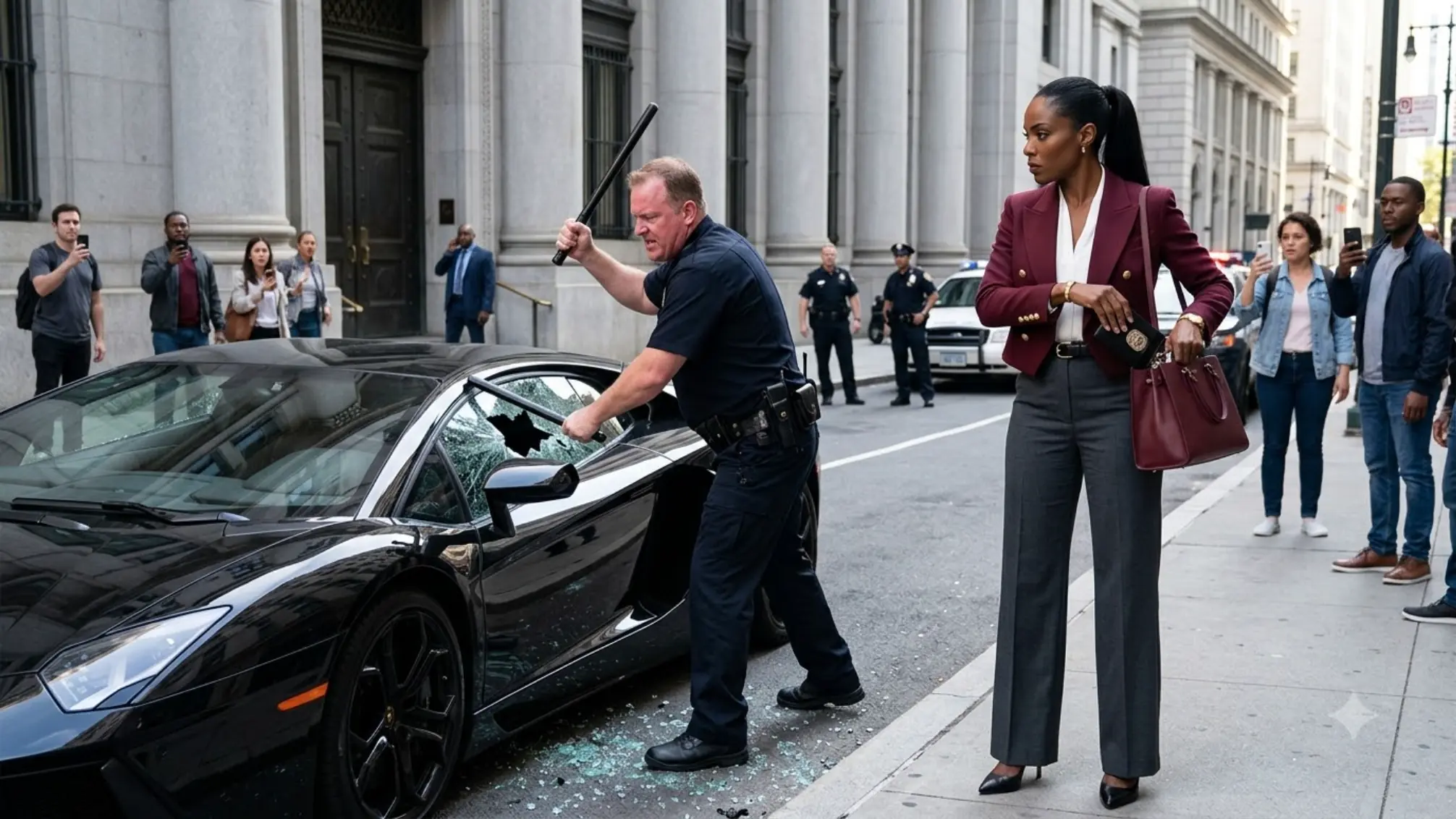
“Keep talking and I’ll cuff you beside the wreck you stole.” Keller struck the window again, sending fragments across the cream leather seat while two younger officers watched from beside their cruisers. Maya slowly opened her structured burgundy handbag and removed a black credential wallet. “Good,” she said, holding his stare as she opened it. “Now explain to the FBI Director why you just destroyed her car.”
Keller’s baton stopped halfway toward the glass. For a moment, his entire expression seemed disconnected from what his eyes were reading, as though his brain refused to accept the words printed beside Maya’s photograph. The credential identified her as Maya Sterling, Director, Federal Bureau of Investigation, accompanied by security markings Keller had only ever seen during interagency briefings. Officer Caleb Monroe, standing nearest him, took one look and whispered, “Grant, put the baton down.”
Keller did not. That hesitation would later become one of the most replayed moments from three different body cameras, because it captured precisely when a questionable stop stopped being a mistake and became something harder to explain. He looked at Maya, then at the Lamborghini, then back at the credentials. “These could be fake.”
Maya’s face remained still. “Then verify them.” She had spent more than two decades interviewing people who lied for a living, and she recognized the reflex immediately: once Keller’s original assumption began collapsing, he searched for another explanation rather than admitting he had been wrong. “Until then,” she added, “step away from my vehicle.”
Keller pointed his baton toward her. “You don’t give orders here.” Maya looked at the shattered window. “Apparently neither does evidence.” Monroe turned his face away, but the corner of his mouth moved before he stopped himself.
The confrontation had started fourteen minutes earlier. Maya had been driving from FBI headquarters to a restricted interagency briefing inside the Halpern Federal Center when a marked city cruiser pulled behind her at an intersection. Her Lamborghini was impossible to overlook, a black limited-production model she had purchased with private family investment income long before accepting the bureau’s top position. She rarely drove it to work precisely because the car attracted attention, but her regular security vehicle was being serviced and Maya had needed to reach the meeting without delaying an entire room of federal officials.
She noticed Keller’s cruiser remain behind her through three turns. When she parked legally in a reserved federal visitor space outside the building, Keller angled his cruiser across the Lamborghini’s rear bumper and activated his lights. Maya sat still for several seconds, assuming he intended to speak with someone else, until Keller approached the driver-side window with one hand already resting near his duty belt. “Turn the engine off.”
Maya complied. “Officer, is there a problem?” Keller looked over the interior, then at her tailored clothes, handbag, and identification lanyard turned backward against her blouse. “License and registration.”
She handed both through the partially lowered window. The registration showed the Lamborghini belonged to Maya Sterling at an Arlington address, matching her driver’s license. Keller studied the papers longer than necessary. “Whose car is this really?”
Maya looked at him. “Mine.” Keller laughed once. “Try again.”
“My name is on the registration you’re holding.”
“Plenty of ways to fake paperwork.”
Maya’s expression tightened. “Did the plate come back stolen?” Keller ignored the question and asked where she was going. “Inside that building.”
“For what?”
“A meeting.”
“What kind?”
“Not your concern.”
Keller’s suspicion appeared to harden at the refusal. “Expensive car, restricted building, vague answers.” Maya leaned slightly closer to the open window. “You stopped a legally parked vehicle after following me for three blocks. Tell me the suspected violation.”
Keller ordered her out. Maya complied because she had no interest in turning a bad stop into a dangerous one. As soon as she stood beside the Lamborghini, several pedestrians recognized that something unusual was happening and began slowing near the curb. Keller told her to place her hands on the roof.
Maya did not move. “Am I detained?” Keller replied that she was being investigated for possible vehicle theft. “Based on what?”
He pointed toward the Lamborghini. “This doesn’t add up.”
“What doesn’t?”
Keller looked directly at her. “You.”
The word hung between them.
Maya understood exactly what he meant, but she forced him to say more. “Explain.”
Keller stepped closer. “You expect me to believe you walked into a dealership and bought a million-dollar Lamborghini?”
“Yes.”
“With what?”
“My money.”
He scoffed. “What do you do, exactly?”
Maya could have ended the encounter immediately. One credential, one phone call, or one glance at the access authorization associated with her federal profile would have transformed Keller’s behavior. But she had already heard enough to wonder what happened to people who could not produce an impressive title.
Instead, she said, “My occupation is not relevant to vehicle ownership.”
Keller’s face reddened. “I decide what’s relevant.”
“No. Facts do.”
Officer Monroe arrived with Officer Rachel Diaz less than two minutes later. Keller told them he believed the vehicle might be stolen and claimed Maya was “evasive about ownership,” even though the registration matched her license. Diaz asked whether dispatch had reported the plate stolen.
“No.”
“VIN issue?”
“Not yet.”
“Altered registration?”
“Could be.”
Maya folded her arms. “Could be is doing a lot of work in this investigation.” Keller turned sharply. “You want to keep pushing me?”
“I want you to identify the basis for detaining me.”
“You’re standing beside a million-dollar car acting like you own the street.”
“I’m standing beside my car.”
Keller walked toward the driver’s door. “Open it.”
Maya shook her head. “No.”
He turned.
“No?”
“You do not have my consent to search the vehicle.”
Keller smiled coldly. “Nobody said anything about searching.”
“Then why do you need it open?”
He stepped closer.
“Because I told you.”
Maya did not move.
That refusal changed his demeanor almost instantly. Keller told Monroe to keep Maya near the curb while he examined the exterior of the vehicle. He walked around it slowly, peering through windows, checking the license plate, and eventually shining a flashlight through the glass despite broad daylight. Nothing appeared suspicious.
The car was immaculate.
Registration valid.
Plate valid.
Driver identified.
Still Keller continued.
Maya asked Monroe quietly, “Does this look normal to you?” The younger officer glanced toward Keller. “He’s conducting his investigation.”
“That wasn’t what I asked.”
Monroe stayed silent.
Diaz did not. “Grant, maybe we should just verify the VIN.”
Keller opened the handheld terminal and ran it. The result came back clean.
Maya saw the screen.
“So we’re done.”
Keller stared at the result.
Then he said, “Not yet.”
That was the moment Maya realized the encounter was no longer connected to anything objective. Keller had started with a conclusion and was now working backward to preserve it. She turned slightly toward her car.
“Officer, unless you can articulate a lawful reason to continue, I am leaving.”
Keller grabbed the door handle.
Maya immediately said, “Do not enter my vehicle.”
He pulled the door open.
“I said do not.”
Keller leaned inside.
Diaz stepped forward. “Grant.”
He ignored her.
“What exactly are you searching for?” Maya asked.
“Proof.”
“Of what?”
He did not answer.
The alarm system began chirping as Keller pulled at the locked center console. When it refused to open, he grew frustrated and returned outside. He looked at the tinted rear window.
Then he reached for the baton.
Monroe’s posture changed.
“What are you doing?”
Keller answered, “Emergency access.”
Maya stared at him.
“There is no emergency.”
“Possible stolen vehicle.”
“Your own terminal just cleared the VIN.”
Keller lifted the baton.
That led to the words that would eventually become evidence.
“A million-dollar Lamborghini? Don’t insult me—someone like you didn’t buy this.”
Maya’s anger became visible for the first time. “Swing that baton one more time and make sure your body camera catches it.”
He did.
The glass cracked.
People on the sidewalk gasped.
Several phones went up.
Keller hit it again.
The window broke.
Maya opened her credential wallet.
And everything changed.
Now, with the FBI identification visible between them, Officer Diaz immediately stepped backward and reached for her radio. Monroe looked like he wanted to disappear into the pavement. Keller remained frozen beside the broken car.
Maya pointed toward his body camera. “Is that recording?”
“Yes.”
“Good.”
She looked toward Monroe and Diaz. “Yours?”
Both nodded.
Maya placed her credential wallet back into her bag. “Nobody shuts anything off.”
Keller finally lowered the baton. “Director Sterling, I didn’t know.”
“That is irrelevant.”
“I thought—”
“I know exactly what you thought.”
He looked toward the shattered window. “I can explain.”
“You’re going to.”
Sirens approached less than three minutes later, but not because Maya had summoned anyone. Diaz’s verification request had automatically triggered a federal security notification when the system matched Maya’s protected executive credentials. Two unmarked SUVs arrived from the Halpern Federal Center, followed by an FBI protective detail that had been waiting inside for Maya.
Special Agent Marcus Reed stepped from the first SUV and stopped when he saw the Lamborghini. “Director?”
Maya raised one hand. “Nobody touches Officer Keller.”
Reed looked surprised.
“He assaulted your vehicle.”
“I saw.”
“You want him detained?”
“No.”
Keller looked relieved too quickly.
Maya continued. “I want every camera preserved, every dispatch record locked, the parking-lot security feeds secured, and an outside agency handling whatever comes next.”
The relief vanished.
Reed nodded.
Maya turned toward Keller. “Hand your baton to your supervisor when one arrives.”
He bristled. “I’m not under arrest.”
“I didn’t say you were.”
“Then you can’t seize my equipment.”
Maya looked toward his cruiser. “You destroyed private property during a documented stop after receiving multiple records confirming ownership.”
Then she paused.
“I suspect your own department will want the baton more than I do.”
Lieutenant Harold Greene arrived six minutes later. He approached Maya with the unmistakable expression of a supervisor who knew the situation was disastrous but had not yet determined the full scale. “Director Sterling, I apologize.”
Maya immediately shook her head.
“No.”
Greene stopped.
“Don’t apologize because you know who I am.”
The lieutenant glanced toward the broken Lamborghini.
“What would you prefer?”
“Ask him why he broke the window.”
Greene turned toward Keller.
The officer began explaining that he suspected vehicle theft.
Greene asked about the plate.
“Clean.”
Registration?
“Clean.”
VIN?
“Clean.”
Driver’s license?
“Matched.”
“Then what evidence suggested theft?”
Keller hesitated.
Maya watched.
Finally he answered, “Behavior.”
Greene’s face tightened.
“What behavior?”
“She was confrontational.”
Maya spoke. “I refused consent.”
Keller looked at her.
Greene slowly turned back toward him. “That’s the behavior?”
“No. It was everything.”
“What everything?”
Again, silence.
Diaz stepped forward.
“He said the car didn’t look like it belonged to her.”
Keller spun toward her.
“I did not say that.”
Her face hardened. “Your camera heard it.”
That ended the argument.
Greene immediately relieved Keller of active street duty pending review. He collected the baton himself and told Monroe and Diaz to return to headquarters separately so their statements could be taken without discussion. Maya appreciated the decision because she had spent much of her career investigating cases damaged by witnesses unconsciously aligning their accounts.
She still refused to direct the investigation.
When Reed asked whether FBI internal security should assume control, Maya shook her head.
“I’m the complainant.”
“But this involves a federal official.”
“It involves a citizen whose car was destroyed.”
Reed understood.
Maya looked toward the glass scattered across the seat.
“And I want to know whether he’s done it before.”
That question widened everything.
The city’s Professional Standards Division began reviewing Keller’s history that afternoon. Maya attended her classified meeting forty-two minutes late, wearing the same burgundy blazer with tiny fragments of window glass caught along one sleeve. She apologized once to the room.
Nobody asked why.
By evening, Keller’s body-camera footage had been secured. Investigators watched the entire encounter from the moment he first approached Maya’s car. The problem was obvious almost immediately.
He had no stolen-vehicle alert.
No plate discrepancy.
No damaged ignition.
No contradictory registration.
No witness claiming theft.
Instead, investigators heard questions about how Maya could afford the Lamborghini.
They heard him challenge the ownership documents after dispatch confirmed them.
Then they heard the sentence:
Someone like you didn’t buy this.
Professional Standards investigator Jennifer Hall paused the footage.
“Play it again.”
They did.
The line was worse the second time.
The search of Keller’s previous stops began the following morning. Investigators identified seventeen complaints alleging disrespectful or unequal treatment during vehicle stops. Six involved expensive vehicles driven by Black motorists.
One man drove a Porsche.
Another owned a Mercedes AMG.
A third, Dr. Julian Price, drove an Aston Martin.
Each told a remarkably similar story.
Keller wanted extensive proof of ownership after normal vehicle databases confirmed everything.
Several had been asked what they did for work.
One had been questioned about where he “really got the money.”
Another complained that Keller threatened to impound his vehicle until a supervisor arrived.
Most cases ended without citations.
Most complaints had been closed.
Maya read none of those files until investigators formally released findings months later. She deliberately kept herself away from the process because her position could contaminate even legitimate accountability. But the people reviewing Keller did not stop at individual stops.
They examined supervisors.
Lieutenant Greene had not approved the old complaint closures.
Sergeant Robert Ames had.
Nine complaints involving Keller passed through Ames’s desk in three years.
Seven were cleared without full body-camera review.
The reason appeared repeatedly in handwritten notes.
Experienced officer. Credible explanation.
Investigator Hall underlined those words.
Experience had become immunity.
Keller had learned that if his written report sounded confident enough, nobody would compare it closely to video.
The Lamborghini incident destroyed that assumption because too many cameras captured the contradiction simultaneously.
Maya eventually received an estimate for the vehicle damage.
The specially treated window, interior trim, scratched paint, and damaged electronics pushed repairs beyond $48,000.
The Lamborghini itself was insured.
The larger damage was institutional.
Weeks later, Maya agreed to one interview with investigators. Hall asked the question everyone expected.
“Why didn’t you identify yourself immediately?”
Maya answered, “Because I had valid registration.”
Hall waited.
“That should have been enough?”
“Yes.”
“You realized your title could end the encounter.”
“Yes.”
“Why not use it?”
Maya folded her hands.
“Because I wanted to see what happened after he thought I had no special authority.”
Hall nodded slowly.
“And what did happen?”
“He broke my window.”
Keller’s disciplinary hearing took place four months later. He argued through counsel that he had made an aggressive but good-faith investigative decision based on suspicion. His attorney emphasized that policing involved uncertain situations.
Professional Standards agreed.
Then investigators showed that uncertainty had ended long before the baton appeared.
Registration removed one uncertainty.
VIN verification removed another.
Identity confirmation removed another.
Lack of stolen-vehicle reports removed another.
Every objective fact pointed in the same direction.
Yet Keller escalated.
The hearing panel concluded that his actions were unsupported by lawful investigative necessity and that his reports included statements inconsistent with recordings. His repeated pattern of appearance-based assumptions made the case significantly worse.
Keller was terminated.
Sergeant Ames lost his supervisory position after investigators concluded his repeated failure to review complaints allowed warning signs to disappear.
The department reopened twelve previous complaints.
Several motorists received written findings acknowledging improper treatment.
Two filed civil lawsuits.
One case resulted in compensation.
Maya filed no personal lawsuit.
Instead, her insurer pursued vehicle damages through standard channels.
Reporters found that strange.
One asked whether she wanted Keller financially punished.
Maya answered, “Accountability is not revenge.”
Another reporter asked whether she had forgiven him.
“That is a different question.”
The reporter waited.
Maya added, “My job is not to make him suffer. The system’s job is to determine whether he should still have authority.”
That sentence traveled widely.
Six months after the incident, Maya returned to the same street.
Her Lamborghini had been repaired perfectly.
The glass was new.
Paint immaculate.
No visible trace of Keller’s baton remained.
She parked in nearly the same space outside the Halpern Federal Center.
A patrol cruiser drove past.
The officer inside glanced at the Lamborghini, then continued.
Maya smiled faintly.
That was all she had ever wanted.
Not fear.
Not recognition.
Normality.
Agent Reed met her at the building entrance.
“You actually drove it again.”
“I paid for it.”
“I figured after last time…”
Maya raised an eyebrow.
“You think I’m letting one officer choose what I drive?”
Reed laughed.
“No, ma’am.”
They entered the building.
Before the elevator doors closed, Maya looked through the glass toward the Lamborghini.
The story had become famous because of its twist.
Police destroyed a Black woman’s million-dollar car.
Then discovered she was the FBI Director.
People loved the reversal.
Maya hated it.
Because the story sounded as though Keller’s mistake had been choosing the wrong Black woman.
As though destroying an ordinary person’s property would have been less serious.
As though the badge hidden inside Maya’s handbag transformed disrespect into misconduct.
It did not.
The badge only transformed Keller’s confidence into fear.
That difference became central to Maya’s next leadership address.
She stood before hundreds of federal investigators and spoke without referencing Keller by name.
“Authority reveals character most clearly when you believe nobody powerful is watching.”
The room became silent.
“When a senator stands in front of you, procedure matters.”
She paused.
“When a janitor stands in front of you, procedure matters exactly the same amount.”
Nobody moved.
“Your integrity is not measured by how carefully you treat people who can damage your career.”
Maya looked across the room.
“It is measured by how carefully you treat the people you believe cannot.”
Years later, the burgundy handbag remained inside Maya’s closet.
The federal credential case she carried that day developed a faint scratch where it struck the metal clasp as she pulled it free.
She never replaced it.
Occasionally someone asked why the FBI Director still kept an old scratched credential wallet.
Maya always gave the same answer.
“It reminds me that I shouldn’t have needed it.”
That was the truth.
Her registration should have been enough.
The clean VIN should have been enough.
The absence of any stolen-vehicle report should have been enough.
Her refusal to consent should have ended the search unless lawful grounds existed.
Every fact should have mattered before anyone read her title.
Keller had looked at the Lamborghini and then at Maya and decided those two things did not belong together.
From that assumption came everything else.
The questions.
The search.
The accusations.
The baton.
The shattered glass.
But the moment he opened Maya’s credentials, his expression changed because suddenly the woman in front of him possessed power he recognized.
Maya never forgot that face.
Not because it gave her satisfaction.
Because it revealed the entire problem.
He had respected consequences before he respected evidence.
And by the time he understood the difference, a million-dollar Lamborghini was sitting beside him with a shattered window, three body cameras were recording, and the woman he had dismissed was holding the credential that would force everyone to finally look closely at how he had treated people long before she ever appeared.