The Black woman had been standing in her garden for less than fifteen minutes when the first police cruiser stopped outside her house.
She never heard it.
The stone walls of the property blocked most street noise, and the steady hiss of water from the green garden hose covered what little remained.
It was a clear Saturday afternoon in an affluent American suburb just outside the center of the city.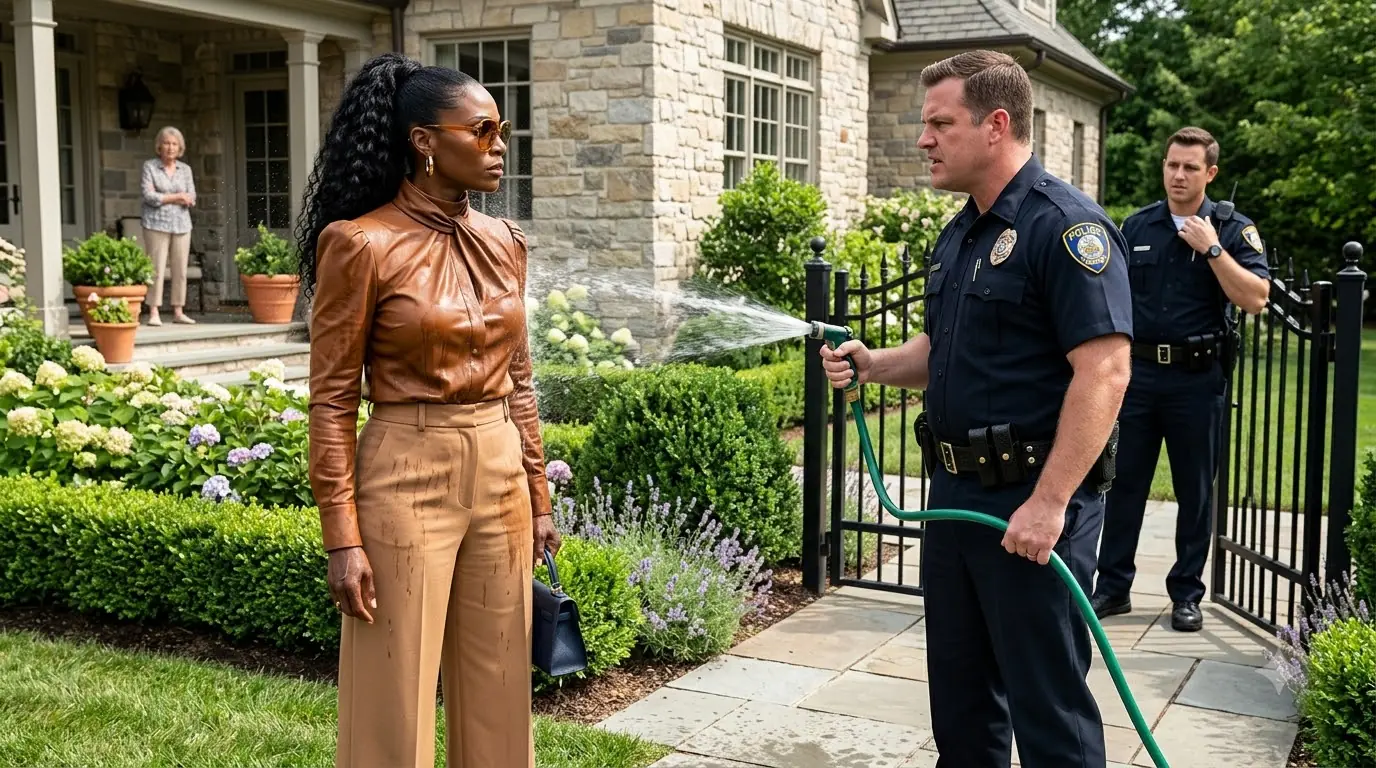
The Black woman had moved into the house only three days earlier.
Most of her furniture had arrived.
Half the boxes were still unopened.
The kitchen looked almost finished.
Her office looked like a warehouse.
The garden, however, was already hers.
That was why she had come outside.
She had spent the previous five years living in a downtown condominium with an impressive view and absolutely no yard.
When she saw the listing for the large stone house with climbing roses, boxwood hedges, old hydrangeas, terracotta planters, and a narrow flagstone path winding through the backyard, she requested a viewing the same afternoon.
The house impressed her.
The garden convinced her.
She bought it six weeks later.
Now, wearing caramel-brown wide-leg trousers, a matching structured blouse, oversized amber-tinted sunglasses, gold earrings, and a small blue designer handbag resting on a nearby bench, she looked considerably more prepared for lunch at an expensive restaurant than for gardening.
That had not been the plan.
She had simply stepped outside to inspect the plants before changing clothes.
Then she noticed one row of hydrangeas looked dry.
Ten minutes later, she was holding the hose.
She had rolled her sleeves slightly above her wrists and was testing the nozzle when the backyard gate opened.
She assumed it was the landscaping contractor.
Without turning, she called, “You can leave the mulch beside the shed.”
No answer came.
She looked over her shoulder.
A white officer stood inside the gate.
He was in his forties, broad-shouldered, with short light-brown hair and a dark navy patrol uniform beneath a heavy tactical vest.
A second white officer, bald and slightly younger, stood several steps behind him.
The Black woman lowered the hose.
“Can I help you?”
The lead officer scanned the garden.
His eyes moved from the stone house to the flowers, then to her.
“Who are you?”
The question immediately changed her expression.
“I live here.”
The officer frowned.
“Name.”
She gave it.
The second officer reached toward his shoulder radio but did not transmit yet.
The lead officer stepped farther onto the property.
“This house was reported vacant.”
“It stopped being vacant when I moved in.”
“When?”
“Wednesday.”
The officer looked toward the rear doors.
“Anyone else inside?”
“No.”
“You have identification?”
“Yes.”
“Where?”
“In the house.”
The officer pointed toward the flagstone path.
“Stay where you are.”
The Black woman stared at him.
“You asked where my identification is.”
“I asked a question.”
“And I answered it.”
“Good. Then keep standing there.”
She slowly released the trigger on the hose nozzle.
Water stopped.
The second officer glanced toward the house.
There were fresh moving boxes visible through the large glass doors.
The lead officer noticed them too.
His expression did not soften.
“We got a report of a suspicious person walking around this property.”
The Black woman looked around the garden.
“You found me watering flowers.”
“You were seen entering through the side gate.”
“Yes.”
“Why?”
“Because it is my gate.”
The second officer looked toward the gate.
There was a keypad lock mounted beside it.
The lead officer continued.
“Did you know the previous homeowners?”
“No.”
“How did you get inside?”
The Black woman looked at him for several seconds.
“The same way homeowners usually enter their own property.”
“That isn’t an answer.”
“I entered the code.”
“What code?”
“The gate code.”
“How did you get it?”
She almost laughed.
“I set it.”
The second officer shifted.
The lead officer noticed.
“What?”
“Nothing.”
The lead officer returned his attention to the Black woman.
“You’re saying you own this entire property?”
“Yes.”
He looked toward the house again.
The home was large.
Three stories.
Stone facade.
Tall windows.
Professionally landscaped grounds.
A swimming pool was partially visible beyond a hedge.
The Black woman saw the conclusion forming before he spoke.
“You got paperwork?”
“Yes.”
“Inside?”
“Yes.”
“Convenient.”
The word irritated her.
Not because it was insulting.
Because it revealed the officer was no longer evaluating information neutrally.
The house contained paperwork because people generally kept real-estate documents inside their houses.
That was not convenient.
That was ordinary.
She looked at the second officer.
“Would one of you like to run my name?”
The lead officer answered.
“I’ll decide what we need.”
The Black woman turned back to him.
“That would answer the question quickly.”
“We’re asking the questions.”
“You asked if I own the home.”
“Yes.”
“I gave you my name.”
“Correct.”
“Property records exist.”
The officer’s jaw tightened.
“Stop telling me how to do my job.”
Her expression became still.
“I’m trying to make your job easier.”
“No, you’re trying to control the conversation.”
The Black woman looked down at the hose in her hands.
Then back at him.
“I was watering flowers.”
“You were reported.”
“Reported doing what?”
“Acting suspicious.”
“That is not an action.”
The lead officer stepped closer.
The second officer looked toward him.
“Sir, we can probably verify ownership through dispatch.”
The lead officer did not turn around.
“In a minute.”
The Black woman noticed the wording.
In a minute.
Verification was available immediately.
He preferred confrontation first.
She had spent twenty-three years working around law enforcement.
She knew that habit.
It was one of the reasons she had accepted her newest job.
The city had hired her after a nationwide search.
She had spent much of her career in public administration, police oversight, organizational reform, and municipal leadership.
On Monday morning, she would be formally introduced to the public as the city’s new Police Commissioner.
The appointment had been announced internally two days earlier.
Senior command knew.
City leadership knew.
Most patrol officers knew only the name.
Very few had met her.
Her official photograph had not yet been widely circulated.
She had deliberately kept a low public profile until Monday’s ceremony.
The two officers in her garden clearly had no idea who she was.
She did not intend to tell them.
Not yet.
Not because she wanted to trap anyone.
Because nothing about her job should be required to resolve what was happening.
She was the homeowner.
That was enough.
The lead officer pointed toward the hose.
“Put that down.”
The Black woman glanced at it.
“Why?”
“Put it down.”
“It’s a garden hose.”
“I can see that.”
“Then why should I put it down?”
The officer stepped closer.
“Because I told you to.”
The Black woman’s mouth tightened.
The second officer shifted again.
“Sir.”
“What?”
“She’s not threatening anyone.”
The lead officer turned.
“I know what I’m doing.”
The second officer stopped.
The Black woman watched the exchange.
The lead officer faced her again.
“Drop the hose.”
She carefully placed the nozzle on the stone path.
The officer pointed toward the open gate.
“Walk over there.”
“No.”
His eyebrows rose.
“What?”
“I will stand here while you verify ownership.”
“You’re being detained while we figure out why you’re on this property.”
The Black woman looked toward the house.
“My property.”
“That has not been confirmed.”
“Because you refuse to confirm it.”