At 7:18 on a cool Monday morning in Alexandria, Virginia, Imani Brooks stepped onto the front porch of the house she had purchased six weeks earlier and wrapped both hands around a white ceramic coffee mug. The neighborhood was quiet except for sprinklers ticking across manicured lawns and the distant hum of traffic moving toward Washington, D.C. Imani wore a light-gray college hoodie, matching sweatpants, and white sneakers because she had no intention of dressing like a deputy chief until the following morning, when she was scheduled to walk into Alexandria Public Safety Headquarters and formally assume command. For one final morning, she wanted to stand outside her own front door without a badge, a uniform, a briefing book, or a room full of people waiting to see whether she lived up to the title.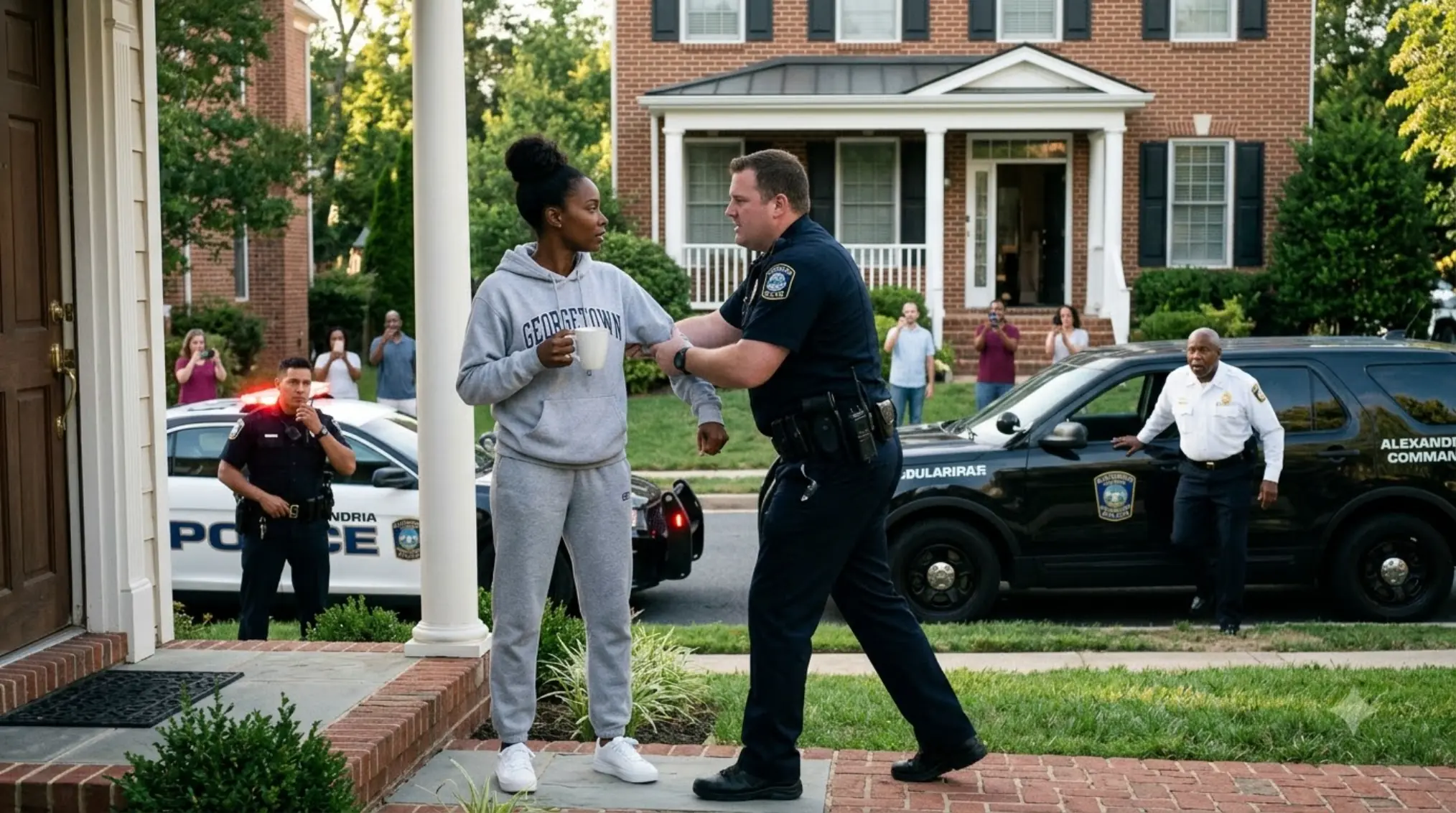
At thirty-nine, Imani had already spent seventeen years learning what authority could do to a person if it was not constantly disciplined by judgment. She had started as a patrol officer in Richmond, moved through investigations, internal accountability, field operations, and eventually command, collecting promotions without ever allowing the brass on her collar to become more important than what happened on the street. She had been recruited to Alexandria after a difficult year for the department, one marked by public complaints, staffing shortages, low morale, and a city council demanding measurable change rather than speeches. Her appointment had been announced quietly on Friday afternoon, but her official introduction to most rank-and-file officers would not happen until Tuesday morning. Only senior command staff had met her in person.
That was why Imani did not immediately understand why a patrol cruiser slowed in front of her house. She watched it roll past the driveway, brake near the curb, and reverse several feet before stopping beneath a maple tree across the street. A second cruiser appeared less than a minute later, its lights suddenly flashing red and blue against the pale brick houses. Imani lowered her coffee mug and glanced toward her front door, wondering whether something had happened farther down the block. Then both officers began walking directly toward her.
The first was a broad white officer in his early forties with a square jaw, close-cropped blond hair, and the thick posture of a man who carried tension in his shoulders. His nameplate read T. HARLAN, and Imani knew the name even before she read it. Officer Trent Harlan had appeared twice in the personnel packet she had reviewed over the weekend, not for formal discipline, but for complaints involving unnecessary escalation during minor calls. Behind him came Officer Miles Boone, younger, leaner, and noticeably more hesitant, his eyes moving between Harlan, Imani, and the open front door behind her.
“Ma’am,” Harlan called from the walkway. “Step away from the door.”
Imani stared at him for half a second, wondering whether she had misunderstood. “Excuse me?”
“Step away from the entrance,” he repeated. “Keep your hands where I can see them.”
Imani looked down at the coffee mug in her right hand, then back toward the officer. “You’re standing on my property.”
Harlan did not respond to the statement. Instead, he continued up the brick walkway while Boone remained near the bottom step, one hand resting near his radio. Across the street, curtains shifted behind a second-floor window. A woman walking a small terrier stopped near the corner, looked toward the flashing patrol cars, and immediately raised her phone.
“We received a report of a suspicious person entering this residence,” Harlan said. “We need to establish who you are.”
“You could establish that by asking,” Imani replied. “My name is Imani Brooks. I own this house.”
Harlan’s expression did not soften. “Do you have identification?”
“Yes.”
“Where is it?”
“Inside.”
His eyes flicked toward the open door. “Don’t go inside.”
“I wasn’t planning to.”
“Then put the mug down.”
Imani felt the first real warning inside her chest. It was not fear exactly, because fear was too simple for what she was experiencing. She recognized the structure of the interaction immediately: one officer had decided what the call meant before collecting enough facts, and every answer she gave was being filtered through that first assumption. She had spent years teaching younger officers about that exact danger.
“Officer Harlan,” she said calmly, “before this goes any farther, ask dispatch to verify the property owner.”
Harlan’s eyes narrowed. “How do you know my name?”
“It’s on your chest.”
“Put the mug down.”
Imani slowly set the white mug on a small wicker table beside the porch swing. Boone watched the movement carefully, then glanced toward Harlan as if expecting the encounter to relax. Instead, Harlan stepped onto the porch. He was now close enough that Imani could see a small scrape near the edge of his body camera housing.
“Turn around,” he ordered.
“No.”
The answer stopped him.
Harlan stared at her. “What did you say?”
“I said no. You have not told me I’m under arrest. You have not identified a crime you believe I committed. I have given you my name, told you I own the residence, and asked you to verify the address. Do that.”
Across the sidewalk, another neighbor had begun recording. Boone shifted his weight and quietly spoke into his radio, but Harlan raised one hand as if ordering him to stop. Imani noticed that immediately.
“Sir,” Boone said softly, “I can run the—”
“I’ve got it.”
Harlan turned back toward Imani. “Hands behind your back.”
For the first time, her expression hardened. “Take your hand off that cuff case and check the damn address.”
Harlan stepped closer. “Keep talking and I’ll add resisting.”
“Resisting what?”
“Turn around.”
“No.”
Harlan reached for her left arm.
Imani did not pull away. She did not raise her voice, push him, or make a sudden movement. She simply locked her eyes on his body camera and said, with the precise calm of someone who understood exactly how recorded evidence worked, “Officer Harlan, I am telling you again that this is my residence, and I am asking you to verify ownership before touching me.”
His fingers closed around her arm.
Down at the curb, Boone looked uncomfortable. “Harlan, maybe we should just—”
“Get the other wrist.”
Boone did not move.
Harlan tightened his grip.
Then tires cut sharply against the curb.
A black Chevrolet Tahoe with municipal command plates swung into the space behind the patrol cars and stopped harder than necessary. The driver’s door opened before the vehicle had fully settled, and Captain Michael Reyes stepped out wearing a dark suit, white shirt, and navy tie with his command badge clipped to his belt. He had been driving toward headquarters when the radio traffic caught his attention—not because the call sounded serious, but because the address sounded familiar.
He looked toward the porch.
Then he stopped.
For one stunned second, Captain Reyes did not move at all. He saw Harlan gripping Imani’s arm, Boone standing below the steps, two patrol cars flashing at the curb, neighbors recording, and the department’s incoming deputy chief standing in gray sweatpants beside a coffee mug. His face changed so completely that even Harlan noticed.
Reyes sprinted across the lawn.
“Let her go!”
Harlan turned.
“Captain?”
“Let her go—right now.”
Harlan released Imani’s arm, but his confusion remained.
Reyes reached the porch and looked from Imani to Harlan, almost unable to believe what he was seeing. “Do you have any idea who you just put your hands on?”
Harlan opened his mouth.
Reyes pointed toward Imani. “That is Deputy Chief Imani Brooks.”
The street went silent.
The woman with the terrier lowered her phone slightly. Boone’s face drained. Harlan stared at Imani as if her clothes had transformed in front of him.
Imani looked at Reyes.
“Captain,” she said.
He immediately understood from her tone that something was wrong beyond the obvious.
“Ma’am.”
Harlan stepped back. “Deputy Chief, I didn’t know—”
Imani cut him off.
“That sentence is not going to help you.”
Harlan swallowed.
“I mean, if I had known who you were—”
“That,” she said, “is exactly why it will not help you.”
Nobody spoke.
Imani picked up her coffee mug, noticed that the coffee had splashed over the rim, and placed it back down. Her left arm carried a faint red mark where Harlan had gripped her. She looked at it once, then toward the patrol units.
“What was the original call?”
Boone answered before Harlan could.
“Suspicious person entering a residence, ma’am.”
“Who called?”
Boone looked toward dispatch on his screen. “Neighbor. Across the street.”
Imani followed his glance.
In the second-floor window of the large white colonial opposite her home, the curtains moved again.
“Name?”
Boone hesitated.
“Read the call.”
He looked down. “Barbara Whitfield.”
Imani had met Barbara Whitfield exactly once.
It had happened four days earlier when Imani was carrying boxes from her SUV. Barbara, a white woman in her early sixties with carefully styled silver-blonde hair and the social confidence of someone accustomed to knowing everyone’s business, had walked across the street and introduced herself before Imani had finished unloading the first box. At first, the conversation had seemed ordinary. Barbara asked whether Imani was helping the owners move in.
Imani had smiled and said, “I am the owner.”
Barbara had blinked.
Then she asked whether Imani was certain she had the correct address.
Imani remembered that question now.
She looked toward Captain Reyes. “Do not turn this into a command incident yet.”