At the bus stop, a small boy from the poorest block froze as the driver barked, "No pay, no ride," and slammed the door toward an elderly woman trembling in the snow after losing her purse.
Despite having only $5, he still couldn't ignore the cruelty unfolding in front of him.
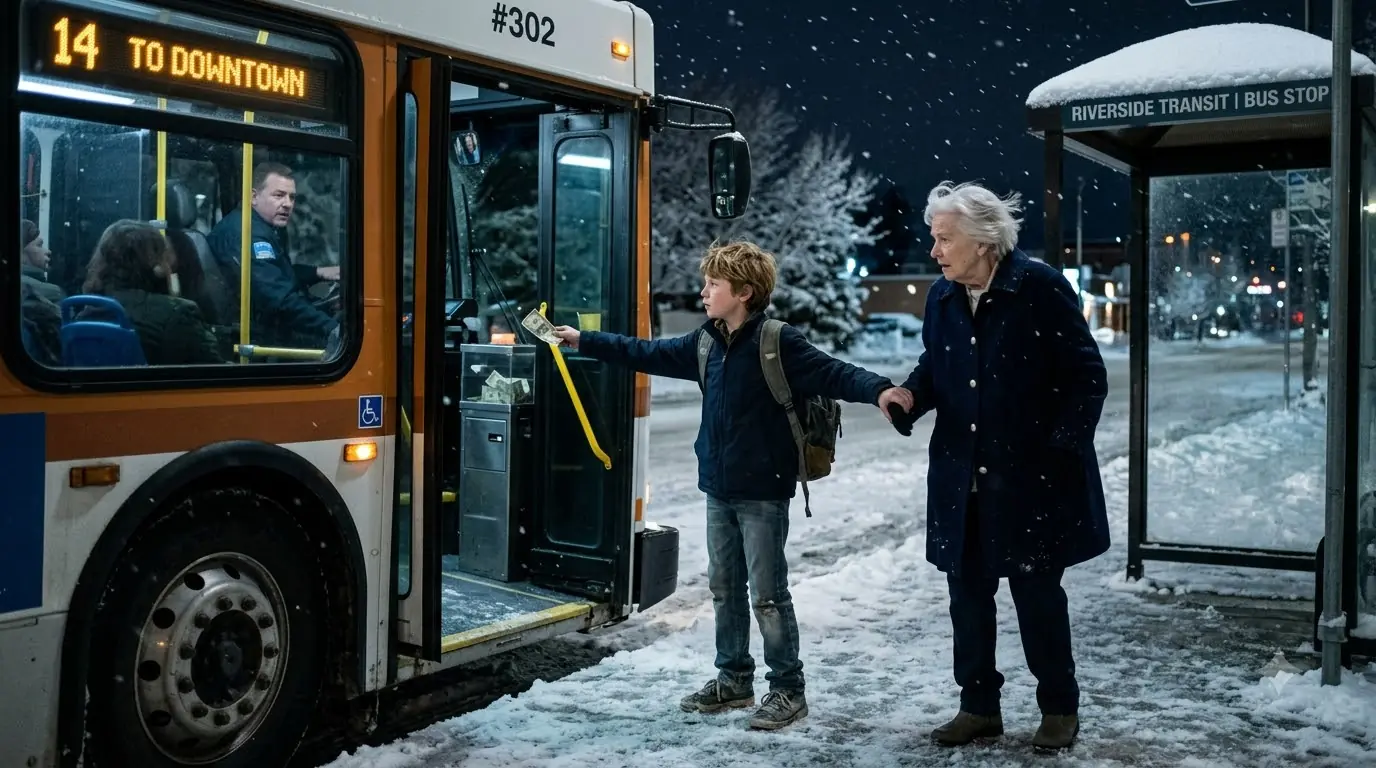
Despite having only $5, he still couldn't ignore the cruelty unfolding in front of him.
So, he made a choice. He stepped forward and paid for the stranger.
That single act of courage would change everything because the woman he helped was the mother of one of the richest men in the state. And when that billionaire learned what happened, his entire world was about to be turned upside down.
12-year-old Tommy Reed stood on the corner of the wealthiest street in Riverside clutching a worn notebook in one hand and his bus fare in the other. He watched the sleek cars glide by wondering if anyone inside them ever worried about how they would get home.
The January wind in Riverside was different than the wind in Millbrook. Here on the wide avenues lined with oak trees and wrought-iron gates, the breeze carried the smell of wood smoke from fireplaces and the faint scent of expensive evergreens.
It whispered through bare branches with a polite reserve even as the sky darkened with the promise of snow. In Millbrook, where Tommy lived, the wind had teeth.
It howled through window cracks and carried the metallic bite of coming storms and the diesel smell of buses that never ran on time. Tommy tightened his grip on the plastic grocery bag he carried.
Inside were his father's work gloves forgotten on the kitchen counter that morning. His father, Robert, was still at the construction site three blocks behind the mansion working a double shift in the freezing cold.
Robert had been an office worker until six months ago, a data analyst who could find patterns in numbers the way other people found shapes in clouds. But his manager had made sure that talent went unrewarded.
When Robert's cost-saving analysis threatened to make his boss look incompetent, the termination paperwork appeared within a week. Performance issues, it claimed.
A lie that stuck like tar. So Robert took whatever work he could find.
His hands meant for keyboards now gripped shovels and hammers. The work was hard, the pay worse, but it kept the lights on.
Barely. Tommy adjusted his thin jacket against the wind.
He was small for 12 with sandy brown hair and watchful green eyes. He checked the time on his old watch.
The number 40 bus was due in 3 minutes. If he missed it, he would have to walk four miles in the dark and his mother needed her evening medication by 6.
The bus stop sat at the borderline between two worlds. Behind him, the Riverside mansion stood proud on the hill.
Ahead, the road sloped down toward the highway, the factories, and the row houses where people like Tommy lived. He wasn't alone at the stop.
An older woman sat on the far end of the bench looking like a piece of fine porcelain left out in the weather. She wore a coat that had once been expensive, navy wool with pearl buttons, but now it looked rumpled and soiled at the cuffs.
Her white hair was pinned up, though strands had escaped and blew across her forehead. She sat with rigid posture, her gloved hands folded in her lap, staring at the street sign as if it held answers to questions she couldn't remember.
Tommy studied her from the corner of his eye. She didn't belong here.
The number 40 carried tired nurses, construction workers, and people like Tommy who were invisible to the rest of the world. This woman looked like she belonged in one of those mansions on the hill.
Yet here she sat, shivering as the temperature dropped and the first snowflakes began to fall. The woman suddenly patted her coat pockets with urgency.
She looked down at the ground, then at the empty bench beside her. Her movements became frantic.
"Ma'am," Tommy said quietly, "are you okay?" The woman turned to him, startled.
Her eyes were sharp and intelligent, a striking pale blue, but clouded with confusion. "My bag," she said.
Her voice was refined, cultured, but edged with fear. "I had a handbag.
I know I did. I set it down somewhere."
Tommy looked around the empty sidewalk. "Did you maybe leave it where you were walking?"
"I went to see the gardens," the woman said, her voice faltering. "The winter gardens at the Riverside Botanical Center.
They were beautiful. I just kept walking.
I must have... I don't know.
I can't remember." She pressed a gloved hand to her forehead.
"My phone, my wallet, everything." Before Tommy could respond, the diesel engine of the number 40 rumbled around the corner.
The bus was a scarred beast, rust-streaked and grimy. The doors hissed open, and the driver glared down at them.
His name badge read Gus. Tommy knew Gus.
Everyone knew Gus. He didn't wait, didn't smile, didn't care.
"Let's go," Gus barked. "I'm behind schedule."
The woman stood shakily and approached the steps. "Sir," she said, trying to maintain dignity, "I seem to have lost my purse.
If you could just" "No pay, no ride," Gus cut her off with a harsh laugh. "Read the sign, lady."
The woman's face flushed. "I'm not asking for charity.
I'm in distress. If you could just" "Three bucks or hit the pavement.
Your choice." The cruelty hit Tommy like a punch.
He watched the woman shrink, watched her step backward as if pushed. It wasn't just embarrassment.
It was shock, the shock of being treated like garbage. The woman stepped back onto the curb.
"I see," she whispered. "I apologize for the delay."
Gus snorted reaching for the door lever. "Wait."
Tommy's voice was louder than intended. He stepped forward jamming his foot between the closing doors.
"Get your foot out of there, kid." Gus yelled.
Tommy didn't move. His heart hammered as he reached into his pocket feeling for the bills and coins.
$5, his mother's medication co-pay, the milk money, everything. But watching this woman being cast out into a January night felt worse than an empty refrigerator.
He climbed the steps and dropped the money into the fare box. The coins clattered loudly.
"That's for both of us." Tommy said looking Gus in the eye.
Gus stared at the money then grunted. "Whatever.
Sit down." Tommy turned back to the woman.
He extended his hand. "Come on.
It's okay." The woman looked at his hand as if it were the most precious thing she'd ever seen.
Her eyes glistened. She took his hand, soft, papery, cold and let him help her up the steps.
The bus lurched forward. Tommy guided her to a seat in the middle away from the noise in back and Gus's glare up front.
They sat on cracked vinyl. The bus smelled of wet wool and tired people.
Outside, snow fell harder. "You didn't have to do that," the woman said.
"That was your money." "It's just money."
Tommy said though his stomach knotted thinking about dinner. "My dad always says nobody should be left behind when they need help."
The woman studied him. "What's your name?"
"Tommy. Tommy Reed."
"I'm Margaret," the woman said, extending her hand. "Margaret Hartley."
They shook hands solemnly. "Why is a 12-year-old riding the bus alone?"
Margaret asked softly. "My mom's home sick.
She has MS. Today's not a good day, so I'm heading home to make dinner and give her medicine."
Margaret's expression flickered. "And your father?"
"Still working. Construction.
He used to work in an office, but he got laid off. Now he does whatever he can find."
"I see." Margaret's voice went quiet.
They rode in silence watching the landscape change as the bus descended into neighborhoods where houses pressed close together. Snow fell in earnest now coating everything white.
"This is my stop," Tommy said as the bus slowed near Maple and Third. He gathered his bag then looked at Margaret's pale confused face.
"Where are you going?" "The downtown terminal, I suppose," Margaret said uncertainly.
"I can find a phone there." Tommy bit his lip.
He knew the downtown terminal. At night it filled with danger.
The thought of sending this lost woman there made his stomach clench. The bus stopped.
The doors hissed open cold air rushing in. Margaret stood to follow him off.
As her feet touched the curb, she suddenly swayed gripping the pole. Her face went pale.
Her breathing rapid. "Ma'am."
Tommy dropped his bag and grabbed her arm. "Are you okay?"
I just... I feel dizzy.
Lightheaded. Margaret pressed her hand to her chest breathing hard.
The cold, I think. I just need a moment.
Tommy looked around frantically. Snow fell thick now wind picking up.
Margaret was shaking either from cold or shock or both. The bus pulled away leaving them on the dark street corner.
"My house is right there," Tommy said, pointing half a block down. "Please, just come inside.
You need to sit down and get warm." "I couldn't..."
Margaret started. "Please."
Tommy's voice was urgent. "You're not okay.
It's not safe. My mom's home.
She'll know what to do. Please."
Margaret looked at the swirling snow felt another wave of dizziness and nodded weakly. "Just for a moment to catch my breath."
Tommy took her arm and guided her slowly down the block to a narrow brick building with a crooked 414 nailed beside the door. Three flights up, Tommy warned, but we'll go slow.
They climbed together, Margaret gripping the banister, Tommy staying close. The stairwell smelled of other people's dinners.
Paint peeled from the walls, each step creaked. By the second landing, Margaret was breathing hard.
Tommy pretended to adjust his bag, giving her time. Almost there, he encouraged.
At the third floor, Tommy jiggled the key, left then right, then pushed hard. The door groaned open.
"Mom," he called, "I'm home. I brought someone who needs help."
The apartment was tiny but meticulously clean. The linoleum floor, though cracked, had been scrubbed until it shone.
The walls were decorated with children's drawings in mismatched frames. It was also cold, almost as cold as outside.
A woman appeared in the bedroom doorway, leaning on a cane. She was younger than Margaret expected, perhaps in her early 40s, with light brown hair pulled back and warm gray eyes.
When she saw Margaret, her expression immediately shifted from surprise to concern. "Oh my goodness," she said, moving forward despite the obvious pain it caused her.
"Please, come in. Come sit down.
You look like you're about to faint." Her voice was gentle, genuinely worried, with none of the suspicion Margaret might have expected.
She wore a thick robe over layers against the cold. "Mom, this is Margaret," Tommy said, helping his mother guide the elderly woman to the sofa.
"She lost her purse. The bus driver was going to leave her in the snow.
I paid her fare, but when we got off, she got really dizzy and almost fell." "I'm Helen Reed," the woman said, settling Margaret onto the sofa and immediately draping a thin quilt over her shoulders.
"Tommy, get some water and start the kettle for tea." "I don't want to impose," Margaret said automatically, though she was grateful to be sitting, to be out of the wind.
"You're not imposing." Helen's smile was warm, genuine.
"You're clearly unwell and it's freezing out there. We're not going to send you back out until you've warmed up and caught your breath."
She lowered herself carefully into the armchair across from Margaret, her movements showing the disease's toll on her body, but her face was kind, open, without a trace of resentment at this unexpected intrusion. "Tommy says you lost your purse.
That must be so frightening." "I went for a walk," Margaret explained, still slightly breathless.
"The botanical gardens. I just kept walking and somewhere along the way I must have set it down.
I can't quite remember where." "That happens to me, too," Helen said, her voice sympathetic rather than pitying.
"I'll forget why I walked into a room or where I put something. It's unsettling."
Margaret looked at this woman, clearly struggling with her own health issues, living in obvious poverty, offering understanding and kindness without hesitation. "You're very kind."
"Kindness doesn't cost anything." Helen said simply, "And my son clearly thought you needed help, so here you are.
We're glad to have you." Tommy brought a glass of water and set the old kettle on the stove.
As it began to heat, Helen asked gentle questions about Margaret's walk, about the gardens, keeping her talking, keeping her calm. Margaret found herself relaxing, responding to Helen's natural warmth.
"The witch hazel was blooming," Margaret said, "yellow flowers against gray bark. It was beautiful.
I used to take Tommy to those gardens when he was little, Helen said, her face lighting up with the memory. Before I got too sick to walk that far.
The winter garden really is special. They talked easily, two women who might have come from different worlds but who found common ground in simple conversation.
Helen asked nothing intrusive, made no judgments, simply offered the comfort of human connection. Tommy brought the tea in chipped mugs, chamomile, apologizing that it was all they had.
Margaret wrapped her hands around the warmth, feeling her heart rate slow, the dizziness fade. You have a wonderful son, Margaret said.
What he did on that bus, giving up his own money to help a stranger, that's extraordinary. Helen's eyes grew bright.
He has a good heart. His father and I tried to teach him that people matter more than things, that you help when you can.
You've taught him well. As they talked, Margaret's observant eyes began to notice the details Helen's warmth and conversation had initially distracted her from.
The near-empty refrigerator visible through the partially open door, the stack of bills on the table, one marked final notice in red, the pill organizer, the blood pressure monitor, the cold radiator beneath the window, clearly broken, the blankets rolled against the window frame to block drafts, but she also noticed the fierce pride in how everything was maintained. The spotless floor, the carefully mended curtains, the drawings on the wall arranged with the precision of a gallery.
This family had almost nothing, yet they'd invited her in without hesitation, offered her their warmth and their time and their genuine care. As Margaret was beginning to feel almost normal again, an old radio on the kitchen counter crackled to life.
Helen must have turned it on while making the tea. A tinny voice cut through the static repeating our top story.
The National Weather Service has just upgraded the winter storm warning to a blizzard warning for the metro area effective 8:00 p.m. tonight through 6:00 a.m. tomorrow morning. 8 to 12 inches of heavy snow expected with winds gusting up to 45 mph.
Whiteout conditions likely. Residents are strongly advised to avoid all travel.
Stay off the roads unless absolutely necessary. The door opened with a gust of cold air and snow.
A man stepped inside, tall and lean, shaking snow from his coat. He had kind eyes that went wide when he saw Margaret sitting on his sofa.
Helen Tommy. His voice carried concern and confusion.
What's going on? Robert.
Helen's face brightened. Come in close the door.
This is Margaret. She needed help.
Tommy jumped up. Dad, Margaret lost her purse.
The bus driver was mean to her so I paid her fare. Then she got dizzy when we got off the bus so I brought her here.
And now there's a blizzard coming. Robert looked from his son to his wife to the elderly woman wrapped in their quilt.
His eyes went to the window where snow was now pelting the glass driven by increasing wind. He looked back at Margaret taking in her expensive coat, her obvious age and vulnerability.
He moved to the window peering out at the deteriorating conditions. The street was already disappearing under white.
He turned back, his decision made. Ma'am, I'm Robert Reed, he said extending a work-roughened hand.
Tommy's father. And I'm very glad he found you because nobody should be out in what's coming.
Margaret shook his hand. I'm Margaret Hartley.
Your son was very kind. Robert smiled.
He gets that from his mother. He looked at Helen and some wordless communication passed between them.
Then he turned back to Margaret, his voice gentle but firm. "Mrs. Hartley, I don't know how you were planning to get home, but with this blizzard, it's not safe for anyone to be traveling.
The roads are going to be impassable within the hour. I was going to call for a car."
Margaret started. "No car service is going to come out in this," Robert said, not unkindly.
"And even if they did, it wouldn't be safe. We'd like you to stay here tonight.
Wait out the storm. In the morning, when it's clear, you can call whoever you need to call."
"I couldn't possibly impose on your family." "You're not imposing," Helen said firmly, her warmth now backed by determination.
"We have a bed, we have a roof that doesn't leak, and we're not going to send you out into a blizzard. That's final."
Margaret looked at their faces, Tommy's earnest concern, Helen's warm insistence, Robert's quiet certainty. These people who had so little were offering her everything they had without a moment's hesitation.
"Then I should at least call my son," Margaret said, her voice thick with emotion. "Let him know I'm safe.
May I use your phone?" "Of course," Helen said, gesturing to the old rotary phone on the wall.
Margaret moved to the phone with Helen's help, her fingers still trembling slightly as she dialed the number she knew by heart. It rang twice.
"Mother?" William's voice was frantic.