At the bus stop, a small boy from one of the poorest neighborhoods in Riverside froze when the driver barked, “No pay, no ride,” and started closing the door on an elderly woman trembling in the snow after losing her purse.
The boy had only five dollars left.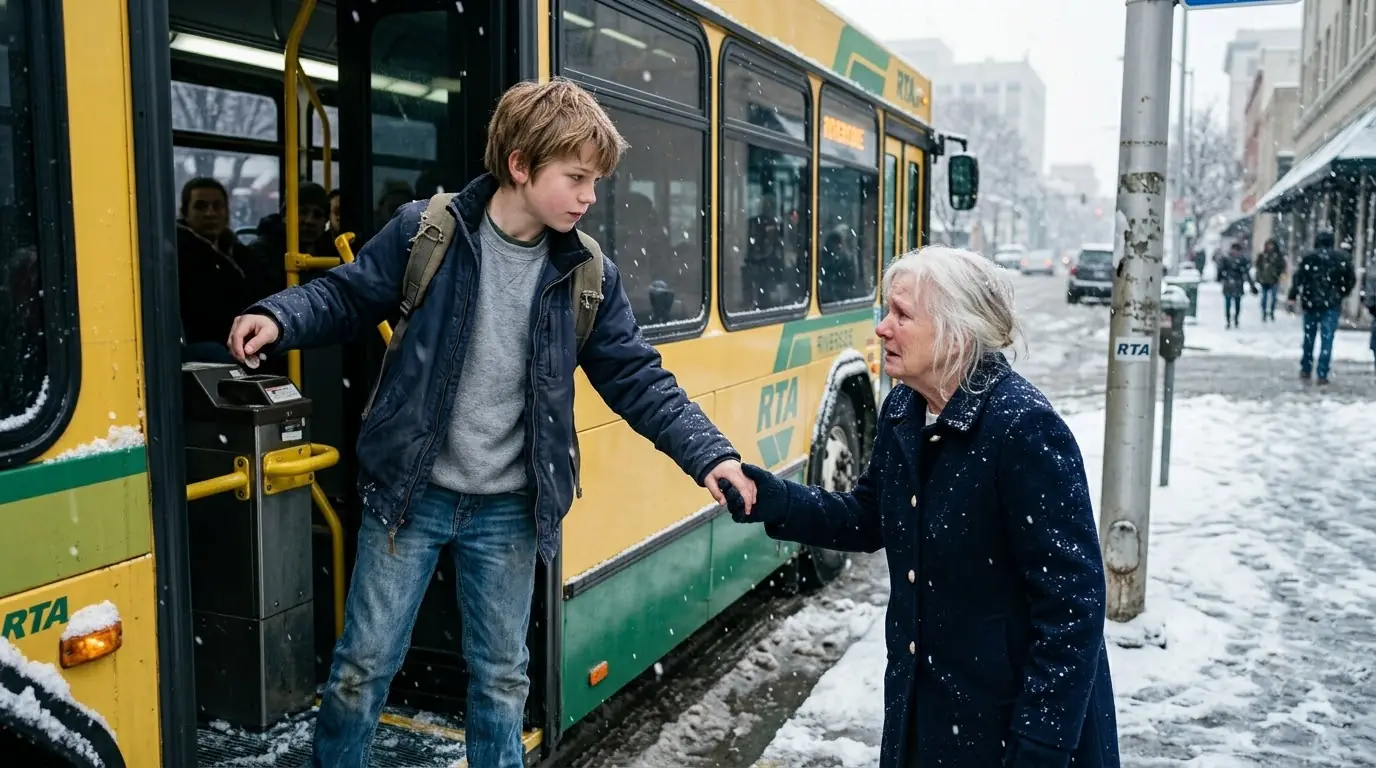
It was money his family needed.
Still, he could not ignore what was happening in front of him.
So he stepped forward and paid for the stranger.
Tommy Reed had no idea that the woman he helped was the mother of one of the wealthiest businessmen in the state.
And by sunrise, that single act of kindness would connect two families separated by more than fifty years.
Twelve-year-old Tommy stood at the corner of one of the wealthiest streets in Riverside, clutching a worn notebook in one hand and his bus money in the other. Sleek cars glided past him, their headlights reflecting off wet pavement as he wondered whether the people inside ever worried about how they were going to get home.
The January wind in Riverside felt different from the wind in Millbrook, where Tommy lived. Here, the broad streets were lined with old oak trees, wrought-iron gates, stone walls, and enormous houses set far back from the road. The breeze carried the scent of wood smoke from fireplaces and fresh evergreens planted around manicured lawns.
In Millbrook, the wind had teeth.
It slipped through cracked window frames, rattled old apartment doors, and carried the smell of diesel from buses that were rarely on time. Winter there felt less like scenery and more like another bill that had to be survived.
Tommy tightened his thin jacket around himself and adjusted the plastic grocery bag hanging from his wrist. Inside were his father’s work gloves, forgotten on the kitchen counter that morning.
His father, Robert Reed, was still working at a construction site three blocks uphill from the bus stop.
Robert had once worked in an office.
He had been a data analyst, the kind of person who could look at thousands of numbers and see relationships other people missed. Six months earlier, however, a manager had taken credit for one of Robert’s cost-saving models, then arranged to have him dismissed when Robert began asking questions.
The official paperwork cited performance problems.
Robert knew it was false.
But false paperwork written by the right person could become very difficult to fight when you had rent due, a sick wife, and a child who needed dinner.
So Robert took whatever work he could find.
The hands that once moved across keyboards now gripped shovels, power tools, and lumber. The work was exhausting, especially in winter, and it paid far less than his office job had.
But it kept the electricity on.
Barely.
Tommy checked the old watch on his wrist.
The number 40 bus was due in three minutes.
If he missed it, he would have to walk nearly four miles home in worsening weather. His mother, Helen, needed her evening medication, and Tommy had promised he would be back before six.
The bus stop sat almost perfectly between two worlds.
Behind him were mansions and private gardens.
Ahead, the road sloped toward factories, warehouses, apartment blocks, and the row houses of Millbrook.
Tommy was not alone.
An elderly woman sat at the far end of the bench.
She looked like a piece of fine porcelain accidentally left outside in bad weather.
Her navy wool coat had clearly once been expensive. Pearl buttons ran down the front, and the fabric was thick and carefully tailored, but now the cuffs were damp and slightly dirty. Her white hair had been pinned neatly, though several strands had escaped and blew across her forehead.
She sat very straight, gloved hands folded in her lap, staring at the street sign.
Tommy glanced at her.
Something did not fit.
The number 40 usually carried nurses after long shifts, construction workers, warehouse employees, students, and elderly residents heading toward Millbrook. This woman looked like she belonged inside one of the large homes overlooking Riverside.
Yet she sat there alone.
Shivering.
As the sky darkened.
The first flakes of snow began to drift down.
Suddenly the woman patted her coat pockets.
Once.
Then again.
Her calm expression disappeared.
She looked beneath the bench.
Then behind her.
Then across the empty sidewalk.
“My bag,” she whispered.
Tommy watched her for another moment before stepping closer.
“Ma’am?”
She turned quickly.
Her eyes were a striking pale blue. Intelligent eyes, though clouded now with confusion.
“Are you okay?” Tommy asked.
“My handbag.”
Her voice sounded educated and refined, but fear trembled beneath it.
“I had it with me. I know I did.”
She checked her pockets again.
“My phone, my wallet, everything was inside.”
“Do you remember where you had it last?”
The woman pressed one hand to her forehead.
“I went to the botanical gardens.”
“The Riverside gardens?”
“Yes.”
Her face tightened as she tried to reconstruct the afternoon.
“The winter garden. I wanted to see the witch hazel. It blooms even in cold weather.”
Tommy waited.
“I remember sitting somewhere,” she continued. “Then I walked. I must have put the bag down. I can’t remember where.”
The words seemed to frighten her more than the missing purse itself.
Before Tommy could respond, the heavy sound of a diesel engine came around the corner.
The number 40 bus appeared through the gathering snow.
It was old, rusted along the bottom panels, and scarred by years of city service.
The brakes hissed.
The doors opened.
The driver looked down at them.
His badge read GUS.
Tommy knew him.
Everyone on the Millbrook route knew Gus.
He was not known for patience.
“Let’s go,” Gus called. “I’m already behind.”
The elderly woman stood carefully and approached the steps.
“Sir,” she began, “I seem to have lost my purse. If you could allow me to ride to the terminal, I can contact my family and arrange—”
“No pay, no ride.”
Gus did not even let her finish.
The woman blinked.
“I’m not asking for charity.”
“Fare is three dollars.”
“I understand, but I have lost my wallet and phone. I’m in some difficulty.”
Gus gave a short laugh.
“Three dollars or stay here.”
The woman’s face turned red.
Not anger.
Humiliation.
She looked behind her at the snow.
The wind had begun to rise.
“I see,” she whispered. “I apologize for delaying you.”
She stepped backward.
Gus reached for the door control.
Tommy felt something tighten inside him.
He thought about the five dollars in his pocket.
Milk.
His mother’s medication co-pay.
Maybe bread if there was anything left after that.
Five dollars was not spending money.
It was everything he had until his father got paid.
The bus door began closing.
“Wait!”
Tommy stepped forward.
Gus frowned.
“Come on, kid.”
Tommy reached into his pocket.
He climbed onto the bus and placed the money into the fare box.
Coins and bills dropped inside.
“That’s for both of us.”
Gus looked at the fare.
Then at Tommy.
“Whatever. Sit down.”
Tommy turned back toward the woman.
She stood on the curb, stunned.
He held out his hand.
“Come on.”
Her eyes moved from his face to his hand.
For a moment, she looked as if nobody had offered her something so precious in years.
Then she took it.
Her glove felt cold and delicate inside Tommy’s small hand.
He helped her up the steps.
The bus pulled away.
Tommy guided her toward a seat in the middle, away from Gus and away from the louder passengers in the back.
They sat side by side on cracked vinyl seats.
Outside, snow thickened.
Inside, the bus smelled of wet coats, old heaters, and tired people going home.
The woman looked at Tommy.
“You didn’t have to do that.”
Tommy shrugged.
“It’s okay.”
“That was your money.”
“It’s just money.”
The words came easily.
His stomach tightened immediately afterward because he knew that for his family it was not just money.
But he did not take them back.
“My dad says nobody should get left behind when they need help.”
The woman studied him.
“What is your name?”
“Tommy Reed.”
She extended one gloved hand.
“I’m Margaret Hartley.”
Tommy shook it solemnly.
“Nice to meet you.”
“You too.”
Margaret looked at him again.
“Why is a twelve-year-old riding the bus alone this late?”
“My mom’s sick.”
Margaret’s expression softened.
“She has multiple sclerosis. Today’s not a good day, so I’m going home to make dinner and help with her medicine.”
“And your father?”
“Working.”
“What does he do?”
“Construction now.”
“Now?”
Tommy nodded.
“He used to work in an office. Data stuff.”
Margaret waited.
“He got fired.”
“I’m sorry.”
Tommy shrugged, though there was anger beneath it.
“He says we’ll be okay.”
They rode in silence for several minutes.
The neighborhoods outside changed gradually.
Large houses became smaller.
Stone walls became chain-link fences.
Streetlights became farther apart.
Snow covered everything equally.
When the bus slowed near Maple and Third, Tommy stood.
“This is my stop.”
He gathered his grocery bag.
Then he looked at Margaret.
“Where are you going?”
“The downtown terminal, I suppose.”
Margaret sounded uncertain.
“I should be able to find a telephone there.”
Tommy knew the downtown terminal.
At night it was cold, poorly staffed, and not a place where he wanted to leave a confused elderly woman without money or a phone.
The bus stopped.
The doors opened.
Cold air rushed inside.
Margaret stood.
“I’ll get off too.”
Tommy frowned.
“You don’t have to.”
“I think I need some air.”
She stepped onto the curb.
Then swayed.
Her hand grabbed the bus pole.
Her face went pale.
“Ma’am!”
Tommy dropped the grocery bag and caught her arm.
Margaret pressed one hand against her chest.
“I’m all right.”
“No, you’re not.”
Her breathing had become quick.
“The cold, perhaps.”
The bus doors closed behind them.
Tommy looked up.
“Wait!”
But the bus was already pulling away.
Within seconds, its taillights disappeared through the snow.
Tommy looked at Margaret.
She was shaking now.
“My house is right there.”
He pointed half a block down.
“Please come inside.”
“I couldn’t impose.”
“You’re not okay.”
“Tommy—”
“My mom’s home. She’ll know what to do.”
Margaret looked at the snow.
Then at the empty road.
Another wave of dizziness seemed to pass through her.
“All right.”
“Just until I feel better.”
Tommy guided her along the sidewalk toward a narrow brick apartment building.
A crooked metal number beside the front door read 414.
“Third floor,” Tommy warned. “We’ll go slow.”
Inside, the stairwell smelled like old paint and everyone’s dinner.
The walls were worn.
The railings had chipped paint.
Every step creaked.
Margaret climbed carefully.
By the second landing, her breathing had become difficult again.
Tommy pretended he needed to adjust the grocery bag.
It gave her time to rest without making her feel watched.
“Almost there.”
At the third floor, Tommy inserted the key into the apartment door.
He turned it left.
Then right.
Then pushed.
The door opened with a groan.
“Mom?”
He stepped inside.
“I’m home.”
Then louder:
“I brought someone who needs help.”
The apartment was small.
Very small.
But it was immaculately clean.
The linoleum floor was cracked, yet scrubbed until it reflected the overhead light. Children’s drawings had been placed in mismatched frames along the walls. A small dining table sat between the kitchen and living room.
It was also cold.
Almost as cold as the hallway.
A woman appeared in the bedroom doorway, leaning on a cane.
She looked younger than Margaret expected.
Early forties.
Light brown hair pulled back.
Warm gray eyes.
She wore a thick robe over several layers of clothing.
When she saw Margaret, surprise immediately turned into concern.
“Oh my goodness.”
She moved forward despite the obvious difficulty in her steps.
“Come in. Please sit down. You look faint.”
“Mom, this is Margaret.”
Tommy helped guide Margaret toward the sofa.
“She lost her purse. The bus driver wouldn’t let her ride, so I paid her fare. Then she almost fell when we got off.”
Helen Reed looked at her son.
Then at Margaret.
No criticism.
No question about the money.
Only concern.
“I’m Helen.”
She helped Margaret sit and pulled a thin quilt over her shoulders.
“Tommy, water. And put the kettle on.”
“I don’t want to impose,” Margaret said.
“You aren’t.”
Helen lowered herself carefully into the armchair.
“You’re cold and shaken. We’re not putting you back outside.”
Margaret looked at her.
Tommy brought a glass of water.
Helen smiled.
“Tommy says you lost your purse.”
“I went walking at the gardens.”
Margaret took a small sip.
“And apparently walked farther than I realized.”
“That must be frightening.”
“I can’t remember exactly where I put it.”
Helen nodded.
“That happens to me sometimes.”
Margaret looked surprised.
“Not the same way perhaps, but I’ll walk into a room and forget why I came. Or I’ll put something somewhere and spend twenty minutes looking for it.”
There was no pity in Helen’s tone.
Only understanding.
“It can be unsettling.”
Margaret felt some of the tension leave her shoulders.
“You’re very kind.”
Helen smiled.
“Kindness doesn’t cost anything.”
Her eyes drifted toward Tommy.
“And my son clearly believed you needed help.”
Tommy busied himself with the kettle.
“So here you are.”
They began talking.
The botanical gardens.
Winter flowers.
Snow.
Margaret mentioned the yellow witch hazel blossoms against gray branches.
Helen’s face brightened.
“I used to take Tommy there when he was little.”
“Before I got worse.”
She tapped her cane lightly.
“The winter garden was always my favorite.”
For several minutes, two women from completely different lives talked as though none of those differences mattered.
Tommy brought chamomile tea in chipped mugs.
“Sorry,” he said. “It’s all we have.”
Margaret wrapped both hands around the cup.
“It’s perfect.”
Her heartbeat began to slow.
The dizziness faded.
“You have a remarkable son,” she told Helen.
Helen looked toward Tommy.
“He has a good heart.”
“What he did on that bus was extraordinary.”
“He learned it from his father.”
Helen paused.
“And his grandfather.”
Margaret smiled.
As the conversation continued, she began noticing details.
The refrigerator door had not fully closed, revealing shelves with almost nothing inside.
Bills had been stacked neatly on the table.
One envelope carried a red FINAL NOTICE.
A weekly pill organizer sat beside a blood pressure monitor.
Blankets had been rolled along the windowsill to block drafts.
The radiator beneath the window was cold.
Broken.
Yet everything had been cared for.
Curtains were patched instead of discarded.
The floor shone.
Tommy’s school drawings had been displayed as if they were museum pieces.
This family had very little.
Still, they had welcomed a stranger without hesitation.
An old radio on the kitchen counter crackled.
A weather announcer interrupted the program.
The winter storm warning had been upgraded.
Heavy snow.
Dangerous winds.
Travel strongly discouraged through morning.
As the announcement continued, the apartment door opened.
A man stepped inside with snow covering his coat.
Tall.
Lean.
Exhausted.
He shook snow from his shoulders, then looked up.
His eyes widened at the sight of Margaret.
“Helen?”
Tommy jumped up.
“Dad.”
Robert Reed closed the door.
“What happened?”
Helen smiled.
“Come in first.”
Tommy hurried through the story.
“Margaret lost her purse. The bus driver was going to leave her outside. I paid for her. Then she almost passed out.”
Robert looked toward the window.
Snow was striking the glass harder now.
Then he looked at Margaret.
He extended a hand roughened by construction work.
“I’m Robert Reed.”
“Margaret Hartley.”
He shook her hand.
“I’m glad Tommy found you.”
Margaret smiled.
“Your son was extremely kind.”
Robert looked toward Tommy.
“He gets that from his mother.”
Helen rolled her eyes.
Robert walked to the window again.
The street was disappearing beneath snow.
“How were you planning to get home?”
“I was going to call someone.”
Margaret hesitated.
“If I can borrow your telephone.”
“You can absolutely call.”
Robert looked outside again.
“But nobody should be driving in this.”
“I don’t want to inconvenience you.”
Helen’s voice became firm.
“You aren’t going anywhere tonight.”
Margaret looked at her.
“We have a bed. We have a roof.”
Helen smiled.
“It may be cold, but it doesn’t leak.”
Robert nodded.
“You can stay until morning.”
Margaret looked around the apartment.
These people had almost nothing.
And they were offering her shelter.
“Then I should at least call my son.”
Helen pointed toward an old wall telephone.
“Of course.”
Margaret dialed from memory.
The line rang twice.
“Mother?”
William Hartley’s voice came through instantly.
“Where are you?”
“William—”
“I’ve been calling everyone. Your assistant said you left for a walk hours ago. Security is ready to start searching.”
“I’m fine.”
“Where are you?”
“I’m safe.”
Margaret forced calm into her voice.
“I went to the botanical gardens and became turned around. I lost my handbag. A very kind family helped me.”
“What family?”
“The Reeds.”
“What address?”
“William—”
“Mother.”
She sighed.
“414 Maple Street. Apartment 3B.”
She heard him writing.
“I’ll send a car.”
“No.”
“Mother—”
“There is a blizzard.”
“I’ll send security.”
“You will do no such thing.”
Her tone sharpened.
“I am seventy-four years old, William. I am safe. I am warm. These people have taken excellent care of me.”
He was silent.
“The roads are dangerous.”
Margaret continued.
“I will call you in the morning.”
“First light.”
“When it is safe.”
Another pause.
“All right.”
“Promise me you will not send anyone into this storm.”
William exhaled.
“I promise.”
“I’ll see you tomorrow.”
She hung up.
The Reed family had politely moved away during the call.
Helen returned first.
“Your son must have been terrified.”
“He worries.”
Margaret smiled.
“Far too much.”
“You must have been frightened too.”
Helen sat across from her.
“I was.”
Margaret looked at Tommy.
“Then your son appeared.”
Tommy looked away, embarrassed.
“My guardian angel on the number 40.”
Robert clapped his hands lightly.
“Well, if we’re all here for the night, we should eat.”
He looked toward Tommy.
“What have we got?”
Tommy opened the refrigerator.
He began inventorying the contents.
“Six eggs.”
He checked another shelf.
“Half a gallon of milk.”
“A little cheese.”
Helen added, “Bread.”
Tommy nodded.
“Scrambled eggs and toast.”
Margaret watched him work.
He cracked every egg carefully.
Scraped the bowl clean.
Used every drop.
Nothing wasted.
Robert checked the radiator.
Cold.
“Heat’s still out,” he said.
Margaret frowned.
“Still?”
“Since Tuesday.”
“The landlord knows?”
Robert smiled without humor.
“He keeps promising.”
He moved toward a small electric heater they used cautiously to take the edge off the cold.
“We’ll stay together in the main room tonight and keep blankets close.”
Margaret watched him.
Everything Robert did was methodical.
Careful.
Resourceful.
Not graceful because life had been easy.
Graceful because life had been difficult and he had learned how to keep moving anyway.
Tommy set the table.
Four mismatched plates.
Four different forks.
Paper napkins folded neatly.
Dinner was ready.
Margaret sat down.
Then noticed her plate.
She had received the largest portion.
“No.”
Helen looked at her.
“This is too much.”
“You need to eat.”
“You barely have anything yourselves.”
“We have enough.”
Robert’s voice was firm.
“Please.”
Margaret looked at Tommy’s small serving.
Then Helen’s.
Then Robert’s.
“This is your food.”
“You’re our guest.”
Helen smiled.
“And you’ve had a difficult day.”
Margaret felt tears pressing behind her eyes.
“Thank you.”
They ate.
The eggs were slightly overcooked.
The toast was dry.
Margaret could not remember a meal that had meant more.
Robert asked about the gardens.
Helen told stories about Tommy’s school.
Tommy complained about a math teacher who assigned too much homework.
Gradually, laughter entered the apartment.
Margaret watched how Robert and Helen communicated.
Small glances.
A hand resting briefly on a shoulder.
Tommy getting water for his mother before she asked.
Helen adjusting Robert’s collar when he sat down.
A family exhausted by hardship, yet still functioning as a team.
“Tell us about your family,” Helen said.
Margaret smiled.
“My son’s name is William.”
“The worried one.”
“Yes.”
They laughed.
“My husband, Arthur, died five years ago.”
Helen’s expression softened.
“I’m sorry.”
“Thank you.”
Margaret looked down at her tea.
“Five years sounds like a long time until you lose someone.”
Robert nodded.
“That’s true.”
Margaret looked at him.
“Arthur and I built our company together.”
She smiled faintly.
“Everything.”
“Business. Family. Life.”
Her voice softened.
“Sometimes I still turn to tell him something.”
Then remember.
Robert nodded slowly.
“The people who matter most don’t leave cleanly.”
Margaret looked at him.
There was grief behind his eyes.
Older grief.
Something he understood personally.
After dinner, Helen insisted on cleaning.
Margaret tried to help.
Helen refused.
“You’re resting.”
Tommy dried dishes.
Robert prepared blankets.
Outside, the wind intensified.
For a while, despite everything, Margaret felt safe.
Then someone pounded on the apartment door.
Three hard knocks.
The entire room changed.
Helen went pale.
Tommy froze.
Robert’s jaw tightened.
He opened the door only partly.
A heavyset man stood outside in a stained canvas jacket.
Donald Vickers.
The landlord.
“Reed.”
His voice was flat.
“We need to talk.”
“Mr. Vickers, tonight isn’t a good time.”
“Rent was due Friday.”
Robert remained calm.
“I called Tuesday.”
“And?”
“My paycheck was short because the site closed during last week’s snow. I’ll have the rest by Wednesday.”
“Wednesday isn’t good enough.”
Vickers pulled out a folded notice.
He pressed it against the wall.
“Three days.”
Helen made a quiet sound.
Robert looked at the paper.
“Please.”
Margaret heard the word.
It carried a humiliation Robert clearly hated.
“We have a child.”
Robert continued.
“My wife is sick.”
Vickers looked around the apartment.
His gaze landed on Margaret.
“You’ve got food for guests.”
“She needed help.”
Robert stepped forward.
“That has nothing to do with the rent.”
“I don’t care.”
Vickers tapped the notice.
“Thursday. Noon.”
Robert’s hands tightened.
“I can get extra hours.”
“Then do it.”
Vickers looked at Helen.
Then Tommy.
“If you can’t pay, you leave.”
He walked out.
The door slammed.
For a moment, nobody moved.
Robert stood with one hand against the doorframe.
His shoulders sagged.
Helen stared at the notice.
Tears ran down her face.
Tommy walked over and wrapped his arms around her.
He cried silently.
Margaret looked at the eviction notice.
Then at the people who had shared their last food with her.
Three days.
They had given her shelter while their own shelter was disappearing.
Margaret instinctively reached for her coat pocket.
Empty.
No purse.
No checkbook.
No phone.
No credit cards.
Nothing.
For the first time in decades, she could not solve a problem by writing a number.
“I’m sorry,” she said.
Robert turned.
“This isn’t your fault.”
His voice sounded exhausted.
“We’ll figure it out.”
He did not sound as if he believed himself.
Helen wiped her face.
“You need to sleep.”
Margaret stared at her.
“Helen—”
“The bedroom is small, but the bed is comfortable.”
Her voice shook.
“I changed the sheets this morning.”
This woman had just been told she could lose her home in three days.
Yet she was worried about whether Margaret had clean sheets.
Margaret understood.
Dignity.
Helen was holding onto it with both hands.
So Margaret allowed herself to be led into the bedroom.
Helen gave her a nightgown.
A thin blanket.
“Thank you,” Margaret whispered.
“For everything.”
Helen smiled sadly.
“It’s what you do.”
“What?”
“You help people.”
She leaned on the cane.
“Even when it’s difficult.”
Then she closed the door.
Margaret stood alone in the bedroom.
A framed family photograph sat on the nightstand.
Robert and Helen younger.
Healthier.
A gap-toothed Tommy between them.
Books filled a shelf.
Library books.
Science books.
A ceramic bird.
Then Margaret noticed another photograph on the dresser.
Older.
Black and white.
She stepped closer.
Two young men stood together in military uniforms.
Their clothes were muddy.
Their faces exhausted.
But both were smiling.
One looked astonishingly like Robert.
Same jaw.
Same eyes.
Margaret picked up the frame.
The second man stopped her breathing.
Arthur.
Her husband.
Young.
Nineteen.
Before business.
Before children.
Before forty years of marriage.
Arthur.
Her hands began to shake.
She turned the frame over.
Writing had faded across the back.
Dad and Arthur Hartley. Vietnam, 1968. Brothers who made it home.
Margaret sat down.
“No.”
She turned it over again.
Arthur.
Beside another young man.
William Reed.
The name opened a memory she had heard many times but never fully understood.
Arthur had once told her that another young man saved his life during the war.
He rarely discussed details.
Only a name.
William Reed.
A young serviceman who refused to leave him behind during a chaotic evacuation, helping get Arthur to safety when the situation had become desperate.
Arthur had spent years trying to find him afterward.
Never succeeded.
Margaret stared at the photograph.
Robert was William Reed’s son.
Tommy was his grandson.
The same Tommy who had given his last five dollars to help her.
Through the bedroom wall, voices drifted in.
Quiet.
But audible.
“We gave her the last food.”
Helen.
Her voice broke.
“Robert, what do we eat tomorrow?”
“I know.”
“You know?”
“It was the right thing.”
Helen began crying.
“Your father always said never leave anybody behind.”
A pause.
“And now nobody is helping us.”
Margaret pressed one hand over her mouth.
“Helen…”
Robert sounded shattered.
“I’ll work more.”
“You can’t.”
“Then I’ll figure something else out.”
“How?”
Helen’s voice rose, then immediately dropped again so Tommy would not hear.
“We’re three days from being homeless.”
“I know.”
“I can barely walk.”
“I know.”
“And Tommy—”
“I know.”
Then Tommy’s voice came from the other room.
Small.
“I can get a job.”
“No.”
Robert’s answer was immediate.
“I’m almost thirteen.”
“No.”
“I can work after school.”
“You’re staying in school.”
“Dad—”
“You’re staying in school.”
Robert’s voice shook.
“You’re going to have opportunities we didn’t have.”
“But—”
“This isn’t your responsibility.”
Silence.
Then Robert spoke again.
Quieter.
“I’m the father.”
His voice cracked.
“I’m supposed to provide.”
Another silence.
“And I’m failing.”
Margaret closed her eyes.
She held the photograph against her chest.
William Reed had helped give Arthur a future.
That future gave Margaret forty years of marriage.
It gave them a son.
A company.
Grandchildren.
A life.
Now William Reed’s family sat one room away, facing eviction after giving their last meal to a stranger.
Margaret looked down at Arthur’s young face.
“We owe them.”
Her voice was barely a whisper.
“We owe them everything.”
She stood.
Walked quietly into the dark apartment.
Everyone had finally settled down.
She reached the wall phone.
Dialed William’s private number.
He answered immediately.
“Mother?”
“William.”
“Are you all right?”
“I need you to listen.”
“What happened?”
“Do not interrupt.”
Silence.
“The family helping me is named Reed.”
Another silence.
“The father is Robert Reed.”
Margaret looked toward the bedroom.
“His father was William Reed.”
William said nothing.
“Sergeant William Reed.”
Still nothing.
“I found a photograph.”
Her voice shook.
“Your father and William Reed together.”
She heard William sit down.
“Mother…”
“It is him.”
Margaret swallowed.
“The man your father searched for.”
William’s breath became audible.
“The man who saved Dad?”
“Yes.”
Margaret’s eyes moved toward the eviction notice.
“His family is here.”
She whispered.
“They shared their last food with me.”
William did not speak.
“They are being evicted in three days.”
“What?”
“Robert lost his office job unfairly.”
Margaret continued.
“His wife has multiple sclerosis.”
She looked down the hallway.
“Their son wears William Reed’s old tags and gave his last five dollars to help me.”
A long silence.
Then:
“Give me the address.”
“You already have it.”
“I’m coming now.”
“No.”
“Mother—”
“The roads are dangerous.”
“I don’t care.”
“I do.”
Margaret’s voice hardened.
“And they would.”
She softened.
“These people have lost enough.”
William breathed heavily.
“Tomorrow.”
“Yes.”
“First safe opportunity.”
“Yes.”
Margaret paused.
“And William?”
“Yes?”
“Bring your father’s photograph.”
Another silence.
“The one from his desk.”
William’s voice weakened.
“He looked at that every day.”
“I know.”
“He always wondered what happened to Reed.”
“I know.”
“He died not knowing.”
Margaret looked toward the dark bedroom.
“William Reed made it home.”
She said.
“His life was not easy.”
Her eyes filled.
“But he had a family.”
William was crying now.
Margaret could hear it.
“When you come tomorrow, you come humble.”
“I will.”
“You do not come as William Hartley, CEO.”
“I understand.”
“You come as Arthur Hartley’s son.”
William took a breath.
“I understand.”
“This is not charity.”
“No.”
“This is gratitude.”
“Yes.”
Margaret closed her eyes.
“A debt our family has carried for fifty years.”
“I know.”
Her voice softened.
“A twelve-year-old boy with five dollars found me, William.”
She smiled through tears.
“Remember that.”
“I will.”
Margaret hung up.
She returned to the bedroom.
Placed the photograph back carefully.
Then lay down.
Outside, the storm raged.
Inside, for the first time in months, Margaret slept peacefully.
Morning arrived beneath gray light.
Snow covered the street.
Tommy was already awake.
He sat at the kitchen table doing homework.
The old military tags hung outside his shirt.
“Good morning, Mrs. Hartley.”
“Good morning.”
“Mom and Dad are downstairs helping clear the entrance.”
Tommy closed his textbook.
“Mr. Kapoor has a bad hip. Dad always helps him after storms.”
Margaret looked at the boy.
“Your father is very kind.”
Tommy touched the tags.
“He says Grandpa would have done it.”
Margaret sat across from him.
“Tell me about your grandfather.”
Tommy smiled.
“Grandpa Reed?”
“Yes.”
“He was in Vietnam.”
Margaret waited.
“Dad says he saved people.”
Tommy touched the tags again.
“He helped another soldier during a really bad situation.”
His young face grew serious.
“Grandpa always said you don’t leave people behind.”
Margaret felt tears in her eyes.
“What happened to him?”
“He came home.”
Tommy smiled faintly.
“Worked construction.”
“Raised Dad.”
“He died when I was little.”
“I’m sorry.”
Tommy nodded.
“Dad gave me these tags when I turned ten.”
“What did he tell you?”
“That they weren’t jewelry.”
Margaret smiled.
“What are they?”
“A reminder.”
The apartment door opened.
Robert and Helen came inside carrying snow on their boots.
Helen smiled when she saw Margaret.
“I hope you slept well.”
“Better than I have in months.”
Margaret looked at both of them.
“I heard Mr. Vickers last night.”
Robert immediately stiffened.
“That isn’t your problem.”
“It became my concern when you gave me your bed and your dinner.”
Robert shook his head.
“You have your own situation.”
Before Margaret could answer, engines sounded outside.
Deep.
Powerful.
Wrong for Maple Street.
Tommy ran to the window.
“Whoa.”
Margaret joined him.
Three black SUVs had stopped along the curb.
In the center was a long black sedan.
Neighbors began appearing outside.
Robert stepped toward the window.
His face changed.
“Margaret.”
“Yes?”
“Who exactly is your son?”
The rear door opened.
William Hartley stepped onto the snow.
Tall.
Late forties.
Steel-gray hair.
Cashmere overcoat.
A face known from business newspapers and financial television.
He carried a leather briefcase in one hand.
In the other was a frame wrapped carefully in cloth.
“That’s your son?” Tommy whispered.
“Yes.”
Robert looked stunned.
“William Hartley?”
Margaret turned.
“You know him?”
“I worked for one of his subsidiaries.”
Robert’s face darkened.
“Miller and Associates.”
Three measured knocks sounded at the door.
Tommy opened it.
A security professional stood outside.
“Mrs. Hartley?”
“That’s me.”
“Your son is here.”
William entered seconds later.
His eyes found his mother.
Relief flashed across his face.
“Mother.”
“I’m fine.”
“You weren’t injured?”
“No.”
William looked around.
The broken radiator.
The blankets against the windows.
The eviction notice.
Then the Reed family.
His eyes stopped on Tommy.
More specifically, on the tags around Tommy’s neck.
William went completely still.
“You must be Thomas Reed.”
“Yes, sir.”
“Tommy.”
William moved closer.
“Those tags.”
Tommy touched them.
“They were my grandfather’s.”
William swallowed.
“May I see them?”
Tommy looked at Robert.
Robert nodded.
Tommy lifted the chain over his head.
William took the tags carefully.
His hands began to tremble.
He read the name.
William J. Reed.
For several seconds, he could not speak.
Robert stepped forward.
“Mr. Hartley?”
William looked at him.
“What was your father’s full name?”
“William James Reed.”
William closed his eyes.
Then he set the briefcase down.
He unwrapped the frame.
Robert made a quiet sound.
Helen covered her mouth.
Tommy stared.
The photograph inside was almost identical to the one in their bedroom.
Two young servicemen.
One was William Reed.
The other Arthur Hartley.
“My father kept this on his desk for forty-two years.”
William’s voice broke.
“That man beside yours is Arthur Hartley.”
He pointed.
“My father.”
Robert stared at the photograph.
“How?”
William looked at him.
“Your father saved his life.”
The apartment fell silent.
Margaret stepped forward.
“Robert, Arthur told me about your father many times.”
She spoke gently.
“Not every detail.”
“Arthur did not like discussing the war.”
“But he never forgot William Reed.”
Robert stared at the image.
“My father received a commendation for helping another soldier.”
His voice had become barely audible.
“He never told us the name.”
“That soldier was Arthur.”
William knelt beside Tommy.
“Your grandfather gave my father a future.”
Tommy looked at him.
William’s eyes filled.
“And because my father survived, he came home.”
“He married my mother.”
“He built a company.”
“He had me.”
“Everything in my life exists because your grandfather chose not to leave him behind.”
William carefully returned the tags to Tommy.
“And yesterday you helped my mother.”
Tommy swallowed.
“I just paid her bus fare.”
“You did more than that.”
“No.”
Tommy looked uncomfortable.
“It was five dollars.”
William smiled through tears.
“It was your last five dollars.”
He stood.
“And you brought her home.”
Margaret looked at Robert.
“Your father’s rule survived.”
Robert covered his mouth.
Tears came freely now.
“My dad used to say that.”
“What?”
Margaret asked.
“You don’t leave people behind.”
Robert laughed through tears.
“He said it all the time.”
William placed the photograph on the table.
“My father searched for yours after he came home.”
Robert stared.
“For years.”
“Different addresses.”
“Old records.”
“Veterans’ contacts.”
“We never found the right William Reed.”
Robert nodded slowly.
“Dad avoided reunions.”
“He didn’t like talking about those years.”
“That explains a lot.”
William looked toward the photograph.
“My father died five years ago.”
“So did my husband.”
Margaret said softly.
“He died never knowing what happened to your father.”
Robert looked at his own father’s face.
“He made it home.”
He whispered.
“He married my mother.”
“He worked construction.”
“He had me.”
“He had a quiet life.”
William closed his eyes.
“Dad would have wanted to know that.”
“He would.”
Robert’s voice shook.
William looked toward the eviction notice.
Then at Robert.
“I know what happened at Miller and Associates.”
Robert froze.
“What?”
“My mother told me you had been dismissed.”
“I had my team look at the file overnight.”
Robert stared.
“The analysis you created.”
William continued.
“The inventory optimization model.”
Robert said nothing.
“Gregory Walsh presented your work as his own.”
Helen covered her mouth.
William’s expression hardened.
“The model saved the company approximately 1.7 million dollars.”
Robert looked stunned.
“Walsh received a bonus.”
“And you received a termination notice.”
Robert sat down.
His legs seemed unable to support him.
“I knew it.”
His voice broke.
“I knew what he did.”
William nodded.
“My legal and compliance teams are reviewing everything.”
Robert looked up.
“You’re investigating him?”
“Yes.”
“For fraud, intellectual property theft, and wrongful termination.”
William’s tone became colder.
“Your personnel file will be corrected.”
Robert stared at him.
William continued.
“And I would like to discuss something else.”
He opened his briefcase.
Removed a folder.
“Employment.”
Robert frowned.
“With me?”
“You are an analyst.”
“I’m currently a construction worker.”
“You took construction work because you needed to feed your family.”
William placed the folder in front of him.
“That does not erase what you know.”
Robert opened it.
His eyes widened.
Director of Analytics.
Hartley Enterprises.
Annual salary: $120,000.
Full benefits.
Health insurance.
Stock options.
Paid vacation.
Robert looked at William.
“This is too much.”
“No.”
“This is a professional offer.”
William met his eyes.
“I read your work.”
“Not just the stolen model.”
“Your earlier reports.”
“Your forecasting.”
“Your efficiency analysis.”
“You are qualified.”
Robert’s hands shook.
“I haven’t worked in analytics for six months.”
“You haven’t forgotten how to think.”
Robert looked toward Helen.
Then Tommy.
Back to the folder.
“I don’t know what to say.”
“Say yes if you want the job.”
Robert began crying.
“Yes.”
His voice came out as a whisper.
“Yes.”
William nodded.
“Good.”
Then he looked at Helen.
“My mother told me about your MS.”
Helen immediately straightened.
“I don’t need—”
“I’m not offering charity.”
William’s voice was gentle.
“Robert’s employee health plan covers treatment at Hartley Medical Center.”
He handed her another sheet.
“I have requested a consultation with Dr. Sarah Matthews.”
Helen stared at the paper.
“She specializes in MS?”
“Yes.”
“All treatment decisions remain between you and your doctors.”
William continued.
“But cost will no longer determine whether you receive care.”
Helen began crying.
“I don’t…”
She pressed a hand to her mouth.
“I don’t know what to say.”
“Say you’ll go.”
Helen laughed through tears.
“I’ll go.”
William looked at the eviction notice again.
“As for housing.”
Robert immediately shook his head.
“No.”
William raised a hand.
“Hear me out.”
He glanced around.
“This building has serious maintenance problems.”
“Heat.”
“Electrical issues.”
“Tenant complaints.”
“According to public records, multiple code concerns have gone unresolved.”
Robert nodded.
“Vickers doesn’t care.”
William took out his phone.
“He will.”
He called someone.
“Patterson.”
He stepped slightly aside.
“I need an acquisition analysis on 414 Maple Street.”
Robert looked at Margaret.
Margaret said nothing.
William continued.
“Full inspection.”
“Tenant protections.”
“Code compliance.”
“Ownership history.”
“I want the fastest lawful timeline possible.”
He listened.
“Yes.”
“And begin a comprehensive review of Donald Vickers’s management practices.”
“Tenant complaints.”
“Violations.”
“Anything relevant for the proper authorities.”
He ended the call.
Robert stared at him.
“You’re buying the building?”
“If due diligence supports it.”
William looked around.
“Yes.”
“Why?”
“Because people live here.”
William pointed toward the cold radiator.
“And because whoever owns a residential building has obligations.”
Robert shook his head.
“You can’t solve everything.”
“No.”
William’s expression softened.
“But I can stop pretending things I can help with are somebody else’s problem.”
He looked at Tommy.
“I recently received a reminder about that.”
Tommy looked down.
Margaret smiled.
William returned his attention to Robert.
“In the meantime, the company has an apartment available in Riverside.”
“Three bedrooms.”
“Furnished.”
“Utilities included.”
“You can use it during the transition.”
“Today?”
Helen whispered.
“If you want.”
Robert stared at the folder.
Then the eviction notice.
Then his family.
“This cannot be real.”
“It is.”
William turned to Tommy.
“And there is something for you.”
Tommy stiffened.
“I don’t need anything.”
William smiled.
“That sounds familiar.”
Margaret laughed softly.
William removed an envelope.
“This is an education trust.”
Tommy looked confused.
“For what?”
“College.”
Tommy stared at him.
“If you choose to attend.”
William continued.
“Undergraduate study.”
“Graduate school, if needed.”
“You told my mother you want to become a doctor.”
Tommy looked toward Margaret.
She nodded.
“I mentioned it.”
Tommy’s eyes filled.
“I don’t know if I can be a doctor.”
William crouched again.
“You do not need to decide today.”
“You are twelve.”
He smiled.
“But money will not be the reason you give up.”
Tommy looked at the envelope.
“Why?”
William’s expression became serious.
“Because fifty years ago your grandfather saw another human being in trouble and chose to help.”
“Yesterday, you did the same.”
Tommy shook his head.
“But that doesn’t mean—”
“No.”
William interrupted gently.
“This isn’t payment for kindness.”
“You do not buy kindness.”
He glanced at Margaret.
“This is our family recognizing that opportunities should not disappear simply because a child was born into a household with fewer resources.”
Tommy looked at his father.
Robert nodded through tears.
“You can take it.”
Tommy held the envelope carefully.
“Then I’ll use it to help people.”
William smiled.
“That’s all I ask.”
Robert stood suddenly.
He crossed the room.
Then stopped in front of William, as if unsure what kind of gesture was appropriate between two men who had been strangers an hour earlier.
William solved it.
He embraced Robert.
Robert held him tightly.
Their fathers had once stood shoulder to shoulder in a photograph.
Now their sons stood together in a cold apartment on Maple Street.
“Thank you.”
Robert’s voice broke.
“For finding us.”
William pulled back.
“Your family found mine first.”
Helen joined them.
Margaret stood nearby, crying openly.
Tommy still held the envelope in one hand and his grandfather’s tags in the other.
Margaret went into the bedroom.
She returned carrying the second photograph.
She placed both frames together on the table.
Two copies.
The same moment.
Preserved separately for more than fifty years.
Arthur Hartley and William Reed.
Young.
Tired.
Alive.
“My husband looked at his copy every day.”
Margaret touched the glass.
Robert picked up his family’s version.
“My father kept this in his Bible.”
The room became quiet.
Helen looked at both photographs.
“They never knew.”
“No,” Margaret said.
“They never knew their families would meet.”
William looked at Tommy.
“Maybe they knew enough.”
The rest of the morning became a blur.
William’s staff helped carefully.
Not like a corporate takeover.
Like people moving through a family’s life with instructions to treat every possession as if it mattered.
Boxes were brought.
Groceries were ordered for the temporary apartment.
Medical appointments were scheduled.
Robert received onboarding paperwork.
Helen received information for her consultation.
Tommy packed his books.
At one point Margaret pulled William aside.
“I’m proud of you.”
William looked toward the Reed family.
“I almost lost you yesterday.”
His voice softened.
“When nobody could find you…”
He stopped.
“I realized how much time I’ve wasted.”
Margaret touched his hand.
“You were busy.”
“That’s not the same as living.”
William looked around the apartment.
“I built walls.”
“Work.”
“Meetings.”
“Security.”
“Schedules.”
“I thought success meant keeping everything controlled.”
He looked toward Tommy.
“Then a twelve-year-old boy spent his last five dollars because an old woman was cold.”
Margaret smiled.
“You were always a slow learner.”
William laughed.
It was the first relaxed laugh she had heard from him in months.
“I want to change the foundation.”
Margaret looked up.
“How?”
“More crisis assistance.”
“Medical support.”
“Tenant protections.”
“Job recovery after wrongful termination.”
“Scholarships.”
“But designed by people who have actually lived through these problems.”
Margaret nodded.
“The Reeds?”
“If they want.”
“Robert understands systems.”
“Helen understands chronic illness and poverty.”
“Tommy understands what it means to be a child carrying adult worries.”
William’s expression became serious.
“I don’t want another group of executives sitting in a room guessing what struggling families need.”
Margaret squeezed his hand.
“That sounds like a good beginning.”
By early afternoon, the Reed family was ready to leave.
Before they did, William asked them to gather in the living room.
He took an envelope from his briefcase.
Older paper.
Different from the corporate documents.
He handed it to Robert.
“What is this?”
“A letter.”
“From my father.”
Robert froze.
William continued.
“Arthur wrote it twenty years ago.”
“He knew his health was changing.”
“He told me that if we ever found William Reed, I was to give it to him.”
Robert’s hands trembled.
“He wrote to Dad?”
“Yes.”
“What does it say?”
“I never read it.”
William shook his head.
“It wasn’t written to me.”
Robert held the envelope against his chest.
William looked toward the two photographs.
“My father wanted your father to know that every year after he came home mattered.”
“Marriage.”
“Children.”
“Business.”
“Birthdays.”
“Ordinary mornings.”
“All of it.”
“He wanted William Reed to know those years existed because someone refused to leave him behind.”
Robert lowered his head.
For several seconds he could not speak.
Then William turned toward Tommy.
“One last thing.”
Tommy immediately looked suspicious.
“No more big things.”
Everyone laughed.
William smiled.
“This is small.”
He handed Tommy a simple silver pendant.
Engraved on the back were the words:
You never left me behind.
Tommy ran one finger over the engraving.
“Your grandfather’s decision lived for fifty years.”
William said.
“Your decision at the bus stop did too.”
Tommy looked up.
“I only did what he would have done.”
“That is exactly the point.”
William nodded toward the tags.
“The best parts of people survive when someone carries them forward.”
The Reed family left 414 Maple Street that afternoon.
Margaret and William remained for one final moment.
The apartment was almost empty.
The eviction notice still hung on the wall.
The two photographs sat on the table.
William lifted them.
“We should display them together.”
Margaret nodded.
“At the foundation?”
“Yes.”
“A reminder.”
“Of what?”
William looked at Arthur and William Reed.
“Why any of this matters.”
They left together.
Outside, sunlight had begun breaking through the clouds.
Snow melted along the curb.
The next several weeks changed the Reed family’s life slowly rather than magically.
William Hartley had enormous resources, but real solutions still required paperwork, legal review, medical decisions, training, and time.
The acquisition of 414 Maple Street moved forward after inspection and legal review confirmed long-standing maintenance problems.
Donald Vickers resisted at first.
Then Hartley’s team documented enough unresolved violations and tenant complaints that selling became the most practical option available to him.
The foundation completed the purchase lawfully.
Records involving possible misconduct were forwarded to the appropriate authorities.
William did not promise criminal consequences.
That was not his decision to make.
He simply made sure the documentation existed.
Then renovation began.
The heating system was replaced.
Wiring was brought up to code.
Plumbing was repaired.
Accessibility upgrades were installed.
Safety inspections were completed.
But William insisted that tenants be protected during the work.
Nobody would be removed simply because the building had new ownership.
Nobody would receive an enormous rent increase just because the apartments became livable.
He met with residents personally.
Mrs. Chen was ninety-two.
She had spent years climbing stairs slowly because the building had no elevator.
When William told her an accessibility plan was being developed, she cried.
“I thought I’d have to leave eventually.”
“You won’t have to leave because stairs defeated you.”
William smiled.
“We’ll fix the stairs problem.”
Mr. Kapoor had lived in the building nearly twenty years.
His hip made bathing dangerous.
Renovations added grab bars and a safer bathroom layout.
He stood inside the finished room with tears in his eyes.
“Do you know what this means?”
William listened.
“I can take a shower without being afraid of falling.”
He looked around.
“That’s dignity.”
The Rodriguez family had three children squeezed into a two-bedroom unit.
After renovation, they were moved into a larger apartment without being priced out of the building.
Their children finally had places to study.
A young nurse living downstairs had been one missed paycheck away from losing her home.
Under the new management structure, emergency rent assistance and hardship review became available.
The building was becoming something different.
Not luxurious.
Safe.
Functional.
Humane.
Robert began working at Hartley Enterprises.
The first week terrified him.
His colleagues wore expensive clothes.
Many had degrees from prestigious universities.
They used corporate terminology Robert had not heard in six months.
For several days, he felt like a construction worker who had wandered into somebody else’s meeting.
Jennifer Martinez, Hartley’s COO, noticed.
On Robert’s first morning she shook his hand.
“Robert Reed.”
“Yes.”
“I’ve heard good things.”
Robert smiled nervously.
“I hope so.”
“The best.”
She looked directly at him.
“William says you see patterns other people miss.”
Robert shrugged.
“I look at data.”
“That’s not what he said.”
She smiled.
“He said you see what matters.”
Then her expression became serious.
“You belong here.”
Robert remembered that sentence throughout the first week.
You belong here.
His first major assignment involved reviewing supply-chain efficiency.
It was supposed to take weeks.
Within three days, Robert found a problem.
A series of small logistical delays created excess inventory and repeated shipping costs.
Individually, each issue looked minor.
Together, they were costing millions annually.
Robert nearly talked himself out of presenting it.
Maybe there was a reason he did not understand.
Maybe the experienced executives already knew.
Maybe he was still thinking like someone desperate to prove himself.
Then he remembered his father.
If you see something wrong, you do not look away.
So Robert prepared the analysis.
Jennifer listened.
Fifteen minutes.
No interruptions.
When he finished, she stared at the charts.
“How long did this take?”
“Three days.”
Jennifer looked up.
“We’ve had outside consultants reviewing this area for six months.”
Robert swallowed.
“Did I miss something?”
“No.”
She smiled slowly.
“They did.”
The changes Robert recommended eventually saved the company several million dollars annually.
William called him personally.
“I heard.”
Robert laughed nervously.
“I just did my job.”
“No.”
William said.
“You did what you do.”
“You saw what other people missed.”
That evening Robert returned home and told Helen and Tommy.
Tommy hugged him.
“I’m proud of you, Dad.”
Robert closed his eyes.
For the first time since losing his old job, he was proud of himself too.
Helen’s progress was different.
Her appointment with Dr. Sarah Matthews was honest from the beginning.
Dr. Matthews reviewed years of records.
Then sat across from Helen.
“I cannot cure your MS.”
Helen nodded.
“I know.”
“I also cannot reverse all the damage already done.”
“I understand.”
“But treatment has changed.”
Dr. Matthews continued.
“There are options that may slow progression and help manage symptoms.”
Helen listened carefully.
“I can’t promise miracles.”
The doctor leaned forward.
“But we can build a better plan than the one you’ve had.”
That was enough.
Helen began treatment.
Medication.
Physical therapy.
Occupational therapy.
Pain management.
Nutrition support.
Not everything improved.
Some days remained difficult.
But within weeks, her pain was better controlled.
Her balance improved slightly.
Fatigue became less crushing.
Most importantly, for the first time in years, Helen stopped assuming that tomorrow would automatically be worse.
She began writing again.
Before illness consumed most of her energy, Helen had loved stories.
She had once dreamed of becoming a writer.
Then came bills.
Motherhood.
Disease.
Work.
Survival.
Writing became something she used to do.
Margaret introduced her to an editor named Patricia Chen.
Patricia specialized in working with writers who lived with chronic illness and disability.
Helen sent her one story.
A quiet piece about a mother trying to maintain dignity while her own body became unpredictable.
Patricia called her.
“This is very good.”
Helen laughed nervously.
“You don’t have to say that.”
“I don’t.”
Patricia replied.
“I want to send it out.”
“To where?”
“Literary magazines.”
Helen almost dropped the phone.
Over the following months, Patricia helped her shape more stories.
She challenged Helen to stop apologizing for writing about illness.
“This is your perspective.”
Patricia told her.
“Not your limitation.”
Two stories were eventually published.
Then a small publisher offered Helen a contract for a collection.
The advance was modest.
That did not matter.
The night Helen signed, Robert opened a bottle of wine they had been saving.
Tommy made a banner.
PUBLISHED AUTHOR.
The letters were uneven.
Helen cried when she saw it.
Flowers arrived from Margaret and William.
The card read:
Your voice matters.
Your story matters.
We are proud of you.
That night Helen lay beside Robert.
The apartment was warm.
No eviction notice on the wall.
No broken radiator.
No landlord pounding on the door.
“Are we allowed to be this happy?”
Robert looked at her.
“What?”
“I keep waiting for somebody to take it back.”
He pulled her closer.
“They won’t.”
“How do you know?”
“Because this isn’t somebody giving us a fantasy.”
Robert kissed her forehead.
“I have a job.”
“You’re writing.”
“You’re getting treatment.”
“Tommy’s in school.”
“These are real things.”
Helen began crying.
Robert held her.
“We survived long enough to reach something better.”
He whispered.
“We’re allowed to live in it.”
Tommy faced his own adjustment.
Riverside Academy was unlike any school he had attended.
Some students talked casually about vacation homes.
Ski trips.
Summer programs overseas.
New cars.
Expensive phones.
At first, Tommy felt like everyone could tell he came from Millbrook just by looking at him.
Before his first day, Robert sat beside him.
“You’re not going there to compete about who owns more.”
Tommy nodded.
“You’re going there to learn.”
“I know.”
“And why do you want to learn?”
“To become a doctor.”
“Why?”
Tommy thought.
“To help people.”
Robert smiled.
“Then remember that.”
Tommy did.
He was behind in some areas.
His previous school had not offered the same curriculum.
English literature was difficult.
His teacher, Mr. Harrison, noticed.
He offered extra help before school.
One morning, they discussed an essay Tommy had written about poverty in The Grapes of Wrath.
Mr. Harrison set the paper down.
“You understand these characters unusually well.”
Tommy looked uncomfortable.
“Is that good?”
“Yes.”
The teacher smiled.
“You know what it feels like to be invisible.”
Tommy stared.
“How do you know?”
“I grew up poor too.”
Mr. Harrison shrugged.
“Worked construction.”
“Community college.”
“Scholarship.”
Tommy smiled.
“My dad worked construction.”
“I know.”
Mr. Harrison leaned back.
“You’re going to discover that people with money are not automatically smarter.”
“Or kinder.”
“Or more worthy.”
Tommy nodded.
“What you know from your old life has value.”
“Don’t be ashamed of it.”
Science was different.
Tommy excelled immediately.
Biology.
Chemistry.
Human anatomy.
His science teacher, Dr. Ellen Rodriguez, asked him to stay after class.
Tommy became nervous.
“I’m not in trouble, am I?”
Dr. Rodriguez laughed.
“No.”
She showed him his placement scores.
“You’re working above grade level in science.”
“Is that bad?”
She stared at him.
“No, Tommy.”
“It’s exceptional.”
She recommended him for an advanced science program.
Older students.
University laboratory access.
Research projects.
Tommy hesitated.
“I don’t know if I’m smart enough.”
“You are.”
Dr. Rodriguez smiled.
“The question is whether you want it.”
Tommy thought of his mother.
Margaret.
The people in Millbrook who delayed medical care because it cost too much.
“I want to be a doctor.”
“Then start.”
Tommy joined the program.
He discovered that he loved research.
Questions.
Evidence.
Testing.
Finding patterns.
Perhaps he inherited more from Robert than he realized.
But the most important part of Riverside Academy happened in the cafeteria.
Three months into the year, a new student arrived.
Jasmine.
Quiet.
Same few outfits.
Careful with her books.
Packed lunches.
Sat alone.
Tommy recognized something in her immediately.
Not poverty itself.
The habits poverty creates.
Taking care of possessions because replacement is not easy.
Avoiding situations where money might become visible.
Trying not to attract attention.
One afternoon, several students made fun of Jasmine’s worn backpack.
Tommy watched her gather her things.
Her face had gone red.
For one moment, he saw the bus stop again.
Margaret standing outside.
Gus reaching for the door.
His grandfather’s rule.
Do not leave people behind.
Tommy picked up his lunch.
Walked across the cafeteria.
Sat beside Jasmine.
“Hi.”
She looked suspicious.
“I’m Tommy.”
“Okay.”
“Mind if I sit here?”
“Why?”
Tommy shrugged.
“Because being new is terrible.”
Jasmine almost smiled.
He nodded toward the students who had mocked her.
“And anybody who thinks a backpack tells them something important about a person is an idiot.”
She laughed.
A real laugh.
“You’re from Millbrook.”
Tommy looked surprised.
“How do you know?”
“Because you said that like somebody from Millbrook.”
“414 Maple.”
“Seventh and Oak.”
Tommy smiled.
“The bus from there is awful.”
“The worst.”
They became friends.
Then they found other scholarship students.
Other kids moving between worlds.
They started studying together.
Sharing notes.
Helping one another.
When Tommy told Robert, his father hugged him.
“You lived it.”
Tommy frowned.
“Lived what?”
“The legacy.”
“Dad, I just sat with a girl at lunch.”
“That’s where it lives.”
Robert smiled.
“Not only in huge moments.”
“In ordinary ones.”
Six months after the snowstorm, the Hartley Foundation held its first major public event.
The renovated building at 414 Maple Street reopened.
William had reluctantly accepted the tenants’ request to name the community project after Sergeant William Reed, though Robert had protested for weeks.
The building was not luxurious.
It was something more important.
Safe.
Reliable.
Affordable.
Every apartment had proper heat.
Electrical work had been updated.
Plumbing was repaired.
An elevator had been installed for elderly and disabled residents.
The first floor contained a community room.
The back courtyard had been turned into a small playground.
Former tenants were given the first opportunity to return.
Many did.
Mrs. Chen stood in the community room crying.
“I never thought I’d see this place warm.”
Mr. Kapoor proudly showed visitors his accessible bathroom.
“I can move around without being afraid.”
He looked toward William.
“You gave me dignity.”
William shook his head.
“No.”
“The building should have given you that from the beginning.”
The Rodriguez family moved into a larger unit.
Their children finally had separate space for homework.
Other tenants received hardship protections and clear written lease terms.
Then William stepped to the podium.
Margaret sat in the front row beside the Reeds.
Behind William stood the two old photographs.
Arthur Hartley.
William Reed.
Side by side.
William looked at them before speaking.
“My father’s life continued because another man refused to leave him behind.”
The room became silent.
“More than fifty years ago, during a terrible moment far from home, William Reed saw a young man who needed help.”
“He chose to help.”
“That young man was Arthur Hartley.”
“My father.”
William looked toward Robert.
“Arthur came home.”
“He married Margaret.”
“He built a company.”
“He had children.”
“He lived decades that would otherwise have disappeared.”
William looked at Tommy.
“Then, more than fifty years later, William Reed’s grandson stood at a bus stop with five dollars.”
“A stranger needed help.”
“Tommy could have looked away.”
“He didn’t.”
Margaret wiped her eyes.
“He helped my mother.”
“He brought her home.”
“And when his family had almost nothing, they shared what they had.”
William paused.
“This foundation did not renovate this building because the Reed family won some kind of prize for kindness.”
He shook his head.
“Kindness should not need a reward.”
“We did it because their story forced us to look more closely at what our resources could accomplish.”
“We did it because safe housing should not depend on whether someone gets lucky.”
“We did it because dignity matters.”
He looked again at the photograph.
“And because our family had spent half a century carrying gratitude toward a man we could never find.”
William stepped back from the podium.
“My father never forgot Sergeant Reed.”
“Now neither will we.”
The applause filled the room.
Later, after most guests had moved outside, Margaret found Tommy near a window overlooking the playground.
“Walk with me.”
They moved slowly through the renovated hallway.
Margaret no longer trusted her memory as completely as she once had, but she remembered that January night with perfect clarity.
The bus stop.
The five dollars.
Tommy’s hand.
“Do you understand what happened because of you?”
Tommy shrugged.
“I helped you.”
“Yes.”
Margaret smiled.
“That’s all you intended to do.”
They stopped near the window.
“And that is why it matters.”
Tommy looked out at the children playing.
“I didn’t know who you were.”
“I know.”
“I didn’t expect anything.”
“I know.”
Margaret took his hand.
“Your act didn’t magically create all of this.”
She gestured around the building.
“People had to make decisions afterward.”
“Your father had to accept a job.”
“Your mother had to go through treatment.”
“William had to decide what kind of foundation he wanted to run.”
“Tenants had to tell us what they needed.”
“Workers had to rebuild.”
“Lawyers had to protect people’s rights.”
“Everyone had a part.”
Tommy listened.
“But your five dollars were the first link.”
Margaret smiled.
“One person seeing another person.”
Tommy looked down at his grandfather’s tags.
“Grandpa would have done it.”
“Yes.”
“And your father would.”
“Yes.”
“And one day, I suspect you’ll teach someone else.”
Tommy looked at her.
“I still want to be a doctor.”
Margaret smiled.
“I know.”
“I want to help people like Mom.”
He paused.
“And people like you.”
Margaret laughed.
“Old women who lose their handbags?”
Tommy grinned.
“Maybe.”
Then his expression became serious.
“People who are scared.”
He looked toward the playground.
“People who feel like nobody sees them.”
Margaret squeezed his hand.
“Then remember the bus stop.”
“I will.”
“Remember what it felt like when you only had five dollars.”
“I will.”
“Remember that sometimes medicine isn’t the first thing someone needs.”
Tommy looked up.
“What do they need?”
“To be seen.”
Outside, the winter sun fell across the renovated building.
Children ran through the playground.
Elderly tenants talked near the entrance.
Robert stood with William discussing the foundation’s new analytics program.
Helen sat beside Patricia Chen, talking about the final edits to her manuscript.
Two families who should never have found each other had been connected by a boy who refused to let a stranger stand alone in the snow.
Arthur Hartley and William Reed never lived long enough to see it.
They never knew their children would meet.
They never knew their grandchildren would carry forward the same lesson.
But perhaps that was the nature of legacy.
The most important things people leave behind are not always money, buildings, photographs, or names.
Sometimes they leave a sentence.
A habit.
A choice.
A way of seeing another human being.
William Reed had taught his son one rule.
Robert passed it to Tommy.
And on a freezing January evening, standing in front of a closing bus door with only five dollars in his pocket, Tommy Reed lived it.
You do not leave people behind.