Friday morning, 8:47 a.m. Three black SUVs roll up to a crumbling apartment building in South Philadelphia.
Tinted windows, engines humming. Four men step out, wearing dark suits, sunglasses, and earpieces. Neighbors freeze mid-conversation.
A woman clutches her purse. Kids on bikes scatter. The men move like they've done this before, with military precision. One carries a leather folder. Another speaks into his wrist. They walk straight into the building, heading for apartment 3C.
They're looking for a 14-year-old boy named Deshawn Carter. His grandmother thinks he's in trouble. The whole block thinks he's in trouble, but no one knows why. What did this kid do? Here's what they don't know.
Sixteen hours ago, in a thunderstorm, Deshawn made a choice. He helped a stranger, an old man stumbling in the rain. What he didn't know was that the old man wasn't just anyone, and that one walk home was about to change everything.
But before we get to those men in suits, you need to understand who Deshawn Carter really is and why nobody ever noticed him before. Deshawn lives with his grandmother, Loretta, in a two-bedroom walk-up. Third floor, no elevator, peeling paint. The ceiling leaks when it rains hard. His father, Jamal, died three years ago in a construction accident after falling from scaffolding.
His mother, Angela, is in and out of rehab and hasn't called in 18 months. Grandma Loretta works double shifts at the hospital laundry. Her hands are twisted with arthritis. Every night, she comes home limping.
Deshawn's routine never changes. Wake at 5:30 a.m., school at 6:30. After-school job at the corner store, 3:00 to 5:00 p.m., $7 an hour. Walk Grandma home at 9:00 p.m.
Homework, sleep, repeat. He's 14. He's been doing this for 18 months.
Thursday morning, 16 hours before the men in suits, Deshawn wakes at 5:30. No alarm needed. He makes instant oatmeal for two, brown sugar in Grandma's bowl and plain for himself. It saves money. He counts out her pills: blood pressure, diabetes, arthritis.
The arthritis bottle has four pills left. A refill costs $85. They don't have $85.
He checks the emergency jar hidden in the flour canister. $47.32. Rent is due in eight days. They need $367 total. The math doesn't work.
The math never works. His stomach knots. He thinks about money 200 times a day.
At Lincoln High School, Deshawn is invisible. There are 2,400 students. Not one could pick him out of a lineup. He wears the same three shirts, two pairs of jeans, and one pair of Nikes with holes in both soles. He sits in the back, gets straight A's in math and science, and never raises his hand.
Once, his physics teacher, Mrs. Lane, stopped him. "Deshawn, you scored 98% on the engineering aptitude test. Have you thought about magnet programs?"
"I work, Mrs. Lane."
She started to say something about scholarships. He walked away. She didn't ask again.
After school, Deshawn works at Mr. Kowalski's corner store. Eighteen months now. He sweeps, stocks shelves, takes out trash, and bags groceries. Paid under the table, $7 an hour.
No complaints, no sick days. He eats expired sandwiches Mr. K lets him take. Sometimes customers tip him for carrying groceries.
Two dollars, three if he's lucky. Once a lady gave him $10 at Christmas. He cried in the bathroom.
The weight Deshawn carries isn't physical. It's the constant calculations. Can we afford eggs? If I walk instead of taking the bus, I save $2.75. Grandma needs new shoes.
Shoes cost $40. We don't have $40. He's Googled jobs for 14-year-olds that pay $15 an hour 23 times. No results. He's Googled how to drop out of school legally in Pennsylvania seven times. He hasn't told Grandma about that one.
At night, he lies awake. Rent plus food plus medicine plus utilities, always more than they have. But Deshawn has one secret. Under his mattress sits a spiral notebook filled with pencil sketches, bridge designs, building blueprints, and architectural renderings. He draws during lunch, in the back of class, and at night when sleep won't come.
He dreams of being a civil engineer, building bridges that connect communities and buildings that last generations. He's never told anyone, not even Grandma. Dreams feel dangerous when you can't afford to eat.
Thursday afternoon, 4:30 p.m. On his way to work, Deshawn passes a construction site. Chain-link fence, security trailers, a giant sign: Future Home of the Reynolds Center for Youth Innovation, Opening Fall 2026. The rendering shows a gleaming glass building, outdoor spaces, and a pedestrian bridge. Deshawn stops and presses his face against the fence. This is what he wants to build someday.
A security guard taps the fence with his flashlight. "Move along, kid. Private property."
Deshawn walks away. He tries not to want things he can't have.
At the store, an elderly white man enters, late 60s, wearing an expensive coat and leather shoes that probably cost more than rent. But something's wrong. His hands tremble. His breathing is labored.
He leans heavily on the counter. He buys a bottle of water and drops a $20 bill. His hands shake so badly it falls.
Deshawn picks it up. "Sir, your change."
The man waves him off. "Keep it."
"Sir, that's $18.74 back."
Deshawn follows him to the door, holding out the money. The man stops and looks at Deshawn, really looks at him, like he's trying to memorize his face.
"You're a good kid. That's rare these days." His voice is rough, emotional. "What's your name?"
"Deshawn, sir."
"Deshawn." The man nods slowly, takes the money, and leaves.
Mr. Kowalski watches from behind the counter. "That's weird. Rich guys never turn down free money."
Deshawn shrugs and gets back to stocking shelves.
At 8:50 p.m., Deshawn walks to the bus stop and waits for Grandma Loretta. She gets off the 64 bus, limping, arthritis flaring badly today, her face tight with pain. He takes her bag without asking. Fifteen pounds of nothing: her lunchbox, change of clothes, and library book. They walk slowly. Three blocks feels like a mile for her.
"Baby, you don't have to meet me every night. You got homework."
"I'm done, Grandma."
She doesn't believe him, but she doesn't argue. She needs the help. Halfway home, she stops to catch her breath.
"Your daddy used to walk me home too when he was your age, before he got tall and thought he was too cool." She smiles. Her eyes water.
"He had a gift. Your daddy could see what needed fixing and just knew how to fix it."
"People called him at midnight. 'Jamal, my sink's busted. My door won't close.' And he'd go. Didn't matter if he was tired. Didn't matter if they couldn't pay."
Deshawn knows this story. He's heard it a hundred times. But he never interrupts.
"You got that in you, baby. That same heart."
Deshawn doesn't answer. He's thinking about the $320 they don't have, the pills they can't afford, and the choice he's going to have to make soon. Dropping out, working full-time. Forty hours a week at $7 an hour equals $280 a week, enough to survive. He turns 15 in three months.
In Pennsylvania, you can drop out at 16 with parental consent. He's researching. He hasn't told Grandma. It would break her heart. But sometimes love means sacrifice, and Deshawn is running out of options.
What Deshawn didn't know was that in exactly 90 minutes, he'd have to make a choice. And that choice would bring men in suits to his door.
Thursday evening, 6:00 p.m. The forecast said a 50% chance of showers. By 5:30, the sky turns black. Wind picks up. The temperature drops 15 degrees in 20 minutes.
By 6:00, it's not rain. It's a wall of water. Thunder shakes buildings. Lightning cracks so bright it turns night into day for half seconds. Flash-flood warnings light up every phone.
Emergency alert: Severe thunderstorm warning. Seek shelter immediately. The city advises everyone to stay indoors.
Deshawn is at the store mopping the floor. Mr. Kowalski watches the news, shaking his head. "This is bad. Really bad."
Rain hammers the windows. The lights flicker. "Deshawn, go home. Your grandma's going to worry. I'll pay you for the full shift."
Deshawn pulls his hood up. Thin zip-up jacket, not waterproof. The only coat he owns. He steps outside. Within three seconds, he's soaked.
Two blocks from home, lightning flashes. In that split second of light, Deshawn sees him. The elderly white man from earlier is standing outside a medical building. No umbrella, no coat.
Soaked through, dress shirt plastered to his body, trying to hail a cab and waving frantically. Cabs pass without stopping. The man stumbles and catches himself on a lamp post, face pale, lips slightly blue, hand clutching his chest.
Deshawn's mind races. Grandma's waiting. She's probably panicking. I'm already soaked. I need to get home.
He's a stranger. He's clearly rich. Look at that watch. He'll be fine. Someone else will help.
But the man staggers again. His breathing, even from 15 feet away, is visible in the heaving of his chest. He looks like Papa. That day, the day before he fell, Papa had been breathing like that. Tired.
Too tired, he'd said. His chest felt tight. He went to work anyway. He fell 40 feet the next morning.
Then Deshawn notices something strange. A black Lincoln Town Car is parked 50 feet away, hazard lights blinking. The driver's door opens. A man in a suit steps out holding an umbrella. The old man sees him and waves him off angrily.
"No, I said no. Get back in the car."
The driver stops. "Mr. Reynolds, please."
"I told you I'm not going with Edwards. I'll find my own way home."
The driver hesitates, then retreats to the car. Deshawn is confused. Why would someone refuse his own ride in a storm when he's clearly sick?
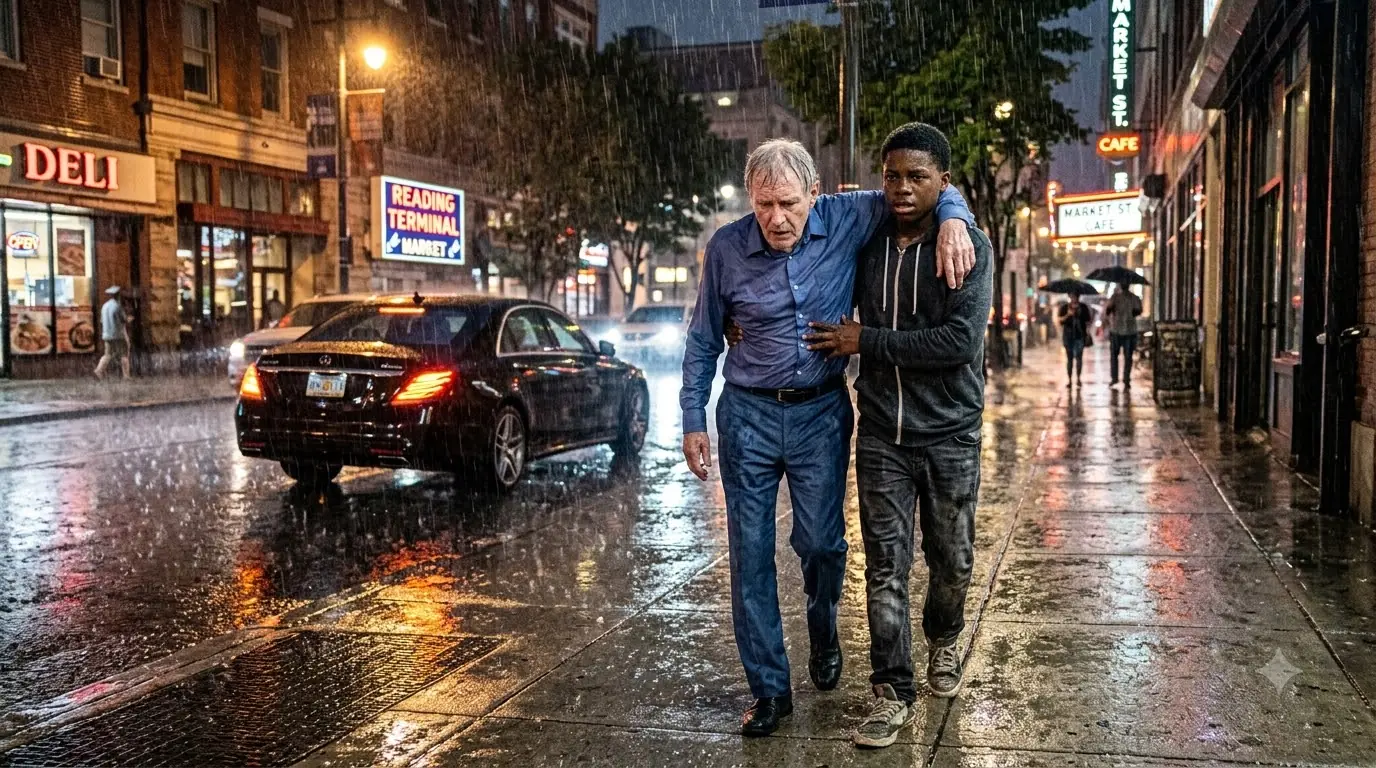
Thunder cracks. The old man's knees buckle. He goes down, catching himself on his hands, kneeling on the wet sidewalk. People rush past. Cars splash through puddles.
No one stops. The man tries to stand. He can't. His arms give out.
Deshawn moves before he decides to.
"Sir. Sir, are you okay?"
He runs over and kneels next to the man, rain pouring down both their faces. The man looks up, eyes unfocused.
"I just... I need to get home. Can't find my phone. I can't..." His voice is slurred. He's in medical distress.
"Where do you live?"
"Rittenhouse Square. 18th Street. Building with the green awning. I can't remember the number."
Rittenhouse Square. Twelve blocks, opposite direction from home, through the worst of the storm. Deshawn's phone is at home charging. He can't call 911. He can't call Grandma. He looks at the town car.
"Sir, your driver's right there."
"No." The man grabs Deshawn's arm.
"Not with him. I won't. I can't explain. Please. I need to walk home."
He's not making sense. But he's desperate, and he's sick. This isn't about the storm. This is about something else. Pride, a fight, it doesn't matter. What matters is that this man is going to collapse if someone doesn't help.
The stakes flash through Deshawn's mind. If I walk this man 12 blocks, I'll be soaked for over an hour. Risk of getting sick. Grandma will be terrified.
I might lose tomorrow's shift. We need $28. But if I walk away and this man dies, I'll carry that forever.