Jamal had $3.47 to his name. His little sister hadn't eaten in 3 days.
His grandmother was so weak from hunger that she could barely move her hands.
They'd been living in their broken-down car for almost a month.
This was their last money, their final chance to buy food before well, before they didn't know what would happen next.
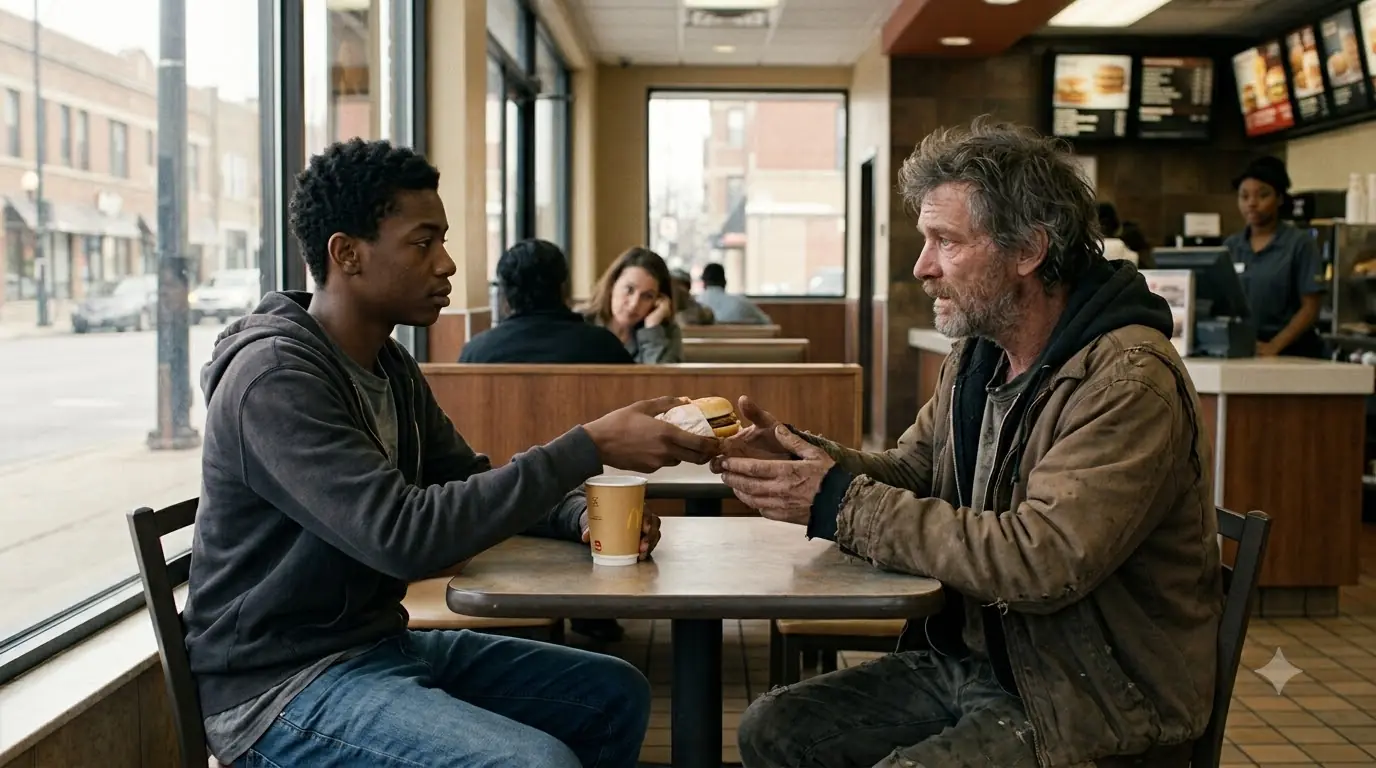
But when 15-year-old Jamal saw the homeless man shivering outside McDonald's, trembling from hunger and cold, he made a choice that would change his life forever.
"Sir," Jamal said, walking toward the stranger. "You look like you haven't eaten in days. Let me buy you something."
What Jamal couldn't see was the expensive watch hidden beneath the man's torn sleeve. He had no idea who he was really talking to, and he definitely didn't know that his next decision would transform his family's life in ways he never imagined possible.
But first, let me show you how desperate things really were. To understand why Jamal would give away his family's last money to a complete stranger, you need to see what their home looked like that morning.
The 1998 Honda Civic sat in the corner of a Walmart parking lot at 5:47 a.m. Inside, three people tried to sleep on seats that weren't meant for sleeping. Jamal's grandmother, Gloria, 64 years old, lay curled in the front passenger seat. Her arthritis had gotten so bad she couldn't straighten her fingers anymore. Every movement sent shooting pain through her joints.
In the back seat, 8-year-old Destiny slept against Jamal's shoulder. She'd stopped asking when they could go home 3 days ago. Now she just asked why her stomach hurt all the time. Jamal hadn't slept. He'd been doing math in his head all night, terrible, impossible math.
They had exactly $3.47 left. The car was nearly out of gas. Gloria needed her arthritis medication, but that cost $60 they didn't have. Destiny needed to eat, but school lunch cost $3.50 a day. Most importantly, if they didn't find somewhere permanent to live soon, winter would kill them.
They'd been homeless for 28 days. 28 days since the landlord changed the locks. 28 days since Jamal had to choose between paying rent or paying for Gloria's medicine. He'd chosen the medicine. Now they had neither.
Jamal's phone buzzed. A text from his friend Marcus. Bro, where have you been? Haven't seen you at school in weeks.
Jamal deleted the message without responding. How could he explain? Hey Marcus, I've been living in a car because my grandmother's arthritis got so bad she can't work, and I'm 15 so nobody will hire me for anything that pays enough to matter.
He couldn't even shower regularly anymore. They used McDonald's bathrooms to wash their faces with paper towels. Jamal had gotten good at timing it so the employees didn't notice the same three people coming in every morning. The hardest part wasn't the hunger or the cold or even the shame. The hardest part was lying to Gloria and Destiny every single day.
Don't worry Grandma. I got something lined up. We'll be back in a real house soon.
It's just temporary Destiny. Like camping, remember? This is our adventure.
But Jamal was 15 years old. He didn't have anything lined up. He'd been to every fast food restaurant, every grocery store, every place that might hire someone his age. They all said the same thing. Come back when you're 16.
When Jamal was 12, his mom died from cancer. Before she passed, she made him promise something. Baby, she'd whispered from her hospital bed, take care of Gloria and Destiny. They're going to need you to be strong.
I will, Mama. And Jamal, no matter how hard things get, you remember what I taught you. We help people. Even when we get nothing, we help people. That's what makes us human.
Now staring at those three crumpled dollar bills and handful of coins, Jamal wondered if his mom knew how hard that promise would be to keep. At 6:00 a.m., Gloria stirred awake. She tried to sit up, but winced in pain. "Morning, baby," she whispered.
"How are you feeling?"
"Good, Grandma. You?"
Gloria looked at her swollen, twisted fingers. "Oh, you know, same as always." But Jamal could see it was getting worse. Yesterday, she couldn't open a water bottle. Two days ago, she couldn't button her sweater. How long before she couldn't move at all?
Destiny woke up next. "Jamal, I'm hungry."
The words hit him like a punch to the stomach. When was the last time she'd had a real meal? He tried to remember. Monday? Tuesday? The days blurred together when you were just trying to survive each one.
"I know, baby girl. We're going to get some food today. Promise. Promise."
But looking at the $3.47 in his palm, Jamal didn't know how he'd keep that promise. At 7:00 a.m., they drove to the gas station where Jamal sometimes found day labor work. Today, nothing. The contractor who usually hired kids for cleanup jobs wasn't there.
At 8:00 a.m., they parked behind the library where Gloria could use the bathroom and sit somewhere warm while Destiny was at school. Jamal had been walking Destiny to school every morning, telling the teachers they were staying with family nearby while their house was being repaired. At 9:00 a.m., after dropping Destiny off, Jamal spent 2 hours walking around looking for work, any work. Cleaning parking lots, moving boxes, anything that would pay enough to buy food. Nothing.
By 11:00 a.m., they were back at McDonald's. The same McDonald's where they'd been going every day for 3 weeks. The bathrooms were clean, the Wi-Fi was free, and if you sat in the corner booth, the employees usually left you alone for a few hours.
That's when Jamal saw him. The homeless man sitting outside on the concrete shaking from cold and hunger. His clothes were torn and dirty. His hair was matted. He looked like he hadn't eaten in days. He looked exactly like how Jamal imagined his family looked to everyone else.
Jamal stared at the man, then at the money in his hand. $3.47, enough for one small meal. But for who? What Jamal couldn't see was that 6 hours earlier in a penthouse apartment across town, the homeless man had been putting on an elaborate disguise.
Robert Morrison stood in front of his bathroom mirror at 5:00 a.m. carefully applying dirt to his face and hands. He pulled on torn clothes that had cost $200 to make look authentically homeless.
"Today's the day," he told his assistant Sarah over the phone. "3 months of testing. If I don't find someone with real character today, I'm calling off the whole experiment."
"And if you do find someone?" Sarah asked.
"Then I'll have found the person who inherits my foundation. Someone who understands what it means to have nothing, but still chooses kindness."
Robert Morrison was worth $2.3 billion. He'd built his fortune in tech, but lost his family along the way. His daughter Emily hadn't spoken to him in 2 years. His wife had died thinking he cared more about money than people.
Now at 55, Robert wanted to give away his entire fortune, but not to some charity organization that would waste it on overhead costs and executive salaries. He wanted to find someone with genuine character. Someone who would help people the right way.
For 3 months, Robert had been conducting what he called Operation True Character. Every day he dressed as a homeless man and positioned himself in different locations around the city. He'd tested over 2,000 people. College students, business executives, working families, teenagers, elderly couples, every demographic you could imagine.
The results had been heartbreaking. 87% of people completely ignored him. They looked right through him like he was invisible. 11% threw spare change at him without making eye contact, like he was a parking meter, not a human being. 2% actually stopped to talk to him, but when he asked for food, they all gave the same response. "Sorry, I don't have cash for that."
Not one single person had offered to buy him a meal when they clearly had little money themselves. Robert was starting to lose faith in humanity. That's why today was his last day of testing. If no one passed his character assessment by sunset, he'd give his money to traditional charities and forget about finding someone special.
At 11:30 a.m., Robert positioned himself outside the McDonald's. He'd chosen this location carefully. It attracted working families, people who understood what it meant to struggle financially.