For thirty-two years, Mama Serita Montigue had prayed the same prayer every single night.
She prayed for her son.
She prayed for his safety.
She prayed that God would bring him back to her before she left this earth.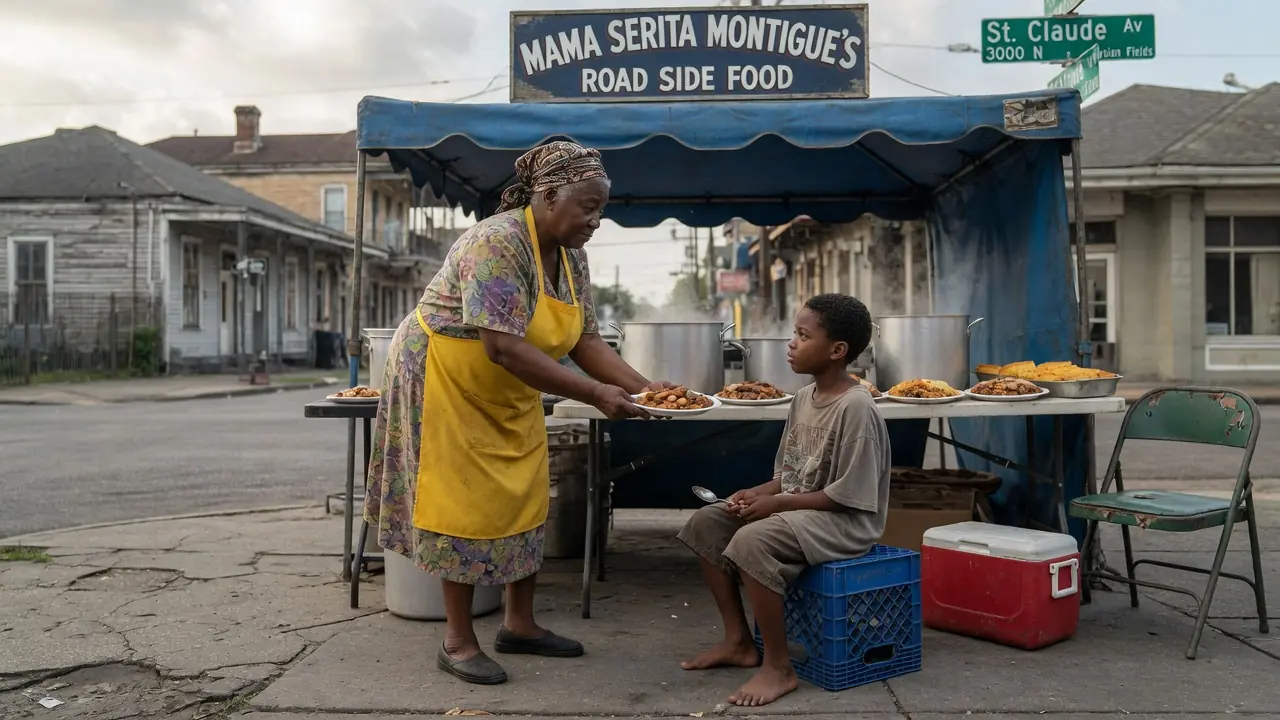
But on this humid Tuesday morning in New Orleans, Louisiana, as she stood behind her roadside food stall, flipping cornbread and stirring gumbo, she had no idea that her grandson was sitting just three feet away from her.
The boy came every morning now, thin and quiet, with eyes that had seen too much for someone so young. She fed him without questions, the way she had fed hundreds of hungry souls over the years.
His name was Taye.
He was eight years old, and he was homeless.
Mama Serita did not know his last name. She did not know where he slept. She did not know that the bracelet hanging around his neck matched the one she had made for her son three decades ago.
And she certainly did not know that in less than three hours, three black SUVs would pull up to her humble stall carrying a man whose face she had seen in her dreams for thirty-two years.
The morning rush had passed.
Mama Serita wiped down her counter with a worn cloth, her movements slow and deliberate. Her knees ached. Her back complained with every bend. But she kept going because this stall was all she had.
The corner of St. Claude Avenue and Elysian Fields was not much, just a patch of cracked concrete where she had set up her portable kitchen six days a week for the past fifteen years.
A faded blue canopy protected her from the sun. Two folding tables held her pots and pans. A small cooler sat in the shade.
Taye sat on an overturned plastic crate nearby, his bare feet dusty, his clothes two sizes too big. He ate his second helping of red beans and rice slowly, savoring every bite.
“You still hungry, baby?” Mama Serita asked.
The boy nodded but did not speak.
He rarely did.
She scooped more rice onto his plate.
“Don’t you worry. Mama Serita always got enough.”
Across the street, Miss Gloria stood on her porch, arms crossed, watching. She had been watching all week.
“Serita,” she called out. “That boy been coming here every day now. You know anything about his people?”
“No, Gloria, I don’t.”
“Well, somebody ought to call somebody. Child services or something. That ain’t right, him being out here alone.”
Mama Serita did not respond.
She had thought about it herself, but something held her back. Something she could not name. A feeling in her chest that told her to wait, to watch, to pray.
The boy finished his food and set the plate down carefully.
“Thank you, ma’am,” he whispered.
“You’re welcome, baby. You come back tomorrow, you hear?”
He nodded and walked away, disappearing around the corner toward the abandoned warehouse where he had been sleeping.
Mama Serita watched him go, her heart heavy.
She had lost her own son when he was seventeen.
Leavonne, her only child.
He had left home after a terrible argument with his father, disappeared into the night, and never come back.
Twenty-five years of searching.
Seven years since her husband died, still broken over losing their boy.
And every night, the same prayer.
Lord, bring him home. Let me see him one more time.
She shook her head and turned back to her stall. The lunch crowd would start arriving soon. Construction workers, delivery drivers, regular folks who knew her gumbo was the best on this side of the city.
But as she stirred her pot, she could not stop thinking about the boy.
About his eyes.
About the way he moved, careful and quiet, like he was trying not to be noticed.
And about that bracelet around his neck.
She had only glimpsed it once when his shirt shifted. Leather cord, small wooden beads, a pattern she recognized but could not quite place.
Miss Gloria crossed the street, her sandals slapping against the pavement.
“I’m telling you, Serita, that child needs help.”
“I’m helping him the best way I know how. By feeding him.”
“That ain’t enough. Where’s his mom? Where’s his dad?”
“I don’t know, Gloria.”
“You need to find out before something bad happens to him out here.”
“I’m praying on it.”
“Prayer is good, but sometimes the Lord needs us to take action, too.”
After Gloria left, Mama Serita stood alone behind her stall, watching the traffic pass by.
The morning sun climbed higher. The heat pressed down. Her hands moved automatically, preparing for the lunch rush.
But her mind was elsewhere.
Something about that boy pulled at her. Something deeper than simple compassion.
She had felt this way only once before in her life.
Thirty-two years ago, when Leavonne was born.
That instant connection.
That fierce, protective love that made you willing to die for someone without question.
Why did this homeless child make her feel the same way?
What she did not know was that the answer was already on its way.
Mama Serita’s memory drifted back as she worked. It always did when the day slowed down and her hands found their rhythm without her mind’s guidance.
Leavonne had been seventeen when he left, tall for his age, smart, stubborn like his father. They had argued that night over something that seemed important then, but felt meaningless now.
“You don’t understand anything,” Leavonne had shouted.
“Then help me understand. Talk to me.”
“I’m tired of talking. I’m tired of this place. I’m tired of being broke.”
Her husband, Raymond, had stepped in, his voice hard.
“Boy, you better watch your mouth in this house.”
“This isn’t a house. It’s a prison.”
Raymond had raised his hand, not to strike, but to point at the door.
“If that’s how you feel, then go. Get out.”
Mama Serita had grabbed Raymond’s arm.
“Don’t say that. Please don’t say that.”
But Leavonne was already moving toward the door, tears streaming down his face.
“Fine. I’m gone.”
“Leavonne, wait.”
He did not wait.
He walked out into the night, and she never saw him again.
They searched everywhere. They filed police reports, put up flyers, called every hospital, every shelter, every jail.
Nothing.
It was as if he had vanished into air.
Raymond had never forgiven himself. He died seven years ago with Leavonne’s name on his lips, begging God for one more chance to tell his son he was sorry.
Mama Serita wiped her eyes with the back of her hand.
The memories still cut deep.
After Raymond passed, she sold their house to pay for more searches. She hired private investigators and followed dead-end leads across three states. She spent every dollar they had saved, and when the money ran out, she started this food stall to survive.
Every morning, she woke up in her small apartment, cooked her food, wheeled her cart to this corner, and prayed the same prayer.
Lord, I know he is out there somewhere. I know he is alive. I can feel it in my bones. Please bring him back to me. Please let me see my son one more time before I die.
She had never stopped believing.
Even when people told her to let it go.
Even when friends said she needed to accept reality.
Even when the police closed the case and told her there was nothing more they could do.
A mother knows.
Deep in her soul, she knows.
The lunch rush arrived, pulling her back to the present. Workers lined up at her stall, cash in hand, hungry for her cooking. She served them one by one, exchanging small talk and smiles, her hands moving with practiced efficiency.
“How you doing today, Mama Serita?”
“Blessed, baby. Blessed.”
“That gumbo smelling good as always.”
“You know I don’t play when it comes to my cooking.”
The line moved. The money box filled. The sun blazed overhead.
But her thoughts kept returning to the boy.
To Taye.
What if he was someone’s Leavonne?
What if somewhere out there, a mother was praying the same prayer she had been praying for thirty-two years?
When the rush ended and the last customer walked away, she sat down on her folding chair and closed her eyes.
“Lord, I don’t know what you’re doing. I don’t know why you brought that boy to me, but I trust you. I trust your timing. Whatever this is, I’m ready.”
The afternoon stretched out quiet and still. Traffic hummed in the distance. A breeze rattled the canopy above her head.
And then she heard it.
The deep rumble of powerful engines growing louder, getting closer.
She opened her eyes.
Three black SUVs turned onto her street, moving slowly, deliberately, like they were searching for something.
Mama Serita stood up, her heart suddenly racing.
The vehicles stopped directly in front of her stall.
The doors of the first SUV opened.
A man stepped out.
He was tall, well-dressed in a dark suit. His posture spoke of money, of confidence, of someone accustomed to being obeyed.
But his face told a different story.
His eyes were red, hollow with exhaustion. His jaw was tight with worry. His hands trembled slightly as he straightened his jacket.
Two other men emerged from the second vehicle, both wearing security badges. They spoke into radios, their heads turning constantly, scanning the street.
The man in the suit walked toward Mama Serita’s stall.
Up close, she could see he was in his mid-thirties, his skin the same deep brown as hers, his hair cut close and neat.
“Excuse me,” he said.
His voice was cultured, educated, but underneath it ran a current of desperation.
“I’m looking for a boy. Eight years old. Thin. Might be alone.”
Mama Serita’s chest tightened.
“What’s his name?”
“Taye. Taye Montigue.”
The name hung in the air between them.
“Montigue,” she repeated slowly.
“Yes, ma’am. That’s my son. He’s been missing for three days. Someone told me they saw a boy matching his description in this area.”
Mama Serita gripped the edge of her table.
“Your son?”
“Yes. We had an incident at home. He got scared and ran. I’ve been searching everywhere.”
His voice cracked.
“Please, if you’ve seen him, I need to know.”
Behind him, more people emerged from the SUVs. A woman with a clipboard. Another security guard. Everyone looked tense, focused, ready to move at a moment’s notice.
“He was here this morning,” Mama Serita said quietly. “I fed him breakfast.”
The man’s entire body sagged with relief. He pressed his hand against his forehead.
“Thank God. Thank God. Where is he now?”
“He left about two hours ago. Went that way.”
She pointed toward the abandoned warehouse district.
The man immediately turned to his security team.
“Search every building in that direction. Go.”
They moved instantly, speaking into radios, organizing a systematic search pattern.
The man turned back to Mama Serita.
“Has he been coming here regularly?”
“Every day this week. Sometimes twice a day.”
“And you’ve been feeding him?”
“Yes.”
He pulled out his wallet, hands shaking, extracting several hundred-dollar bills.
“Please take this. For your kindness. For taking care of my son when I couldn’t.”
Mama Serita held up her hand.
“I don’t need your money.”
“Please. I insist.”
“I fed your son because he needed help, not because I expected payment.”
The man stared at her, something shifting in his expression.
“What’s your name?”
“Serita. Serita Montigue.”
He froze.
The wallet slipped from his hand and hit the ground.
“What did you say?”
“My name is Serita Montigue.”
The color drained from his face. He took a step back, his mouth opening, but no words came out.
Miss Gloria had returned to her porch, watching the scene unfold. Other neighbors had emerged too, drawn by the sight of the expensive SUVs.
“Montigue,” the man whispered. “Your last name is Montigue?”
“Yes. From New Orleans. Born and raised.”
He was breathing fast now, his chest rising and falling rapidly.
“Do you… did you have a son?”
Mama Serita’s hands began to shake.
“Yes. I had a son named Leavonne.”
The man made a sound that was half sob, half gasp. His legs seemed to give out, and he grabbed the edge of her table to steady himself.
“Mom.”
The word came out broken, desperate, full of thirty-two years of pain and longing and regret.
Mama Serita’s vision blurred.
The world tilted.
“Leavonne?”
“Mom, it’s me.”
She could not move, could not breathe, could not process what was happening.
The man she had been praying for.
The son she had been searching for.
The child she had lost thirty-two years ago.
He was standing right in front of her.
Was this really him? Or was grief playing cruel tricks on her heart?
Mama Serita’s hands gripped the table so hard her knuckles turned white. She could not trust her eyes. She could not trust her ears.
How many times had she seen his face in crowds, only to realize it was a stranger?
How many times had she heard his voice in her dreams?
“I don’t… I can’t.”
Her words caught in her throat.
Leavonne’s tears were falling freely now.
“Mama, it’s really me. I know you can’t believe it. I know I don’t deserve—”
“Show me your left wrist,” she interrupted, her voice suddenly strong.
He looked confused.
“What?”
“Your left wrist. Show me.”
With trembling hands, Leavonne pushed up his sleeve.
There, wrapped around his wrist, was a bracelet.
Leather cord. Wooden beads carved with an intricate pattern. Shells interspersed between the beads. And in the center, a small cross made from dark wood.
Mama Serita’s legs gave out.
She collapsed into her folding chair, her hand pressed against her mouth.
She had made that bracelet herself thirty-three years ago. She had spent weeks carving each bead by hand, using techniques her grandmother had taught her. She had blessed it, prayed over it, placed it on her son’s wrist.
He had worn it every day of his life until he left.
“You kept it,” she whispered.
Leavonne knelt down beside her chair, his expensive suit getting dusty on the concrete.
“I never took it off. Not once in thirty-two years. Even when I had nothing else, I had this.”
She reached out with shaking fingers and touched the bracelet. The beads were worn smooth now, darkened with age and oils from his skin. But she recognized every marking, every shell, every bead.
“My son,” she breathed. “My son.”
“Mama, I’m so sorry. I’m so sorry for everything. For leaving, for staying away, for not coming back sooner.”
She pulled him into her arms, and he buried his face in her shoulder the way he used to when he was small. His body shook with sobs.
“I thought you were dead,” she whispered into his hair. “I thought I lost you forever.”
“I wanted to come back so many times, but I was ashamed. I was angry. And then so much time passed, and I thought you wouldn’t want to see me.”
“Not want to see you? Leavonne, I’ve been praying for you every single day, every single night. I never stopped looking. Never stopped believing you were out there.”
Miss Gloria was openly crying now across the street. Other neighbors had gathered, hands over their mouths, witnessing something they would never forget.
Mama Serita pulled back and held her son’s face in her hands.
She studied every line, every feature. He had aged. Life had marked him. But underneath it all, she saw her baby.
The child she had rocked to sleep.
The boy she had raised.
The son she had loved with every fiber of her being.
“Where have you been?” she asked softly. “What happened to you?”
“It’s a long story, Mama. After I left, I went to Atlanta. I was homeless for a while. Angry. Lost. But I met some people who helped me. They got me back in school. I worked hard. I went to college. Built a business.”
He gestured at the SUVs.
“I made something of myself. But none of it meant anything because I didn’t have you.”
“And your daddy? Did you know that he died?”
“Yes. I found out two years ago. That’s when I started searching for you. But you’d moved. The house was gone. The neighbors didn’t know where you went. I’ve had investigators looking ever since.”
Mama Serita touched the bracelet again.
“And Taye?”
Leavonne’s expression darkened.
“That’s my son. Your grandson. And I’m about to lose him the same way Daddy lost me.”
She gripped his hand.
“What do you mean?”
“We had a fight, just like you and Daddy and me. And he ran, just like I did.”
The pattern was repeating.
But this time, could it be stopped?
Leavonne stood up, wiping his eyes with the back of his hand. Despite the expensive suit and the obvious success he had achieved, Mama Serita could see the boy he had been.
The same way he always carried his shoulders when he was worried.
The same gesture of running his hand over his head when he was thinking.
“Tell me about Taye,” she said. “Tell me what happened.”
Leavonne pulled out his phone and showed her a picture.
A beautiful boy with bright eyes and a wide smile. So different from the haunted child who had been sitting on that crate just hours ago.
“His mother died three years ago. She had cancer. It was just the two of us after that. I tried to be a good father, Mama. I really did. But I didn’t know how. Nobody taught me.”
The words hit Mama Serita like a physical blow.
“I’m not blaming you. I’m not. I’m the one who left. But I didn’t have a model for what a father should be after I walked out that door. I had to figure it out on my own. And I made mistakes.”
“What kind of mistakes?”
“I worked too much. I was never home. I thought if I could give him everything I didn’t have growing up, that would be enough. A big house, good schools, anything he wanted. But he didn’t want things. He wanted me.”
Mama Serita nodded slowly.
She understood.
Raymond had been the same way after Leavonne was born, working double shifts, trying to provide, thinking love could be measured in dollars.
“Two weeks ago, I missed his school play. He had been practicing for weeks. He was so excited. But I had a business meeting that ran late. When I got home, he was in his room crying. And I…”
Leavonne’s voice broke.
“I got angry. I told him he was being selfish. That he didn’t understand how hard I worked to give him the life he had.”
“Oh, Leavonne.”
“He looked at me with these eyes, Mama. These hurt, broken eyes. And he said, ‘I don’t want this life. I just want my daddy.’ And then he ran. He ran out of the house, and I couldn’t catch him. I’ve been searching for two weeks.”
Mama Serita stood up and took her son’s hands.
“You made a mistake. We all make mistakes. But you’re here now. You’re looking for him. That’s what matters.”
“What if I can’t find him? What if he’s gone forever, just like I was?”
“He’s not gone. I’ve been feeding him for two weeks. He’s close by.”
One of the security guards approached.
“Mr. Montigue, we’ve searched the first three buildings. No sign yet.”
Leavonne’s jaw tightened.
“Keep looking. Search every inch of this area.”
After the guard left, Mama Serita studied her son’s face.
“You really built something for yourself, didn’t you?”
“Yes, ma’am. I own a construction company now. Started with nothing. Worked my way up. We do major projects all over the South.”
“Your daddy would be proud.”
“I hope so. I hope you both can be proud of me despite everything.”
“I am proud of you. But success isn’t just about money or buildings. It’s about who you are inside. It’s about the person you become when nobody’s watching.”
Leavonne nodded.
“Taye said something similar once. He’s wise beyond his years.”
“Takes after his grandmother, I guess.”
For the first time, Mama Serita smiled.
“When we find him, I want to get to know him. Really know him.”
“When we find him, you’ll be part of his life every single day. I promise you that, Mama. No more lost years. No more distance.”
Another guard approached, speaking urgently into his radio.
“We found something. Building Four. Looks like someone’s been staying there.”
Leavonne immediately started moving toward his vehicle.
“Let’s go.”
“Wait.”
Mama Serita grabbed his arm.
“Let me come with you.”
“Mama, it might not be safe.”
“That’s my grandson. I’m coming.”
He looked at her for a long moment, then nodded.
“Okay. But you stay close to me.”
They climbed into the lead SUV, and the convoy began moving slowly down the street toward the abandoned warehouses.
What they would find in that building would change everything.
The warehouses loomed ahead, their broken windows like empty eye sockets staring out at the street. Graffiti covered the walls. Weeds pushed through cracks in the concrete.
This was the forgotten part of the city, the place people drove past without really seeing.
The SUV stopped in front of the fourth building.
Leavonne helped his mother out of the vehicle, keeping his hand on her arm.
“Stay behind me,” he said again.
The security team had already entered, moving carefully through the abandoned structure. Their flashlights cut through the darkness inside, revealing debris, old machinery, and evidence that homeless people had been using the space for shelter.
“Over here,” one of them called.
They followed the voice through a maze of corridors, past rooms filled with rotting equipment and collapsed ceilings.
Mama Serita’s heart pounded.
The contrast between this place and the clean, expensive interior of her son’s SUV was stark.
This was where her grandson had been living while Leavonne slept in what she imagined was a mansion somewhere.
They reached a small room in the back corner.
Someone had made an effort to clean it. Cardboard had been laid out as a makeshift bed. A plastic bag hung from a nail, holding a few items of clothing. In the corner sat an empty water bottle and some food wrappers.
Mama Serita recognized those wrappers.
They were from her stall.
“He’s been here,” Leavonne said, his voice tight. “But where is he now?”
One of the guards picked up something from the floor.
“Sir.”
He held out a small toy car, battered and old, but clearly well-loved.
Leavonne took it with shaking hands.
“I gave this to him when he was four. He still carries it everywhere.”
“Then he’s close,” Mama Serita said. “He wouldn’t leave without it.”
They spread out, searching the building more thoroughly. Mama Serita moved slowly, her eyes adjusting to the dim light.
She tried to understand what her grandson’s life had been like, sleeping on cardboard, eating only what she had given him, alone in this dark, frightening place.
“Taye,” Leavonne’s voice echoed through the empty building. “Taye, it’s Daddy. Please come out. I’m not angry. I just want to talk.”
Silence.
“Taye, your grandmother is here. She wants to meet you.”
Still nothing.
Mama Serita walked to what looked like a loading dock at the back of the building. The door hung open, revealing the street beyond.
She stepped outside into the bright afternoon sun.
And there, sitting against the wall about thirty feet away, was Taye.
He saw her immediately and tensed, ready to run.
“Wait,” she said softly. “Don’t go.”
He did not move, but he did not run either.
She walked toward him slowly, the way you would approach a frightened animal. When she was close enough, she sat down on the ground beside him, her old bones protesting.
They sat in silence for a moment.
“You know who I am?” she finally asked.
The boy nodded.
“Your daddy’s inside. He’s been looking for you.”
Taye’s voice was barely a whisper.
“Is he mad?”
“No, Taye. He’s not mad. He’s scared. He’s worried. He thinks he lost you forever.”
“I didn’t mean to make him worry. I just… I couldn’t stay there anymore.”
“Why not?”
“Because he doesn’t want me. He wants his work. He wants his meetings. He wants everything except me.”
Mama Serita’s heart broke.
“That’s not true.”
“Yes, it is. He’s always gone. And when he’s home, he’s on the phone or his computer. I’m just in the way.”
“Baby, can I tell you something? Your daddy went through something similar when he was your age. He felt the same way about his father.”
Taye looked at her for the first time.
“Really?”
“Really. And you know what? His father died still wishing he could tell your daddy how sorry he was. How much he loved him. How much he regretted not being there.”
Tears started rolling down the boy’s cheeks.
“Your daddy doesn’t want to make the same mistake. That’s why he’s here. That’s why he’s been searching for three days without sleeping. That’s why he came to find me, his own mama, after thirty-two years.”
Inside the building, footsteps approached.
Time was running out.
Mama Serita reached out and gently took Taye’s hand.
It was small and dirty, the fingernails chewed down to the quick.
This was her grandson.
Her blood.
The answer to prayers she had not even known to pray.
“You know what I’ve been doing for thirty-two years?” she asked softly.
Taye shook his head.
“I’ve been praying every single night. I prayed for your daddy to come home. I prayed for God to keep him safe. I prayed for one more chance to hold him and tell him I love him.”
“Did God answer?”
“Baby, you’re looking at the answer. Your daddy is inside that building right now. After thirty-two years of praying, God brought him back to me. And you know how?”
“How?”
“Through you. God used you to bring us back together. Because you came to my stall every morning. Because you were hungry and needed help. Because God knew exactly where to place you so I could feed you and take care of you.”
Taye wiped his nose with his sleeve.
“But I ran away. I did something bad.”
“Running away isn’t bad, baby. It’s human. Your daddy ran away, too. I understand why you did it. When we’re hurt, sometimes we don’t know what else to do except run.”
“I was so mad at him.”
“I know, and that’s okay. But being mad doesn’t mean you stop loving someone. And it doesn’t mean they stop loving you.”
“How do you know he still loves me?”
Mama Serita gestured toward the street where the three SUVs sat.
“You see those vehicles? Your daddy brought all those people to search for you. He shut down his whole business. He drove through this city street by street, looking in every neighborhood, asking every person he could find. Does that sound like someone who doesn’t care?”
Taye stared at the SUVs.
“Love isn’t perfect, baby. People make mistakes. Your daddy made mistakes with his father. His father made mistakes with him. And your daddy is making mistakes with you. But the important thing is that he’s trying. He’s here. He’s searching. He hasn’t given up.”
“What if I mess up again?”
“Then you try again. That’s what family does. We mess up, and we forgive, and we keep trying.”
Inside the building, she heard Leavonne calling again, his voice strained with worry.
“Your daddy’s voice sounds different, doesn’t it?” Mama Serita said.
Taye nodded.
“That’s fear. That’s love. That’s a father who realizes what he almost lost.”
She stood up slowly, her knees popping.
“I’m going to tell you something my mama told me a long time ago. She said, ‘The Lord works in mysterious ways, but He’s always working. Even when we can’t see it, even when we think He’s forgotten about us, He’s working everything together for good.’”
“You really believe that?”
“Baby, I’m looking at the proof. I fed you for a week without knowing who you were. Your daddy drove down my street without knowing I was there. And God brought us all together at exactly the right time. That’s not coincidence. That’s divine timing.”
Taye stood up too, still holding her hand.
“I’m scared,” he whispered.
“I know. But you know what’s scarier? Staying away. Living with regret. Wondering what might have been if you just had the courage to take one step toward forgiveness. Will you come with me, baby? I’m not letting go of your hand.”
They walked together around the building toward the front entrance.
With each step, Mama Serita felt decades of pain lifting off her shoulders.
This moment, right now, was the culmination of thirty-two years of faith. Thirty-two years of believing when logic said to give up. Thirty-two years of trusting that God heard her prayers.
When they rounded the corner, one of the security guards saw them immediately. He spoke into his radio, and within seconds, Leavonne came bursting out of the building.
He stopped when he saw them.
Stopped and stared as if afraid that moving would make them disappear.
Father and son looked at each other across twenty feet of cracked pavement.
This was the moment everything would either heal or break forever.
Nobody moved.
The world seemed to hold its breath.
Leavonne’s face was a mask of emotion. Fear, hope, regret, love. All of it warring for dominance. His hands hung at his sides, clenched into fists.
Taye stood frozen beside Mama Serita, his small body trembling.
“I’m sorry,” Leavonne finally said, his voice breaking. “I’m so sorry, son.”
Taye did not respond.
“I missed your play. I missed a lot of things. I’ve been a terrible father.”
Still silence.
“But I want to be better. I want to do better. I just need you to give me another chance.”
Mama Serita felt Taye’s hand tighten around hers. The boy was struggling, torn between the hurt he had been carrying and the love he still felt for his father.
“Your daddy means it,” she said softly. “I can see it in his eyes.”
“But what if he doesn’t change?” Taye whispered. “What if it’s the same as before?”
Leavonne heard him.
“Then you hold me accountable. You tell me when I’m messing up. You remind me what’s important. But please, Taye, please don’t run away again.”
Miss Gloria had followed them from the street, along with several other neighbors. They stood at a distance, watching, invested in this family story in a way that only close community members can be.
“That boy needs his father,” Miss Gloria said to no one in particular. “And that father needs his son.”
Taye took one small step forward.
Then another.
His eyes never left Leavonne’s face, searching for something, some sign that this time would be different.
Leavonne dropped to his knees on the pavement, bringing himself to his son’s eye level.
“I love you more than anything in this world. More than my business, more than my money, more than my own life. You are everything to me, and I’m going to prove it to you every single day from now on.”
“Promise?” Taye’s voice was tiny.
“I promise on everything I hold sacred. On your mother’s memory. On my own mother’s prayers. I promise.”
Taye let go of Mama Serita’s hand and ran.
He crashed into his father’s arms with such force that Leavonne almost fell backward.
They clung to each other, both crying, both broken, both beginning to heal.
Mama Serita watched through her own tears.
This was what she had prayed for.
Not just her son’s return, but his restoration. His chance to be the father he could not be before. His opportunity to break the cycle that had stolen so many years from their family.
The security guards stood back, several of them wiping their eyes. Miss Gloria was openly sobbing. Other neighbors applauded softly.
After a long moment, Leavonne stood up, lifting Taye into his arms. Even though the boy was getting too big to carry, he walked over to his mother, and suddenly the three of them were embracing.
Three generations connected by blood and pain and forgiveness and love.
“Thank you, Mama,” Leavonne whispered. “Thank you for not giving up on me. Thank you for feeding my son. Thank you for being here.”
“Leavonne, I’ll always be here. That’s what mothers do.”
He pulled back and looked at her.
“Come home with us. Right now. Pack up this stall and come home. You’re never working another day on this street.”
“Leavonne…”
“I mean it. You’re coming to live with us. Taye and I need you. We’ve lost too much time already.”
Taye nodded against his father’s shoulder.
“Please, Grandma. Please come.”
Mama Serita looked at her humble stall.
The faded canopy.
The worn pots and pans.
The folding chair where she had sat through heat and rain and loneliness for fifteen years.
This corner had been her life. Her purpose. Her way of surviving.
But maybe it was time for something new.
Maybe God had sustained her here just long enough to bring her family back together.
Maybe this chapter was ending so a better one could begin.
“Okay,” she said. “Okay, I’ll come.”
But what she did not know was that life was about to change in ways she could not even comprehend.
The security team helped pack up Mama Serita’s stall. They carefully loaded her pots, her pans, her precious recipes written in her own hand on stained index cards.
Everything that had been her world for fifteen years was carefully placed in the back of one of the SUVs.
Miss Gloria hugged her tight.
“You deserve this, Serita. You deserve every bit of happiness coming to you.”
“Thank you, Gloria. For everything. For being a good neighbor, a good friend.”
“You call me, you hear? Don’t forget about us down here.”
“I could never forget.”
The ride to Leavonne’s house took twenty minutes, moving from the rough streets of her neighborhood into areas she had only seen on television.
Gated communities.
Mansions behind iron fences.
Manicured lawns that probably cost more to maintain than she had earned in a year.
When they pulled through the gates of Leavonne’s property, Mama Serita’s breath caught.
The house was enormous, modern, beautiful, with floor-to-ceiling windows and a circular driveway with a fountain in the center.
“This is where you live?” she asked.
Leavonne helped her out of the vehicle, Taye still clinging to his hand.
“This is where we live now. All of us.”
Inside, the house was even more impressive. High ceilings. Marble floors. Art on the walls.
But Mama Serita also noticed something else.
Despite all the luxury, the house felt empty.
Cold.
Like a showroom rather than a home.
“It needs your touch, Mama,” Leavonne said, as if reading her mind. “It needs your warmth, your cooking, your prayers. It needs to feel like a real home.”
Over the following weeks, that was exactly what happened.
Mama Serita transformed the house.
She filled it with the smell of her gumbo, her cornbread, her red beans and rice. She planted herbs in the garden. She set up her rocking chair on the back porch. She made the guest room her own, though Leavonne had wanted to give her the master suite.
But more than the physical changes, she brought life back to that house.
She brought routine.
Every morning, she and Taye had breakfast together while Leavonne got ready for work. Every evening, she insisted they all sit down for dinner as a family.
No phones.
No laptops.
No distractions.
Leavonne kept his promise.
He cut back his hours. He attended every school event. He learned to be present, not just physically, but emotionally.
And when he started to slip back into old habits, Taye would remind him, and he would adjust.
Mama Serita watched her son become the father he was meant to be.
She watched her grandson blossom from a scared, hungry child into a confident, happy boy.
And she thanked God every single day for the miracle He had performed.
One Sunday evening, six months after their reunion, the three of them sat on the back porch watching the sunset.
Taye was doing homework.
Leavonne was reading.
Mama Serita was rocking gently in her chair.
“Grandma,” Taye said suddenly.
“Yes, baby?”
“Do you think Grandpa Raymond can see us now? Do you think he knows we’re all together?”
Mama Serita smiled.
“I believe he does. I believe he’s watching from heaven, and he’s proud of your daddy. Proud of all of us.”
Leavonne set down his book, his eyes glistening.
“I wish I could tell him I’m sorry.”
“Leavonne, he knows. And he forgives you, just like I forgive you. Just like Taye forgave you.”
They sat in comfortable silence as the sun dipped below the horizon, painting the sky in shades of orange and purple.
Mama Serita thought about the roadside stall, about the years of struggle, about the nights she had cried herself to sleep, wondering if her prayers would ever be answered.
And she understood now that none of it had been wasted.
Every tear.
Every prayer.
Every moment of faith.
It had all been building toward this.
She pulled out her worn Bible from the pocket of her apron, something she always kept close. Opening to a page she had marked long ago, she read aloud.
“For I know the plans I have for you, declares the Lord. Plans to prosper you and not to harm you. Plans to give you hope and a future.”
Jeremiah 29:11.
She closed the book and looked at her family.
Her restored family.
And whispered, “Thank you, Jesus.”
The Lord’s timing is always perfect.