Sarah Whitmore drove the hammer into the nail hard enough to split the board straight down the middle. Her palms were raw, her back had been aching for hours, and the child inside her kicked against her ribs as though reminding her that eleven weeks was not nearly as much time as it sounded. Sarah closed her eyes, rested one dirty hand over her swollen belly, and waited until the sharp pain passed. Then she picked up another board.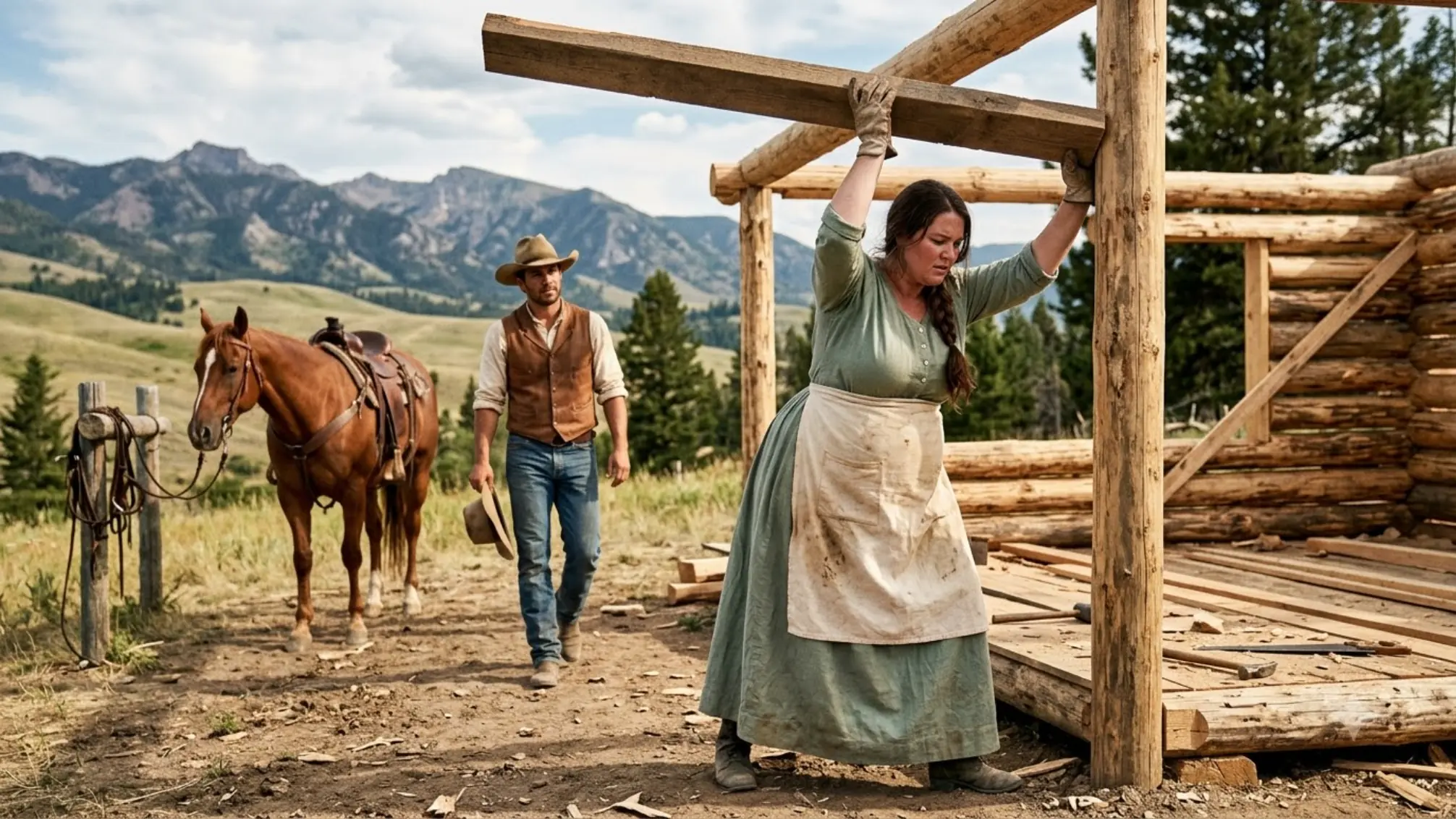
Nobody was coming to save her, and for the first time in Sarah’s life, that knowledge felt almost like freedom. She had arrived outside Cedar Ridge, Wyoming Territory, with forty acres of rocky ground, forty-three dollars left in her purse, a worn leather suitcase, a box of tools, and a building manual whose spine had nearly broken from use. There was no house waiting for her, no family, no hired crew, and no husband making decisions on her behalf. There was only open land, a creek along the eastern edge, a stand of pines against the northern rise, and enough stubbornness inside Sarah to make all of it feel possible.
The people in Cedar Ridge had decided what Sarah was before she ever reached her property. They saw a heavily pregnant woman traveling alone and assumed desperation, shame, or foolishness. At the livery stable, the owner stared at her belly before looking at the land deed she placed on his counter. “There’s nothing out there,” he warned.
“I know,” Sarah answered.
He read the deed again. “No cabin?”
“That’s why I bought lumber.”
He stared at her as though she had spoken in another language. Sarah had become familiar with that look. Men had spent years looking at her as though confidence belonged to someone else and had somehow landed on her by mistake.
Her former husband, Thomas Caldwell, had been different only in presentation. Thomas never shouted and never struck her. His control came wrapped in concern, financial security, polite instructions, and decisions made so smoothly that Sarah often realized they had been made only after they were finished.
For six years, she managed his Denver household, balanced the accounts, supervised staff, arranged social obligations, and kept everything around him functioning. Thomas accepted her competence without ever recognizing that it belonged to her. To him, Sarah’s intelligence was useful only when it served the structure of his life.
Pregnancy exposed that truth completely.
The moment Sarah told him she was expecting, Thomas began removing responsibility from her. First he told her to rest. Then he hired a male secretary to handle the household accounts she had managed for years. Finally, without asking her, he arranged for Sarah to spend the remainder of her pregnancy at his sister Margaret’s home in St. Louis.
Sarah discovered the plan from the housekeeper.
She walked directly into Thomas’s study.
“You’re sending me away.”
Thomas placed down his pen. “I was going to discuss it with you.”
“You already wrote to Margaret.”
“It is the sensible arrangement.”
Sarah stared at the man she had married and finally understood the difference between being cared for and being controlled. Thomas believed they were the same thing because he had never needed permission to control his own life.
“I need to be consulted before my husband decides where I will live.”
Thomas gave her the patient expression she had come to hate.
“You’re not well, Sarah.”
Those three words ended the marriage more effectively than shouting ever could.
Sarah packed before sunrise. She took half of the household money available to her, her mother’s sewing box, the building manual from the reading room, several dresses, and nothing Thomas could later claim belonged only to him. Weeks later, after legal filings and a journey west, she stood on Wyoming soil that was legally hers.
The first night, she slept beneath canvas stretched between two pine trees. Wind moved through the branches while Sarah lay under a wool blanket with both hands resting over her stomach. She could feel the child moving.
“I know,” she whispered into the darkness. “It isn’t much yet.”
The baby kicked.
“Give me time.”
By the fourth day, Sarah had raised the first wall.
It was not perfectly straight.
She measured it twice, frowned, consulted the manual, and decided it was close enough to continue. Each day taught her something the previous day had not. She learned how much more difficult timber became when it had to be lifted above shoulder height, how quickly the Wyoming sun drained strength from a pregnant body, and how one incorrect measurement could steal half a day.
She also learned that failure felt different when the decision belonged entirely to her.
When Thomas’s plans failed, Sarah had usually been expected to repair them quietly. When Sarah made a mistake on the cabin, nobody blamed her, corrected her, or explained what she should have done. She simply looked at the mistake, understood it, and tried again.
There was dignity in that.
Twice during the first week she cried after sunset. The first time was over a beam joint she had cut incorrectly. The second time had no single cause.
Her body hurt.
The cabin seemed impossibly unfinished.
The baby was coming whether the roof existed or not.
Sarah cried until nothing else came, washed her face, ate dried meat and bread, and went to sleep.
The following morning she worked again.