The dash-cam footage would eventually become the most-watched video in the state's history.
But on that humid afternoon, Officer Royce Harlan did not know the world was about to see everything he did.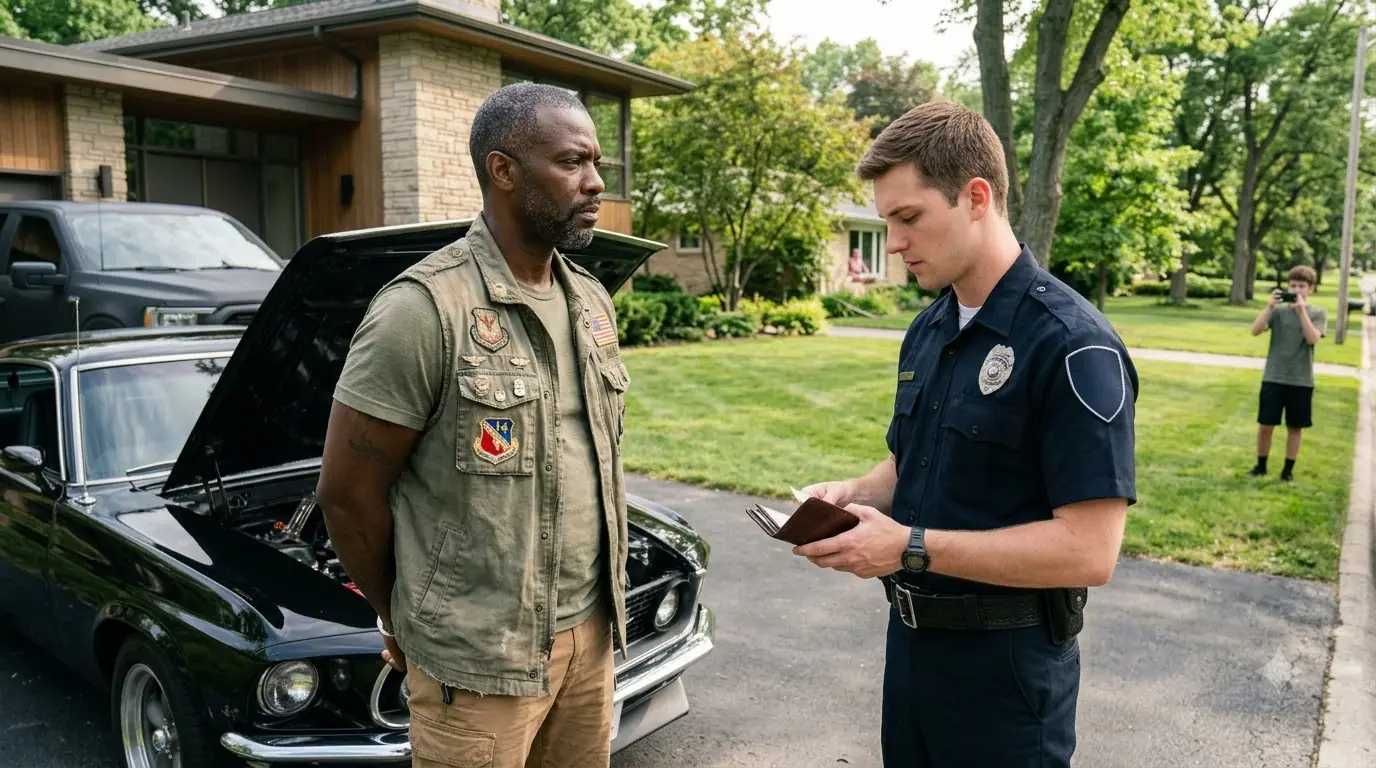
He saw a Black man in a faded olive T-shirt, cargo pants, and tactical boots standing beside a 1969 Dodge Charger on a property where Harlan had already decided he did not belong. He saw a suspect before he saw a homeowner.
He did not see the classified clearance card in the man's wallet, the scars from a long military career, or the contacts in his phone that reached people far above the Oak Haven Police Department. Harlan reached for authority before he reached for facts.
The man in the driveway was Darius "Dez" Kane, forty-five years old, recently retired after more than two decades in special operations. He moved with the careful economy of someone who had spent years learning that wasted motion could become a liability.
Dez had recently closed on 422 Maple Ridge, a sprawling mid-century modern home in Oak Haven, a suburb known for manicured lawns, high property taxes, and neighbors who noticed every unfamiliar vehicle. He had not moved in all his furniture yet, but his tools were there, along with the Charger he had been restoring.
The engine of the Charger rumbled as Dez wiped grease from his knuckles and leaned over the open hood. He was enjoying the rare luxury of a quiet afternoon.
Across the street, Loretta Voss watched from behind sheer curtains. She had lived on Maple Ridge for thirty years and considered herself an unofficial guardian of the block.
She knew which cars usually belonged on the street, and she did not recognize Dez's matte-black Ford F-150. She also did not recognize the broad-shouldered Black man working on the Charger in the Henderson home's driveway.
Loretta saw the tattoo on his forearm and assumed it was a gang symbol. In reality, it was connected to a military unit Dez rarely discussed.
She picked up her phone and dialed 911 instead of the non-emergency number. "There's a man stripping a car in the driveway of the old Henderson place," she said, lowering her voice as though Dez could somehow hear her through the glass.
"I think he's looting the property," Loretta continued. "He looks aggressive."
At that moment, Dez was humming an Otis Redding song and tightening a spark plug. There was nothing aggressive about what he was doing.
Several miles away, Officer Royce Harlan sat in his patrol cruiser behind a billboard, scrolling through his phone and waiting for something to happen. Harlan was twenty-six, ambitious, restless, and far too eager for confrontation.
Oak Haven was usually quiet, and quiet made him impatient. When dispatch announced a possible burglary in progress at 422 Maple Ridge, Harlan immediately answered.
"Show me en route," he said, pulling away from the roadside. He turned on his lights but left the siren off because he liked arriving before people knew he was there.
Back at the house, Dez heard tires crunching over gravel at the end of the driveway. He finished the turn of his wrench, placed it carefully on the felt cloth protecting the Charger's paint, and straightened.
Officer Harlan stepped out of the cruiser and rested his hand near his service weapon. He left the driver's door open behind him.
"Step away from the vehicle," Harlan ordered.
Dez kept both hands visible and turned toward him. "Afternoon, Officer."
"Can I help you with something?"
"I said step away from the vehicle. Put your hands where I can see them."
"You can see them," Dez replied. "I live here, and this is my car."
"I'm doing a tune-up."
Harlan stopped several feet away and looked from the expensive house to the restored Charger and then back to Dez. In his mind, the pieces did not fit because he had already chosen the explanation he wanted.
"You live here?" Harlan said with a short laugh.
"Sure you do. ID now."
"It's inside on the kitchen counter," Dez said. "I can get it, or you can run the plates on the truck and the Charger."
"Both come back to me."
"Don't move," Harlan snapped. "You have proof you own this car?"
Dez let out a tired breath. "My name is Darius Kane."
"Check the deed, check the registration, check anything you need to check, but lower your voice."
"Don't tell me how to do my job."
Harlan stepped closer until he was well inside Dez's personal space. He wanted the older man to react, because a reaction would make the story in his head easier to justify.
Dez did not step back. His posture remained still and controlled.
"Turn around," Harlan ordered. "Hands behind your back."
"I'm detaining you while I investigate burglary and failure to comply."
"Failure to comply? I'm standing here answering your questions."
"You're resisting. Turn around now."
Dez knew he could physically stop the encounter, but he also knew exactly what that would look like once the first few seconds were removed from context. He chose restraint.
"All right," he said quietly. "You're making a serious mistake."
Harlan grabbed Dez's wrist, turned him, and pushed him against the side of the Charger. The impact made the metal give a dull thud.
Harlan applied the handcuffs roughly, tightening them more than necessary. Dez adjusted his stance and remained calm.
"The left cuff is too tight," Dez said. "Check the spacing."
"I told you to shut your mouth."
Harlan searched Dez's pockets and removed a wallet, keys, and folded paperwork. He placed the items on the car and opened the wallet.
The driver's license read Darius Kane, 422 Maple Ridge. Harlan stared at it long enough to understand what it meant.
The address matched the house. Dez was exactly where he had said he belonged.
For a fraction of a second, Harlan could have ended the encounter, apologized, removed the cuffs, and left. Instead, pride pushed him deeper.
Beneath a hardware-store receipt in the wallet was a small black laminated card with clearance codes and a holographic chip. Harlan held it up.
"What is this? Fake federal ID?"
"Look at the back," Dez said. "There's a number."
"Call it."
"I'm not calling your friend to bail you out."
Harlan shoved the wallet into his own pocket and grabbed Dez by the arm. "You're coming in."
"We'll sort out your fake ID at the station."
Dez planted his feet and looked directly at him. "There is a camera on my porch, and there is a camera in your cruiser."
"You are arresting a homeowner on his own property for no crime."
Harlan's face reddened. He pulled his Taser and pointed it toward Dez.
"Get in the car or I will use this."
Dez looked at the device, then at Harlan. "Do what you think you have to do, but make sure your body camera stays on."
Harlan glanced down at the blinking light on his chest. Then he shoved Dez toward the cruiser.
This time Dez went with him. He had already seen a teenager two houses away recording from an upstairs window, and he knew the more witnesses there were, the less room Harlan would have to rewrite the story later.
Dez sat in the back of the cruiser with his wrists cuffed behind him. Harlan climbed into the front and keyed his radio.
"Dispatch, one in custody, uncooperative," Harlan said. "Transporting for processing."
"Possible forgery and possession of fraudulent government identification."
Dez closed his eyes briefly. The officer had now turned a bad stop into a false arrest and an invented federal-ID allegation.
As they drove, Harlan kept checking the rearview mirror. "We get guys like you all the time," he said.
"Move into a nice town, flash some cash, think you can do whatever you want."
"Is that what I am?" Dez asked.
"You don't belong there, Kane. I don't care what the deed says."
"I know a drug front when I see one."
Dez gave a humorless laugh. "A drug front."
"That's the story now?"
"Where else does a guy like you get money for a place like that?"
Dez looked through the cage separating the front and back seats. "I served twenty-two years in the United States military."
"The money for that house came from years of service and compensation for injuries that ended my career."
Harlan said nothing.
"If you search my truck," Dez continued, "you'll find tools, paperwork, and a copy of the Constitution. You should spend some time with the last one."
Harlan braked hard at a stop sign. Dez lurched forward against the cage.
"Not another word," Harlan shouted.
"Remember that you started this," Dez replied.
The Oak Haven precinct was a squat brick building that looked decades overdue for renovation. Harlan brought Dez through the rear entrance into the booking area.
Sergeant Marcus Kowalski looked up from a sandwich. "What have you got, Royce?"
"Resisting and disorderly," Harlan said. "Possible forged government ID, too."
He tossed the black laminated card onto the booking desk. "Caught him stripping a car on Maple Ridge."
"Claims he lives there."
Kowalski picked up the card, wiped his fingers, and looked at the holographic chip. His expression changed.
He turned it over and read the number printed on the back. Then he looked at Dez.
"Sir, full name and rank?"
"Master Sergeant Darius Kane, retired," Dez answered. "And I would like these cuffs removed."
Harlan rolled his eyes. "Sarge, don't listen to him."
"He's lying."
"Royce, stop talking."
The booking room went quiet. Kowalski came around the desk with a handcuff key.
"You didn't run this card, did you?" he asked Harlan.
"You didn't call the number."
"It's fake."
"It's not fake."
Kowalski unlocked the cuffs. "This is Department of Defense identification tied to a high-level clearance."
"Whatever you think you arrested, you have badly misread the situation."
Dez rubbed his wrists. "I told him to call the number."
"He preferred to accuse me of running drugs out of my own home."
Kowalski closed his eyes for a moment. "Royce, go to Captain Thorn's office."
"Now."
Harlan walked away angry and confused.
"And don't turn off the camera," Dez said. "My home security system already has the first half of this afternoon, and your cruiser has the rest."
Kowalski tried to lower the temperature. "Mr."
"Kane, I'm sure this can be cleared up. Harlan is young."
"Young is not the problem," Dez said. "The problem is that he decided what I was before he checked anything."
He took his ID back from the desk. "I want to file a formal complaint, and I want the badge number of every officer involved, including his supervisor."
Captain Elias Thorn believed most departmental crises could be managed with paperwork, careful language, and enough time for public attention to move elsewhere. He had run the precinct for twelve years and had survived problems that should have ended other careers.
When Dez entered Thorn's office, the captain tried a conciliatory smile. "Mr."
"Kane, please sit down. I think we got off on the wrong foot."
Dez remained standing.
"Officer Harlan is young and overzealous," Thorn continued. "We're prepared to void the disorderly conduct charge immediately."
"You're prepared to drop a charge that never had a lawful basis," Dez said. "That's generous."
Thorn tapped a pen against his desk. "Technically, Harlan reported that you were combative and refused to identify yourself."
"But in the interest of community relations, we can make this disappear."
"And what happens to Harlan?"
"A reprimand, retraining, perhaps a short suspension."
Dez stepped closer. "Your officer put a weapon on a calm, unarmed homeowner, ignored identification, trespassed on private property, used unnecessary force, and seized a federal credential."
"Let's not exaggerate."
"I'm not exaggerating."
Thorn's smile vanished. "You were in the military."
"You know how split-second decisions work."
"This was not a battlefield," Dez replied. "It was a driveway in suburbia."
He pulled out his phone. "I'm making a call."
Thorn leaned back. "A lawyer?"
"I would advise you to think carefully. Local attorneys still have to work with this department."
Dez ignored him and dialed a number from memory. When the line connected, his voice changed only slightly.
"Colonel Vance, it's Master Sergeant Kane. Yes, sir, I'm fine."
"I have a situation in Oak Haven. False arrest, unlawful seizure, and a local officer took my clearance ID and tried to enter it into their system."
Thorn stopped tapping the pen.
"Yes, sir. The Yankee White card."
"I'm currently in Captain Elias Thorn's office."
Dez listened for several seconds, then held out the phone. "Colonel Vance would like to speak with you."
Thorn stared at it before finally taking it. "Captain Thorn speaking."
Colonel Vance's voice was controlled and severe. "Captain, your department seized a Department of Defense credential tied to protected information."
"Do not alter any record connected to this encounter."
Thorn's face drained of color.
"A liaison is being dispatched to your precinct," Vance continued. "Preserve every body-camera file, cruiser recording, dispatch record, and booking entry."
"Do not let Officer Harlan leave the building."
"Understood," Thorn said.
"Put Kane back on."
Dez took the phone. "Roger that, sir."
"I'll wait."
He hung up and looked at Thorn. "Now we can talk about the formal complaint."
Thorn immediately summoned Harlan. The young officer entered with the confidence of someone who still believed the department would protect him from every consequence.
"You wanted me, Cap?"
"Close the door."
Harlan noticed Dez and frowned. "Why is he still here?"
"Did you book him?"
Thorn's restraint snapped. "Do you have any idea what you've done?"
"I did my job," Harlan said. "He was noncompliant, and I smelled marijuana near the car."
Dez turned his head slowly. "You never mentioned any smell at the scene, in the cruiser, or at booking."
"I put it in the report," Harlan said quickly. "Suspect appeared intoxicated."
"Strong odor of cannabis. That gives probable cause."
Thorn knew the story had changed in front of him. He also understood the temptation hidden inside the lie.
If the department could find something illegal in Dez's vehicles, the entire encounter would become messier. Thorn's instinct for self-preservation started working faster than his ethics.
"You're certain you smelled it?" Thorn asked.
Harlan recognized the opening. "Absolutely."
"Search the truck and the Charger, and we'll find something."
"Stop digging," Dez said. "You still have time to stop making this worse."
Thorn made the worst decision available to him. "Take a K-9 unit back to the house."
"Verify the odor and document the search."
Dez stared at him. "A federal liaison is coming here, my attorney is on the way, and my property is covered by cameras."
"If anyone plants evidence, that becomes part of the record, too."
Harlan gave him a thin smile. "We'll be careful."
He left before Thorn could reconsider.
Outside the station, another version of events was already spreading faster than any police report. Tyler, the seventeen-year-old who lived two houses from Dez, had recorded the arrest from his upstairs window.
The video showed Dez standing beside his own car with his hands visible. It showed Harlan escalating, refusing to verify the address, applying cuffs, and forcing Dez into the cruiser.
Tyler uploaded the clip to social media with a simple caption about a neighbor being arrested while working on his own car. Within minutes, thousands of people had seen it.
By the time Harlan left the station with the K-9 unit, the video had crossed a million views. Veterans, attorneys, mechanics, Oak Haven residents, and people who knew Harlan from previous encounters filled the comments.
Some viewers recognized military insignia on Dez. Others focused only on the officer's failure to verify the simplest facts.
The station phones began ringing. Local residents called first, then local newsrooms, then national producers asking for a statement.
A dispatcher knocked on Thorn's door. "Captain, the phones are jammed."
"News vans are pulling up, and the mayor is on line one."
Thorn put his face in his hands. "Tell them we're reviewing the incident."
Back at 422 Maple Ridge, Harlan stepped out with a German Shepherd named Buster. The neighborhood no longer felt empty.
People stood on porches and sidewalks, watching. Loretta remained behind her window, increasingly uncertain that her original call had led to what she thought it would.
Harlan led Buster around the Charger. The dog sniffed the tires, the rocker panels, and the driver's side but gave no indication of narcotics.
Harlan's jaw tightened. He reached into his pocket and closed his fingers around a small plastic bag containing marijuana that had never been logged into evidence.
He looked around and saw no officer standing close enough to challenge him. Then he moved toward the open side of the Charger.
He had just begun to lower his hand when a voice came from the sidewalk. "I would not do that if I were you."
Harlan jerked around. The bag fell onto the gravel beside his boot.
A man in a tailored navy suit was walking up the driveway with a briefcase in one hand. Beside him was a Channel 5 camera crew whose lens was pointed directly at Harlan.
"Officer, step away from the vehicle," the man said.
"Who are you?" Harlan demanded, trying to move one foot over the plastic bag.
"Harrison Lang. I represent Darius Kane."
Harlan knew the name. Lang was one of the most successful civil-rights attorneys in the state and had built a reputation on cases involving police misconduct.
Lang pointed toward the camera. "We have been recording for several minutes."
"Do not touch that bag, the car, or anything else in this driveway."
"I found this," Harlan said, his voice suddenly unsteady. "It fell from the vehicle."
The reporter stepped forward. "Officer, our camera recorded you taking it from your pocket."
Harlan stared at the camera's red recording light. For the first time that day, panic overtook anger.
"This is an active investigation," he said. "Move back."
"The district attorney has already been notified," Lang replied. "You have been ordered to stand down and return to the precinct."
The neighborhood heard every word.
At the same time, two dark vehicles pulled into the Oak Haven station lot. Colonel Vance arrived with two federal investigators, including Special Agent Sterling from the FBI Public Corruption Unit.
They moved directly through the booking area and into Thorn's office. Thorn stood as soon as he saw them.
"Can I help you?"
Agent Sterling showed her credentials. "Captain Elias Thorn, your department is under immediate investigation for possible civil-rights violations, obstruction, and falsification of police records."
She placed a preservation order on his desk. "We are securing your body-camera files, cruiser recordings, dispatch logs, booking records, and internal servers."
Dez straightened from the wall where he had been waiting. Colonel Vance offered him a hand.
"Good to see you, Dez. You look like you had a difficult afternoon."
"I've had better, sir."
Thorn tried to speak. "This is a misunderstanding."
"Harlan said he smelled drugs."
Agent Sterling's expression did not change. "We have Mr. Kane's home-security video."
"We have dash-camera audio. We also have live news footage from his driveway showing Officer Harlan with suspected contraband taken from his own pocket."
Thorn sank into his chair.
"Where is he?" Dez asked.
"Returning now," Sterling said. "He will not be returning to duty."
Dez left the office with Colonel Vance and the federal agents. Officers in the booking room avoided his eyes.
Outside, cameras flashed in the late-afternoon light. Dez looked past them and saw Harlan's cruiser turning into the lot.
The Oak Haven Police Department parking lot had become a public scene of accountability. Satellite trucks lined the curb, reporters crowded the fence, and unmarked federal vehicles blocked the easiest exits.
Harlan saw all of it through the windshield and gripped the steering wheel. He still believed explanation might save him.
He parked, stepped out, and immediately faced shouted questions. "Officer Harlan, did you plant evidence?"
"Why did you arrest the homeowner? Did you turn off your camera audio?"
Harlan pushed past microphones and reached the back door. He swiped his key card.
The reader flashed red. Access denied.
He tried again with the same result. "Open the door."
"It's Harlan."
The door opened from inside, but Sergeant Kowalski blocked the threshold. He held out one hand.
"Badge, weapon, and keys."
Harlan gave a nervous laugh. "What is this?"
"You're not coming into the squad room as an officer."
"You can't do that. I have rights."
"You do," Agent Sterling said as she stepped into view. "Including the right to remain silent."
She showed her badge. "Royce Harlan, you are under arrest for deprivation of rights under color of law, obstruction, and conspiracy to manufacture evidence."
Harlan froze.
"Federal? This is a local matter."
"It stopped being only local when evidence connected to a federal investigation was compromised and when your conduct became part of a broader corruption inquiry."
Harlan looked at Kowalski. "Sarge, help me."
"I did this for the department."
Kowalski's face hardened. "You did it for yourself."
"Turn around."
The handcuffs closed around Harlan's wrists.
Dez stepped out behind the group with his personal effects returned. He stopped several feet away from the man who had called him a criminal and tried to turn a false stop into a fabricated drug case.
"I warned you that you were making a mistake," Dez said. "You had several chances to verify the truth and walk away."
"You set me up," Harlan said, his voice shaking. "You knew who you were and let me do it."
"I did not make you do anything."
Dez looked him in the eye. "You saw a Black man in a nice house and decided he was a criminal before you checked his name, his address, or his registration."
"I just refused to give you a reaction you could use to rewrite what happened."
Agent Sterling took Harlan by the arm. "Let's go."
The federal agents walked him toward an unmarked vehicle. People beyond the fence watched in silence and then began shouting questions as the doors closed.
Dez felt no celebration. He felt only the heavy relief that comes when a threat has finally been stopped.
He turned to Colonel Vance. "What happens to Thorn?"
Vance glanced toward the station. "If he is smart, he tells the truth before the records tell it for him."
The FBI interview that followed revealed that the incident was not an isolated burst of misconduct. It was part of something larger.
Harlan sat in a plain interview room while Agent Sterling placed files in front of him. He had stopped trying to look defiant.
"We have the video from the driveway," Sterling said. "We have the attempt to plant drugs, the changing report, and your conversation with Captain Thorn."
Harlan looked at the table.
"But we also reviewed your arrest history. Over the last three years, you made dozens of arrests for vague offenses such as suspicious activity and resisting arrest in Maple Ridge and Oak Haven Heights."
Sterling slid a second stack forward. "In many of those arrests, vehicles, jewelry, electronics, or cash were seized."
Harlan remained silent.
"Some of those assets went through civil forfeiture," she continued. "The auction trail makes no sense."
"A luxury vehicle sold for a fraction of its value to a shell company connected to Captain Thorn's brother-in-law. A seized watch disappeared from evidence."
Harlan finally looked up.
Sterling leaned closer. "This was not only profiling."
"Profiling helped you choose victims, but greed was part of the system."
She tapped a photo of Dez's Charger. "You did not just see a man you did not think belonged on Maple Ridge."
"You saw a valuable car you thought your department could seize."
Harlan's face lost color.
"Thorn said that if we established probable cause, the car could be held," he whispered. "He said he knew people who could buy parts."
Harrison Lang, present as counsel for Dez in the civil matter, wrote the statement down. Agent Sterling kept her attention on Harlan.
"Then tell us every vehicle, every watch, every cash seizure, every false report, and every person who helped."
Harlan broke. He named Thorn, two other officers, and a court employee who had expedited questionable forfeiture orders.
He described how stops were created, how vague complaints became pretexts, and how seized property moved through paperwork that made theft look administrative. The more he spoke, the less the story resembled misconduct by one officer and the more it resembled an organized scheme.
Across town, Loretta Voss sat in her living room watching the news. The headline read: "Oak Haven Police Corruption Probe Expands After Homeowner Arrest."
For the first time, she watched the entire recording from Tyler's window instead of the fragment she had imagined through her curtains. Dez had been calm from the beginning.
Harlan had escalated. Her 911 call had provided the opening.
Loretta felt a hard knot in her stomach. She had thought she was protecting the neighborhood, but the department had known people like her would call on strangers who did not fit their expectations.
Her phone rang. Her daughter was calling from college.
"Mom, is that our street on the news? Did you call the police on him?"
Loretta hesitated. "I thought he was stealing the car."
"He owns the house."
Loretta closed her eyes.
"Mom, everyone has seen the video. How could you decide that without asking anything?"
Loretta had no answer. After the call ended, she looked through the window at 422 Maple Ridge.
Dez had returned home. He passed in front of his living-room window and briefly looked across the street.
He did not wave or glare. He simply looked at Loretta's house, and she closed the curtains.
Within weeks, she would put the property on the market. The shame of the call, combined with the public attention, had made the home she had occupied for thirty years feel unlivable.
Dez sat alone that evening in the quiet house. Federal and military officials had left after ensuring the scene was secured and the evidence preserved.
The doorbell rang. The monitor showed Captain Elias Thorn standing outside without his uniform.
Dez opened the door but did not invite him in.
"Mr. Kane," Thorn said.
"The FBI is at my house. They gave me a few minutes before I go with them."
"Why are you here?"
Thorn swallowed. "Why didn't you just show the military ID before Harlan arrested you?"
"Why not end it before it became all of this?"
Dez stared at him for several seconds. "I tried to identify myself."
"He did not care."
"But if he had known who you were-"
"That is the point."
Dez's voice remained calm. "I should not need a high-level clearance to be treated like a human being in my own driveway."
"I should not need a colonel to make a patrol officer respect the truth."
Thorn looked down. "I'm sorry."
"Save that for the people whose property you took."
Thorn's shoulders sagged.
"You used this town," Dez continued. "You used the badge to take from people who had fewer resources and less power to fight back."
"You finally chose someone who could document every step."
Dez started to close the door.
"Harlan is young," Thorn said quickly. "Don't let them destroy his whole life."
Dez stopped. "He was old enough to invent a drug allegation and old enough to carry evidence in his pocket to plant in my car."
"That was not youth. It was a decision."
He closed the door.
A message from Harrison Lang arrived minutes later. The governor had suspended the Oak Haven command staff, the Department of Justice was opening a pattern-or-practice investigation, and the city wanted to settle Dez's civil claim before it reached trial.
The first offer was three million dollars.
Dez typed back, "I want a legal defense fund for everyone Harlan arrested and everyone the department took property from. Every case gets reviewed."
He put the phone down and looked through the front window at the unfinished Charger. "Tomorrow," he said quietly.
"I'll finish it tomorrow." The story had already dominated the news cycle for days when another revelation came from the governor's mansion.
Governor Katherine Holloway called an emergency press conference and stood beside the state police commander.
"Yesterday, I learned the identity of the veteran mistreated by the Oak Haven Police Department," Holloway said. "The public knows him as Master Sergeant Darius Kane, but his service record contains acts that most citizens were never meant to know in detail."
She paused and steadied herself.
"Six years ago, my son, a freelance journalist, was taken hostage overseas. The government publicly warned that a rescue might be impossible."
Reporters shifted in their seats.
"A special operations team went anyway," Holloway continued. "They crossed dangerous terrain, recovered the hostages, and brought my son home."
Her voice tightened with emotion. "The team leader carried my son for miles after he himself had been injured."
"That team leader was Darius Kane."
The room erupted in murmurs.
"He is one of the reasons my family is whole," the governor said. "What happened in Oak Haven is therefore personal to me, but it should matter even if he had never served a day in uniform."
She looked directly into the cameras. "No citizen should have to prove extraordinary service before being treated with ordinary dignity."
That sentence spread farther than the details of Dez's military past. It became the line repeated in editorials, legal panels, community meetings, and police-training discussions across the state.
A crowdfunding page that supporters had created for Dez's legal expenses surged into the millions. Dez immediately announced that he did not need the money for himself and wanted the funds redirected to people seeking review of wrongful arrests and questionable property seizures connected to Oak Haven.
In county custody, Royce Harlan watched the governor's statement on a television mounted high on a wall. He finally understood the scale of what he had triggered.
The man he had dismissed as a criminal had enough credibility to draw federal, state, military, and media scrutiny at the same time. But the most damaging evidence still had nothing to do with Dez's status.
It was the video. It was the false report.
It was the attempted evidence planting.
It was also the years of seizure records, auction paperwork, missing property, and victims who began coming forward as soon as they realized someone was finally listening.
The Department of Justice review moved quickly because the pattern was already visible. Cases that once looked disconnected began to line up by officer, neighborhood, property value, and forfeiture outcome.
Several residents described nearly identical encounters. An officer would arrive on a vague complaint, escalate the contact, create a justification for arrest, and then list valuable property as connected to an investigation.
Some people had fought the seizure in court. Others had lacked the money or time to do so and walked away from property they could not afford to recover.
Harlan's cooperation helped investigators fill gaps in the paper trail. He admitted that Thorn had pushed officers to identify "productive stops" in affluent neighborhoods where expensive vehicles or valuables might be seized.
He also admitted that race and class shaped who officers considered suspicious. People who appeared out of place in expensive neighborhoods were easier to frame because biased assumptions made the reports sound believable.
The court employee implicated by Harlan eventually cooperated as well. Financial records tied several discounted forfeiture purchases to companies linked to associates of Thorn and his family.
The seized Mercedes mentioned by Agent Sterling had indeed been sold at a fraction of its value. The missing Rolex was traced to a private resale transaction.
Two additional officers were suspended and later charged. The Oak Haven department's command structure began collapsing almost immediately.
Harrison Lang filed Dez's civil suit, but its language was broader than a single false arrest. It described a departmental culture that rewarded escalation, tolerated biased policing, and allowed forfeiture procedures to become a private revenue stream.
Lang also filed preservation requests for every arrest and seizure involving Harlan and Thorn over the relevant period. The city initially resisted the scope, then changed position when federal subpoenas arrived seeking many of the same records.
Sergeant Kowalski gave a voluntary statement. He admitted that he had seen warning signs in the department but had treated them as personality problems rather than evidence of a corrupt system.
"I thought Harlan was reckless," he told investigators. "I did not understand that the recklessness was useful to people above him."
The sentence appeared in a later public report.
Tyler's original phone video was authenticated and preserved. The dash-cam and body-camera files matched it, while Dez's porch cameras added angles that removed any remaining doubt about the beginning of the encounter.
The records showed that Dez had never threatened Harlan. He had not attempted to flee, had not reached for a weapon, and had repeatedly offered lawful ways to verify his identity and ownership.
The audio from the cruiser became even more damaging. Harlan's remarks about who belonged in Oak Haven and how someone "like" Dez could afford the house were played repeatedly on the news.
Dez hated hearing them. He also understood why the public needed to hear them without edits or euphemisms.
At Lang's request, Dez gave only one major interview. He sat in his unfinished living room with the Charger visible through the front window behind him.
"People keep asking why I stayed calm," he said. "I stayed calm because I knew anger would become evidence against me even if the anger was justified."
The interviewer asked whether his military background helped.
"Discipline helped," Dez said. "But a citizen should not need special training to survive a police encounter."
"The responsibility belongs to the person with the badge and the authority."
He refused to describe classified operations or turn the interview into a celebration of his past. Every time the conversation moved toward heroism, he brought it back to the people who had lost cars, money, jobs, and trust because they did not have his resources.
"I was lucky," he said. "My cameras worked."
"A teenager recorded from a window. A sergeant recognized the card."
"My attorney arrived fast. Federal people answered the phone."
He leaned forward. "Most of the people this system hurt had none of that."
"That is who this case should be about."
The federal grand jury returned indictments several months later. Harlan, Thorn, two officers, and the court employee faced combinations of civil-rights, obstruction, fraud, and conspiracy charges.
The indictment described the property-seizure scheme in dry legal language. The clinical phrasing made the conduct sound almost ordinary, which Dez found more disturbing than sensational headlines.
Harlan initially considered going to trial. His attorney changed course after prosecutors disclosed the synchronized video from Tyler's window, Harlan's body camera, the cruiser, the news crew, and Dez's security system.
The attempted evidence planting was visible from more than one angle. His evolving reports contradicted the recordings.
Thorn faced an even larger problem. Financial records connected people close to him to forfeited assets, and Harlan's cooperation gave investigators a map of where to look.
Both men eventually pleaded guilty. The other defendants followed after their motions to suppress evidence failed.
Before sentencing, dozens of victims submitted impact statements. Some described financial losses, while others described years of fear whenever a patrol car slowed near their homes.
One man had lost a work truck and nearly lost his business. A woman had spent more than a year trying to recover jewelry that had belonged to her mother.
Parents described telling teenagers not to drive through certain neighborhoods because a minor traffic stop could become something much worse. The pattern had reshaped daily life in ways no spreadsheet could show.
Dez read the statements alone at his kitchen table. The house was finally furnished, but the room still felt quieter than it should have.
He thought about the first few minutes in his driveway. If Harlan had checked the address and left, none of the deeper records might have been examined for years.
That did not make Dez grateful for what happened. It made him aware of how much corruption had depended on never choosing a victim capable of forcing the system to look back at itself.
At sentencing, the courtroom was packed. Reporters filled one side, former Oak Haven residents filled the other, and several officers from neighboring departments stood quietly near the rear.
The judge spoke first to Harlan. "You were given public authority and used it to manufacture suspicion instead of investigate facts."
She described the attempted evidence planting as a deliberate choice rather than an impulsive mistake. She also cited Harlan's cooperation while making clear that cooperation did not erase the conduct.
Harlan received fifteen years in federal prison. He lowered his head and said nothing as marshals led him away.
Captain Elias Thorn received twenty years. The judge described his role as more serious because he had authority to stop misconduct and instead organized and benefited from it.
The remaining defendants received lesser but substantial sentences based on their roles and cooperation. Restitution and forfeiture orders were entered, and federal monitors continued reviewing Oak Haven cases.
Dez stood at the back of the courtroom when the gavel came down. He did not smile, applaud, or look toward the defendants.
He buttoned his suit jacket, nodded once to Harrison Lang, and walked outside.
The civil settlement that followed was larger than the city's first offer, but Dez insisted on conditions beyond money. The agreement funded independent review of past arrests, legal representation for victims, and outside oversight of future seizure practices.
A separate legal defense fund received the crowdfunding money that supporters had raised in Dez's name. The fund paid for attorneys, filing fees, expert review, and replacement identification or records for people whose cases had been mishandled.
Some convictions were overturned. Some property was returned, and some people received compensation when property could no longer be recovered.
The Oak Haven Police Department itself was restructured under outside supervision. Several supervisors resigned, and new leadership rewrote policies on probable cause, body-camera preservation, complaint review, and civil asset forfeiture.
The reforms did not erase what happened. They created a record that could no longer be hidden under internal paperwork.
Loretta Voss moved away before the first anniversary of the arrest. She sent Dez a handwritten letter before leaving.
She did not ask for forgiveness. She wrote that she had spent most of her life believing vigilance meant noticing who looked unfamiliar, and only afterward understood how easily that belief could become prejudice.
"I made your race and your appearance part of my definition of danger," she wrote. "I am ashamed of that."
Dez read the letter once and put it in a drawer. He never responded, but he did not throw it away.
Tyler, the teenager whose video had exposed the first minutes of the arrest, was offered money by several media outlets. He declined the largest offers and licensed the footage through an attorney so part of the proceeds went to the legal defense fund.
When Dez heard about it, he walked two houses down and thanked him. Tyler looked embarrassed.
"I just filmed what happened," the teenager said.
"Sometimes that is enough to stop somebody from rewriting it," Dez replied.
Sergeant Kowalski remained in law enforcement after cooperating with investigators and completing outside retraining. He later told Dez that the case had changed how he understood loyalty.
"I thought loyalty meant protecting the department," Kowalski said. "Now I think it means protecting what the department is supposed to be."
Dez nodded. "Took you long enough."
Kowalski laughed for the first time in months.
Governor Holloway invited Dez to a public ceremony recognizing his service. He declined the large event and accepted a private meeting instead.
Her son attended. He embraced Dez without cameras in the room.
"I never got to thank you the right way," the younger man said.
"You made it home," Dez replied. "That was the point."
The governor later repeated another line from their meeting during a statewide law-enforcement summit. "A decorated past does not create greater constitutional rights, and an ordinary life does not create fewer."
Dez preferred that line to every nickname the media tried to give him.
Months after the sentencing, he drove back to Maple Ridge after a long meeting with Lang and found the street almost exactly as it had looked on the day of the arrest. Lawns were trimmed, sprinklers clicked, and someone was grilling behind a fence.
The difference was psychological. The street no longer felt like a place where he needed to prove he belonged.
The for-sale sign in Loretta's yard was gone because a new family had moved in. Their children had left bicycles on the grass.
Tyler and two friends were skating in the street. They moved aside when Dez's truck approached and waved.
Dez turned into his driveway. The Charger sat where it had been on the afternoon Harlan arrived, polished and waiting.
He parked the truck, walked to the classic car, and opened the hood. The same wrench he had been holding that day still had a place in the top drawer of his tool chest.
He picked it up, tightened the final spark plug, and felt the small click through the handle. For a moment, he stood with one hand resting on the edge of the engine bay.
"Finally," he said.
He closed the hood, wiped his hands, and slid into the driver's seat. The leather creaked beneath him.
He turned the key. The engine came alive with a deep rumble that shook lightly through the driveway.
Dez sat there for several seconds, listening to it settle into a steady idle. He had spent months answering lawyers, investigators, reporters, and committees.
Now there was nothing to explain. The car ran, the house was quiet, and the road ahead was open.
He backed down the driveway and paused at the curb. The place where Harlan's cruiser had stopped that afternoon was empty.
Dez looked forward instead of toward it. Then he eased the Charger onto Maple Ridge and drove away.
The arrest of Darius Kane had begun with an assumption in a driveway. It ended by exposing a system that had depended on assumptions, weak oversight, manipulated paperwork, and the belief that certain people would never have the resources to challenge authority.
Harlan and Thorn had believed power meant deciding who belonged and who did not. Dez understood power differently.
For him, power had been the control to remain calm when provoked, the discipline to preserve evidence instead of seek revenge, and the patience to let records, witnesses, and law expose what anger alone could not. The department tried to reduce him to a suspect, but its own evidence revealed the truth about itself.
Oak Haven's victims received review, representation, and compensation. The department was rebuilt under scrutiny, and Dez finally returned to the quiet life he had wanted before a patrol cruiser ever entered his driveway.