The cast-iron skillet struck the table hard enough to make three tin cups jump.
“Who baked this cornbread?” the rancher demanded.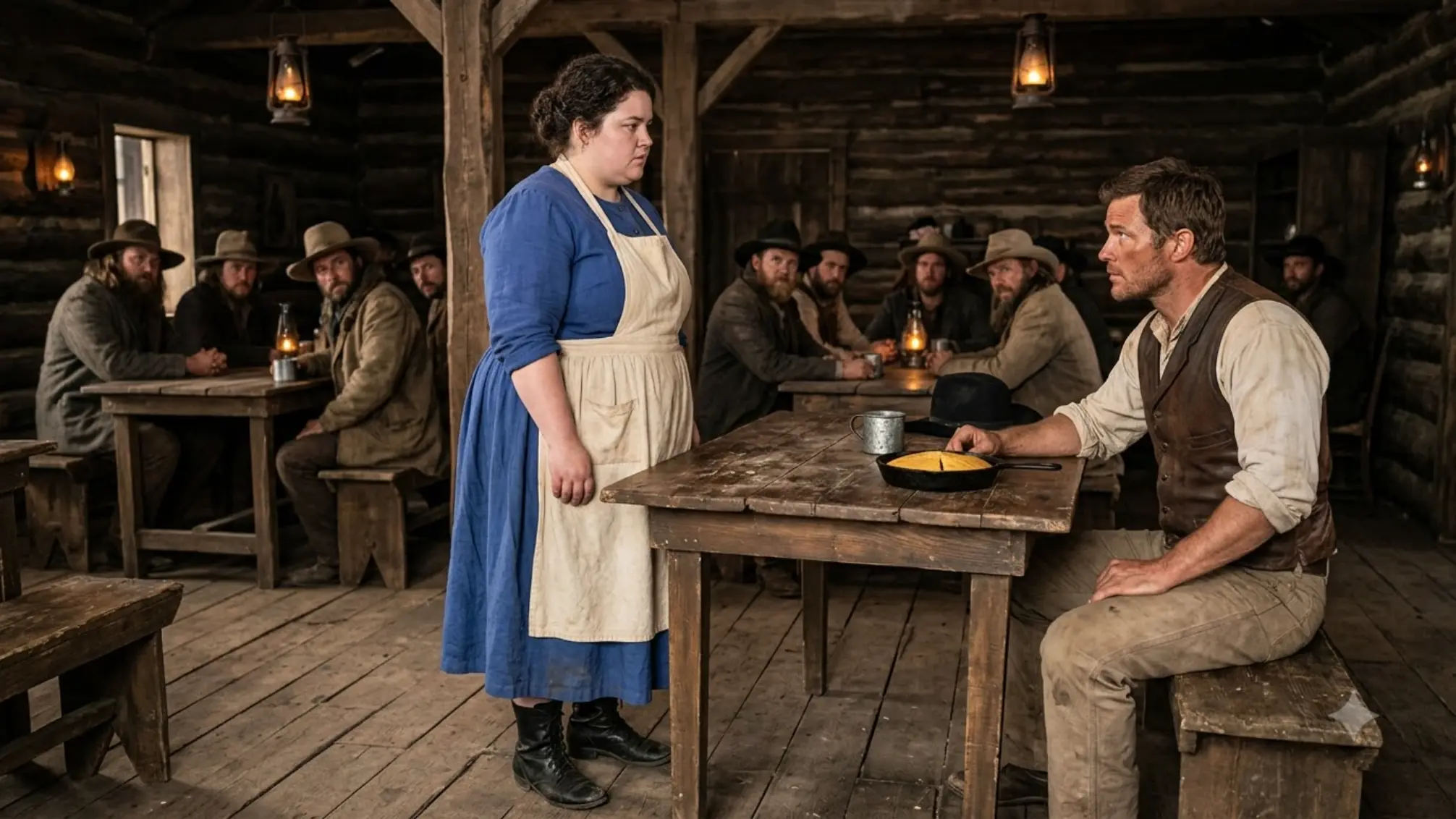
Every conversation inside the Cedar Lantern Meal House stopped. Forks hovered above plates, chairs creaked beneath suddenly motionless bodies, and even the wind pushing through the loose boards seemed to quiet. At the rear of the dining room, Mary Beth Walker stood beside the kitchen doorway with both hands twisted into her cream apron.
She knew that tone.
A man spoke that sharply only when the beans were burned, the coffee was weak, or something unpleasant had been found beneath a crust. For six years, Mary Beth had cooked for stagecoach drivers, cattle buyers, railroad workers, merchants, and men returning from places they wanted everyone to believe had made them dangerous. She had learned that when a customer demanded the cook, the room usually expected entertainment.
No one answered.
The rancher remained seated at the end of the long table, one broad hand resting beside the skillet. He was perhaps thirty-five, sun-browned and strongly built, with short dark hair, light stubble, and attentive hazel eyes beneath a weathered face. His cream work shirt was open at the throat, his sleeves were rolled over muscular forearms, and a brown vest carried the dust of many miles.
His black hat rested beside a dented tin mug.
“I asked who made it.”
A cloth merchant named Cyrus Bell glanced toward the kitchen and smirked. “Probably Bethlehem. Hard to believe she left enough cornmeal for the rest of us.”
Laughter broke from three tables.
Mary Beth felt the familiar heat climb her throat. At twenty-four, she weighed close to four hundred and forty pounds, and there was no garment, doorway, chair, or cruel eye in Fort Worth that allowed her to forget it. Her royal-blue dress had been altered so many times that three different shades of thread ran along the seams, while the apron over it covered a body people discussed as though she were not standing near enough to hear.
She stepped through the doorway.
“I did.”
The laughter faded when the rancher looked directly at her.
His eyes moved over her face rather than down the length of her body. That alone felt so unusual that Mary Beth nearly glanced behind herself to see whether someone more important had entered. She clasped her hands tightly, forcing herself to remain where she stood.
“If you’re fixing to humiliate me,” she said, “do it to my face.”
The rancher’s expression changed.
“Humiliate you?”
“You struck the table and demanded the cook.”
“I struck the table because everyone ignored me.”
Cyrus leaned back in his chair. “You’ll have to forgive Bethlehem. She’s sensitive about certain subjects.”
The rancher turned toward him.
“No,” he said. “I’m looking at the fools who left the best cook in Texas standing in a corner.”
No one laughed this time.
Mary Beth stared at him.
The rancher cut another piece from the cornbread. Its golden crust broke cleanly beneath his knife, releasing the smell of browned butter, roasted corn, and the small amount of honey Mary Beth had hidden from Mrs. Remedios, the meal-house owner. He ate slowly, as if confirming his own judgment, then looked back at her.
“Did you grind the meal yourself?”
“Yes.”
“Fresh buttermilk?”
“From the Turner farm.”
“And bacon fat around the skillet?”
She nodded.
“What did you put beneath the batter?”
“Salt and crushed sage. Very little.”
His mouth lifted at one corner.
“I knew there was something.”
Cyrus muttered, “A man that hungry would praise saddle leather.”
The rancher pushed back his chair.
The scrape of wood across the floor silenced the room again. He stood, revealing a tall, broad frame made more imposing by how calmly he carried it. Cyrus’s smile weakened as the man approached his table.
“You insulted her twice,” the rancher said.
Cyrus glanced around, searching for amusement that no longer existed. “It was a joke.”
“I know what it was.”
The rancher stopped beside him.
“Apologize.”
Cyrus’s face reddened. “You don’t order me around.”
“No. I’m giving you an opportunity to correct yourself before I decide you’re too cowardly to recognize decency.”
Several cattle hands lowered their eyes into their plates.
Cyrus studied the rancher’s hands, shoulders, and unhurried expression. He apparently calculated that dignity was worth less than broken teeth.
He looked toward Mary Beth.
“Sorry.”
She barely nodded.
The rancher returned to his seat and continued eating as though nothing unusual had happened. Mary Beth retreated to the kitchen before anyone could see how badly her hands shook.
She placed both palms against the preparation table and breathed.
No one had defended her since her father died nine years earlier. People occasionally offered pity, but pity always felt like another form of observation—another way of saying she was too unfortunate to be treated normally. The rancher had not spoken gently because he considered her helpless.
He had been angry because the insult was wrong.
That distinction followed her through the rest of the day.
The stranger’s name was Joaquin Arriaga.
Mary Beth learned it from the lodging register after he paid for four nights. Joaquin owned the Arroyo Mesa Ranch south of Fort Worth, where he raised cattle, cut hay, and managed a small orchard beside a creek that had become the subject of an increasingly bitter water dispute.
He spoke little during meals.
Yet Mary Beth noticed that he thanked her whenever she filled his coffee, carried his dishes toward the wash basin without being asked, and never moved his chair farther away when she passed behind him. Other men treated the space her body occupied as an inconvenience. Joaquin adjusted naturally, without staring or making her feel she had disrupted the room.
On his second evening, she served beef stew.
He tasted it, looked toward the kitchen, and asked, “Bay leaf?”
Mary Beth nodded.
“And cider vinegar?”
“A spoonful.”
“Why?”
“The meat was old. Acid softens it.”
Joaquin glanced at Mrs. Remedios, who stood near the register counting coins.
“You make poor provisions taste expensive.”
Mrs. Remedios laughed. “That is why I keep her.”
Mary Beth heard the truth beneath the praise.
Mrs. Remedios paid her less than half the wage given to the male cook who occasionally handled Sunday supper. Mary Beth slept in a narrow storage room beside the kitchen, received no share of tips, and was expected to eat only after every customer had finished. The owner believed employment itself was a kindness because no respectable household would hire a woman of Mary Beth’s size.
On Joaquin’s third morning, he entered the kitchen.
No customer came through that doorway.
Men shouted requests from the dining room or struck cups against tables until she responded. Even Mrs. Remedios rarely crossed the threshold unless checking the flour or ensuring Mary Beth had not used too much meat.
Joaquin stopped inside the frame with his hat held against his chest.
“I need a cook at my ranch.”
Mary Beth looked behind him. “Tell Mrs. Remedios. She may know someone.”
“I’m telling you.”
She stared at him.
He continued. “I need someone who understands provisions, can feed twelve men, preserve vegetables, organize a pantry, and make little food last without making it taste like punishment.”
“Why would you ask me?”
“Because you know how.”
“People in this town don’t look at me and think that.”
“I am not the people in this town.”
Mary Beth turned back toward the dough beneath her hands.
“You tasted two meals.”
“Four.”
“Four meals are not enough to trust a stranger with your ranch kitchen.”
“I watched you correct the flour ledger after Mrs. Remedios counted it wrong. I watched you save yesterday’s beans for today’s filling. You portion meat according to the work each table is doing, and you remember which travelers cannot eat onions.”
She slowly wiped her hands.
“You’ve been studying me.”
“I study anyone I may trust with the lives of my workers.”
“Lives?”
“Men working cattle in winter need food that keeps them standing. Bad management does more damage than bad weather.”
Mary Beth could not imagine leaving the meal house. It was cruel, exhausting, and small, but it was known. The Arroyo Mesa Ranch belonged to a stranger, miles from town, among twelve men who might treat her worse once no witnesses were near.
“What would you pay?”
“Twenty-five dollars a month, private room, food, and a share of preserved-goods sales if you improve production.”
She nearly laughed from disbelief.
Mrs. Remedios paid her seven.
“Why so much?”
“Because that is what the position is worth.”
“What if your men refuse to eat food made by me?”
“Then they may cook for themselves.”
“What if they laugh?”
“They may laugh once.”
The quiet certainty in his answer made her look up.
Joaquin placed a folded paper on the table. It contained the wage, duties, room, and a thirty-day trial allowing Mary Beth to leave with full pay if either party considered the arrangement unsuitable. He had signed the bottom but left space for her decision.
“No marriage clause?” she asked bitterly.
His eyebrows lifted.
“Men sometimes hire women with expectations not written on paper.”
“My expectations are listed.”
“And if you decide my appearance offends your ranch?”
“Then I would have to remove every mirror before dismissing you honestly.”
Mary Beth stared at him.
Joaquin looked suddenly uncertain. “That sounded kinder in my mind.”
A laugh escaped her before she could stop it.
It was small and rusty from disuse, but it was real.
She signed the paper that afternoon.
Mrs. Remedios reacted as though Mary Beth had stolen from her.
“You’ll be back within a week,” the older woman snapped. “Ranch hands won’t tolerate you lumbering around their kitchen.”
Mary Beth packed her few dresses, recipe book, iron spoon, and the small framed photograph of her parents. Everything fit inside one battered trunk.
Joaquin loaded it into his wagon without commenting on its weight.
The Arroyo Mesa Ranch lay across dry winter grass beneath a broad Texas sky. A long adobe-and-timber house faced the south pasture, with barns, cattle pens, sheds, and a stone kitchen built against the rear wall. The land appeared tired but cared for, every fence repaired and every tool returned to its place.
Twelve ranch hands gathered as Joaquin helped Mary Beth from the wagon.
Their faces revealed surprise.
One young man whispered something to another and received an elbow in the ribs. Mary Beth heard only the final word.
“—cook?”
Joaquin faced them.
“This is Mary Beth Walker. She manages the kitchen and provisions from this moment. What she says about food stores, meal times, or kitchen work carries my authority.”
A gray-haired ranch hand named Silas raised his hat. “Welcome, ma’am.”
The others followed.
Not warmly, but respectfully enough.
Mary Beth’s room stood beside the kitchen. It contained a wide reinforced bed, a washstand, a chest, and a window overlooking the orchard. She noticed the heavy chair near the wall had been built without arms and strengthened beneath the seat.
Joaquin had prepared for her body without making the preparation feel like ridicule.
That kindness nearly undid her.
The pantry did not.
It was a disaster.
Flour sacks sat directly on the floor, two bacon sides had begun spoiling, mice damaged the cornmeal, and dried beans were stored beside kerosene. The former cook recorded nothing and purchased supplies whenever shelves looked empty.
Mary Beth spent her first three days counting.
By the fourth, she knew Joaquin’s ranch was in trouble.
“You’re losing food faster than twelve men can eat it,” she told him across the kitchen table.
“Stealing?”
“Some. Mostly waste. Flour absorbs dampness from the floor. Salt meat hangs too close to the stove. Your cook ordered coffee twice in one month because no one recorded the first delivery.”
Joaquin studied her new ledger.
“How much can we save?”
“Thirty dollars a month before spring. More if the orchard produces.”
“The orchard hasn’t produced well in two years.”
“Because no one pruned it.”
“You know trees?”
“My father kept an orchard.”
Joaquin nodded. “Show me what you need.”
Mary Beth reorganized the entire food system.
She raised dry goods onto shelves, sealed grain inside tin-lined bins, created weekly inventories, and assigned two men to bring kitchen waste to the chickens. She rendered spoiled fat into soap, dried apple peelings for tea, and turned cracked corn considered unsuitable for sale into thick breakfast porridge flavored with molasses.
At first, the ranch hands complained about portions.
Then they realized no one went hungry.
Mary Beth served eggs, beans, cornbread, stew, roasted squash, biscuits, hand pies, and preserved peaches. She learned which men worked the hardest shifts and packed additional food into their saddlebags. When Silas developed a cough, she made onion broth with pepper and honey until he recovered.
The laughter stopped.
Not because Joaquin threatened anyone.
Because Mary Beth became indispensable.
Three weeks after her arrival, a ranch hand named Caleb entered drunk and found her kneading dough. He leaned against the table, looked over her body, and smirked.
“Joaquin ought to charge neighboring ranches when you block the north wind.”
Mary Beth’s hands froze.
The kitchen went silent.
Joaquin was not present.
Before she could respond, Silas stood from the table.
“Apologize.”
Caleb laughed. “I was joking.”
Another man pushed back his chair.
“We know what it was.”
Mary Beth looked around.
The men Joaquin had warned only once were defending her without him.
Caleb removed his hat.
“Sorry, Miss Walker.”
She resumed kneading.
“Good. Now wash your hands and peel those potatoes.”
The room erupted in laughter, but this time she laughed with them.
Arroyo Mesa’s greatest danger was not spoiled flour.
It was water.
A wealthy neighboring cattleman named Preston Vale had built an illegal diversion gate along Cottonwood Creek, redirecting most of the winter flow toward his own pastures. Joaquin’s cattle weakened while Vale expanded his herd. The county judge delayed every complaint because Vale financed his campaigns and entertained officials at his home.
One evening, Joaquin returned from the creek with blood on his sleeve.
Mary Beth met him near the kitchen door.
“What happened?”
“Vale’s men objected to me measuring the water.”
“They shot you?”
“Only grazed me.”
She forced him into a chair.
Joaquin removed his shirt while Mary Beth cleaned the wound. The bullet had cut a shallow line across his upper arm, painful but not dangerous. She was aware of his warmth, the strength beneath his skin, and the way he watched her face rather than her hands.
“You should have taken men with you.”
“I did not want a fight.”
“You nearly brought one home inside your arm.”
His mouth lifted.
“Are you scolding your employer?”
“I am scolding a fool bleeding near my bread.”
Joaquin became serious.
“If the creek remains closed, I may lose half the herd before spring.”
Mary Beth tied the bandage.
“Then we open it.”
“Vale has six armed men guarding the gate.”
“I did not say break it.”
She had studied the supply ledgers, property maps, and receipts stored in Joaquin’s office. One document showed that Vale’s diversion channel crossed an unused strip belonging not to him but to the county stage company. Another proved the channel reduced flow to a public watering point used by travelers.
Vale had bribed a local judge.
He had not purchased every authority in Texas.
Mary Beth prepared copies and wrote letters to the stage company, territorial livestock board, and three ranches downstream. Joaquin watched her work beneath the lamp.
“Where did you learn this?”
“My father believed daughters should know accounts in case husbands proved stupid.”
“Was your husband stupid?”
“I never had one.”
Joaquin looked surprised.
Mary Beth’s defensive anger rose automatically. “Men were not lining the roads.”
“That was not why I asked.”
“Why did you?”
He hesitated.
“Because I wanted to know whether someone would come looking for you.”
“No one ever has.”
His eyes remained on hers.
“That may change.”
The livestock inspector arrived twelve days later with a representative from the stage company and eight downstream ranchers. Faced with witnesses, maps, and the threat of criminal charges, Vale denied knowledge of the diversion and blamed his foreman.
The gate was dismantled.
Water returned to Arroyo Mesa before sunset.
The ranch hands gathered beside the creek and cheered as the first strong current pushed through the dry channel. Joaquin stood near Mary Beth while water spread across the lower pasture.
“You saved the herd,” he said.
“I wrote letters.”
“You saw what none of us did.”
“I read what none of you organized.”
Joaquin smiled. “That too.”
That night, he asked her to sit at the main table.
Mary Beth remained near the kitchen doorway.
“I eat after everyone.”
“Not tonight.”
“There isn’t a chair—”
Joaquin placed the reinforced chair beside his own.
Every ranch hand waited.
Mary Beth crossed the room slowly and sat among them.
Silas raised his cup. “To the woman who fed us, saved thirty dollars a month, healed my lungs, and frightened Preston Vale worse than a loaded rifle.”
“To Mary Beth,” the men answered.
Joaquin lifted his own cup last.
“To the best thing that ever entered my kitchen.”
Her eyes filled before she could stop them.
Mary Beth turned her face away, ashamed of the tears, but Joaquin spoke quietly enough that only she heard.
“You don’t have to hide those here.”
She looked at him.
“Tears do not change the price of corn,” she whispered.
“No.”
“They do not soften people’s tongues.”
“No.”
“What good are they?”
Joaquin rested his hand near hers without touching.
“They tell the heart it survived long enough to feel something else.”
Mary Beth cried then.
Not loudly.
Not helplessly.
She simply allowed four years of swallowed pain to move through her while the men continued eating and no one stared.
Spring transformed Arroyo Mesa.
The restored creek fed the orchard, Mary Beth’s pruning revived the trees, and the first green apples appeared before summer. She began selling preserves, cornbread, soap, and dried fruit to travelers. Her share of the profits soon exceeded her monthly wage.
Joaquin built a small roadside kitchen where she could serve meals twice a week.
People came from Fort Worth.
Even Cyrus Bell arrived one afternoon, removed his hat, and asked whether there was bread available. Mary Beth served him without mentioning the meal house.
He ate in silence.
Before leaving, he said, “It really is the best in Texas.”
“I know.”
Joaquin heard and smiled from across the yard.
Months later, on a warm evening beneath the orchard trees, he brought Mary Beth a plate holding one piece of cornbread.
She looked at it suspiciously.
“Is this a complaint?”
“I made it.”
She tasted the edge and struggled not to grimace.
“You forgot salt.”
“I knew something was missing.”
“And the skillet was cold.”
“I was distracted.”
“By what?”
Joaquin set the plate aside.
“You.”
Mary Beth’s humor disappeared.
He stepped closer but left enough room for her to choose whether the distance closed.
“I hired you because you were the finest cook I had ever met,” he said. “Then you saved my provisions, my orchard, and my cattle. But none of those are why I wait for your footsteps every morning.”
She looked down.
“Do not say something kind because you feel responsible for me.”
“I have never known a woman less in need of rescuing.”
“Then what are you saying?”
“That I love you.”
Mary Beth’s breath stopped.
Joaquin continued before fear could silence him. “I love your mind, your temper, the way you hum when the dough rises correctly, and the way every person on this ranch stands straighter because you expect something better from them. I love that you occupy every room honestly, even after cruel people spent years making you apologize for it.”
She looked into his eyes.
“And my body?”
“It is yours.”
“That was not my question.”
Joaquin smiled softly.
“I have wanted to hold you since the night you bandaged my arm and called me a fool. I have simply been trying to behave like a gentleman.”
Mary Beth laughed through sudden tears.
“That must have been difficult.”
“Nearly impossible.”
She took his hand and placed it against her waist.
“Then stop trying so hard.”
His kiss was gentle.
There was no mockery, gratitude, bargain, or surprise in it. Joaquin kissed Mary Beth as a man who knew precisely whom he wanted and had waited for her to believe she could be wanted freely.
They married beneath the orchard that autumn.
The ranch hands built a long table large enough for every worker, neighbor, traveler, and friend. Mary Beth baked twelve skillets of cornbread, though Joaquin attempted one himself and was forbidden from placing it near the guests.
Years later, people still told the story of the day a rancher struck a table and demanded to know who baked his bread.
Some said Joaquin rescued a lonely woman from a cruel meal house.
Mary Beth always corrected them.
“He offered me a job,” she would say. “I saved his ranch.”
Joaquin never disagreed.
But when visitors asked what he had thought upon seeing the nearly four-hundred-and-forty-pound cook step nervously through the kitchen doorway, he always gave the same answer.
“I thought the entire room had gone blind.”
Then he would cut another piece of cornbread, place it on Mary Beth’s plate, and sit beside the woman everyone else had ignored—as though that had always been where she belonged.