Wind rattled the kitchen windows as Clara Bennett sat beside her five-year-old daughter at the rough wooden table. Her faded blue dress was still creased from the three-day wagon journey, and a dark wool shawl covered shoulders aching from cold and exhaustion. Pearl pressed against her mother’s side, watching the rancher standing in the doorway with his weathered hat crushed between both hands. Only hours earlier, Wesley Tate had looked at them as though the wagon company had delivered the wrong people.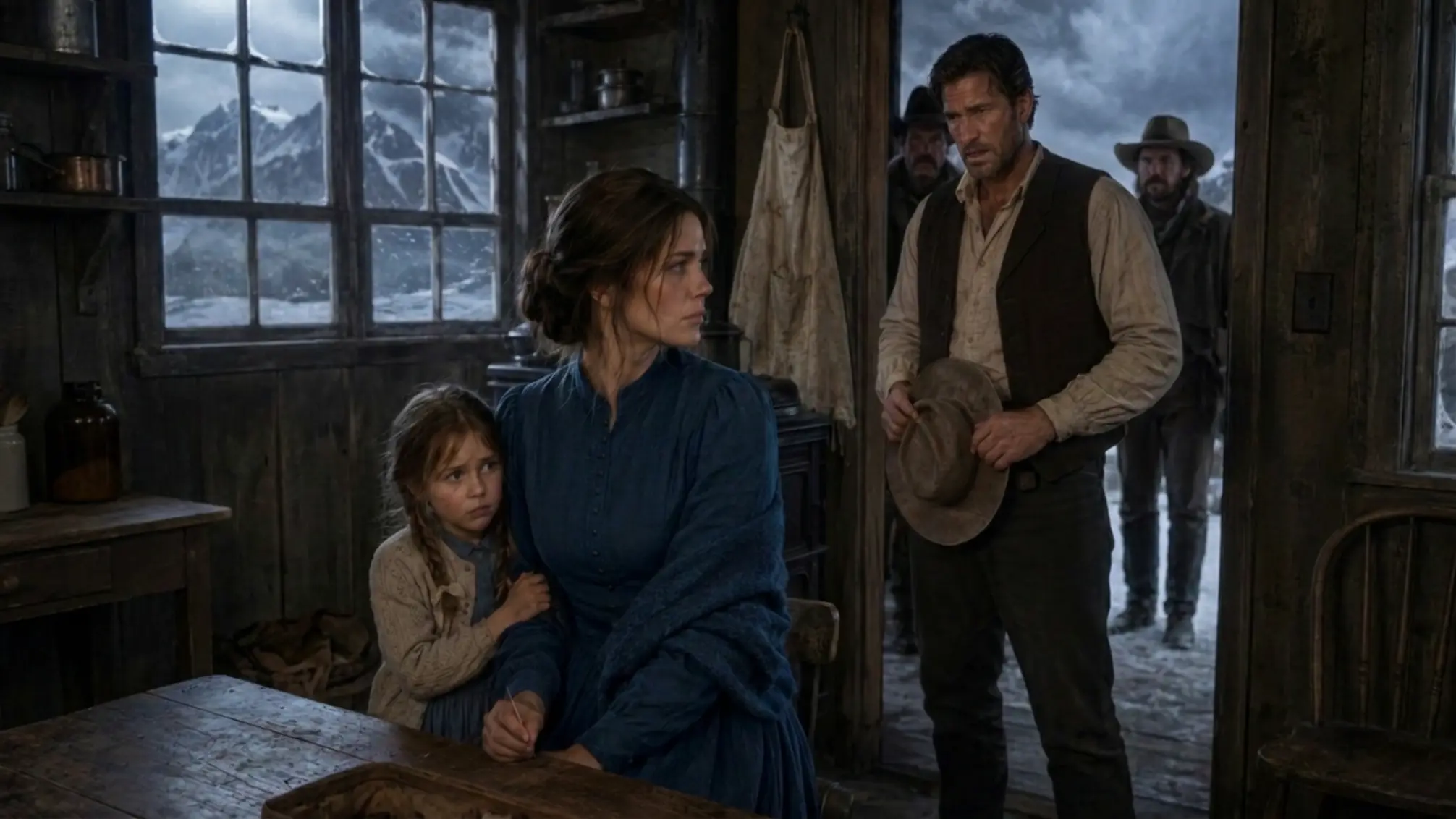
Wesley glanced toward the cold stove as though it had personally betrayed him. Outside, the approaching storm had turned the Wyoming sky nearly black, and sixteen ranch hands were riding home after spending the night gathering cattle from the northern range. They would arrive frozen, exhausted, and hungry enough to abandon the ranch if they found another meal of stale biscuits and burnt beans waiting for them.
The cook Wesley had hired from Cheyenne had never arrived. A rider sent to investigate returned with news that the man had taken an offer from a hotel and boarded a westbound train without sending word. Wesley had no replacement, no time to find one, and no idea how to prepare enough food for a single man, much less sixteen.
That left Clara.
She had arrived at Roan Fork Ranch the previous afternoon after answering a newspaper advertisement seeking a capable housekeeper and cook. The advertisement promised a private room, regular wages, and a permanent position for a respectable woman willing to live far from town. It had not mentioned that Wesley expected a strong older widow with years of ranch experience.
Instead, the wagon delivered a slender twenty-seven-year-old mother wearing a faded blue dress and carrying every possession she owned inside one worn carpetbag.
Pearl had stood beside her in a blue pinafore, trembling beneath the attention of the ranch hands gathered near the bunkhouse. The wagon boss, Amos Rudd, had looked Clara up and down before laughing loudly enough for everyone to hear.
“So this is the cook?” he said. “Looks more like somebody’s worn-out aunt.”
Several men laughed with him.
Clara had felt Pearl’s fingers tighten around her skirt, but she did not lower her head. She had learned long ago that cruel people searched a face for proof they had caused pain. Once they found it, they returned to the wound whenever they wanted entertainment.
Wesley heard the insult.
For a moment, shame crossed his weathered face. Then he looked at Clara’s small frame, Pearl’s frightened eyes, and the single carpetbag resting in the dirt. Whatever sympathy he possessed disappeared beneath disappointment.
“The supply wagon returns Monday at noon,” he told her stiffly. “You can decide by then whether you want it to take you back.”
Clara looked beyond him at the gray ranch house. The porch leaned slightly toward the east, one shutter hung loose, and weeds pushed through frozen soil around the steps. Nothing about Roan Fork appeared welcoming.
She lifted Pearl into her arms and walked inside anyway.
The kitchen revealed more than Wesley intended. Dust covered the shelves, grease blackened the stove, and a sewing basket sat untouched beside the window. Inside it rested a half-finished child’s shirt, a rusted needle, and thread faded by years of sunlight.
A flour-sack apron hung beside the stove.
Clara understood immediately that another woman had once kept the house alive.
She also understood that no one had dared replace her.
Wesley remained near the doorway as Clara inspected the pantry. There was flour, dried beans, potatoes, onions, several jars of preserved tomatoes, salt pork, coffee, molasses, and enough beef stored in the cold cellar to feed the ranch for months. The supplies were plentiful.
The neglect was the problem.
“I’ll prepare supper tonight,” Clara told him. “After you taste it, you can decide whether Pearl and I stay.”
Wesley seemed surprised that she had offered him the decision rather than asking permission.
“You understand this is not charity?” he said.
“I crossed half the country to work, Mr. Tate.”
“There are no easy days here.”
“I have not known many.”
He left without answering.
Clara spent the evening cleaning only enough space to prepare food safely. She scrubbed one table, washed three pots, and built a steady fire while Pearl peeled potatoes with a dull knife beneath her supervision. From the pantry, Clara chose onions, salt pork, preserved tomatoes, and a small bundle of dried herbs tied with string.
By nightfall, thick potato soup simmered over the fire. She baked skillet bread with molasses and prepared fried apples dusted with cinnamon from a small packet she carried inside her carpetbag.
Wesley ate in silence.
Amos Rudd and two senior ranch hands joined him, initially wearing expressions of suspicion. By the end of the meal, every bowl had been scraped clean. One man reached for the last piece of bread at the same moment as Amos, and the two nearly fought over it.
Wesley looked across the table at Clara.
“Where did you learn to cook like this?”
“My mother ran a boardinghouse.”
“That does not make you a ranch cook.”
“No,” Clara replied. “Feeding thirty factory workers every morning did.”
Amos smirked. “These ain’t factory men.”
Clara collected his empty bowl. “Hunger rarely cares what work a man does.”
Amos did not laugh again that evening.
Still, Wesley told her the next morning that the arrangement remained temporary. He had expected an older woman who could handle heavy work without bringing a child into the house. Clara nodded as though the judgment meant nothing.
Pearl waited until they were alone.
“Does he want us to leave?”
Clara knelt and straightened the child’s pinafore. “He does not know what he wants.”
“Mr. Rudd does.”
“Yes.”
“He doesn’t like us.”
“He does not know us.”
Pearl looked toward the window, where Amos crossed the yard. “Maybe he doesn’t want to.”
Clara kissed her forehead. “Then that is his loss.”
The storm arrived before dawn on Saturday.
Wind swept across the plains with enough force to tear loose boards from the barn. Snow followed, first as hard white grains and then in heavy sheets that erased fences, roads, and distant buildings. Wesley sent riders to guide the northern crew home before the trail vanished completely.
At ten o’clock, the message came that sixteen men were approaching.
The kitchen remained barely functional. The hired cook was gone, Clara had not officially been accepted, and Amos had already told several hands she would be back on the Monday wagon.
Then Wesley appeared in the doorway and asked whether she could feed them.
Clara rose from the table.
She crossed the kitchen and reached for the old flour-sack apron. Her fingers stopped an inch from the fabric.
“Did this belong to your wife?” she asked.
Wesley’s expression changed.
“Her name was Ruth.”
“I will not wear it without your permission.”
For several seconds, only the wind spoke.
“You may use it,” he said quietly.
Clara lifted the apron from its hook, shook away the dust, and tied it around her blue dress. Then she turned toward Wesley with the authority of a woman who had already planned the next two hours.
“I need four sacks of potatoes, six onions, twenty pounds of beef, two jars of tomatoes, all the flour you can spare, and every clean pan on the property.”
Wesley nodded.
“I also need dry firewood.”
“I’ll bring it.”
“And Mr. Rudd.”
Wesley frowned. “Why?”
“Because he mocked me in front of your men. Now he can carry water in front of them.”
For the first time since her arrival, amusement touched Wesley’s eyes.
“I’ll send him.”
Within fifteen minutes, the kitchen transformed into a command post.
Clara placed two large iron pots over the stove. Beef browned in rendered fat while Pearl measured salt and dried herbs into small cups. Wesley carried potatoes from the cellar, and Amos entered with two buckets of water, his face red with anger.
“Boss says you ordered me into the kitchen.”
“I requested help.”
“I’m a wagon boss, not a kitchen girl.”
Clara handed him a knife. “Then a capable wagon boss should have no trouble peeling potatoes.”
Pearl covered a smile.
Amos looked toward Wesley for rescue.
The rancher leaned against the doorway. “You heard her.”
For the next hour, knives struck cutting boards, firewood cracked, and steam clouded the windows. Clara built a rich beef stew with potatoes, onions, tomatoes, herbs, and thickened broth. She mixed biscuit dough in a wide basin, working cold fat through flour before adding milk from the ranch cow.
Pearl cut each biscuit with an overturned tin cup.
“Not too thin,” Clara reminded her.
“I know, Mama.”
“You are doing beautifully.”
The child’s nervousness slowly disappeared. For the first time since arriving at Roan Fork, Pearl had a task that belonged to her. She arranged the biscuits on greased trays with the solemn concentration of a jeweler setting precious stones.
Clara found dried apples in the pantry and cooked them with molasses and cinnamon. She rolled leftover biscuit dough thin, filled it with the sweet fruit, and folded it into small hand pies.
Wesley watched her move through the kitchen without wasting a step. She did not resemble the tired stranger who had climbed from the wagon. Her cheeks had grown warm from the fire, loose strands of dark hair framed her face, and the faded blue dress seemed brighter beneath the white apron.
“You said your mother ran a boardinghouse,” he said.
“Until she died.”
“And afterward?”
“I ran it.”
“How old were you?”
“Seventeen.”
Wesley stared at her.
Clara continued kneading dough. “My father had already passed. I had two younger sisters and debts that arrived more regularly than guests.”
“What happened to the boardinghouse?”
“My husband sold it.”
The room grew quieter.
Wesley had assumed Clara was widowed. The agency letter stated only that she traveled with a daughter and sought respectable employment.
“Is he dead?” Wesley asked.
“No.”
Amos stopped peeling.
Clara did not look up. “He gambled away the sale money and left after Pearl was born. I have not heard from him in four years.”
Wesley’s jaw tightened. “Then he is a fool.”
“He was many things.”
“Did he hurt you?”
Clara’s hands paused in the dough.
Wesley immediately regretted asking.
“He taught me that promises mean nothing without work behind them,” she said. “That is enough history for today.”
The first riders reached the yard shortly before noon.
Their horses stumbled through the snow, heads lowered against the wind. The men dismounted stiffly, faces gray with cold and fatigue. Several had not eaten since the previous afternoon.
Then the kitchen door opened.
The scent of stew rolled across the yard.
Men who could barely lift their saddles suddenly found enough strength to hurry toward the bunkhouse dining room. Clara had arranged sixteen bowls along the table, each filled with beef, potatoes, and thick broth. Biscuits sat in baskets wrapped with clean cloth, while the apple pies waited near the stove.
Nobody spoke during the first minutes of the meal.
Spoons moved rapidly. Biscuits disappeared. One man closed his eyes after his first bite as though he had received a blessing.
Calvin Price, the oldest ranch hand, scraped the bottom of his bowl and looked toward Clara.
“Ma’am, is there more?”
“There is enough for everyone to have seconds.”
Sixteen weathered men turned toward her at once.
Clara smiled. “Form a line.”
The silence broke into laughter.
By the time the last hand pie disappeared, the storm had sealed every road around Roan Fork. The men remained trapped at the ranch for three days, but no one complained. Clara prepared stews, fresh bread, fried potatoes, beef hash, dumplings, and warm molasses cake.
The ranch’s mood changed.
Men who once ate separately began gathering around the same table. Arguments diminished. Work crews stayed longer to repair storm damage because they knew hot food waited inside.
Even Amos stopped insulting Clara.
He remained proud and difficult, but each morning he entered the kitchen carrying water without being asked. Pearl began calling him Mr. Sour Face, though never loudly enough for him to hear.
On Monday, the supply wagon did not come. Snow made the road impassable.
Wesley found Clara sewing beside the window that evening. Pearl slept with her head in her mother’s lap.
“The wagon may not reach us for another week,” he said.
Clara continued stitching. “Then I suppose your deadline has changed.”
“I was wrong.”
Her needle stopped.
Wesley stepped farther into the room. “About you.”
“That is not a small subject.”
“No.”
He removed his hat. “I saw a tired woman and a child and decided you would become another burden.”
Clara looked down at Pearl.
“You were not the first man to make that decision.”
“I should have defended you when Amos laughed.”
“Yes.”
The answer struck harder than anger.
Wesley nodded. “You deserved better.”
“So did Pearl.”
His gaze moved toward the sleeping child. “She did.”
Clara returned to her sewing. “An apology does not become valuable simply because it is difficult to give.”
“What would make it valuable?”
“What you do afterward.”
Wesley remembered those words.
The following weeks revealed how badly Roan Fork needed more than food. Ranch records were scattered across drawers. Suppliers charged different prices because nobody checked invoices. Meat spoiled because storage rooms were poorly organized, and grain disappeared faster than the cattle could consume it.
Clara noticed everything.
She began keeping a kitchen ledger, recording supplies used and meals served. Soon she discovered that the ranch was purchasing nearly twice as much flour as she actually received.
“Who collects the supplies?” she asked Wesley.
“Amos.”
The wagon boss stood near the stove and immediately stiffened.
Clara opened the ledger. “Twenty sacks were purchased last month. I found seven in storage when I arrived.”
“We used the rest,” Amos said.
“For what?”
“Feeding men.”
“With no cook?”
Amos’s face darkened. “You accusing me of stealing?”
“I am asking where thirteen sacks went.”
He stepped toward her. “A woman who arrived five minutes ago has no right questioning me.”
Wesley moved between them.
“She manages the kitchen,” he said. “She has every right.”
Amos stared at the rancher. “You taking her word over mine?”
“I am taking the ledger over your temper.”
A search of the wagon shed uncovered flour, coffee, and preserved meat hidden beneath tarps. Amos had been selling ranch supplies in town and keeping the money. He also inflated invoices and claimed the difference as transportation expenses.
Wesley dismissed him before sunset.
Amos left swearing that the ranch would collapse without him.
It did not.
Calvin became wagon boss. Clara’s ledgers reduced food expenses by nearly one-third while improving every meal. Wesley used the savings to repair fencing and purchase medicine for sick cattle.
By spring, Roan Fork looked different.
Smoke rose from a clean chimney. Curtains hung in the kitchen windows, and the porch had been repaired. Pearl planted wildflowers beside the steps while ranch hands built her a small swing from rope and polished wood.
The child who once hid behind her mother now ran between the bunkhouse and barn as though the entire ranch belonged to her.
Wesley encouraged it.
He taught Pearl to feed chickens, brush a gentle mare, and recognize storms by the movement of clouds. When she fell asleep during evening stories, he carried her to bed with such care that Clara sometimes turned away to hide what it stirred inside her.
One night, Pearl asked him a question while Clara prepared bread.
“Did you have a little girl before me?”
Wesley froze.
Clara looked toward the sewing basket by the window.
“Yes,” he said after a long silence. “Her name was Annie.”
“Where is she?”
“With her mother.”
Pearl frowned. “In town?”
“No, sweetheart.”
The child understood enough to stop asking.
After she went to bed, Wesley sat beside the cold fireplace. Clara waited without speaking.
“Scarlet fever,” he finally said. “Ruth died first. Annie followed two days later.”
Clara’s heart tightened.
“The house became quiet,” he continued. “I thought if I left everything untouched, some part of them would remain.”
“The sewing basket.”
Wesley nodded. “Ruth was making Annie a new shirt.”
Clara sat beside him. “I should not have moved anything.”
“You brought the house back to life.”
“That may not feel like honoring them.”
“For years, I believed grief was all I had left of them. Then Pearl laughed in the hallway.” His voice broke. “I had forgotten a house could sound like that.”
Clara placed her hand over his.
Wesley looked at their joined fingers. “I don’t want you to leave.”
“The position has become permanent?”
“I’m not talking about the position.”
Her breath caught.
He turned toward her. “I know what it looks like—a lonely rancher becoming attached to the woman caring for his house. But it is not the cooking, Clara. It is the way you look at something broken and refuse to believe it must remain that way.”
She lowered her eyes.
“I cannot promise you I will never fail,” he continued. “I already failed you the day you arrived. But I can promise I will work behind every word I give you.”
Clara remembered what she had told him about promises.
“What are you asking?”
Wesley knelt before her.
“I am asking you to stay as my wife.”
Tears filled her eyes, but she did not answer immediately.
“And Pearl?” she asked.
His expression softened. “I would be honored if she allowed me to become her father.”
From the hallway came a small voice.
“I allow it.”
Pearl stood barefoot in her nightdress, clutching a blanket.
Clara laughed through her tears. Wesley opened his arms, and the child ran into them.
They married beneath the cottonwood tree near the house. Every ranch hand attended in clean clothes, and Calvin stood beside Wesley as witness. Pearl scattered wildflowers along the ground, though the wind carried most of them away before Clara reached the preacher.
She wore the same blue dress in which she had arrived.
The flour-sack apron remained hanging inside the kitchen.
After the ceremony, sixteen men sat at long outdoor tables eating beef stew, biscuits, and apple pies prepared from Clara’s recipes. This time, the ranch hands had cooked under her direction while she prepared to become Mrs. Tate.
Calvin raised his cup.
“To the woman who fed sixteen starving fools and somehow saved the biggest fool among us.”
The men cheered.
Wesley leaned toward Clara. “He means me.”
“I know.”
“Do you agree?”
“Entirely.”
Years later, travelers passing Roan Fork often heard the story of the storm that nearly stopped the ranch. They heard how a cook abandoned his contract, sixteen men rode home hungry, and a woman everyone dismissed prepared a feast before noon.
But the hands who had been there remembered something deeper.
Clara did not save the ranch with stew alone.
She saved it by making men feel worth feeding, a child feel worth protecting, and a grieving rancher believe his home could hold love without betraying those he had lost.
The apron beside the stove eventually wore thin. Clara folded it carefully and placed it inside Ruth’s sewing basket, alongside the unfinished shirt meant for Annie.
She never erased the women who came before her.
She simply completed what grief had interrupted.
On winter mornings, Wesley sometimes paused in the kitchen doorway and watched Clara work in her blue dress while Pearl helped cut biscuits at the table. Each time, he remembered the day he had stood there holding his hat, too proud to admit he needed her.
“Can you cook for a whole outfit?” he had asked.
Clara had fed sixteen men.
Then she gave an entire ranch its life back.