The laughter started before Emma Carter even raised her bidding card. Inside the crowded West Plains Livestock Exchange outside Amarillo, Texas, more than two hundred farmers, ranchers, cattle buyers, and feedlot operators filled the wooden benches surrounding the sale ring. Thirteen-year-old Emma stood near the lower railing in an oversized brown ranch jacket that had once belonged to her grandfather, holding Bid Card 82 tightly against her chest while a massive black Angus bull limped slowly behind the metal gate. When an older rancher noticed the card in her hands, he pointed at her and laughed loudly enough for half the barn to turn around.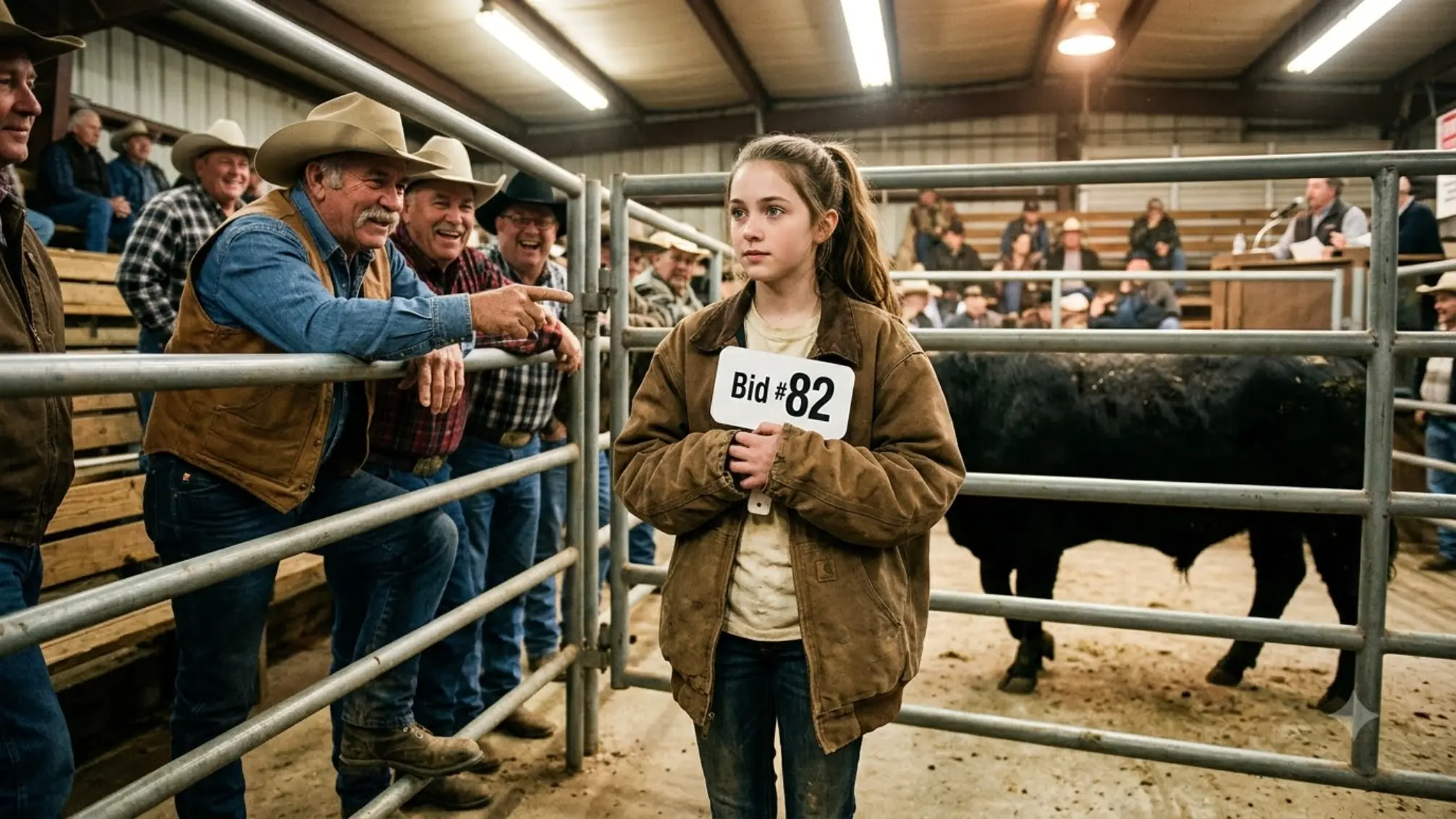
“Put that bid card down, little girl,” Earl Maddox called from the rail. “This isn’t a petting zoo.” Several men around him laughed, and Emma felt every eye in the building land on her at once. She was small for thirteen, with long chestnut-brown hair tied into a loose ponytail, blue-green eyes, dusty boots, and the kind of serious expression adults often mistook for shyness. Emma looked directly at Earl and answered, “Then stop laughing and bid against me.”
The laughter grew louder. Earl was sixty-one, broad through the shoulders, with a thick gray mustache, a tan cowboy hat, and the confidence of a man who had bought and sold cattle longer than Emma had been alive. He leaned over the rail and pointed toward the limping bull. “That cripple will burn every dollar your daddy gave you.”
Emma tightened her grip on the card. “Good thing the money’s mine,” she said. “And you still haven’t figured out what’s wrong with him.” The words landed harder than she expected, and several men stopped laughing long enough to stare at her. Earl’s smile vanished for half a second before returning wider and meaner.
What nobody in the barn understood was that Emma had not come to the auction because she liked the animal. She had not seen a sad bull and decided she could rescue him, and she was not gambling because she was too young to understand money. Emma had been studying Blackstone Ridge for fourteen days. She had watched him walk on hard gravel, packed dirt, dry pasture, and the uneven loading ramp behind the seller’s ranch.
The bull was four years old and weighed almost two thousand pounds. His papers traced back to one of the strongest Angus bloodlines in the region, and the previous year a breeder had reportedly offered more than sixteen thousand dollars for him. Then the limp appeared. Within three months, buyers went from calling Blackstone Ridge a championship prospect to calling him slaughter weight.
The veterinary report provided by the seller was frustratingly vague. It noted persistent right hind-limb lameness but found no obvious fracture, dislocation, or severe joint degeneration. Most buyers assumed the problem was hidden somewhere deeper in the hip or leg, something expensive enough that nobody wanted the risk. Emma had read the same report six times.
Her grandfather Walter Carter had taught her that reports were useful, but animals told you more than paperwork if you knew where to look. Walter had raised Angus cattle on eighty-seven acres outside Amarillo for almost forty years, and Emma had spent nearly every weekend beside him from the time she could climb through a fence. He taught her how to watch breathing, posture, appetite, foot placement, ear movement, and the way cattle transferred weight when something hurt. “Anybody can see an animal,” Walter used to tell her. “A cattleman learns to notice one.”
Walter died eight months before the auction. Cancer had taken his strength first, then his voice, and finally everything else, but two weeks before he died he gave Emma a battered spiral notebook filled with decades of handwritten observations. The first page contained only one sentence. Learn to see what other people miss.
He also left Emma three thousand dollars. Her mother wanted the money saved for school, and Emma agreed until she saw Blackstone Ridge listed in the November auction catalog. At first, she only circled the page. Then she convinced her uncle Mason to drive her to the seller’s ranch.
Mason thought she wanted to see a famous bull before he disappeared into a feedlot. Instead, Emma spent nearly two hours crouched outside the fence taking notes. She never approached the bull carelessly and never pretended she knew more than she did. She watched.
Blackstone Ridge’s limp became more obvious on gravel. On soft ground, he moved considerably better. The timing between his steps stayed regular, his hip remained level, and he still pushed strongly from the affected leg when turning sharply. Emma noticed that he avoided placing full pressure on one particular section of the hoof rather than protecting the whole limb.
That detail changed everything. A serious hip problem should have affected the entire stride. Nerve damage should have created dragging or weakness. A joint injury should have changed how the bull rotated the leg.
Blackstone Ridge did none of those things. He placed the hoof carefully, shifted pressure away quickly, and then used the leg normally once it was off the ground. To Emma, the pattern looked less like a broken animal and more like an animal stepping on something painful every single time his weight came down. Her grandfather’s notebook contained three nearly identical cases.
Deep hoof bruises. Trapped pressure. Sometimes a small abscess forming beneath hard horn tissue. Miserable enough to make a two-thousand-pound bull limp, but treatable if caught correctly.
Mason had listened to Emma explain all of this during the drive home. He did not laugh, but he did not fully believe her either. “You’re talking about risking Grandpa’s money on a guess,” he warned. Emma looked out the truck window and answered, “No. I’m risking it on what he taught me.”
The auction began at ten that morning. Healthy calves sold quickly, followed by bred heifers, replacement cows, and several high-quality young bulls that pushed beyond Emma’s entire savings account within seconds. Emma sat quietly near the back with the notebook on her knees. Every time another animal entered, she wrote down the sale price even though she had no intention of bidding.
People noticed her. Some assumed Mason had brought his niece along because nobody could watch her at home. Others thought Bid Card 82 was a toy he had handed her to keep her entertained. Emma heard jokes throughout the morning and ignored all of them.
At 11:52, the auctioneer finally announced Blackstone Ridge. The enormous black bull entered slowly, his muscles still impressive beneath a glossy winter coat, but the limp ruined the effect immediately. Buyers who had been sitting forward relaxed against their benches. Someone behind Emma muttered, “There’s your hamburger.”
The auctioneer tried to generate enthusiasm. “Four-year-old registered Angus, excellent pedigree, gentlemen, who wants to start me at twenty-five hundred?” The barn remained silent. He dropped to two thousand.
Nothing. He tried eighteen hundred. A meat buyer named Rick Palmer raised his card without enthusiasm.
“Eighteen hundred, thank you,” the auctioneer said rapidly. “Nineteen, nineteen, looking for nineteen.” Emma lifted Bid Card 82. “Nineteen.”
Every head around her turned.
Earl Maddox laughed first. “Lord help us. She’s serious.” Another rancher slapped the railing.
Rick Palmer looked back and saw Emma. His expression shifted from surprise to irritation. He raised his card for two thousand. Emma responded immediately at twenty-one.
“Twenty-two,” Rick called. Emma answered twenty-three. The exchange became the only thing anyone in the barn cared about.
Rick was not emotionally attached to the bull. He ran cattle into a meat operation and had calculated Blackstone Ridge’s salvage value before the animal ever entered the ring. At twenty-four hundred, he raised his card reluctantly. The auctioneer turned toward Emma.
Emma looked at the bull.
Blackstone Ridge shifted his weight. For perhaps three seconds, he placed the sore hoof differently and stood almost perfectly square. Emma saw it.
“Twenty-five hundred.”
Mason leaned toward her. “Emma.”
She did not look away from the ring.
Rick Palmer shook his head. The price was too high for his purpose. He lowered his card.
“Twenty-five hundred,” the auctioneer called. “Going once.” Emma could hear her own heartbeat.
“Going twice.”
Nobody moved.
“Sold! Bidder eighty-two!”
The auctioneer pointed directly at Emma.
For one strange moment, the barn was almost silent. Then laughter broke out again, though now it sounded different. Some men were amused, others genuinely uncomfortable.
Emma had just spent most of what her grandfather left her on an animal experienced cattlemen considered almost worthless. Earl Maddox leaned closer as she passed the rail. “Hope you’ve got enough left to pay the rendering truck.”
Emma stopped.
Mason expected her to keep walking, but she turned.
“If I’m wrong,” Emma said, “you can laugh at me next month too.”
Earl grinned.
“And if you’re right?”
Emma looked toward Blackstone Ridge.
“Then you’ll remember today longer than I will.”
She walked away.
Near the opposite rail stood Caleb Dawson, and he had not laughed once. At fifty-six, Caleb owned Dawson Heritage Ranches, more than forty thousand acres of Texas cattle country spread across three properties. His bulls had won national breeding awards, and photographs of his livestock appeared in industry magazines that Emma kept stacked beside her grandfather’s notebook.
Caleb had come that day to inspect two replacement bulls. He bought neither. Instead, he spent the final thirty minutes of the auction watching Emma.
What interested him was not that a child had bid. Children sometimes did strange things when adults gave them money. What interested Caleb was that Emma never watched the auctioneer while bidding.
She watched the bull.
Every time Blackstone Ridge moved, Emma’s eyes went toward his feet. She did not seem worried about Rick Palmer’s reaction, the crowd’s laughter, or Earl Maddox’s insults. Her attention remained on the animal.
Caleb recognized that behavior because his own father had taught him the same way. Good livestock buyers did not fall in love with noise. They watched the animal.
When the auction ended, Caleb found Emma and Mason behind the loading pens. Blackstone Ridge stood inside a narrow alley waiting to enter their borrowed trailer. Emma was crouched several feet away studying the hoof again.
“Why’d you buy him?” Caleb asked.
Emma looked up.
She recognized him immediately, though she tried not to show it.
“Because he’s not broken.”
Caleb folded his arms.
“Everybody inside thinks he is.”
Emma stood.
“Everybody inside watched him for thirty seconds.”
Caleb glanced toward Mason.
“How long did you watch him?”
“Two weeks.”
That answer wiped the faint smile from Caleb’s face.
He walked closer to the pen but remained outside the rail. “What’s wrong with him?”
Emma hesitated.
Part of her feared saying it aloud would make her sound foolish.
Then she remembered Walter.
“A deep bruise or abscess inside the right rear hoof. Probably near the lateral claw. He puts weight on the leg fine until the hoof lands, and he gets worse on gravel but better on soft ground. His hip stays level, and he still pushes from the leg when he turns.”
Caleb stared at her.
Mason stopped loading equipment.
Emma continued. “If it was the hip, his whole stride should change. If it was a nerve problem, he should drag or weaken the leg. He doesn’t.”
Caleb walked toward the bull and watched for almost a minute.
Blackstone Ridge shifted.
Caleb’s eyes narrowed.
“Who taught you that?”
“My grandfather.”
“Name?”
“Walter Carter.”
Recognition immediately appeared.
“Walter Carter from Randall County?”
Emma nodded.
Caleb looked at Mason.
“You’re Walter’s boy?”
“Son-in-law.”
Caleb looked back at Emma.
“I bought two heifers from Walter twenty-three years ago.”
Emma’s expression softened.
Caleb turned toward the bull again.
“Your grandfather had the patience of a fence post.”
Emma smiled faintly.
“He’d probably say you were insulting the fence post.”
Caleb laughed.
It was the first laughter Emma heard that day that did not hurt.
Ten days later, veterinarian Dr. Laura Bennett arrived at the Carter property. Emma had not touched the hoof herself because Walter had also taught her that confidence did not mean pretending to be a veterinarian. They restrained Blackstone Ridge safely, cleaned the hoof, and began examining the area Emma had identified.
Dr. Bennett found the problem within minutes.
A deep stone bruise had developed into a small localized abscess beneath the horn. Pressure from the infection caused severe pain whenever the bull placed weight on that portion of the hoof. There was no structural leg injury.
Mason stared.
Emma did not celebrate.
She simply opened her grandfather’s notebook and wrote the date beside the similar case she had found weeks earlier.
Dr. Bennett looked over her shoulder.
“You knew?”
“I thought.”
“That’s different.”
Emma looked confused.
The veterinarian smiled.
“People who know everything are dangerous. People who observe, make a careful guess, and then verify it usually become good at something.”
The hoof was treated and pressure released. Blackstone Ridge received proper veterinary care and was moved onto dry, soft ground during recovery. Within four days, the limp had visibly improved.
After twelve days, it was almost gone.
By the third week, Blackstone Ridge walked across the pasture without a noticeable hitch.
Mason filmed him and sent the video to Caleb Dawson.
Caleb called within ten minutes.
“Don’t sell that bull.”
Mason laughed.
“You planning to buy him?”
“I’m planning to drive over tomorrow.”
Somehow, word spread before Caleb even arrived. Amarillo cattle circles were smaller than people realized, and by breakfast the story had reached men who had been sitting inside the auction barn. The thirteen-year-old kid had been right.
Earl Maddox heard it at the feed store.
He refused to believe it.
“Bull probably just rested,” he said.
The store owner showed him the veterinarian’s report.
Earl stopped talking.
Caleb arrived at the Carter property shortly after noon the following day. He spent almost an hour inspecting Blackstone Ridge, studying his papers, watching him move, and asking Emma questions about feed, recovery, temperament, and bloodline. Emma answered carefully and admitted whenever she did not know something.
That impressed Caleb almost as much as the diagnosis.
Finally, they stood outside the fence.
“I’ll give you eleven thousand dollars.”
Mason nearly dropped the coffee cup in his hand.
Emma stared at Caleb.
Three weeks earlier, she had spent twenty-five hundred dollars.
Now one of the richest cattle breeders in Texas was offering more than four times that amount.
“Cash transaction,” Caleb said. “I’ll take him today.”
Mason whispered, “Emma.”
She looked at Blackstone Ridge.
The bull was grazing quietly.
Eleven thousand dollars could change things at home. Her mother worked two jobs after Walter’s medical bills drained much of the family savings. The barn roof needed repairs, Mason’s trailer was borrowed, and Emma had never owned a horse of her own.
She thought about every one of those things.
Then she thought about Walter’s notebook.
“No, thank you.”
Mason’s mouth opened.
Caleb blinked.
“You’re turning down eleven thousand?”
Emma nodded.
“Why?”
“My grandfather said good breeding cattle are worth more than one sale.”
Caleb stared at her.
“Eleven thousand dollars is a very good sale for a thirteen-year-old.”
Emma looked at him calmly.
“It’s a good sale for anybody.”
“Then why no?”
“Because you’re not offering eleven thousand because you feel sorry for me.”
Caleb’s eyebrows rose.
“You want him because his genetics are still valuable.”
Caleb smiled slowly.
Emma continued. “If that’s true, selling him once doesn’t make as much sense as keeping him.”
Mason rubbed one hand across his face.
Caleb laughed.
“What if he gets hurt?”
“That’s possible.”
“What if breeding doesn’t work out?”
“Possible.”
“What if feed prices go up?”
“Probably.”
“Then you understand the risk.”
Emma nodded.
“That doesn’t make eleven thousand a bad offer.”
Caleb’s expression became more serious.
“It makes saying no harder.”
Emma looked directly at him.
“My grandfather didn’t leave me money so I could make one lucky trade.”
Caleb waited.
“He left it so I could learn.”
That answer changed the conversation.
Caleb rested both hands on the fence.
“What do you want to learn?”
“Everything.”
“That’s a terrible answer.”
Emma frowned.
Caleb smiled.
“Everybody says everything when they don’t know enough yet.”
Emma considered that.
“Breeding selection.”
“Better.”
“Genetics, fertility, cattle nutrition, pasture management, markets.”
“Much better.”
“And how to tell when men at auctions have no idea what they’re talking about.”
Mason burst out laughing.
Caleb did too.
“You’ve already got a head start on the last one.”
Instead of buying Blackstone Ridge, Caleb offered Emma something else. Every Saturday morning for the next year, if her mother agreed, Emma could visit Dawson Heritage Ranch and shadow his livestock team. No special treatment, no child-sized version of the work, and no pretending she knew more because one prediction had been right.
Emma agreed before he finished the sentence.
The following Saturday, she arrived at 5:45 a.m.
Caleb had told her six.
She waited outside the office with Walter’s notebook in her hands.
The ranch manager, a stern woman named Rebecca Sloan, opened the door at 5:58 and looked her up and down.
“You the auction girl?”
Emma nodded.
Rebecca pointed toward the mud.
“Good. Clean those water troughs.”
For three hours, Emma cleaned troughs.
Nobody taught her genetics.
Nobody showed her championship cattle.
At lunch, Emma’s shoulders hurt and her boots were soaked.
Caleb sat across from her.
“Disappointed?”
“A little.”
“Good.”
She frowned.
“Why?”
“Because cattle ranching has a lot more dirty water than million-dollar bulls.”
Emma understood.
So she returned the next Saturday.
And the next.
Winter became spring.
Emma learned feed ratios, vaccination schedules, pasture rotation, record keeping, calving assistance, basic business accounting, sale preparation, and how quickly pride could become expensive. She also learned that her grandfather had been right about another thing: livestock rarely cared how confident the person standing beside them felt.
Blackstone Ridge recovered completely. His first breeding season produced an unusually strong calf crop for the Carter family's small program. By the following year, breeders began calling Mason asking whether semen rights or offspring would be available.
Emma saved the money.
She purchased two registered heifers.
Then another.
At sixteen, she leased twenty additional acres.
At seventeen, she won a regional youth cattle judging competition.
Earl Maddox happened to be standing beside the ring that day.
Emma spotted him.
He spotted her.
For a moment, neither spoke.
Then Earl walked across the aisle.
“You still remember me?”
Emma smiled.
“You’re pretty hard to forget.”
He removed his hat.
“I was a jerk.”
Emma raised an eyebrow.
“That’s shorter than your speech at the auction.”
Earl laughed.
“I deserved that.”
He looked toward her cattle.
“You were right about the bull.”
“I know.”
Another laugh.
Then Earl became serious.
“I’ve thought about that day more than I care to admit.”
Emma waited.
“I wasn’t laughing because you were stupid.”
“Could’ve fooled me.”
“I was laughing because you were thirteen and standing where men like me thought experience belonged.”
Emma’s expression changed slightly.
Earl looked toward the ring.
“Then you showed us experience ain’t always the same thing as paying attention.”
Emma nodded.
Walter would have liked that sentence.
Years passed.
At twenty-one, Emma graduated from Texas A&M with a degree focused on animal science and livestock production. She returned to the Panhandle rather than accepting a corporate agricultural position in Dallas. By then, Carter Ridge Angus had grown from two heifers and Blackstone Ridge into a respected small breeding operation.
Emma never became rich overnight.
There was drought.
A disastrous hay year.
A calf they could not save.
Two breeding decisions that failed completely.
A fence destroyed by a storm.
A truck transmission that died the same week a major feed payment came due.
Real ranching was less like an inspirational story and more like waking up repeatedly to problems that did not care whether anyone believed in you.
Emma learned from those too.
Caleb remained her mentor, though eventually their conversations changed. He stopped explaining basic decisions and began asking Emma what she thought first. Sometimes he disagreed.
Sometimes she changed his mind.
One November morning, nearly ten years after the auction, Emma returned to West Plains Livestock Exchange. The building looked smaller than she remembered. The benches were worn in the same places, the air still smelled of hay, diesel, coffee, and cattle, and an auctioneer’s voice still bounced from wall to wall.
Emma stood near the rail.
She was twenty-three now, confident and composed, wearing a fitted brown work jacket and boots polished enough for sale day but dirty enough to prove she belonged there. Walter’s spiral notebook remained inside her bag.
A little boy stood several feet away holding a bid card.
He could not have been older than twelve.
Two men nearby laughed.
“Somebody let the kid buy cattle now?”
The boy lowered the card slightly.
Emma felt ten years disappear.
She walked toward him.
“What are you looking at?”
The boy pointed toward a red heifer.
“Her left eye.”
Emma studied the animal.
“What about it?”
“She keeps turning so she can see the crowd with the right.”
Emma watched.
The boy was correct.
“What do you think?”
“I don’t know yet.”
Emma smiled.
“That’s a good answer.”
One of the laughing men recognized her.
His expression changed.
“That’s Emma Carter.”
The other man turned.
The boy looked up.
“You’re the girl with Blackstone Ridge?”
Emma laughed softly.
“Not much of a girl anymore.”
His eyes widened.
“Did everybody really laugh at you?”
“Pretty much.”
“How’d you know you were right?”
Emma looked toward the heifer.
“I didn’t.”
The boy appeared confused.
Emma continued.
“I knew what I had seen. Then I was willing to risk being wrong long enough to find out.”
Across the barn, Caleb Dawson stood near the upper rail. His hair was almost completely gray now. He had been watching Emma without her noticing.
Ten years earlier, he had watched a thirteen-year-old girl stand alone while an entire auction barn laughed.
Today, nobody laughed when Emma Carter raised a bidding card.
People watched.
Some took notes.
Others waited to see whether she had noticed something they had missed.
The difference was not money.
It was not age.
It was not Blackstone Ridge.
The difference was that Emma had earned something no one at that first auction could give her and no crowd could take away.
Trust in her own eyes.
The auctioneer called another number.
Emma raised her card.
Across the ring, another buyer countered.
Emma smiled.
She still loved this part.
Not winning.
Not proving anyone wrong.
Watching.
Learning.
Seeing.
And somewhere inside the worn notebook resting in her bag, Walter Carter’s handwriting remained exactly where he had left it years ago.
Learn to see what other people miss.
Emma had spent her childhood trying to understand what those words meant.
Now she knew.
Sometimes what everyone misses is a bruised hoof.
Sometimes it is hidden value.
And sometimes it is the quiet thirteen-year-old standing in the middle of a room full of laughing experts, holding a bidding card while everyone else is too busy judging her to notice that she is the one paying attention.