The old coat had barely touched the back of the chair. When the laughter started rolling through the restaurant like a wave, nobody bothered to stop.
A table of wealthy guests mocked the worn shoes the outdated watch and decided out loud that the old man had wandered into a place he did not belong.
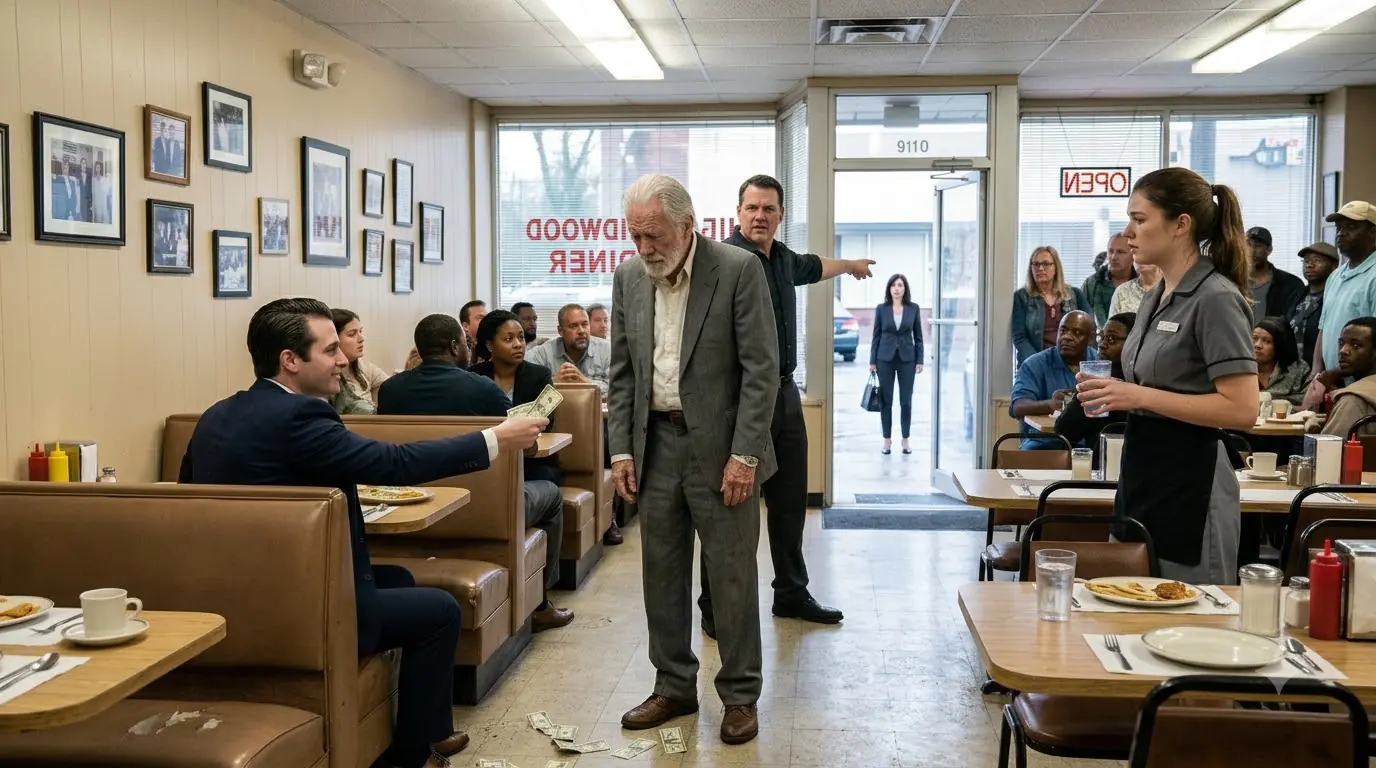
The manager told him to leave, unaware that he was waiting for the daughter, who had invited him herself.
Only one waitress stood between him and the door, refusing to let the moment pass in silence. Then the glass doors swung open, and the most powerful woman in the city walked in and called that same old man dad.
The small house on the edge of Charlotte still smelled like cedar shavings, even though Gideon Holloway had not touched a lathe in almost a decade. He sat at his kitchen table that morning with a cup of black coffee going cold beside him, listening to his daughter's voice through the phone, warm and a little rushed the way it always was before a big meeting.
Lenora reminded him about dinner at the restaurant, told him a car would come for him at 6, and asked if he needed anything before then. Gideon said no to the car the way he always did and told her he would drive himself in the truck.
There was a particular weight to that evening, one Lenora had not fully put into words on the phone. 20 years earlier, almost to the week, Gideon had sold Holloway Woodworks, the small but respected shop he had built with his own hands, and placed $86,000 into his daughter's palm so she could start the company that would one day become Holloway Dominion Capital.
It was also the last dinner the three of them, Gideon, his wife, and Lenora, had shared together before cancer took her mother 18 months later. Lenora wanted to mark the anniversary the way her mother would have wanted, with a good meal and her father across the table.
Gideon opened the closet and found the gray suit hanging exactly where it always hung, a little stiff at the shoulders now, a thread loosening at the cuff where his wife had once mended it herself. He could have bought a dozen new suits with the money sitting untouched in accounts he barely looked at, but the idea never crossed his mind as anything worth doing.
The suit still smelled faintly of her perfume if he pressed his face close enough, and that was worth more to him than any tailor on any avenue in the city. His phone buzzed once more before he left.
A message from Lenora's assistant confirming the reservation. The private table had been booked under the name Holloway, and Miss Holloway would be arriving later once the board meeting downtown wrapped for the evening.
Gideon read it twice, tucked the phone into his breast pocket, and pulled his old leather wallet from the drawer where it always sat, worn soft at the corners from four decades of honest use. He paused at the mirror in the hallway before leaving, straightening the collar of the old suit with hands that still bore the faint scars of a lifetime spent around table saws and chisels.
There was a version of tonight where he simply let Lenora send the car, sat back, and arrived exactly the way people expected a rich man's father to arrive. He had never once chosen that version, not because pride forbade it, but because something in him needed the walk, the cold air on his face, the ordinary rhythm of driving himself somewhere that mattered.
His late wife used to tease him about it, calling him the most stubborn man in three counties, and he liked to think she would still be teasing him now if she could see him standing in that same suit 20 years later. He arrived nearly 30 minutes early, out of habit more than eagerness, and pulled his faded Ford pickup into the valet line outside the restaurant.
The young attendant glanced at the truck, then at Gideon, and asked if he was there to make a delivery. Gideon said no thank you, found his own spot two blocks down instead of waiting for an answer that clearly was not coming and walked the rest of the way with his hands in his coat pockets against the evening chill.
By the time he reached the entrance, several sets of eyes near the windows had already found him and were slow to look away. The restaurant glittered the way expensive rooms always did, chandeliers throwing soft gold light across white tablecloths and crystal that had never known a chip.
Gideon stepped up to the host stand and gave his name, calm and unhurried, the same voice he had once used to settle disputes on job sites twice this loud. The man behind the stand, dressed sharper than most of the guests, looked him over from his shoes to his collar before answering.
Everett Sloan did not bother softening his tone when he told Gideon that the Holloway table was not meant for him. Gideon held up his phone, the confirmation text still open on the screen, and asked Everett to look again before deciding anything.
Everett barely glanced at it, dismissing the message as something anyone could have copied or overheard from somewhere else. He told Gideon to wait near the service corridor instead, out of view of the guests who mattered most tonight, and turned away before Gideon could respond.
It was the kind of casual cruelty that did not even register to Everett as cruelty at all. To him, it was simply the ordinary maintenance of a room built for people who looked a certain way.
A young waitress named Norah Bennett had been refilling water glasses two tables away and caught the exchange from the corner of her eye. She had worked at the restaurant for nearly 4 years, long enough to know every quirk of the reservation system better than most of the managers who came and went above her.
Something about the way Everett dismissed the old man without checking the system first struck her as wrong, and she quietly pulled up the reservation on the nearest terminal to see for herself. The screen confirmed it instantly.
A table for two under Lenora Holloway with a note specifying that the first guest to arrive would be a gentleman named Gideon Holloway. Norah carried the information straight to Everett, expecting him to correct his mistake the moment he saw it in writing.
Instead of apologizing, he leaned past her and deleted the note from the screen with two quick clicks, telling her plainly that this was not her concern. She stood there for a moment, the injustice of it settling uncomfortably in her chest before Everett walked off toward the private dining room without another word.
Norah looked back toward the service corridor where Gideon stood patiently, his hands folded, his expression unreadable, and decided she was not finished with this yet. In the private dining room, Preston Whitmore sat at the head of a table crowded with champagne flutes and half-eaten appetizers, flanked by his fianceé, Marissa Vale, and three young investors eager to be seen near him.
They were celebrating early, certain the deal with Holloway Dominion was as good as signed. It was a $210 million lifeline that would quietly erase the debts Preston had spent two years hiding from everyone outside his father's inner circle.