Seventeen-year-old Leo Gallagher was freezing when the sound reached him.
At first, he thought it was thunder.
That made no sense.
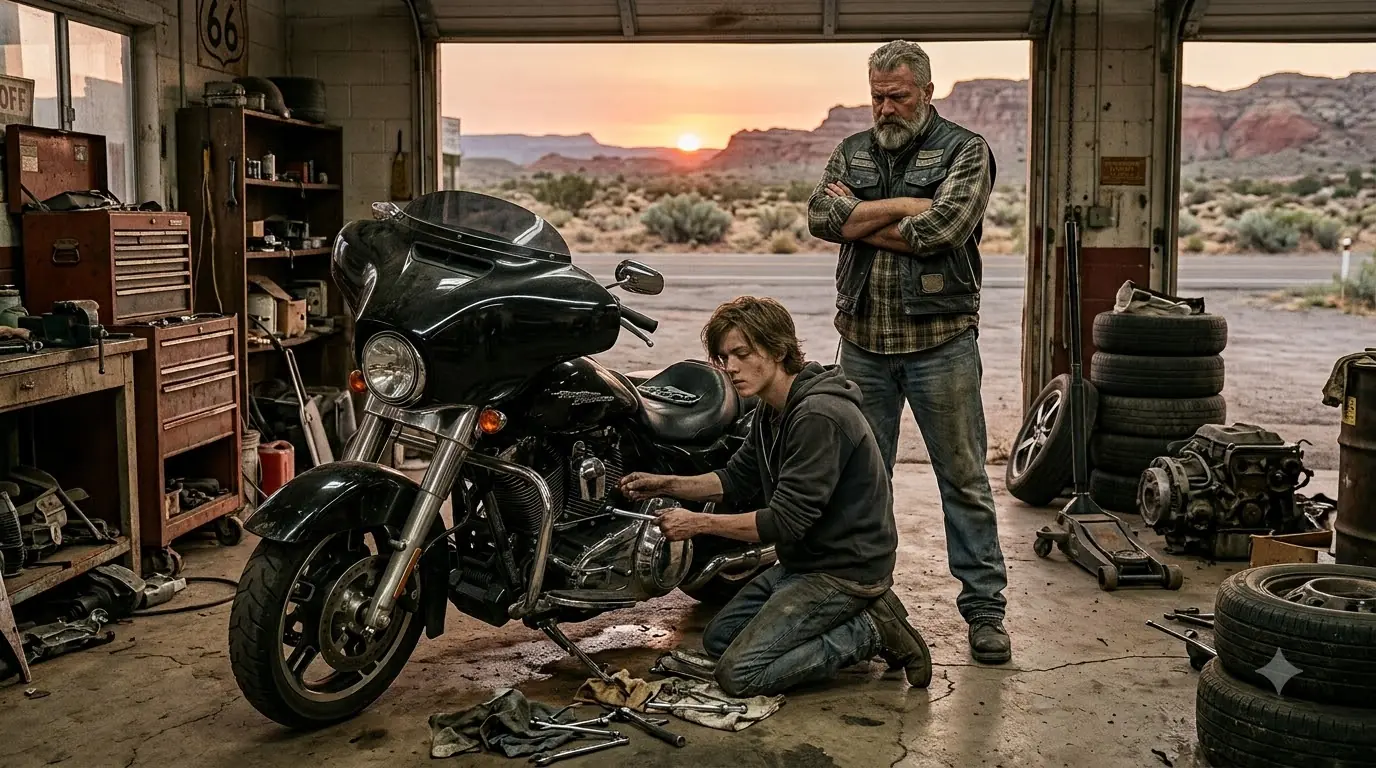
There had not been a cloud over the western Arizona desert all day, and the night sky visible through the broken roof of the abandoned garage was perfectly clear.
Then the sound came again.
A deep mechanical cough.
A violent backfire.
Then the unmistakable roar of a large motorcycle fighting to stay alive.
Leo stopped moving.
He was sitting behind an overturned workbench inside what remained of an old Sinclair gas station along a forgotten stretch of Route 66, roughly forty miles outside Kingman.
The building had been abandoned for decades.
The office windows were shattered.
The roof over the service bay had partially collapsed.
Wind had pushed sand through every opening until drifts collected against rusted tires, broken shelving, and pieces of machinery nobody had wanted badly enough to haul away.
Leo had been living there for six days.
Living was probably too generous a word.
He existed there.
He slept beneath two stained moving blankets he had found behind the garage.
He kept his water in an old military-style canteen that was now less than one-third full.
His food supply consisted of half a sleeve of crackers, two packets of peanut butter taken from a diner, and a can of peaches he was saving because opening it would mean admitting he had almost nothing left.
At night, the desert became colder than most people imagined Arizona could be.
Leo wore two shirts beneath a faded work jacket.
The jacket had belonged to his father.
It was too large when his father died.
Seven years later, it finally fit.
Leo pulled the collar higher around his neck and listened.
The motorcycle coughed again.
Then silence.
For three weeks, every unfamiliar sound had carried the possibility of danger.
A truck slowing on the road.
Tires over gravel.
A distant siren.
A door shutting.
Leo had learned to freeze first and identify the sound second.
That habit had kept him hidden since leaving Flagstaff.
He had not planned to run this far.
He had not really planned anything.
Three weeks earlier, he had climbed through a second-story bathroom window at Hank Dawson's foster home with seventy-three dollars in cash, one change of clothes, his father's pocket screwdriver set, and a bottle of water.
He left at 2:13 in the morning.
Leo knew the exact time because he had stared at the digital clock beside the hallway door for nearly ten minutes before moving.
The house held six foster boys.
The state paperwork described Hank Dawson as an experienced caregiver providing structure to difficult adolescents.
Structure was Hank's favorite word.
Everything he did became structure when he explained it to social workers.
Taking phones away for weeks was structure.
Locking food cabinets outside meal times was structure.
Forcing boys to spend weekends cleaning rental properties Hank owned was teaching responsibility.
Keeping part of the small clothing allowances intended for the children was financial discipline.
Making them repeat that they should be grateful to have a roof over their heads was character building.
The paperwork never described what happened after inspectors left.
Hank understood timing.
He knew when visits were scheduled.
He knew which rooms needed to look clean.
He knew which boys would stay quiet.
He knew that teenagers with behavioral histories were easy to discredit.
If one complained, Hank said the boy was angry about rules.
If two complained, he said they were reinforcing each other's behavior.
If a teacher asked questions, Hank produced folders.
Medication records.
School reports.
Incident notes.
He was never unprepared.
Leo had arrived at Hank's house fourteen months earlier.
Before that came three other placements.
The first was crowded but tolerable.
The second ended when the foster parents divorced.
The third lasted five months.
Then Hank.
Leo had stopped unpacking completely by then.
He kept important belongings in a backpack.
There were not many.
A photograph of his father.
A small combination wrench his father once carried in his shirt pocket.
A folded registration card from one of his father's motorcycles.
A notebook filled with mechanical drawings.
And the old work jacket.
Leo's father, Patrick Gallagher, had been a motorcycle mechanic in Reno.
Not famous.
Not wealthy.
But good.
Very good.
He specialized in custom motorcycles and difficult repairs other shops did not want.
Patrick never called himself an artist.
Customers did.
He hated the word.
"Artists get to blame feelings," he once told Leo.
"Mechanics have to make the thing run."
Leo had been six the first time Patrick let him hold a flashlight beneath a motorcycle.
At seven, Leo learned the difference between a Phillips and flathead screwdriver.
At eight, he could identify most common hand tools.
At nine, Patrick began letting him help with oil changes under supervision.
Then Patrick died.
A sudden aneurysm.
No warning.
Leo came home from school one afternoon and found two adults waiting in the living room.
Afterward, almost everything mechanical became painful.
For nearly a year, Leo avoided garages.
Then one day he opened Patrick's old toolbox.
The smell hit him first.
Metal.
Oil.
Rubber.
The faint chemical smell of cleaner.
Leo sat on the garage floor for two hours.
By the time he stood up, he had decided that engines were the only conversations with his father he still knew how to continue.
Years later, at Hank Dawson's house, that knowledge became useful.
Hank owned three vehicles and two lawn tractors.
Leo fixed them.
At first, Hank praised him.
Then he stopped paying mechanics.
Soon every mechanical problem became Leo's responsibility.
If something broke because it was old, Hank blamed Leo.
If Leo asked for a part, Hank complained about the cost.
If Leo repaired something successfully, Hank told social workers how much structure had improved the boy's behavior.
The final argument began over twenty dollars.
Hank claimed money had disappeared from a drawer.
Leo had not taken it.
One of the younger boys admitted privately that he had seen Hank's nephew borrow cash earlier.
Nobody wanted to say that to Hank.
Leo denied stealing it.
Hank accused him again.
Leo refused to confess.
The confrontation escalated.
Leo ended up injured badly enough that breathing hurt for days.
Hank told him he had fallen against a workbench.
Then he told him that if anyone asked, Leo had become aggressive first.
Something inside Leo changed that night.
He understood that the next time could be worse.
He also understood that Hank already controlled the story anyone outside the house would initially hear.
So Leo ran.
Bus to Williams.
Walking.
Hitching one ride with an elderly couple who believed he was visiting family.
Another bus he could barely afford.
Sleeping behind a laundromat.
Then the old Route 66 station.
The Mojave did not care about any of that.
It cared whether Leo had water.
Whether he understood heat.
Whether he knew where shade would still exist three hours later.
Whether he could survive a night when the temperature dropped and wind found every hole in the garage walls.
By his sixth day there, Leo had begun considering walking toward Kingman.
That was dangerous.
But staying was becoming impossible.
Then the motorcycle arrived.
Leo crawled toward the broken office window.
On the highway shoulder, a large man struggled with a Harley-Davidson Road King.
Even in fading light, Leo recognized the model.
Late 1990s.
Probably 1998.
Large touring frame.
Twin engine.
Heavy enough that controlling it while injured would be difficult even for a powerful rider.
The man finally managed to guide the motorcycle onto gravel.
The engine backfired.
Coughed.
Then died.
The rider kicked the stand down.
Removed his helmet.
Leo immediately regretted looking.
The man was enormous.
At least six feet four.
Heavy boots.
Faded jeans.
Black leather vest.
A red-and-white winged emblem across the back identified the motorcycle club.
Hells Angels.
Leo's stomach tightened.
He had seen patches before.
Not many.
Patrick knew riders from different clubs through the shop in Reno, but he always told Leo the same thing.
"Read the room before you read the patch."
People were individuals first.
But patches carried history.
And history sometimes carried trouble.
Leo stayed behind the wall.
The biker examined the Road King.
He moved stiffly.
His left shoulder looked injured beneath torn clothing.
Dust and road grit covered one side of his jeans.
The right saddlebag was missing.
One highway guardrail farther west showed fresh scraping.
Whatever happened had been more than a simple breakdown.
The biker crouched near the motorcycle.
Swore.
Pulled a small tool roll from the remaining luggage.
Leo watched.
The man inspected a damaged fuel line.
Then the engine casing.
Leo leaned closer to the broken glass.
Fuel-system damage.
Fluid beneath the motorcycle.
Possibly oil.
Maybe a cracked cover rather than catastrophic block damage.
The rider wrapped something temporarily.
Tried the starter.
Nothing useful.
Again.
A cough.
Then silence.
Leo knew the repair would not hold.
He also knew he should remain hidden.
That was the intelligent decision.
A runaway minor in an abandoned garage did not need to introduce himself to a stranded outlaw biker after sunset.
Leo moved away from the window.
Then stopped.
Patrick's voice entered his mind.
Not a memory of a specific sentence.
More like a way of thinking.
What is the machine telling you?
Leo returned to the window.
The biker looked down the highway.
Once.
Then again.
Not impatiently.
Worried.
That caught Leo's attention.
The man was not simply stranded.
He expected something.
Headlights appeared far away.