The finger stopped less than six inches from Malik Johnson’s face. Senior manager Linda Mercer stood across the sleek reception counter in her tailored gray suit, her expression twisted with the confidence of someone accustomed to speaking without consequences. “People like you don’t belong up here—get back behind that desk before I have you thrown out.” Malik kept both hands on the counter and answered quietly, “Point that finger at me again and make sure you’re ready to explain why.” Linda stepped closer and snapped, “I can end your job before lunch, and nobody upstairs will even know your name.”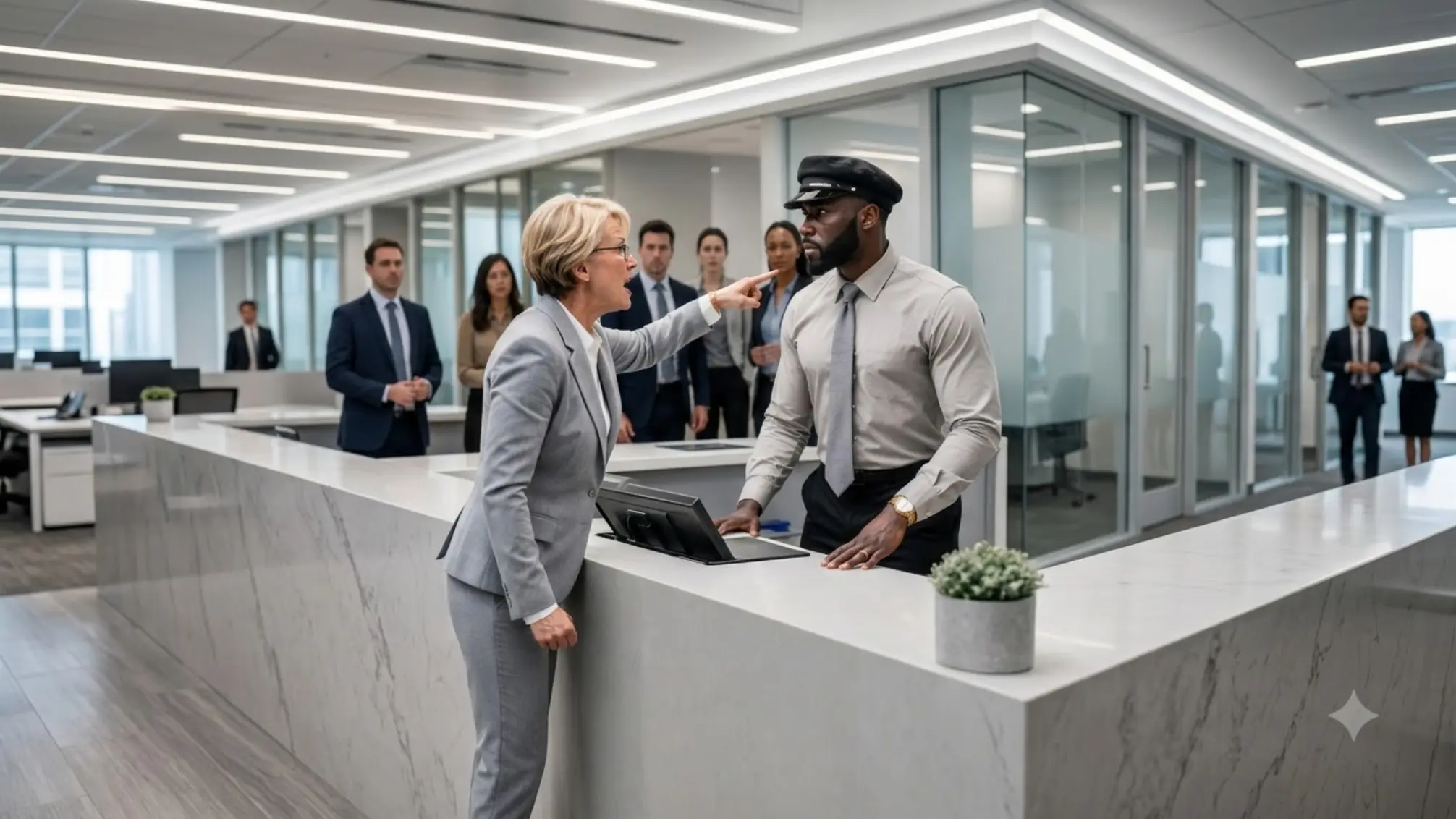
Malik stared directly into her eyes. “Keep talking—because the man upstairs already knows every word you’ve said.” Linda gave him a dismissive laugh, assuming the receptionist was attempting to sound important, while four employees behind the glass partitions immediately lowered their eyes. Malik noticed that reaction more carefully than her insult. These people were not surprised by Linda’s behavior; they were afraid of becoming her next target.
Only six days earlier, Malik had been sitting thirty floors above the city in a corner office decorated with awards, acquisition plaques, and framed magazine covers celebrating Tech Vision’s growth. The company he had founded sixteen years earlier employed thousands of people, and the Virginia division had once ranked among its strongest locations. Then employee satisfaction dropped fifteen percent in three consecutive reporting periods, voluntary departures increased, and anonymous complaints began using the same words repeatedly: favoritism, disrespect, retaliation, and fear. Malik had asked his executive team why, but every presentation offered polished explanations that somehow blamed workload, changing markets, or employee expectations.
The answers bothered him because none explained why the complaints sounded personal. One employee wrote that senior managers treated frontline workers as if they were invisible, while another claimed promotions depended more on social connections than actual performance. Several people said complaining only made conditions worse, and a smaller number described treatment that appeared influenced by race, background, or job status. Malik ordered an internal review, but the resulting report called the problems “isolated communication issues.” He read that phrase three times before deciding he no longer trusted what was reaching his desk.
The idea of going undercover seemed ridiculous when it first occurred to him. He was recognizable inside executive circles, appeared periodically in company newsletters, and had addressed employees through annual broadcasts, but the Virginia office had grown rapidly and many newer workers had never met him personally. With the help of only two trusted board members, Malik removed the tailored suits, expensive shoes, and executive security badge that normally announced his position before he spoke. A plain gray company shirt, gray tie, black trousers, service cap, and deliberately understated appearance transformed him into a temporary front-desk employee assigned to help during a staffing shortage.
He expected the telephone system to challenge him. He expected awkwardness learning visitor procedures and scheduling conference rooms while pretending not to know executives he had personally hired. What he did not expect was how quickly people stopped seeing him. Managers walked past without eye contact, employees handed him packages without greeting him, and visitors spoke over him as though the reception counter itself had answered their questions.
During his first morning, two department managers stopped beside the desk to discuss new efficiency targets. One complained that the customer-service team was already overloaded, and the other shrugged before saying, “Let HR deal with the whining. We have actual work.” They said it directly in front of Malik because neither believed a receptionist’s opinion mattered. Malik wrote the exact words inside a small notebook hidden beneath the desk.
By lunch, he understood something spreadsheets had hidden from him. The Virginia office did not merely have morale problems; it had developed invisible social levels that determined whose problems deserved attention. Senior staff occupied one world, technical and accounting employees occupied another, and receptionists, assistants, support workers, and junior employees existed near the bottom. Tech Vision’s public values promised respect across every position. Its daily habits told a different story.
A veteran receptionist named Doris Coleman became Malik’s first real guide. She showed him how to redirect complicated calls, which managers ignored calendar invitations, and which executives expected reception staff to solve mistakes without acknowledging them. During a coffee break, Doris watched a vice president walk past them without responding to her greeting and smiled sadly. “Don't expect anyone upstairs to notice us,” she said. “To them, we're furniture that answers phones.”
Malik had built Tech Vision believing exactly the opposite. His father had spent thirty-three years maintaining hospital equipment and had taught Malik that organizations collapsed when leaders stopped respecting the people who kept ordinary systems working. Yet somewhere during expansion, acquisitions, board meetings, and investor presentations, Malik had allowed himself to become too dependent on reports prepared by people whose careers benefited from telling him things were fine. Doris’s comment followed him long after his first shift ended. He went home that evening feeling less like a CEO gathering information and more like a founder discovering how badly he had neglected his own house.
The second morning brought Linda Mercer. She was considered one of the Virginia office’s strongest managers, praised in executive reports for efficiency, cost control, and her ability to “drive accountability.” Malik had approved two bonuses connected to her department’s performance without ever watching her lead people directly. From the reception desk, he finally did.
Linda entered the lobby at 8:11 and immediately criticized a junior employee for carrying documents in the wrong folder. Twenty minutes later, she spoke warmly to a visiting executive from headquarters, complimenting his presentation and asking about his children. The instant he disappeared into the elevator, she turned toward an administrative assistant and ordered her to redo a report because the margins were “embarrassing.” Malik watched the assistant apologize three times for something that could have been corrected in less than a minute.
The pattern repeated throughout the morning. Linda was polished around people who could affect her career and openly contemptuous toward those she considered beneath her. She interrupted receptionists, mocked customer-service workers, blamed IT technicians for delays outside their control, and once dropped a folder onto a junior employee’s desk instead of handing it to him. Yet whenever another senior manager appeared, her voice softened and her posture changed.
Then she came for Malik.
A rush of visitors had arrived simultaneously while two telephone lines malfunctioned. Malik was helping a contractor sign in when Linda marched toward the counter, looked at several papers waiting beside the monitor, and demanded to know why the front desk looked “like a disaster zone.” He calmly explained that one phone system had failed and IT was already working on it. Linda barely listened.
“People like you always have excuses,” she said.
Malik looked up.
“People like me?”
Linda paused for perhaps half a second, then decided she did not need caution.
“Temporary workers. Reception staff. People who can't handle basic responsibility but somehow expect the rest of us to carry them.”
Several employees heard her.
Nobody intervened.
That silence told Malik almost as much as Linda did.
He answered, “The phones are down because of a server issue, not because reception failed.”
Linda laughed. “Don't lecture me about operations.”
“I wasn't.”
“You were correcting me.”
“I was giving you accurate information.”
Her face hardened immediately.
That was when she stepped closer, pointed directly at him, and told him people like him did not belong “up here.”
The confrontation lasted less than two minutes. To the employees watching, however, it seemed much longer because they had spent years seeing versions of it happen without anyone challenging Linda. Malik felt anger rising, but he forced himself to remember why he was there. Revealing himself now would punish one manager. Remaining undercover might reveal why everyone had allowed her to become this comfortable.
When Linda finally walked away, an IT technician named Henry Wallace approached the desk carrying replacement equipment. He was thirty-two, soft-spoken, and almost apologetic even when he had done nothing wrong. “Don't take it personally,” Henry said. “That's just how she talks to people.”
Malik looked at him. “That supposed to make it better?”
Henry gave a tired smile.
“No.”
Those two letters carried years of resignation.
Henry replaced the malfunctioning hardware in less than fifteen minutes. Malik expected him to leave afterward, but instead Henry stayed long enough to teach Doris how to identify the problem if it happened again. He explained everything without condescension, then helped an intern recover a document she believed she had permanently deleted. When the frightened young woman apologized repeatedly, Henry told her, “Computers make people panic. We fix the computer first and the panic second.”
Malik wrote Henry’s name in his notebook.
Later that afternoon, he noticed Angela Morris, a senior accountant whose title suggested experience but whose organizational status remained surprisingly low. Angela arrived before most managers and routinely stayed after them. She corrected financial errors without announcing who had made them, helped younger staff understand reporting procedures, and carried responsibilities Malik believed should have belonged to someone at least one level above her.
On his third evening undercover, Malik watched the office empty while Angela remained at her desk surrounded by quarterly reports. A coworker stopped beside her and reminded her about her daughter’s recital. Pain crossed Angela’s face before she answered that the board numbers needed to be flawless and she would make it up to her daughter another weekend. Malik felt the weight of that sentence because somewhere else inside the building, managers who took credit for those same reports had already gone home.
The following morning, he searched only the information a receptionist would legitimately have access to and learned that Angela had applied for promotion three times. Each application had ended unsuccessfully. The official notes described her as technically strong but lacking “executive presence.” Malik had read that phrase in hundreds of performance reviews and never questioned how easily it could hide subjective preference.
Later, Angela spoke quietly with another employee near reception. “I keep thinking if I work harder, someone will eventually notice,” she said. “But sometimes it feels like you’re invisible unless you belong to the right circle.” Malik lowered his eyes toward the visitor log so she would not realize he was listening. Her words reminded him almost exactly of what Doris had said.
By the fourth day, Malik had stopped wondering whether Tech Vision’s problem came from one bad manager. Linda was an obvious symptom, but she was operating inside a system that rewarded visibility upward and obedience downward. Employees had learned that managers could behave badly so long as results looked good, while talented workers had learned that competence did not guarantee opportunity. The company had not officially created that culture. It had simply failed to stop it.
Then Malik discovered something more troubling.
A customer-service employee named Rachel quietly approached Doris during lunch and asked whether she still had copies of several complaints submitted the previous month. Doris said she did not because managers normally forwarded them electronically. Rachel looked nervous and explained that three complaints she had personally filed regarding abusive behavior had disappeared from the internal tracking system. Malik pretended to continue sorting mail.
“Disappeared how?” Doris asked.
“They were there Friday.”
Rachel lowered her voice.
“Monday they weren't.”
Doris looked toward the management corridor.
“You ask anyone?”
Rachel laughed without humor.
“You want me fired?”
Malik wrote everything down.
That evening he contacted only one person from his trusted board circle and requested a silent preservation of complaint-system logs. He gave no explanation beyond saying the records should not be altered. The board member understood the seriousness and arranged it through outside technical support rather than the Virginia management chain.
The next morning, Malik continued working as if nothing had happened.
Linda became harsher.
She criticized a receptionist for taking too long with an elderly visitor, accused customer-service employees of exaggerating workload problems, and ordered Henry to fix a conference-room display immediately even though he was already handling a network issue affecting dozens of people. Henry calmly explained the priority conflict. Linda responded, “Then maybe we need someone competent enough to do both.”
Malik expected Henry to defend himself.
He did not.
He simply lowered his eyes and said, “I'll handle it.”
That moment angered Malik more than Linda pointing in his face.
Henry was not weak. He had simply learned that defending himself cost more energy than completing the work. Malik suddenly understood why employee surveys used words like exhausted instead of merely dissatisfied. People were not only doing their jobs; they were constantly calculating how much disrespect they could safely absorb.
At the end of the fifth day, the preserved system logs arrived.
Twenty-nine complaints had been submitted during the previous six months.
Only eleven remained visible in the official dashboard.
Several were reclassified from “managerial conduct” to “general workplace concern,” reducing their severity. Others had been closed without employee confirmation. Three had been deleted entirely.
Administrative access records pointed toward two management accounts.
One belonged to Linda Mercer.
The second belonged to Thomas Vane, the Virginia operations director.
Malik stared at the report for nearly an hour.
Now he had evidence.
Still, he waited.
He wanted to understand motive before acting.
The sixth day produced an unexpected development. Linda arrived visibly nervous, checked her phone repeatedly, and disappeared into an empty conference room twice before noon. Her behavior was so different that even Doris noticed.
“She looks scared,” Doris whispered.
Malik nodded.
“Have you ever seen her scared?”
“Never.”
That afternoon Linda approached Malik but did not insult him. She simply stared for several seconds, almost as though trying to decide whether she recognized something beneath his disguise. Malik prepared himself for exposure. Instead she turned away.
Hours later, after most employees left, Malik changed back into his normal suit inside a secure office and prepared for the emergency board meeting he had scheduled. Before he could leave, someone knocked on the door. Linda stepped inside.
She stopped when she saw him.
Her face emptied of color.
For a moment neither spoke.
The receptionist she had threatened that morning was gone. Before her stood the man whose portrait hung inside Tech Vision headquarters, whose signature appeared on executive appointments, and whose approval had once helped promote her. Malik removed the glasses he had used during the undercover assignment and placed them on the desk.
Linda whispered, “Mr. Johnson.”
Malik’s expression remained unreadable.
“You knew my name after all.”
She lowered herself into the nearest chair.
“I can explain.”
“You'll have the opportunity.”
“Please.”
“Start with the complaints.”
Linda stared at him.
That confirmed enough.
Malik sat across from her.
“Twenty-nine were filed. Eleven stayed visible.”
Linda’s hands began trembling.
“You accessed the system.”
“I own the system.”
She closed her eyes.
Malik continued.
“Why were complaints altered?”
Linda hesitated so long that he prepared to end the conversation.
Then she said something he did not expect.
“Because someone told us to.”
“Thomas?”
“Not only Thomas.”
Malik leaned forward.
“Who?”
Linda looked toward the closed door.
“There’s something happening inside Tech Vision that you don't know about.”
Malik almost laughed.
“I’ve spent a week discovering that.”
“No.”
She shook her head.
“I mean someone has been deliberately making it worse.”
Linda explained that months earlier, managers began receiving anonymous messages containing private information. Some messages included embarrassing financial records, personal relationships, or internal mistakes that could threaten careers. Employees were told to create conflict, bury complaints, disrupt projects, or leak information if they wanted their secrets protected.
Malik listened without interrupting.
Linda admitted she had altered complaints.
She also admitted nobody forced her to insult employees.
That mattered.
“The messages scared me,” she said. “But the way I treated people was still my choice.”
Malik appreciated the distinction without forgiving it.
“Show me.”
Linda handed him her phone.
A hidden-camera feed filled the screen.
Inside a darkened administrative area, a hooded figure appeared to be moving between desks after hours. The footage came from a small camera Linda claimed she had installed because she suspected someone was entering offices without authorization.
Malik stared.
“Who is that?”
“I don't know.”
A knock interrupted them.
A tall man carrying a leather briefcase entered after security cleared him.
His name was Oliver Grant, an investigator known for handling complex corporate fraud and internal sabotage cases. One of Malik’s board members had contacted him after receiving the preserved complaint logs. Oliver placed the briefcase on the conference table.
“I think your employee is telling part of the truth,” he said.
Linda looked relieved.
Malik did not.
“Part?”
Oliver opened a folder.
“We traced several anonymous communications.”
The evidence led toward a former Tech Vision senior analyst dismissed the previous year following disputes over access controls and unauthorized data use. The analyst possessed extensive knowledge of company systems, reporting structures, and employee vulnerabilities. More troublingly, investigators identified communications connecting him with several current and former employees.
Oliver explained that the sabotage appeared designed to make leadership look incompetent while lowering employee trust.
Someone had encouraged conflict.
Someone had manipulated information.
Someone had exploited existing weaknesses rather than inventing them.
That distinction became critical.
Malik turned toward Linda.
“You want me to believe the toxic culture was manufactured?”
Linda hesitated.
“No.”
He waited.
“The sabotage made it worse,” she said. “But it worked because problems were already here.”
Malik nodded.
Finally, someone was speaking honestly.
The outside manipulation had not forced Linda to treat receptionists with contempt. It had not forced management to ignore Angela, undervalue Henry, or create social circles that controlled promotions. The saboteur had discovered fractures inside Tech Vision and widened them.
That truth shaped everything Malik did next.
The following morning, he called an emergency meeting of the Virginia senior management team and selected board members. Linda entered quietly and took a seat near the end of the table. Thomas Vane arrived looking irritated about the short notice.
Then Malik walked in.
Nobody initially understood why he placed a black service cap on the table.
Several managers exchanged confused looks.
Malik remained standing.
“For the past week, I worked inside this office.”
Silence.
“As a receptionist.”
Linda looked down.
Thomas stared at him.
Malik continued.
“I answered your calls. I watched your meetings. I listened in the break room. I saw who you respected when you thought leadership wasn't watching.”
The room became painfully still.
“One of you told me people like me didn't belong here.”
Everyone looked toward Linda.
She did not defend herself.
Malik raised one hand.
“This meeting is not about one sentence.”
He placed several folders on the table.
“It is about the system that made someone comfortable enough to say it.”
He described the fifteen-percent employee satisfaction decline, altered complaints, hidden grievances, promotion failures, and toxic management habits. He also described Angela and Henry without initially naming them, explaining how two of the office’s strongest employees had been allowed to remain overlooked while managers received recognition for work those employees often carried.
Then he named them.
Angela was called into the room first.
She entered believing there was a problem with quarterly reports.
Henry followed and looked even more confused.
Malik invited both to sit.
“Angela,” he said, “how many times have you applied for promotion?”
She glanced around nervously.
“Three.”
“Why were you rejected?”
“I was told I lacked executive presence.”
Malik turned toward the managers.
“Can anyone define that using measurable performance criteria?”
Nobody answered.
He looked at Henry.
“How long have you been junior IT support?”
“Four years.”
“How many senior-level incidents have you handled during that period?”
Henry hesitated.
“I don't know.”
Oliver slid a report toward Malik.
“Forty-seven documented incidents.”
Several managers shifted.
Malik closed the folder.
“Then our system is not merely unfair.”
He looked around the table.
“It is stupid.”
No one expected the CEO to use that word.
He continued anyway.
“A company that hides talent because the right manager doesn't notice it is wasting its own future.”
Then Oliver entered.
The meeting changed immediately.
Evidence of outside sabotage was presented carefully, without revealing private employee information unnecessarily. Investigators had traced communications to the former analyst and several collaborators. The sabotage included system interference, misinformation, intimidation, and attempts to worsen tensions between management and employees.
Thomas Vane began insisting the discovery proved complaints had been manipulated from the outside.
Malik stopped him.
“No.”
Thomas stared.
“The sabotage explains interference.”
Malik pointed toward the managers.
“It does not explain behavior.”
Thomas opened his mouth.
Malik continued.
“Nobody forced Linda to point in a receptionist’s face.”
Linda closed her eyes.
“Nobody forced managers to laugh about overworked employees.”
He looked toward another executive.
“Nobody forced Angela to miss her daughter’s recital while people above her went home.”
The room went silent again.
“Nobody forced us to ignore Henry for four years.”
Malik placed both hands on the table.
“The saboteur found a weak culture because we gave him one.”
That became the sentence nobody inside Tech Vision forgot.
The investigation continued for several weeks.
The former analyst and accomplices were identified through system access records, communications, security footage, and financial evidence. Legal proceedings followed, and Tech Vision cooperated with authorities rather than attempting to hide the embarrassment. Malik ordered every finding separated clearly between deliberate sabotage and genuine internal misconduct.
Linda faced consequences.
Her cooperation with the investigation mattered, but it did not erase how she had treated people.
She was suspended from management duties, removed from employee-evaluation authority, and required to complete an extensive leadership remediation program before any consideration of returning to supervision. She also apologized directly to several employees she had mistreated.
When she reached Malik, she hesitated.
“I owe you an apology too.”
Malik shook his head.
“You owe the receptionist one.”
She stared.
“He was me.”
“I know.”
“No.”
Malik leaned back.
“You’re still thinking about my title.”
Linda finally understood.
“The man behind that desk deserved respect before you knew he was CEO.”
Her eyes lowered.
“Yes.”
“Remember that.”
Malik did not know whether Linda would ever become the leader Tech Vision needed. That decision would depend on measurable behavior over time, not one emotional apology. Accountability, he believed, should create conditions for change without pretending change had already happened.
Angela’s situation was simpler.
An independent review of her performance history showed she had been performing responsibilities well above her assigned level for years. Malik offered her promotion to Director of Financial Operations, a salary increase, and authority to redesign part of the reporting process she had quietly kept functioning. Angela stared at the offer letter so long that Malik wondered whether something was wrong.
“My daughter has another recital next month,” she finally said.
Malik smiled.
“Then don't be here.”
She looked up.
“I mean it.”
“What if reports are due?”
“Build a department capable of surviving one evening without you.”
Angela laughed through tears.
“I can do that.”
“I know.”
Henry received promotion to IT Team Lead with authority over training and incident response. Malik told him that technical expertise had earned the promotion, but his ability to teach frightened employees without making them feel foolish had made the decision easy. Henry looked genuinely uncomfortable being praised.
“You really watched all that?”
“For a week.”
Henry laughed.
“That explains why you were terrible with the switchboard.”
Malik stared at him.
Angela covered her mouth.
Then Malik laughed too.
It was the first light moment of the entire investigation.
Doris became part of a new employee-experience advisory group reporting outside the normal management chain. When Malik told her, she shook her head and said, “You realize I’m going to complain constantly.” Malik smiled.
“That is specifically why I picked you.”
Changes followed across Tech Vision.
Promotions required written performance evidence rather than vague descriptions such as executive presence.
Complaint systems were moved outside direct managerial control.
Employees could track reports and see whether they had been reclassified.
Senior leaders were evaluated partly on team retention, internal development, and verified employee feedback.
Anonymous reporting protections were strengthened.
Malik also changed himself.
He began spending scheduled days every quarter outside executive floors without large entourages. He visited support teams, accounting departments, reception desks, call centers, and technical operations. He did not pretend he could run every job after observing it for a few hours.
He listened.
That habit produced uncomfortable discoveries even after the Virginia crisis ended.
One afternoon, six months later, Malik walked through the same reception area where Linda had confronted him. The lobby looked almost identical: polished counters, glass walls, gray carpeting, and employees moving between meetings. Yet something subtle had changed.
Doris was training a new receptionist.
A senior director approached the desk carrying a stack of documents.
Instead of dropping them down and walking away, he waited.
“Whenever you have a second,” he said.
The receptionist finished helping a visitor.
“Thank you for waiting.”
The director smiled.
“No problem.”
Nothing extraordinary happened.
Malik continued walking.
That ordinary interaction affected him more than any board presentation.
Later that day, he found Linda attending a leadership session instead of managing a department. She approached him after class.
“I've been thinking about what you said.”
“Which part?”
“That the receptionist deserved respect even if he wasn't you.”
Malik waited.
Linda continued.
“I used hierarchy as permission.”
He nodded.
“Yes.”
“I thought demanding more meant leading.”
“You demanded downward.”
Linda accepted the criticism.
“I know.”
She eventually returned to management months later under supervision, but she never regained her old authority automatically. Her team feedback improved slowly. Employees reported fewer incidents.
Malik considered that progress.
Not redemption.
Not yet.
The sabotage investigation eventually reached court. The former executive who had coordinated much of the disruption had hoped declining morale, failed projects, and public complaints would weaken Malik’s position enough for investors to demand leadership change. He had exploited disgruntled employees, stolen internal information, and used personal secrets to pressure vulnerable staff.
The plan almost worked because Tech Vision already had weaknesses.
That fact remained in every internal review.
Malik refused suggestions that the company publicly blame everything on one disgruntled former employee.
“It would be convenient,” he told the board.
“And dishonest.”
The final report admitted management failures openly.
Employee trust had been damaged before the sabotage.
Promotions lacked transparency.
Complaints could be manipulated too easily.
Senior managers received insufficient behavioral oversight.
The outside attack intensified those failures.
It did not create them.
Investors initially worried about the admission.
Malik insisted on publishing a summarized version internally anyway.
“You cannot ask employees to trust leadership while hiding what leadership did wrong.”
Within a year, satisfaction scores began recovering.
Turnover declined.
Internal promotion rates increased.
Angela’s department became one of the strongest-performing financial teams in the company.
Henry created a technical mentorship program connecting experienced specialists with junior employees.
Doris’s advisory group became notoriously blunt.
Malik considered that a compliment.
One afternoon she sent him a message consisting of seven words:
Executives still schedule too many useless meetings.
Malik replied:
Finally, a problem I can personally fix.
He canceled two.
Years later, people at Tech Vision would still tell the story of the CEO who went undercover as a receptionist. Employees embellished details until some versions claimed Malik spent months in disguise or personally fired half the executive team in one afternoon. None of that was true.
The real story was quieter.
He spent one week where nobody believed he mattered.
That was enough.
Malik learned how people spoke when they thought power was not listening.
He learned how easily talented employees disappeared beneath weak management.
He learned that anonymous complaints meant little if the system receiving them rewarded silence.
He learned that external enemies could exploit problems leaders refused to acknowledge.
Most importantly, he learned something about himself.
For years he had believed creating good values was similar to creating a good culture.
It was not.
Values were what leadership printed.
Culture was what employees expected to happen after the door closed.
If a poster said respect but employees expected humiliation, the humiliation was the culture.
If policy promised fairness but promotions depended on social circles, favoritism was the culture.
If reporting systems promised protection but employees expected retaliation, fear was the culture.
Malik carried that lesson into every future decision.
In his office, he eventually placed the black receptionist cap inside a glass case.
Not because he thought the disguise made him heroic.
The opposite.
It reminded him how much had happened inside his own company without requiring any disguise at all.
He simply had not been close enough to see it.
Visitors occasionally asked why the CEO of a technology company kept an ordinary service cap beside awards worth millions of dollars.
Malik usually smiled.
Then he told them about Linda’s finger.
About Doris saying receptionists were invisible.
About Angela sacrificing evenings while managers claimed credit.
About Henry solving senior-level problems from a junior position.
And about a company nearly convinced its biggest threat came from the outside before discovering the outside attack had succeeded only because too many failures already lived within.
But Malik’s favorite part of the story was not the boardroom reveal.
It was not the investigation.
It was not Linda discovering whom she had insulted.
His favorite moment came almost two years later.
Malik entered the Virginia lobby wearing his normal suit.
A newly hired receptionist did not recognize him.
“Good morning, sir.”
“Morning.”
“Who are you here to see?”
Malik almost smiled.
“Malik Johnson.”
The receptionist typed.
“Do you have an appointment with Mr. Johnson?”
Malik looked toward Doris.
She was struggling not to laugh.
“Yes.”
The receptionist checked again.
“I don't see one.”
Doris finally turned away before Malik saw her grin.
Malik could have produced his executive badge immediately.
Instead he waited.
The receptionist remained polite but firm.
“I’ll need to verify before allowing access upstairs.”
Malik nodded.
“Please do.”
She called executive security.
Thirty seconds later, her face changed completely.
“Oh.”
Malik smiled.
“I assume you found him.”
The receptionist looked mortified.
“Mr. Johnson, I'm so sorry.”
“Why?”
“I didn't recognize you.”
“You followed procedure.”
She relaxed slightly.
Malik leaned toward the counter.
“And you treated me exactly the same before you knew who I was.”
The young woman waited, uncertain whether she had made another mistake.
Malik smiled.
“That's the part I care about.”
He walked toward the elevators.
Behind him, Doris finally started laughing.
Malik turned.
“You enjoyed that.”
“More than you know.”
The elevator doors opened.
Before entering, Malik looked across the reception area where his undercover week had begun.
Nobody was pointing in anyone’s face.
Nobody was shrinking when a manager approached.
Nobody seemed invisible.
Tech Vision was still imperfect.
It always would be.
But the company finally understood that its strongest culture could not be measured by how employees treated the CEO.
It was measured by how they treated the person they believed had no power at all.