“She belongs in the kitchens,” the Dowager Duchess of Marchwood said.
And she said it the way one might remark on the weather.
Pleasantly, certainly, with the full expectation of being agreed with.
Clara Whitfield heard the word kitchens land in the long dining hall and felt it the way she felt a draft under a door, precisely and without surprise.
She did not look up at once.
She kept her hands where they were, folded against the dark wool of her traveling gown, and she counted one, two.
The seconds it took for the laughter to gather among the guests, because laughter at a table this fine was never spontaneous.
It waited for permission.
The Dowager had just given it.
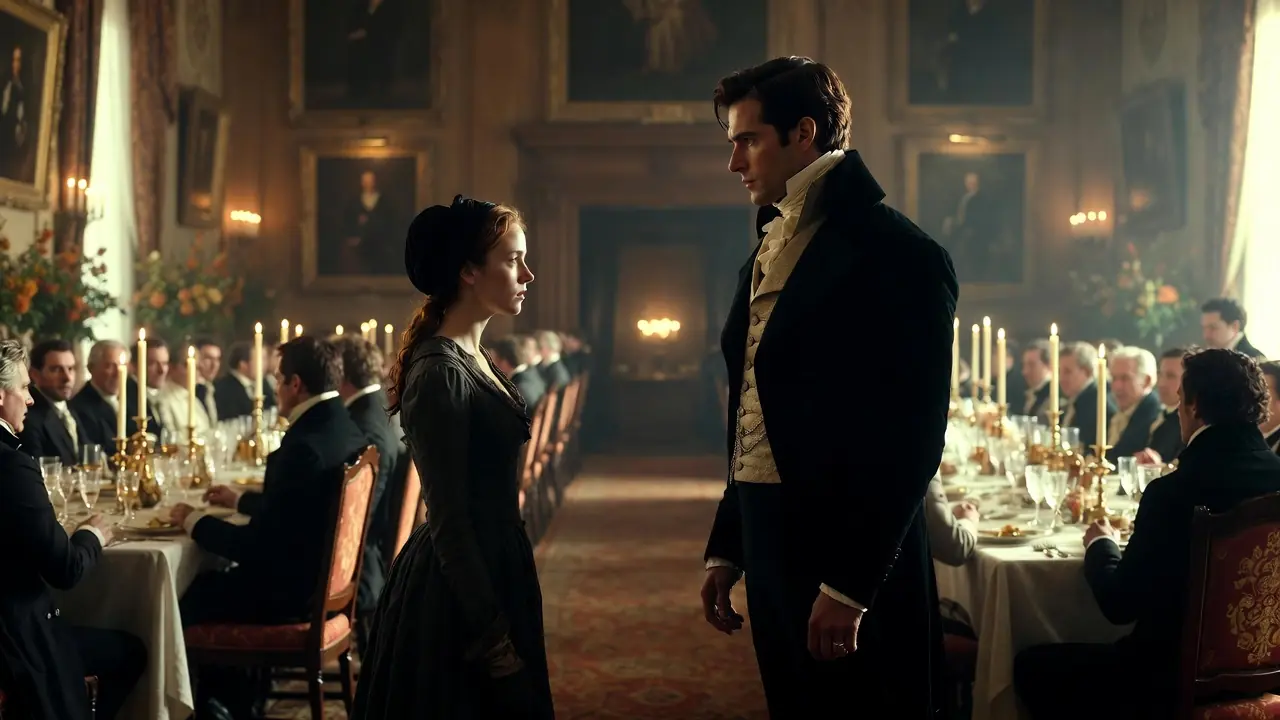
There were nineteen people in that hall and a duke at the head of it, and every one of them now understood that the plain woman who had arrived by the carrier’s cart, with mud on her hem and no maid behind her, had been invited here only to be made an example of.
Clara understood it too.
What none of them understood, what the Duke alone in that room knew and would not say, was that the woman his mother had just consigned to the scullery had once held the whole of this house in her two ink-stained hands, saved it, and walked away without leaving her name.
“Mama,” the Duke of Marchwood spoke without rising.
His voice was not loud.
In a hall built to carry a whisper to its furthest corner, he had never once needed it to be.
“Mrs. Whitfield will sit beside me.”
The laughter stopped as though a hand had closed over it.
He crossed to her himself.
That was the part that made the footmen forget their training and stare.
That a duke, in his own house, with a hundred candles burning down the length of the board and the silver laid for nineteen, walked the length of the hall to where a steward’s daughter stood near the door and offered her his arm.
Clara did not take it.
Not at first.
She looked at the chair he meant.
The chair to the right of the head of the table.
The chair that by every law of precedence in England belonged to the highest-ranking lady present, which tonight was the Countess of Selborne, who had already half risen to claim it.
And she understood, in the cold and orderly way she understood most things, exactly what it would cost her to sit there.
It would cost her invisibility.
It would cost her the only protection she had carried out of the wreck of her father’s name.
“Your Grace,” she said quietly. “The countess.”
“The countess will forgive me.”
He had not stopped looking at her.
“Or she will not. I find I do not greatly care which.”
She had never in her life held a silver fork that was hers to hold.
And somehow, with the whole of England’s finest table watching, she let the Duke of Marchwood draw out the second-best chair in the room and seat her at the head of it.
He returned to his own place.
He picked up his glass.
He looked down the length of the table at his mother, and he said very mildly, “Shall we go on?”
They went on.
Of course they went on.
One does not refuse a duke at his own board.
But Clara, lifting the wrong fork on purpose, the fish fork, when the soup had not yet come, caught the Dowager’s eyes across the candles and read in them not embarrassment, but calculation.
She thought, “She will want to know why, and so will all of them, and he will not tell them.”
The question was already loose in the room, running under the polite murmur like water under ice.
Why had he done it?
Why would a man who had spent four years putting Marchwood back together stone by stone, who could not afford a single wrong word in front of nineteen of the most consequential people in the county, throw away an evening’s diplomacy to seat a nobody at his side?
Clara knew the answer.
She had carried it for six years.
She simply could not yet imagine how he had found it out.
The soup came.
It was a clear consommé, faintly gold, and it smelled of bone and bay leaf and the long patience of a kitchen that knew its work.
Clara took up the correct spoon this time, because the joke had done its work, and there was no profit in being thought a fool past the point of usefulness.
Beside her, the Duke ate in silence.
The silence was not unkind.
It had the quality of a man waiting for something to begin.
“You are wondering,” he said at last, so low that only she could hear it, “whether I have lost my reason.”
“I am wondering,” Clara answered just as low, “whether you have any idea what you have done to that poor countess.”
“She has weathered worse. Her husband, for one.”
It was not a thing a duke ought to say at his own table.
It surprised a breath out of her that was nearly a laugh, and she turned it into a sip of consommé before it could escape.
He noticed.
She saw him notice the corner of his mouth easing the smallest fraction before he composed it again.
So there was a man in there somewhere under the granite.
She filed the fact away with all the other facts she had been filing about him since the carrier’s cart had set her down at the gates that afternoon.
She had been told only that she was wanted at Marchwood.
The letter had been brief, and the hand had not been the Duke’s.
She would have known his hand anywhere, after six years of copying its careless slant into her own neat figures, so that no one would suspect the accounts had passed through a woman.
The letter had borne the seal of the house and a single line.
“Your presence is desired at Marchwood for the harvest dinner, the eleventh of October. A carriage will not be sent.”
A carriage will not be sent.
She had understood that too.
It meant come as what you are.
Come small.
Come unannounced.
She had come.
What she had not expected was the table.
To understand why a duke would do such a thing, you must understand what Marchwood had been six years before.
And to understand that, you must go back to a cold March morning in a record room that smelled of dust and tallow and the particular sourness of ledgers gone wrong.
But that is the Duke’s story, and the Duke was not telling it.
Clara, eating her soup at the head of England’s finest table, would have to find it out the way she found out everything.
By watching.
By waiting.
By letting the proud people around her reveal themselves while they believed her too small to matter.
The fish came, and a saddle of mutton after it.
The conversation found its feet again and began carefully to flow around the strange new fact at the head of the board, the way a river finds its way around a fallen tree.
The Countess of Selborne, restored to the chair on the Duke’s left and visibly unsoothed by it, addressed her remarks pointedly to the gentleman beyond her.
The Dowager presided.
It did not take long.
It never did.
People who believed themselves observed performed.
People who believed themselves safe revealed.
Within the hour, she knew that the red-faced man at the foot of the table was in debt to the Duke and resented it.
She knew that the young woman in the saffron silk was the Dowager’s choice for her son and knew it and was bored by it.
She knew that the vicar drank more than he confessed and confessed more than he should.
And she knew that the Dowager herself, for all her serene cruelty, kept glancing toward the Duke with an expression Clara could not at first name.
It was not anger.
It was something closer to fear.
That was interesting.
Clara stored it.
“You have not asked me a single question about yourself,” the Duke observed near the end of the meal, when the sweet dishes had come and the candles had burned to two-thirds and the hall had warmed to that close, golden, wine-loosened hum that comes over a long dinner.
“Most people seated where you are sitting would have asked by now. Loudly.”
“Most people would not have noticed they were being given the chance to,” Clara said. “You want me to ask, which is an excellent reason not to.”
He turned his head and looked at her fully for the first time since he had seated her.
There was something in his gray eyes that she had not seen in any face in a long while.
Not pity, which she despised.
Not contempt, which she could manage.
Recognition.
As though he had set a trap, baited with a question, watched her step neatly around it, and was pleased.
“My mother,” he said, “believes I have brought you here to humiliate her. She is wrong, but she will not be wrong for long. When she discovers the truth, she will be far angrier than humiliation could ever make her. I should like you to be prepared for that.”
“I am rarely unprepared, Your Grace.”
“No,” he said, looking back at his plate. “No, I don’t imagine you are. That has always been the difficulty with you.”
Always.
The word went into her like a splinter, fine and deep, because it meant he had been thinking of her for longer than this one strange evening.
And a man in his position did not think of steward’s daughters.
She kept her face smooth.
She had had years of practice at keeping her face smooth.
But under the table, her hand had closed without her permission around the edge of the fine damask cloth, and she made herself let it go.
He had said always.
She would find out what he meant by it if it took her the whole of the harvest.
The dinner ended the way grand dinners end.
The ladies withdrew.
The gentlemen were left to their port.
The candles guttered and were replaced.
Clara, who belonged to neither company, found herself in the long gallery between the dining hall and the drawing room, alone for a moment in the dark, with the portraits of dead Marchwoods looking down at her out of their gilt frames.
She stood very still and breathed and let herself feel, for exactly the length of one breath, how strange it was to be standing in this house again.
Because she had been here before.
Not at this table.
Never at this table.
But in the record room three floors below with her father when she was a girl of seventeen, and the old Duke was dying, and the estate was sliding quietly and respectably toward a ruin that would have turned out three hundred tenant families onto the roads.
She had been here.
She had saved this house once with a pencil and a candle and a head for figures that no one had thought to look for in a girl.
Then her father had been blamed for a theft he did not commit and disgraced, and within a year he was dead from the shame of it.
She had taken her competence and her grief and folded them up small, then gone away to be a companion to querulous old women who paid her in boredom and condescension.
Six years.
And now a duke had crossed a dining hall for her.
“You’ll catch your end standing in the dark.”
Clara turned.
A woman stood in the gallery doorway with a branch of candles in her hand.
Older, broad, in the black gown and white cap of an upper servant, with a face like a closed account that had finally been made to balance.
Clara knew her at once, though six years had thickened and grayed her.
“Mrs. Pringle,” she said.
The housekeeper came forward, lifting the candles, and looked into Clara’s face for a long moment.
Something moved behind her eyes that she did not let reach her mouth.
“So,” she said. “It is you. His Grace said you’d come, and I called him an optimist to his face, which I’ll thank you not to repeat.”
She set the candles on a side table.
“You’ve gone thin, Miss Clara. They didn’t feed you wherever you’ve been.”
“Mrs. Whitfield now. And they fed me enough.”
“Mrs.”
The housekeeper’s mouth pursed.
“Married? Were you widowed?”
“Briefly. It is a useful thing for a woman alone to be a widow. It explains why she is alone.”
Mrs. Pringle absorbed this with the unsurprised gravity of a woman who had spent forty years learning what people needed to be in order to survive, and asked no more.
“He’s not told them,” she said instead, lowering her voice, though there was no one to hear up there. “About the ledgers. About any of it.”
“No.”
“He’ll have to in the end.”
“He knows that. He told me so himself over the mutton.”
Clara almost smiled.
“He has a great deal more nerve than his father had. I’ll say that for him.”
“Well,” Mrs. Pringle said, picking up her candles again, “his father had nerve enough. He just spent it all on the wrong things.”
She paused at the doorway.
“The blue room’s made up for you. Second floor east. Not the servants’ wing.”
She let that sit a beat.
“His orders. I’d not have dared myself.”
Then she went, leaving Clara alone again with the dead Marchwoods and the new impossible weight of a made-up bed in the family wing.
She climbed the stairs slowly.
She found the blue room.
It was indeed a guest’s room, with a fire lit, the bed turned down, and a single hothouse rose in a glass on the writing table.
She stood and looked at it for a long time without touching it.
A rose in October meant a hothouse.
A hothouse meant money.
And money at Marchwood meant that someone had taken the work she had done six years ago and built on it carefully, year by year, into something that could afford to waste a bloom on a companion’s bedside.
She did touch it then.
One finger to the cool edge of a petal.
“Well,” she said aloud to the empty room in the dry, private voice she let no one hear. “He’s not idle, at least.”
Then she went to bed in a duke’s house for the first time in her life and lay awake, listening to a great house settling around her.
She did not sleep until the small hours, because somewhere below her, a man knew her secret, and she did not yet know his.
The morning came gray and clean, with a mist lying low over the park and the smell of woodsmoke from the stable yard already in the air.
Clara, who had never in her life been able to lie abed, was up and dressed before the maids came.
She went down through the quiet house, looking, she told herself, for the kitchens and a cup of tea before the family stirred.
She told herself this, even as her feet carried her, with a sureness of long habit, past the kitchens entirely and down the back stair, along the stone passage to a door she had not opened in six years.
The record room.
It was locked.
She had not expected otherwise.
She stood with her hand on the cold iron of the latch and her forehead nearly against the wood, and felt the old pull of it.
The room where she had been most herself and most invisible both at once.
Then a voice behind her said, “I had it locked when my father died. I’ve never been able to make myself open it.”
She did not start.
She had heard him on the stair.
She heard most things.
She turned, and the Duke of Marchwood stood in the gray passage in his shirt sleeves, with no neckcloth, his hair undone, and the branch of keys in his hand.
He looked younger than he had at the head of his table and a great deal less sure of himself.
“It is your room,” she said. “You may open it whenever you choose.”
“That is precisely the trouble.”
He came forward.
He was, she registered without wishing to, a very large man up close, broad through the shoulder in the way of men who had done their own labor, with hands that had clearly held a spade and a bridle, and not only a pen.
She put the observation away with the others, in the orderly drawer where she kept things she had decided not to feel.
“I have run this estate for six years on the back of work I did not do and cannot explain,” he said. “Every improvement I have made, I made by following a hand I did not recognize. In books I was told my father kept, that my father could no more have kept than he could have flown.”
He stopped an arm’s length from her.
“He could not add a column of figures without losing his place twice. I learned that the year I turned twelve. And yet, when he died, I found his record room in perfect order. Six years of it. A system so elegant I’ve spent four years failing to improve on it, and not one page of it in his hand.”
Clara said nothing.
This was the moment.
She could feel it the way she felt a draft, a change in the pressure of the air.
“Whose hand was it, Mrs. Whitfield?” the Duke asked. “I have known for two years. I want to hear you say it.”
“You unlocked the room to make me?”
“I unlocked nothing. The room is still locked. I followed you down here because Mrs. Pringle told me you would come. And Mrs. Pringle has been right about you every single time.”
He held out the keys.
“Open it. Then tell me how a girl of seventeen taught herself the management of a ducal estate well enough to save it, and let a foolish, weak man take the credit, and never once asked for a farthing or a word of thanks, because I have been unable to understand it, and I am very tired of not understanding it.”
She took the keys.
Her hand did not shake, which she counted a private triumph.
She fitted the right one to the lock.
She knew which one.
Of course she knew which one.
She had known the weight of every key on that ring before he was old enough to be trusted with them.
She turned it.
The door of the record room swung open on six years of dust and the held breath of a room that had been waiting.
She stepped inside.
He followed.
It was exactly as she had left it.
The long table under the high window.
The ledgers in their ranks.
The cupboard where the tithe maps were rolled.
The candle stub burned to nothing in its dish, the one she had blown out on the last night, the night before everything broke, never imagining she would not return to light it again.
Clara stood in the cold gray light and put her hand flat on the surface of the table.
To her great annoyance, her eyes stung, and she blinked it fiercely away.
Because a woman who has learned to keep her own counsel does not weep over a table in front of a duke.
“My father was an honest man,” she said.
Her voice came out steadier than she had any right to expect.
“And a kind one. And not, as you say, a man who could keep a column of figures. He knew it. He hid it for thirty years the way a man hides a limp. And I had a head for it, the way some children have a head for music. I used to sit under this table when I was small and listen to him struggle. One day, I climbed up and showed him where the error was. And he wept.”
She drew in a slow breath.
“After that, it was our secret. His work and my hand. No one ever thought to question it. A steward keeps the books. Everyone knows that. No one wonders whose fingers held the pen.”
She looked at him.
“It was the safest thing in the world. A woman’s competence dressed as a man’s. Invisible until it wasn’t.”
“The theft,” the Duke said quietly.
“The theft.”
Clara’s mouth went hard.
“Four hundred pounds gone from the rent collection of the Michaelmas quarter. My father was the last man to handle it and the easiest man to blame because he could not defend himself. He could not show the books, you see, because the books would have shown my hand, and then we both would have been ruined and worse. So he held his tongue and took the disgrace, and I held mine, and we let them turn us out. Within the year, the shame had…”
She stopped.
She did not finish it.
There were words she did not use about her father’s death, not because she could not bear them, but because they were no one’s business, least of all a duke’s.
“He died,” she said instead, “of being thought a thief, which is as good a way to put it as any.”
The record room was very quiet.
Outside, far off, a dog barked once in the stable and was silent.
“Who took the money?” the Duke asked.
Clara, who had spent six years not saying it, looked at the man who had crossed a dining hall for her and decided, fairly or not, that he had earned the truth.
“I never proved it,” she said. “But I know who balanced the books afterward to hide the gap. And I know whose hand it was, because I had taught that hand its letters myself years before, when she was a bride newly come to a house she did not understand, and frightened of her own ignorance, and asked the steward’s clever daughter to teach her how the great estate worked.”
She held his eyes.
“Your mother, Your Grace. The Dowager. She took it and she let my father hang for it. And last night, she told nineteen people that I belonged in the kitchens.”
She watched the truth land in him.
She had wondered whether he would refuse it, the way the proud refuse anything that costs them.
But he did not.
His face went still.
Then it went somewhere worse than still, somewhere cold and tired and very old.
He turned and walked to the high window, and stood looking out at the mist over his own park with his back to her, silent for a long time.
“I have wondered,” he said at last, not turning, “for two years, why my mother grew so frightened when I began idly to ask questions about the year my father died. I thought it grief. I see now it was not grief.”
His shoulders moved once.
“Thank you. That cannot have been easy to give me.”
“It was not easy to carry either,” Clara said. “Easy is not a thing I have had much acquaintance with.”
He turned then.
The look he gave her was so direct, so entirely without the screen of his title, that she very nearly stepped back from it.
“I’m going to set it right,” he said. “All of it. Your father’s name. The four hundred pounds with six years’ interest paid back to your father’s estate, which means to you. And your place in this house, your real place, not the kitchen my mother would put you in. I have been trying to find a way to do it for two years, Mrs. Whitfield, and I could not because I could not find you. You hid yourself very well.”
He paused.
“It was Mrs. Pringle who found you in the end. She has a sister in service who had a place with the same family that last employed you, and the two of them keep up a correspondence. A name in a letter is a small thing until it is the one name you have been hunting for two years. After that, it was only a matter of a sealed invitation and the hope that you would come.”
“I had practice.”
“So you said.”
And there it was again.
The easing at the corner of his mouth.
The man under the granite.
“Tell me, did you teach yourself to disappear with the same thoroughness you taught yourself the management of forty thousand acres? Because if so, I begin to understand why my mother is frightened. You are the most dangerous woman I have ever met, and you have been hiding it under a traveling gown and a fish fork lifted out of turn.”
Clara looked at him for a moment.
Then, because it had been six years since anyone had seen her clearly enough to tease her, and because the morning light was kind, and the room was full of her father’s ghost and her own young self, she let him see her smile.
A real one.
Quick and warm.
Gone again.
“You noticed the fish fork.”
“I notice a great deal.”
His voice had dropped.
“It is the great difficulty of my life.”
The moment stretched.
It might have gone on stretching, perhaps into something neither of them was ready for, had the door of the record room not filled just then with the rustle of silk and the cold, clear voice of a woman who had risen early, found her son missing, and gone looking for him through her own house.
“Adrian.”
The Dowager Duchess of Marchwood stood in the doorway, beautiful in the gray light, in a gown the color of deep claret, with her dark hair dressed and her face composed.
Her eyes moved once around the record room.
The table.
The open ledgers.
The steward’s daughter standing where she had no right to stand.
Then they arrived finally at her son.
She went very still with the particular stillness of a woman who had just understood that a door she had bolted six years ago had come quietly open in the night.
“What is the meaning of this?”
Clara watched her and saw the fear under the claret silk.
She thought, “Now it begins.”
The Duke did not answer his mother at once.
He looked at her for a long, level moment across the cold light of the record room.
Clara saw him decide something and then saw him put it away again, unused, the way a careful man pockets a weapon he hopes not to draw.
“The meaning,” he said, “is that I have business with Mrs. Whitfield that does not concern you, Mama. We will speak at breakfast.”
“Mrs. Whitfield?”
The Dowager said the name as though tasting something gone off.
“Is that what we are calling her? The Whitfield girl. The steward’s…”
She stopped.
She had seen the open ledgers.
Clara watched her see them, watched the dark eyes move along the ranks of books, and understand with the swift, terrible intelligence that Clara had always known lived under the woman’s serene cruelty, exactly which books they were and exactly whose hand had filled them.
The Dowager’s composure did not break.
But her hand at her side closed on a fold of claret silk and gripped it.
She did not let go.
“We will speak at breakfast,” the Duke said again, more gently, which was somehow worse.
The Dowager inclined her head a fraction.
A queen acknowledging a parley she had not consented to.
Then she withdrew.
The silk whispered away down the stone passage and was gone.
Clara let out a breath she had not known she was holding.
“She knows the books,” she said.
“She always knew them. She’s the only person in this house besides you and me who could read what is in them and understand what it means.”
“Then breakfast,” said the Duke, “will be interesting.”
He moved to the door and held it for her, an absurd courtesy in a servant’s passage.
Clara went through it because there was nothing else to do.
They climbed the back stair together in a silence that was no longer entirely cold.
Breakfast was not interesting.
Breakfast was a battlefield laid with white linen.
The harvest guests had mostly gone.
Country dinners scatter at first light, the carriages called for before the dew is off the grass, and only a handful remained.
The young woman in saffron, who turned out to be Miss Hartington and the Dowager’s particular project.
An elderly cousin who ate enormously and heard nothing.
The Duke.
His mother.
And Clara, arranged around a smaller table in a sunny morning room as though they were an ordinary family and not three people circling a six-year-old grave.
It was the Dowager who opened the engagement, and she did it beautifully.
Clara had to grant her that.
She waited until the footman had set out the coffee and withdrawn.
She buttered a piece of toast with great care, and then she said to the room at large, in the lightest of voices, “I have been thinking, Adrian, that it is past time you settled the matter of Marchwood’s succession. Miss Hartington’s family is everything one could wish, and the girl herself is biddable and well-dowered. I see no reason the thing should not be arranged before Christmas.”
Miss Hartington, biddable and well-dowered, went the color of her own saffron silk and looked at her plate.
“That is not a conversation for the breakfast table, Mama,” the Duke said.
“On the contrary, it is precisely a conversation for the breakfast table. It is a domestic matter, and we are at home.”
The Dowager turned then and fixed her dark, beautiful eyes on Clara for the first time.
“And we are among family, are we not? Mrs. Whitfield will not mind. Mrs. Whitfield, I am sure, takes a great interest in the proper management of estates.”
There it was.
The blade slid in under the linen.
Clara felt the whole table tense.
Miss Hartington in confusion.
The deaf cousin chewing.
The Duke going dangerously still.
Clara understood that the Dowager had just done something very clever.
She had not attacked.
She had invited Clara to attack.
To rise to the bait.
To reveal in front of witnesses that the steward’s daughter presumed to have opinions about ducal succession.
One sharp word, and Clara would prove herself exactly the grasping nobody the Dowager needed her to be.
So Clara did not say a sharp word.
She set down her cup.
She looked at the Dowager with an expression of mild, pleasant, slightly stupid interest, the expression she had worn for six years in the parlors of querulous old women.
The expression that said, “Here is no one to fear.”
Then she said, “Oh, I’m sure I know nothing of such things, Your Grace. I leave estates to those clever enough to manage them.”
A pause the length of a heartbeat.
“Though I have noticed the home farm’s drainage has been carried very handsomely since the old Duke’s time. The lower meadows used to flood every Candlemas. My father used to say they flood no longer. Someone has been clever indeed.”
And she picked up her cup again and drank, and let the silence do its work.
It was a small thing.
It was nothing.
A remark about drainage.
The sort of thing any country body might say.
But the Duke’s drainage of the lower meadows had been the very first improvement he had made from her books the year after his father died.
The Dowager knew it.
And the Dowager knew that Clara knew it.
Across the breakfast table, the two women looked at each other and understood that the game had changed.
Clara would not be drawn into a quarrel she could lose.
She would fight, if she fought at all, on the ground she had chosen six years ago.
In figures.
In facts.
In a record no one could erase.
And a Dowager who had spent a lifetime winning by making other people lose their tempers found herself across a breakfast table from a woman who simply would not.
“How very observant,” the Dowager said softly.
“I have little else to do, Your Grace, but observe.”
The Duke had not moved through any of this.
But there was something at the corner of his mouth again, suppressed.
When the Dowager rose at last and gathered Miss Hartington with a look, sweeping from the morning room and leaving the deaf cousin to his fourth egg, the Duke turned to Clara and said under his breath with what she could only call delight, “Drainage.”
“It seemed the safest possible subject.”
“You disarmed my mother with drainage.”
“I disarmed your mother,” Clara said, “by being too dull to be worth fighting. It is a very old trick, Your Grace, and it works on the proud every time, because the proud cannot imagine being beaten by anything dull.”
She rose.
“If you will excuse me, I find I should like to walk in the park before the mist lifts. I have not walked in this park in six years, and I should like to see whether the limes still drop their leaves all at once, the way they used to. It was the only inefficient thing my father ever loved about this place.”
She went out through the long windows into the wet gray morning.
The Duke watched her go and did not follow.
And the deaf cousin ate his egg.
The days that followed settled into a strange and careful rhythm, the way a household does when a great matter is hanging unresolved over it, and everyone has silently agreed not to be the one to bring it down.
Clara stayed.
No one told her to.
No one told her not to.
The blue room remained hers.
Mrs. Pringle, thawing by degrees, began sending up small extra comforts.
A warming pan.
A better candle.
Once, a plate of the seedcake Clara had loved as a girl, with no note.
Clara, who had meant to be gone within the week, found herself instead drawn back day after day into the record room.
The seedcake was waiting on the blue room windowsill the third morning, on a plain plate with a cloth over it against the dust.
She stood looking at it for a long time before she understood.
It was Mrs. Pringle’s own recipe.
The caraway too generous, the way no fashionable cook would dare.
Clara had not tasted it in six years and could have wept at the smell of it.
She held the tears off.
Because a woman who has trained herself for six years not to weep does not break the habit over a seedcake.
But she ate it slowly at the window, watching the mist burn off the park.
When she carried the empty plate down to the kitchens herself rather than ring for it to be fetched, Mrs. Pringle took it without a word and turned away too quickly to the fire.
That was its own kind of conversation.
They had loved the same dead man, the two of them, in their different ways.
Neither had ever said so.
The empty plate said it for them.
Because the Duke had asked her to.
He had asked her plainly the morning after the breakfast, standing in the doorway of the room with the keys in his hand and an expression that cost him something to wear.
“I have improved the estate as far as I can by guessing at your intentions,” he said. “I should like, before you go, to be taught by the person who wrote the book. There is a question of the eastern coppices I have never been able to resolve. My father’s notes, your notes, break off in the middle. I’ve always wondered what you meant to do.”
It was, Clara understood, only partly about the coppices.
But she said yes.
Because the eastern coppices had in fact troubled her for six years, abandoned in the middle of a thought.
And because she had spent her whole life wanting to be asked just once by someone who understood the value of what she was being asked for.
So they worked.
They worked in the record room in the mornings, with the high window letting in the autumn light and a fire that Mrs. Pringle had ordered laid without being asked.
Clara found, with a kind of slow astonishment, that the Duke of Marchwood was not a fool.
He had told the truth in the passage that first morning.
He could not have written her books.
His mind did not run that way.
But he understood land in a manner she had never been able to teach her own father.
He knew his tenants by name and his soil by feel.
He had walked every acre.
When she explained the figures, he saw at once the men and the fields the figures stood for.
Twice, he caught a consequence in her own reasoning that she had missed.
And the second time he caught it, she sat back, looked at him, and said, “That is… yes. That is right. I did not see that.”
He looked so unguardedly pleased to have surprised her that she had to bend her head over the ledger to hide her face.
This was the danger.
She knew it was the danger.
A woman who has spent six years being invisible is not proof against being seen.
She is the opposite of proof against it.
Every morning, the Duke saw her clearly.
He asked her real questions.
He took her answers seriously.
He argued with her when she was wrong and conceded when she was right.
Every morning, the orderly drawer where Clara kept the things she had decided not to feel grew a little harder to close.
There was a morning when the fire smoked, and they carried the ledgers to the long table by the window to escape it.
Their hands met over the same column, and neither moved away as quickly as decorum required.
Clara was aware of the warmth of him across the inch of cold air between them, the way one is aware of a fire in a far room, not touching it, only knowing it is there.
There was an afternoon when he read aloud to her from his father’s old notes in the old Duke’s crabbed hand, stumbled over a word, and she supplied it before she thought, because she had written it.
He looked up at her with the page held out like an accusation and a gift at once.
He said nothing.
She said nothing.
And the unsaid thing sat between them on the table among the figures.
These were the moments she cataloged at night, lying awake in the blue room, the way she had once cataloged rents and yields.
Small.
Exact.
Dangerous.
Impossible to balance.
She told herself it was the work.
She loved the work.
That was all it was.
She was lying.
And she knew she was lying, which was the worst part, because a woman skilled at concealment can deceive anyone except the one person whose accounts she has never been able to falsify, which is herself.
“You are frowning at that column as though it has insulted you,” the Duke observed one morning, three weeks in, when the limes had finished dropping their leaves and the park had gone bare and beautiful below the window.
“It has.”
Clara tapped the page.
“Look. The wood sales from the eastern coppices. Year after year, a steady figure. Then, the year your father died, it doubles, and the year after, it halves again. Someone cut hard the year of the disgrace, more than the coppice could bear, and then could not understand why the yield collapsed afterward.”
She frowned harder.
“Whoever made these entries did not understand the woodland. They understood money. They needed money that year very badly, and they took it out of the trees the way a desperate person takes it out of anything that cannot complain.”
The Duke had gone quiet beside her.
“The year my father died,” he said. “The year of the four hundred pounds.”
“Yes.”
“My mother kept the books that year. Between my father’s death and my taking them up. She told me she did it to spare me while I grieved.”
He was looking at the doubled figure as though it were a face.
“She was selling my woods to cover what she had taken.”
“She was.”
He stopped.
“She has been frightened of these books for six years because they are a confession. They have been sitting in a locked room confessing in figures the whole time. And no one could read the confession but you.”
“And now you,” Clara said gently. “I taught you to read it. That is what these three weeks have been.”
He turned and looked at her.
There was something in his face she had not seen before.
Not the granite.
Not the easing at the corner.
Something raw and almost frightened.
“Why did you teach me?” he asked. “You could have left after the first morning. I had already promised to clear your father’s name. You owed me nothing. Why stay and teach me to read the thing that will damn my mother?”
It was a fair question.
Clara found she did not have a safe answer to it.
Only a true one.
She had been giving him true answers for three weeks and had lost the habit of caution.
“Because,” she said, “for six years, I have known something no one else in the world knew and carried it alone. It was the loneliest thing I have ever done. You are the first person who ever wanted to be let in. I find I did not want to refuse you.”
She heard her own voice and was appalled by it.
“It is the work,” she said quickly. “I love the work.”
“Of course,” said the Duke. “The work.”
And neither of them believed it.
They bent their heads over the ledger again.
Outside, the bare limes stood in the cold, clear light.
A footman, three rooms away, dropped a tray.
The morning went on.
It could not, of course, go on.
These things never can.
The pressure had been building under the surface of Marchwood for three weeks, the way water builds behind a dam.
The thing that broke it came, as such things do, from the direction no one was watching.
It came in the form of a morning caller.
Clara was in the record room alone when she heard the carriage on the gravel, earlier than the family received, an urgent hour for a visit.
Through the high window, she watched a thin, elegant, hard-faced woman descend from a traveling chaise and go up the steps with the brisk certainty of someone who had come to collect a debt.
She did not know the woman, but Mrs. Pringle knew her.
Mrs. Pringle came down to the record room not ten minutes later, with her closed-account face open for once in plain alarm.
“Lady Cardy,” the housekeeper said. “The Dowager’s sister. They’ve been thick as thieves these forty years, and where one’s money goes, the other follows. If she’s come at this hour with that face, it’s because Her Grace has written to her in a fright, and she’s come to put out the fire.”
Mrs. Pringle wrung her hands once, a thing Clara had never seen her do.
“Miss Clara, they mean to be rid of you. I’d lay the house on it. Quietly, before His Grace can act. A sum of money, a carriage to the coast, a character so you’ll go without trouble. That’s how it was done before. That’s how they turned your father out.”
Her voice dropped.
“Don’t take their money. Whatever they offer. Don’t take it and go quiet the way he did. It killed him.”
“I have no intention of going quiet,” Clara said.
But her hands had gone cold on the ledger because Mrs. Pringle was right.
This was the shape of it.
Exactly the shape.
The elegant relative arriving to make a problem disappear with money and a closed carriage.
Clara had lived the first half of this story already and knew how it ended.
She was sent for an hour later.
Not by the Duke.
The Duke, she learned from the footman who came to fetch her, had ridden out at dawn to a far tenancy and was not expected back before dark.
The timing of that, she thought, climbing the stairs to the small drawing room where the two sisters waited, was not an accident.
They had waited until he was gone.
Of course they had.
The Dowager and Lady Cardy sat together on a sofa of pale blue silk in a pretty room full of cold autumn light.
They had arranged themselves to be looked at the way generals arrange themselves on a hill.
Clara, coming in plain and quiet in her dark gown, felt the full weight of two lifetimes of effortless rank settle onto her and bore it because she had borne it before.
“Mrs. Whitfield,” Lady Cardy said, not rising. “Sit if you like. This need not take long.”
Clara sat.
She folded her hands.
She waited.
“My sister tells me,” Lady Cardy began, “that you have formed an attachment to this house. That you have, in some confusion of your situation, come to believe yourself owed a place here. It is a natural enough error in a young woman of your origins, who finds herself unexpectedly noticed by a man of rank. We have all seen it. It is always sad, and it always ends the same way. The kindest thing one can do is to end it quickly and generously before it becomes…”
A thin smile.
“Humiliating.”
“How generously?” Clara asked.
The directness of it startled them just slightly.
She saw it.
Lady Cardy recovered.
“Five hundred pounds,” she said. “A draft on the London bank payable the day you reach the coast. A carriage at the door within the hour, and a character in my sister’s own hand that will see you comfortably placed anywhere in England.”
She let it sit.
“It is a great deal of money, Mrs. Whitfield. More than your father saw in ten years of service. You would be a fool to refuse it.”
Five hundred pounds.
It was, in fact, more money than Clara had ever in her life had the chance to touch.
It would mean a cottage.
Independence.
An end to querulous old women and borrowed rooms.
It would mean she need never be invisible again except because she chose it, because she could afford it.
And it was, to the pound, the four hundred the Dowager had stolen, plus the interest of a guilty conscience.
To take it would be to sell her father’s name a second time.
All three of them knew it.
Clara looked at the Dowager, who had not spoken, who sat very straight and very still and watched her with those dark, beautiful, frightened eyes.
And Clara understood in a sudden, cold, clear rush that the Dowager had not come to this room to win.
The Dowager had come to be refused.
Some part of the woman, buried under forty years of silk and cruelty but not dead, never quite dead, wanted to be stopped.
Wanted, after six years, for someone to refuse her money and force the thing into the open and end it.
She could not do it herself.
She had never in her life been able to do the hard, true thing herself.
But she could sit very still and hope that a steward’s daughter would have the courage she lacked.
It was the most human thing Clara had ever seen in her.
It nearly undid her resolve.
Because it is far easier to refuse an enemy than to refuse a frightened woman who is asking, in the only way she knows how, to be saved from herself.
“No,” Clara said. “Thank you, Lady Cardy. But no.”
Lady Cardy’s face did not change, but her voice sharpened to an edge.
“Six hundred, then. Do not be greedy. It is unbecoming.”
“It is not the sum.”
Clara stood.
She found she was steadier on her feet than she had expected.
“There is no sum. You are offering me money to go quietly away and let a dead man stay a thief. I did that once, Lady Cardy, at seventeen, because I was frightened and alone, and I believed there was no other way. I have learned since that there was another way. There was always another way. I simply lacked the courage for it.”
She looked at the Dowager.
“I have the courage for it now.”
The room was very still.
Lady Cardy had gone white about the mouth.
The Dowager said nothing at all, but she looked at Clara with an expression that was no longer frightened.
It was something stranger and quieter.
Almost like relief.
Then she looked away, out the window at her son’s bare park.
“You will regret this,” Lady Cardy said. “You have no idea what we can do to a woman in your position. A word in the right ear, a character withdrawn. You will be unemployable from Cornwall to the Tweed.”
“Cardy.”
The Dowager spoke for the first time, and her voice was tired and cold and final.
“Be quiet.”
Her sister turned to her, astonished.
“Margaret.”
“Be quiet and go home.”
The Dowager Duchess of Marchwood rose from the pale blue sofa, and the years rose with her.
For the first time, Clara saw her as what she was.
Not serene cruelty, but an old, frightened woman who had done a terrible thing in a terrible year and built six years of armor over it so that she would never have to look at it again.
“She has refused you,” the Dowager said. “She has refused us both. Let her go. There is nothing more to be done here that is not worse than what is already done.”
Then she walked out of her own drawing room, leaving her sister staring.
She left Clara standing alone in the cold blue light, with her father’s name unsold in her hands and her heart beating so hard she could hear it.
She did not weep.
She had been right that there was nothing to weep over.
She had won, after all.
Or as near to winning as the thing allowed.
But she stood for a long time at the window after Lady Cardy had gone, watching the carriage take her sister away down the avenue of bare limes.
Instead of triumph, she felt only a great and unexpected hollowness, as though she had set down a weight she had carried so long that her arms no longer knew how to be empty.
It was nearly dark when the Duke came home.
She heard the horse on the gravel and the stable yard waking.
She heard his step in the hall, quicker than usual.
Urgent.
A man who had been told something on the road.
He came into the small drawing room where she still sat in the unlit dark, and he stood in the doorway with the cold of the ride still on him and the candlelight from the hall behind him.
He said her name.
Just her name.
“Clara.”
Not Mrs. Whitfield.
He had never once used her Christian name in three weeks of mornings.
He used it now in the dark, and it went through her like the first warm day after a long winter.
“They are gone,” she said. “Lady Cardy. Your mother sent her home.”
“Mrs. Pringle told me. She told me everything in the stable before I had got my boot out of the stirrup.”
He came into the room.
He did not light a candle.
“She had a footman posted outside the drawing room door the whole while for your sake,” she said. “In case it turned ugly. The man has good ears and no loyalty to Lady Cardy.”
“She told me they offered you money. Six hundred pounds and a carriage to the coast.”
His voice was rough.
“And that you refused it.”
“I did.”
“Why?”
He was close now, a dark shape against the dim hall light, and his voice was low and not quite steady.
“You could have had your cottage, your independence, and an end to all of it. You could have been free of this house and my mother and me. Why in God’s name did you refuse it?”
Clara sat in the dark with three weeks of mornings behind her, and the work she loved, and a man who had crossed a dining hall and used her name in the dark.
Clara found that the orderly drawer where she kept the things she had decided not to feel had finally, quietly, come all the way open.
She could not close it again.
And did not want to.
“You know why,” she said.
“I want to hear you say it.”
“You always want to hear me say it.”
But there was no sting in it.
“You wanted me to say whose hand wrote the books. You wanted me to say who took the money. And now you want me to say…”
She stopped.
She made herself go on because she had refused six hundred pounds that afternoon and could not now be a coward over six words.
“I refused it because there is nothing it could buy me that I want more than the next morning in that record room with you. I have spent six years making myself small enough to disappear. And you walked the length of a dining hall and made me sit where everyone could see me. I have hated it, and I have not slept, and I would not undo it for any sum of money on this earth.”
She drew a breath.
“There. You have heard me say it. Are you satisfied?”
For a moment, he did not answer.
She thought, with a plummeting heart, that she had read it wrong.
That the easing at the corner of his mouth, and the use of her name, and the three weeks of mornings had been only what they appeared to be.
The gratitude of a duke to a useful woman.
She had just made an irreparable fool of herself in the dark.
Then he was there, kneeling so that his face was level with hers, close enough that she could feel the cold coming off his coat and the warmth under it.
He took both her cold hands in his large warm ones and held them as though they were the most valuable things in a house full of valuable things.
“Satisfied? No,” he said. “I have not been satisfied since the morning I first read your handwriting in my father’s books and fell, like a complete fool, in love with a mind I could not even put a face to. It took me two years to find the face. It has taken me three weeks not to disgrace myself by saying so before I had cleared your father’s name and earned the right.”
His thumb moved over her knuckles.
“I have not earned it yet. But I find I cannot wait for the deserving.”
He looked up at her.
“Clara, stay. Not as my steward, though God knows you are the best this house has ever had. Stay as my wife. Sit at the head of my table because it is yours. Let my mother and the Countess of Selborne and the whole of England think what they like.”
The room was dark and cold.
The great house settled around them.
Somewhere below, Mrs. Pringle was no doubt listening shamelessly at a door.
Clara Whitfield, who had never in her life held a silver fork that was hers to hold, looked into the face of the Duke of Marchwood and felt six years of carefully tended invisibility fall away from her all at once, like the limes dropping their leaves, all in a single inefficient, beautiful rush.
“You are aware,” she said when she could speak, “that I will reorganize the entire estate.”
“I am counting on it.”
“And the household accounts. They are a disgrace.”
“I have seen them, Clara.”
“Yes,” she said. “Yes, of course. Yes. I refused six hundred pounds this afternoon to be able to say it. Do you imagine I would say anything else?”
And then, because he was still kneeling there, holding her hands and looking at her as though she had hung the moon and balanced its accounts afterward, she leaned forward in the dark and rested her forehead against his.
Just for a moment.
Just to feel that she was allowed to.
The two of them stayed like that, breathing, while the candle in the hall burned down and the night came on.
The clearing of Joseph Whitfield’s name was not done in a day.
And it was not done quietly, because the Duke of Marchwood had discovered in himself, somewhere in those three weeks of mornings, that he no longer had any patience for things done quietly.
He did it at the Michaelmas quarter sessions before the assembled magistracy of the county, with the record room ledgers open on the table and Clara at his side to read them.
There was a stillness in the room so complete that the scratch of the clerk’s pen could be heard in every corner.
He laid out the figures.
He showed the doubled wood sales of the year his father died, the halved yield after, the four hundred pounds that had gone missing from the Michaelmas rents, and the four hundred, near enough, that had been concealed in the coppice accounts to cover it.
He did not name the thief.
He had wrestled with that in the long nights of October, and Clara had wrestled with it beside him.
In the end, they had agreed the name need not be spoken aloud in a public hall.
It was enough to prove that Joseph Whitfield could not have done it, that the books a thief had altered had been altered by a hand that was not his, and to enter into the permanent record of the county the fact of his innocence.
It was Clara who provided the proof of the hand.
She had kept, all those years, in the bottom of the small box that held everything she owned, a single letter her father had written her when she was a girl at a neighbor’s for the summer.
Three lines in his own true, painful, crabbed script.
The hand of a man who could not keep a column of figures.
She laid it on the table beside the ledgers.
The magistrates passed it from one to another and compared it with the elegant flowing entries in the books.
Not a man among them could pretend the two hands were the same.
“My father,” Clara said when they asked her, and her voice carried clear and unhurried to every corner of the room, “kept the management of this estate for thirty years by the kindness of those around him who covered his single failing because they loved him for his many virtues. He was not a clever man with a pen. He was an honest man with a heart. He was disgraced for a theft his own hand could not have committed and could not defend himself without exposing the kindness that had protected him.”
She looked once at the Duke.
“I am here to expose it now because he is past being hurt by it, and because the truth is owed to him, late as it is. I have been told that there was always another way. I lacked the courage for it at seventeen. I have it now.”
The magistrate of the county entered into the permanent record that Joseph Whitfield, late steward of Marchwood, had died falsely accused.
The Duke caused it to be printed in the county paper.
And that, Clara thought, sitting very straight in the public hall with her father’s three-line letter folded once more into her bodice over her heart, was as near to resurrection as the dead are ever granted.
There remained the matter of the Dowager.
Clara had thought a great deal about how it would go and had braced herself for every version of it.
The cold refusal.
The renewed cruelty.
The proud old woman fighting to the last from the high ground of her rank.
What she had not braced for was the version that came.
It came on a still gray afternoon in November, three days after the quarter sessions, with the first frost on the park and the fires lit early.
Clara was in the record room.
She could not seem to stay out of it when a footman brought word that the Dowager Duchess of Marchwood requested the favor of a few moments in Mrs. Whitfield’s own time, at Mrs. Whitfield’s own convenience, in the small drawing room.
In Mrs. Whitfield’s own time.
At Mrs. Whitfield’s convenience.
The Dowager had never in her life asked for anything at anyone’s convenience but her own.
Clara set down her pen and went up.
The Dowager was waiting by the window in the cold light.
No longer in claret, but in a gray gown that made her look older and plainer and somehow more real.
On the small table at her side lay a folded paper and a small worn velvet box.
She did not sit.
She did not offer Clara a chair.
She stood very straight, the way she had stood in the doorway of the record room that first morning.
But the fear was gone out of her now.
What had replaced it was harder to look at because it was shame.
Plain, unarmored shame in the face of a woman who had spent sixty years making certain no one would ever see her wear it.
“I have written it down,” the Dowager said.
She did not waste words on greeting.
Clara gave her that.
“All of it. What I took, and why, and how I covered it, and how I let your father bear it. It is here in my own hand, signed and witnessed by my solicitor, who was displeased.”
A ghost of the old dry edge returned.
“You may do with it what you wish. Give it to the magistrates. Print it in the paper beside the rest. I will not contest it. I have spent six years afraid of a locked room, Mrs. Whitfield, and I find I am too old and too tired to be afraid any longer.”
She picked up the folded paper and held it out.
Her hand was steady.
“Take it.”
Clara crossed the room.
She took the paper.
She unfolded it there in front of the woman who had written it because she would not insult either of them by pretending not to read it.
She read the first lines in the Dowager’s elegant flowing hand.
The same hand Clara had taught herself to copy six years ago without ever knowing whose it truly was.
“I, Margaret, Dowager Duchess of Marchwood, do confess that in the spring of the year of my husband’s death, I took from the Michaelmas rents the sum of four hundred pounds, and that I did conceal the theft in the accounts of the eastern coppices, and that I did permit Joseph Whitfield, an innocent and honorable man, to be disgraced in my place.”
Clara read it to the end.
She folded it again.
She looked at the Dowager and found that the triumph she had imagined she would feel was not there.
In its place was something quieter and more complicated, something that had to do with the worn velvet box still lying on the table.
“And that?” Clara asked.
The Dowager’s composure flickered at last.
“That,” she said, “is a different matter. It is not part of the confession. It is…”
She stopped.
She picked up the box and opened it.
Inside, on a bed of faded silk, lay a small plain ring, gold worn thin, the sort of thing a steward’s wife might have owned.
“Your father gave this to your mother on their marriage,” the Dowager said. “When he was turned out, in the confusion, certain of the household goods were gathered up by me to cover the debt. I told myself it was worth a few shillings. It covered nothing. I have kept it for six years in a drawer because I could not sell it and could not bring myself to look at it. Until very lately, I never understood why.”
She held out the box.
“It is your mother’s ring. It should have gone to you. I am returning it to you. It is six years and a lifetime too late, and it does not undo anything, and I am aware of that. But it is yours, and I have kept what is yours for long enough.”
Clara took the box.
The ring was small and warm from the Dowager’s hand.
She had not seen it since she was a child.
She had not known it still existed.
The sight of it, this one small surviving thing of her mother’s, did what the confession had not and made her eyes sting in front of the Dowager, exactly as she had sworn never to let them do.
“Thank you,” Clara said.
The word came out rough.
“I did not… I had thought everything of theirs was gone.”
“Not everything. Not quite.”
The Dowager looked at her for a long moment.
Then she said the thing that Clara understood afterward had cost her more than the confession and the ring together.
“My son is going to marry you. I have known it since the harvest dinner when he crossed the hall. He has not looked at a woman the way he looks at you since he was a boy. I came into this room prepared to hate you for it. I find I cannot manage it.”
She drew a breath.
“You refused six hundred pounds to keep your father’s honor. You will keep my son’s honor and this house far better than I ever did, because you keep things by telling the truth about them, and I have spent my life keeping them by lies. Look where it has brought me.”
She inclined her head a fraction.
This time, it was not a queen acknowledging a parley, but something older and humbler.
“I will not be in your way. I shall go to the dower house at Lady Day. We need not pretend to an affection we do not feel, but I will not be your enemy, Mrs. Whitfield. I have been enemy enough to enough people for one lifetime.”
She gathered her gray skirts and walked to the door.
An old woman in the cold November light.
At the door, she paused and said without turning, “He kept the room locked, you know. For six years. The record room. He told everyone it was sentiment, that he could not bear to disturb his father’s things.”
Her voice was very low.
“It was not sentiment. He locked it because he had begun to suspect what was in it. And he was protecting me from the truth. From you.”
A pause.
“He chose you over me in the end, and he was right to. I only wanted you to know that he tried for a long time not to have to.”
Then she was gone.
Clara stood alone in the small drawing room, with her father’s confession in one hand and her mother’s ring in the other.
The frost lay on the park beyond the window.
She understood that she had been given, in a single gray afternoon, both halves of a thing she had carried broken for six years.
The proof of her father’s innocence.
The last small relic of her mother’s love.
The woman who had broken her life had been the one, in the end, to hand them back.
She did not give the confession to the magistrates.
She talked it over with the Duke that evening in the record room, with the fire low and the ledgers closed and her mother’s ring on her own finger, where it fit as though it had been made for her.
They agreed, the two of them, that the public record already said all that the dead man needed it to say.
Joseph Whitfield was cleared.
That was done and printed and permanent.
To name the Dowager now, to print her shame in the county paper beside her son’s wedding, would be to buy a second cruelty with the first.
Clara had had enough of cruelty to last her several lifetimes.
“You are letting her off,” the Duke said.
It was not an accusation.
He was watching her closely, the way he had learned to.
“I’m letting your house off,” Clara said. “And our children, when there are any, who will not thank us for having printed their grandmother’s disgrace the year of their parents’ marriage.”
She turned the confession in her hands.
“I will keep this in the box with my father’s letter and my mother’s ring. Not as a weapon. As a true account. There has been enough false accounting in this family. Let there be one drawer where everything is written down exactly as it happened, and let it stay locked, and let us all simply know that it is there.”
She looked up at him.
“That is what a good set of books is in the end. A place where the truth is kept, whether or not anyone ever has to open it.”
The Duke looked at her for a long moment in the firelight.
Then he said, “I knew the morning I read your handwriting that I was lost. I did not know until just now quite how thoroughly.”
He reached across the closed ledger and took her hand, the one with her mother’s ring on it.
He turned it over and pressed his mouth to the palm of it once with great gentleness.
Clara, who had taught herself never to be touched and never to be seen and never to want either, let him.
She found that she was not, after all, going to break.
They were married at the parish church on a clear, cold morning in December, with the frost thick on the lychgate and the bells ringing out over the bare park.
It was not a grand wedding, because Clara would not have a grand one, and the Duke found he did not want one either.
The county came, of course.
One does not miss a duke’s wedding.
The Countess of Selborne sat in a forward pew and watched the steward’s daughter become a duchess with an expression of such concentrated disapproval that the Duke, catching Clara’s eye across the chancel, very nearly disgraced himself by laughing in the middle of his own vows.
The Dowager came.
She sat where the Dowager sits, and she wore gray.
At the wedding breakfast, held at Clara’s insistence in the great dining hall where it had all begun, she rose at the proper moment and spoke the proper words of welcome to the new Duchess of Marchwood.
They were only the proper words.
Clara had not expected anything more and was content.
But afterward, in the press of the leaving, the Dowager paused by Clara’s chair.
She looked just for a moment at where Clara was sitting.
At the head of the table.
At the right hand of the Duke.
In the chair that was now indisputably hers.
The old woman’s mouth moved in something that was very nearly, against all expectation, a smile.
“It suits you,” she said. “The chair. It always did. I knew it the moment he sat you in it, which is precisely why I could not bear it.”
Then she went on into the December cold toward the dower house and her gray, reduced, honest years.
Clara watched her go and felt, where she had once thought she would feel triumph, only a kind of peace.
Mrs. Pringle, who had refused all morning to behave like a servant and had instead behaved like a fierce and weeping aunt, found Clara at last and gripped both her hands hard enough to bruise.
“Your father,” the housekeeper said, “would have…”
She could not finish.
She did not need to.
Clara held the old woman’s hands and finished it for her in her own heart.
That was enough.
There was a moment in the middle of the breakfast that Clara would keep for the rest of her life and tell to no one.
The Duke had risen to speak as a bridegroom must, and the hall had quieted.
The whole bright assembled county had turned to hear what the Duke of Marchwood would say of the woman he had so scandalously raised.
He stood at the head of the table at her side, where for six years there had been an empty chair.
He did not speak of her beauty, which the county would have forgiven.
Nor of her birth, which it could not.
He said only, lifting his glass, “I have spent my life being told what a duke owes his name. I have lately learned that a name is only a ledger like any other, kept honestly or kept falsely, and that this house was very near to ruin in its honor and its fortune both until a woman, whom none of you would have seated below the salt, set it quietly to rights and asked for nothing.”
He looked down at her.
“I am the luckiest man in this county. I am married to the only person in it who could read the truth.”
He drank and sat.
The county did not know where to look.
Clara looked at her plate and at the silver fork beside it.
Hers now.
Every fork in the house was hers now.
She did not trust herself to lift her eyes until the moment had safely passed.
It is a year later.
The limes along the avenue are dropping their leaves all at once in the great inefficient golden rush that Clara’s father had loved.
The one thing about Marchwood he had never wanted made tidy.
Clara, Duchess of Marchwood, stands at the high window of the record room, which is not locked anymore and never will be again, and watches them fall with her mother’s thin gold ring on her finger and a column of figures half finished under her hand.
She has been reorganizing the household accounts, and they were, as she had promised, a disgrace.
She has been happily setting them to rights for twelve months and is not nearly finished.
She hopes she never quite will be.
Behind her, she hears the door and her husband’s step, which she would know among a thousand.
She does not turn, because she likes to make him come to her, and because she has earned, after six years of invisibility, the right to be looked at without having to ask for it.
“The eastern coppices,” the Duke says, coming to stand beside her at the window, “are yielding exactly what you said they would, to the shilling. The foreman thinks I am a genius. I have not corrected him.”
“You should correct him.”
“I should. I find I cannot bear to. It is the only thing I have ever taken credit for that I did not deserve, and I am enjoying it enormously.”
He looks down at the page under her hand.
“The household accounts?”
“A disgrace, as advertised. Your mother kept them like a woman scattering seed in a high wind. I have found three separate sums entered twice, and one entered backward.”
Clara sets down her pen.
“I shall have them perfect by Lady Day.”
“Of course you will.”
He is quiet a moment, watching the limes.
“She is well at the dower house. I rode over this morning. She has taken up the management of the village school, of all things, and terrorizes the curate. She seems… not happy, perhaps, but settled. As though she had put something down at last.”
“She had.”
Clara turns from the window then and looks up at him.
At the broad shoulders.
The careless dark hair.
The gray eyes that had read her handwriting before they ever read her face and had, against every law of sense and rank in England, fallen in love with the mind first and trusted the rest to follow.
“We all had. It was a very heavy room, this one, for a great many years. I am glad it is open.”
He puts his arm around her.
She lets him.
They stand together at the high window in the autumn light.
The Duke and his duchess.
The man who could read the land and the woman who could read the books.
Watching the limes let go of their leaves all at once over the park that they have, between the two of them, brought back from the edge of ruin.
“You know,” he says after a while, “my mother told me once that you belonged in the kitchens.”
“I remember. She said it to nineteen people.”
“She was wrong about the room.”
His arm tightens.
“But she was right about one thing. You always did belong at the head of the table. I only had to be brave enough to put you there.”
Clara Whitfield, who had never in her life held a silver fork that was hers to hold, and who now holds the whole of Marchwood in her two ink-stained hands and means to keep it, looks out at the falling gold of the limes.
She rests her head against her husband’s shoulder and says in the dry, private voice she had spent six years letting no one hear, and now lets him hear every day, “Then I suppose, Your Grace, you had better ring for tea. There is a great deal of accounting still to do, and I find I do my best work at that table.”
Outside, the last of the lime leaves let go and came down golden over the cold bright grass all at once.
The inefficient way.
The only way they had ever known.